Article

A New Natural Gas Accumulation Model in the Triassic Xujiahe Formation: A Case Study in the Tongjiang-Malubei Area of the Sichuan Basin

1
State Key Laboratory of Oil and Gas Reservoir Geology and Exploitation, Chengdu University of Technology, Chengdu 610059, China
2
Research Institute of SINOPEC Exploration Company, Chengdu 610041, China
3
College of Geosciences, China University of Petroleum (Beijing), Beijing 102249, China
4
Chengdu North Petroleum Exploration & Development Technology Co., Ltd., Chengdu 610051, China
*
Author to whom correspondence should be addressed.
Energies 2023, 16(16), 5936; https://doi.org/10.3390/en16165936
Submission received: 27 June 2023 / Revised: 22 July 2023 / Accepted: 3 August 2023 / Published: 11 August 2023
(This article belongs to the Section L: Energy Sources)

Abstract

The natural gas in the Triassic Xujiahe Formation (T3x) is reported to be mainly derived from the T3x source rock itself. Here, we report a new natural gas accumulation model, which demonstrates that the T3x gas in the Tongjiang-Malubei (TM) area is derived from both T3x and underline marine source rocks. The T3x gas in the TM area is characterized by CH4 with a gas dryness coefficient above 0.99, indicating a high thermal maturity. The δ13C values of the methane, ethane, and propane in the T3x gas in the TM area are −33.7~−29.2‰, −32.7~−28.3‰, and −32.8~−29.5‰, respectively. Compared with the T3x gas in the Yuanba area, which was sourced from the T3x source rock, the T3x gas in the TM area contains heavier δ13C in methane and lighter δ13C in ethane, showing a partial reversal carbon isotope distribution (δ13C1 > δ13C2). According to their chemical and isotopic compositions, the T3x gas in the TM area was a mixture of coal-type and oil-type gases. The coal-type gas was mainly derived from the type III kerogen of the T3x source rock, and the oil-type gas was derived from the type-I kerogen of marine source rock in the Permian Wujiaping Formation (P3w). The oil-type gas migrated upward along the deep-seated faults that connect the P3w source rock and T3x sandstone reservoirs, and then mixed with coal-type gas in the T3x reservoirs, resulting in large-scale gas accumulation. This new gas accumulation model is controlled by a dual gas source supply and a high efficiency migration via the fault system. The findings of this study can help us to better understand the gas accumulation mechanism with the development of late-stage penetrating faults, which not only have implications for future petroleum exploration and development in the TM area, but also affect other analogous areas in the Sichuan Basin.

1. Introduction

The Sichuan Basin, with an area of approximately 18 × 104 km2, is a diamond-shaped basin located in the west of the Yangtze block, surrounded by the Longmenshan, Qiyueshan, Chengkou, and Emei-Washan fault belts [1,2]. Influenced by the early Himalayan movement, the Longmenshan island arc in the northwest gradually closed during the Late Triassic. Consequently, the Sichuan Basin evolved from a marine craton basin into a large non-marine basin [3,4,5]. During this time, the marine sedimentation of the Middle Triassic Leikoupo Formation (T2l) was gradually transformed into the terrigenous sedimentation of the Upper Triassic Xujiahe Formation (T3x), and there is an angular or parallel unconformity between the T3x rocks and underlying strata [6,7]. Then, thick terrigenous clastic rocks developed in the marine sedimentation [8,9,10].
The T3x source rocks in the Sichuan Basin are mainly dark shale and carbonaceous mudstone in the first, third, and fifth members of the Xujiahe Formation (T3x1, T3x3, and T3x5). The organic matter is mainly type III, which has a high thermal maturity [11,12,13,14]. Moreover, the T3x sandstone reservoir is generally tight and has a low porosity and permeability, and the second, fourth, and sixth members of the Xujiahe Formation (T3x2, T3x4, and T3x6) are the main gas producing intervals in the Sichuan Basin. The gas–source correlation shows that the T3x2, T3x4, and T3x6 gases are mainly derived from their own coal-type source rocks from the T3x1, T3x3, and T3x5 [15,16,17,18]. The source rock and reservoirs are vertically interbedded, and the process of gas accumulation was reported as a “sandwich model” [19,20].
In recent years, multiple wells have achieved industrial gas flows in the T3x of the TM area, with such intense structural deformation that faults and fractures are believed to commonly develop in this area [21,22,23]. However, the debate regarding the gas source and gas accumulation model continues. Whether the gas mainly comes from T3x source rocks or underline marine source rocks is unclear, and previous studies mainly depended on geochemical evidence, such as the chemical and isotopic compositions of the gas [24,25,26,27,28,29].
Much evidence from geological methods was used here to build a new natural gas accumulation model for an in-depth illustration of the genesis and sources of T3x gas in the TM area, which is much more abundant than in previous studies. Firstly, we analyzed the chemical and isotopic compositions of the gas. Then, a geological framework was constructed, mainly including penetrating faults, based on direct evidence from seismic profiles. Evidence regarding gas charging in fluids is also significant, with both the homogeneous temperature of fluid inclusions and diagenetic responses being important. Finally, this study helped to construct a new T3x gas accumulation model, and provide a new approach to the exploration and development of T3x gas in the Sichuan Basin.

2. Geological Setting

Due to the multi-stage, asynchronous, and differently oriented thrust-overthrust tectonic activity, controlled by the surrounding three major orogenic systems (Longmenshan, Micangshan, and Dabashan), the structural deformation intensity of different tectonic units varies in the northern Sichuan Basin [30,31,32,33]. Generally, it exhibits an increasing structural deformation intensity from west to east. The Yuanba (YB) area has a relatively weak structural deformation, and high-angle faults developed only in the non-marine Triassic and Jurassic layers [34,35,36]. On the contrary, the TM area experienced dual thrusts of the two orogenic systems of Mi-cangshan and Dabashan, especially the strong inverse thrust and overthrust from the late Yanshan movement to the Early Himalaya movement (Figure 1), which resulted in abnormally strong tectonic deformation. Consequently, folds, faults, and fractures are highly developed in the TM area. What is more, some high-angle and deep-seated faults connected the T3x reservoirs and underline marine Permian and even Silurian source rock [37,38].
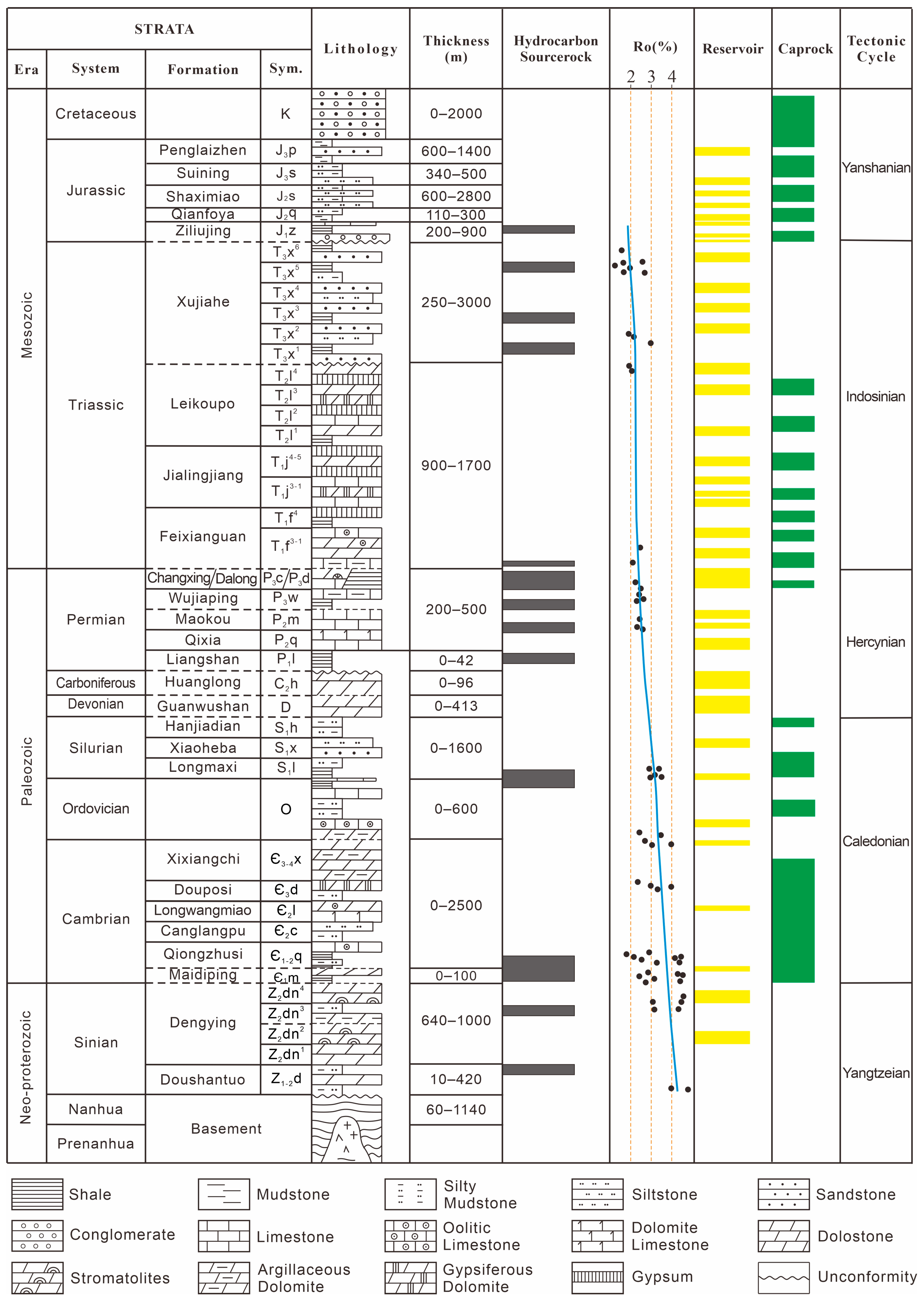
The T3x in the northern Sichuan Basin developed in a braided river delta-lake sedimentary system with multiple sedimentary cycles [39,40,41]. Among them, the T3x1 is dominated by tide-controlled deltaic sedimentation, mainly developing sand-mudstone. The T3x2, T3x4, and T3x6 were primarily deposited in the front of the braided river delta, and the sandstone reservoirs, commonly developed laterally and vertically, overlapped, while the T3x3 and T3x5 were mainly deposited in a lake environment, developing lacustrine mudstone and shale (Figure 2).
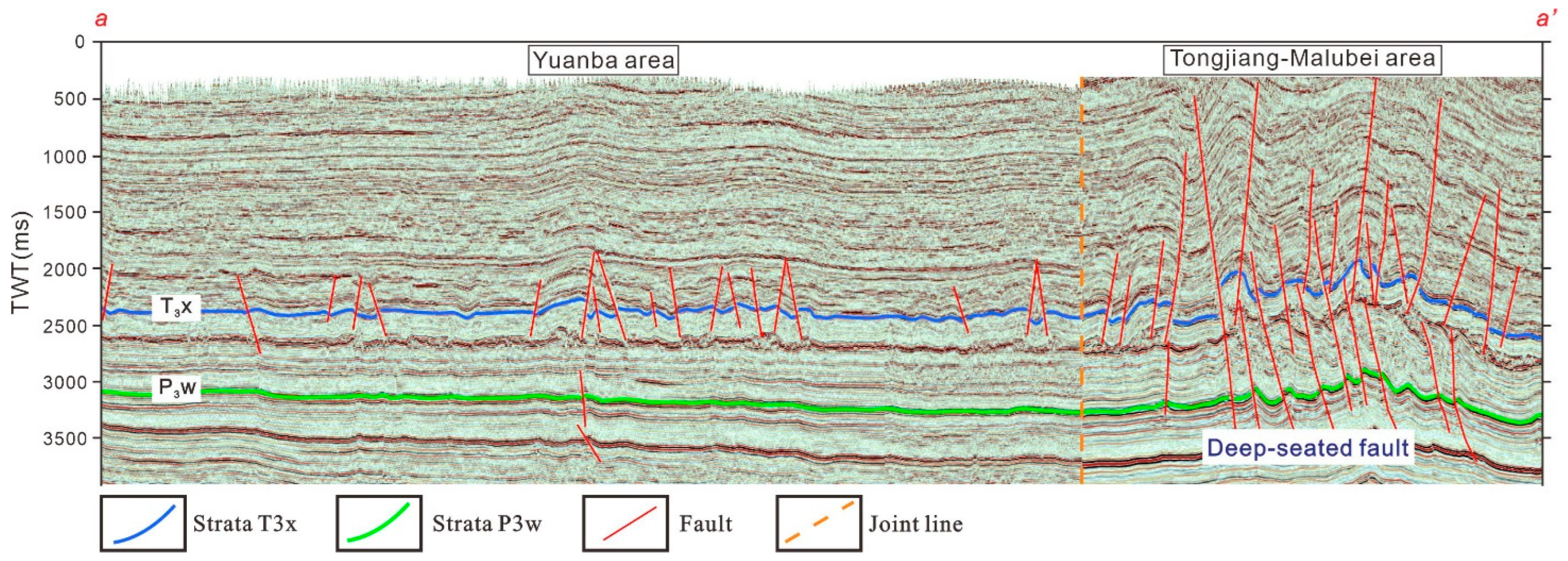
The T3x was gradually eroded from the eastern to the western Sichuan Basin, leading to the absence of the T3x6 and part of the T3x5 in the TM area. The T3x in the TM area is composed of T3x2, T3x3, T3x4, and T3x5, with an absence of T3x6 and a cumulative thickness of 280–430 m [42]. The T3x3 and T3x5 are humic-rich source rocks with an average total organic carbon (TOC) content of 2.43% and Ro% values of 1.91%, while the T3x2 and T3x4 are dominated by sandstone reservoirs [20,43]. Overall, the T3x source rocks and sandstone reservoirs are vertically interbedded, showing a good configuration of source and reservoir rocks [44]. In addition, some deep-seated faults connected the T3x reservoirs and underlined the high-quality marine source rock of Permian and Silurian (Figure 3), which can supply additional gas for the T3x reservoirs [37]. As a result, the gas accumulation conditions in the TM area are relatively good because both the inner T3x source rock and underline marine source rock can be gas sources [28,45].

3. Samples and Methods

Thirteen and eighteen T3x gas samples were collected from the TM and YB areas, respectively, and were analyzed for their chemical and isotopic compositions. In addition, twenty-six core samples of T3x sandstone were collected from the TM area and were analyzed for the homogenization and ice melting temperatures of fluid inclusions.
Thirty-one T3x gas samples were collected at the wellhead separator. A kind of gas cylinder (diameter of 25 cm) with two cut-off valves (maximum pressure of 22.5 MPa) was used to collect the gas sample. The pressure inside the gas cylinder was always maintained above 5.0 MPa. Before collecting the gas samples, the pipeline was flushed for 15–20 min to eliminate air pollution. Finally, the gas cylinder was placed in water for tightness testing.
Chemical compositions of gas samples were analyzed using an HP 6890 gas chromatograph equipped with a flame ionization detector (FID) and a thermal conductivity detector. Each gas sample was injected into an Equity-5 chromatographic column (length of 60 m, inner diameter of 0.25 mm, film thickness of 0.25 μm), with an initial oven temperature of 50 °C. After 2 min, the oven temperature was increased to 300 °C (4 °C/min) and then was held for 25 min. Hydrocarbon gases components were separated on the gas chromatograph and were converted to carbon dioxide in the combustion chamber. Finally, the carbon dioxide was injected into a MAT-253 mass spectrometer for stable carbon isotope analysis. Pure helium was used as the carrier gas, and the analytical error of δ13CVPDB was less than 0.3‰.
The homogenization temperature of fluid inclusions was analyzed at the State Key Laboratory of Oil and Gas Reservoir Geology and Exploitation Engineering, Chengdu University of Technology. Firstly, sandstone samples were collected and thin sections were made for diagenetic analysis under a microscope. Then, fluid inclusions were identified and characterized based on their size, shape, and fluorescence features. Subsequently, homogenization temperature was measured on a THMSG600 Cooling-Heating Stage, and the analytical error was ±0.1 °C.

4. Results

4.1. Chemical and Isotopic Compositions of T3x Gas

The T3x gas in the TM area is mainly composed of hydrocarbon gases, and the concentrations of the CH4, C2H6, and C3H8 are 92.60~99.04% (average of 97.90%), 0.34~1.54% (average of 0.66%), and 0.01~0.21% (average of 0.07%), respectively. The mean gas dryness coefficient (C1/(C1–C5)) is 0.9926. Non-hydrocarbon gases components include nitrogen (N2, 0.04–6.20%, average of 0.92%) and carbon dioxide (CO2, 0.11–1.21%, average of 0.48%) (Table 1). In the adjacent YB area, the average concentrations of CH4, C2H6, and C3H8 are 94.13~98.66% (average of 96.91%), 0.36~2.80% (average of 1.23%), and 0.03~0.42% (average of 0.13%), respectively, while the mean gas dryness coefficient is 0.9857 (Table 1).
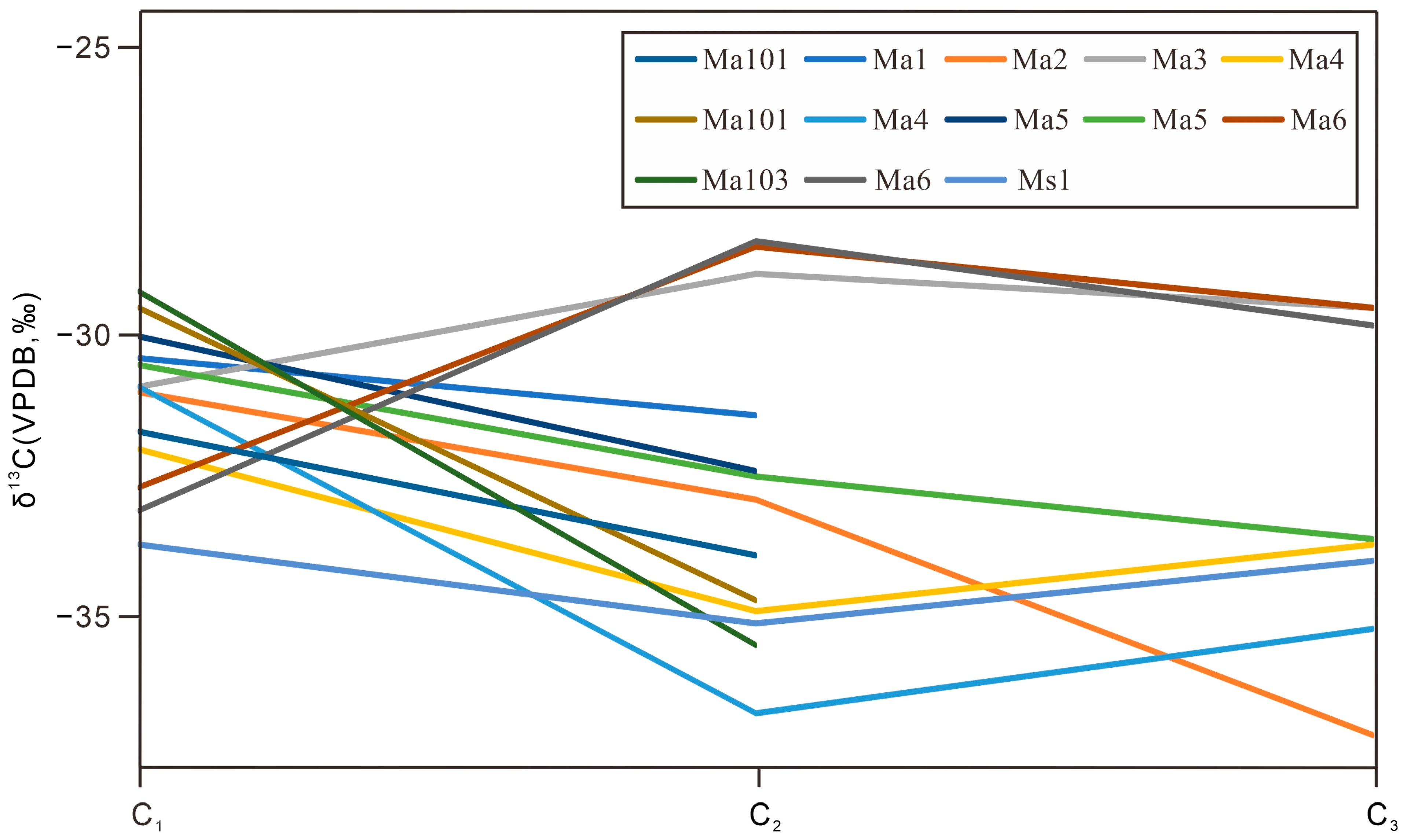
The carbon isotope (δ13C) values of the CH4, C2H6, and C3H8 in the TM area are −33.7~−29.2‰, −36.7~−28.3‰, and −37.1~−29.5‰, respectively, while the δ13C values of the CH4, C2H6, and C3H8 adjacent to the YB area are −33.8~−28.2‰, −28.0~−20.7‰, and −28.8~−20.6‰, respectively (Table 1). As a result, the T3x gases in the TM area show a partial reverse carbon isotope distribution of hydrocarbon gases (δ13C1 > δ13C2) (Figure 4), while the T3x gas in the YB area shows a normal carbon isotope distribution of hydrocarbon gases (δ13C1 < δ13C2) (Table 1).

4.2. Types and Homogenization Temperatures of Fluid Inclusions

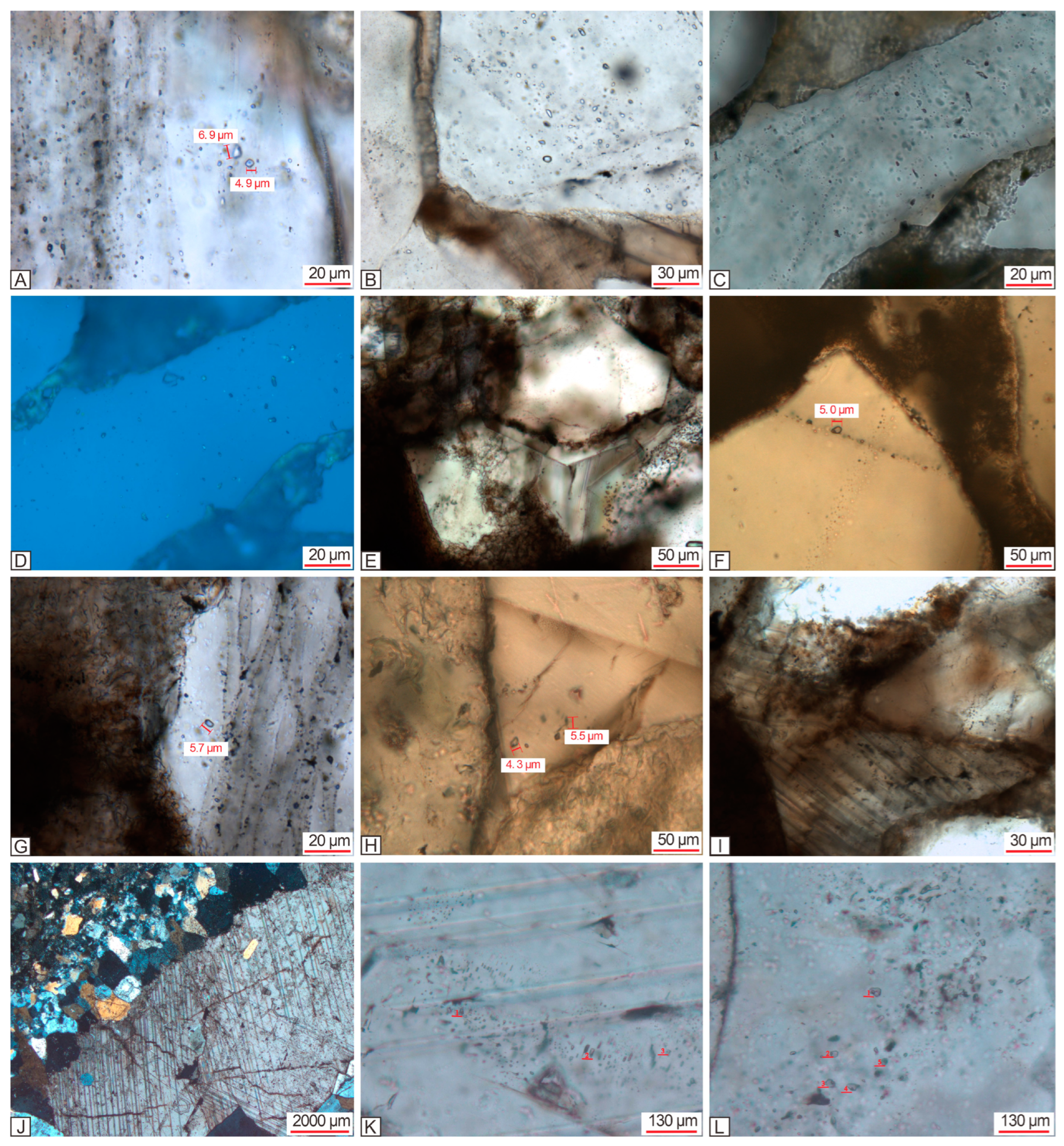
Fluid inclusions of the T3x sandstone samples in the TM area are mainly developed in micro-fractures and secondary enlargement rims of quartz grains, calcite cement, calcite-filled veins, and veins of quartz (Figure 5). The individual inclusions are irregular in shape with a wide range of sizes (2~15 µm in diameter) and are mainly composed of liquid-rich fluid inclusions with gas–liquid ratios generally less than 10%. The types of fluid inclusions are mainly pure gas hydrocarbon inclusions, hydrocarbon-saline water inclusions, liquid hydrocarbon-saline water inclusions, and saline water inclusions, with a small number of bitumen inclusions but also oil inclusions.
Based on the petrographic analyses, microscopic fluorescence characteristics, and the diagenetic sequence of host minerals, the hydrocarbon inclusions in the T3x can be divided into three stages. The inclusions of the first stage are distributed in a band or linear zone within the secondary enlargement rims and the microcracks of quartz, mostly consisting of dark brown liquid hydrocarbon inclusions and gray gas hydrocarbon inclusions. The inclusions of the second stage are clustered within the calcite cement between clastic particles, mostly consisting of liquid hydrocarbon inclusions and gas hydrocarbon inclusions. The inclusions of the third stage, mostly consisting of hydrocarbon–saline water inclusions, are clustered or zoned within quartz crystal microcracks, calcite-filled fractures, and calcite-filled veins. In addition, a small amount of carbonaceous bitumen is filled in the porosity and fractures, which appears black under plane-polarized light and fluorescent light, indicating it is an alteration product of early injected hydrocarbon.
The homogeneous temperature of fluid inclusions commonly represents its formation temperature. The stability of the saline water inclusions is relatively higher than the associated hydrocarbon inclusions. Therefore, by measuring the homogeneous temperature of associated saline water inclusions and combining it with the burial and thermal evolution history of reservoirs, the timing of hydrocarbon charging can be determined.
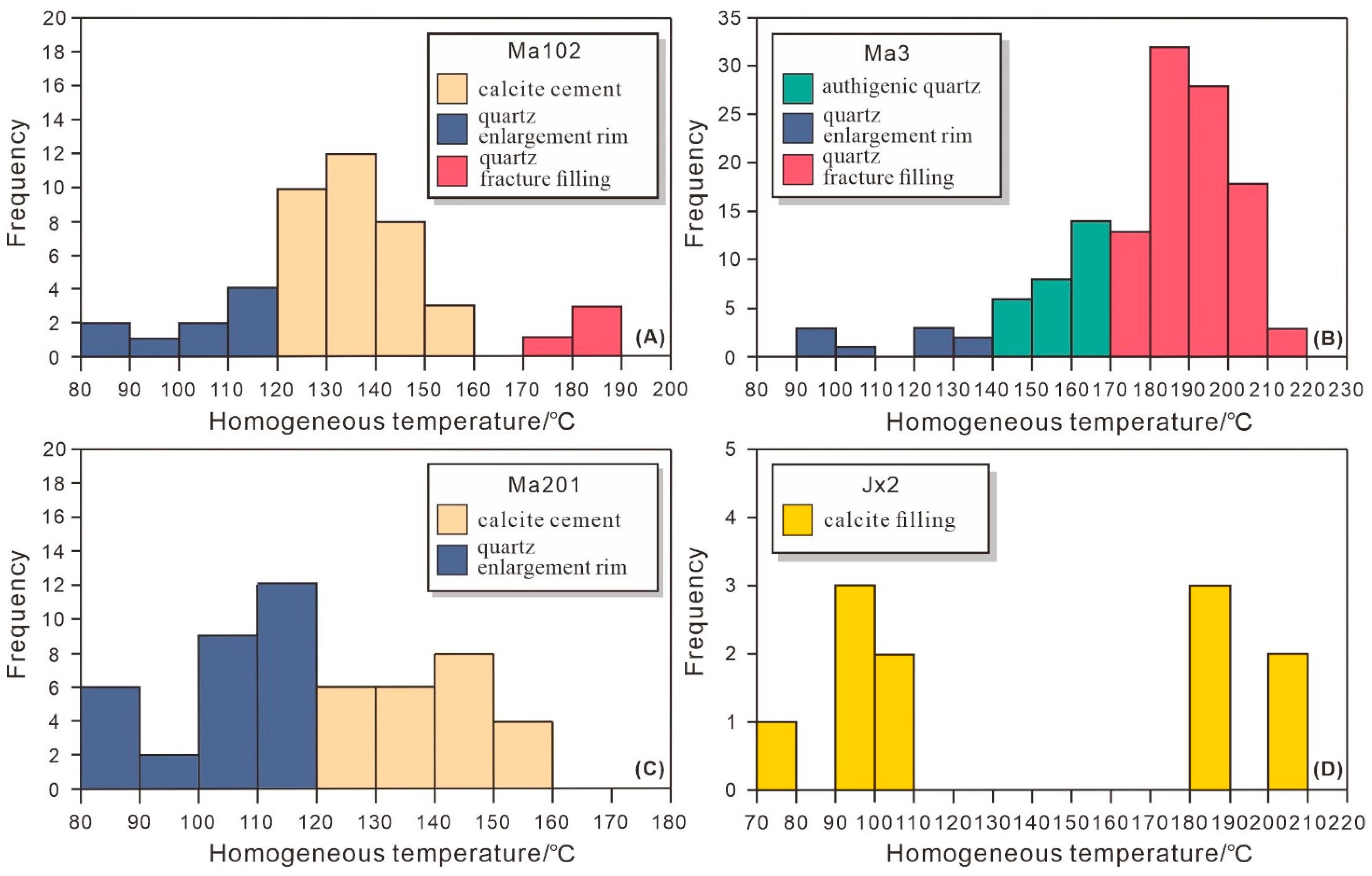
According to the division of hydrocarbon inclusions mentioned above, the homogeneous temperature of saline water inclusions indicates the fact that different stages of fluid charging were tested. The homogeneous temperatures of saline water inclusions are 80–220 °C (Figure 6), and the ordered distribution range of homogeneous temperature reveals completely different charging stages. The homogeneous temperatures of the first, second, and third stages of saline water inclusions are 80–140 °C (peak temperature of 100–120 °C), 120–170 °C (peak temperature of 130–150 °C), and 180–220 °C (peak temperature of 190–210 °C), respectively. The peak homogeneous temperature of the first and second stages’ saline water inclusions are continuous, suggesting they are related to one hydrocarbon charging process, while the peak homogeneous temperature of the third stage’s saline water inclusions is significantly higher than that of the first and second stages, indicating another hydrocarbon-charging process.

5. Discussion

5.1. Origins and Sources of T3x Gas in the TM Area

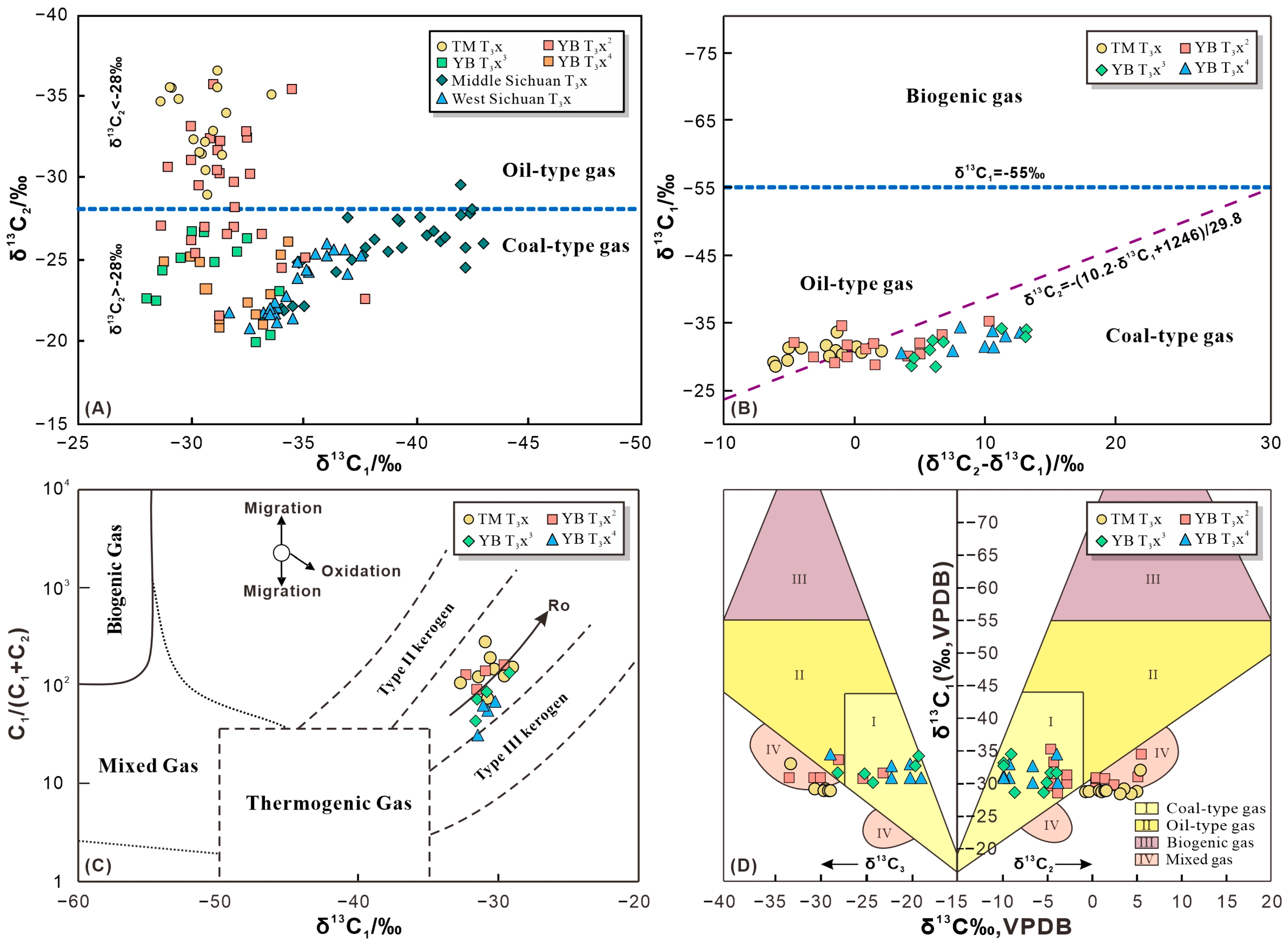
Chemical and isotopic compositions of hydrocarbon gases are important indicators for identifying the origins and sources of natural gas [46,47,48]. Specifically, carbon isotopic values of methane (δ13C1) and ethane (δ13C2) are the most commonly used indicators to distinguish coal-type gas and oil-type gas [49]. δ13C2 < −28‰ represents a coal-type gas, while δ13C1 > −28‰ represents an oil-type gas [50,51,52,53,54]. According to this indicator, the T3x gases in the YB area are all coal-type gases. Conversely, the T3x gases in the TM area are all oil-type gases (Figure 7A). This is inconsistent with the fact that the coal-bearing mudstone was developed in the T3x3 in the TM area. Therefore, the δ13C2 value is not suitable for distinguishing the origin of over-mature gas in the T3x of the TM area. The δ13C2 value together with the δ13C1 value was used to study the origin of over-mature gas. Han et al. [55] proposed the boundary for distinguishing coal-type gas and oil-type gas, based on the gas compositions and alkane carbon isotopes in nearly 200 gas wells in seven gas-bearing basins of China. When the δ13C2 value is above −(10.2 × δ13C1 + 1246)/29.8, it presents a coal-type gas, while if the δ13C2 value is below −(10.2 × δ13C1 + 1246)/29.8 and δ13C1 > −55‰, it presents an oil-type gas. According to this method, the T3x gases in the TM area are a mixture of coal-type and oil-type gases, while the T3x gases in the YB area are all coal-type gases (Figure 7B).
Due to the complexity of geological conditions and the ambiguity of geochemical parameters, it is necessary to use both chemical compositions and isotopic data to accurately reflect the origin of natural gas [56,57,58]. Bernard’s and Dai’s diagrams are commonly used to determine the origin of natural gas [46,52,59,60]. According to Bernard’s diagram based on the δ13C1 value and the C1/ (C2 + C3) ratio, the T3x gases in the TM and YB area are both thermal cracking gases. The T3x gases in the TM area tend to be derived from a source rock with type II kerogen, and the T3x gases in the YB area tend to be derived from a source rock with type III kerogen (Figure 7C). Furthermore, according to Dai’s diagram based on δ13C1, δ13C2 and δ13C3 values [52], the T3x gases in the YB area are coal-type gases, while T3x gases in the TM area are a mixture of coal-type gas and oil-type gas (Figure 7D).
Based on the discussion above, chemical composition and isotopic data support that the T3x gases in the TM area are a mixture of coal-type gas and oil-type gas, and the T3x gases in the YB area are mainly coal-type gases. It is a known fact that coal-type gas mainly comes from type III kerogens; conversely, oil-type gas mainly comes from type I or II kerogens. In the TM and YB area, the T3x3 and T3x5 mainly develop lacustrine source rocks dominated by type III kerogens. On the contrary, the underlying Upper Permian Wujiaping Formation (P3w) and Dalong Formation (P3d) developed marine source rocks, which were dominated by type I and II kerogens. As a result, the coal-type gas was most probably derived from the T3x3 and T3x5 source rock, while the oil-type gas was most probably derived from the underlined Permian source rock. There is no fault connecting the T3x reservoir and Permian source rock developed in the YB area, so it is reasonable that T3x are coal-type gases derived only from T3x3 and T3x5 source rock. Large-scale faults connecting the T3x reservoir and Permian source rock can be observed in the TM area, which serve as vertical migration pathways for underlined oil-type gas in the Permian source rock. In addition, the geochemical data of the T3x gases, a reverse carbon isotope distribution of methane and ethane, support the mixture of oil-type and coal-type gases. As a result, both the geochemical and vertical migration pathways in the TM area demonstrate that the T3x gases are a mixture of oil-type and coal-type gases. Additionally, oil-type gas is mainly derived from the underlined P3w and P3d source rock.

5.2. Fluid Inclusions and Diagenetic Responses for Underline Marine Gas Charging

Micro-thermometry results of fluid inclusions indicate that there are saline water inclusions, exhibiting abnormally high temperatures (>180 °C), inside the T3x fracture-filling quartz within the TM area (Figure 5A,B). The peak homogeneous temperature (190–200 °C) of these saline water inclusions exceeds the maximum burial temperature of the T3x but is similar to the high homogeneous temperature of fluid inclusions (180–200 °C) inside the Triassic Feixianguan Formation (T1f) in adjacent wells (Figure 6D). As the T1f gas was mainly derived from the Upper Permian source rocks, it is speculated that the abnormally high temperature of fluid inclusions in the T3x may result from the underlined Permian fluids.
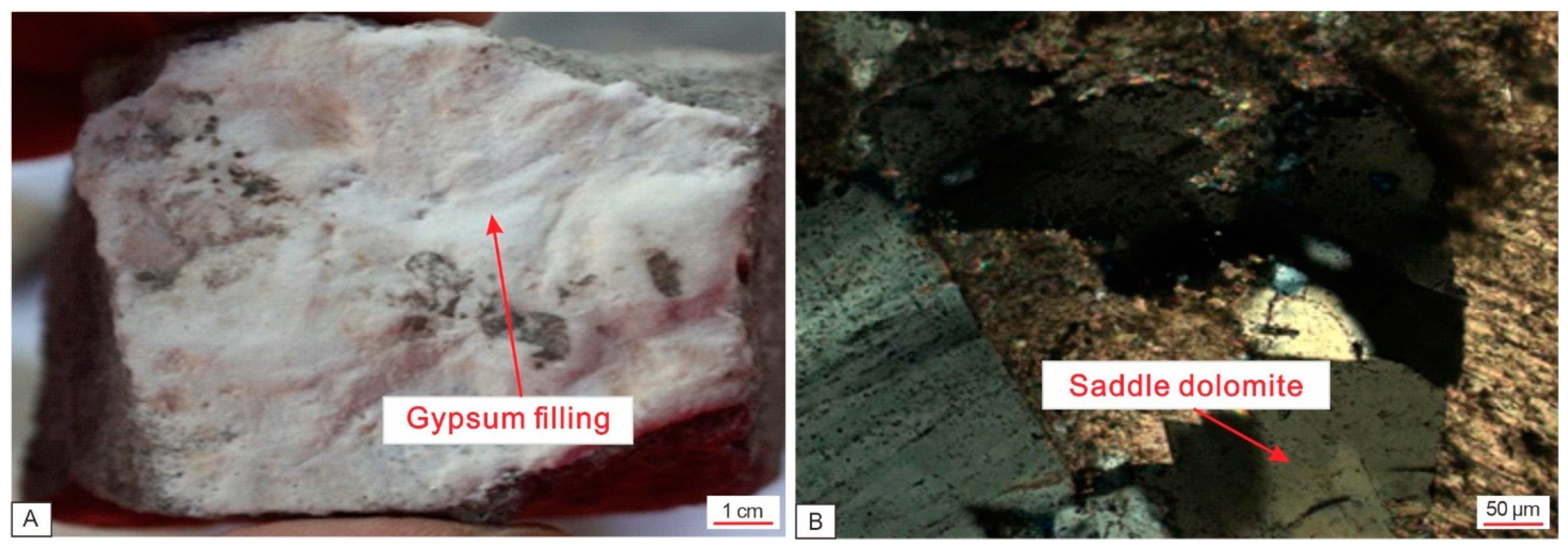
In addition, gypsum filling can be observed in the core of T3x (Figure 8A), and saddle-shaped dolomite cement with wave extinction can be observed in the T3x sandstone under a microscope (Figure 8B), indicating that a marine fluid activity exists in the T3x. As previously discussed, the gas in the T3x is a mixture of coal-type and oil-type gases, and the deeply penetrating faults serve as migration channels for marine fluids. In this way, the high-temperature marine fluids and Permian oil-type gas moved upward along these faults and accumulated in the T3x reservoir together with the coal-type gas, which was generated from the T3x source rocks. Consequently, a mixed thermal cracking gas of marine and lacustrine source rock accumulated in the T3x sandstone, with fluid inclusions of abnormally high temperature developing in the fracture-filling calcite.

5.3. Gas Accumulation Model and Controlling Factors

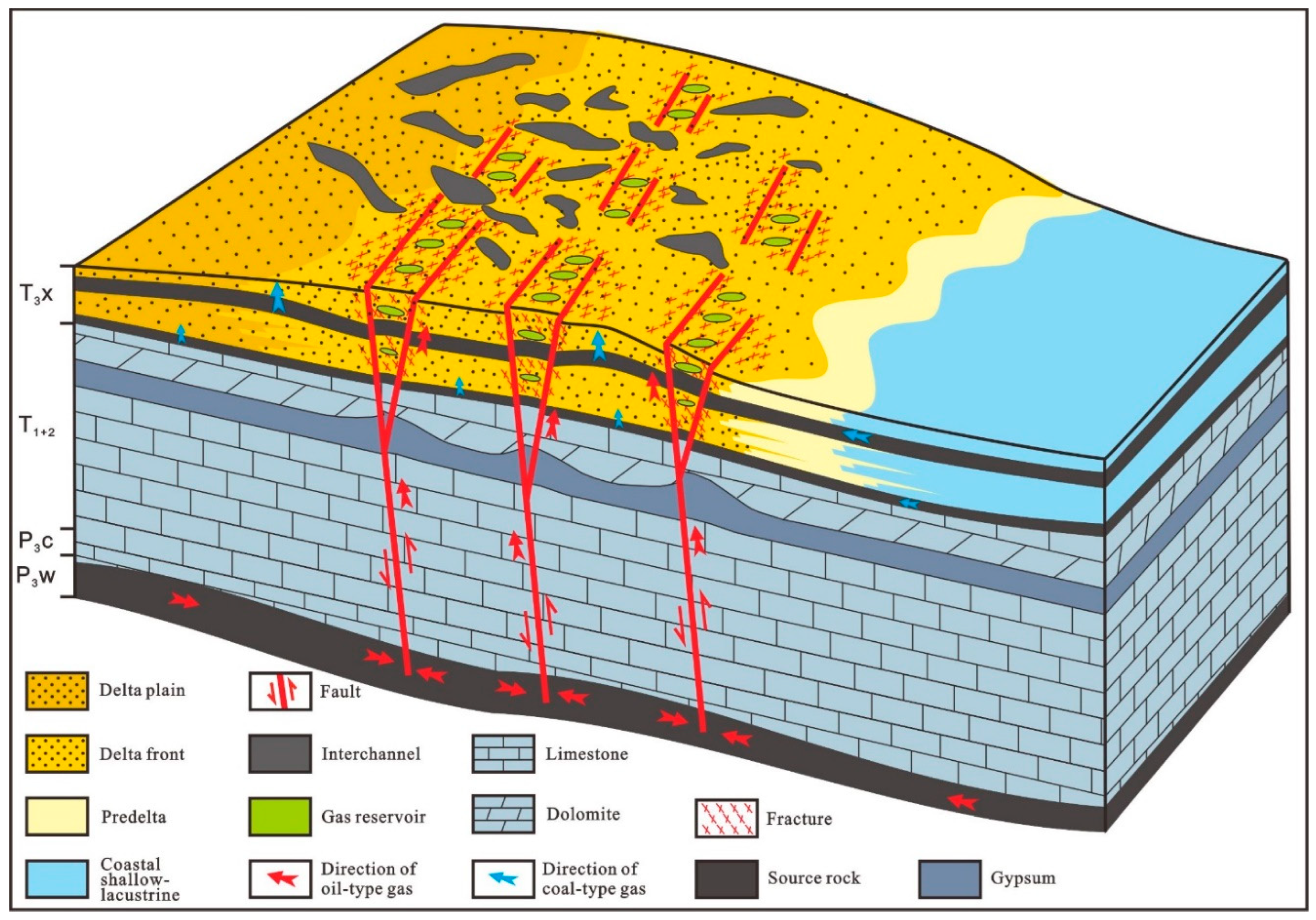
Based on the origin and sources of the T3x gases, structural deformation and faults distribution, the homogeneous temperature of saline water inclusion, the gypsum filling, and the saddled dolomite cement in the T3x sandstone, it is believed that the deep-seated faults cutting across the Permian-Triassic are the migration pathways for the underline marine gas in the TM area. The mixture of marine and continental gases constituted the thermogenic gas reservoir in the T3x. The enrichment of T3x gas in the TM area is closely related to the double-source hydrocarbon, which is rooted in marine and continental source rocks, as well as the deep-seated faults which effectively connected the multiple sets of source rocks and reservoirs. As a result, the double-source hydrocarbon supply, and the efficient migration through the deep-seated faults, are the key factors for T3x gas enrichment in the TM area (see Figure 9).
Previous studies have shown that the gas accumulation of T3x in the Sichuan Basin follows the “sandwich model” in which natural gas is mainly derived from the T3x source rock itself and the gas reservoir is mainly lithological type [19,20]. This can be attributed to the immediately interbedded coal-type source rock and siliciclastic reservoir, which mainly exist in the low or gentle structural area of the lacustrine basin. However, the new model in our study is significantly different from the “sandwich model”.
The new natural gas accumulation model in the TM area is characterized by a double-source hydrocarbon supply with deep-seated faults developed, which is obviously distinguished from the reported “sandwich model”. What is more, this new model could be applied to the gas reservoir controlled by the strong tectonic deformation, where folds, faults, and fractures are highly developed instead of the gentle structural area. Controlled by the efficient migration pathway of deep-seated faults, the hydrocarbon charging type includes near-source accumulation and the distal migration of external sources (Figure 9), while the “sandwich model” is only characterized by near-source gas accumulation.
This new model of the T3x in the Sichuan Basin may not be appropriate for the structurally stable areas such as the relatively stable area of the intracratonic basin and depression basin. What is more, a single type of source rock cannot construct the model of the double-source hydrocarbon supply. Nevertheless, the new model not only highlights the importance of future oil and gas exploration in the TM area but also extends to other analogous areas in the Sichuan Basin.

6. Conclusions

(1)
The T3x gas in the TM area is characterized by CH4 (average content of 97.90%) and the gas dryness is high (>0.99). Each sample in the TM, respectively, shows a partially reversed carbon isotope distribution of methane and ethane. Based on the chemical composition and stable carbon isotopes, it is believed that the T3x gas in the TM area is a mixture of coal-type gases generated from the type-III source rocks in the T3x and oil-type gases generated from the type-I source rocks in the Permian. What is more, large-scale faults connecting the T3x reservoir and Permian source rock can be observed in the TM area through seismic profiles, which can supply vertical migration pathways for underline oil-type gases in the Permian source rock.
(2)
The peak homogeneous temperature (190–200 °C) of the saline water inclusions in T3x is similar to the T1f in adjacent wells. Additionally, gypsum filling and saddle dolomite cement are found in the sandstone reservoirs of T3x. Based on the evidence, the underline marine gas migrated through deep-seated faults connecting the Permian source rock and the T3x sandstone reservoirs.
(3)
The formation and enrichment of T3x gas in the TM area is controlled by the dual-source hydrocarbon from marine and continental source rocks as well as the efficient migration through the deep-seated faults. Finally, the mixing gases promoted the production of the thermogenic gas reservoir in the T3x of the TM area.
(4)
This new natural gas accumulation model points out a new potential area for T3x gas exploration in the Sichuan Basin and any other analogue areas. However, the new model proposed in our study may not be directly applicable to stable regions in a basin where the development of faults is minimal or absent. In addition, considering the history of basin evolution, only the concurrence of the marine and continental source rocks may be applied to this model.

Author Contributions

Conceptualization, H.D. and Z.S.; methodology, H.D.; validation, Z.S.; formal analysis, H.D. and H.C.; investigation, H.D., H.C., T.Z., B.L., L.P. and Y.T.; resources, B.L. and L.P.; writing—original draft preparation, H.D. and H.C.; writing—review and editing, H.D., Z.S., H.C., T.Z. and Y.T.; visualization, H.C.; supervision, Z.S.; project administration, Z.S.; funding acquisition, Z.S., T.Z., B.L. and L.P. All authors have read and agreed to the published version of the manuscript.

Funding

This research was supported by the NSFC Basic Research Program on Deep Petroleum Resource Accumulation and Key Engineering Technologies, grant number (U19B6003).

Data Availability Statement

Not applicable.

Acknowledgments

This work received financial assistance from the NSFC Basic Research Program on Deep Petroleum Resource Accumulation and Key Engineering Technologies (U19B6003). We thank three anonymous reviewers for their constructive comments which greatly improved this work.

Conflicts of Interest

The authors declare no conflict of interest.

References

  1. Hu, J.; Chen, H.; Qu, H.; Wu, G.; Yang, J.; Zhang, Z. Mesozoic deformations of the Dabashan in the southern Qinling orogen, central China. J. Asian Earth Sci. 2012, 47, 171–184. [Google Scholar] [CrossRef]
  2. Liu, S.; Yang, Y.; Deng, B.; Zhong, Y.; Wen, L.; Sun, W.; Li, Z.; Jansa, L.; Li, J.; Song, J.; et al. Tectonic evolution of the Sichuan Basin, Southwest China. Earth-Sci. Rev. 2021, 213, 103470. [Google Scholar] [CrossRef]
  3. Li, T.; Zhu, D.; Yang, M.; Zhang, X.; Li, P.; Lu, C.; Zou, H. Early-stage marine dolomite altered by hydrothermal fluids in the Middle Permian Maokou Formation in the eastern Sichuan Basin, Southern China. Mar. Pet. Geol. 2021, 134, 105367. [Google Scholar] [CrossRef]
  4. Yong, L.; Allen, P.A.; Densmore, A.L.; Qiang, X. Evolution of the Longmen Shan Foreland Basin (Western Sichuan, China) during the Late Triassic Indosinian Orogeny: Evolution of the Longmen Shan Foreland Basin. Basin Res. 2003, 15, 117–138. [Google Scholar] [CrossRef]
  5. Zhang, L.; Guo, X.; Hao, F.; Zou, H.; Li, P. Lithologic characteristics and diagenesis of the Upper Triassic Xujiahe Formation, Yuanba area, northeastern Sichuan Basin. J. Nat. Gas Sci. Eng. 2016, 35, 1320–1335. [Google Scholar] [CrossRef]
  6. Yang, W.; Wei, G.; Wu, S.; Xie, W.; Jin, H.; Zeng, F.; Hao, C.; Bai, Z.; Su, Y.; Li, R. Regional unconformities and their controls on hydrocarbon accumulation in Sichuan Basin, SW China. Pet. Explor. Dev. 2023, 50, 573–587. [Google Scholar] [CrossRef]
  7. Yang, M.; Yu, X.; Zhu, D.; Long, K.; Lu, C.; Zou, H. Depositional framework and reservoir characteristics of microbial carbonates in the fourth member of the middle Triassic Leikoupo Formation, western Sichuan Basin, South China. Mar. Pet. Geol. 2023, 150, 106113. [Google Scholar] [CrossRef]
  8. Lan, C.; Xu, Z.; Chen, H.; Yang, W.; Lu, C.; Li, P.; Zou, H. Paleoceanographic reconstruction of the Ediacaran Dengying Formation, Sichuan Basin, Southwest China: Implications for the origin of Precambrian microbial carbonates. J. Asian Earth Sci. 2022, 236, 105340. [Google Scholar] [CrossRef]
  9. Yan, Y.J.; Wu, Y.L. Evolution of the Bayan Har-West Sichuan peripheral foreland basin in Southwestern China. Sediment. Geol. Tethyan Geol. 1996, 16, 16–29, (In Chinese with English Abstract). [Google Scholar]
  10. Zheng, R.C.; Zhu, R.K.; Dai, C.C.; Gao, H.C.; Zhai, W.L. Depositional sequence features during coupling process between basin and mountain of the Xujiahe Formation of Upper Triassic in the foreland basin, NE Sichuan. Acta Geol. Sin. 2008, 82, 1077–1087, (In Chinese with English abstract). [Google Scholar]
  11. Dai, J.; Ni, Y.; Zou, C. Stable carbon and hydrogen isotopes of natural gases sourced from the Xujiahe Formation in the Sichuan Basin, China. Org. Geochem. 2012, 43, 103–111. [Google Scholar] [CrossRef]
  12. Huang, S.; Wang, Z.; Lv, Z.; Gong, D.; Yu, C.; Wu, W. Geochemical identification of marine and terrigenous condensates—A case study from the Sichuan Basin, SW China. Org. Geochem. 2014, 74, 44–58. [Google Scholar] [CrossRef]
  13. Liu, J.-D.; Zhang, C.-J.; Jiang, Y.-L.; Bai, G.-S. Overpressure and gas charging in tight sandstone: Xujiahe Formation, northeastern Sichuan Basin. Pet. Sci. 2022, 19, 2583–2600. [Google Scholar] [CrossRef]
  14. Zhang, S.C.; Mi, J.K.; Liu, L.H.; Tao, S.Z. Geological features and formation of coal-formed tight sandstone gas pools in China: Cases from Upper Paleozoic gas pools, Ordos Basin and Xujiahe Formation gas pools, Sichuan Basin. Pet. Explor. Dev. 2009, 36, 320–330. [Google Scholar]
  15. Dai, J.; Ni, Y.; Zou, C.; Tao, S.; Hu, G.; Hu, A.; Yang, C.; Tao, X. Stable carbon isotopes of alkane gases from the Xujiahe coal measures and implication for gas-source correlation in the Sichuan Basin, SW China. Org. Geochem. 2009, 40, 638–646. [Google Scholar] [CrossRef]
  16. Deng, J.; Liu, M.; Ji, Y.; Tang, D.; Zeng, Q.; Song, L.; Tan, X.; Zeng, W.; Lian, C. Controlling factors of tight sandstone gas accumulation and enrichment in the slope zone of foreland basins: The Upper Triassic Xujiahe Formation in Western Sichuan Foreland Basin, China. J. Pet. Sci. Eng. 2022, 214, 110474. [Google Scholar] [CrossRef]
  17. Jiang, L.; Zhao, W.; Fan, Y.; Hong, F.; Gong, Y.; Hao, J. Effects of micro-fracture and micro-coal line on tight gas accumulation, Triassic Xujiahe Formation, Sichuan Basin, China. Energy Rep. 2021, 7, 7913–7924. [Google Scholar] [CrossRef]
  18. Zhao, W.Z.; Wang, H.J.; Xu, C.C.; Bian, C.S.; Wang, Z.C.; Gao, X.H. Reservoir-forming mechanism and enrichment conditions of the extensive Xujiahe Formation gas reservoirs, central Sichuan Basin. Pet. Explor. Dev. 2010, 37, 146–157. [Google Scholar]
  19. Yang, W.; Zuo, R.; Chen, D.; Jiang, Z.; Guo, L.; Liu, Z.; Chen, R.; Zhang, Y.; Zhang, Z.; Song, Y.; et al. Climate and tectonic-driven deposition of sandwiched continental shale units: New insights from petrology, geochemistry, and integrated provenance analyses (the western Sichuan subsiding Basin, Southwest China). Int. J. Coal Geol. 2019, 211, 103227. [Google Scholar] [CrossRef]
  20. Zhao, W.Z.; Wang, Z.C.; Wang, H.J.; Wang, Z.Y. Principal characteristics and forming conditions for medium-low abundance large scale oil/gas fields in China. Pet. Explor. Dev. 2008, 35, 641–650. [Google Scholar] [CrossRef]
  21. Li, H. Accumulation process and pattern of oolitic shoal gas pools in the platform: A case from Member 3 of Lower Triassic Feixianguan Formation in the Heba area, northeastern Sichuan Basin. Pet. Explor. Dev. 2016, 43, 787–797. [Google Scholar] [CrossRef]
  22. Wang, Z.-C.; Zhao, W.-Z.; Li, Z.-Y.; Jiang, X.-F.; Li, J. Role of basement faults in gas accumulation of Xujiahe Formation, Sichuan Basin. Pet. Explor. Dev. 2008, 35, 541–547. [Google Scholar] [CrossRef]
  23. Zhang, C.; Liu, J.; Jiang, Y. Formation pressure evolution and its causes for the reservoirs of the upper Triassic Xujiahe formation in the northeast portion of the Sichuan basin, China. Energy Explor. Exploit. 2021, 39, 1894–1918. [Google Scholar] [CrossRef]
  24. Cheng, F.Q.; Jin, Q.; Liu, W.H. Investigation on classifying types and forming patterns of gas-mixed reservoirs. J. China Univ. Pet. 2007, 31, 19–24, (In Chinese with English Abstract). [Google Scholar]
  25. Cheng, F.Q.; Jin, Q.; Liu, W.H.; Chen, M.J. Formation of source-mixed gas reservoir in Ordovician Weathering Crust in the central gas-field of Ordos Basin. Acta Petrol. Sin. 2007, 28, 38–42, (In Chinese with English Abstract). [Google Scholar]
  26. Gao, X.Z. Volume evaluation of the gas mixed with other gases using carbon isotopic compositions. Acta Sedimentol. Sin. 1997, 15, 63–65. [Google Scholar]
  27. Liu, R.B.; Guo, T.L.; Shao, M.L. Sources and genetic types of gas in the middle-shallow strata of the Yuanba area, northeastern Sichuan Basin. Nat. Gas Ind. 2011, 31, 34–38, (In Chinese with English Abstract). [Google Scholar]
  28. Wang, W. High efficient reservoir accumulation models of natural gas of Xujiahe Formation in northeastern Sichuan Basin. Lithol. Reserv. 2018, 30, 27–34, (In Chinese with English Abstract). [Google Scholar]
  29. Wu, X.Q.; Liu, G.X.; Liu, Q.Y.; Liu, J.D.; Luo, K.P. Geochemical characteristics and origin of natural gas in the Xujiahe Formation in Yuanba-Tongnanba area of Sichuan Basin. Oil Gas Geol. 2015, 36, 955–962, (In Chinese with English Abstract). [Google Scholar]
  30. Dirks, P.H.G.M.; Wilson, C.J.L.; Chen, S.; Luo, Z.L.; Liu, S. Tectonic evolution of the NE margin of the Tibetan Plateau; evidence from the central Longmen Mountains, Sichuan Province, China. J. Southeast Asian Earth Sci. 1994, 9, 181–192. [Google Scholar] [CrossRef]
  31. Guo, Z.W.; Deng, K.L.; Han, Y.H.; Liu, Y.K.; Yin, J.T.; Wang, Q.G.; Liang, E.Y.; Li, G.J.; Chen, Z.G.; Liu, Z.Z. Formation and Evolution of the Sichuan Basin; Geological Publishing House: Beijing, China, 1996. [Google Scholar]
  32. Xu, Z.; Lan, C.; Zhang, B.; Hao, F.; Lu, C.; Tian, X.; Zou, H. Impact of diagenesis on the microbial reservoirs of the terminal Ediacaran Dengying Formation from the Central to Northern Sichuan Basin, SW China. Mar. Pet. Geol. 2022, 146, 105924. [Google Scholar] [CrossRef]
  33. Zhu, D.; Zou, H.; Yang, M.; Li, T.; Li, T.; Li, H.; Xu, L.; Wen, L.; Zhou, G. The Middle Permian Maokou reservoir (southern Sichuan Basin, China): Controls on karst development and distribution. J. Pet. Sci. Eng. 2021, 204, 108686. [Google Scholar] [CrossRef]
  34. Jiang, D.; Li, P.; Zheng, M.; Chen, Q.; Xiong, W.; Zou, H. Impacts of different matrix components on multi-scale pore structure and reservoir capacity: Insights from the Jurassic Da’anzhai member in the Yuanba area, Sichuan Basin. Energy Rep. 2023, 9, 1251–1264. [Google Scholar] [CrossRef]
  35. Li, P.; Hao, F.; Guo, X.; Zou, H.; Yu, X.; Wang, G. Processes involved in the origin and accumulation of hydrocarbon gases in the Yuanba gas field, Sichuan Basin, southwest China. Mar. Pet. Geol. 2015, 59, 150–165. [Google Scholar] [CrossRef]
  36. Li, P.; Zou, H.; Yu, X.; Hao, F.; Wang, G. Source of dolomitizing fluids and dolomitization model of the upper Permian Changxing and Lower Triassic Feixianguan formations, NE Sichuan Basin, China. Mar. Pet. Geol. 2021, 125, 104834. [Google Scholar] [CrossRef]
  37. Li, F.; Zhang, Q.; Huang, R.C.; Zhao, Y.Q.; Tian, J.; Zhu, X. Relation between geochemical characteristics of natural gas and hydrocarbon accumulation in Yuanba and Tongnanba areas. J. Oil Gas Technol. 2011, 33, 36–39, (In Chinese with English Abstract). [Google Scholar]
  38. Yu, Y.; Li, P.; Guo, R.; Zhao, Y.; Li, S.; Zou, H. Upwelling-induced organic matter enrichment of the Upper Permian Dalong Formation in the Sichuan Basin, SW China and its paleoenvironmental implications. Palaeogeogr. Palaeoclim. Palaeoecol. 2021, 576, 110510. [Google Scholar] [CrossRef]
  39. Zhao, C.; Jiang, Y.; Liu, J.; Liu, M.; Wang, L. Occurrence and origin of chlorite and associated impact on tight sandstone reservoir quality: A case study of the Xujiahe Formation (NE Sichuan Basin, China). J. Pet. Sci. Eng. 2022, 209, 109859. [Google Scholar] [CrossRef]
  40. Zhu, R.K.; Zhao, X.; Liu, L.H.; Wang, X.S.; Zhang, N.; Guo, H.L.; Song, L.H. Depositional system and favorable reservoir distribution of Xujiahe Formation in Sichuan Basin. Pet. Explor. Dev. 2009, 36, 46–55. [Google Scholar]
  41. Zou, C.N.; Tao, S.Z.; Zhu, R.K.; Yuan, X.J.; Li, W.; Zhang, G.Y.; Zhang, X.X.; Gao, X.H.; Liu, L.H.; Xu, C.C.; et al. Formation and distribution of “continuous” gas reservoirs and their giant gas province: A case from the Upper Triassic Xujiahe Formation giant gas province, Sichuan Basin. Pet. Explor. Dev. 2009, 36, 307–319. [Google Scholar]
  42. Guo, T. Key controls on accumulation and high production of large non-marine gas fields in northern Sichuan Basin. Pet. Explor. Dev. 2013, 40, 150–160. [Google Scholar] [CrossRef]
  43. Wu, X.; Chen, Y.; Wang, Y.; Zeng, H.; Jiang, X.; Hu, Y. Geochemical characteristics of natural gas in tight sandstone of the Chengdu large gas field, Western Sichuan Depression, Sichuan Basin, China. J. Nat. Gas Geosci. 2021, 6, 279–287. [Google Scholar] [CrossRef]
  44. Zhao, W.; Bian, C.; Xu, C.; Wang, H.; Wang, T.; Shi, Z. Assessment on gas accumulation potential and favorable plays within the Xu-1, 3 and 5 Members of the Xujiahe Formation in the Sichuan Basin. Pet. Explor. Dev. 2011, 38, 385–393. [Google Scholar] [CrossRef]
  45. Li, J.; Hu, D.F.; Zou, H.Y.; Li, P.P. Coupling relationship between reservoir diagengesis and gas accumulation in Xujiahe Formation of Yuanba-Tongnanba area, Sichuan Basin, China. Nat. Gas Geosci. 2016, 27, 1164–1178, (In Chinese with English Abstract). [Google Scholar]
  46. Hao, F.; Guo, T.; Zhu, Y.; Cai, X.; Zou, H.; Li, P. Evidence for multiple stages of oil cracking and thermochemical sulfate reduction in the Puguang gas field, Sichuan Basin, China. AAPG Bull. 2008, 92, 611–637. [Google Scholar] [CrossRef]
  47. Li, W.; Zhang, Z.; Zhang, H.; Zhao, S.; Yan, H.; Liu, X. Hydrocarbon source and accumulation in Upper Triassic to Lower Jurassic in the Tongnanba area, northeastern Sichuan Basin. Arab. J. Geosci. 2015, 8, 2515–2525. [Google Scholar] [CrossRef]
  48. Prinzhofer, A.A.; Huc, A.Y. Genetic and post-genetic molecular and isotopic fractionations in natural gases. Chem. Geol. 1995, 126, 281–290. [Google Scholar] [CrossRef]
  49. Liu, Q.; Wu, X.; Wang, X.; Jin, Z.; Zhu, D.; Meng, Q.; Huang, S.; Liu, J.; Fu, Q. Carbon and hydrogen isotopes of methane, ethane, and propane: A review of genetic identification of natural gas. Earth-Sci. Rev. 2019, 190, 247–272. [Google Scholar] [CrossRef]
  50. Dai, J.X. Characterization of carbon and hydrogen isotopes of natural gases and their origin identification. Nat. Gas Geosci. 1993, 4, 1–40, (In Chinese with English Abstract). [Google Scholar]
  51. Dai, J.X. Significance of the study on carbon isotopes of alkane gases. Nat. Gas Ind. 2011, 31, 1–6, (In Chinese with English Abstract). [Google Scholar]
  52. Dai, J.; Gong, D.; Ni, Y.; Huang, S.; Wu, W. Stable carbon isotopes of coal-derived gases sourced from the Mesozoic coal measures in China. Org. Geochem. 2014, 74, 123–142. [Google Scholar] [CrossRef]
  53. Dai, J.X.; Xia, X.Y.; Qin, S.F.; Zhao, J.Z. Origin of carbon isotope reverse of gaseous hydrocarbons of natural gas in China. Oil Gas Geol. 2003, 24, 3–6, (In Chinese with English Abstract). [Google Scholar]
  54. Liu, Q.; Jin, Z.; Li, H.; Wu, X.; Tao, X.; Zhu, D.; Meng, Q. Geochemistry characteristics and genetic types of natural gas in central part of the Tarim Basin, NW China. Mar. Pet. Geol. 2018, 89, 91–105. [Google Scholar] [CrossRef]
  55. Han, Z.X.; Li, J.; Guo, Y.X.; Yan, Q.T.; Wang, S.Y.; Li, J.; Liu, J.F.; Ge, S.G. The application of methane and ethane carbon isotopes as an identification index for gas origin study. Nat. Gas Geosci. 2016, 27, 665–671, (In Chinese with English Abstract). [Google Scholar]
  56. Berner, U.; Faber, E. Maturity related mixing model for methane, ethane and propane, based on carbon isotopes. Org. Geochem. 1988, 13, 67–72. [Google Scholar] [CrossRef]
  57. Berner, U.; Faber, E. Empirical carbon isotope/maturity relationships for gases from algal kerogens and terrigenous organic matter, based on dry, open-system pyrolysis. Org. Geochem. 1996, 24, 947–955. [Google Scholar] [CrossRef]
  58. Jenden, P.D.; Newell, K.D.; Kaplan, I.R.; Watney, W.L. Composition and stable-isotope geochemistry of natural gases from Kansas, Midcontinent, U.S.A. Chem. Geol. 1988, 71, 117–147. [Google Scholar] [CrossRef]
  59. Bernard, B.B.; Brooks, J.M.; Sackett, W.M. Light hydrocarbons in recent Texas continental shelf and slope sediments. J. Geophys. Res. Atmos. 1978, 83, 4053–4061. [Google Scholar] [CrossRef]
  60. Li, P.; Hao, F.; Zhang, B.; Zou, H.; Yu, X.; Wang, G. Heterogeneous distribution of pyrobitumen attributable to oil cracking and its effect on carbonate reservoirs: Feixianguan Formation in the Jiannan gas field, China. AAPG Bull. 2015, 99, 763–789. [Google Scholar] [CrossRef]
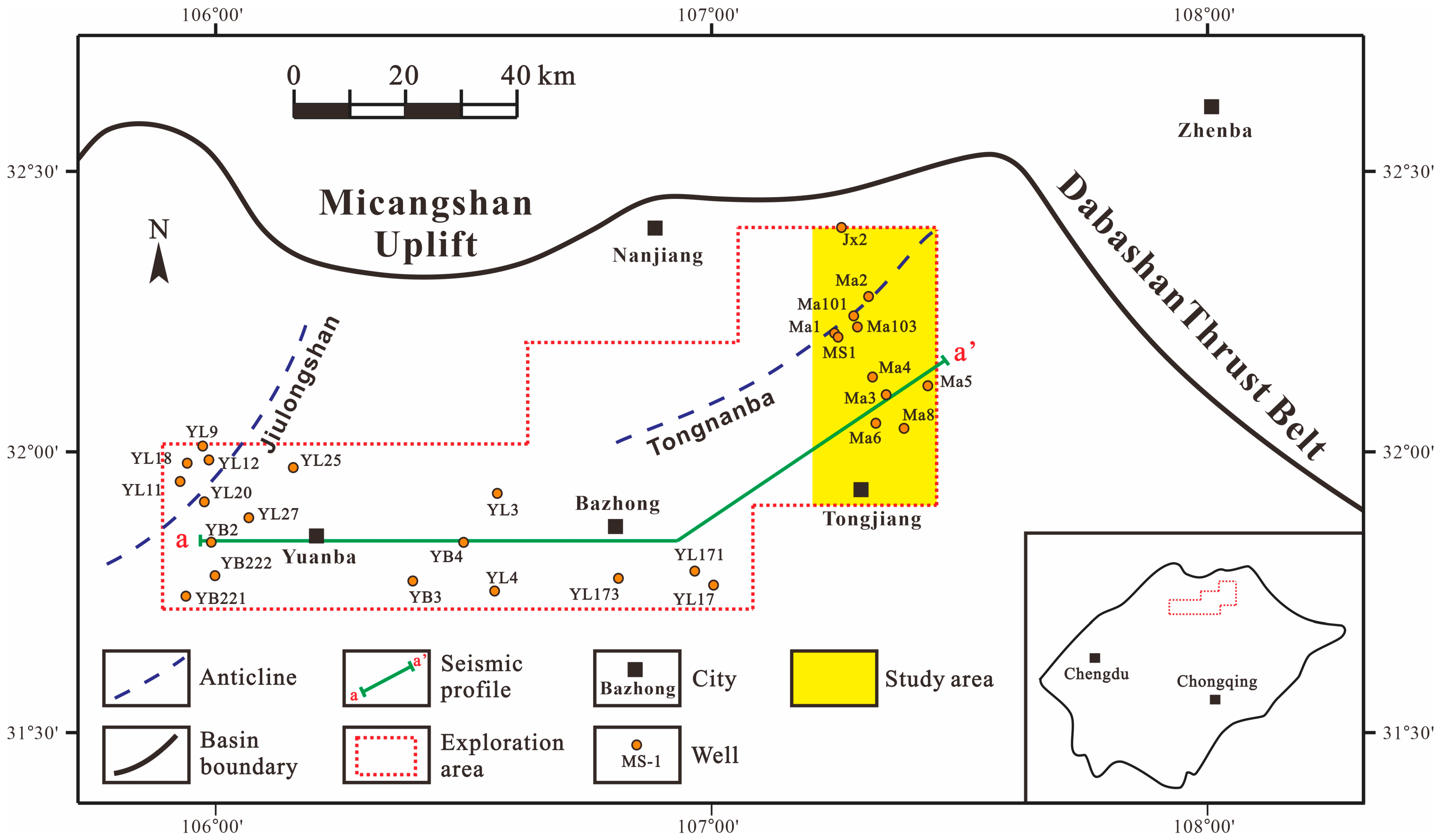
Figure 1. Locations of the Tongjiang-Malubei area, Northeastern Sichuan Basin.
Energies 16 05936 g001
Figure 2. General stratigraphy, lithology, tectonic cycles, and movements in the Northeastern Sichuan Basin.
Energies 16 05936 g002
Figure 3. Seismic profile of the Yuanba and Tongjiang-Malubei area showing faults (red line), bottom surfaces of the Triassic Xujiahe (T3x) and Permian Wujiaping (P3w) formations. The location of the seismic profile is shown in Figure 1.
Energies 16 05936 g003
Figure 4. Line graph of δ13C1, δ13C2, and δ13C3 distribution of the T3x gas in the TM area.
Energies 16 05936 g004
Figure 5. Typical photos of fluid inclusions of the Xujiahe Formation, Tongjiang-Malubei area. (A) Well M-102, 2935.07 m, gaseous hydrocarbon inclusion, polarized light; (B) Well M-102, 2936.46 m, hydrocarbon inclusion, saline water inclusion, polarized light; (C) Well M-3, 4932.16 m, gaseous hydrocarbon inclusion, polarized light; (D) Well M-3, 4932.16 m, gaseous hydrocarbon inclusion, fluorescence; (E) Well M-102, 2936.46 m, quartz overgrowth and calcite cements, polarized light; (F) Well M-201, 3377.54 m, fluid inclusions developed in the rim of the quartz secondary enlargement, polarized light; (G) Well M-102, 2935.07 m, fluid inclusions developed in fracture of quartz grain, polarized light; (H) Well M-201, 3144.17 m, fluid inclusions developed within calcite cement, polarized light; (I) Well M-102, 2936.46 m, fluid inclusions developed within the calcite cement, polarized light; (J) Well M-3, 4904.04 m, fractures are filled with calcite and quartz, cross-polarized light; (K) Well M-3, 4904.04 m, fluid inclusions developed in calcite veins, polarized light; (L) Well M-3, 4904.04 m, fluid inclusions developed in fractures of authigenic quartz, polarized light. The size of fluid inclusions is shown in A, F, G, and H. The numbers are marked in K and L for better recognizing of the different fluid inclusions.
Energies 16 05936 g005
Figure 6. Histogram of the homogeneous temperatures of saline water inclusions in sandstone from the well Ma102 (A), well Ma3 (B), well Ma201 (C), and well Jx2 (D) in Tongjiang-Malubei area.
Energies 16 05936 g006
Figure 7. Plot of δ13C2 vs. δ13C1 (A), δ13C1 vs. (δ13C213C1) (B), C1/(C2 + C1) vs. δ13C1 (C), and δ13C1 vs. δ13C2 and δ13C3 (D) in the Xujiahe Formation, Northeastern Sichuan Basin.
Energies 16 05936 g007
Figure 8. Photographs of gypsum filling in fracture of T3x sandstone in well M-4 (A), and saddle dolomite cement in T3x sandstone in well M-3 (B).
Energies 16 05936 g008
Figure 9. Natural gas accumulation model of the Xujiahe Formation in the Tongjiang-Malubei area.
Energies 16 05936 g009
Table 1. Chemical and isotopic compositions of T3x natural gas from the Tongjiang-Malubei (TM) and Yuanba (YB) gas fields in the Sichuan Basin.
Gas FieldWellStrataChemical Composition (%)C1/(C1–C3)
/%
δ13C (VPDB, ‰)
C1/%C2/%C3/%N2/%CO2/%C1C2C3
TMMa1T3x498.790.600.020.320.2099.38−30.4−31.4/
TMMa2T3x498.880.500.010.220.3299.49−31.0−32.9−37.1
TMMa3T3x499.040.380.04/0.5499.58−30.9−28.9−29.5
TMMa4T3x298.580.77/0.080.5599.22−32.0−34.9−33.7
TMMa4T3x297.041.540.150.041.2198.29−30.9−36.7−35.2
TMMa5T3x498.250.71/0.050.9999.28−30.5−32.5−33.6
TMMa5T3x398.000.480.040.880.4899.47−30.0−32.4/
TMMa6T3x498.790.340.030.730.1199.63−32.7−28.4−29.5
TMMa6T3x297.490.350.031.360.7799.61−33.1−28.3−29.8
TMMa101T3x298.400.760.060.380.2999.17−29.5−34.7/
TMMa101T3x298.510.790.070.280.2899.12−31.7−33.9/
TMMa103T3x298.270.750.070.480.3099.13−29.2−35.5/
TMMS1T3x292.600.670.216.200.1899.06−33.7−35.1−34.0
YBYL25T3x498.280.540.040.180.999.41−28.9−28.0/
YBYB222T3x496.161.520.190.841.1798.18−33.3−21.8−21.3
YBYB224T3x494.132.620.351.091.6496.82−33.6−20.9−21.9
YBYB3T3x497.941.370.10.020.0198.5−31.4−21.5−23.9
YBYB4T3x497.461.250.140.68/98.56−31.7−28.0−26.9
YBYL3T3x498.390.930.090.250.2998.96−30.6−24.8/
YBYL4T3x494.832.800.421.310.4296.56−33.8−23.3−22.7
YBYL17T3x496.542.110.220.560.4897.59−32.9−27.3/
YBYL171T3x497.280.860.081.190.5799.04−33.3−28.0−28.8
YBYL173T3x496.661.800.210.810.4197.92−30.8−23.3/
YBYL18T3x398.660.360.030.250.6499.61−28.2−22.7/
YBYL11T3x398.450.560.050.200.6999.37−30.3−26.8/
YBYL12T3x398.210.530.040.270.8999.41−29.5−25.2/
YBYL20T3x397.230.600.050.241.8599.32−28.7−24.4/
YBYL27T3x397.580.570.050.391.3499.36−28.5−22.3/
YBYL9T3x396.750.560.050.601.9799.37−32.4−26.4−26.9
YBYB2T3x395.381.130.060.82.4398.76−30.9−25.2−24.4
YBYB221T3x394.402.020.251.092.1097.57−33.8−20.7−20.6
Disclaimer/Publisher’s Note: The statements, opinions and data contained in all publications are solely those of the individual author(s) and contributor(s) and not of MDPI and/or the editor(s). MDPI and/or the editor(s) disclaim responsibility for any injury to people or property resulting from any ideas, methods, instructions or products referred to in the content.