


Abstract
The use of wind power has grown strongly in recent years and is expected to continue to increase in the coming decades. Solar power is also expected to increase significantly. In a power system, a continuous balance is maintained between total production and demand. This balancing is currently mainly managed with conventional power plants, but with larger amounts of wind and solar power, other sources will also be needed. Interesting possibilities include continuous control of wind and solar power, battery storage, electric vehicles, hydrogen production, and other demand resources with flexibility potential. The aim of this article is to describe and compare the different challenges and future possibilities in six systems concerning how to keep a continuous balance in the future with significantly larger amounts of variable renewable power production. A realistic understanding of how these systems plan to handle continuous balancing is central to effectively develop a carbon-dioxide-free electricity system of the future. The systems included in the overview are the Nordic synchronous area, the island of Ireland, the Iberian Peninsula, Texas (ERCOT), the central European system, and Great Britain.
1. Introduction
The world’s total annual electricity consumption in 2021 was around 28 466 TWh, of which around 1862 TWh (6.5%) was served by wind power, and 1033 TWh (3.6%) was served by solar power [1]. However, the share of these variable renewable energy (VRE) sources has increased significantly in the last few years. The average yearly growth rate of installed wind power capacity in the years 2011–2021 was 14.1%, while installed solar power capacity increased by 27.9% per year. In this article, the studied countries are among the frontrunners in VRE integration, serving on average more than 20% of total production with wind power in 2021 in their respective system [1,2,3]. In the IEA future Net Zero system report, the result is that on a global level, by 2050, “solar PV and wind together account for almost half of electricity supply” [4]. By 2050, the electricity supply is also expected to significantly increase, as society becomes increasingly decarbonized. With such a high global share of VRE generation, and considering the variability of VRE resources, this certainly means that in some areas/countries, during some hours, the power system must be able to operate at close to 100% VRE generation, in order to minimize wind and solar curtailments.
One of the main challenges with operating the power system at a very high share of VRE generation is that the continuous balance between production and consumption must be maintained in a reliable and economic manner. At very high shares of VRE, power systems will have to be operated at low levels of inertia [5], while imbalances likely will be larger and more frequently occurring, due to the uncertainty and variability of VRE generation, see, e.g., [6,7,8]. Historically, the continuous balance has been maintained by generators adjusting their output according to the power systems’ needs. However, along with the increasing share of VRE generation, there is a parallel development toward more flexible demand resources being available, which can contribute to continuous balancing. These resources include electric vehicles, electric heating systems, batteries, hydrogen production, and demand-side management (both larger consumers, e.g., industries and data centers, and smaller consumers, e.g., households). VRE generation also can contribute to maintaining the continuous balance, in different ways, e.g., [9,10].
The aim of this article is to provide an overview of the challenges and proposed solutions regarding how to efficiently maintain a continuous balance in systems targeting significantly larger amounts of VRE generation. The article studies six different power systems, summarizing the current mechanisms for continuous balancing, current and future challenges that the systems face, and how they plan to tackle these challenges. The six systems are then compared and some general conclusions are drawn. The purpose of this article is to create a deeper understanding among researchers and decision makers regarding the challenges and solutions to continuous balancing at a very high share of VRE generation.
The remainder of this article continues as follows. In Section 2, an overview of power system balancing and related activities, services, mechanisms, and technologies is given. In Section 3, we provide detailed descriptions of how continuous balancing is currently handled, and how future challenges related to continuous balancing will be tackled, in six different systems targeting a significantly increased share of VRE. In Section 4, we summarize the current setups, proposed changes, and future challenges in these six systems, and discuss differences and similarities. In Section 5, we make some concluding remarks regarding how to efficiently maintain continuous balance in power systems with high VRE shares.
2. Power System Balancing—Overview
In a power system, there is always an instantaneous balance between the electric power supplied and consumed. The task of continuous balancing in a power system refers to supplying the demanded power at every time instant. Poor balancing can lead to large frequency changes or transmission line overloading. If the frequency deviates too much from the nominal level (50 Hz in Europe and 60 Hz in North America), or the flow over a transmission line becomes too high, control systems may be triggered. This, in turn, will lead to all demanded power not being supplied. The challenge with continuous balancing is that all components and their operational status in a power system are not predictable and controllable. In order to retain the continuous balance in a power system, a combination of power system planning, efficient handling of margins, equipment’s inherent physical reactions, automated controls, and manual instructions are used.
In Section 2.1, the three general activities performed to keep a continuous balance in power systems are described. How the combination of these three activities is performed forms the balancing principles of a power system. To perform some of these activities in practice, the system needs certain balancing services. Section 2.2 provides an overview of the purpose and technical characteristics of the most common categories of balancing services. In Section 2.3, an overview of different mechanisms used to ensure the availability of balancing services is given. Finally, Section 2.4 describes how the characteristics of different technologies make them suitable, or not, for providing different types of balancing services.
2.1. Balancing Principles
Strategies used to keep the continuous balance vary between countries and regions in the world. Generally, there are three main types of balancing activities performed at different time frames and at different spatial resolutions in a power system. The combination of these balancing activities forms the balancing principles of a power system. These balancing activities are:
Frequency balancing: Frequency balancing refers to keeping the frequency close to nominal in a synchronous system. The synchronous system is balanced if the frequency is close to the nominal level, with small variations within a certain band being acceptable. The rationale behind frequency balancing is that some power system components are designed to be operated at nominal frequency, and frequency deviations may impact or damage these components. Frequency deviations occur when the rotational energy of synchronous machines increases, or decreases, as the immediate reaction to handle a mismatch between power production and consumption. This mismatch is then compensated by some units having automatic controls changing their power setpoint, which will stabilize the frequency. After a while, frequency is restored by a combination of slower automatic controls and manual actions to change units’ power setpoints.
Power balancing: Power balancing refers to keeping the sum of produced and imported power equal to the sum of consumed and exported power in a certain balancing area. A balancing area is a region operated by one transmission system operator (TSO) (commonly known as Independent System Operator (ISO) in the US and Electricity System Operator (ESO) in Great Britain; however, we use the term TSO here when referring to the entity responsible for balancing the power system in real time), and, commonly, a synchronous system consists of many balancing areas. The rationale behind power balancing is to consider transmission constraints within a synchronous system by using resources in the correct location to balance out deviations within dispatch intervals. In each balancing area, power balancing is performed by both proactively and reactively applying a combination of automatic controls and manual actions to change generator power setpoints to mitigate the area control error (ACE). The ACE is calculated as the difference between measured and planned flows to/from the area (ΔP), added with a “frequency bias” term to consider the activation of resources used for frequency balancing based on the regulating strength (K) of frequency reserves in the balancing area and the frequency deviation (Δf) [11]. The ACE of a balancing area is calculated according to (1). When the ACE is close to zero, a balancing area is balanced. Just as for frequency, smaller variations within a certain band are deemed acceptable and, hence, automatic or manual actions are not taken.
ACE = ΔP + KΔf,
Energy balancing: Energy balancing refers to power system planning where the anticipated energy demanded in a certain time interval is matched against the anticipated energy supplied. Energy balancing is commonly performed in markets such as day-ahead markets, intraday markets, and real-time markets. These markets vary in the duration of the planning intervals, planning horizon, and spatial resolution. Although power systems are planned to be balanced for certain time intervals in these markets, there remains a need to have more resources to keep the continuous balance. This need is caused by both uncertainties, such as imperfect forecasts of VRE generation unit outages, as well as by imperfect markets not fully considering the variability of VRE generation/demand and ramp restrictions of units in power system planning. This paper focuses on how to keep a continuous balance after energy balancing is performed, and when referring to “continuous balancing”, the balancing performed after energy balancing is intended from that time on. However, the features of energy balancing impact the need for additional resources for continuous balancing, and energy balancing can thus not be neglected. With energy balancing being performed closer to real time and for shorter time intervals, the anticipated conditions for which energy balancing is performed will be more similar to actual conditions. Hence, there will be a reduced need for reserves to perform frequency and power balancing.
2.2. Common Services Contributing to Continuous Balancing
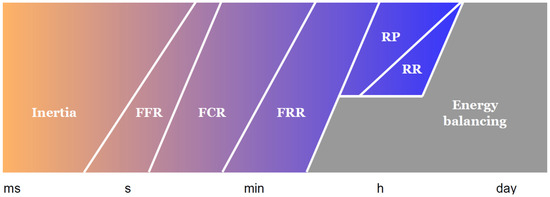
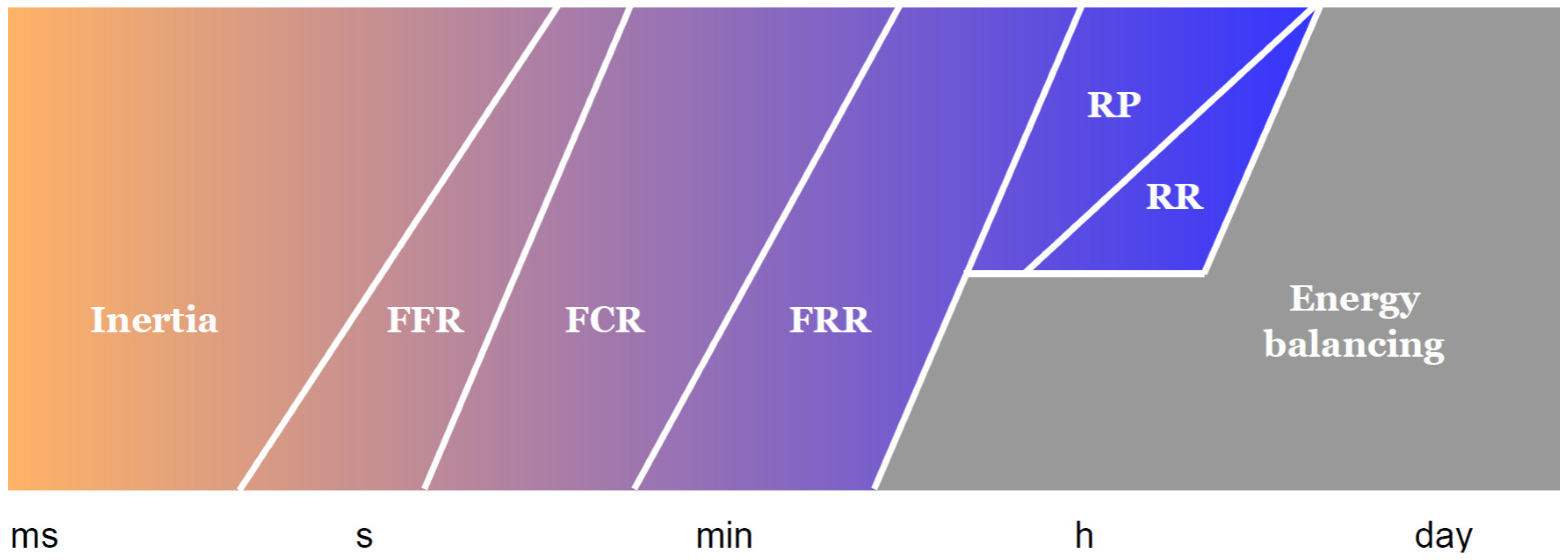
There are a number of services contributing to keeping the continuous balance in power systems by both frequency balancing and power balancing. The types of services, their names, and their requirements are often specific for each TSO and depend on the system’s characteristics. Some services are procured through markets, while others are not remunerated. Here, we list a number of common types of services used to keep the continuous balance and describe the purpose of each service. The different types of service are categorized according to the EU SysFlex project [12]. The ability to provide services related to voltage control may influence if a technology is used to provide balancing services. However, this paper focuses solely on services directly used for continuous balancing. Figure 1 shows the approximate time frame within which the different categories of balancing services discussed in this section, as well as energy balancing, contribute to keeping the continuous balance in power systems.
Figure 1.
Approximate time frames of different balancing services (in color), as well as energy balancing (in gray). The balancing services in the figure are Fast frequency response (FFR), Frequency containment reserves (FCR), Frequency restoration reserves (FRR), Ramping products (RP), and Replacement reserves (RR). Modified after [13].
Inertial response: In a power system context, inertia is the rotational energy stored in spinning directly grid-connected electrical machines. When a mismatch between production and consumption occurs, the immediate initial reaction will be an increase or decrease in this rotational energy leading to a change in frequency. This is defined as the inertial response of a power system [12]. High inertia resists changes in frequency, and gives other services more time to respond to compensate for the mismatch between production and consumption. With high shares of conventional (so-called grid-following) inverter-based resources, the inertia from spinning machines is reduced. This inertia reduction could impose challenges related to frequency stability in power systems if the size of the largest disturbance is not reduced [5]. Recently, a new class of inverter-based resource controls has emerged (so-called grid-forming), which can allow the nearly instantaneous injection of active power in response to a mismatch between production and consumption in the direction resisting changes in frequency. While grid-following inverters assume that frequency and voltage are regulated by synchronous machines and, hence, follow the grid, grid-forming inverters aim to, by the use of advanced controls, provide services traditionally provided by synchronous machines. Provided that a sufficient energy buffer is available behind an inverter, these grid-forming resources can then support the grid in the inertial time frame, similar to spinning machines. If a grid-forming inverter is controlled with a “virtual synchronous machine philosophy”, this technology is known as synthetic inertia.
Fast frequency response: With lower inertia levels, the frequency will change more rapidly following the occurrence of a mismatch between production and consumption. To give other services more time to compensate for this mismatch, fast frequency response services are used. Fast frequency response can be defined as “power injected to, or absorbed from, the grid in response to changes in measured or observed frequency during the arresting phase of a frequency excursion event to improve the frequency nadir or initial rate-of-change of frequency” [14]. Fast frequency response services generally react in a time frame faster than 2 s, and can include both existing services from synchronous resources as well as services from new fast-acting non-synchronous resources [12]. In systems with high inertia, there is no need to distinguish between fast frequency response and frequency containment reserves, due to frequency containment reserves having sufficient time to react to frequency deviations [14].
Frequency containment reserves: Frequency containment reserves have the main objective to compensate for a mismatch between production and consumption to stabilize the frequency [12]. Frequency containment reserves shall stabilize the frequency at a stationary level in a synchronous system in a time frame of 5–30 s after a mismatch between production and consumption. However, frequency containment reserves do not aim to restore the frequency to its nominal value. Frequency containment reserves react to frequency deviations in a few seconds within a certain frequency range. Sufficient frequency containment reserves should be available to stabilize the frequency at a level within an acceptable range in the case of a dimensioning incident (a dimensioning incident refers to the loss of the largest single component in a synchronous system in terms of active power).
Frequency restoration reserves: Frequency restoration reserves are used to keep the ACE toward zero in a balancing area and to restore the frequency to its nominal value [12]. Frequency restoration reserves may be activated in parallel with frequency containment reserves, and it is thus important that the frequency restoration reserves do not impair the frequency containment reserves. Frequency restoration reserves are commonly based on automatic generation control (AGC) using either the frequency deviation or the ACE as a setpoint. The full activation time of frequency restoration reserves generally varies within a time frame from 30 s to 15 min [12]. Frequency restoration reserves can also be manually activated.
Replacement reserves: Replacement reserves are used to replace fast frequency response, frequency containment reserves, and frequency restoration reserves when the system is in a balanced situation, to prepare these services to be activated again [12]. Replacement reserves may also be used as a complement to frequency restoration reserves when restoring the frequency after a larger disturbance. Replacement reserves generally act in a time frame from 15 to 60 min after a disturbance [12]. Replacement reserves are most often activated manually by a TSO when activation of frequency restoration reserves is either expected (scheduled activation of replacement reserves) or observed (direct activation of replacement reserves). Replacement reserves are generally a slower balancing service operating during a longer time frame compared to frequency restoration reserves.
Ramping products: Ramping products are online resources being able to decrease or increase the active power output over a specific time horizon for a certain time duration, to maintain supply, and demand balance in the case of net load ramps [12]. These net load ramps can both be unforeseen (such as unforecasted wind and solar production) or predictable (such as sunrise and sunset). Some ramping products act in time frames shorter than 15 min, while others act in longer time frames between 1 and 8 h. The motivation behind holding ramping products varies between time frames, whereby, in some systems, ramping products are needed to ensure the availability of certain technical capabilities not provided by shorter time frame balancing services. In other systems, ramping products are instead used to deal with market design failures, as the markets used for energy balancing fail to bring conventional generation online in sufficient time for it to deal with the net load ramps.
2.3. How to Achieve Sufficient Balancing Services?
Given the portfolio of balancing services available in a power system, it is the task of TSOs to determine how much of each balancing service must be available to keep the continuous balance in a reliable manner. The criterion for how to determine the sufficient volumes varies between TSOs, and includes both static (for a longer time frame, e.g., a year), as well as dynamic dimensioning methods (for a shorter time frame, e.g., a day). Before the real-time operation, TSOs must then acquire the needed balancing services. The process of acquiring balancing services can either be an independent process or a process in co-optimization with other parts of the short-term power system operation planning, such as clearing the day-ahead market. To ensure sufficient balancing services will be available, TSOs rely on different mechanisms to incentivize, or oblige, market actors to provide balancing services. Some common mechanisms are as follows:
Grid codes: in some systems, there are regulations, called grid codes, which make it compulsory for a power plant owner to keep certain margins, or to offer certain services, to be allowed to be connected to the transmission network.
Cost remuneration: an alternative mechanism is to require a technology to keep certain margins and have control systems available, but the technology is economically compensated, as it cannot be operated in a cost-optimal way from the owner’s perspective.
Tender system—capacity: This implies a system where the TSO procures the availability of a certain balancing service in a market. Owners of various technologies are then free to provide offers in this market, based on the costs of keeping sufficient margins and having control systems available. The least-cost offers will be accepted until the TSO’s needs are met. The market players who had their offer accepted then need to plan their real-time dispatch, such that the balancing service, can be activated if given a certain trigger signal.
Tender system—energy: This means that the TSO procures the activation of a certain balancing service in a market. Owners of various technologies are then free to provide offers in this market, based on the cost of changing their output level, such that the balancing service is provided. The least-cost offers will be accepted until the TSO’s needs are met. The market players who had their offer accepted then need to increase or decrease their output in a manner that complies with the technical regulations of the specific balancing service.
2.4. Technology Options for Continuous Balancing
Technologies that are able to provide continuous balancing services can be categorized into generation, demand, electrical storage, and transmission. They must have a reaction time suitable for the particular balancing service. They have upward and/or downward capacity limits, which means that they must keep a margin, in order to be controllable in upward or downward directions. Most technologies have relevant ramp rate restrictions, i.e., how fast the technology can change its output. There is also a need for an observation and control system to execute balancing based on local signals (frequency and/or voltage), as well as communication systems that can trigger not only locally measured balancing commands, but also can enable new setpoints for the local controls.
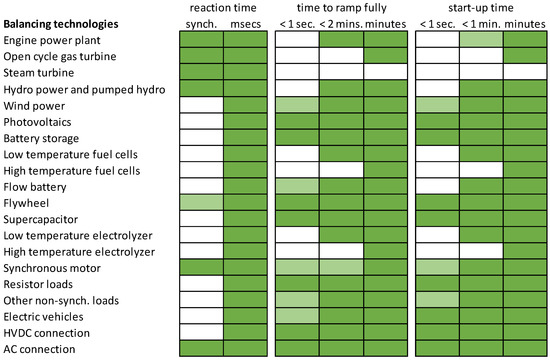
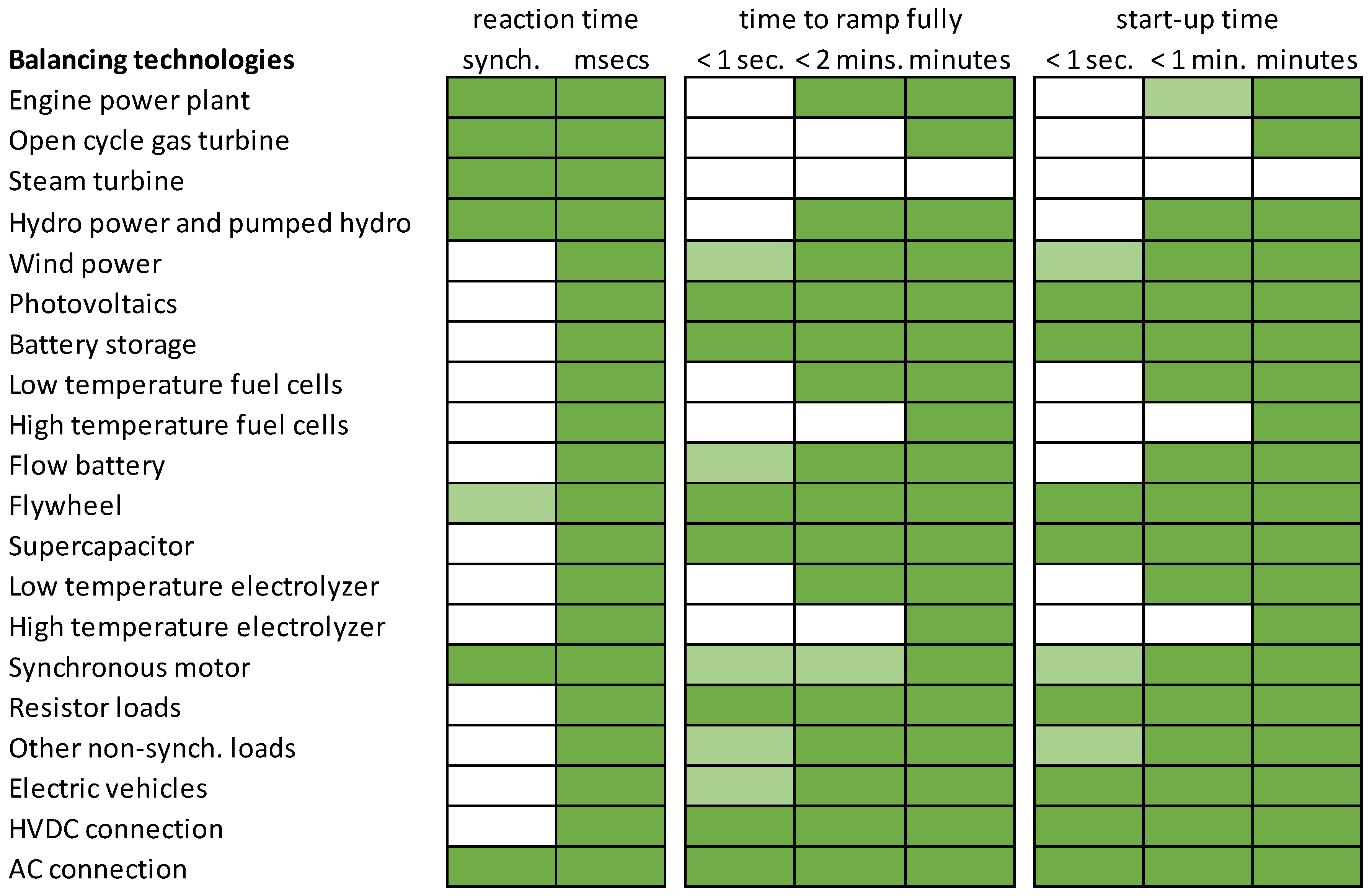
Figure 2 shows the potential of different technologies to provide intra-hour balancing services. A notable difference is that while the synchronously connected generators (four top rows) provide physical inertia, they also tend to be slower in starting up, or in ramping from minimum load to full capacity, than inverter and resistor loads. From the synchronously connected machines, hydro power plants stand out, since they are not restricted by the thermal stresses that turbine plants must manage. Hydro power still has limits, since valves need to be opened, and water flows need to be managed. Electric motor-driven applications (synchronous and non-synchronous) can ramp their consumption fast depending on the processes these motors are driving. Fuel cells and electrolyzers are other groups with somewhat slower ramping and start-up capabilities. Their limitations are caused by the management of gas and liquid flows, as well as thermal stresses. These limitations are technology-specific, as there are many different fuel cell and electrolyzer types.
Figure 2.
Potential performance of different technologies that can participate in the continuous balancing of power systems. Reaction time is the time for initial response for units in operation, while start-up time refers to the time it takes to start up an offline unit. Lighter green indicates a dependency on a specific technology, while darker green indicates capability in prevalent technologies. The figure is a rough compilation of the work in [15,16,17,18,19,20].
4. Summary and Discussion
The challenges and solutions to continuous balancing at a high share of VRE in the six different systems from Section 3 are here summarized and discussed. A brief summary of the six systems, including the expected increase in VRE generation, future challenges with continuous balancing, measures to cope with these challenges, and today’s and tomorrow’s technologies used for continuous balancing, is provided in Table 1.
Table 1.
Summarizes the balancing challenges in the six different systems.
As can be seen in Table 1, the size of the studied systems, in terms of yearly electricity demand, varies from a relatively small system in Ireland to a very large system in Central Europe. The Nordic, Iberian, Texas, and British power systems are of relatively comparable size. However, the Iberian system is synchronously connected to the central European system, and hence they share the same challenges related to frequency balancing. All studied systems already have a significant share of VRE generation today, and except for Texas, emission reduction targets will drive an increase in VRE capacity in the coming 10–20 years. For all these systems, VRE is either expected to serve at least twice as large a share of the electricity demand as of today, or the installed VRE capacity is expected to at least increase threefold. In Texas, economic incentives are expected to drive a significant increase, especially in PV installations.
From Table 1, and the detailed descriptions in Section 3, it is clear that the challenges related to continuous balancing at a high share of VRE vary widely across the six systems. The reasons behind these variations can mainly be summarized by differences in system size, the technologies used/available in the system, as well as the established balancing principles of the system. Ireland and Texas represent systems that have already adopted a wide range of measures, such as introducing an inertia floor to ensure frequency stability, as they directly face the challenge of how best to cope with even larger shares of non-synchronous generation. The two systems share in common that the dimensioning incident is large in comparison to the size (inertia) of the system. Both systems are “centrally operated”, with five-minute resolution real-time economic dispatch. This allows the uncertainty and variability associated with VRE generation to mainly be handled in the energy balancing stage. Hence, the main focus when designing balancing services is to incentivize as many resources as possible to handle disturbances and to incentivize the provision of inertial support. Of the six systems studied, Ireland and Texas currently face the largest challenge in maintaining a continuous balance, with the balancing mechanisms designed such that available assets can usefully contribute. In Great Britain, the main current concern relates to the increasing balancing costs following larger imbalances, given that most balancing is provided by gas-fired power stations. Low inertia levels have driven the curtailment of VRE generation, while large generators are mandated to provide a frequency response. In the presence of gas-fired power stations, these measures, in combination with markets for balancing services, have been sufficient for ensuring a continuous balance. However, being able to maintain a continuous balance, without relying as much on gas-fired power stations, at higher shares of VRE, is keenly acknowledged. This situation has strong similarities with the challenges currently faced by Ireland and Texas. In those systems, balancing principles and balancing services must be designed, as far as possible, for (all) available technologies to contribute. The Nordic, Iberian, and central European power systems currently do not face the same degree of challenges in keeping a continuous balance as the above systems. The Nordic system has introduced a fast frequency response service for frequency stability concerns, but no inertia floor has been implemented (deemed not to be needed). Due to the large size (and hence high inertia levels) of the continental European power system, minimum inertia levels, or fast frequency response services, are not needed, as frequency stability is not a major concern. Instead, the main challenge is to maintain the continuous balance in a cost-efficient manner as the electricity demand and VRE generation increase. Larger VRE generation capacity will increase the need for resources to maintain the continuous balance, as forecast errors and variability will lead to more frequent and larger imbalances. In Germany, VRE generation may also drive an increasing need for re-dispatch, to handle intra-zonal grid congestion, which, in turn, increases the need for reserves. The pan-European balancing energy activation platforms, MARI and PICASSO, should ensure the cost-optimal activation of balancing energy across continental Europe. Much current focus is directed toward making the existing balancing services compliant with the balancing services in these platforms. Meanwhile, balancing services must also be designed so that more technologies are eligible to provide low-cost balancing services.
Regarding technologies used for the provision of balancing services, hydro power currently plays an important role in systems with such resources. The expectation is that it will continue to do so. However, hydro power also plays an important role in energy balancing, and the provision of balancing services from non-hydro resources can increase hydro flexibility in the energy balancing stage. Systems with limited (or no) hydro resources mostly rely on fossil-fueled power plants for continuous balancing at present. So, as fossil-fueled power plants are gradually displaced (by renewables), there is also a question in terms of what will provide the balancing services in the future. The expectation is that flexibility on the demand side will provide a large share, especially in combination with storage technologies. The responsive loads could be large, e.g., industrial loads, flexible electrolyzers for hydrogen production, and data centers, as well as smaller distributed resources, e.g., EVs charging, battery storage, and heat pumps. Furthermore, hybrid resources, such as VRE generation in combination with storage, are expected to play an important future role. In Texas, loads incorporating an underfrequency relay have long since contributed to balancing services, while a specific regulation service for batteries has also been introduced. In the Irish system, ambitious targets for demand-side flexibility have been set out, with one specific focus being on large energy users, such as data centers. In Germany, large-scale battery storage is expected to play a key role in phasing out fossil-fueled generators. In the Netherlands, demand-side flexibility is stimulated through real-time communication of the balance-delta. In Great Britain, the need for TSO-DSO coordination is being discussed to ensure that full advantage from distributed flexible resources is achieved. VRE technologies are expected to increasingly contribute to balancing services, mainly in terms of down-regulating power and fast frequency response. In Spain, wind power is already the dominant down-regulating technology. The first step toward a larger contribution from VRE is to make such resources eligible for providing balancing services by designing the services to be technology agnostic, as in Texas. Both in the Nordic region and in Ireland, the frameworks for existing balancing services are being reviewed. In Portugal, it is expected that VRE resources will be allowed to provide balancing services in the coming years. In the Netherlands, the aFRR pilot projects have increased the participation of VRE technologies in continuous balancing. Meanwhile, the focus in Germany is on involving VRE generation as part of the re-dispatch process for the management of intra-zonal congestion. For VRE generation, it may be more economically viable to provide up-regulation following an increased buildout of VRE capacity. However, some systems, such as Ireland and Great Britain, see the need for VRE technologies contributing to balancing services. Hence, these systems are mandating VRE resources to be capable of providing certain reserves and system services. These requirements should be pursued through regulatory frameworks. Finally, to handle inertia scarcity at very high VRE generation shares, grid-forming inverter technologies are mentioned as a key solution in Texas, Ireland, and Great Britain. Fast frequency response from wind power and HVDC interconnectors are solutions being investigated in both the Nordic and the Irish power systems. In Texas and Ireland, synchronous condensers represent a potential alternative option to ensure sufficient inertia levels are maintained as synchronous generators are gradually being displaced. For the Irish power system, specific low-carbon inertia services are in the process of being procured by the TSOs.
5. Conclusions
To conclude, strategies for continuous balancing in power systems have been studied by describing the challenges and solutions implemented today, and anticipated in the future, for six different systems across Europe and the United States. All the studied systems are expecting to achieve very large shares of VRE generation within the coming decades. In detail, the potential future development of these systems, in terms of underlying characteristics, balancing principles, service arrangements, and the technologies used for continuous balancing, was described for each system. Various challenges and solutions to continuous balancing were then compared and discussed across the six systems. Subsequently, some important conclusions can be stated. Firstly, the challenges faced by the different systems, and the solutions adopted, vary quite noticeably. This indicates that there is no “one-solution-fits-all” approach to continuous balancing at high VRE shares. Instead, the challenges depend critically on the size of the system and its interconnection opportunities, the technologies available, and the underlying balancing principles. Secondly, for systems performing energy balancing with fine temporal granularity close to real time (such as Ireland and Texas), the major challenge for continuous balancing relates to frequency balancing at low inertia levels. For the other systems considered, the main focus, instead, relates to operating the system in the most cost-efficient manner. Of course, questions around cost, and attribution of cost, are also highly important in Ireland and Texas. Thirdly, there is a strive toward involving more technologies in contributing to continuous balancing. This is especially important for the systems where fossil-fuel-fired generation provides much of the existing (and historical) balancing services. Demand-side flexibility, VRE generation, and storage technologies, such as batteries, are expected to contribute to a much larger extent in the future. However, those measures, already taken and/or planned, to stimulate these technologies to participate in providing balancing services vary largely. Hence, it is highly likely that the different (and other) systems could benefit greatly from each other’s experiences. This makes it important to understand the motivations behind the approaches taken and the decisions made. Finally, grid-forming technologies and synchronous condensers will likely play an important role for systems that, at times, will operate at (or near) 100% non-synchronous generation. Hence, it is important to develop mechanisms to stimulate investments in such resources, while also being agnostic to other, as yet unforeseen, technology solutions.
Author Contributions
Conceptualization, H.N. and L.S.; writing—original draft preparation, H.N., L.S., D.F., J.M., J.K., H.H., T.K.V., A.v.d.W., G.M.-E., D.P., G.S., J.D., A.E., H.A., S.M.M., E.G.L. and B.-M.H.; writing—review and editing, H.N., L.S., D.F., J.M., J.K., H.H., T.K.V., A.v.d.W., G.M.-E., D.P., G.S., J.D., A.E., H.A., S.M.M., E.G.L. and B.-M.H.; visualization, H.N and J.K.; project administration, H.N and L.S. All authors have read and agreed to the published version of the manuscript.
Funding
The work by H.N. and L.S. was funded by the Swedish Energy Agency (Energimyndigheten), project “Efficient handling of power system balance in a future with close to 100% renewable power”, project number 51292-1. The work by D.F. was funded by Sustainable Energy Authority of Ireland (SEAI). The work by J.K. was funded by Horizon Europe Project Mopo (grant agreement N°101095998). The work by S.M.M. and E.G.L. was partially funded by the Council of Communities of Castilla–La Mancha (Junta de Comunidades de Castilla–La Mancha, JCCM) through Project SBPLY/19/180501/000287; by the State Research Agency (Agencia Estatal de Investigación, AEI) and by the European Regional Development Fund (Fondo Europeo de Desarrollo Regional, FEDER) through project PID2021-126082OB-C21.
Data Availability Statement
No new data were created or analyzed in this study. Data sharing is not applicable to this article.
Acknowledgments
This research was conducted as an international collaboration in IEA Wind TCP Task 25: Design and Operation of Energy Systems with Large Amounts of Variable Generation. H.N. and L.S. thank Matti Koivisto and Kaushik Das at DTU Wind and Energy Systems for their input on the article structure in the early phases of the work. H.N. and L.S. acknowledges the funding by the Swedish Energy Agency (project number 51292-1). J.K. acknowledges funding from Horizon Europe project Mopo (grant agreement N°101095998). This work was authored in part by the National Renewable Energy Laboratory, operated by Alliance for Sustainable Energy, LLC, for the US Department of Energy (DOE) under contract no. DE-AC36-08GO28308. The views expressed in the article do not necessarily represent the views of the DOE or the US Government.
Conflicts of Interest
The authors declare no conflict of interest.
References
- BP. Statistical Review of World Energy. 2022. Available online: https://www.bp.com/content/dam/bp/business-sites/en/global/corporate/pdfs/energy-economics/statistical-review/bp-stats-review-2022-full-report.pdf (accessed on 29 March 2023).
- IEA Wind TCP. Annual Report 2021. 2022. Available online: https://iea-wind.org/wp-content/uploads/2022/12/IEA_Wind_TCP_Annual_Report_2021.pdf (accessed on 29 May 2023).
- IEA. Renewables 2022: Analysis and Forecast to 2027. 2022. Available online: https://www.iea.org/reports/renewables-2022 (accessed on 29 May 2023).
- IEA—International Energy Agency. Net Zero by 2050—A Roadmap for the Global Energy Sector. 2021. Available online: https://iea.blob.core.windows.net/assets/405543d2-054d-4cbd-9b89-d174831643a4/NetZeroby2050-ARoadmapfortheGlobalEnergySector_CORR.pdf (accessed on 29 May 2023).
- Denholm, P.; Trieu, M.; Wallace Kenyon, R.; Kroposki, B.; O’Malley, M. Inertia and the Power Grid: A Guide without the Spin; National Renewable Energy Laboratory: Golden, CO, USA, 2020. [Google Scholar]
- Hirth, L.; Ziegenhagen, I. Balancing power and variable renewables: Three links. Renew. Sustain. Energy Rev. 2015, 50, 1033–1051. [Google Scholar] [CrossRef] [Scilit]
- Miettinen, J.; Holttinen, H. Impacts of wind power forecast errors on the real-time balancing need: A Nordic case study. IET Renew. Power Gener. 2019, 13, 227–233. [Google Scholar] [CrossRef] [Scilit]
- Kanellas, P.; Das, K.; Gea-Bermudez, J. Modeling the intra-hour power system balancing of the Danish power system for 2020, 2030 & 2050. In Proceedings of the 18th International Wind Integration Workshop, Dublin, Ireland, 16–18 October 2019. [Google Scholar]
- Martín-Martínez, S.; Lorenzo-Bonache, A.; Honrubia-Escribano, A.; Cañas-Carretón, M.; Gómez-Lázaro, E. Contribution of wind energy to balancing markets: The case of Spain. WIREs Energy Environ. 2018, 7, e300. [Google Scholar] [CrossRef] [Scilit]
- Algarvio, H.; Lopes, F.; Couto, A.; Estanqueiro, A. Participation of wind power producers in day-ahead and balancing markets: An overview and a simulation-based study. WIREs Energy Environ. 2019, 8, e343. [Google Scholar] [CrossRef] [Scilit]
- ENTSO-E. P1—Policy 1: Load-Frequency Control and Performance; ENTSO-E: Brussels, Belgium, 2009. [Google Scholar]
- EU-SysFlex. Product Definition for Innovative System Services. 2019. Available online: https://eu-sysflex.com/wp-content/uploads/2019/08/D3.1_Final_Submitted.pdf (accessed on 13 April 2022).
- Kölle, K.; Göçmen, T.; Garcia-Rosa, P.B.; Petrović, V.; Eguinoa, I.; Vrana, T.K.; Long, Q.; Pettas, V.; Anand, A.; Barlas, T.K.; et al. Towards integrated wind farm control: Interfacing farm flow and power plant controls. Adv. Control. Appl. Eng. Ind. Syst. 2022, 4, e105. [Google Scholar] [CrossRef] [Scilit]
- NERC Inverter-Based Resources Performance Task Force. Fast Frequency Response Concepts and Bulk Power System Reliability Needs; North American Electric Reliability Corporation: Atlanta, GA, USA, 2020. [Google Scholar]
- Miller, N.; Lew, D.; Piwko, R. Technology Capabilities for Fast Frequency Response. 2017. Available online: https://www.aemo.com.au/-/media/files/electricity/nem/security_and_reliability/reports/2017/20170310-ge-ffr-advisory-report.pdf?la=en (accessed on 19 April 2023).
- IRENA. Flexibility in Conventional Power Plants: Innovation Landscape Brief. 2019. Available online: https://www.irena.org/-/media/Files/IRENA/Agency/Publication/2019/Sep/IRENA_Flexibility_in_CPPs_2019.pdf?la=en&hash=AF60106EA083E492638D8FA9ADF7FD099259F5A1 (accessed on 19 April 2023).
- Gonzalez-Salazar, M.A.; Kirsten, T.; Prchlik, L. Review of the operational flexibility and emissions of gas- and coal-fired power plants in a future with growing renewables. Renew. Sustain. Energy Rev. 2018, 82, 1497–1513. [Google Scholar] [CrossRef] [Scilit]
- Power Circle. Flexibility for a More Stable and Secure Power System. 2022. Available online: https://www.powercircle.org/kartlaggning_flexibilitet.pdf (accessed on 19 April 2023). (In Swedish)
- Svenska Kraftnät. System Development Plan 2022–2031. 2021. Available online: https://www.svk.se/siteassets/om-oss/rapporter/2021/svk_systemutvecklingsplan_2022-2031.pdf (accessed on 19 April 2023). (In Swedish)
- Danish Energy Agency. Technology Data: Generation of Electricity and District Heating. 2023. Available online: https://ens.dk/sites/ens.dk/files/Analyser/technology_data_catalogue_for_el_and_dh.pdf (accessed on 19 April 2023).
- IEA. Sweden. Available online: https://www.iea.org/countries/sweden (accessed on 16 March 2022).
- IEA. Norway. Available online: https://www.iea.org/countries/norway (accessed on 16 March 2022).
- IEA. Finland. Available online: https://www.iea.org/countries/finland (accessed on 16 March 2022).
- YLE. Historical Day for Finnish Nuclear Power: Olkiluoto 3 Has Been Started Up. 2021. Available online: https://svenska.yle.fi/a/7-10010571 (accessed on 16 March 2022). (In Swedish)
- IEA. Denmark. Available online: https://www.iea.org/countries/denmark (accessed on 16 March 2022).
- Energinet; Fingrid; Statnett; Svenska kraftnät. Nordic Grid Development Perspective 2021; Svenska Kraftnät: Sundbyberg, Sweden, 2021. [Google Scholar]
- European Commission. Commission Regulation (EU) 2017/1485 of 2 August 2017 Establishing a Guideline on Electricity Transmission System Operation. 2017. Available online: https://eur-lex.europa.eu/legal-content/EN/TXT/?uri=uriserv:OJ.L_.2017.220.01.0001.01.ENG&toc=OJ:L:2017:220:TOC (accessed on 23 March 2023).
- Nordic Analysis Group. Requirement for Minimum Inertia in the Nordic Power System. 2021. Available online: https://www.epressi.com/media/userfiles/151043/1634122821/requirement-for-minimum-inertia-in-the-nordic-power-system.pdf (accessed on 23 March 2023).
- Modig, N.; Eriksson, R.; Ruokolainen, P.; Nerbø Ødegård, J.; Weizenegger, S.; Dalgas Fechtenburg, T. Overview of Frequency Control in the Nordic Power System. 2022. Available online: https://www.epressi.com/media/userfiles/107305/1648196866/overview-of-frequency-control-in-the-nordic-power-system-1.pdf (accessed on 23 March 2023).
- Svenska Kraftnät. Ancillary Services and Remedial Actions in a Changing Energy System. 2021. Available online: https://www.svk.se/siteassets/om-oss/rapporter/2021/rapport-regeringsuppdrag-avseende-stodtjanster_211018_.pdf (accessed on 20 December 2021). (In Swedish)
- Nordic Balancing Model. Nordic aFRR Capacity Market. 2023. Available online: https://nordicbalancingmodel.net/roadmap-and-projects/nordic-afrr-capacity-market/ (accessed on 23 March 2023).
- Nordic Balancing Model. Nordic mFRR Capacity Market. 2023. Available online: https://nordicbalancingmodel.net/roadmap-and-projects/nordic-mfrr-capacity-market/ (accessed on 23 March 2023).
- Papavasiliou, A.; Bouso, A.; Apelfröjd, S.; Wik, E.; Gueuning, T.; Langer, Y. Multi-area reserve dimensioning using chance-constrained optimization. IEEE Trans. Power Syst. 2021, 37, 3982–3994. [Google Scholar] [CrossRef] [Scilit]
- ENTSO-E. Manually Activated Reserves Initiative. 2023. Available online: https://www.entsoe.eu/network_codes/eb/mari/ (accessed on 23 March 2023).
- ENTSO-E. PICASSO. 2023. Available online: https://www.entsoe.eu/network_codes/eb/picasso/ (accessed on 23 March 2023).
- Nordic Balancing Model. Roadmap. 2023. Available online: https://nordicbalancingmodel.net/roadmap-and-projects/ (accessed on 23 March 2023).
- Nordic TSOs. Amended Nordic LFC Block Methodology for FRR Dimensioning in Accordance with Article 157(1) of the Commission Regulation (EU) 2017/1485 of 2 August 2017 Establishing a Guideline on Electricity Transmission System Operation. 2022. Available online: https://www.statnett.no/globalassets/for-aktorer-i-kraftsystemet/systemansvaret/metoder---innsendt-til-godkjenning/metode-iht.-sogl-art-157-29.06.2022.pdf (accessed on 27 October 2022).
- Svenska Kraftnät. Disturbance Reserve. 2019. Available online: https://www.svk.se/aktorsportalen/bidra-med-reserver/om-olika-reserver/storningsreserven/ (accessed on 27 October 2022). (In Swedish)
- Svenska Kraftnät. Power Reserve. 2022. Available online: https://www.svk.se/aktorsportalen/bidra-med-reserver/om-olika-reserver/effektreserv/ (accessed on 27 October 2022). (In Swedish)
- Nordström, H.; Söder, L.; Eriksson, R. Estimating the future need of balancing power based on long-term power system market simulations. In Proceedings of the 11th Bulk Power Systems Dynamics and Control Symposium (IREP 2022), Banff, AB, Canada, 25–30 July 2022. [Google Scholar]
- Svenska Kraftnät. Supply in the Reserve Markets. 2023. Available online: https://www.svk.se/aktorsportalen/bidra-med-reserver/behov-av-reserver-nu-och-i-framtiden/utbud-pa-marknaderna-for-reserver/ (accessed on 23 March 2023). (In Swedish)
- Fingrid. Offered and Procured Capacity in the Finnish Reserve Markets. 2022. Available online: https://www.fingrid.fi/globalassets/dokumentit/fi/ajankohtaista-tapahtumat/reservilahdekuvaajat-eng.pdf (accessed on 30 May 2023).
- Energinet. Scenario Report 2022–2032: Expectations for the Future Ancillary Services. 2022. Available online: https://energinet.dk/media/m3iae1hz/scenarierapport-2022-2032.pdf?la=da&hash=157C10468C69D977631F420DA5A0D5FACFFE17B0 (accessed on 23 March 2023). (In Danish)
- Dalton, J. Optimal Day-Ahead Scheduling and Bidding Strategy of Risk-Averse Electric Vehicle Aggregator: A Case Study of the Nordic Energy and Frequency Containment Reserve Markets. KTH. 2018. Available online: http://kth.diva-portal.org/smash/record.jsf?pid=diva2%3A1249791&dswid=178 (accessed on 30 May 2023).
- Kazemi Neira, S. Control of Aggregations of Electric Heaters to Provide Primary Reserves. KTH. 2019. Available online: http://kth.diva-portal.org/smash/record.jsf?pid=diva2%3A1381350&dswid=411 (accessed on 25 November 2021).
- Power Circle. Battery Storage in the Future Power System. 2020. Available online: https://powercircle.org/wp-content/uploads/2020/11/Batterilager_i_framtidens_elsystem_SamspEL.pdf (accessed on 20 December 2021). (In Swedish)
- EnerginetDK. Offentliggørelse af Priser for Systemydelser på SK4. Announcement, 1 December 2014. (In Danish)
- Suul, J.A.W. HVDC Inertia Provision. SINTEF. Available online: https://www.sintef.no/en/projects/2017/hvdc-inertia-provision/ (accessed on 2 March 2023).
- EirGrid; SONI. System & Renewable Summary Report. 2023. Available online: https://www.eirgridgroup.com/how-the-grid-works/ (accessed on 2 February 2023).
- SEAI. Energy in Ireland, 2022 Report; Sustainable Energy Authority of Ireland: Dublin, Ireland, 2022.
- EirGrid; SONI. Annual Renewable Energy Constraint and Curtailment Report; EirGrid: Dublin, Ireland, 2022. [Google Scholar]
- DECC. Climate Action Plan 2023; Department of the Environment, Climate and Communications, Irish Government: Dublin, Ireland, 2022.
- Northern Ireland Assembly. Climate Change Act (Northern Ireland) 2022; Northern Ireland Assembly: Belfast, Ireland, 2022.
- EirGrid; SONI. Ireland Capacity Outlook 2022–2031; EirGrid: Dublin, Ireland, 2022. [Google Scholar]
- EirGrid; SONI. Shaping Our Electricity Future: A Roadmap to Achieve Our Renewable Ambition; EirGrid: Dublin, Ireland, 2021. [Google Scholar]
- EirGrid; SONI. DS3 System Service Protocol—Regulated Arragements, DS3 System Services Implementation Project; Version 4.0; EirGrid: Dublin, Ireland, 2022. [Google Scholar]
- Single Electricity Market Committee. Procurement of Low Carbon Inertia Services (LCIS) Decision Paper; SEM-23-002; SEM: Dublin, Ireland, 2023. [Google Scholar]
- Zhao, X.; Thakurta, P.; Flynn, D. Grid-forming requirements based on stability assessment for 100% converter-based Irish power system. IET Renew. Power Gener. 2022, 16, 447–458. [Google Scholar] [CrossRef] [Scilit]
- EirGrid; SONI. Operational Policy Roadmap 2023–2030; EirGrid: Dublin, Ireland, 2022. [Google Scholar]
- Single Electricity Market Committee. System Services, Future Arrangements, High Level Design Decision; SEM-22-012; SEM: Dublin, Ireland, 2022. [Google Scholar]
- Red Eléctrica de Espãna. Monthly Report December 2022. 2022. Available online: https://www.ree.es/es/datos/publicaciones/boletines-mensuales/boletin-mensual-diciembre-2022 (accessed on 9 March 2023).
- European Commission. Portgual National Energy and Climate Plan 2021–2030 (NECP 2030). 2019. Available online: https://energy.ec.europa.eu/system/files/2020-06/pt_final_necp_main_en_0.pdf (accessed on 1 March 2023).
- European Commission. Spain National Energy and Climate Plan 2021–2030 (NECP 2030). 2020. Available online: https://www.miteco.gob.es/images/es/pnieccompleto_tcm30-508410.pdf (accessed on 9 March 2023).
- ERSE. Manual de Procedimentos de Gestão Global de Sistema. 2022. Available online: https://mercado.ren.pt/PT/Electr/InfoMercado/DocReg/BibSubregula/mpggs-consolidado.pdf#search=manual%20de%20procedimentos (accessed on 4 May 2023). (In Portuguese)
- Direção Geral de Energia e Geologia. Risk-Preparedness Plan for the Portuguese Electricity Sector Pursuant to Article 10 of Regulation (EU) 2019/941. 2022. Available online: https://energy.ec.europa.eu/system/files/2022-03/PT_RPP_electricity.pdf (accessed on 4 May 2023).
- Frade, P.M.; Pereira, J.P.; Santana, J.; Catalão, J. Wind balancing costs in a power system with high wind penetration—Evidence from Portugal. Energy Policy 2019, 132, 702–713. [Google Scholar] [CrossRef] [Scilit]
- ERSE. Diretiva No. 19/22 Aprova o Manual de Procedimentos da Gestão Global do Sistema do Setor Elétrico. 2022. Available online: https://www.erse.pt/media/dr3dsx1m/diretiva-erse-19-2022-aprova-mpggs_pext.pdf (accessed on 4 May 2023). (In Portuguese)
- Edmunds, C.; Martín-Martínez, S.; Browell, J.; Gómez-Lázaro, E.; Galloway, S. On the participation of wind energy in response and reserve markets in Great Britain and Spain. Renew. Sustain. Energy Rev. 2019, 115, 109360. [Google Scholar] [CrossRef] [Scilit]
- ERCOT. ERCOT Fact Sheet 2022. 2022. Available online: https://www.ercot.com/files/docs/2022/02/08/ERCOT_Fact_Sheet.pdf (accessed on 4 May 2023).
- Matevosyan, J. Evolution of ERCOT’s Frequency Control and Ancillary Services for Higher Levels of Inverter-Based Generation. 2019. Available online: https://www.esig.energy/resources/evolution-of-ercots-frequency-control-and-ancillary-services-for-higher-levels-of-inverter-based-generation-julia-matevosyan-february-2019/ (accessed on 2 March 2023).
- ESIG. Webinar: ERCOT Contingency Reserve Service (ECRS). 2023. Available online: https://www.esig.energy/event/webinar-ercot-contingency-reserve-service-ecrs/ (accessed on 4 May 2023).
- Burger, B. Energy-Charts. Fraunhofer ISE. 2023. Available online: https://energy-charts.info/charts/installed_power/chart.htm?l=en&c=DE&chartColumnSorting=default&year=2022 (accessed on 4 May 2023).
- IEA. The Netherlands. 2023. Available online: https://www.iea.org/countries/the-netherlands (accessed on 4 May 2023).
- CBS. Statline—Elektriciteit; Productie en Productiemiddelen. 2023. Available online: https://opendata.cbs.nl/#/CBS/nl/dataset/37823wkk/table (accessed on 30 May 2023). (In Dutch)
- CBS. Hernieuwbare Elektriciteit; Productie en Vermogen. 2023. Available online: https://www.cbs.nl/nl-nl/cijfers/detail/82610NED (accessed on 30 May 2023). (In Dutch)
- Netbeheer Nederland. Scenario’s Investeringsplannen 2024. 2023. Available online: https://www.netbeheernederland.nl/_upload/RadFiles/New/Documents/Netbeheer_NL_Scenarios_IP2024_v1.01_final%20(1).pdf (accessed on 30 May 2023). (In Dutch)
- Bundesnetzagentur für Elektrizität, Gas, Telekommunikation, Post und Eisenbahnen. Bericht Zum Redispatch Nach Artikel 13 Verordnung (EU) 2019/943 Entwicklungsstand, Maßnahmen und Nächste Schritte 2023. Available online: https://www.bundesnetzagentur.de/SharedDocs/Downloads/DE/Sachgebiete/Energie/Unternehmen_Institutionen/Versorgungssicherheit/Engpassmanagement/RedispatchBericht2022.pdf?__blob=publicationFile&v=4 (accessed on 4 May 2023). (In German)
- Bundesnetzagentur für Elektrizität, Gas, Telekommunikation, Post und Eisenbahnen. Grid Reserve/Reserve Power Plant Requirement. 2022. Available online: https://www.bundesnetzagentur.de/EN/Areas/Energy/SecurityOfSupply/GridReserve/start.html (accessed on 4 May 2023).
- ACM. Netcode Elektriciteit. 2023. Available online: https://www.acm.nl/nl/publicaties/publicatie/14381/Netcode-Elektriciteit (accessed on 30 May 2023). (In Dutch)
- DTe; TenneT. Transparantie Voor Onbalanssystematiek—Onderzoek En Maatregelen. The Hague. 2004. Available online: https://www.acm.nl/sites/default/files/old_publication/bijlagen/6935_12_19168.pdf (accessed on 30 May 2023). (In Dutch)
- van der Welle, A.; Morales-Espana, G.; Sijm, J.; Hernandez-Serna, R. Design of Ancillary Service Markets and Products—Challenges and Recommendations for EU Renewable Power Systems; TradeRES deliverable 3.3; EU Horizon 2020 project; LNEG: Amadora, Portugal, 2021. [Google Scholar]
- ENTSO-E. Survey on Ancillary Services Procurement, Balancing Market Design 2021. Brussels. 2022. Available online: https://eepublicdownloads.blob.core.windows.net/public-cdn-container/clean-documents/mc-documents/balancing_ancillary/2022/2022-06-20_WGAS_Survey.pdf (accessed on 30 May 2023).
- ENTSO-E. Demand of Each LFC-block Towards the Regional FCR Cooperation Market for the Year 2023. 2022. Available online: https://eepublicdownloads.blob.core.windows.net/public-cdn-container/clean-documents/Network%20codes%20documents/NC%20EB/2022/221216_Announcement_Demand_per_LFC_block_in_2023.pdf (accessed on 5 May 2023).
- European Commission. Commission regulation (EU) 2017/2195 of 23 November 2017 establishing a guideline on electricity balancing. 2017. Available online: https://eur-lex.europa.eu/legal-content/EN/TXT/?uri=CELEX%3A32017R2195 (accessed on 5 May 2023).
- ENTSO-E. Demand of Each Country Towards the Regional FCR Cooperation Market for the Year 2022. 2021. Available online: https://eepublicdownloads.blob.core.windows.net/public-cdn-container/clean-documents/Network%20codes%20documents/NC%20EB/2021/211210_Announcement_Demand_per_country_in_2022.pdf (accessed on 30 May 2023).
- Consentec GmbH. Verfahren Zur Dynamischen Bestimmung Des Bedarfs Für Sekundärregel- Und Minutenreserve; Consentec GmbH: Aachen, Germany, 2018. (In German) [Google Scholar]
- TenneT. Dutch Ancillary Services. 2023. Available online: https://www.tennet.eu/markets/dutch-ancillary-services (accessed on 5 May 2023).
- Killinger, S.; Kreifels, N.; Burger, B.; Björn, M.; Stiff, G.; Wittwer, C. Impact of the solar eclipse from 20th March 2015 on the German electrical supply—Simulation and analysis. Energy Technol. 2015, 4, 288–297. [Google Scholar] [CrossRef] [Scilit]
- ACER. Decision No 02/2020 on the Implementation Framework for the European Platform for the Exchange of Balancing Energy from aFRR; ACER: Ljubljana, Slovenia, 2020. [Google Scholar]
- ACER. Decision No 03/2020 on the Implementation Framework for the European Platform for the Exchange of Balancing Energy for mFRR; ACER: Ljubljana, Slovenia, 2020. [Google Scholar]
- NRAs. Approval by Relevant Regulatory Authorities on the Proposal of all TSOs Performing the RR Process for the Implementation Framework for the Exchange of Balancing Energy from RR in Accordance with Article 19 of EB GL; ENTSO-E: Brussels, Belgium, 2018. [Google Scholar]
- Consentec GmbH. Beschreibung von Konzepten Des Systemausgleichs Und Der Regelreservemärkte in Deutschland; Consentec GmbH: Aachen, Germany, 2022. (In German) [Google Scholar]
- ENTSO-E. Balancing Report 2022. Brussels. 2022. Available online: https://ee-public-nc-downloads.azureedge.net/strapi-test-assets/strapi-assets/2022_ENTSO_E_Balancing_Report_Web_2bddb9ad4f.pdf (accessed on 30 May 2023).
- TenneT. aFRR Pilot End Report. 2021. Available online: https://netztransparenz.tennet.eu/fileadmin/user_upload/SO_NL/aFRR_pilot_end_report.pdf (accessed on 5 May 2023).
- Morley, K.R. National Grid Live. 2023. Available online: https://grid.iamkate.com/ (accessed on 13 March 2023).
- Strbac, G.; Pudjianto, D. Flexibility in Great Britain. 2021. Available online: https://publications.carbontrust.com/flex-gb/report (accessed on 30 May 2023).
- National Grid ESO. What Is the Balancing Mechanism? 2023. Available online: https://www.nationalgrideso.com/what-we-do/electricity-national-control-centre/what-balancing-mechanism (accessed on 4 May 2023).
- BEIS; Ofgem. Future System Operator: Government and Ofgem’s Response to Consultation. 2022. Available online: https://www.gov.uk/government/publications/energy-security-bill-factsheets/energy-security-bill-factsheet-future-system-operator (accessed on 30 May 2023).
- Ye, Y.; Papadaskalopoulos, D.; Yuan, Q.; Tang, Y.; Strbac, G. Multi-Agent Deep Reinforcement Learning for Coordinated Energy Trading and Flexibility Services Provision in Local Electricity Markets. IEEE Trans. Smart Grid 2023, 14, 1541–1554. [Google Scholar] [CrossRef] [Scilit]
- National Grid ESO. Future of Balancing Services. 2023. Available online: https://www.nationalgrideso.com/industry-information/balancing-services/future-balancing-services (accessed on 13 March 2023).
- National Grid ESO. Mandatory Frequency Response (MFR). 2023. Available online: https://www.nationalgrideso.com/industry-information/balancing-services/frequency-response-services/mandatory-frequency-response (accessed on 4 May 2023).
- National Grid ESO. Dynamic Containment: What Is It, and Why Do We Need It? 2020. Available online: https://www.nationalgrideso.com/news/dynamic-containment-what-it-and-why-do-we-need-it (accessed on 4 May 2023).
- National Grid ESO. New Dynamic Services (DC/DM/DR). 2023. Available online: https://www.nationalgrideso.com/industry-information/balancing-services/frequency-response-services/new-dynamic-services-dcdmdr#Existing-Providers (accessed on 4 May 2023).
- Fu, P.; Pudjianto, D.; Zhang, X.; Strbac, G. Integration of hydrogen into multi-energy systems optimisation. Energies 2020, 13, 1606. [Google Scholar] [CrossRef] [Scilit]
- National Grid ESO. Short Term Operating Reserve (STOR). 2023. Available online: https://www.nationalgrideso.com/industry-information/balancing-services/reserve-services/short-term-operating-reserve-stor (accessed on 4 May 2023).
- National Grid ESO. GC0154: Incorporation of Interconnector Ramping Requirements into the Grid Code as Per SOGL Article 119. 2023. Available online: https://www2.nationalgrideso.com/industry-information/codes/gc/modifications/gc0154-incorporation-interconnector-ramping (accessed on 4 May 2023).

Disclaimer/Publisher’s Note: The statements, opinions and data contained in all publications are solely those of the individual author(s) and contributor(s) and not of MDPI and/or the editor(s). MDPI and/or the editor(s) disclaim responsibility for any injury to people or property resulting from any ideas, methods, instructions or products referred to in the content. |
© 2023 by the authors. Licensee MDPI, Basel, Switzerland. This article is an open access article distributed under the terms and conditions of the Creative Commons Attribution (CC BY) license (https://creativecommons.org/licenses/by/4.0/).