Article

Nonlinear Self-Synchronizing Current Control for Grid-Connected Photovoltaic Inverters †
by
Moath Alqatamin
and
Michael L. McIntyre
*
Electrical and Computer Engineering Department, Speed School of Engineering, University of Louisville, Louisville, KY 40292, USA
*
Author to whom correspondence should be addressed.
This paper is an extended version of our paper published in 2020 American Control Conference (ACC), Denver, CO, USA, 1–3 July 2020; pp. 192–197, doi:10.23919/ACC45564.2020.9147600.
Energies 2022, 15(13), 4855; https://doi.org/10.3390/en15134855
Submission received: 1 June 2022 / Revised: 27 June 2022 / Accepted: 29 June 2022 / Published: 2 July 2022
(This article belongs to the Special Issue Power System Analysis, Operation and Control)

Abstract

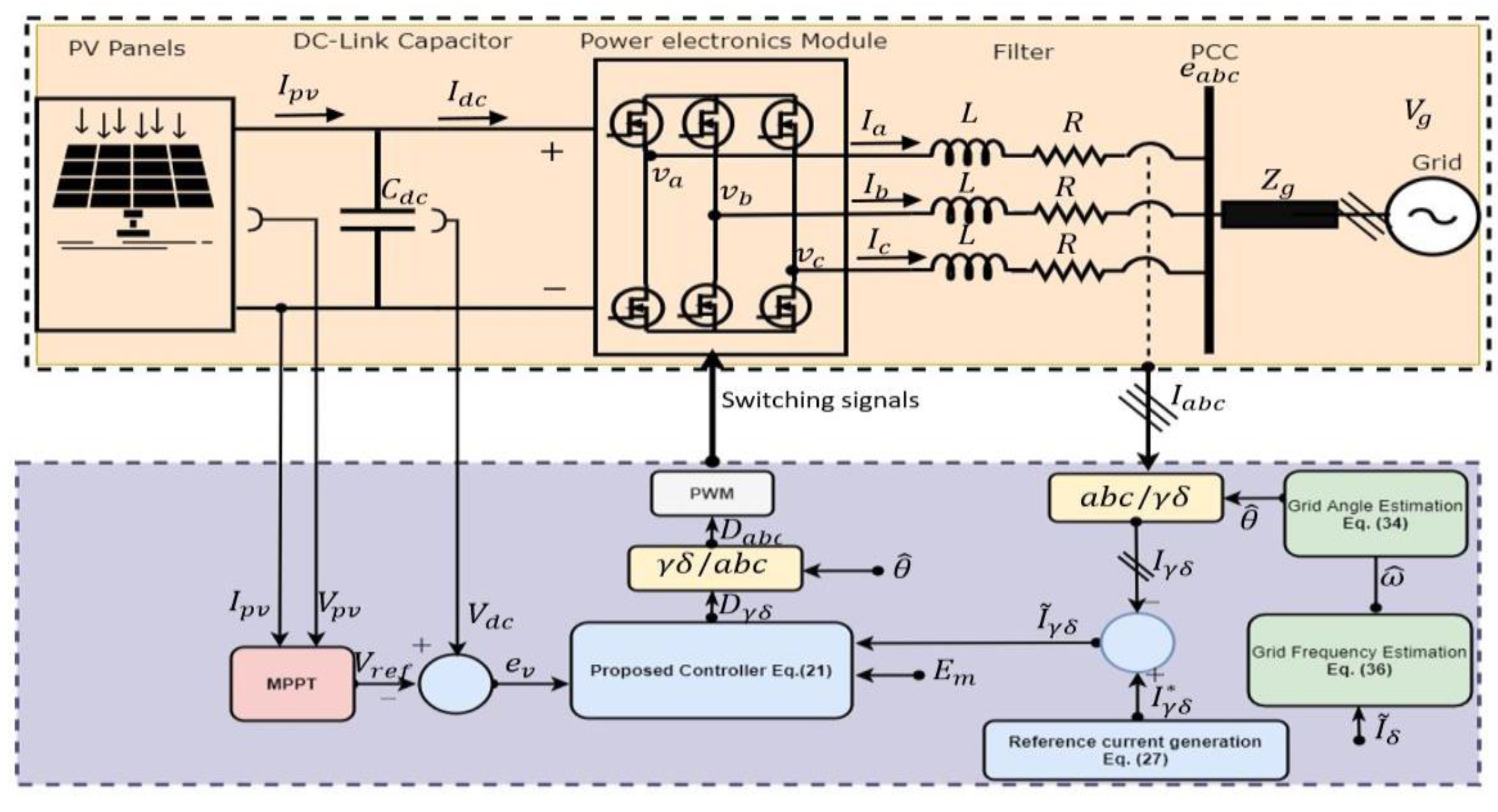
Three-phase inverters for photovoltaic grid-connected applications typically require some form of grid voltage phase-angle detection in order to properly synchronize to the grid and control real and reactive power generation. Typically, a phase-locked loop scheme is used to determine this real-time phase angle information. However, in the present work, a novel method is proposed whereby the phase angle of the grid can be accurately identified solely via the grid current feedback. This phase-angle observer is incorporated into a current controller which can manage the real and reactive power of the grid-connected PV inverter system. Moreover, the maximum power point of the photovoltaic arrays is achieved without using a DC–DC converter. The proposed method achieves the grid current and DC-link voltage control objectives without the knowledge of the grid information and without the need for a cascaded control scheme. The design of this combined observer/controller scheme is motivated and validated via a Lyapunov stability analysis. The experimental setup is prototyped utilizing a real-time Typhoon HIL 603 and National Instrument cRIO embedded controller in order to validate the proposed observer/controller scheme under different operation scenarios such as irradiation changes, frequency changes, reactive power injection, and operation with a distorted grid. The results show that the DC-link voltage and the active and reactive powers are well regulated from the proposed control scheme without the measurement of the grid phase and frequency.
Keywords: photovoltaic system; grid angle estimation; self-synchronization current control photovoltaic system; grid angle estimation; self-synchronization current control