Convolutional Neural Network and Support Vector Machine for Prediction of Damage Intensity to Multi-Storey Prefabricated RC Buildings



Abstract
1. Introduction
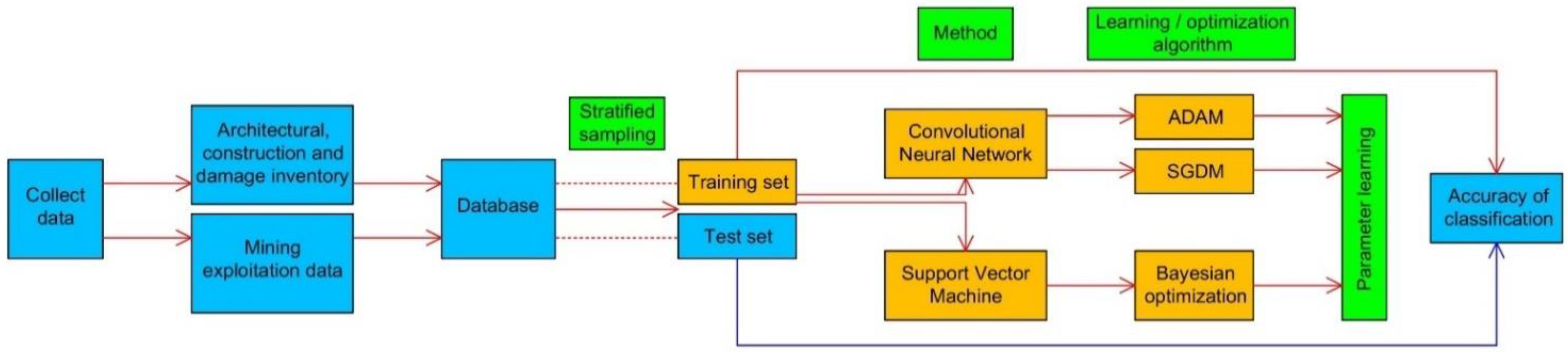
2. Methods
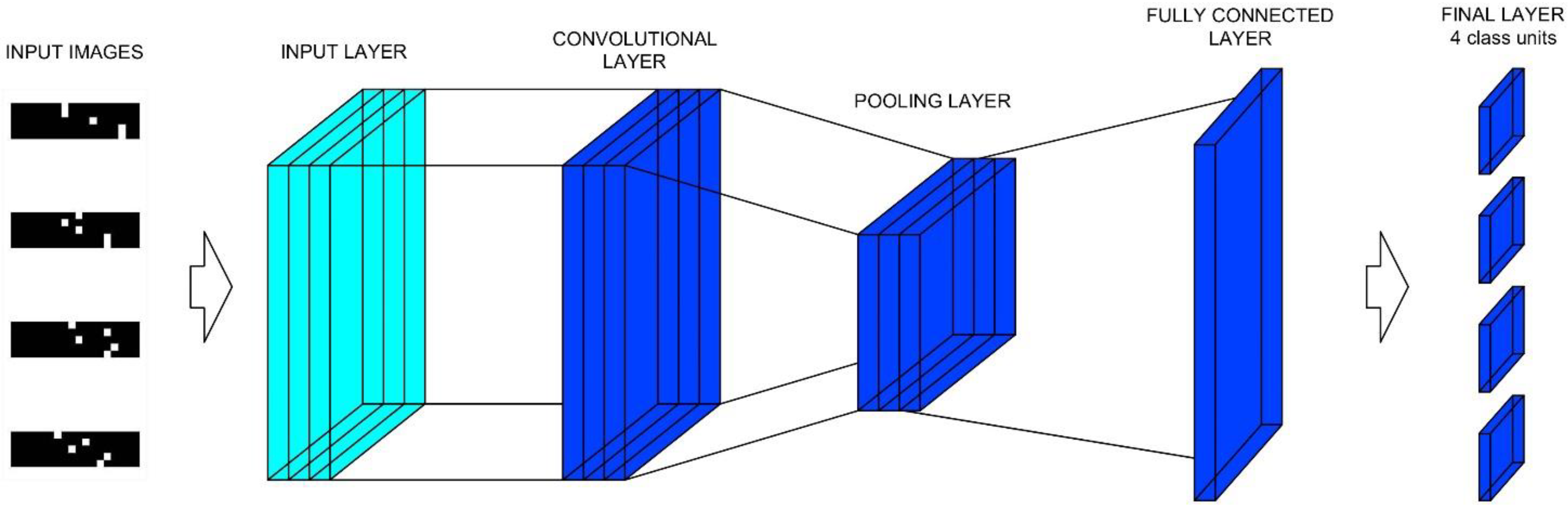
2.1. Convolutional Neural Network
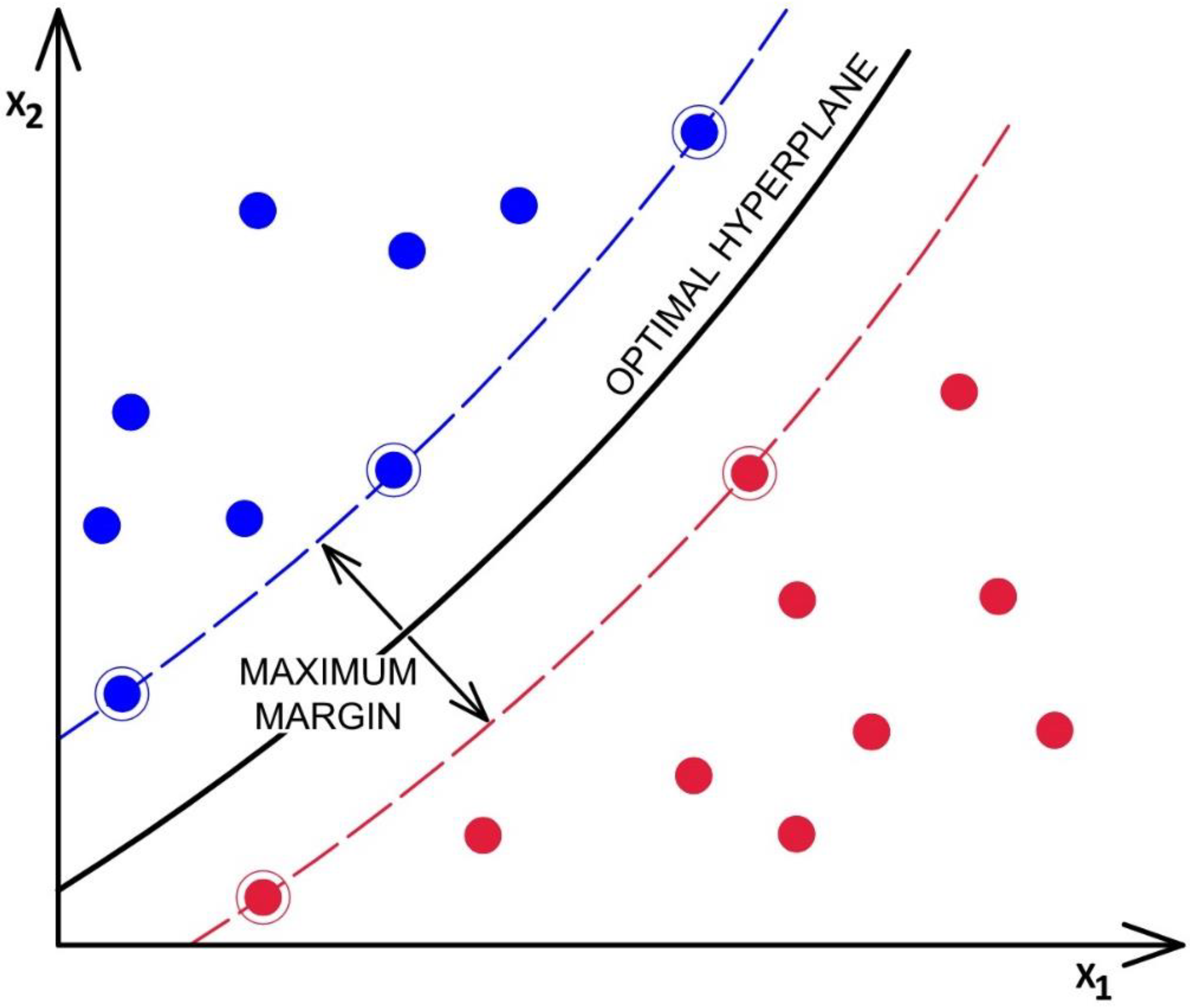
2.2. Support Vector Machine
3. Materials (Preparation of a Testing Ground)
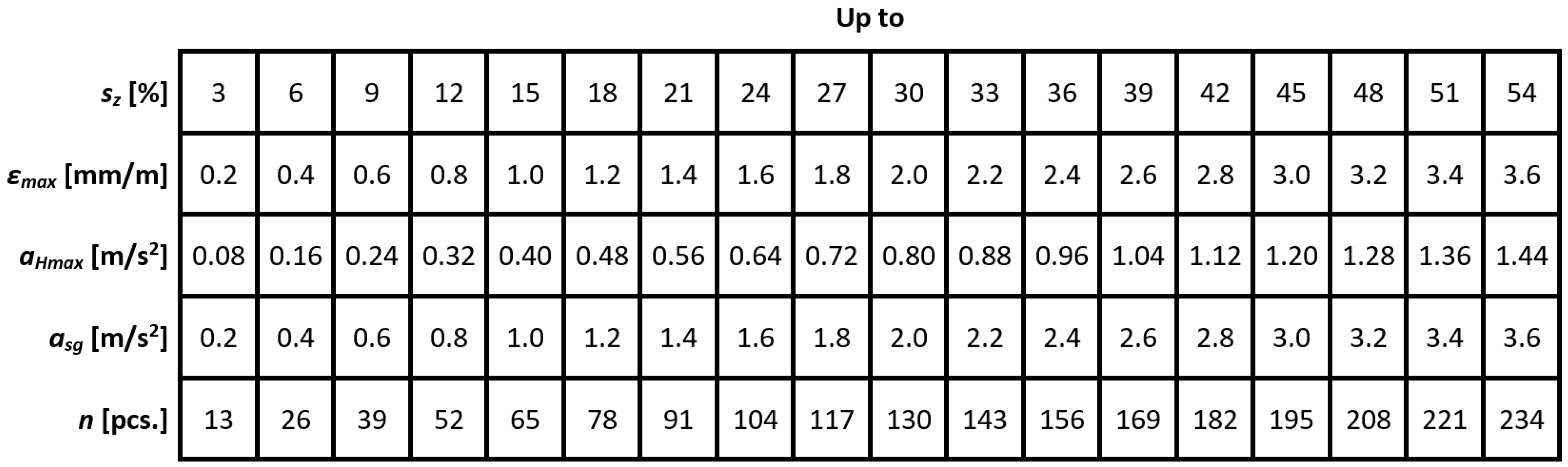
- The degree of technical wear (sz), which was determined for individual buildings using the weighted average method, taking into account individual structural and technological solutions.
- Extreme horizontal ground deformation (εmax), one of the indicators of the risk of continuous deformation of the ground surface, which takes into account the maximum deformation that occurred from the date of construction to the date of the building inventory.
- Maximum horizontal component of the vibration acceleration (aHmax), which is the maximum ground vibration acceleration induced by a tremor that occurred during the lifetime of the building.
- Tremor intensity index (asg), which is a measure of the impact of mining tremors on the technical wear of buildings [52].
- Number of tremors (n), which indicates the number of tremors with a maximum vibration acceleration value higher than the threshold value ap ≥ 0.12 m/s2 [52] that has occurred during the lifetime of a building.
Preparation of Quasi-Images Displaying Data for CNN Analysis
4. Results
- Precision:
- Recall:
4.1. Results for the Convolutional Neural Network
4.2. Results of the Support Vector Machine
4.3. Comparison of the CNN and SVM
4.4. Critical Analysis and Discussion
5. Conclusions
Author Contributions
Funding
Institutional Review Board Statement
Informed Consent Statement
Data Availability Statement
Conflicts of Interest
References
- Surana, M.; Meslem, A.; Singh, Y.; Lang, D.H. Analytical evaluation of damage probability matrices for hill-side RC buildings using different seismic intensity measures. Eng. Struct. 2020, 207, 110254. [Google Scholar] [CrossRef] [Scilit]
- Harirchian, E.; Kumari, V.; Jadhav, K.; Das, R.R.; Rasulzade, S.; Lahmer, T. A machine learning framework for assessing seismic hazard safety of reinforced concrete buildings. Appl. Sci. 2020, 10, 7153. [Google Scholar] [CrossRef] [Scilit]
- Rusek, J.; Tajduś, K.; Firek, K.; Jędrzejczyk, A. Score-based Bayesian belief network structure learning in damage risk modelling of mining areas building development. J. Clean. Prod. 2021, 296, 126528. [Google Scholar] [CrossRef] [Scilit]
- Wodyński, A. Zużycie Techniczne Budynków na Terenach Górniczych (Technical Wear of Buildings in Mining Areas); AGH Publishing House: Krakow, Poland, 2007. [Google Scholar]
- Ostrowski, J.; Ćmiel, A. The use of a logit model to predict the probability of damage to bullding structures in mining terrains. Arch. Min. Sci. 2008, 53, 161–182. Available online: https://www.infona.pl//resource/bwmeta1.element.baztech-article-BPZ2-0036-0029 (accessed on 7 November 2021).
- Pohoryles, D.A.; Maduta, C.; Bournas, D.A.; Kouris, L.A. Energy performance of existing residential buildings in Europe: A novel approach combining energy with seismic retrofitting. Energy Build. 2020, 223, 110024. [Google Scholar] [CrossRef] [Scilit]
- Manfredi, V.; Masi, A. Seismic strengthening and energy efficiency: Towards an integrated approach for the rehabilitation of existing RC buildings. Buildings 2018, 8, 36. [Google Scholar] [CrossRef] [Scilit]
- Tajduś, K. Analysis of horizontal displacements measured over the mining operations in longwall No. 537 at the Girondelle 5 seam of the BW Friedrich Heinrich-Rheinland coal mine. Arch. Min. Sci. 2016, 61, 157–168. [Google Scholar] [CrossRef] [Scilit]
- Tajduś, K.; Tajduś, A.; Cała, M. Seismicity and rock burst hazard assessment in fault zones: A case study. Arch. Min. Sci. 2018, 63, 747–765. [Google Scholar]
- Malinowska, A.A.; Misa, R.; Tajduś, K. Geomechanical modeling of subsidence related strains causing earth fissures. Acta Geodyn. Geomater. 2018, 15, 197–204. [Google Scholar] [CrossRef] [Scilit]
- Misa, R.; Sroka, A.; Tajduś, K.; Dudek, M. Analytical design of selected geotechnical solutions which protect civil structures from the effects of underground mining. J. Sustain. Min. 2019, 18, 1–7. [Google Scholar] [CrossRef] [Scilit]
- Kwinta, A.; Gradka, R. Analysis of the damage influence range generated by underground mining. Int. J. Rock Mech. Min. Sci. 2020, 128, 104263. [Google Scholar] [CrossRef] [Scilit]
- Ścigała, R.; Szafulera, K. Linear discontinuous deformations created on the surface as an effect of underground mining and local geological conditions-case study. Bull. Eng. Geol. Environ. 2020, 79, 2059–2068. [Google Scholar] [CrossRef] [Scilit]
- Ilki, A.; Fardis, M.N. Seismic Evaluation and Rehabilitation of Structures; Springer: Berlin/Heidelberg, Germany, 2014. [Google Scholar]
- European Parliament (EU). Regulation (EU) No 305/2011 of the European Parliament and of the Council of 9 March 2011 laying down behavior conditions for the marketing of construction products and repealing Council Directive 89/106/EEC. Off. J. Eur. Union 2011, L88, 5. [Google Scholar]
- International Energy Agency. World Energy Outlook. Executive Summary. 2021. Available online: www.iea.org/weo (accessed on 15 April 2022).
- Analytical Report—Improving Energy and Resource Efficiency. European Commission and European Construction Sector Observatory. 2018. Available online: https://ec.europa.eu/growth/document/download/eac86e75-3865-47ea-8411-a9a707da3e05_en (accessed on 30 April 2022).
- Vilches, A.; Garcia-Martinez, A.; Sanchez-Montañes, B. Life cycle assessment (LCA) of building refurbishment: A literature review. Energy Build. 2017, 135, 286–301. [Google Scholar] [CrossRef] [Scilit]
- Magrini, A.; Lentini, G.; Cuman, S.; Bodrato, A.; Marenco, L. From nearly zero energy buildings (NZEB) to positive energy buildings (PEB): The next challenge–The most recent European trends with some notes on the energy analysis of a forerunner PEB example. Dev. Built Environ. 2020, 3, 100019. [Google Scholar] [CrossRef] [Scilit]
- Commission Recommendation (EU). 2019/786 of 8 May 2019 on building renovation, C/2019/3352. Off. J. Eur. Union 2019, L127, 34. [Google Scholar]
- Rezaei, F.; Bulle, C.; Lesage, P. Integrating building information modeling and life cycle assessment in the early and detailed building design stages. Build. Environ. 2019, 153, 158–167. [Google Scholar] [CrossRef] [Scilit]
- Konior, J.; Sawicki, M.; Szóstak, M. Intensity of the Formation of Defects in Residential Buildings with Regards to Changes in Their Reliability. Appl. Sci. 2020, 10, 6651. [Google Scholar] [CrossRef] [Scilit]
- D’Amico, B.; Myers, R.J.; Sykes, J.; Voss, E.; Cousins-Jenvey, B.; Fawcett, W.; Richardson, S.; Kermani, A.; Pomponi, F. Machine Learning for Sustainable Structures: A Call for Data. Structures 2019, 19, 1–4. [Google Scholar] [CrossRef] [Scilit]
- Marzouk, M.; Azab, S.; Metawie, M. BIM-based approach for optimizing life cycle costs of sustainable buildings. J. Clean. Prod. 2018, 188, 217–226. [Google Scholar] [CrossRef] [Scilit]
- Jędrzejczyk, A.; Byrdy, A.; Firek, K.; Rusek, J. Partial Least Squares Regression Approach in the Analysis of Damage Intensity Changes to Prefabricated RC Buildings during the Long Term of Mining Activity. Appl. Sci. 2022, 12, 467. [Google Scholar] [CrossRef] [Scilit]
- Manzoor, B.; Othman, I.; Durdyev, S.; Ismail, S.; Wahab, M.H. Influence of Artificial Intelligence in Civil Engineering toward Sustainable Development—A Systematic Literature Review. Appl. Syst. Innov. 2021, 4, 52. [Google Scholar] [CrossRef] [Scilit]
- Pham, A.D.; Ngo, N.T.; Truong, T.T.H.; Huynh, N.T.; Truong, N.S. Predicting energy consumption in multiple buildings using machine learning for improving energy efficiency and sustainability. J. Clean. Prod. 2020, 260, 121082. [Google Scholar] [CrossRef] [Scilit]
- Rusek, J.; Tajdus, K.; Firek, K.; Jedrzejczyk, A. Bayesian Networks and Support Vector Classifier in Damage Risk Assessment of RC Prefabricated Building Structures in Mining Areas. In Proceedings of the 2020 5th International Conference on Smart and Sustainable Technologies (SpliTech), Split, Croatia, 23–26 September 2020. [Google Scholar] [CrossRef] [Scilit]
- Firek, K.; Rusek, J.; Wodyński, A. Decision Trees in the Analysis of the Intensity of Damage to Portal Frame Buildings in Mining Areas. Arch. Min. Sci. 2015, 60, 847–857. [Google Scholar] [CrossRef] [Scilit]
- Rusek, J. Application of Support Vector Machine in the analysis of the technical state of development in the LGOM mining area. Eksploat. I Niezawodn. 2017, 19, 54–61. [Google Scholar] [CrossRef] [Scilit]
- Getting Started with MATLAB: A Quick Introduction for Scientists and Engineers, 7e—MATLAB & Simulink Books. Available online: https://www.mathworks.com/academia/books/getting-started-with-matlab-pratap.html (accessed on 10 April 2022).
- Russakovsky, O.; Deng, J.; Su, H.; Krause, J.; Satheesh, S.; Ma, S.; Huang, Z.; Karpathy, A.; Khosla, A.; Bernstein, M.; et al. ImageNet Large Scale Visual Recognition Challenge. Int. J. Comput. Vis. 2015, 115, 211–252. [Google Scholar] [CrossRef] [Scilit]
- Yamashita, R.; Nishio, M.; Do, R.K.G.; Togashi, K. Convolutional neural networks: An overview and application in radiology. Insights Imaging 2018, 9, 611–629. [Google Scholar] [CrossRef] [Scilit]
- Krizhevsky, A.; Sutskever, I.; Hinton, G.E. ImageNet Classification with Deep Convolutional Neural Networks. Available online: http://code.google.com/p/cuda-convnet/ (accessed on 4 April 2022).
- Rusek, J.; Firek, K.; Wodynski, A. Assessing the Influence of Mining Impacts on Buildings using SVM and MLR Method. In Proceedings of the IOP Conference Series: Materials Science and Engineering, Perm, Russia, 18–22 February 2019; Volume 471, p. 052060. [Google Scholar] [CrossRef] [Scilit]
- Hajeb, M.; Karimzadeh, S.; Matsuoka, M. SAR and LIDAR Datasets for Building Damage Evaluation Based on Support Vector Machine and Random Forest Algorithms—A Case Study of Kumamoto Earthquake, Japan. Appl. Sci. 2020, 10, 8932. [Google Scholar] [CrossRef] [Scilit]
- Chomacki, L.; Rusek, J.; Słowik, L. Selected Artificial Intelligence Methods in the Risk Analysis of Damage to Masonry Buildings Subject to Long-Term Underground Mining Exploitation. Miner 2021, 11, 958. [Google Scholar] [CrossRef] [Scilit]
- Nex, F.; Duarte, D.; Tonolo, F.G.; Kerle, N. Structural Building Damage Detection with Deep Learning: Assessment of a State-of-the-Art CNN in Operational Conditions. Remote Sens. 2019, 11, 2765. [Google Scholar] [CrossRef] [Scilit]
- Xiong, C.; Li, Q.; Lu, X. Automated regional seismic damage assessment of buildings using an unmanned aerial vehicle and a convolutional neural network. Autom. Constr. 2020, 109, 102994. [Google Scholar] [CrossRef] [Scilit]
- Konstantinidis, D.; Argyriou, V.; Stathaki, T.; Grammalidis, N. A modular CNN-based building detector for remote sensing images. Comput. Netw. 2020, 168, 107034. [Google Scholar] [CrossRef] [Scilit]
- Pan, Z.; Yang, J.; Wang, X.e.; Wang, F.; Azim, I.; Wang, C. Image-based surface scratch detection on architectural glass panels using deep learning approach. Constr. Build. Mater. 2021, 282, 122717. [Google Scholar] [CrossRef] [Scilit]
- Firek, K.; Rusek, J. Partial least squares method in the analysis of the intensity of damage in prefabricated large-block building structures. Arch. Min. Sci. 2017, 62, 269–277. [Google Scholar] [CrossRef] [Scilit]
- O’shea, K.; Nash, R. An Introduction to Convolutional Neural Networks. arXiv 2015, arXiv:1511.08458. [Google Scholar]
- Zhou, V. An Introduction to Convolutional Neural Networks. Towards Data Science. Available online: https://towardsdatascience.com/an-introduction-to-convolutional-neural-networks-bdf692352c7 (accessed on 5 April 2022).
- Ma, W.; Lu, J. An Equivalence of Fully Connected Layer and Convolutional Layer. arXiv 2017, arXiv:1712.01252. [Google Scholar]
- Kim, S.; Yu, H. SVM Tutorial: Classification, Regression, and Ranking. In Handbook of Natural Computing; Springer: Berlin/Heidelberg, Germany, 2012. [Google Scholar] [CrossRef] [Scilit]
- Osowski, S. Sieci Neuronowe do Przetwarzania Informacji; Oficyna Wydawnicza Politechniki Warszawskiej: Warsaw, Poland, 2020. [Google Scholar]
- Sammut, C.; Webb, G.I. Encyclopedia of Machine Learning and Data Mining; Springer: New York, NY, USA, 2017. [Google Scholar]
- Smola, A.J.; Schölkopf, B. A tutorial on support vector regression. Stat. Comput. 2004, 14, 199–222. [Google Scholar] [CrossRef] [Scilit]
- Chang, C.C.; Lin, C.J. LIBSVM: A Library for support vector machines. ACM Trans. Intell. Syst. Technol. 2011, 2, 1–27. [Google Scholar] [CrossRef] [Scilit]
- MATLAB Release. Statistics and Machine Learning Toolbox; The MathWorks Inc.: Natick, MA, USA, 2021; Available online: https://www.mathworks.com/products/statistics.html (accessed on 10 April 2022).
- Wodyński, A.; Lasocki, S. Badanie wpływu wstrząsów górniczych na zużycie techniczne budynków murowanych. Przegląd Górniczy 2003, 59, 1–6. [Google Scholar]
- Rusek, J.; Firek, K. Machine learning for determining dynamic characteristics of portal frame buildings. In Proceedings of the 16th International Multidisciplinary Scientific GeoConference SGEM 2016, Albena, Bulgaria, 30 June–6 July 2016; Volume 2, pp. 539–544. [Google Scholar]
- Du, Y.; Chen, W.; Cui, K.; Zhang, J.; Chen, Z.; Zhang, Q. Damage Assessment of Earthen Sites of the Ming Great Wall in Qinghai Province. J. Comput. Cult. Herit. 2020, 13, 14. [Google Scholar] [CrossRef] [Scilit]
- Li, P.; Song, B.; Xu, H. Urban building damage detection from very high resolution imagery by One-Class SVM and shadow information. In Proceedings of the International Geoscience and Remote Sensing Symposium (IGARSS), Vancouver, BC, Canada, 24–29 July 2011; pp. 1409–1412. [Google Scholar] [CrossRef] [Scilit]
- Chicco, D.; Jurman, G. The advantages of the Matthews correlation coefficient (MCC) over F1 score and accuracy in binary classification evaluation. BMC Genom. 2020, 21, 6. [Google Scholar] [CrossRef] [Scilit]
- Chomacki, L.; Rusek, J.; Słowik, L. Machine Learning Methods in Damage Prediction of Masonry Development Exposed to the Industrial Environment of Mines. Energies 2022, 15, 3958. [Google Scholar] [CrossRef] [Scilit]
- Alzubaidi, L.; Zhang, J.; Humaidi, A.J.; Al-Dujaili, A.; Duan, Y.; Al-Shamma, O.; Santamaría, J.; Fadhel, M.A.; Al-Amidie, M.; Farhan, L. Review of deep learning: Concepts, CNN architectures, challenges, applications, future directions. J. Big Data 2021, 81, 1–74. [Google Scholar] [CrossRef] [Scilit] [PubMed]
- Kingma, D.P.; Ba, J.L. Adam: A Method for Stochastic Optimization. In Proceedings of the International Conference on Learning Representations (ICLR), San Diego, CA, USA, 7–9 May 2015. [Google Scholar]
- Sajedi, S.O.; Liang, X. A data-driven framework for near real-time and robust damage diagnosis of building structures. Struct. Control Health Monit. 2020, 27, e2488. [Google Scholar] [CrossRef] [Scilit]



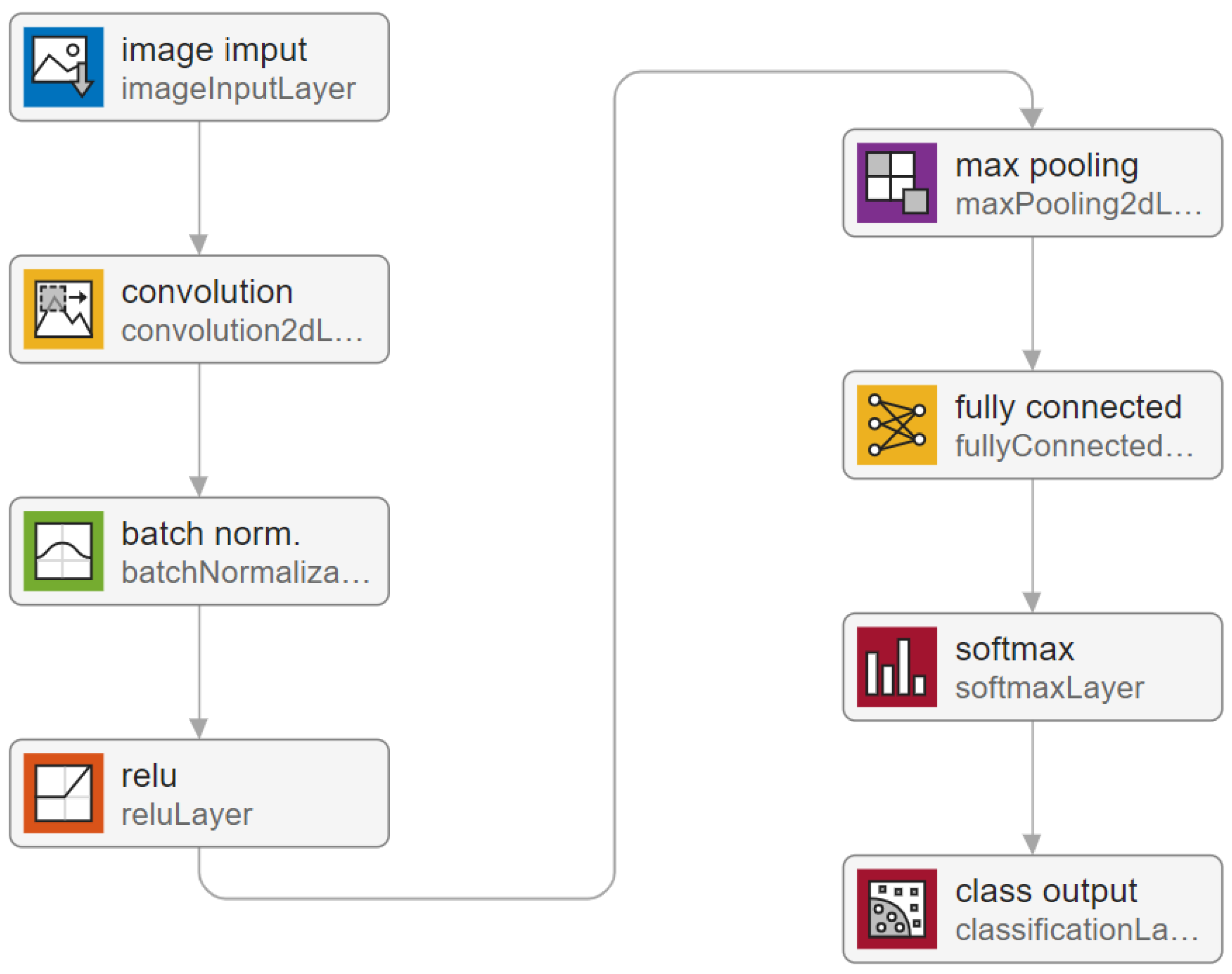
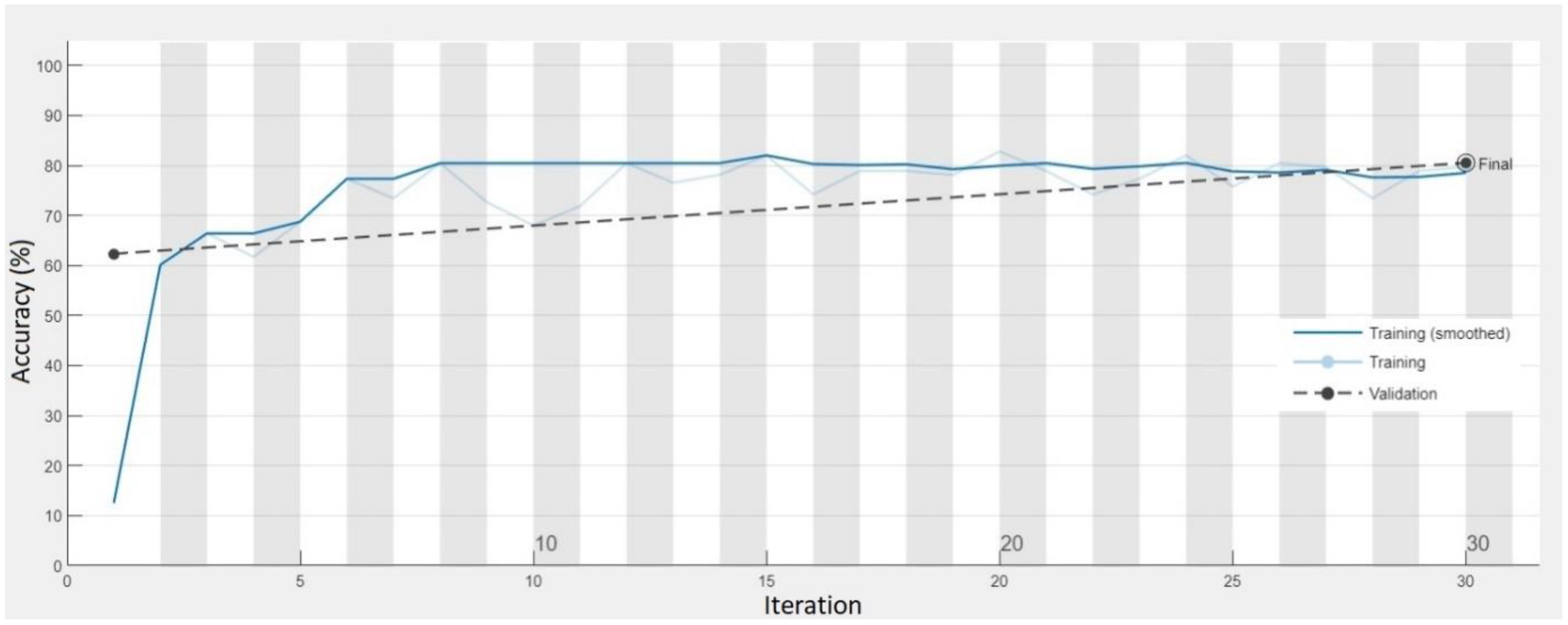

| Actual Positive | Actual Negative | |
|---|---|---|
| Predicted positive | True positives TP | False positives FP |
| Predicted negative | False negatives FN | True negatives TN |
| Algorithm | Data Set | Quality Classification Level Qc [%] |
|---|---|---|
| ADAM | training set | 80.35 |
| test set | 80.52 | |
| SGDM | training set | 78.60 |
| test set | 80.52 |
| Training Set Containing 229 Cases | |||||||
| Damage intensity | Value (up to) | 3.2% | 6.4% | 9.6% | 12.8% | Σ | Precision PPV |
| Category | 1 | 2 | 3 | 4 | |||
| Predicted | 1 | 0 | 7 | 2 | 0 | 9 | 0.00% |
| 2 | 0 | 51 | 11 | 0 | 62 | 82.26% | |
| 3 | 0 | 5 | 120 | 4 | 129 | 93.02% | |
| 4 | 0 | 1 | 15 | 13 | 29 | 44.83% | |
| Σ | 0 | 64 | 148 | 17 | 229 | avg. PPV | |
| 55.03% | |||||||
| Recall TPR | 0.00% | 79.69% | 81.08% | 76.47% | avg. TPR | Qc | |
| 59.31% | 80.35% | ||||||
| Test set containing 77 cases | |||||||
| Damage intensity | Value (up to) | 3.2% | 6.4% | 9.6% | 12.8% | Σ | Precision PPV |
| Category | 1 | 2 | 3 | 4 | |||
| Predicted | 1 | 0 | 3 | 0 | 0 | 3 | 0.00% |
| 2 | 0 | 13 | 8 | 0 | 21 | 61.90% | |
| 3 | 0 | 0 | 43 | 0 | 43 | 100.00% | |
| 4 | 0 | 0 | 4 | 6 | 10 | 60.00% | |
| Σ | 0 | 16 | 55 | 6 | 77 | avg. PPV | |
| 55.48% | |||||||
| Recall TPR | 0.00% | 81.25% | 78.18% | 100.00% | avg. TPR | Qc | |
| 64.86% | 80.52% | ||||||
| Optimization Method | Parameters | ||
|---|---|---|---|
| C | γ | Kernel Function | |
| Bayesian optimization | 1.048 | 0.98 | RBF |
| Training set containing 229 cases | |||||||
| Damage intensity | Value (up to) | 3.2% | 6.4% | 9.6% | 12.8% | Σ | Precision PPV |
| Category | 1 | 2 | 3 | 4 | |||
| Predicted | 1 | 1 | 6 | 2 | 0 | 9 | 11.11% |
| 2 | 0 | 53 | 9 | 0 | 62 | 85.48% | |
| 3 | 0 | 2 | 125 | 2 | 129 | 96.90% | |
| 4 | 0 | 1 | 13 | 15 | 29 | 51.72% | |
| Σ | 1 | 62 | 149 | 17 | 229 | avg. PPV | |
| 61.30% | |||||||
| Recall TPR | 100.00% | 85.48% | 83.89% | 88.24% | avg. TPR | Qc | |
| 89.40% | 84.72% | ||||||
| Test set containing 77 cases | |||||||
| Damage intensity | Value (up to) | 3.2% | 6.4% | 9.6% | 12.8% | Σ | Precision PPV |
| Category | 1 | 2 | 3 | 4 | |||
| Predicted | 1 | 0 | 3 | 0 | 0 | 3 | 0.00% |
| 2 | 0 | 15 | 6 | 0 | 21 | 71.43% | |
| 3 | 0 | 1 | 42 | 0 | 43 | 97.67% | |
| 4 | 0 | 0 | 2 | 8 | 10 | 80.00% | |
| Σ | 0 | 19 | 50 | 8 | 77 | avg. PPV | |
| 62.28% | |||||||
| Recall TPR | 0.00% | 78.95% | 84.00% | 100.00% | avg. TPR | Qc | |
| 65.74% | 84.42% | ||||||
| Method | Training Set | Test Set | ||||
|---|---|---|---|---|---|---|
| Qc | avg. PPV | avg. TPR | Qc | avg. PPV | avg. TPR | |
| CNN | 80.35 | 55.03 | 59.31 | 80.52 | 55.48 | 64.86 |
| SVM | 84.72 | 61.30 | 89.40 | 84.42 | 62.28 | 65.74 |
Publisher’s Note: MDPI stays neutral with regard to jurisdictional claims in published maps and institutional affiliations. |
© 2022 by the authors. Licensee MDPI, Basel, Switzerland. This article is an open access article distributed under the terms and conditions of the Creative Commons Attribution (CC BY) license (https://creativecommons.org/licenses/by/4.0/).
Share and Cite
Jędrzejczyk, A.; Firek, K.; Rusek, J. Convolutional Neural Network and Support Vector Machine for Prediction of Damage Intensity to Multi-Storey Prefabricated RC Buildings. Energies 2022, 15, 4736. https://doi.org/10.3390/en15134736
Jędrzejczyk A, Firek K, Rusek J. Convolutional Neural Network and Support Vector Machine for Prediction of Damage Intensity to Multi-Storey Prefabricated RC Buildings. Energies. 2022; 15(13):4736. https://doi.org/10.3390/en15134736
Chicago/Turabian StyleJędrzejczyk, Adrian, Karol Firek, and Janusz Rusek. 2022. "Convolutional Neural Network and Support Vector Machine for Prediction of Damage Intensity to Multi-Storey Prefabricated RC Buildings" Energies 15, no. 13: 4736. https://doi.org/10.3390/en15134736
APA StyleJędrzejczyk, A., Firek, K., & Rusek, J. (2022). Convolutional Neural Network and Support Vector Machine for Prediction of Damage Intensity to Multi-Storey Prefabricated RC Buildings. Energies, 15(13), 4736. https://doi.org/10.3390/en15134736