A Comparative Study on the Performance of Single and Multi-Layer Encapsulated Phase Change Material Packed-Bed Thermocline Tanks


Abstract
1. Introduction
- Investigate the transient thermal evaluation (temperature maps and dynamic performance analyses) of single-PCM and multiple-PCMs thermocline TES systems which use in combined heat and power units for district heating (not reported in detail in the literature and need further study).
- Investigate the effects of the volume fraction of PCM and the inverse Stefan number on the dynamic performance of a multiple-PCMs thermocline TES system for low-temperature via various operation modes, such as a single charge/discharge and cyclic operation. The former two parameters are not addressed before for multiple-PCMs water thermocline tank and need further study.
2. Physical and Mathematical Model
2.1. System Modeling Formulation
2.2. Mathematical Model
- (1)
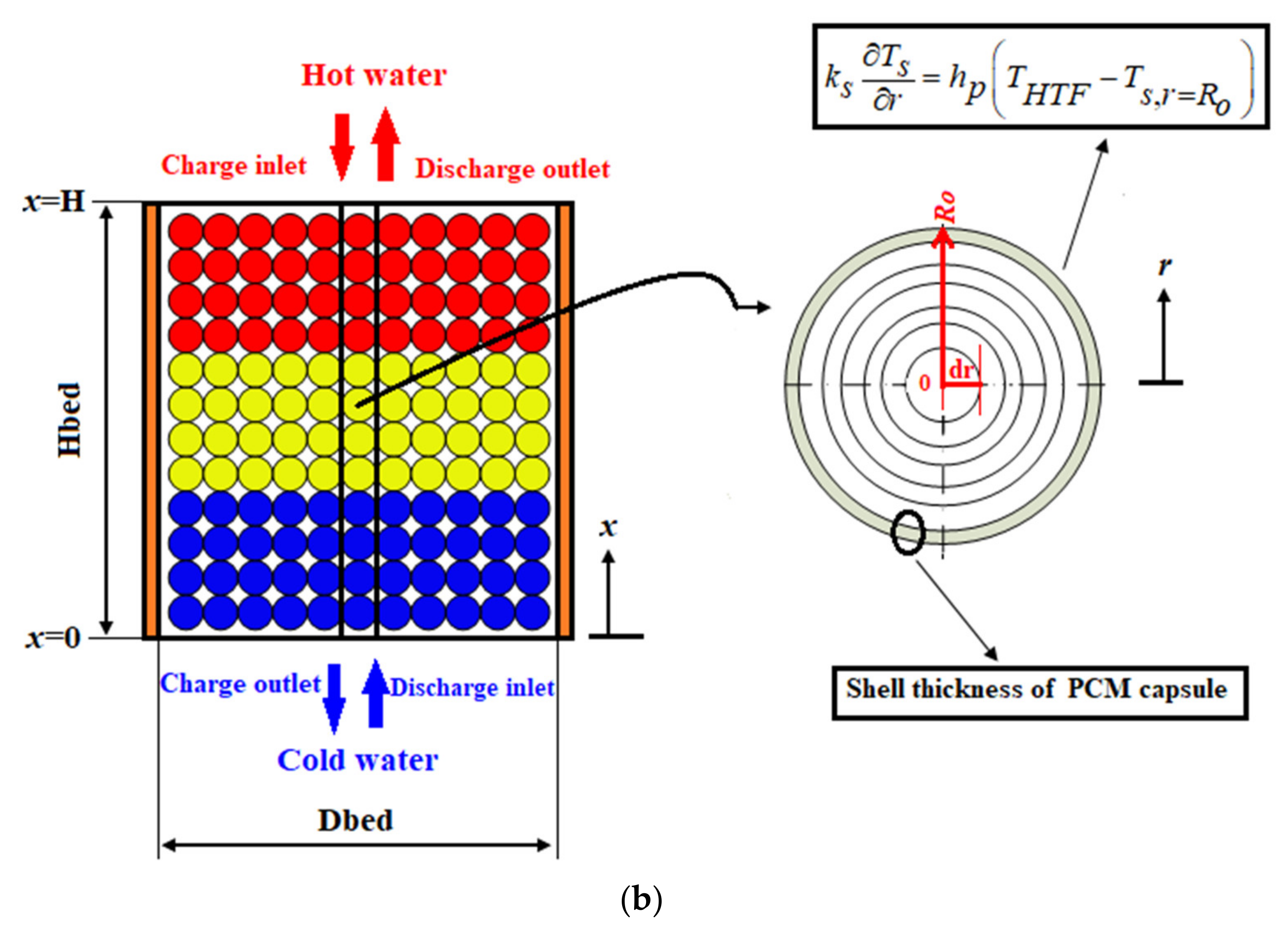
- The fluid flow of water exhibits dispersed plug flow [26].
- (2)
- All the PCM filler materials are spherical capsules with the same diameter treated as a homogenous and isotropic porous medium. Since the temperature variation in the radial direction of the tank is neglected.
- (3)
- The distributors (spiral nozzles) are not taken into consideration in the current numerical model.
- (4)
- The heat losses at the top and the bottom surfaces of the tank are neglected. The heat loss occurred by the heat exchange between HTF and tank wall is only considered.
- (5)
- The finalized shape of the numerical model domain is the cylindrical part only of 0.9 m height.
- (6)
- The thermo-physical properties of HTF are determined based on the inlet and exit temperature, Tave = (Tin + Tex)/2 [26], where Tave, is the average temperature, Tin is the inlet temperature of HTF, and Tex is the exit temperature of HTF.
- (7)
- Heat transfer by radiation is neglected.
- Energy balance equation for the HTF (water)
- Energy balance equation for the solid phase of PCM
- The initial and boundary conditions
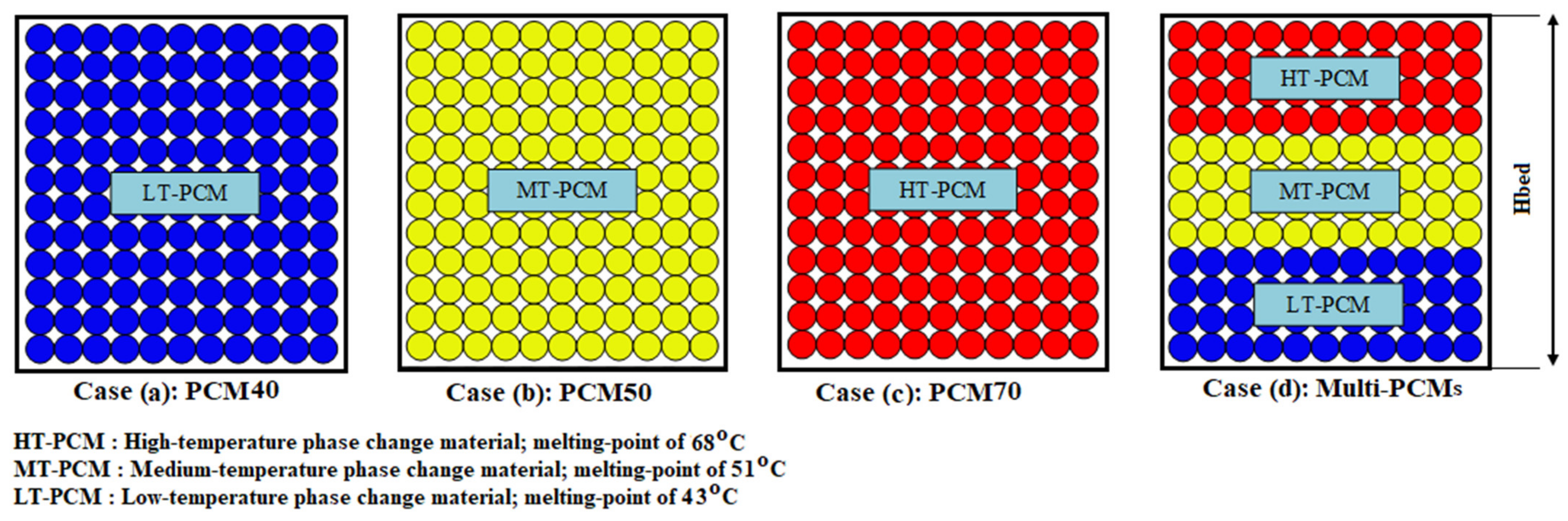
2.3. Material Properties of PCM Multi-Layer TES System
2.4. The Substantial Indicators for the Dynamic Performance Assessment
2.4.1. System Energy Efficiency
2.4.2. System Capacity and Total Utilization Ratios
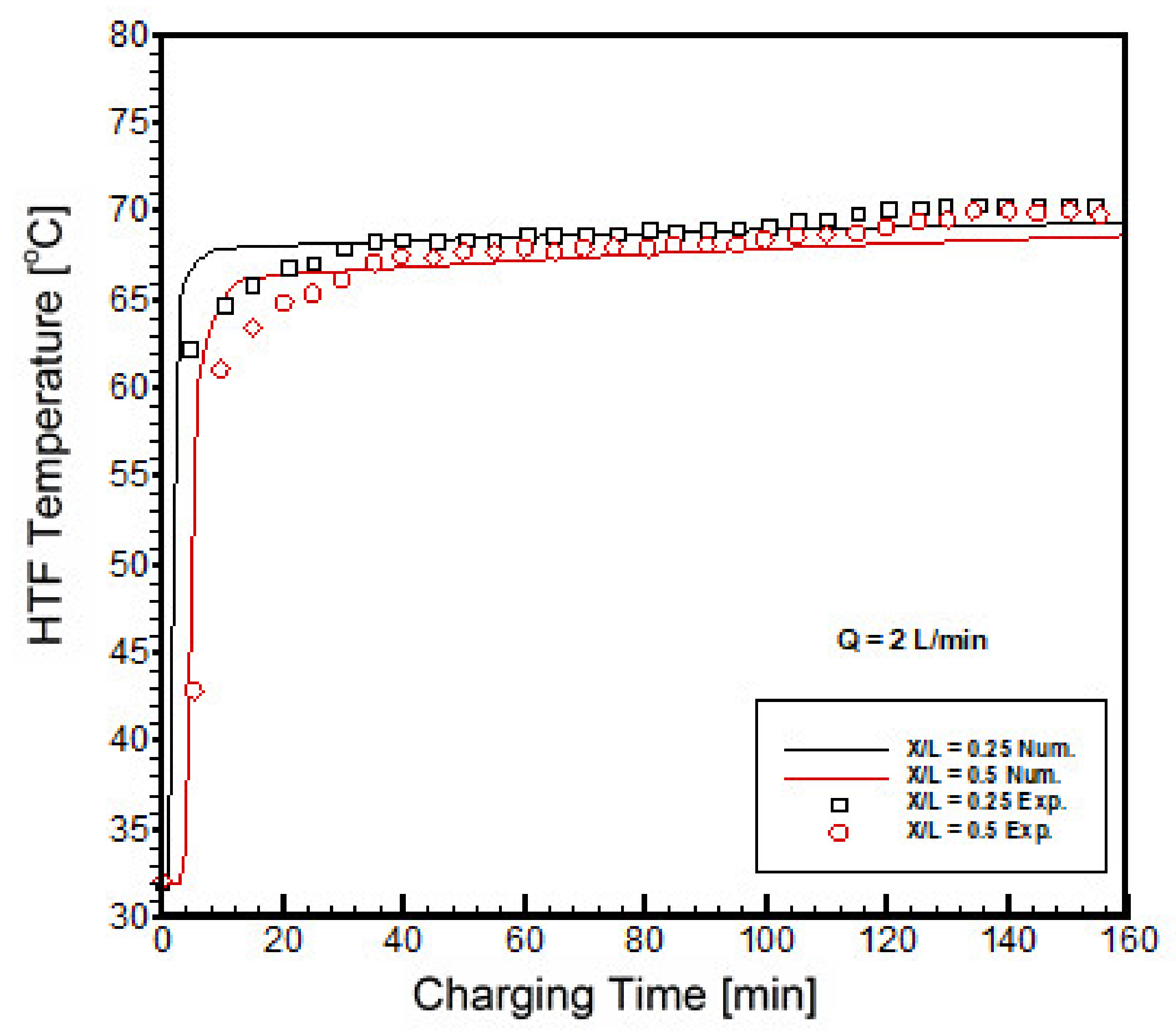
2.5. Numerical Approach and Model Validation
3. Results with Analysis
- (1)
- The volume fraction of PCMs packed in a tank. This parameter is addressed in a detailed description through a single charge/discharge and cyclic operation.
- (2)
- The inverse Stefan number during cyclic operation.
3.1. General Thermal Behavior Comparison of Single-PCM and Multi-PCM-TES Systems
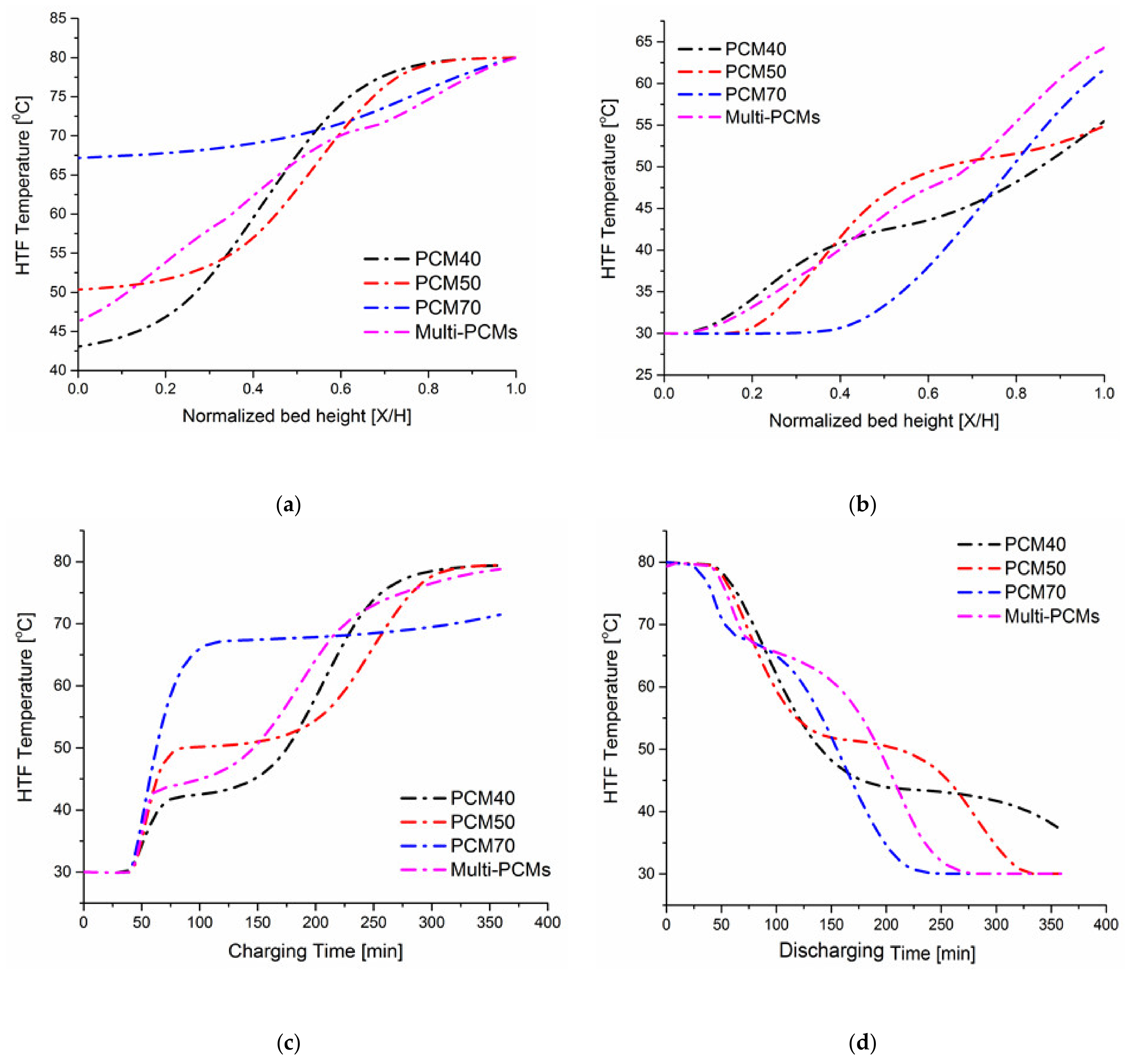
3.1.1. Comparison of Temperature Fields
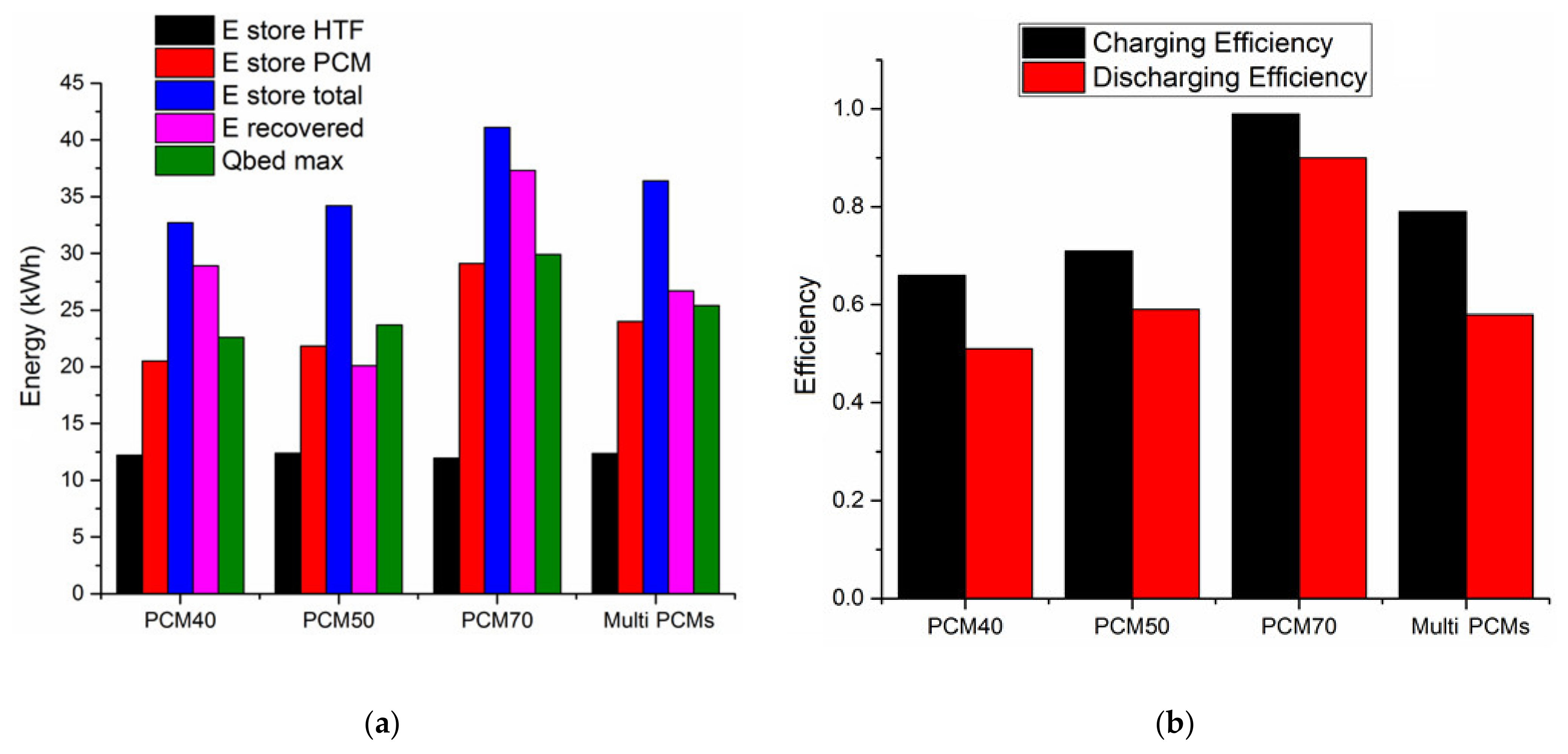
3.1.2. Comparison of Dynamic Performances
3.2. Effects of Volume Fraction of PCMs
3.2.1. Temperature Field and Dynamic Performance during Single Charge/Discharge Phase
3.2.2. Temperature Field and Dynamic Performance during Cyclic Operation
3.3. Effect of Inverse Stefan Number on the Multi-PCM-TES System
Temperature Field and Dynamic Performance under Cyclic Operation
4. Practical Significance and Usefulness
5. Conclusions
- (1)
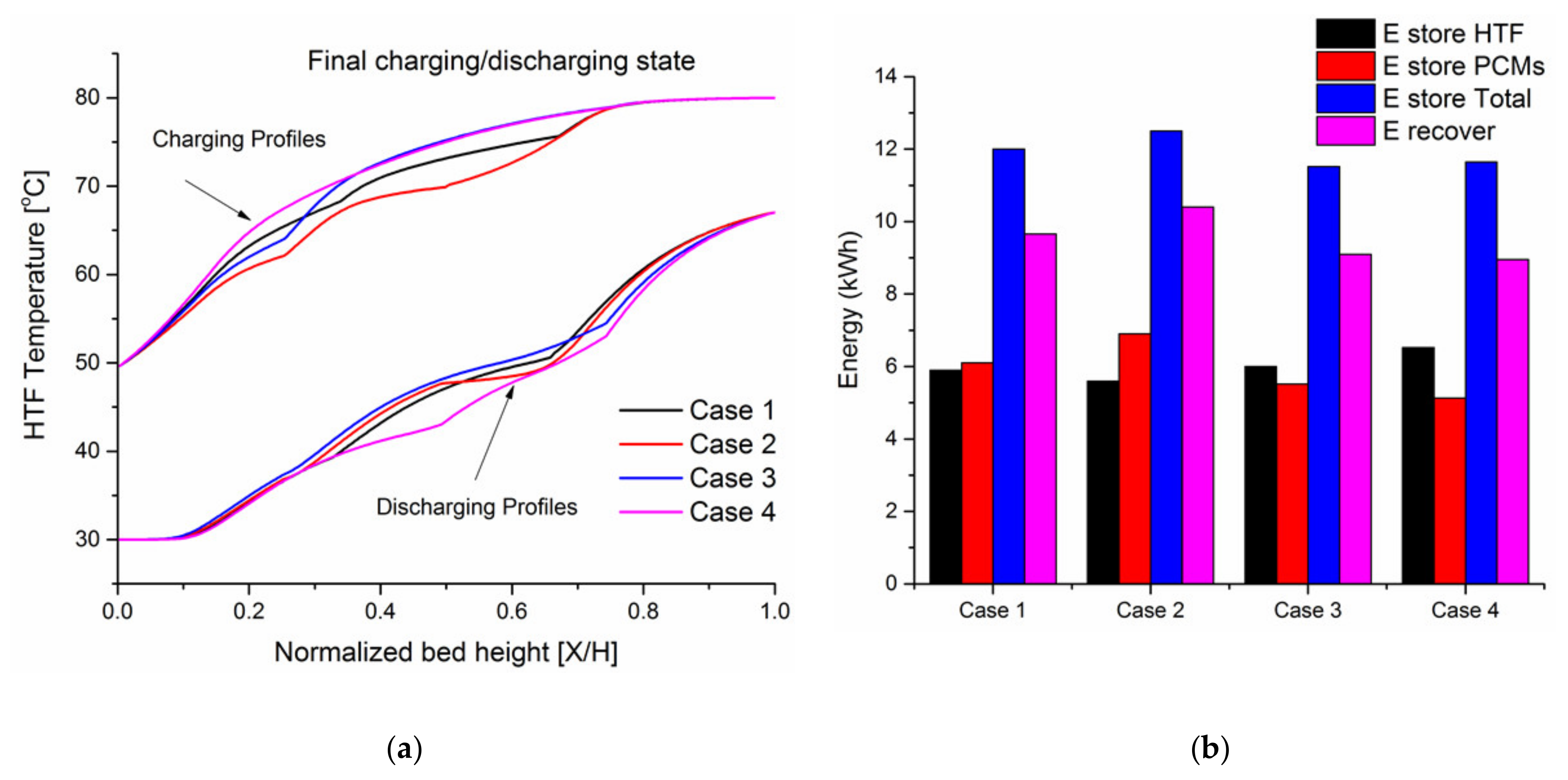
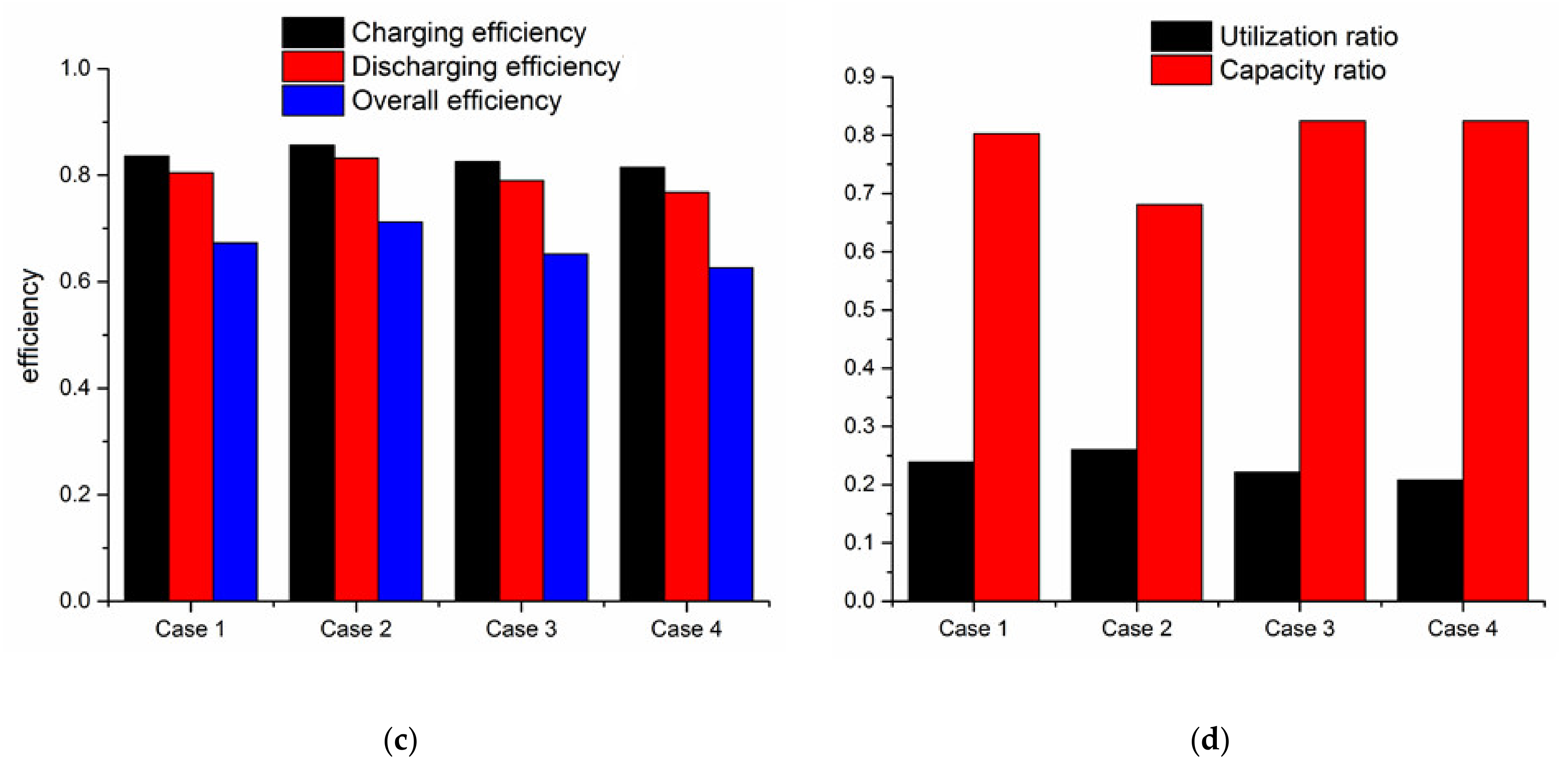
- During a single charge/discharge phase, the single-PCM70 system is the highest performance, followed by the multi-PCM system. Besides, the multi-PCM system shows an average dynamic performance compared to the three-single PCM systems.
- (2)
- The effects of PCMs volume fraction do not add any significant differences in the system performance when the multi-PCM system is operated in a single charge/discharge phase.
- (3)
- During cyclic operation, the higher the volume fraction of a PCM70 layer, the higher the heat storage and release periods and, therefore, the higher the energy storage and release.
- (4)
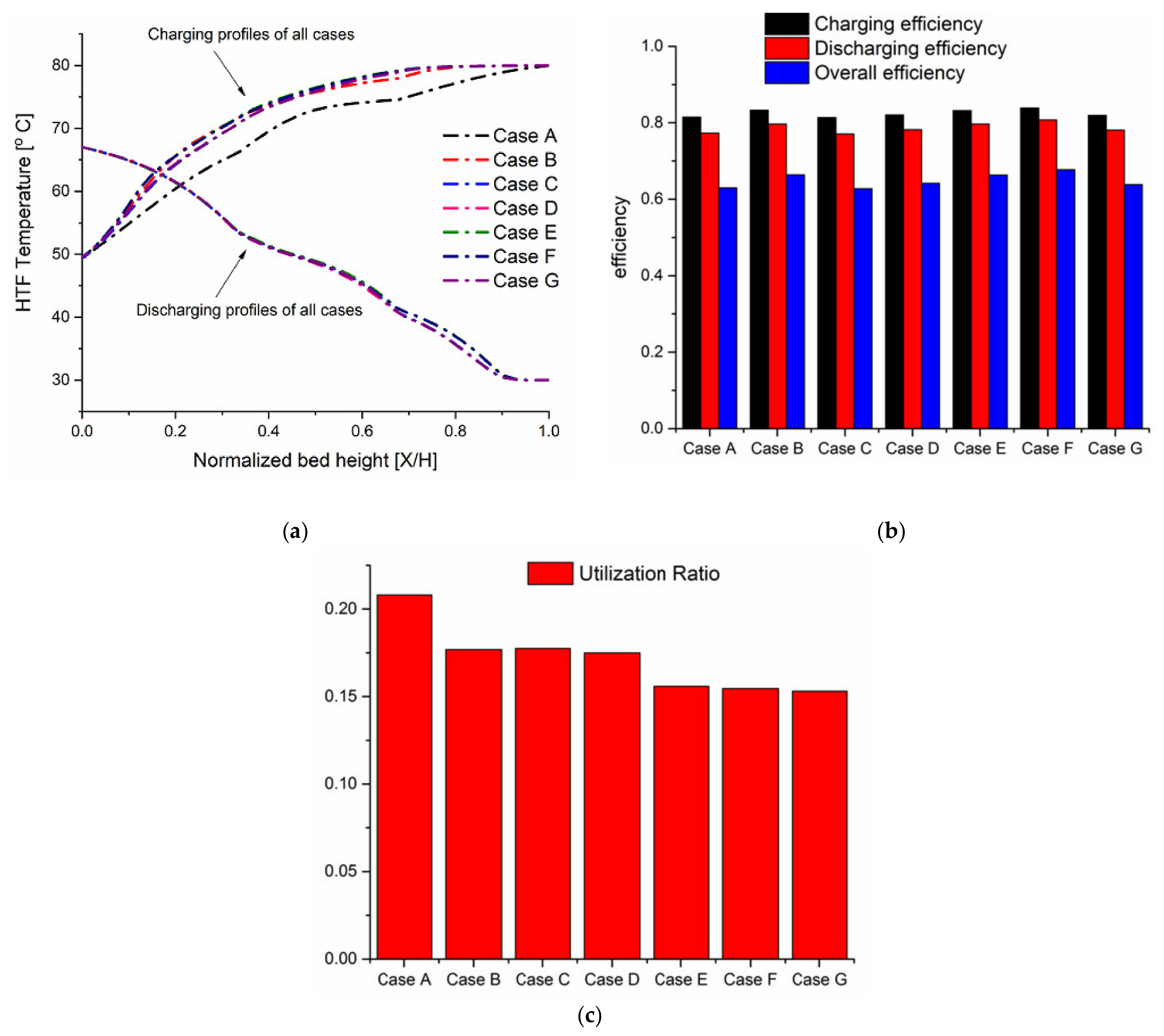
- The effect of the inverse Stefan number has a strong influence on the dynamic performance. The TES system in which the middle and bottom PCMs have a high inverse Stefan number exhibits the same dynamic performance. The scenario in which the middle PCM has lower latent heat is most beneficial in terms of system energy efficiency.
- (1)
- Due to the relatively low cost of both construction and operation of a water tank as well as the manufacturing of PCM capsules is very expensive. Besides, there are numerous technical issues in implementing encapsulation methods that can sustain thousands of thermal cycles. Hence, it is possible to propose a suitable packed-bed TES system pursuing economic and social benefits. The proposed system consists of a mixture of solid material and paraffin wax PCM capsules. The primary concept behind such arrangements is the use of high and low melting temperature PCM as filler material at the top and bottom of the tank close to the inlet/outlet ports while the solid filler is placed between the two PCM. The possible use of low-cost solid filler (quartzite rock or slag pebbles) with the high-cost PCM capsules reduces the capital cost of a TES system and to be more reliable for the heat-supply net.
- (2)
- Subsequent studies should focus on the feasibility and economic analyses of various volume fractions of PCM combined with solid filler within a thermocline tank to optimize the arrangement that achieves the highest performance with the lowest capital costs.
Author Contributions
Funding
Institutional Review Board Statement
Informed Consent Statement
Data Availability Statement
Acknowledgments
Conflicts of Interest
Nomenclature
| A | area, m2 |
| as | interfacial area density, 1/m |
| cp | specific heat at constant pressure, kJ/kg.K |
| CR | capacity ratio |
| D | diameter, m |
| Dp | particle size diameter, m |
| E | energy, J |
| EV | experimental value |
| H | height, m |
| InvSte | inverse Stefan number |
| hi | inner wall heat loss coefficient, W/m2.K |
| hp | particle convective heat transfer coefficient, W/m2.K |
| hv | volumetric heat transfer coefficient, W/m3.K |
| k | thermal conductivity, W/m.K |
| kHTF,eff | liquid effective thermal conductivity, W/m.K |
| Lfus | latent heat of fusion, kJ/kg |
| LF | liquid fraction |
| fluid mass flow rate, kg/s | |
| Nu | Nusselt number |
| Nx | nodes in the axial direction |
| Pr | Prandtl number |
| pressure drop across the bed, Pa | |
| Qbedmax | maximum storage capacity of the bed, J |
| Re | Reynolds number |
| Rx | nodes within each sphere |
| r | radial direction within a sphere |
| t | time, s |
| T | temperature, K |
| Tm | melting temperature, K |
| Tm1 | the peak temperature of PCM during solid-solid transition, K |
| Tm2 | the peak temperature of PCM during solid-liquid transition, K |
| TV | theoritical value |
| temperature differnce, K | |
| U | inlet fluid velocity, m/s |
| UW | overall heat transfer coefficient between the tank and the surroundings, W/m2.K |
| Vtank | volume of the tank, m3 |
| UR | total utilization ratio |
| X/H | normalized bed height |
| Greek symbols | |
| porosity of packed-bed region | |
| efficiency | |
| volumetric heat expansion coefficient of fluid, 1/K | |
| axial thermal diffusivity, m2/s | |
| density, kg/m3 | |
| dynamic viscosity, kg/m.s | |
| Subscripts | |
| ave | average |
| bed | packed-bed |
| ch | charging phase |
| disch | discharging phase |
| HTF | heat transfer fluid |
| in | inlet |
| ex | exit |
| inf | ambient |
| inp | input |
| j | index of insulation layer |
| l | liquid state of PCM |
| m | melting point |
| p | particle of PCM |
| pump | pumping |
| s | solid state of PCM |
References
- Sun, F.; Cheng, L.; Fu, L.; Gao, J. New low temperature industrial waste heat district heating system based on natural gas fired boilers with absorption heat exchangers. Appl. Therm. Eng. 2017, 125, 1437–1445. [Google Scholar] [CrossRef] [Scilit]
- Zhang, Y.; Tang, N.; Niu, Y.; Du, X. Wind energy rejection in China: Current status, reasons and perspectives. Renew. Sustain. Energy Rev. 2016, 66, 322–344. [Google Scholar] [CrossRef] [Scilit]
- Wang, H.; Yin, W.; Abdollahi, E.; Lahdelma, R.; Jiao, W. Modelling and optimization of CHP based district heating system with renewable energy production and energy storage. Appl. Energy 2015, 159, 401–421. [Google Scholar] [CrossRef] [Scilit]
- Xu, C.; Wang, Z.; He, Y.; Li, X.; Bai, F. Sensitivity analysis of the numerical study on the thermal performance of a packed-bed molten salt thermocline thermal storage system. Appl. Energy 2012, 92, 65–75. [Google Scholar] [CrossRef] [Scilit]
- Pacheco, J.E.; Showalter, S.K.; Kolb, W.J. Development of a molten-salt thermocline thermal storage system for parabolic trough plants. J. Sol. Energy Eng. Trans. ASME 2002, 124, 153–159. [Google Scholar] [CrossRef] [Scilit]
- He, Z.; Qian, Y.; Xu, C.; Yang, L.; Du, X. Static and dynamic thermocline evolution in the water thermocline storage tank. Energy Procedia 2019, 158, 4471–4476. [Google Scholar] [CrossRef] [Scilit]
- Karim, A.; Burnett, A.; Fawzia, S. Investigation of stratified thermal storage tank performance for heating and cooling applications. Energies 2018, 11, 1049. [Google Scholar] [CrossRef] [Scilit]
- Nelson, J.E.B.; Balakrishnan, A.R.; Murthy, S.S. Experiments on stratified chilled-water tanks. Int. J. Refrig. 1999, 22, 216–234. [Google Scholar] [CrossRef] [Scilit]
- Cabeza, L.F.; Ibáñez, M.; Solé, C.; Roca, J.; Nogués, M. Experimentation with a water tank including a PCM module. Sol. Energy Mater. Sol. Cells 2006, 90, 1273–1282. [Google Scholar] [CrossRef] [Scilit]
- Castell, A.; Solé, C.; Medrano, M.; Nogués, M.; Cabeza, L.F. Comparison of stratification in a water tank and a PCM-water tank. J. Sol. Energy Eng. Trans. ASME 2009, 131, 0245011–0245015. [Google Scholar] [CrossRef] [Scilit]
- Oró, E.; Castell, A.; Chiu, J.; Martin, V.; Cabeza, L.F. Stratification analysis in packed bed thermal energy storage systems. Appl. Energy 2013, 109, 476–487. [Google Scholar] [CrossRef] [Scilit]
- Xia, L.; Zhang, P.; Wang, R.Z. Numerical heat transfer analysis of the packed bed latent heat storage system based on an effective packed bed model. Energy 2010, 35, 2022–2032. [Google Scholar] [CrossRef] [Scilit]
- Zhao, W.; Neti, S.; Oztekin, A. Heat transfer analysis of encapsulated phase change materials. Appl. Therm. Eng. 2013, 50, 143–151. [Google Scholar] [CrossRef] [Scilit]
- Nallusamy, N.; Sampath, S.; Velraj, R. Experimental investigation on a combined sensible and latent heat storage system integrated with constant/varying (solar) heat sources. Renew. Energy 2007, 32, 1206–1227. [Google Scholar] [CrossRef] [Scilit]
- He, Z.; Wang, X.; Du, X.; Amjad, M.; Yang, L.; Xu, C. Experiments on comparative performance of water thermocline storage tank with and without encapsulated paraffin wax packed bed. Appl. Therm. Eng. 2019, 147, 188–197. [Google Scholar] [CrossRef] [Scilit]
- Wu, S.; Fang, G.; Liu, X. Dynamic discharging characteristics simulation on solar heat storage system with spherical capsules using paraffin as heat storage material. Renew. Energy 2011, 36, 1190–1195. [Google Scholar] [CrossRef] [Scilit]
- He, Z.; Wang, X.; Du, X.; Xu, C.; Yang, L. Cyclic characteristics of water thermocline storage tank with encapsulated PCM packed bed. Int. J. Heat Mass Transf. 2019, 139, 1077–1086. [Google Scholar] [CrossRef] [Scilit]
- Du, X.; He, Z.; Wang, X.; Xu, C.; Yang, L. Unsteady characteristics of water thermocline storage tank with encapsulated paraffin wax packed bed. In Proceedings of the International Heat Transfer Conference, Beijing, China, 10–15 August 2018; pp. 4287–4294. [Google Scholar]
- Domański, R.; Fellah, G. Exergy analysis for the evaluation of a thermal storage system employing PCMS with different melting temperatures. Appl. Therm. Eng. 1996, 16, 907–919. [Google Scholar] [CrossRef] [Scilit]
- Nkwetta, D.N.; Vouillamoz, P.E.; Haghighat, F.; El-Mankibi, M.; Moreau, A.; Daoud, A. Impact of phase change materials types and positioning on hot water tank thermal performance: Using measured water demand profile. Appl. Therm. Eng. 2014, 67, 460–468. [Google Scholar] [CrossRef] [Scilit]
- Gong, Z.X.; Mujumdar, A.S. Thermodynamic optimization of the thermal process in energy storage using multiple phase change materials. Appl. Therm. Eng. 1997, 17, 1067–1083. [Google Scholar] [CrossRef] [Scilit]
- Kousksou, T.; Strub, F.; Lasvignottes, J.C.; Jamil, A.; Bédécarrats, J.P. Second law analysis of latent thermal storage for solar system. Sol. Energy Mater. Sol. Cells 2007, 91, 1275–1281. [Google Scholar] [CrossRef] [Scilit]
- Aldoss, T.K.; Rahman, M.M. Comparison between the single-PCM and multi-PCM thermal energy storage design. Energy Convers. Manag. 2014, 83, 79–87. [Google Scholar] [CrossRef] [Scilit]
- ELSihy, E.S.; Wang, X.; Xu, C.; Du, X. Investigation on Simultaneous Charging and Discharging Process of Water Thermocline Storage Tank Employed in Combined Heat and Power Units. J. Energy Resour. Technol. 2020, 143. [Google Scholar] [CrossRef] [Scilit]
- de Gracia, A.; Cabeza, L.F. Numerical simulation of a PCM packed bed system: A review. Renew. Sustain. Energy Rev. 2017, 69, 1055–1063. [Google Scholar] [CrossRef] [Scilit]
- Leiva, L. Heat and Mass Transfer in Packed Beds. pages. AICHE J. 1983, 29, 1055. [Google Scholar] [CrossRef] [Scilit]
- Wakao, N.; Kaguei, S.; Funazkri, T. Effect of fluid dispersion coefficients on particle-to-fluid heat transfer coefficients in packed beds. Correlation of nusselt numbers. Chem. Eng. Sci. 1979, 34, 325–336. [Google Scholar] [CrossRef] [Scilit]
- Abdulla, A.; Reddy, K.S. Effect of operating parameters on thermal performance of molten salt packed-bed thermocline thermal energy storage system for concentrating solar power plants. Int. J. Therm. Sci. 2017, 121, 30–44. [Google Scholar] [CrossRef] [Scilit]
- Hänchen, M.; Brückner, S.; Steinfeld, A. High-temperature thermal storage using a packed bed of rocks—Heat transfer analysis and experimental validation. Appl. Therm. Eng. 2011, 31, 1798–1806. [Google Scholar] [CrossRef] [Scilit]
- Beek, J. Design of Packed Catalytic Reactors. Advances in Chemical Engineering; Elsevier: Amsterdam, The Netherlands, 1962; pp. 203–271. [Google Scholar]
- Gonzo, E.E. Estimating correlations for the effective thermal conductivity of granular materials. Chem. Eng. J. 2002, 90, 299–302. [Google Scholar] [CrossRef] [Scilit]
- Gunarathne, D.S.; Chmielewski, J.K.; Yang, W. Pressure drop prediction of a gasifier bed with cylindrical biomass pellets. Appl. Energy 2014, 113, 258–266. [Google Scholar] [CrossRef] [Scilit]
- Elfeky, K.E.; Mohammed, A.G.; Ahmed, N.; Lu, L.; Wang, Q. Thermal and economic evaluation of phase change material volume fraction for thermocline tank used in concentrating solar power plants. Appl. Energy 2020, 267. [Google Scholar] [CrossRef] [Scilit]
- Bellan, S.; Alam, T.E.; González-Aguilar, J.; Romero, M.; Rahman, M.M.; Goswami, D.Y.; Stefanakos, E.K. Numerical and experimental studies on heat transfer characteristics of thermal energy storage system packed with molten salt PCM capsules. Appl. Therm. Eng. 2015, 90, 970–979. [Google Scholar] [CrossRef] [Scilit]
- Jegadheeswaran, S.; Pohekar, S.D.; Kousksou, T. Exergy based performance evaluation of latent heat thermal storage system: A review. Renew. Sustain. Energy Rev. 2010, 14, X2580–X2595. [Google Scholar] [CrossRef] [Scilit]




| Simulation Parameters | Value |
|---|---|
| Height of the tank | 0.9 m |
| Diameter of the tank | 0.9 m |
| Volume of the tank | 0.57255 m3 |
| Tank wall thickness (stainless steel) | 0.006 m |
| Outer insulation layer thickness (asbestos) | 0.035 m |
| Tank wall thermal conductivity | 15.3 W/m.K |
| Insulation layer thermal conductivity | 0.034 W/m.K |
| Number of PCM capsules | 9170 |
| Outer diameter of PCM capsule | 0.042 m |
| Ambient temperature | 15 |
| Shell thickness of PCM capsule | 0.5 mm |
| Bed porosity | 0.379 |
| Bed volume | 0.356 m3 |
| Volume of confined HTF | 0.217 m3 |
| PCM shell specific heat | 500 J/kg.K |
| PCM shell thermal conductivity | 15.3 W/m.K |
| PCM shell density | 7930 kg/m3 |
| Heat transfer fluid (HTF) | water |
| Operating temperature range of HTF | 80/30 |
| Volume flow rate of HTF | 0.3 m3/h |
| Nodes in the axial direction (Nx) | 296 |
| Nodes within each sphere (Rx) | 30 |
| Property | PCM40 [23] | PCM50 [23] | PCM70 [17] |
|---|---|---|---|
| Solid density, kg/m3 | 844 | 848 | 838 |
| Liquid density, Kg/m3 | 760 | 767 | 834 |
| Solid specific heat at constant pressure, J/kg.K | 2052 | 1650 | 2150 |
| Liquid specific heat at constant pressure, J/kg.K | 2411 | 1863 | 2190 |
| Solid thermal conductivity, W/m.K | 0.4 | 0.4 | 0.21 |
| Liquid thermal conductivity, W/m.K | 0.15 | 0.15 | 0.21 |
| Latent heat of fusion, kJ/kg | 168 | 200 | 254 |
| Melting temperature, | 43 | 51 | 68 |
| Case No. | Top Layer, PCM70 | Middle Layer, PCM50 | Bottom Layer, PCM40 |
|---|---|---|---|
| 1 | VF = (H/3) | VF = (H/3) | VF = (H/3) |
| 2 | VF =(H/2) | VF = (H/4) | VF = (H/4) |
| 3 | VF = (H/4) | VF = (H/2) | VF = (H/4) |
| 4 | VF = (H/4) | VF= (H/4) | VF= (H/2) |
| Case No. | Top PCM70 | Middle PCM50 | Bottom PCM40 |
|---|---|---|---|
| A | InvSte = 2.34 | InvSte = 2.28 | InvSte = 1.51 |
| B | InvSte = 2.34 | InvSte = 2.28 | InvSte = 3.02 |
| C | InvSte = 2.34 | InvSte = 4.56 | InvSte = 1.51 |
| D | InvSte = 4.68 | InvSte = 2.28 | InvSte = 1.51 |
| E | InvSte = 2.34 | InvSte = 4.56 | InvSte = 3.02 |
| F | InvSte = 4.68 | InvSte = 2.28 | InvSte = 3.02 |
| G | InvSte = 4.68 | InvSte = 4.56 | InvSte = 1.51 |
Publisher’s Note: MDPI stays neutral with regard to jurisdictional claims in published maps and institutional affiliations. |
© 2021 by the authors. Licensee MDPI, Basel, Switzerland. This article is an open access article distributed under the terms and conditions of the Creative Commons Attribution (CC BY) license (https://creativecommons.org/licenses/by/4.0/).
Share and Cite
Guo, H.; ELSihy, E.S.; Liao, Z.; Du, X. A Comparative Study on the Performance of Single and Multi-Layer Encapsulated Phase Change Material Packed-Bed Thermocline Tanks. Energies 2021, 14, 2175. https://doi.org/10.3390/en14082175
Guo H, ELSihy ES, Liao Z, Du X. A Comparative Study on the Performance of Single and Multi-Layer Encapsulated Phase Change Material Packed-Bed Thermocline Tanks. Energies. 2021; 14(8):2175. https://doi.org/10.3390/en14082175
Chicago/Turabian StyleGuo, Huiqian, ELSaeed Saad ELSihy, Zhirong Liao, and Xiaoze Du. 2021. "A Comparative Study on the Performance of Single and Multi-Layer Encapsulated Phase Change Material Packed-Bed Thermocline Tanks" Energies 14, no. 8: 2175. https://doi.org/10.3390/en14082175
APA StyleGuo, H., ELSihy, E. S., Liao, Z., & Du, X. (2021). A Comparative Study on the Performance of Single and Multi-Layer Encapsulated Phase Change Material Packed-Bed Thermocline Tanks. Energies, 14(8), 2175. https://doi.org/10.3390/en14082175