Article

Roof Color-Based Warm Roof Evaluation in Cold Regions Using a UAV Mounted Thermal Infrared Imaging Camera


1
Department of Spatial Information, Kyungpook National University, Daegu 41566, Korea
2
Korea Land and Geospatial Informatix Corporation, Andong 36691, Korea
3
Department of Convergence and Fusion System Engineering, Kyungpook National University, Sangju 37224, Korea
*
Author to whom correspondence should be addressed.
Energies 2021, 14(20), 6488; https://doi.org/10.3390/en14206488
Submission received: 9 September 2021 / Revised: 6 October 2021 / Accepted: 7 October 2021 / Published: 10 October 2021
(This article belongs to the Special Issue Building, District, and Community Energy Systems Optimization)

Abstract

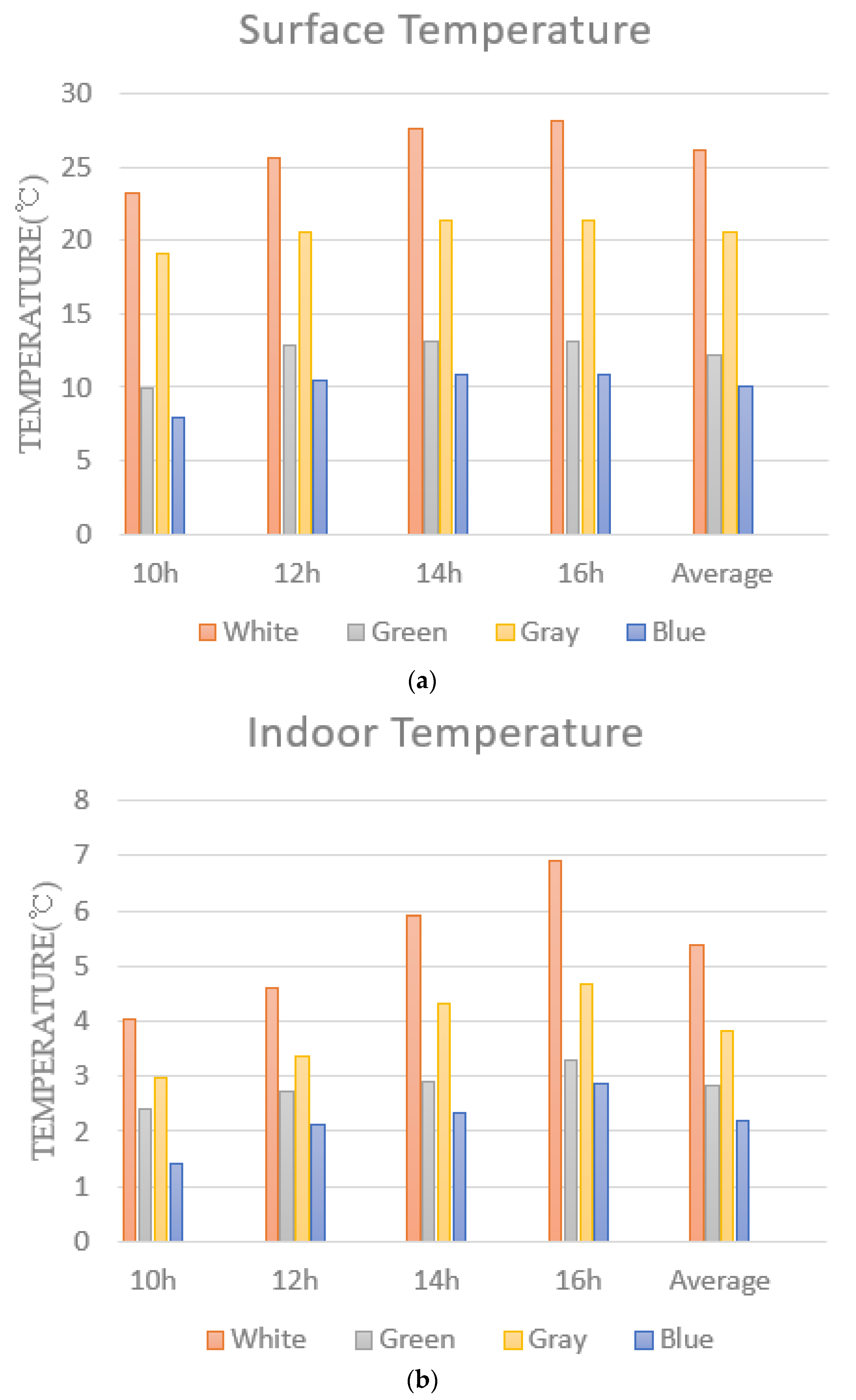
Existing studies on reducing urban heat island phenomenon and building temperature have been actively conducted; however, studies on investigating the warm roof phenomenon to in-crease the temperature of buildings are insufficient. A cool roof is required in a high-temperature region, while a warm roof is needed in a low-temperature or cold region. Therefore, a warm roof evaluation was conducted in this study using the roof color (black, blue, green, gray, and white), which is relatively easier to install and maintain compared to conventional insulation materials and double walls. A remote sensing method via an unmanned aerial vehicle (UAV)-mounted thermal infrared (TIR) camera was employed. For warm roof evaluation, the accuracy of the TIR camera was verified by comparing it with a laser thermometer, and the correlation between the surface temperature and the room temperature was also confirmed using Pearson correlation. The results showed significant surface temperature differences ranging from 8 °C to 28 °C between the black-colored roof and the other colored roofs and indoor temperature differences from 1 °C to 7 °C. Through this study, it was possible to know the most effective color for a warm roof according to the color differences. This study gave us an idea of which color would work best for a warm roof, as well as the temperature differences from other colors. We believe that the results of this study will be helpful in heating load research, providing an objective basis for determining whether a warm roof is applied.
Keywords: UAV; warm roof; thermal infrared images; surface temperature; indoor temperature UAV; warm roof; thermal infrared images; surface temperature; indoor temperature