Article

On the Emergence of Sociotechnical Regimes of Electric Urban Water Transit Systems

Division of Regional Development, Faculty of Social Sciences, University of Gdańsk, 80-309 Gdańsk, Poland
Energies 2021, 14(19), 6111; https://doi.org/10.3390/en14196111
Submission received: 31 July 2021 / Revised: 7 September 2021 / Accepted: 22 September 2021 / Published: 25 September 2021
(This article belongs to the Special Issue Regional Economic Adaptability and Sustainability Transition)

Abstract

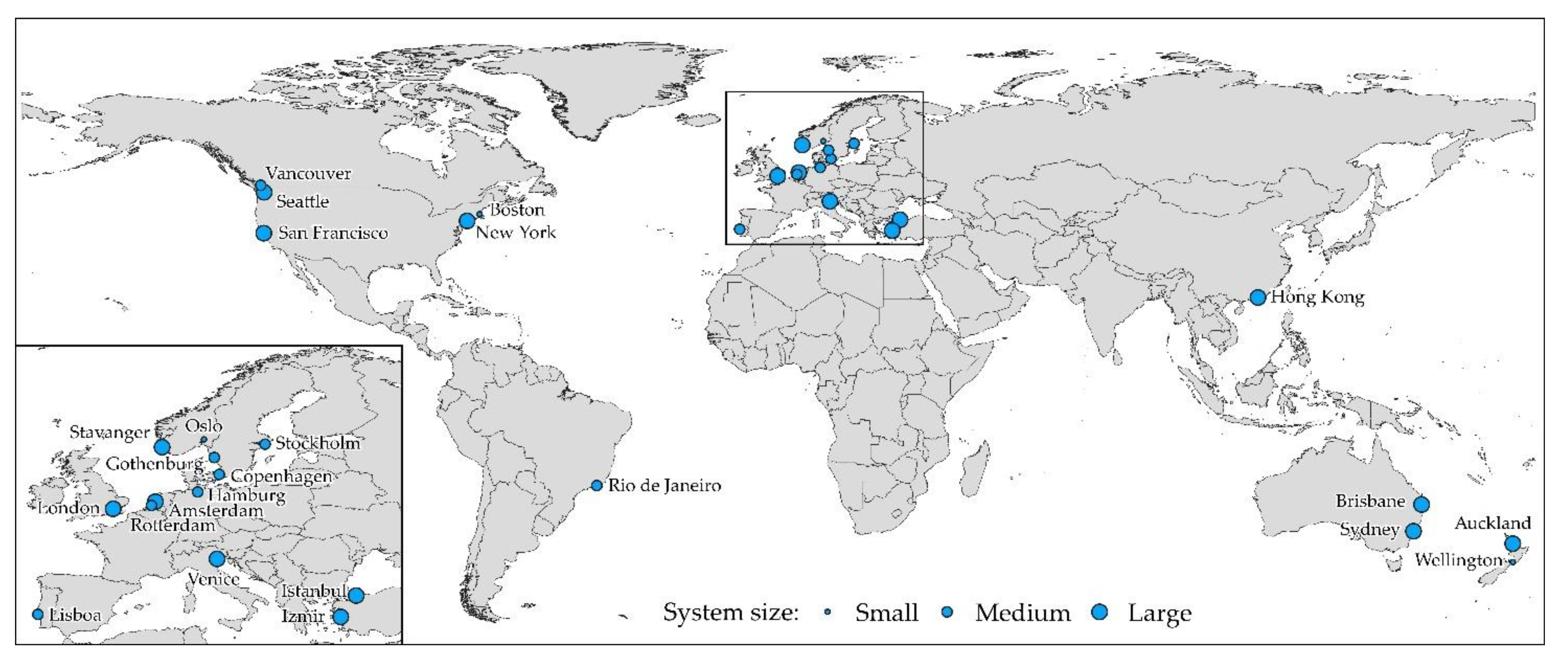
Urban activities, including urban mobility, play a crucial role in climate change mitigation. Urban mobility is currently at a crossroads. In a business as usual scenario, CO2 emissions from urban transportation will grow by one fourth by 2050. Nevertheless, during this period, it may drop by about one third. To make the drop happen, we need to introduce comprehensive policies and measures. Electrifying urban transit is one feasible solution. This study investigates whether and how urban water transit systems have been electrified—a means of transport which has not been well researched in this respect. A multilevel perspective and the comparative case study method were employed to answer the research questions. The comprehensive study focussed on 24 cities representing the current experience in planning and operating water transport, based mainly on secondary, primarily qualitative, data, such as industry reports, feasibility studies, urban policies, and scientific papers. The primary outcome is that urban electric passenger ferries left their market niches and triggered a radical innovation, diffusing into mainstream markets. However, urban diversity results in various paths to electrification, due to the system’s physical characteristics, local climate and transport policies, manufacturing capacity, green city branding, and the innovativeness of international ferry operators. Three dominant transition pathways were identified—a comprehensive carbon neutral policy, a transport sector policy, and a research and development policy. From a multilevel perspective, cities can be considered a bridge between niches and regimes that provide the actual conditions for implementing sociotechnical configurations.
Keywords: transport electrification; urban transit system; sociotechnical regime; electric ferry; hybrid diesel–electric ferry; carbon neutrality transport electrification; urban transit system; sociotechnical regime; electric ferry; hybrid diesel–electric ferry; carbon neutrality