Article

Multivariate Features Extraction and Effective Decision Making Using Machine Learning Approaches


1
Electrical Engineering Department, Laboratory of Automatic Signal and Image Processing, National Higher Engineering School of Tunis, University of Tunis, Avenue Taha Hussein Montfleury, 1008 Tunis, Tunisia
2
Electrical and Computer Engineering Program, Texas A&M University at Qatar, P.O. Box 23874, Education City, 77874 Doha, Qatar
3
Laboratory of Automatic Signal and Image Processing, National Engineering School of Monastir, University of Monastir, 5019 Monastir, Tunisia
*
Author to whom correspondence should be addressed.
Energies 2020, 13(3), 609; https://doi.org/10.3390/en13030609
Submission received: 28 November 2019 / Revised: 16 January 2020 / Accepted: 21 January 2020 / Published: 31 January 2020

Abstract

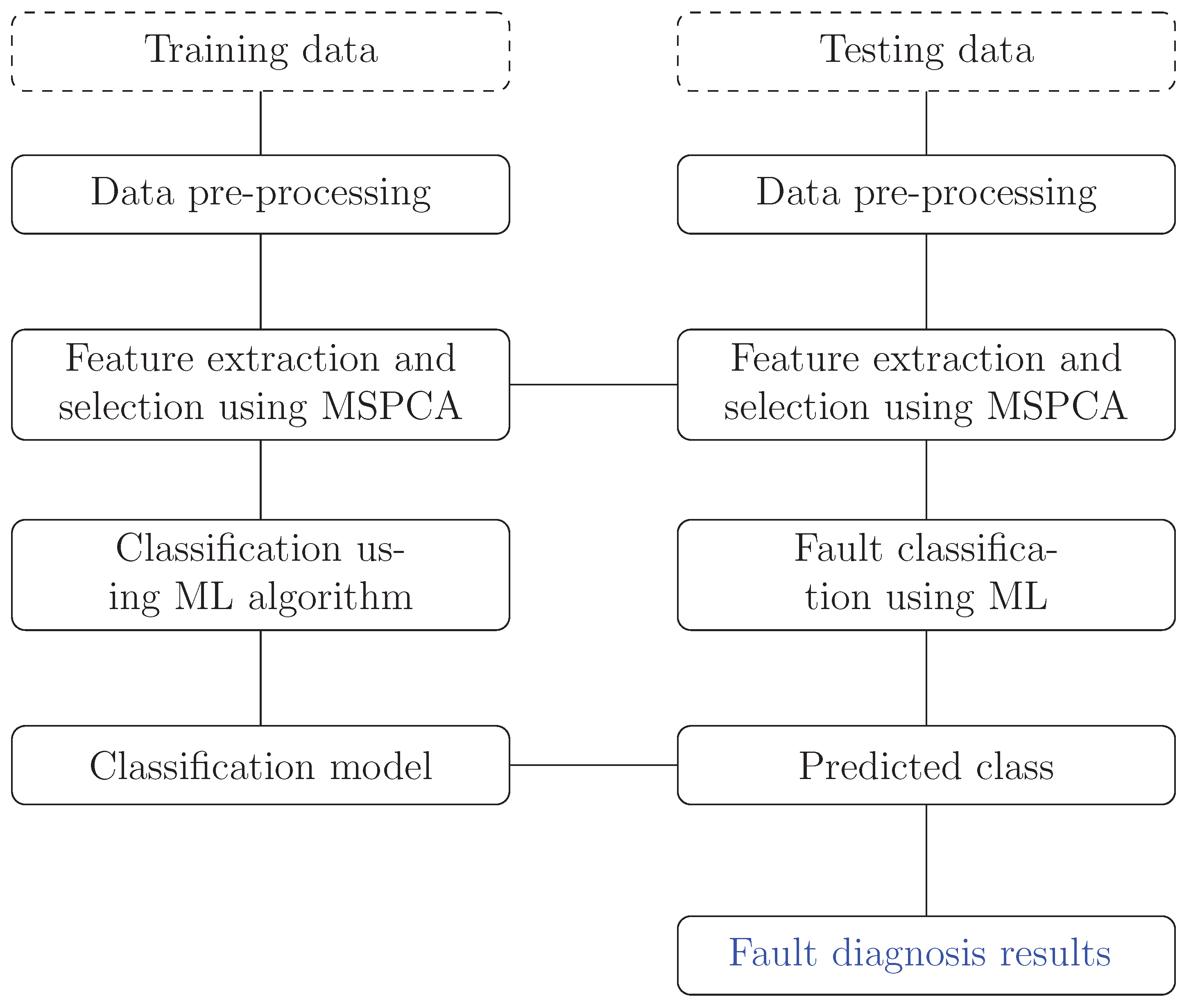
Fault Detection and Isolation (FDI) in Heating, Ventilation, and Air Conditioning (HVAC) systems is an important approach to guarantee the human safety of these systems. Therefore, the implementation of a FDI framework is required to reduce the energy needs for buildings and improving indoor environment quality. The main goal of this paper is to merge the benefits of multiscale representation, Principal Component Analysis (PCA), and Machine Learning (ML) classifiers to improve the efficiency of the detection and isolation of Air Conditioning (AC) systems. First, the multivariate statistical features extraction and selection is achieved using the PCA method. Then, the multiscale representation is applied to separate feature from noise and approximately decorrelate autocorrelation between available measurements. Third, the extracted and selected features are introduced to several machine learning classifiers for fault classification purposes. The effectiveness and higher classification accuracy of the developed Multiscale PCA (MSPCA)-based ML technique is demonstrated using two examples: synthetic data and simulated data extracted from Air Conditioning systems.
Keywords: machine learning (ML); principal component analysis (PCA); air conditioning systems; feature extraction; fault detection; fault classification machine learning (ML); principal component analysis (PCA); air conditioning systems; feature extraction; fault detection; fault classification