Article

Effects of Building Energy Efficiency Measures on Air Quality at the Neighborhood Level in Athens, Greece †

Laboratory for Innovative Environmental Technologies, School of Mechanical Engineering, National Technical University of Athens, Heroon Polytechniou 9, 15780 Athens, Greece
*
Author to whom correspondence should be addressed.
This paper is an extended version of our paper presented at SBE19-Thessaloniki Conference, Thessaloniki, Greece, 23–25 October 2019 and published in IOP Conf. Ser.: Earth Environ. Sci. 410 012002, 2020.
Energies 2020, 13(21), 5689; https://doi.org/10.3390/en13215689
Submission received: 30 September 2020 / Revised: 21 October 2020 / Accepted: 26 October 2020 / Published: 30 October 2020
(This article belongs to the Special Issue Novel Systems for the Era of Zero-Energy Buildings)

Abstract

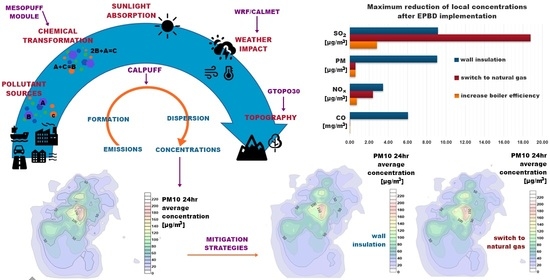
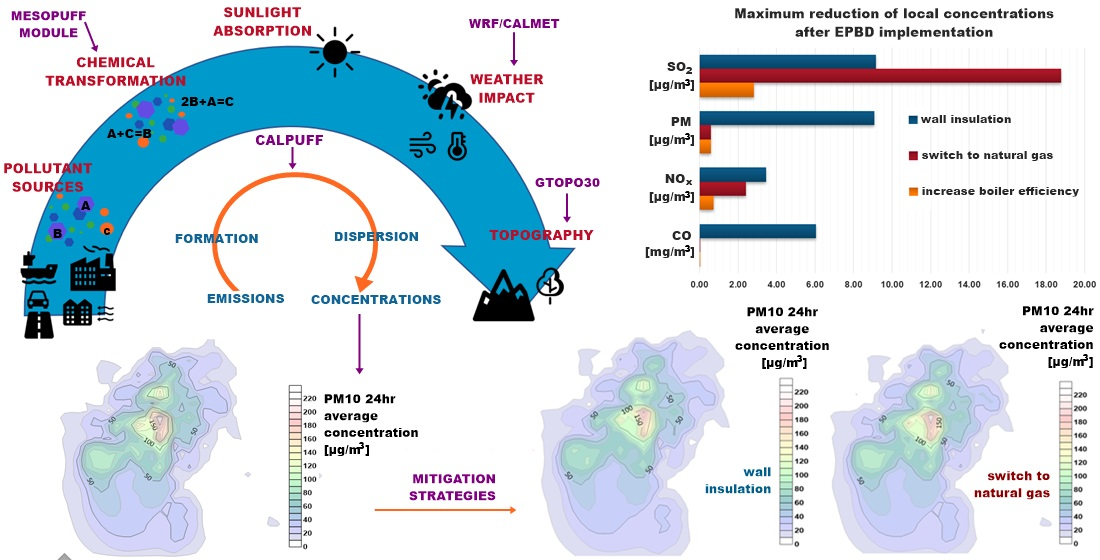
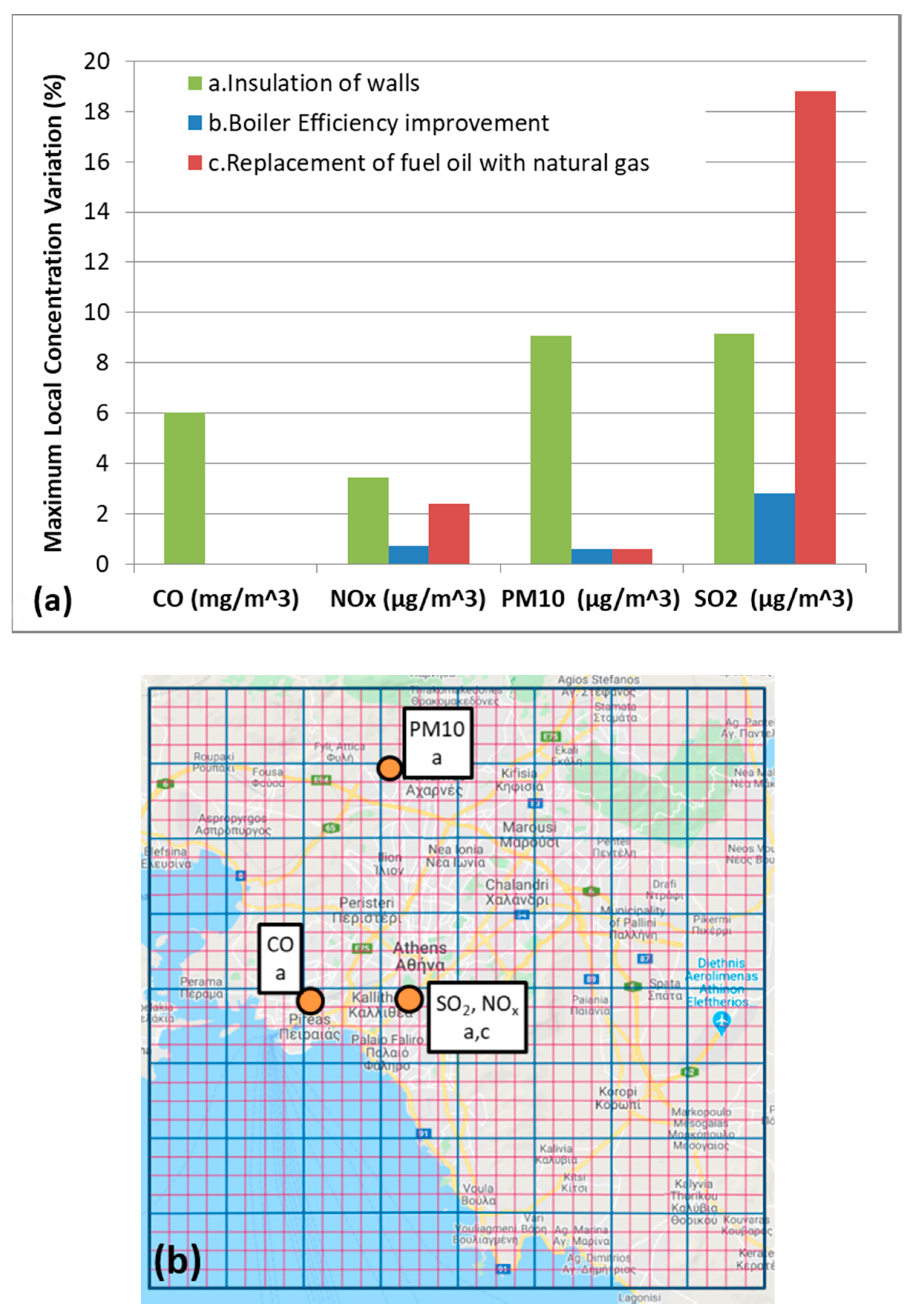
The high concentration of pollutant sources, complex topography, and regional meteorology are all factors that may contribute to air episodes in dense urban areas. Energy use in buildings is a significant source of pollution in the Greater Athens Area (GAA), Greece, where over 90% of the existing building stock has been classified below energy class B. The present study focuses on the potential effects that a realistic level of building energy efficiency upgrades will have on the air quality over the GAA. Results are expected to be relevant to similar urban areas. Furthermore, the study of primary pollutants’ dispersion is applied at a 1.2 × 1.2 km spatial resolution, providing significant local (neighborhood) level information. Numerical simulations were performed using EPA’s CALPUFF modeling system with wind field input from an independent numerical weather prediction using NCAR’s Weather Research and Forecasting (WRF) model. In order to calculate emission rates from major roads, highways, shipping ports, residential heating installations, and major industrial facilities, data were taken from National and European statistics, demographics, and local topography. After validation, the modeling system was used to examine three building energy efficiency upgrade scenarios, implemented on 20% of the buildings. Ground level concentrations of SO2, NOx, CO, and PM10 were calculated and reductions of up to 9% were found for GAA maximum values but up to 18% for local values that were also close to or above the European safety thresholds.
Keywords: urban air quality; building energy efficiency; mesoscale pollutant dispersion simulation; numerical weather prediction urban air quality; building energy efficiency; mesoscale pollutant dispersion simulation; numerical weather prediction
Graphical Abstract