A Semi-Analytical Method for Three-Dimensional Heat Transfer in Multi-Fracture Enhanced Geothermal Systems

Abstract
1. Introduction
2. Materials and Methods
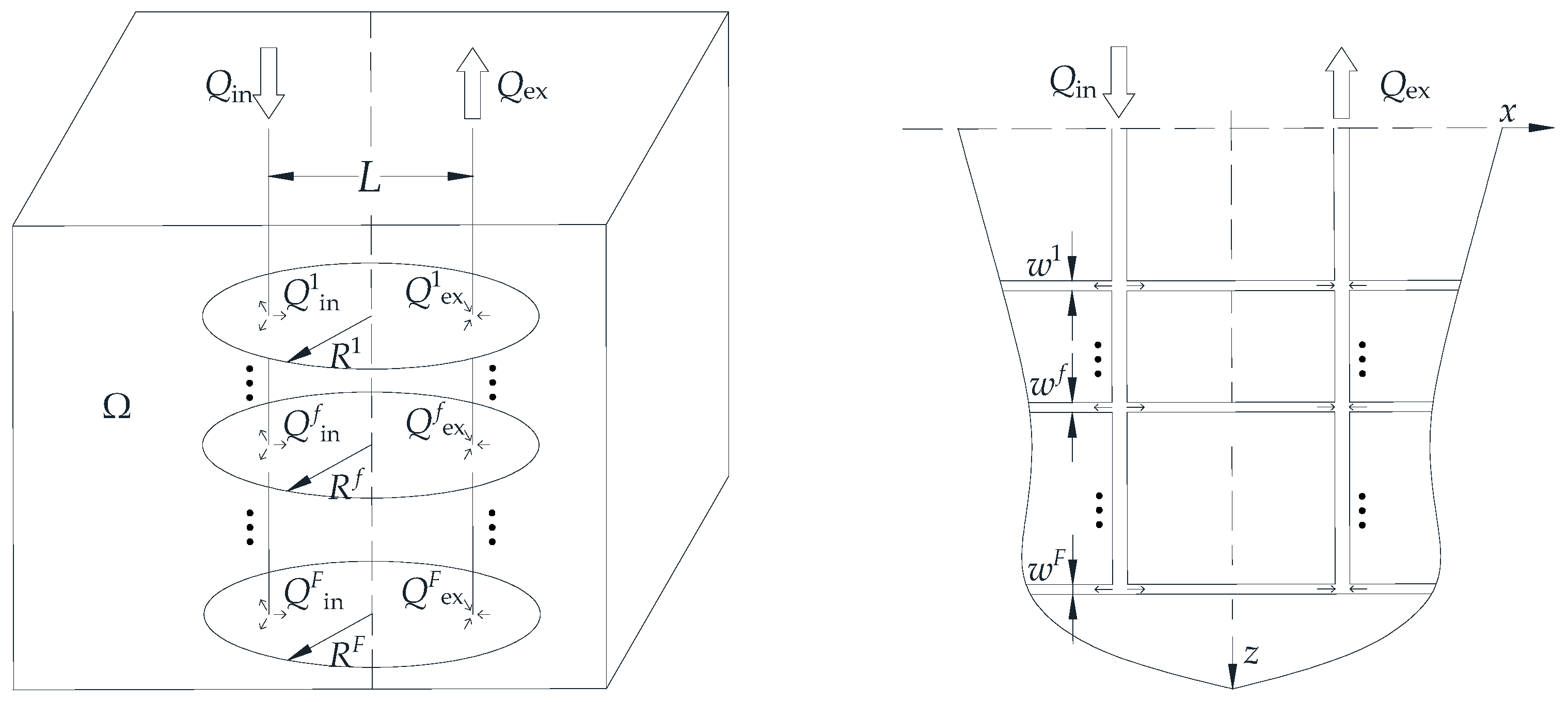
- The fracture water is incompressible, and the rock matrix is impermeable and homogenous.
- The thermal properties of the rock matrix and fracture water are independent of temperature variation.
- The aperture of the fractures remains uniform and invariant without considering the deformation induced by hydro-mechanical coupling or thermo-mechanical interaction. Due to the fact that the fracture aperture is relatively small compared to the fracture surface, each fracture is simplified as a plane that coincides with its axisymmetric surface.
- The heat transfer coefficient between the rock matrix and fracture water is infinite, which means that the temperature of the fracture water is equal to that of the rock matrix at the fracture surfaces.
- There is steady-state water flow in the fractures because the heat exchange in a geothermal reservoir is a long-term process.
2.1. Water Flow in Fractures
2.2. Heat Transfer in Fractures
2.3. Heat Transfer in the Rock Matrix
2.4. Initial and Boundary Condition
2.5. Numerical Formation
2.5.1. Integral Equation Method
2.5.2. Numerical Calculation
3. Results and Discussion
3.1. Verification of the Temporal Semi-Analytical Method
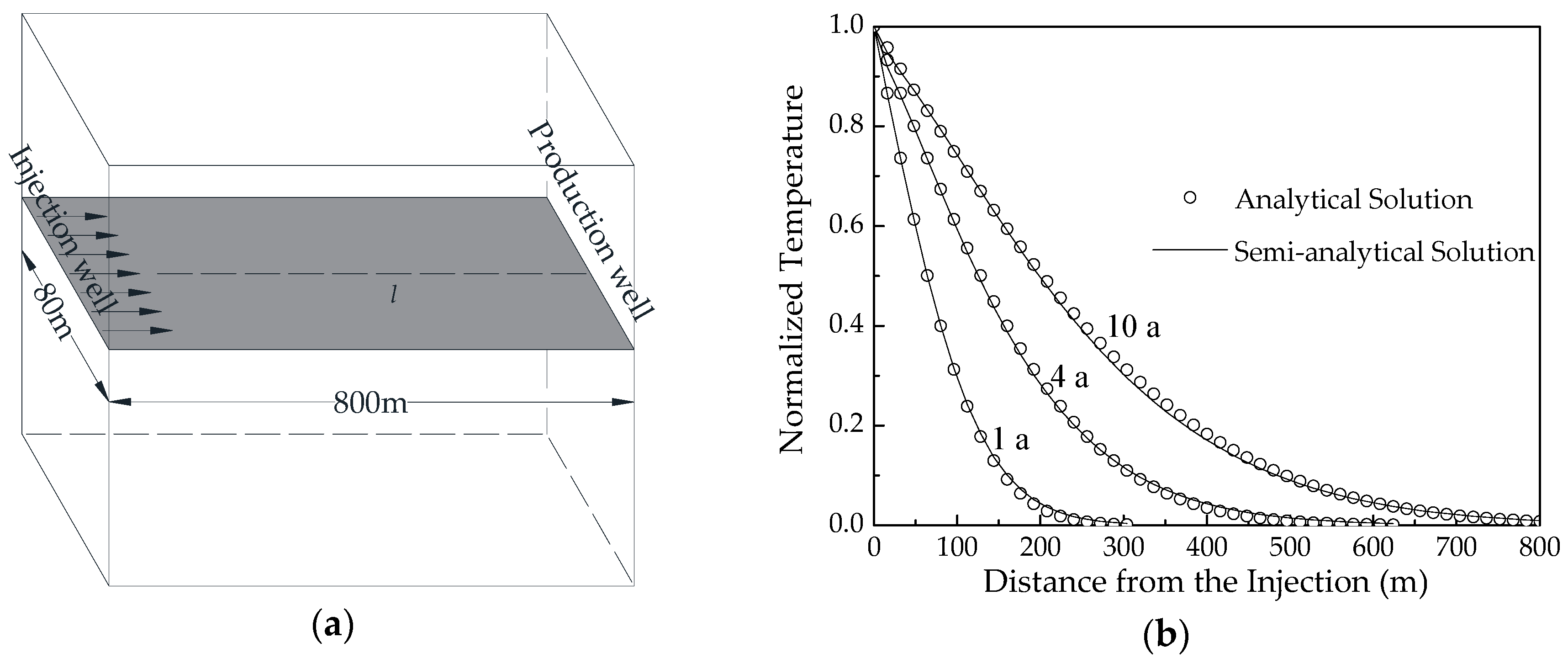
3.1.1. Injection into an Infinite Rectangular Fracture
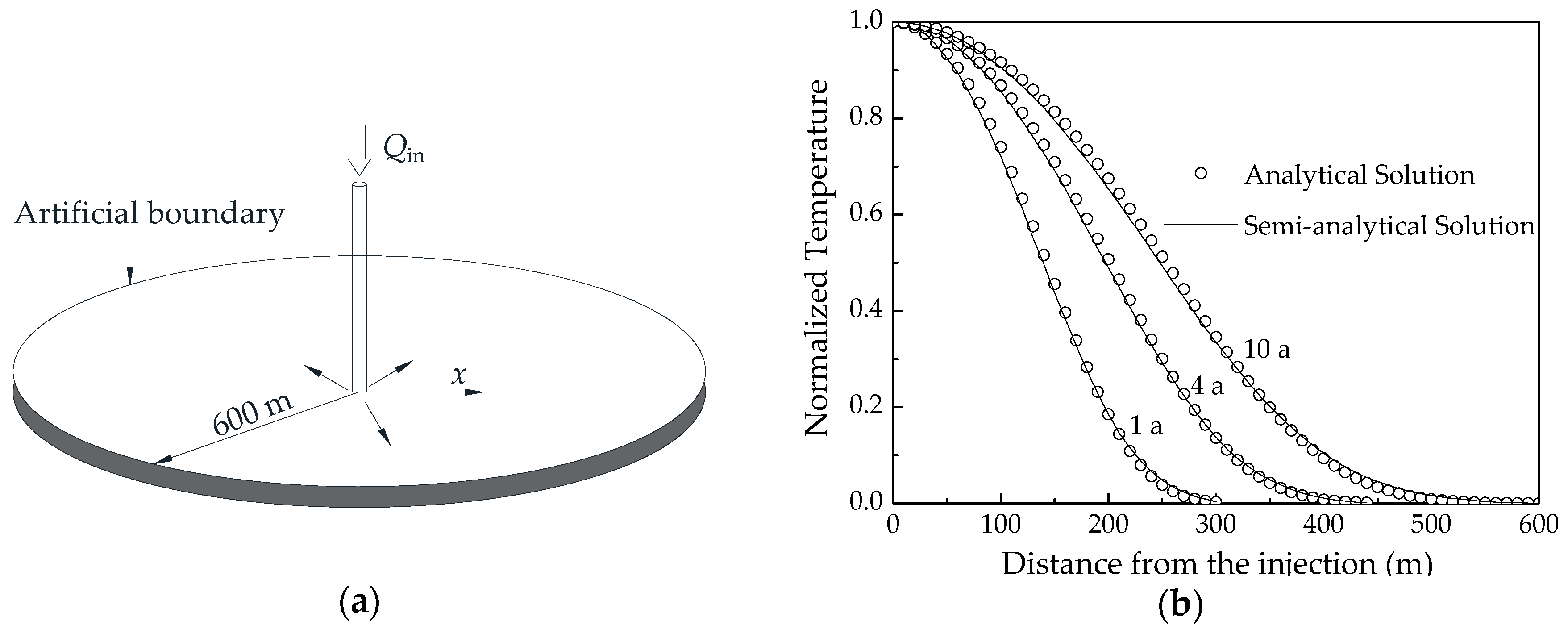
3.1.2. Injection into an Infinite Radial Fracture
3.2. Multi-Fracture EGS
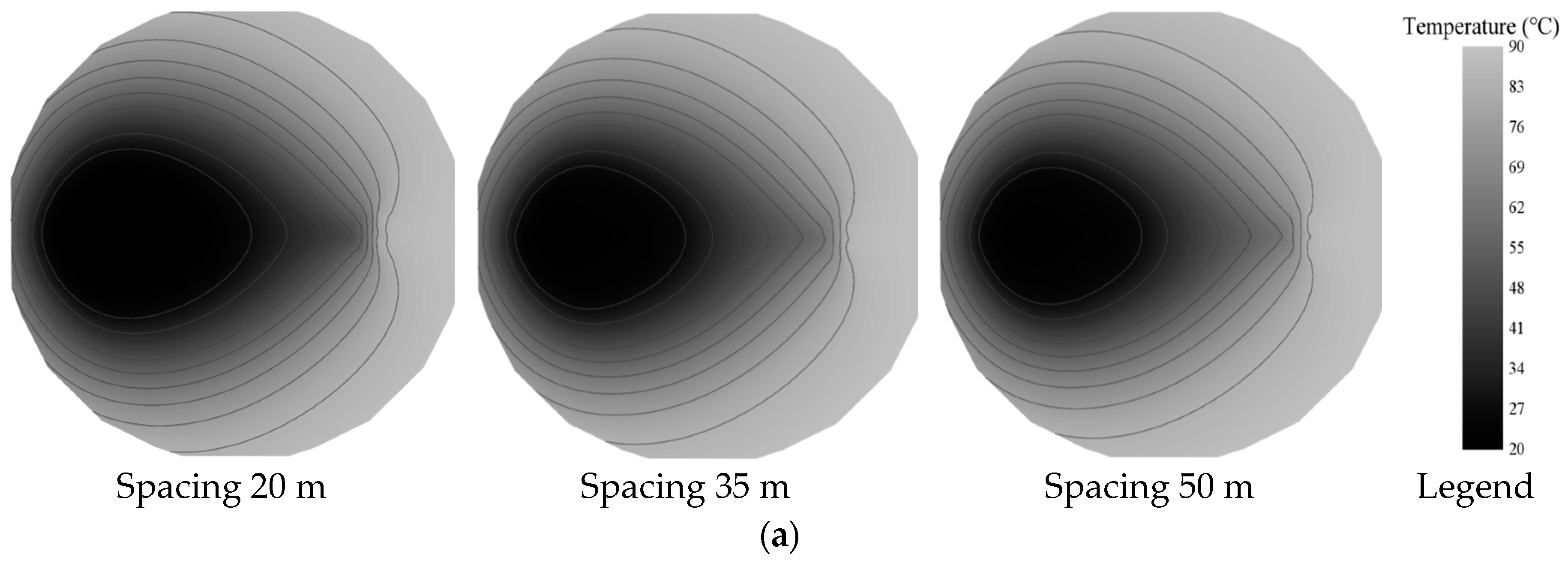
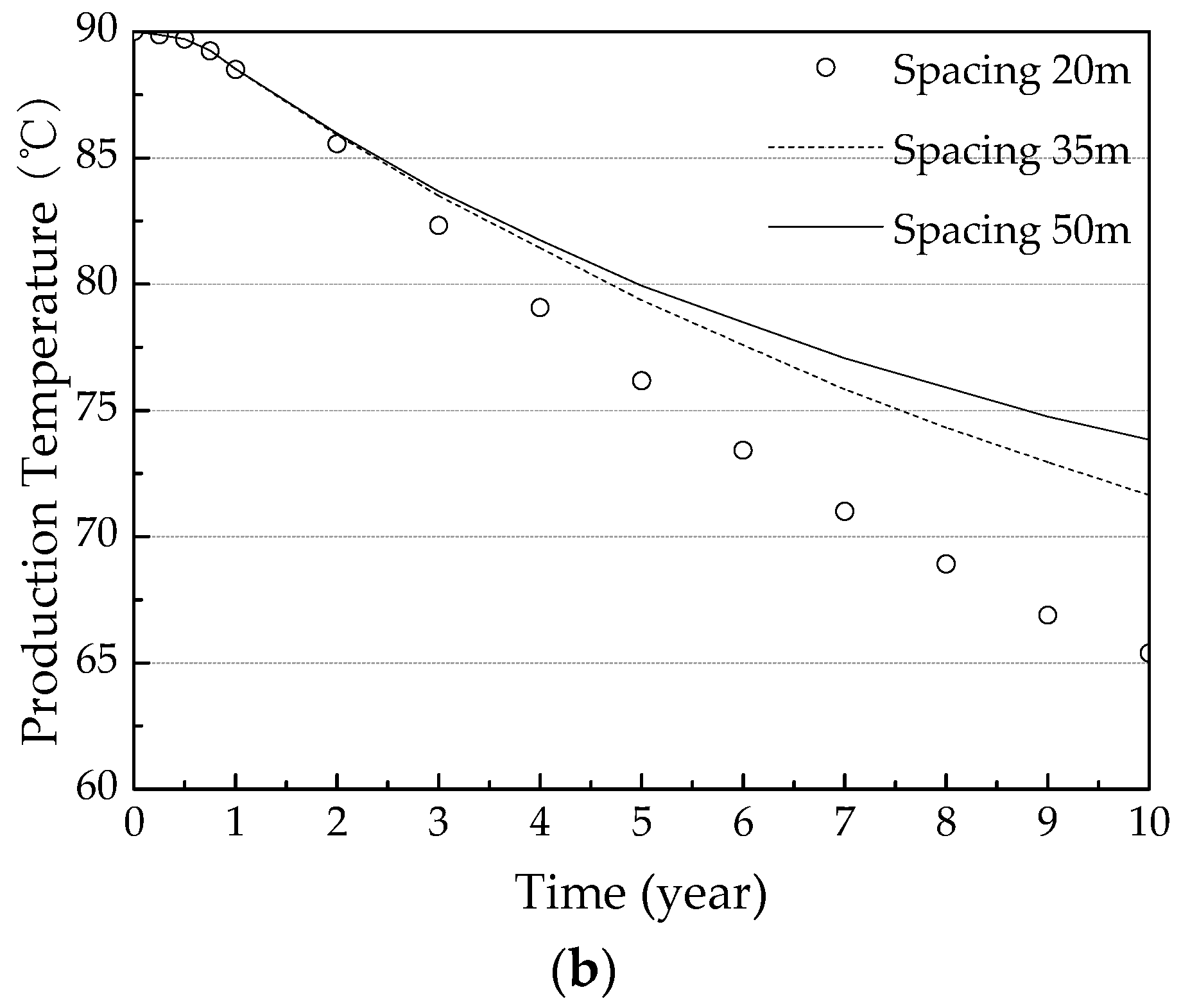
3.2.1. Effects of the Fracture Spacing
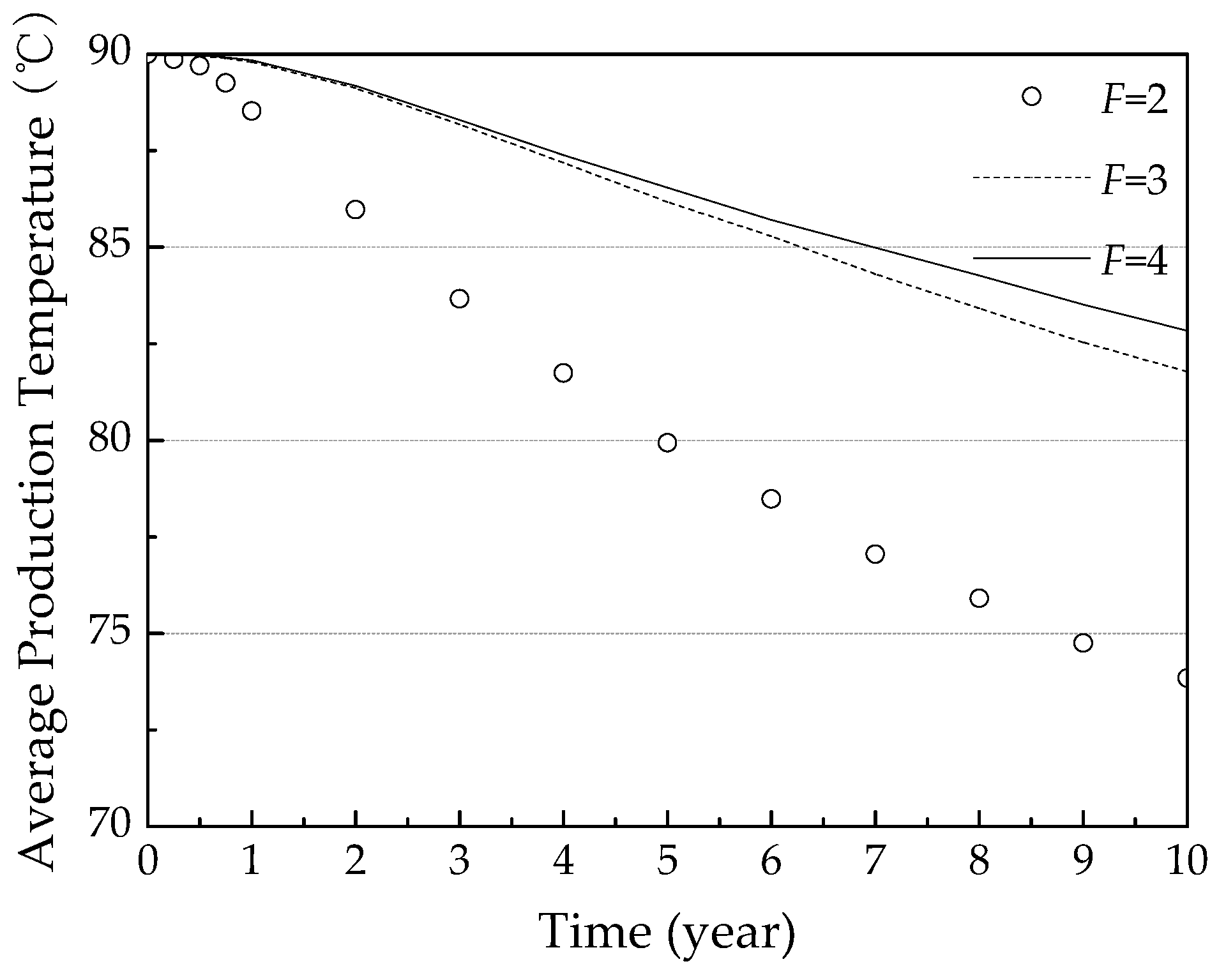
3.2.2. Effects of the Fracture Number
4. Conclusions
- The temporal semi-analytical method provides an accurate solution and, thus, can serve as a benchmark for numerical methods.
- The fracture spacing and fracture number are two key factors controlling the heat extraction from an EGS. Increasing the fracture spacing maintains the production temperature by decreasing the thermal interaction between fractures. A multi-fracture also extends the life of a geothermal reservoir by increasing the contacting area between the fracture water and rock matrix. In terms of improving heat exploitation, increasing the fracture number is more efficient than increasing fracture spacing.
- The proposed method is efficient in calculations and is applicable to the design and optimization of an EGS.
Author Contributions
Funding
Conflicts of Interest
References
- Luo, J.; Luo, Z.Q.; Xie, J.H.; Xia, D.S.; Huang, W.; Shao, H.B.; Xiang, W.; Rohn, J. Investigation of shallow geothermal potentials for different types of ground source heat pump systems (GSHP) of Wuhan city in China. Renew. Energy 2018, 118, 230–244. [Google Scholar] [CrossRef] [Scilit]
- Olasolo, P.; Juárez, M.C.; Morales, M.P.; D’Amico, S.; Liarte, I.A. Enhanced geothermal systems (EGS): A review. Renew. Sustain. Energy Rev. 2016, 56, 133–144. [Google Scholar] [CrossRef] [Scilit]
- Vik, H.S.; Salimzadeh, S.; Nick, H.M. Heat Recovery from Multiple-Fracture Enhanced Geothermal Systems: The Effect of Thermoelastic Fracture Interactions. Renew. Energy 2018, 121, 606–622. [Google Scholar] [CrossRef] [Scilit]
- Yao, J.; Zhang, X.; Sun, Z.X.; Huang, Z.Q.; Li, Y.; Xin, Y.; Yan, X.; Liu, W.Z. Numerical simulation of the heat extraction in 3D-EGS with thermal-hydraulic-mechanical coupling method based on discrete fractures model. Geothemics 2018, 74, 19–34. [Google Scholar] [CrossRef] [Scilit]
- Xia, Y.D.; Plummer, M.; Mattson, E.; Podgorney, R.; Ghassemi, A. Design, modeling, and evaluation of a doublet heat extraction model in enhanced geothermal systems. Renew. Energy 2017, 105, 232–247. [Google Scholar] [CrossRef] [Scilit]
- Galgaro, A.; Farina, Z.; Emmi, G.; Crali, M.D. Feasibility analysis of a Borehole Heat Exchanger (BHE) array to be installed in high geothermal flux area: The case of the Euganean Thermal Basin, Italy. Renew. Energy 2015, 78, 93–104. [Google Scholar] [CrossRef] [Scilit]
- Kelkar, S.; Lewis, K.; Karra, S.; Zyvoloski, G.; Rapaka, S.; Viswanathan, H.; Mishra, P.K.; Chu, S.; Coblentz, D.; Pawar, R. A simulator for modeling coupled thermo-hydro-mechanical processes in subsurface geological media. Int. J. Rock Mech. Min. 2014, 70, 569–580. [Google Scholar] [CrossRef] [Scilit]
- Zeng, Y.C.; Su, Z.; Wu, N.Y. Numerical simulation of heat production potential from hot dry rock by water circulating through two horizontal wells at Desert Peak geothermal field. Energy 2013, 56, 92–107. [Google Scholar] [CrossRef] [Scilit]
- Huang, W.B.; Cao, W.J.; Jiang, F.M. Heat extraction performance of EGS with heterogeneous reservoir: A numerical evaluation. Int. J. Heat Mass. Transf. 2017, 108, 645–657. [Google Scholar] [CrossRef] [Scilit]
- Lauwerier, H.A. The transport of heat in an oil layer caused by the injection of hot fluid. Appl. Sci. Res. Sect. A 1955, 5, 145–150. [Google Scholar] [CrossRef] [Scilit]
- Cheng, A.H.D.; Ghassemi, A.; Detournay, E. Integral equation solution of heat extraction from a fracture in hot dry rock. Int. J. Numer. Anal. Methods Geomech. 2001, 25, 1327–1338. [Google Scholar] [CrossRef] [Scilit]
- Ghassemi, A.; Tarasovs, S.; Cheng, A.H.D. An integral equation for three-dimensional heat extraction from planar fracture in hot dry rock. Int. J. Numer. Anal. Methods Geomech. 2003, 27, 989–1004. [Google Scholar] [CrossRef] [Scilit]
- Xiang, Y.Y.; Guo, J.Q. A Laplace transform and Green function method for calculation of water flow and heat transfer in fractured rocks. Rock Soil Mech. 2011, 32, 333–340. [Google Scholar]
- Zhang, Y.; Xiang, Y.Y. A semi-analytical method for calculation of three-dimensional water flow and heat transfer in single-fracture rock with distributed heat sources. Rock Soil Mech. 2013, 34, 685–695. [Google Scholar]
- Zhou, X.X.; Ghassemi, A.; Cheng, A.H.D. A three-dimensional integral equation model for calculating poro- and thermoelastic stresses induced by cold water injection into a geothermal reservoir. Int. J. Numer. Anal. Methods Geomech. 2009, 33, 1613–1640. [Google Scholar] [CrossRef] [Scilit]
- Abbasi, M.; Khazali, N.; Sharifi, M. Analytical model for convection-conduction heat transfer during water injection in fractured geothermal reservoirs with variable rock matrix block size. Geothermics 2017, 69, 1–14. [Google Scholar] [CrossRef] [Scilit]
- Wu, B.S.; Zhang, X.; Jeffrey, R.G.; Bunger, A.P.; Jia, S.P. A simplified model for heat extraction by circulating fluid through a closed-loop multiple-fracture enhanced geothermal system. Appl. Energy 2016, 183, 1664–1681. [Google Scholar] [CrossRef] [Scilit]
- Liggett, J.A.; Liu, P.L.F. The Boundary Integral Equations Method for Porous Media Flow; George Allen & Unwin: London, UK, 1983. [Google Scholar]
- Ghassemi, A.; Zhou, X.X. A three-dimensional thermo-poroelastic model for fracture response to injection/extraction in enhanced geothermal systems. Geothemics 2011, 40, 39–49. [Google Scholar] [CrossRef] [Scilit]
- Xiang, Y.Y. Fundamental Theory of Groundwater Mechanics; Science Press: Beijing, China, 2011. [Google Scholar]
- Dargush, G.; Banerjee, P.K. A time domain boundary element method for poroelasticity. Int. J. Numer. Meth. Eng. 1989, 28, 2423–2449. [Google Scholar] [CrossRef] [Scilit]
- Brooks, A.N.; Hughes, T.J.R. Streamline upwind/Petrov-Galerkin formulations for convection dominated flows with particular emphasis on the incompressible Navier-Stokes equations. Comput. Method. Appl. M 1982, 32, 19–259. [Google Scholar] [CrossRef] [Scilit]
- Mossop, A.P. Seismicity, subsidence and strain at the Geysers geothermal field. Ph.D. Thesis, Stanford University, Location of University, Stanford, CA, USA, 2001. [Google Scholar]



| Parameters | Values | Parameters | Values |
|---|---|---|---|
| Water density ρw (Kg m−3) | 1000 | Water diffusivity kw (m2 s−1) | 0.01 |
| Rock density ρr (Kg m−3) | 2650 | Rock conductivity λr (W m−1 °C−1) | 2.59 |
| Water-specific heat cw (J kg−1 °C−1) | 4180 | Initial rock temperature T0 (°C−1) | 90 |
| Rock-specific heat cr (J kg−1 °C−1) | 1000 | Injected water temperature Tin (°C−1) | 20 |
© 2019 by the authors. Licensee MDPI, Basel, Switzerland. This article is an open access article distributed under the terms and conditions of the Creative Commons Attribution (CC BY) license (http://creativecommons.org/licenses/by/4.0/).
Share and Cite
Liu, D.; Xiang, Y. A Semi-Analytical Method for Three-Dimensional Heat Transfer in Multi-Fracture Enhanced Geothermal Systems. Energies 2019, 12, 1211. https://doi.org/10.3390/en12071211
Liu D, Xiang Y. A Semi-Analytical Method for Three-Dimensional Heat Transfer in Multi-Fracture Enhanced Geothermal Systems. Energies. 2019; 12(7):1211. https://doi.org/10.3390/en12071211
Chicago/Turabian StyleLiu, Dongdong, and Yanyong Xiang. 2019. "A Semi-Analytical Method for Three-Dimensional Heat Transfer in Multi-Fracture Enhanced Geothermal Systems" Energies 12, no. 7: 1211. https://doi.org/10.3390/en12071211
APA StyleLiu, D., & Xiang, Y. (2019). A Semi-Analytical Method for Three-Dimensional Heat Transfer in Multi-Fracture Enhanced Geothermal Systems. Energies, 12(7), 1211. https://doi.org/10.3390/en12071211