An Immune Firefly Algorithm for Tracking the Maximum Power Point of PV Array under Partial Shading Conditions

Abstract
1. Introduction
2. Firefly Algorithm
2.1. Basic Assumptions
2.2. Terminologies of FA and PV System
2.3. Mathematical Expression
3. Immune Firefly Algorithm
3.1. Vaccine Data-Base
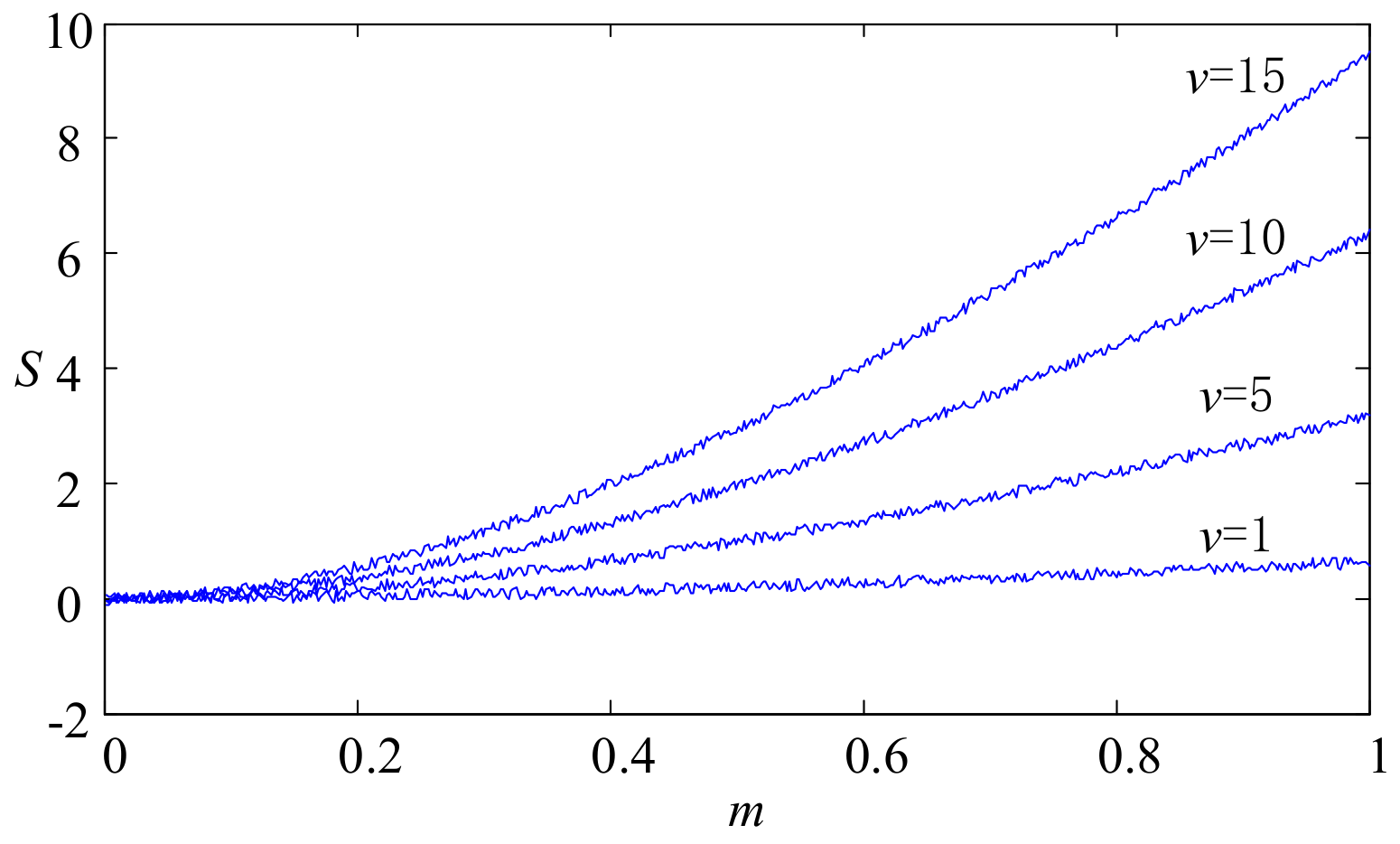
3.2. Improved Iteration Formula
3.3. Immune Replenishment Operation
4. Case Studies
4.1. Parameters
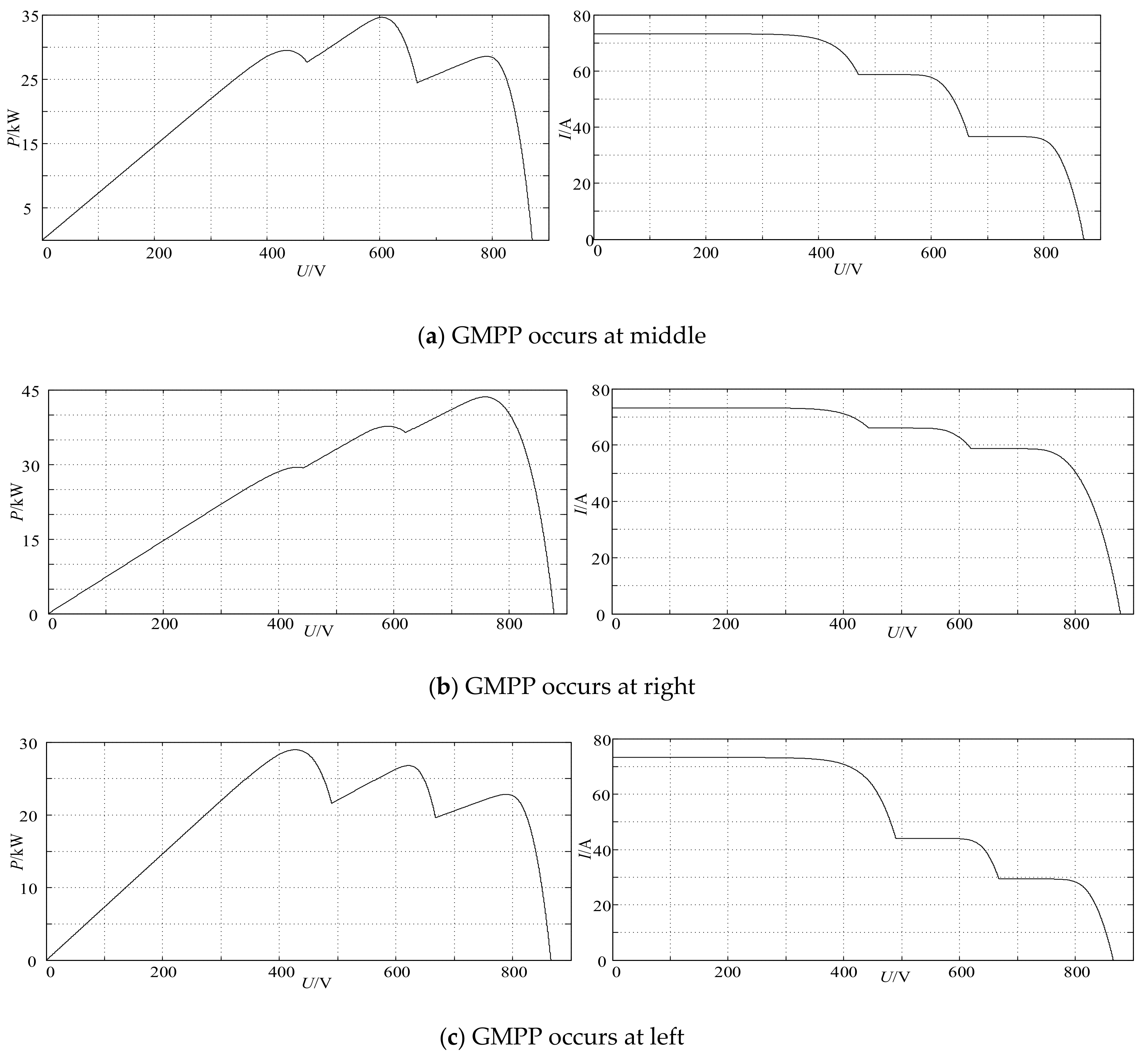
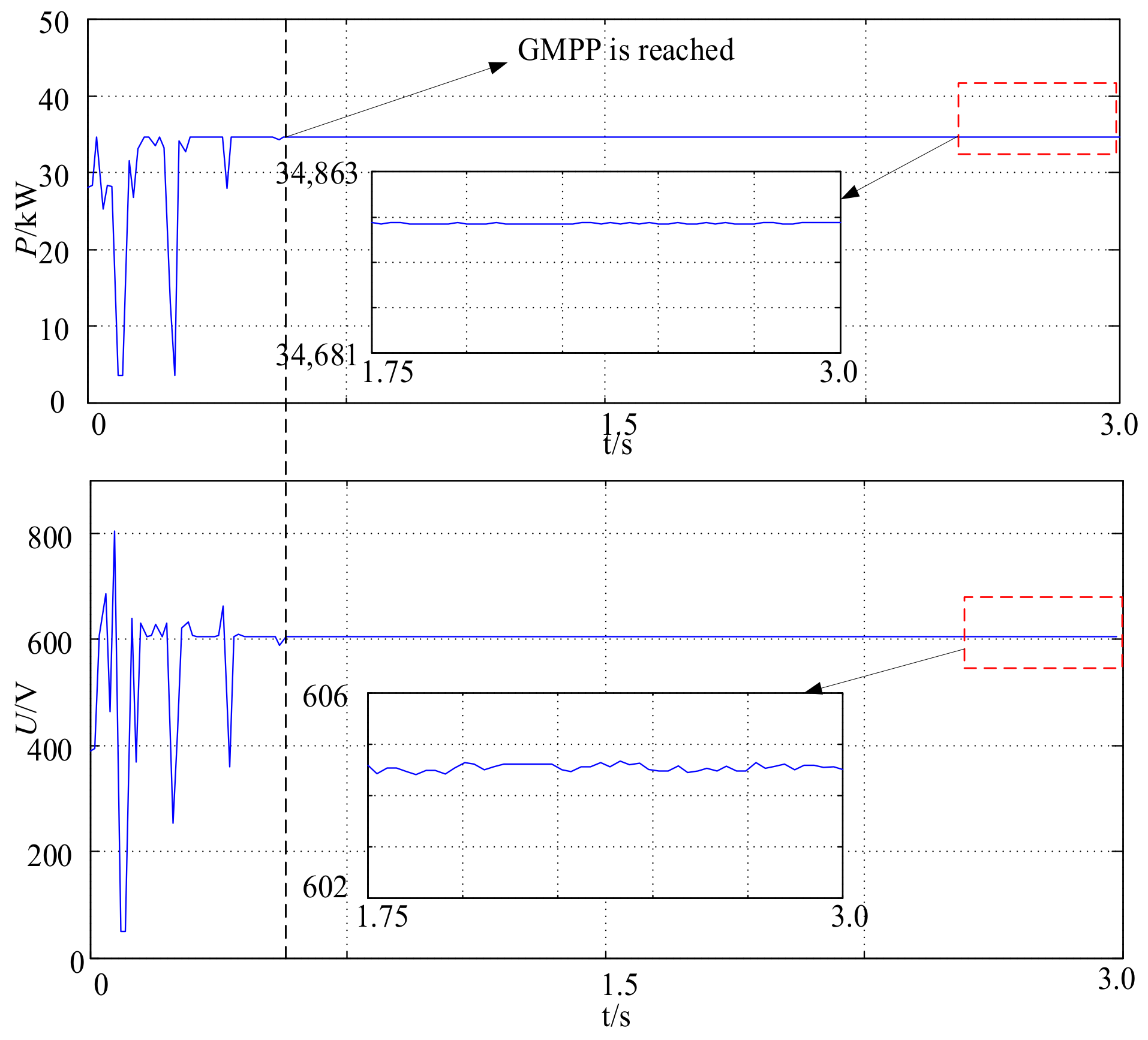
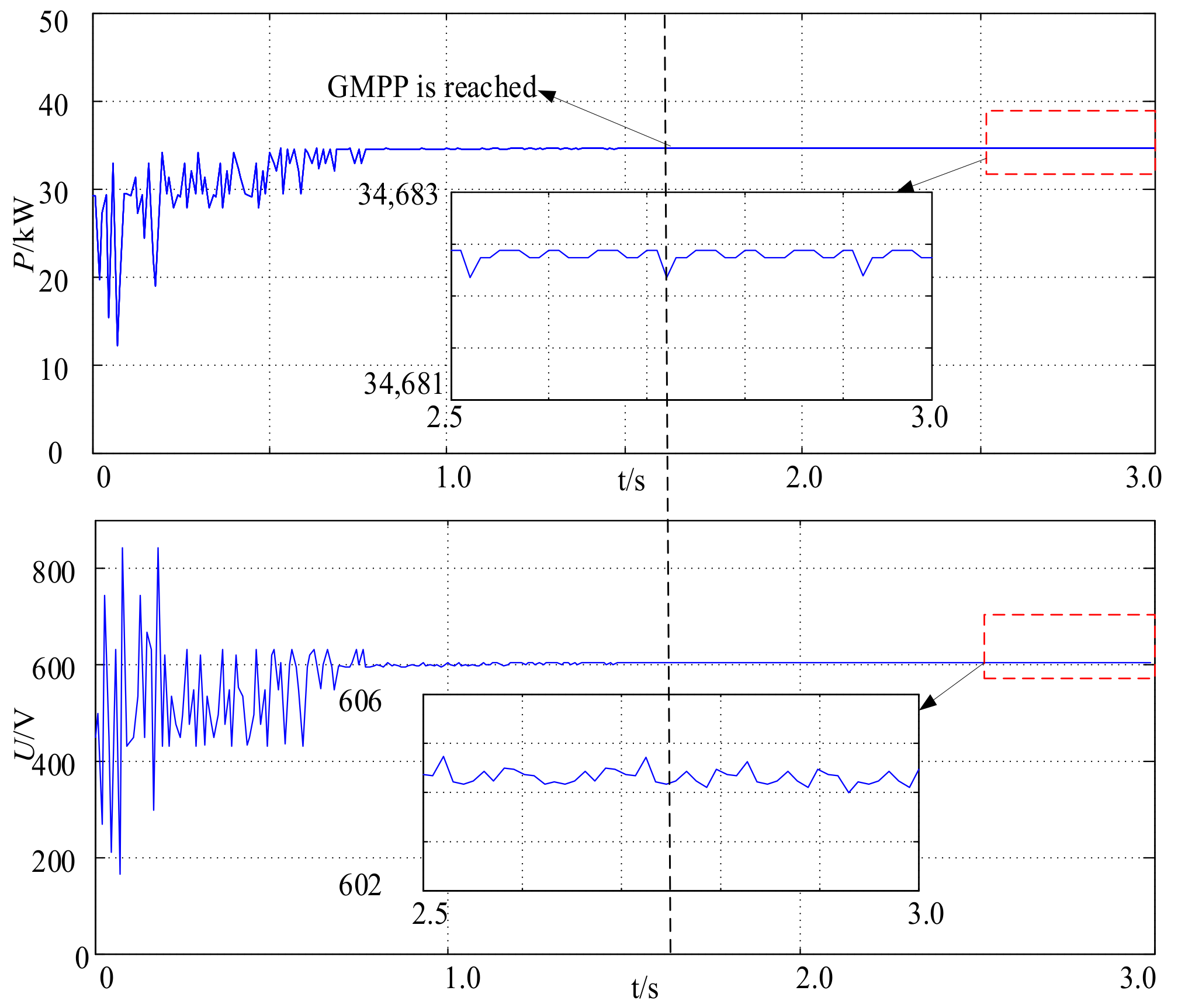
4.2. Static Cases
4.3. Dynamic Case
5. Conclusions
Author Contributions
Funding
Conflicts of Interest
References
- Jones, D.C.; Erickson, R.W. Probabilistic analysis of a generalized perturb and observe algorithm featuring robust operation in the presence of power curve traps. IEEE Trans. Power Electron. 2013, 28, 2912–2926. [Google Scholar] [CrossRef] [Scilit]
- Pilawa-Podgurski, R.C.N.; Li, W.; Celanovic, I.; Perreault, D.J. Integrated CMOS energy harvesting converter with digital maximum power point tracking for a portable thermophotovoltaic power generator. IEEE J. Emerg. Sel. Top. Power Electron. 2015, 3, 1021–1035. [Google Scholar] [CrossRef] [Scilit]
- Alajmi, B.N.; Ahmed, K.H.; Finney, S.J.; Williams, B.W. Fuzzylogic-control approach of a modified hill-climbing method for maximum power point in microgrid standalone photovoltaic system. IEEE Trans. Power Electron. 2011, 26, 1022–1030. [Google Scholar] [CrossRef] [Scilit]
- Hsieh, G.C.; Hsieh, H.I.; Tsai, C.Y.; Wang, C.H. Photovoltaic power-increment-aided incremental-conductance MPPT with two-phased tracking. IEEE Trans. Power Electron. 2013, 28, 2895–2911. [Google Scholar] [CrossRef] [Scilit]
- Spagnuolo, E.R.; Franquelo, L.G.; Ramos-Paja, C.A.; Suntio, T.; Xiao, W.M. Grid-connected photovoltaic generation plants: Components and operation. IEEE Ind. Electron. Mag. 2013, 7, 6–20. [Google Scholar]
- Shimizu, T.; Hirakata, M.; Kamezawa, T.; Watanabe, H. Generation control circuit for photovoltaic modules. IEEE Trans. Power Electron. 2001, 16, 293–300. [Google Scholar] [CrossRef] [Scilit]
- Karatepe, E.; Hiyama, T.; Boztepe, M.; Colak, M. Voltage based power compensation system for photovoltaic generation system under partially shaded insolation conditions. Energy Convers. Manag. 2008, 49, 2307–2316. [Google Scholar] [CrossRef] [Scilit]
- Sharma, P.; Agarwal, V. Maximum power extraction from a partially shaded PV array using shunt-series compensation. IEEE J. Photovolt. 2014, 4, 1128–1137. [Google Scholar] [CrossRef] [Scilit]
- Sharma, P.; Argarwal, V. Exact maximum power point tracking of grid-connected partially shaded PV source using current compensation concept. IEEE Trans. Power Electron. 2014, 29, 4684–4692. [Google Scholar] [CrossRef] [Scilit]
- El-Dein, M.Z.S.; Kazerani, M.; Salama, M.M.A. Optimal photovoltaic array reconfiguration to reduce partial shading losses. IEEE Trans. Sustain. Energy 2013, 4, 145–153. [Google Scholar] [CrossRef] [Scilit]
- Hu, Y.; Chen, H.; Xu, R.D.; Li, R. Photovoltaic (PV) array fault diagnosis strategy based on optimal sensor placement. Proc. CSEE 2011, 31, 19–30. [Google Scholar]
- Velasco-Quesada, G.; Guinjoan-Gispert, F.; Pique-Lopez, R.; Roman-Lumbreras, M.; Conesa-Roca, A. Electrical PV array recon-figuration strategy for energy extraction improvement in grid-connected PV systems. IEEE Trans. Ind. Electron. 2009, 56, 4319–4331. [Google Scholar] [CrossRef] [Scilit]
- Koutroulis, E.; Blaabjerg, F. A new technique for tracking the global maximum power point of PV arrays operating under partialshading conditions. IEEE J. Photovolt. 2012, 2, 184–190. [Google Scholar] [CrossRef] [Scilit]
- Shubhajit, S.R.; Saha, H. Maximum power point tracking of partially shaded solar photovoltaic array. Sol. Energy Mater. Sol. Cells 2010, 94, 1441–1447. [Google Scholar]
- Liu, Y.; Huang, S.; Liang, W. A particle swarm optimization-based maximum power point tracking algorithm for PV systems operating under partially shaded conditions. IEEE Trans. Energy Convers. 2012, 27, 1027–1035. [Google Scholar] [CrossRef] [Scilit]
- Ishaque, K.; Salam, Z.; Amjad, M.; Mekhilef, S. An improved particle swarm optimization (PSO)-based MPPT for PV with reduced steady-state oscillation. IEEE Trans. Power Electron. 2012, 27, 3627–3638. [Google Scholar] [CrossRef] [Scilit]
- Sundareswarm, K.; Sankar, P.; Nayak, P.S.R.; Simon, S.P.; Palani, S. Enhanced energy output from a PV system under partial shaded conditions through artificial bee colony. IEEE Trans. Sustain. Energy. 2015, 6, 198–209. [Google Scholar] [CrossRef] [Scilit]
- Alajmi, B.N.; Ahmed, K.H.; Finney, S.J.; Williams, B.W. A maximum power point tracking technique for partially shaded photovoltaic systems in microgrids. IEEE Trans. Ind. Electron. 2013, 60, 1596–1606. [Google Scholar] [CrossRef] [Scilit]
- Zhou, L.; Chen, Y.; Guo, K.; Jia, F. New approach for MPPT control of photovoltaic system with mutative-scale dual-carrier chaotic search. IEEE Trans. Power Electron. 2011, 26, 1038–1048. [Google Scholar] [CrossRef] [Scilit]
- Nguyen, T.L.; Low, K.S. A global maximum power point tracking scheme employing DIRECT search algorithm for photovoltaic systems. IEEE Trans. Ind. Electron. 2010, 57, 3456–3467. [Google Scholar] [CrossRef] [Scilit]
- Ahmed, N.A.; Miyatake, M. A novel maximum power point tracking for photovoltaic applications under partially shaded insolation conditions. Electr. Power Syst. Res. 2008, 78, 777–784. [Google Scholar] [CrossRef] [Scilit]
- Ishaque, K.; Salam, Z. A deterministic particle swarm optimization maximum power point tracker for photovoltaic system under partial shading condition. IEEE Trans. Ind. Electron. 2013, 60, 3195–3206. [Google Scholar] [CrossRef] [Scilit]
- Patel, H.; Agarwal, V. Maximum power point tracking scheme for PV systems operating under partially shaded conditions. IEEE Trans. Ind. Electron. 2008, 55, 1689–1698. [Google Scholar] [CrossRef] [Scilit]
- Tey, K.S.; Mekhilef, S. Modified incremental conductance algorithm for photovoltaic system under partial shading conditions and load variation. IEEE Trans. Ind. Electron. 2014, 61, 5384–5392. [Google Scholar]
- Tey, K.S.; Mekhilef, S. A fast-converging MPPT technique for photovoltaic system under fast-varying solar irradiation and load resistance. IEEE Trans. Ind. Inform. 2014, 11, 176–186. [Google Scholar]
- Tey, K.S.; Mekhilef, S. Modified incremental conductance MPPT algorithm to mitigate inaccurate responses under fast-changing solar irradiation. Sol. Energy 2014, 101, 333–342. [Google Scholar] [CrossRef] [Scilit]
- Tey, K.S.; Mekhilef, S.; Safari, A. Simple and low cost incremental conductance maximum power point tracking using buck-boost converter. J. Renew. Sustain. Energy 2013, 5, 023106. [Google Scholar]
- Seyedmahmoudian, M.; Mekhilef, S.; Rahmani, R.; Yusof, R.; Renani, E.T. Analytical modeling of partially shaded photovoltaic systems. Energies 2013, 6, 128–144. [Google Scholar] [CrossRef] [Scilit]
- Yang, X.-S. Nature-Inspired Metaheuristic Algorithms; Luniver Press: Cambridge, UK, 2008. [Google Scholar]
- Sundareswaran, K.; Peddapati, S.; Palani, S. MPPT of PV systems under partial shaded conditions through a colony of flashing fireflies. IEEE Trans. Energy Convers. 2014, 29, 463–472. [Google Scholar]
- Femia, N.; Petrone, G.; Spagnuolo, G.; Vitell, M. Optimization of perturb and observe maximum power point tracking method. IEEE Trans. Power Electron. 2005, 20, 963–973. [Google Scholar] [CrossRef] [Scilit]
- Teshome, D.F.; Lee, C.H.; Lin, Y.W.; Lian, K.L. A Modified Firefly Algorithm for Photovoltaic Maximum Power Point Tracking Control Under Partial Shading. IEEE J. Emerg. Sel. Top. Power Electron. 2017, 5, 661–671. [Google Scholar] [CrossRef] [Scilit]


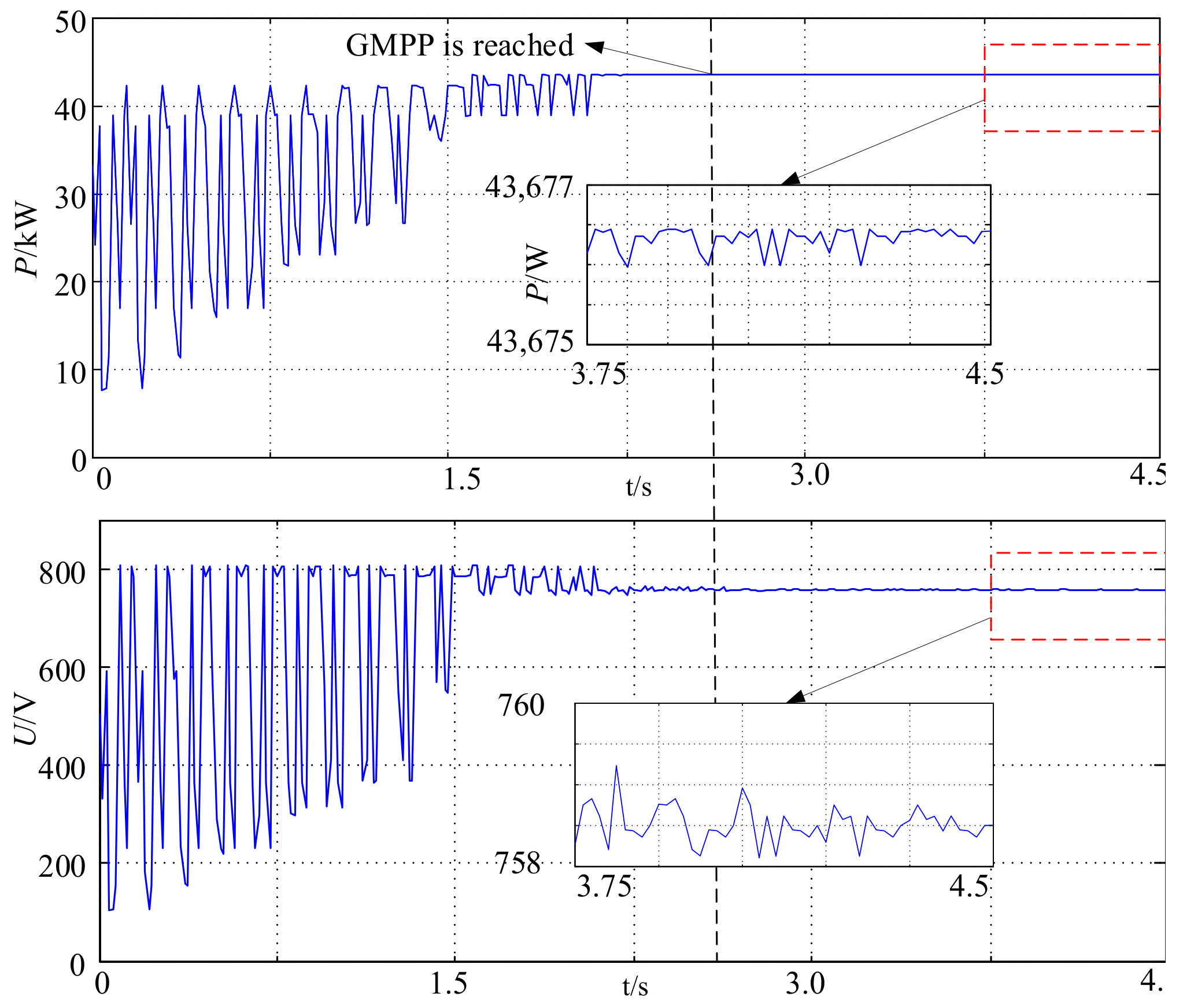

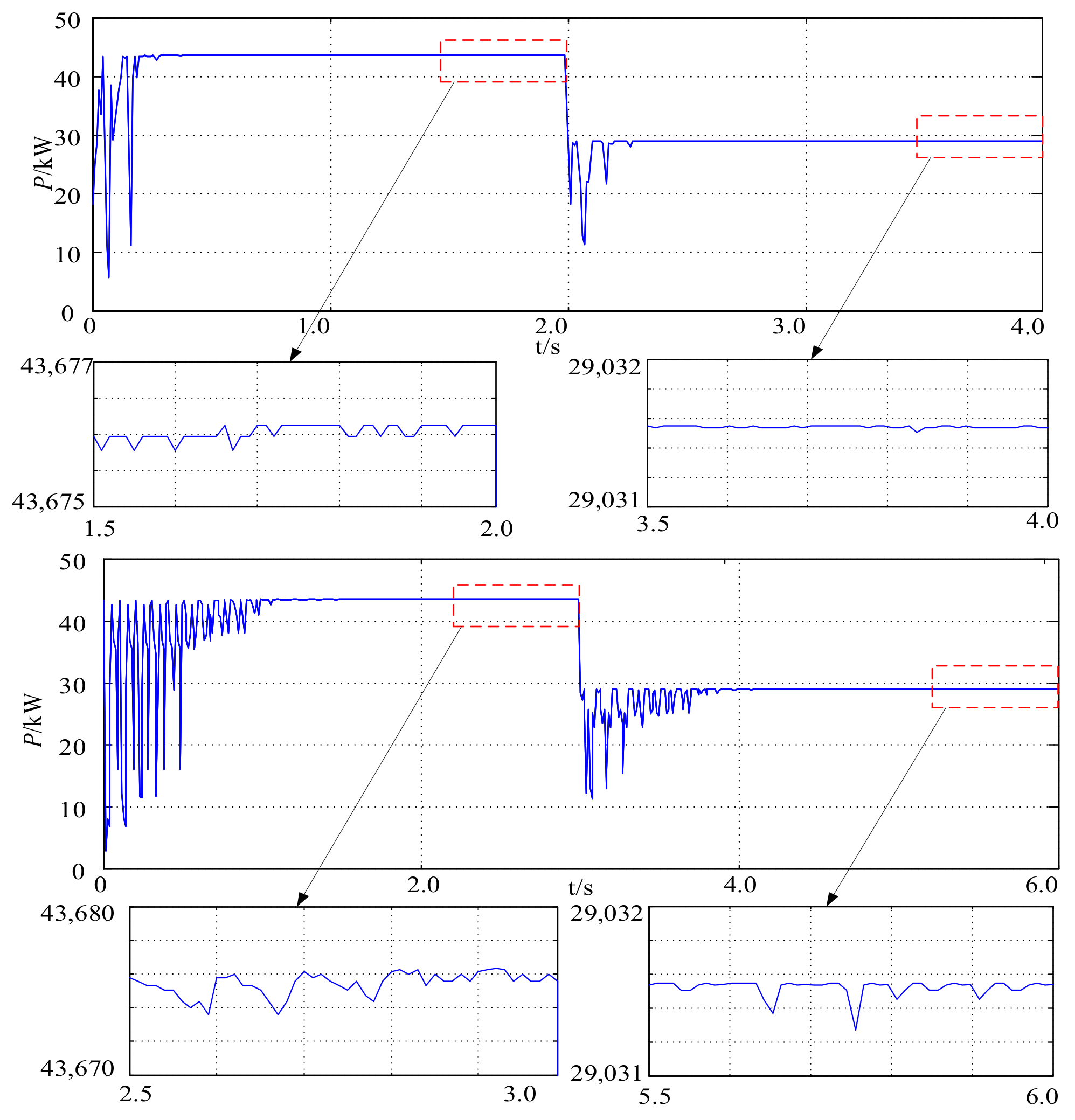
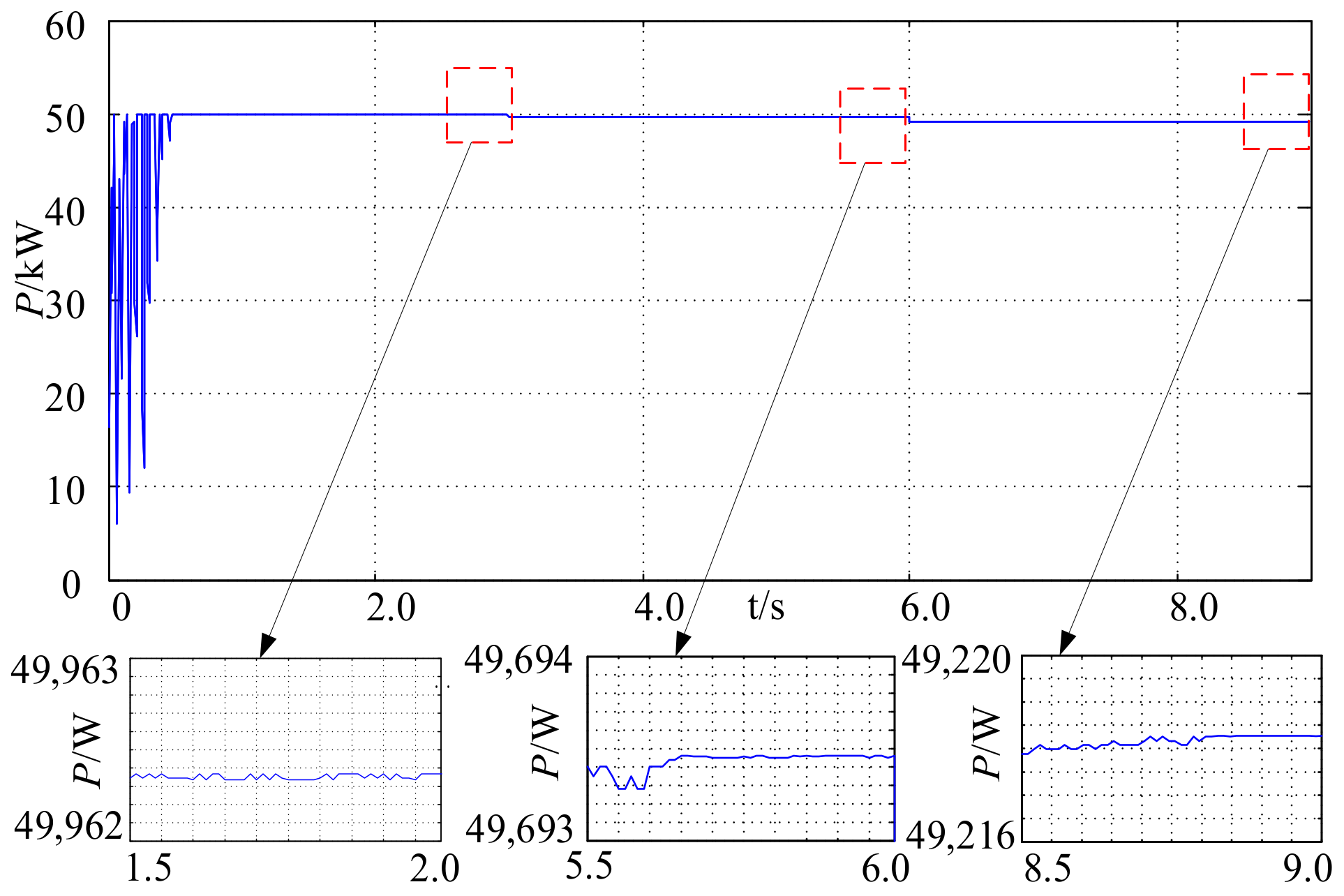
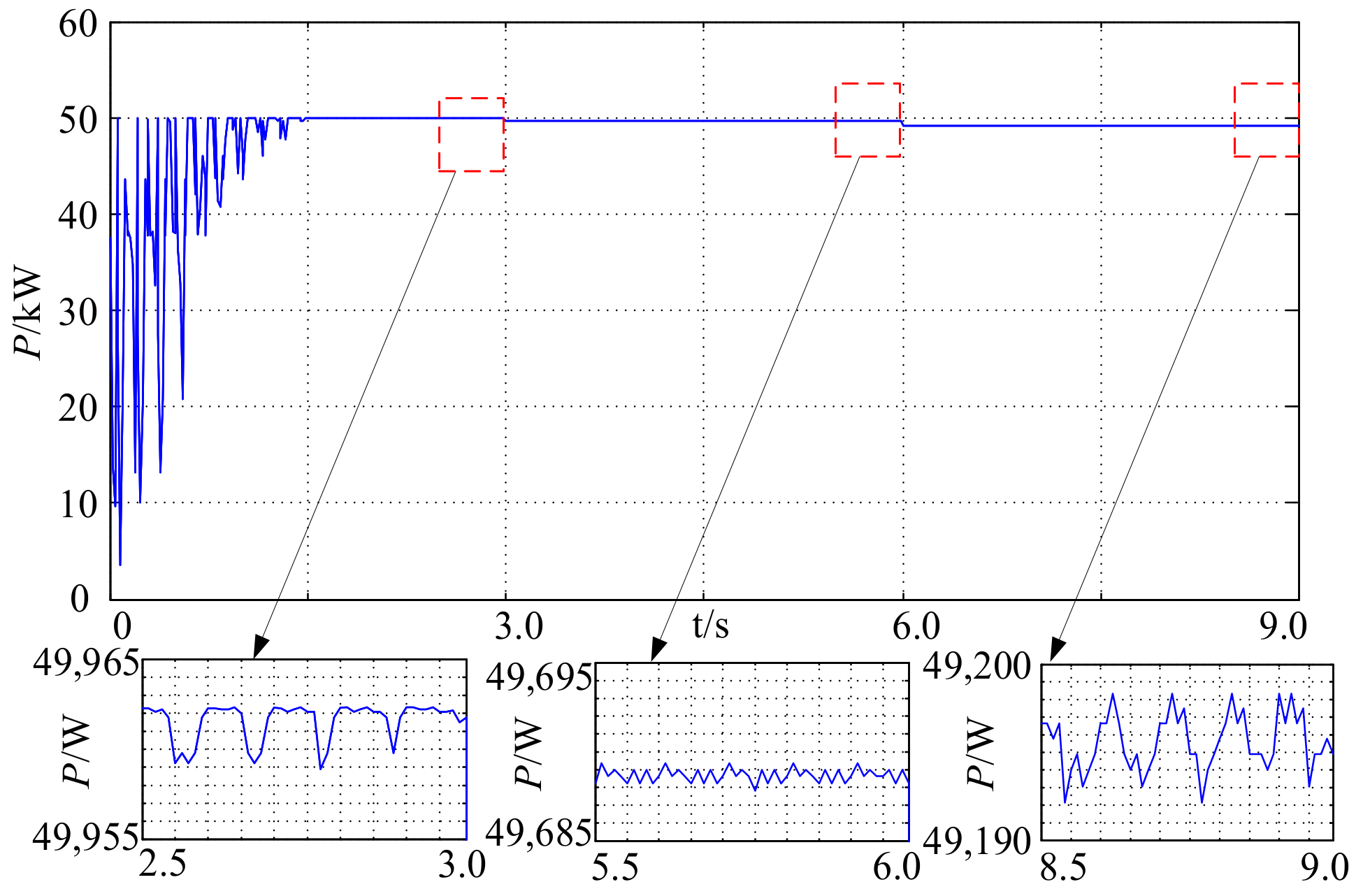

| Firefly Algorithm | PV System |
|---|---|
| Firefly position | Two-dimensional coordinates expressed as (Voltage, Power) |
| Distance | Cartesian distance between firefly positions |
| Attractiveness | An exponential function of distance |
| Brightness | Power |
| Brightness of the brightest firefly | Global maximum power |
| Parameters | Value |
|---|---|
| n | 10 |
| γ | 10−8 |
| β0 | 1 |
| α | 0.5 |
| v | 5 |
| θ | 0.6 |
| μ | 0.2 |
| Convergence Time | Case | IFA | FA |
|---|---|---|---|
| Best | 1 | 0.21 s | 0.60 s |
| Worst | 0.50 s | 1.56 s | |
| Average | 0.33 s | 0.97 s | |
| Best | 2 | 0.39 s | 0.95 s |
| Worst | 0.57 s | 1.67 s | |
| Average | 0.45 s | 1.18 s | |
| Best | 3 | 0.27 s | 0.79 s |
| Worst | 0.38 s | 1.26 s | |
| Average | 0.31 s | 0.96 s |
| Case | Posc/W | |
|---|---|---|
| IFA | FA | |
| 1 | 0.42 | 1.07 |
| 2 | 0.69 | 1.16 |
| 3 | 0.45 | 1.22 |
© 2019 by the authors. Licensee MDPI, Basel, Switzerland. This article is an open access article distributed under the terms and conditions of the Creative Commons Attribution (CC BY) license (http://creativecommons.org/licenses/by/4.0/).
Share and Cite
Zhang, M.; Chen, Z.; Wei, L. An Immune Firefly Algorithm for Tracking the Maximum Power Point of PV Array under Partial Shading Conditions. Energies 2019, 12, 3083. https://doi.org/10.3390/en12163083
Zhang M, Chen Z, Wei L. An Immune Firefly Algorithm for Tracking the Maximum Power Point of PV Array under Partial Shading Conditions. Energies. 2019; 12(16):3083. https://doi.org/10.3390/en12163083
Chicago/Turabian StyleZhang, Mingrui, Zheyang Chen, and Li Wei. 2019. "An Immune Firefly Algorithm for Tracking the Maximum Power Point of PV Array under Partial Shading Conditions" Energies 12, no. 16: 3083. https://doi.org/10.3390/en12163083
APA StyleZhang, M., Chen, Z., & Wei, L. (2019). An Immune Firefly Algorithm for Tracking the Maximum Power Point of PV Array under Partial Shading Conditions. Energies, 12(16), 3083. https://doi.org/10.3390/en12163083