FACTS Providing Grid Services: Applications and Testing

 ,
,  ,
, 
Abstract
1. Introduction
- It is the only review paper of the bibliography that is focused on the different grid services provided by various FACTS devices.
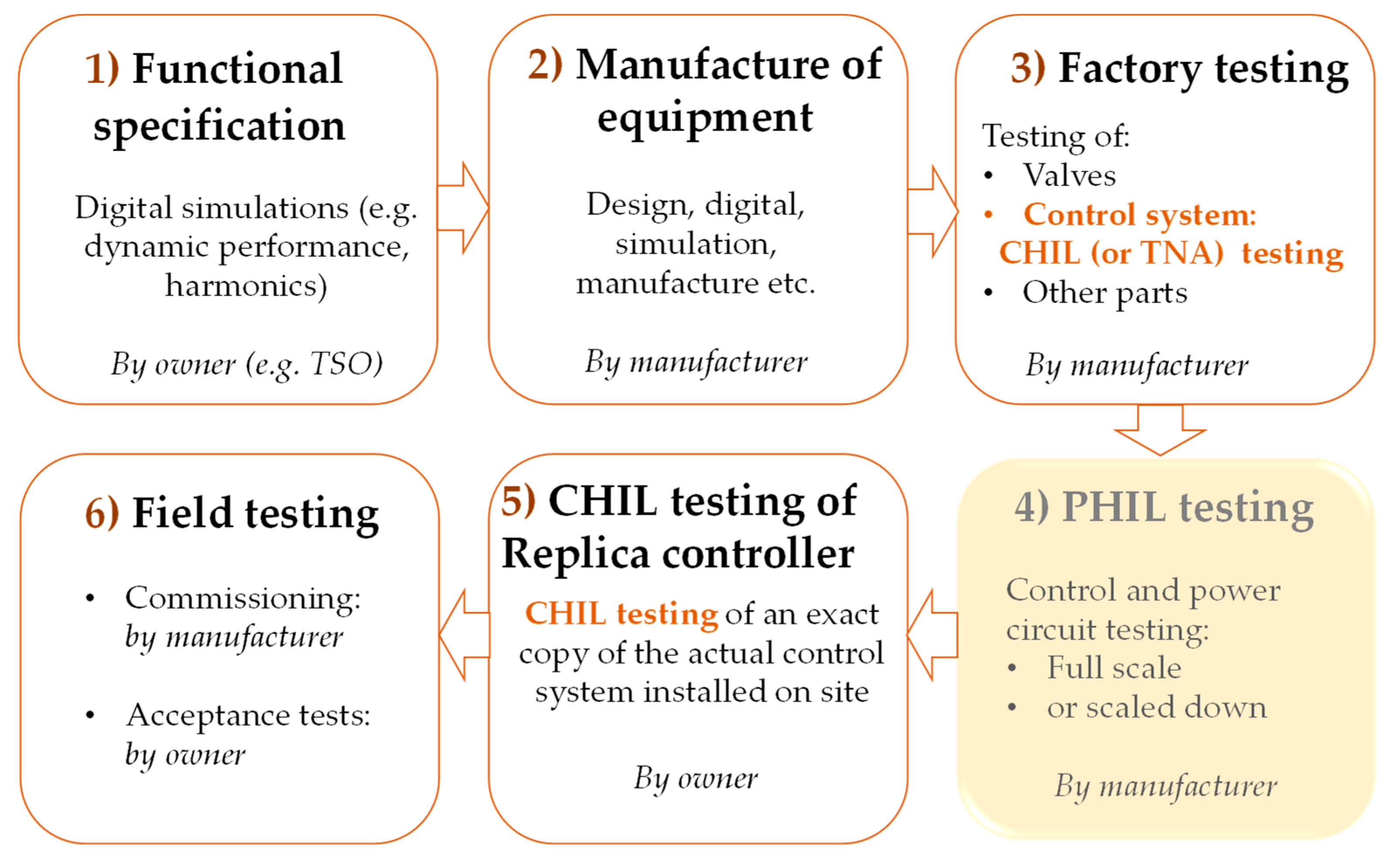
- It is the first paper that reviews the different testing stages of FACTS. It addresses conventional testing and advanced industry practices.
- It proposes the use of PHIL simulation for the testing of FACTS, as an additional stage before field testing, and presents laboratory results.
2. FACTS Providing Grid Services: A Review
- Series devices. These are variable impedance devices that inject voltage in a series with the transmission line. Depending on the phase angle between the injected voltage and the line current, they can help control the real and reactive power. Examples of series devices include thyristor controlled series capacitor (TCSC), thyristor switched series capacitor (TSSC), and static synchronous series compensator (SSSC).
- Shunt devices. These are variable impedance devices that inject current at the point of connection. Depending on the phase angle between the injected current and the line voltage, these devices can control the real and reactive power. Examples of shunt devices include SVC and STATCOM.
- Series-series devices. These are a combination of series devices, where each series device provides series compensation for each line and also transfers active power among the transmission lines. An example of such a device is the interline power flow controller (IPFC).
- Shunt-series devices. These are a combination of series and shunt devices, which are controlled in a coordinated way. An example of such a device is the UPFC, which is the most versatile among all FACTS devices, because it can control, selectively or concurrently, the real and reactive power flow via the transmission line, the bus voltage magnitude, and the compensation of reactive power [5].
2.1. Power Flow Control
- Control of power flow [13,14,15,16,17,18]. The split TCSC provides better power flow control services than the single TCSC [13]. An adaptive TSSC with discrete nonlinear control provides power flow control and improves power system transient stability [14]. An SSSC with an oscillation damping controller simultaneously achieves power flow control and low frequency oscillation damping in a system with a wind farm [15]. The modular multilevel converter-based UPFC regulates the power flow of the power system in both steady state and transient state conditions [16]. A hybrid UPFC, composed of a smaller capacity UPFC and a larger capacity Sen transformer, provides the same services of active and reactive power flow control, with the advantage of much lower installation costs [17].
- Congestion management [19,20,21,22]. A method for the optimum location of TCSC relieves congestion in both the normal state and contingency state with single line outage [19]. An analytical method determines the optimum location of the TCSC and SSSC and relieves congestion in both the normal state and contingency state with a single line fault [20]. A pricing-based method finds the optimum location of the UPFC that mitigates line congestion and minimizes system operation costs [21]. A sensitivity-based optimization method finds the optimum location and rated capacity of the UPFC that minimizes congestion costs [22].
- Reactive power dispatch (RPD) [23,24,25,26]. RPD is a grid service that simultaneously minimizes reactive power flow in lines, total active power loss in transmission lines, and voltage deviation in buses. The optimal allocation of four TCSCs and three SVCs at the IEEE 30 bus system significantly reduces the total reactive power flow in lines [23]. The optimal reactive power allocation of three different FACTS, namely TCSC, SVC, and thyristor controlled phase angle regulator (TCPAR), shows that a SVC is slightly better in the improvement of the voltage profile, while a TCPAR is better in reducing the total active power loss [24]. In comparison with the case without a UPFC, the optimal allocation of one UPFC provides a greater reduction of transmission lines’ total active power loss and buses’ voltage deviation for both the IEEE 57-bus and the IEEE 118-bus test systems [25]. In an AC-DC power system with 96 AC buses and two DC terminals, the optimal allocation of one UPFC, under contingency conditions, has a significant impact on the minimization of power loss and voltage deviation [26].
- Available transfer capability enhancement [27,28,29,30,31,32,33]. The available transfer capability (ATC) measures the capability of interconnected power systems to transfer electric power from one power system to another through the transmission lines. The increase of ATC is important because it helps transfer low cost energy to the loads. FACTS devices can increase the ATC by redistributing power flows. The optimal allocation of one UPFC increases the ATC for the IEEE reliability test system as well as for a 196-bus power system in North America [27]. Since series FACTSs help increase the ATC, it is proposed that these devices should be simultaneously optimized with power generation in a market environment [28]. The UPFC provides a higher increase of the ATC in comparison to STATCOM and SSSC [29], and in comparison to a SVC and thyristor controlled phase shifter (TCPS) [30]. The optimal allocation of multiple FACTS, namely TCSC, TCPS, SVC, and UPFC, provides a significant increase of the ATC [31].
- Load curtailment minimization. An optimally allocated UPFC is more effective than an optimally allocated TCSC in the minimization of load curtailment on IEEE 14-bus and IEEE 30-bus test systems [35].
- Minimization of wind power curtailment [36,37,38,39]. Wind power curtailment is minimized by an optimally allocated TCSC [36] and an optimally allocated distributed power flow controller [37]. An optimally allocated SVC is more effective than an optimally allocated TCSC in the minimization of wind power curtailment [38]. The combined optimal allocation of SVC and TCSC significantly reduces wind power curtailment [39].
2.2. Voltage Control
2.3. Improvement of Power Quality
2.4. Improvement of Power System Stability
- Damping of inter-area and intra-area oscillations [50,51,52]. A nonlinear control method of UPFC and STATCOM was developed for damping inter-area oscillations, which was validated on a power system with 16 generators and 68 buses [50]. A single FACTS device (STATCOM, UPFC, or multi-terminal UPFC) successfully damps inter-area oscillations and intra-area (local) oscillations [51]. The UPFC provides robust damping of inter-area oscillations at different load conditions [52].
- Transient stability improvement [53,54,55,56,57,58]. The coordinated control of STATCOM and generator excitation achieves transient stability and voltage regulation [53]. A hardware in the loop validation verified the transient stability enhancement obtained by a wide-area controlled SVC [54]. STATCOM in combination with energy storage system enhances the transient stability of power systems with induction generators and synchronous generators [55]. UPFC offers vast improvement of first swing transient stability [56,57]. The coordinated use of SSSC, TCSC, and STATCOM improved the transient stability of a power system with photovoltaics and wind farms [58].
- Voltage stability improvement [59,60,61,62,63,64]. Eigen-value analysis or modal analysis can be applied to identify buses (locations) sensitive to voltage collapse and buses where power injections are the most beneficial. Modal analysis identifies the optimum location of SVC for voltage support [59]. Optimally allocated UPFCs enhance power system voltage stability under single outage contingency criterion [60]. The coordinated optimal allocation of SVCs and TCSCs enhance security against voltage collapse by keeping bus voltages and ensuring voltage stability margins [61]. In case of low loads or low voltages, regarding voltage stability, the SSSC is superior to the controllable series compensator (CSC) [62]. An analytical method was used estimate the efficiency of CSC, SSSC, SVC, and STATCOM for voltage stability enhancement [63].
2.5. Multiple Grid Services
3. Current Practices and Future Trends in the Testing of FACTS
3.1. Conventional Testing of FACTS
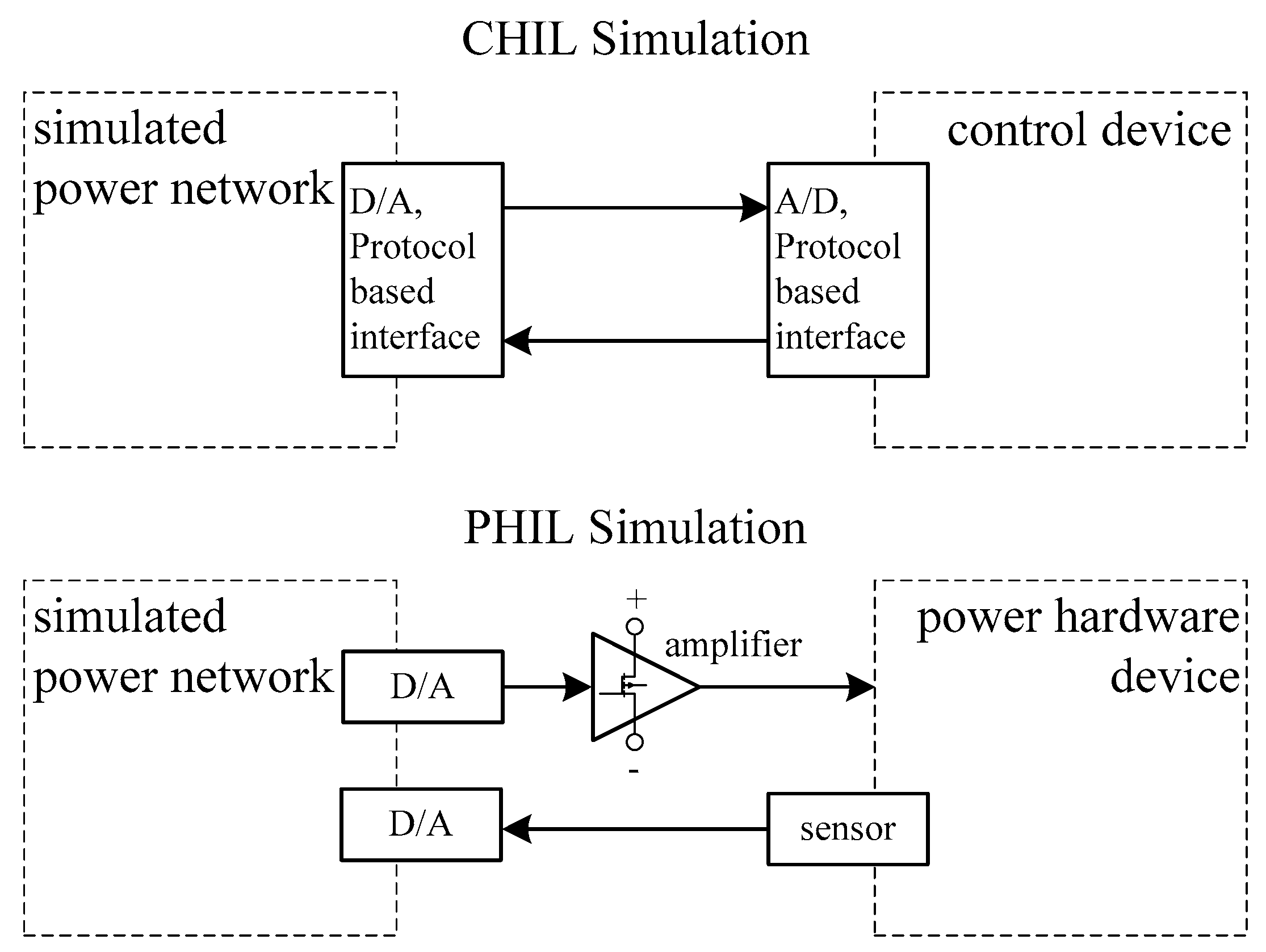
3.2. Hardware in the Loop Testing of FACTS
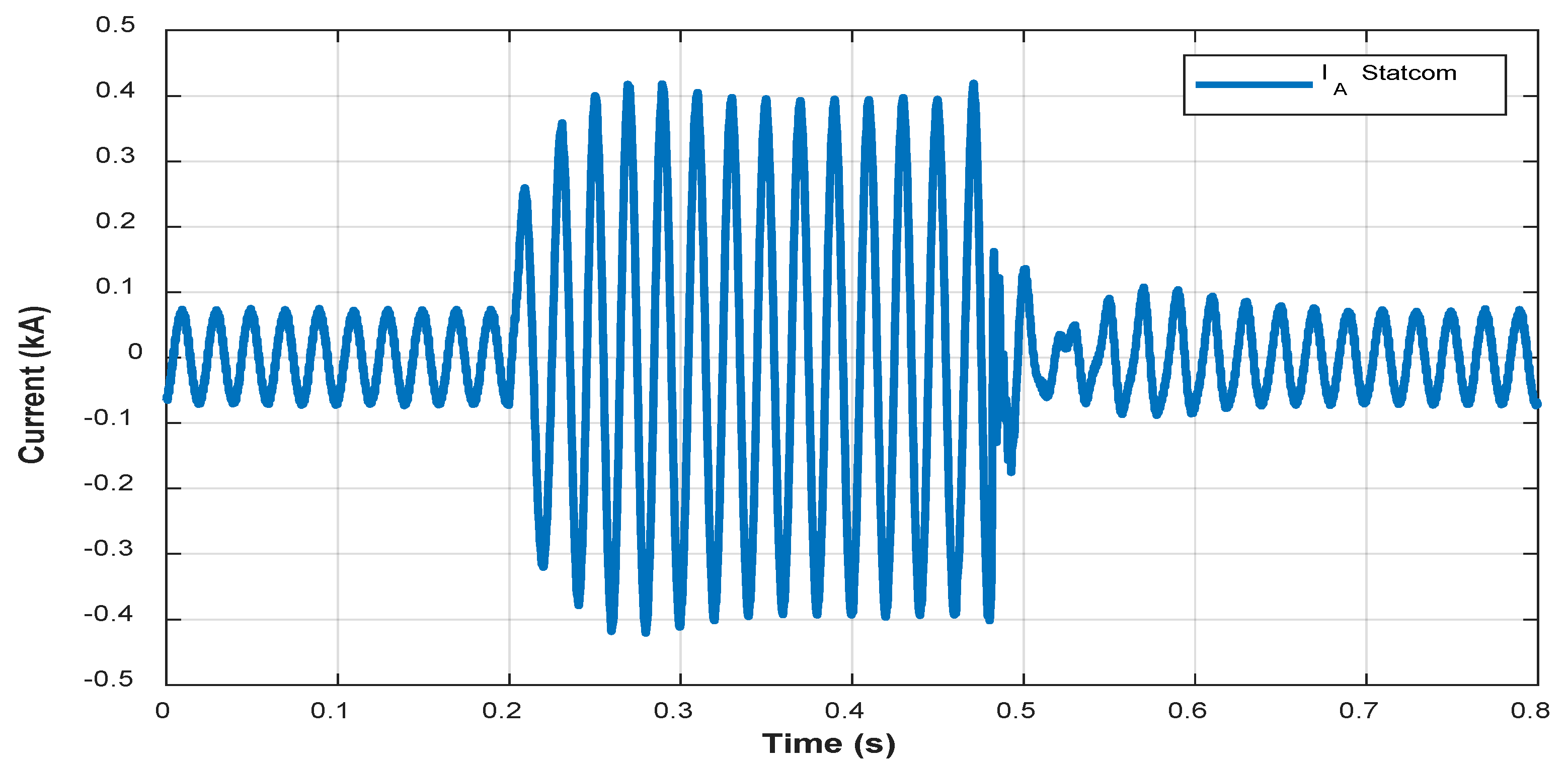
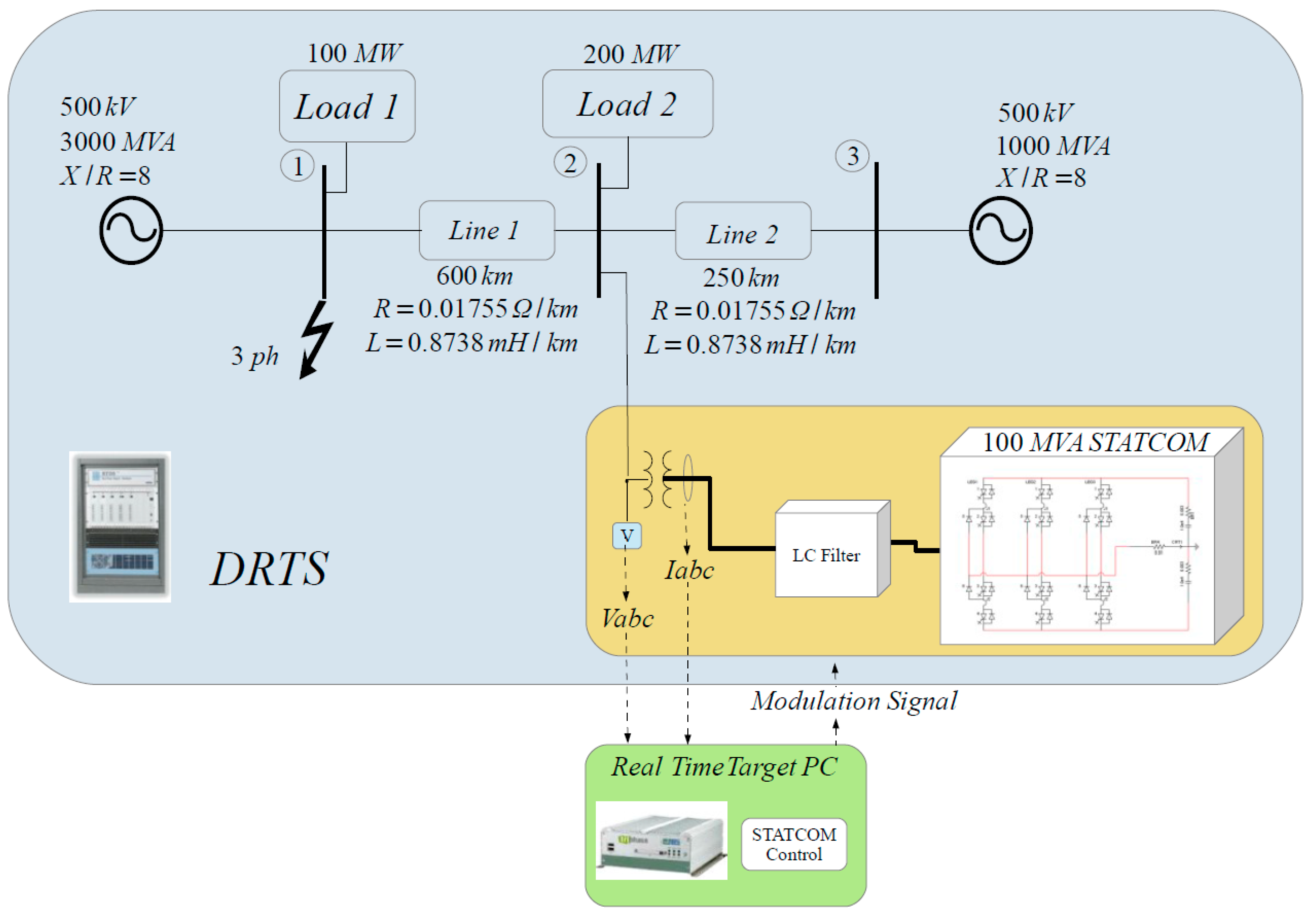
3.3. Testing Results
3.3.1. Controller Hardware in the Loop Tests
3.3.2. Power Hardware in the Loop Tests
4. Discussion
Author Contributions
Funding
Conflicts of Interest
References
- Lopes, J.P.; Hatziargyriou, N.; Mutale, J.; Djapic, P.; Jenkins, N. Integrating distributed generation into electric power systems: A review of drivers, challenges and opportunities. Electr. Power Syst. Res. 2007, 77, 1189–1203. [Google Scholar] [CrossRef]
- Strasser, T.; Andrén, F.; Kathan, J.; Cecati, C.; Buccella, C.; Siano, P.; Leitao, P.; Zhabelova, G.; Vyatkin, V.; Vrba, P.; et al. A review of architectures and concepts for intelligence in future electric energy systems. IEEE Trans. Ind. Electron. 2014, 62, 2424–2438. [Google Scholar] [CrossRef]
- Reza, M.; Slootweg, J.G.; Schavemaker, P.H.; Kling, W.L.; Van der Sluis, L. Investigating impacts of distributed generation on transmission system stability. In Proceedings of the IEEE Power Tech Conference, Bologna, Italy, 23–26 June 2003. [Google Scholar]
- Sullivan, D.; Buterbaugh, B.; Paramalingam, J.; Nakamura, F.; Paramalingam, J.; Nakamura, F.; Matsuda, A.; Yamanaka, D.; Tsuchiya, T. Application of FACTS Devices for a Dynamic Power System within the USA. In Proceedings of the International Power Electronics Conference (IPEC), Niigata, Japan, 20–24 May 2018. [Google Scholar]
- Georgilakis, P.S.; Hatziargyriou, N.D. Unified power flow controllers in smart power systems: models, methods, and future research. IET Smart Grid 2019, 2, 2–10. [Google Scholar] [CrossRef]
- Singh, B.; Saha, R.; Chandra, A.; Al-Haddad, K. Static synchronous compensators (STATCOM): A review. IET Power Electron. 2009, 2, 297–324. [Google Scholar] [CrossRef]
- Iravani, M.R.; Maratukulam, D. Review of semiconductor-controlled (static) phase shifters for power system applications. IEEE Trans. Power Syst. 1994, 9, 1833–1839. [Google Scholar] [CrossRef]
- Gandoman, F.H.; Ahmadi, A.; Sharaf, A.M.; Siano, P.; Pou, J.; Hredzak, B.; Agelidis, V.G. Review of FACTS technologies and applications for power quality in smart grids with renewable energy systems. Renew. Sustain. Energy Rev. 2018, 82, 502–514. [Google Scholar] [CrossRef]
- Singh, B.; Mukherjee, V.; Tiwari, P. A survey on impact assessment of DG and FACTS controllers in power systems. Renew. Sustain. Energy Rev. 2015, 42, 846–882. [Google Scholar] [CrossRef]
- Faruque, M.O.; Dinavahi, V.; Santoso, S.; Adapa, R. Review of electromagnetic transient models for non-VSC FACTS. IEEE Trans. Power Delivery 2005, 20, 1065–1079. [Google Scholar] [CrossRef]
- Faruque, M.O.; Strasser, T.; Lauss, G.; Jalili-Marandi, V.; Forsyth, P.; Dufour, C.; Dinavahi, V.; Monti, A.; Kotsampopoulos, P.; Martinez, J.A.; et al. Real-time simulation technologies for power systems design, testing, and analysis. IEEE Power Energy Technol. Syst. J. 2015, 2, 63–73. [Google Scholar] [CrossRef]
- Hingorani, N.G.; Gyugyi, L. Understanding FACTS: Concepts and technology of Flexible AC Transmission Systems; IEEE Press: Piscataway, NJ, USA, 2000; pp. 1–35. [Google Scholar]
- Meikandasivam, S.; Nema, R.K.; Jain, S.K. Fine power flow control by split TCSC. Int. J. Electr. Power Energy Syst. 2013, 45, 519–529. [Google Scholar] [CrossRef]
- Johansson, N.; Angquist, L.; Nee, H.P. An adaptive controller for power system stability improvement and power flow control by means of a thyristor switched series capacitor (TSSC). IEEE Trans. Power Syst. 2010, 25, 381–391. [Google Scholar] [CrossRef]
- Wang, L.; Vo, Q.S. Power flow control and stability improvement of connecting an offshore wind farm to a one-machine infinite-bus system using a static synchronous series compensator. IEEE Trans. Sustain. Energy 2013, 4, 358–369. [Google Scholar] [CrossRef]
- Liu, J.; Xu, Z.; Fei, W.; Chen, L.; Chen, B.; Chen, B. Comprehensive power flow analyses and novel feedforward coordination control strategy for MMC-based UPFC. Energies 2019, 12, 824. [Google Scholar] [CrossRef]
- Yuan, J.; Liu, L.; Xiao, L. Hybrid electromagnetic unified power flow controller: A novel flexible and effective approach to control power flow. IEEE Trans. Power Delivery 2018, 33, 2061–2069. [Google Scholar] [CrossRef]
- Georgantzis, G.J.; Hatziargyriou, N.D.; Leonidaki, E.A.; Papadias, B.C.; Vlachogiannis, J.G. Application of thyristor controlled series capacitor to load flow redistribution in the Hellenic transmission system. In Proceedings of the International Conference on Electric Power Engineering PowerTech, Budapest, Hungary, 29 August–2 September 1999. [Google Scholar]
- Besharat, H.; Taher, S.A. Congestion management by determining optimal location of TCSC in deregulated power systems. Int. J. Electr. Power Energy Syst. 2008, 30, 563–568. [Google Scholar] [CrossRef]
- Lim, J.U.; Moon, S.I. An analytical approach for the operation of series compensators to relieve power flow congestion. Euro. Trans. Electr. Power 2003, 13, 247–252. [Google Scholar] [CrossRef]
- Reddy, A.K.; Singh, S.P. Congestion mitigation using UPFC. IET Gener. Transm. Distrib. 2016, 10, 2433–2442. [Google Scholar]
- Chong, B.; Zhang, X.P.; Godfrey, K.R.; Yao, K.R.; Yao, L.; Bazargan, M. Optimal location of unified power flow controller for congestion management. Euro. Trans. Electr. Power 2010, 20, 600–610. [Google Scholar] [CrossRef]
- Bhattacharyya, B.; Gupta, V.K. Fuzzy based evolutionary algorithm for reactive power optimization with FACTS devices. Int. J. Electr. Power Energy Syst. 2014, 61, 39–47. [Google Scholar] [CrossRef]
- Preedavichit, P.; Srivastava, S.C. Optimal reactive power dispatch considering FACTS devices. Electr. Power Syst. Res. 1998, 46, 251–257. [Google Scholar] [CrossRef]
- Dutta, S.; Mukhopadhyay, P.; Roy, P.K.; Nandi, D. Unified power flow controller based reactive power dispatch using oppositional krill herd algorithm. Int. J. Electr. Power Energy Syst. 2016, 80, 10–25. [Google Scholar] [CrossRef]
- Thukaram, D.; Yesuratham, G. Optimal reactive power dispatch in a large power system with AC-DC and FACTS controllers. IET Gener. Transm. Distrib. 2008, 2, 71–81. [Google Scholar] [CrossRef]
- Sawhney, H.; Jeyasurya, B. Application of unified power flow controller for available transfer capability enhancement. Electr. Power Syst. Res. 2004, 69, 155–160. [Google Scholar] [CrossRef]
- Shahraei-Ardakani, M.; Blumsack, S.A. Transfer capability improvement through market-based operation of series FACTS devices. IEEE Trans. Power Syst. 2016, 31, 3702–3714. [Google Scholar] [CrossRef]
- Kumar, A.; Kumar, J. ATC with ZIP load model - A comprehensive evaluation with third generation FACTS in restructured electricity markets. Int. J. Electr. Power Energy Syst. 2014, 54, 546–558. [Google Scholar] [CrossRef]
- Xiao, Y.; Song, Y.H.; Liu, C.C.; Sun, Y.Z. Available transfer capability enhancement using FACTS devices. IEEE Trans. Power Syst. 2003, 18, 305–312. [Google Scholar] [CrossRef]
- Jirapong, P.; Ongsakul, W. Optimal placement of multi-type FACTS devices for total transfer capability enhancement using hybrid evolutionary algorithm. Electr. Power Compon. Syst. 2007, 35, 981–1005. [Google Scholar] [CrossRef]
- Leonidaki, E.; Hatziargyriou, N.; Manos, G.; Papadias, B. A systematic approach for effective location of series compensation to increase available transfer capability. In Proceedings of the IEEE PowerTech, Porto, Portugal, 10–13 September 2001. [Google Scholar]
- Leonidaki, E.A.; Georgiadis, D.P.; Hatziargyriou, N.D. Decision trees for determination of optimal location and rate of series compensation to increase power system loading margin. IEEE Trans. Power Syst. 2006, 21, 1303–1310. [Google Scholar] [CrossRef]
- Packiasudha, M.; Suja, S.; Jerome, J. A new cumulative gravitational search algorithm for optimal placement of FACT device to minimize system loss in the deregulated electrical power environment. Int. J. Electr. Power Energy Syst. 2017, 84, 34–46. [Google Scholar] [CrossRef]
- Singh, J.G.; Qazi, H.W.; Ghandhari, M. Load curtailment minimization by optimal placement of unified power flow controller. Int. Trans. Electr. Energ. Syst. 2016, 26, 2272–2284. [Google Scholar] [CrossRef]
- Nasri, A.; Conejo, A.J.; Kazempour, S.J.; Ghandhari, M. Minimizing wind power spillage using an OPF with FACTS devices. IEEE Trans. Power Syst. 2014, 29, 2150–2159. [Google Scholar] [CrossRef]
- Tang, Y.; Liu, Y.; Ning, J.; Zhao, J. Multi-time scale coordinated scheduling strategy with distributed power plow controllers for minimizing wind power spillage. Energies 2017, 10, 1804. [Google Scholar] [CrossRef]
- Rasoulzadeh-Akhijahani, A.; Mosallanejad, A. Analyzing TCSC and SVC effects in wind power curtailment mitigation. Int. Trans. Electr. Energ. Syst. 2016, 26, 2445–2462. [Google Scholar] [CrossRef]
- Kapetanaki, A.; Levi, V.; Buhari, M.; Schachter, J.A. Maximization of wind energy utilization through corrective scheduling and FACTS deployment. IEEE Trans. Power Syst. 2017, 32, 4764–4773. [Google Scholar] [CrossRef]
- Li, S.; Ding, M.; Wang, J.; Zhang, W. Voltage control capability of SVC with var dispatch and slope setting. Electr. Power Syst. Res. 2009, 79, 818–825. [Google Scholar] [CrossRef]
- Varma, R.K.; Siavashi, E.M. PV-STATCOM: A new smart inverter for voltage control in distribution systems. IEEE Trans. Sustain. Energy 2018, 9, 1681–1691. [Google Scholar] [CrossRef]
- Liu, J.Y.; Song, Y.H.; Mehta, P.A. Strategies for handling UPFC constraints in steady state power flow and voltage control. IEEE Trans. Power Syst. 2000, 15, 566–571. [Google Scholar]
- Sao, W.; Vittal, V. LP-based OPF for corrective FACTS control to relieve overloads and voltage violations. IEEE Trans. Power Syst. 2006, 21, 1832–1839. [Google Scholar] [CrossRef]
- Faried, S.O.; Billinton, R.; Aboreshaid, S. Probabilistic technique for sizing FACTS devices for steady state voltage profile enhancement. IET Gener. Transm. Distrib. 2009, 3, 385–392. [Google Scholar] [CrossRef]
- Liao, H.; Milanovic, J.V. On capability of different FACTS devices to mitigate a range of power quality phenomena. IET Gener. Transm. Distrib. 2017, 11, 1202–1211. [Google Scholar] [CrossRef]
- Goswami, A.K.; Gupta, C.P.; Singh, G.K. Minimization of voltage sag induced financial losses in distribution systems using FACTS devices. Electr. Power Syst. Res. 2011, 81, 767–774. [Google Scholar] [CrossRef]
- Milanovic, J.V.; Zhang, Y. Global minimization of financial losses due to voltage sags with FACTS based devices. IEEE Trans. Power Delivery 2010, 25, 298–306. [Google Scholar] [CrossRef]
- Enslin, J.H.R.; Zhao, J.; Spee, R. Operation of the unified power flow controller as harmonic isolator. IEEE Trans. Power Electron. 1996, 11, 776–784. [Google Scholar] [CrossRef]
- Rajabi-Ghahnavieh, A.; Fotuhi-Firuzabad, M.; Shahidehpour, M.; Feuillet, R. UPFC for enhancing power system reliability. IEEE Trans. Power Delivery 2010, 25, 2881–2890. [Google Scholar] [CrossRef]
- Zarghami, M.; Crow, M.L.; Jagannathan, S. Nonlinear control of FACTS controllers for damping interarea oscillations in power systems. IEEE Trans. Power Delivery 2010, 25, 3113–3121. [Google Scholar] [CrossRef]
- Du, W.; Wu, X.; Wang, H.F.; Dunn, R. Feasibility study to damp power system multi-mode oscillations by using a single FACTS device. Int. J. Electr. Power Energy Syst. 2010, 32, 645–655. [Google Scholar] [CrossRef]
- Pal, B.C. Robust damping of interarea oscillations with unified power-flow controller. IEE Proc. Gener. Transm. Distrib. 2002, 149, 733–738. [Google Scholar] [CrossRef]
- Cong, L.; Wang, Y. Co-ordinated control of generator excitation and STATCOM for rotor angle stability and voltage regulation enhancement of power systems. IEE Proc. Gener. Transm. Distrib. 2002, 149, 659–666. [Google Scholar] [CrossRef]
- Esparza, A.; Segundo, J.; Nunez, C.; Visairo, N.; Barocio, E.; Garcia, H. Transient stability enhancement using a wide-area controlled SVC: An HIL validation approach. Energies 2018, 11, 1639. [Google Scholar] [CrossRef]
- Kanchanaharuthai, A.; Chankong, V.; Loparo, K.A. Transient stability and voltage regulation in multimachine power systems vis-a-vis STATCOM and battery energy storage. IEEE Trans. Power Syst. 2015, 30, 2404–2416. [Google Scholar] [CrossRef]
- Mihalic, R.; Zunko, P.; Povh, D. Improvement of transient stability using unified power flow controller. IEEE Trans. Power Delivery 1996, 11, 485–492. [Google Scholar] [CrossRef]
- Gholipour, E.; Saadate, S. Improving of transient stability of power systems using UPFC. IEEE Trans. Power Delivery 2005, 10, 1677–1682. [Google Scholar] [CrossRef]
- Movahedi, A.; Niasar, A.H.; Gharehpetian, G.B. Designing SSSC, TCSC, and STATCOM controllers using AVURPSO, GSA, and GA for transient stability improvement of a multi-machine power system with PV and wind farms. Int. J. Electr. Power Energy Syst. 2019, 106, 455–466. [Google Scholar] [CrossRef]
- Mansour, Y.; Xu, W.; Alvarado, F.; Rinzin, C. SVC placement using critical modes of voltage instability. IEEE Trans. Power Syst. 1994, 9, 757–763. [Google Scholar] [CrossRef]
- Kumar, G.N.; Kalavathi, M.S. Cat swarm optimization for optimal placement of multiple UPFC’s in voltage stability enhancement under contingency. Int. J. Electr. Power Energy Syst. 2014, 57, 97–104. [Google Scholar] [CrossRef]
- Yorino, N.; El-Araby, E.E.; Sasaki, H.; Harada, S. A new formulation for FACTS allocation for security enhancement against voltage collapse. IEEE Trans. Power Syst. 2003, 18, 3–10. [Google Scholar] [CrossRef]
- Gasperic, S.; Mihalic, R. The impact of serial controllable FACTS devices on voltage stability. Int. J. Electr. Power Energy Syst. 2015, 64, 1040–1048. [Google Scholar] [CrossRef]
- Gasperic, S.; Mihalic, R. Estimation of the efficiency of FACTS devices for voltage-stability enhancement with PV area criteria. Renew. Sustain. Energy Rev. 2019, 105, 144–156. [Google Scholar] [CrossRef]
- Leonidaki, E.A.; Manos, G.A.; Hatziargyriou, N.D. An effective method to locate series compensation for voltage stability enhancement. Electr. Power Syst. Res. 2005, 74, 73–81. [Google Scholar] [CrossRef]
- Galvani, S.; Hagh, M.T.; Sarifian, M.B.B.; Mahammadi-Ivatloo, B. Multiobjective predictability-based optimal placement and parameters setting of UPFC in wind power included power systems. IEEE Trans. Ind. Inf. 2009, 15, 878–888. [Google Scholar] [CrossRef]
- Tripathy, M.; Mishra, S. Bacteria foraging-based solution to optimize both real power loss and voltage stability limit. IEEE Trans. Power Syst. 2007, 22, 240–248. [Google Scholar] [CrossRef]
- Benabid, R.; Boudour, M.; Abido, M.A. Optimal location and setting of SVC and TCSC devices using non-dominated sorting particle swarm optimization. Electr. Power Syst. Res. 2009, 79, 1668–1677. [Google Scholar] [CrossRef]
- Lashkar Ara, A.; Kazemi, A.; NabaviNiaki, S.A. Multiobjective optimal location of FACTS shunt-series controllers for power system operation planning. IEEE Trans. Power Delivery 2012, 27, 481–490. [Google Scholar] [CrossRef]
- Bhattacharyya, B.; Kumar, S. Approach for the solution of transmission congestion with multi-type FACTS devices. IET Gener. Transm. Distrib. 2016, 10, 2802–2809. [Google Scholar] [CrossRef]
- Brundlinger, R.; Strasser, T.; Lauss, G.; Hoke, A.; Chakraborty, S.; Martin, G.; Kroposki, B.; Johnson, J.; de Jong, E. Lab tests: Verifying that smart grid power converters are truly smart. IEEE Power Energy Mag. 2015, 13, 30–42. [Google Scholar] [CrossRef]
- Kotsampopoulos, P.; Hatziargyriou, N.; Bletterie, B.; Lauss, G.; Strasser, T. Introduction of advanced testing procedures including PHIL for DG providing ancillary services. In Proceedings of the 39th Annual Conference of the IEEE Industrial Electronics Society (IECON), Vienna, Austria, 10–13 November 2013. [Google Scholar]
- Sullivan, D.; Mader, D. Fundamentals and Characteristics of Dynamic Reactive Power Control. In Proceedings of the IEEE PES Webinar, 18 December 2018. [Google Scholar]
- IEEE. IEEE 1031:2011. IEEE Guide for the Functional Specification of Transmission Static Var Compensators; IEEE: Piscataway, NJ, USA, 2011. [Google Scholar]
- IEEE. IEEE P1052/08. IEEE Approved Draft Guide for the Functional Specifications for Transmission Static Synchronous Compensator (STATCOM) Systems; IEEE: Piscataway, NJ, USA, 2018. [Google Scholar]
- IEC. IEC 61954:2011. Static var Compensators (SVC)—Testing of Thyristor Valves; International Electrotechnical Commission: Geneva, Switzerland, 2011. [Google Scholar]
- IEC. IEC 62927:2017. Voltage Sourced Converter (VSC) Valves for Static Synchronous Compensator (STATCOM)—Electrical Testing; International Electrotechnical Commission: Geneva, Switzerland, 2017. [Google Scholar]
- IEEE. IEEE 1303:2011. IEEE Guide for Static Var Compensator Field Tests; IEEE: Piscataway, NJ, USA, 2011. [Google Scholar]
- IEEE. IEEE 1676:2010. IEEE Guide for Control Architecture for High Power Electronics (1 MW and Greater) Used in Electric Power Transmission and Distribution Systems; IEEE: Piscataway, NJ, USA, 2010. [Google Scholar]
- IEEE. IEEE 1534:2009. IEEE Recommended Practice for Specifying Thyristor-Controlled Series Capacitors; IEEE: Piscataway, NJ, USA, 2009. [Google Scholar]
- IEEE. IEEE P2745.1. IEEE Draft Guide for Technology of Unified Power Flow Controller Using Modular Multilevel Converter: Part 1 Functions; IEEE: Piscataway, NJ, USA, 2018. [Google Scholar]
- IEEE. IEEE 857:1996. IEEE Recommended Practice for Test Procedures for High-Voltage Direct-Current Thyristor Valves; IEEE: Piscataway, NJ, USA, 1996. [Google Scholar]
- IEC. IEC 60700-1:2015. Thyristor Valves for high Voltage Direct Current (HVDC) Power Transmission—Part 1: Electrical Testing; International Electrotechnical Commission: Geneva, Switzerland, 2015. [Google Scholar]
- IEC. IEC 62501:2009. Voltage Sourced Converter (VSC) Valves for High-Voltage Direct Current (HVDC) Power Transmission—Electrical Testing; International Electrotechnical Commission: Geneva, Switzerland, 2009. [Google Scholar]
- Tang, G.; Zha, K.; He, Z.; Wang, H. Study on operational tests for FACTS thyristor valves. IEEE Trans. Power Delivery. 2013, 28, 1525–1532. [Google Scholar] [CrossRef]
- Lal, G.; Dutta, D.; Arunachalam, M. Design and testing of thyristor valves of TCSC for Kanpur-Ballabhgarh 400 kV line. In Proceedings of the IEEE/PES Transmission and Distribution Conference and Exposition, Chicago, IL, USA, 21–24 April 2008. [Google Scholar]
- Chivite-Zabalza, F.J.; Izurza, P.; Calvo, G.; Rodriguez, M.A. Laboratory tests of the voltage source converter for a 47 MVAR Series Static Synchronous Compensator for the Spanish high voltage transmission grid. In Proceedings of the 7th IET International Conference on Power Electronics, Machines and Drives (PEMD 2014), Manchester, UK, 8–10 April 2014. [Google Scholar]
- Sato, T.; Matsushita, Y.; Temma, K.; Morishima, N.; Iyoda, I. Prototype test of STATCOM and BTB based on voltage source converter using GCT thyristor. In Proceedings of the IEEE/PES Transmission and Distribution Conference and Exhibition, Yokohama, Japan, 6–10 October 2002. [Google Scholar]
- Valdez-Resendiz, J.E.; Mayo-Maldonado, J.C.; Rosas-Caro, J.C.; Alejo-Reyes, A.; Llamas-Terres, A.; Valderrabano-Gonzalez, A.; Del-Valle-Soto, C.; Valdivia, L.J. Energy Recycling Laboratory Experimental Test Bench for Three-Phase FACTS Devices Prototypes. In Proceedings of the International Conference on Electronics, Communications and Computers (CONIELECOMP), Cholula, Mexico, 27 February–1 March 2019. [Google Scholar]
- Hauer, J.F.; Mittelstadt, W.A.; Piwko, R.J.; Damsky, B.L.; Eden, J.D. Modulation and SSR tests performed on the BPA 500 kV thyristor controlled series capacitor unit at Slatt substation. IEEE Trans. Power Syst. 1996, 11, 801–806. [Google Scholar] [CrossRef]
- O’Connor, J.; Reed, G.F.; Sullivan, D.; Shimokaji, N.; Birsa, J. Testing and Commissioning Experiences for the Duke Energy Progress Static VAR Compensator at Jacksonville, NC. In Proceedings of the IEEE PES T&D Conference and Exposition, Chicago, IL, USA, 14–17 April 2014. [Google Scholar]
- Geraldes, W.; Rose, E.H.; Machado, C.; Honda, J.T.; Vendramini, P.M. Static VAR compensator from Coxipo Substation (Brazil)-comparison between computer simulations and field tests. In Proceedings of the International Conference on AC and DC Power Transmission, London, UK, 17–20 September 1991. [Google Scholar]
- Kandula, R.P.; Chen, H.; Prasai, A.; Lambert, F.; Heidel, T.; Schauder, C.; Schatz, J.; Powell, T.; Divan, D. Field test results for a 3-phase 12.47 kV 1 MVA power router. In Proceedings of the IEEE Energy Conversion Congress and Exposition (ECCE), Milwaukee, WI, USA, 18–22 September 2016. [Google Scholar]
- He, S.; Zhou, X.; Liu, J. Large load disturbance test of south Gansu power grid based on WAMS. In Proceedings of the International Conference on Advanced Power System Automation and Protection, Beijing, China, 16–20 October 2011. [Google Scholar]
- Hauer, J.F.; Mittelstadt, W.A.; Piwko, R.J.; Damsky, B.L.; Eden, J.D. Test results and initial operating experience for the BPA 500 kV thyristor controlled series capacitor-modulation, SSR and performance monitoring. In Proceedings of the IEEE Technical Applications Conference and Workshops, Northcon/95, Portland, OR, USA, 10–12 October 1995. [Google Scholar]
- Kinney, S.J.; Mittelstadt, W.A.; Suhrbier, R.W. Test results and initial operating experience for the BPA 500 kV thyristor controlled series capacitor design, operation, and fault test results. In Proceedings of the IEEE Technical Applications Conference and Workshops, Northcon/95, Portland, OR, USA, 10–12 October 1995. [Google Scholar]
- Kalsi, S.S.; Madura, D.; Snitchler, G.; Ross, M.; Voccio, J.; Ingram, M. Discussion of test results of a superconductor synchronous condenser on a utility grid. IEEE Trans. Appl. Supercond. 2007, 17, 2026–2029. [Google Scholar] [CrossRef]
- Steurer, M.; Edrington, C.S.; Sloderbeck, M.; Ren, W.; Langston, J. A megawatt-scale power hardware-in-the-loop simulation setup for motor drives. IEEE Trans. Ind. Electron. 2010, 57, 1254–1260. [Google Scholar] [CrossRef]
- Molitor, C.; Benigni, A.; Helmedag, A.; Chen, K.; Calì, D.; Jahangiri, P.; Muller, D.; Monti, A. Multiphysics test bed for renewable energy systems in smart homes. IEEE Trans. Ind. Electron. 2013, 60, 1235–1248. [Google Scholar] [CrossRef]
- Lauss, G.F.; Faruque, M.O.; Schoder, K.; Dufour, C.; Viehweider, A.; Langston, J. Characteristics and design of power hardware-in-the-loop simulations for electrical power systems. IEEE Trans. Ind. Electron. 2015, 63, 406–417. [Google Scholar] [CrossRef]
- Maniatopoulos, M.; Lagos, D.; Kotsampopoulos, P.; Hatziargyriou, N. Combined control and power hardware in-the-loop simulation for testing smart grid control algorithms. IET Gener. Transm. Distrib. 2017, 11, 3009–3018. [Google Scholar] [CrossRef]
- Kotsampopoulos, P.; Lagos, D.; Hatziargyriou, N.; Faruque, M.O.; Lauss, G.; Nzimako, O.; Forsyth, P.; Steurer, M.; Ponci, F.; Monti, A.; et al. A Benchmark System for Hardware-in-the-Loop Testing of Distributed Energy Resources. IEEE Power Energy Technol. Syst. J. 2018, 5, 94–103. [Google Scholar] [CrossRef]
- Kuffel, R.; Forsyth, P.; Peters, C. The Role and Importance of Real Time Digital Simulation in the Development and Testing of Power System Control and Protection Equipment. IFAC-PapersOnLine 2016, 49, 178–182. [Google Scholar] [CrossRef]
- Iyoda, I.; Belanger, J. History of Power System Simulators to Analyze and Test of Power Electronics Equipment. In Proceedings of the IEEE History of Electrotechnolgy conference (HISTELCON), Kobe, Japan, 7–8 August 2017. [Google Scholar]
- Yoon, Y.B.; Kim, T.K.; Cha, S.T.; Kuffel, R.; Wierckx, R.; Yu, M. HVDC control and protection testing using the RTDS simulator. In Proceedings of the 4th International HVDC Transmission Operating Conference, Yichang, China, 6–8 September 2001. [Google Scholar]
- Xiao, X.; Zhao, Y.; Zhang, Y.; Ye, M.; Wang, X. Closed loop test platform for SVC controller based on RTDS. In Proceedings of the International Conference on Electrical Machines and Systems, Wuhan, China, 17–20 October 2008. [Google Scholar]
- Boshoff, S.; van Dyk, C.; Becker, L.; Halonen, M.; Rudin, S.; Lidholm, J.; Maguire, T. Auas SVC, performance verification by RTDS and field tests. In Proceedings of the Seventh International Conference on AC-DC Power Transmission, London, UK, 28–30 November 2001. [Google Scholar]
- Musleh, A.S.; Muyeen, S.M.; Al-Durra, A.; Kamwa, I. Testing and validation of wide-area control of STATCOM using real-time digital simulator with hybrid HIL–SIL configuration. IET Gener. Transm. Distrib. 2017, 11, 3039–3049. [Google Scholar] [CrossRef]
- Guillaud, X.; Faruque, M.O.; Teninge, A.; Hariri, A.H.; Vanfretti, L.; Paolone, M.; Dinavahi, V.; Mitra, P.; Lauss, G.; Dufour, C.; et al. Applications of real-time simulation technologies in power and energy systems. IEEE Power Energy Technol. Syst. J. 2015, 2, 103–115. [Google Scholar] [CrossRef]
- Cowan, I.L.; Marshall, S.C.M. Installation and interfacing HVDC control replicas at the national HVDC centre. In Proceedings of the 15th IET International Conference on AC and DC Power Transmission (ACDC 2019), Coventry, UK, 5–7 February 2019. [Google Scholar]
- Saad, H. System Studies of HVDC links using Real-Time Simulation. In Vortragsreihe des Vereins Freunde des Instituts für Stromrichtertechnik und Antriebsregelung; Technische Universität Darmstadt: Darmstadt, Germany, 2018. [Google Scholar]
- Saad, H.; Vernay, Y.; Dennetière, S.; Rault, P.; Clerc, B. System dynamic studies of power electronics devices with real time simulation—A TSO operational experience. In CIGRE Session Papers & Proceedings; E-Cigré: Paris, France, 2018. [Google Scholar]
- Martin, C. The use of real time simulation to de-risk and manage HVDC and FACTS schemes—Experiences on the French Transmission grid. In Proceedings of the OPAL-RT’s 9th International Conference on Real-Time Simulation, Montreal, QC, Canada, 5–8 September 2017. [Google Scholar]
- Kotsampopoulos, P.C.; Kleftakis, V.A.; Hatziargyriou, N.D. Laboratory education of modern power systems using PHIL simulation. IEEE Trans. Power Syst. 2017, 32, 3992–4001. [Google Scholar] [CrossRef]
- Kleftakis, V.; Rigas, A.; Vassilakis, A.; Kotsampopoulos, P.; Hatziargyriou, N. Power-Hardware-in-the-loop simulation of a D-STATCOM equipped MV network interfaced to an actual PV inverter. In Proceedings of the IEEE PES Innovative Smart Grid Technologies Europe (ISGT Europe), Lyngby, Denmark, 6–9 October 2013. [Google Scholar]
- Vodyakho, O.; Edrington, C.S.; Steurer, M.; Azongha, S.; Fleming, F. Synchronization of three-phase converters and virtual microgrid implementation utilizing the power-hardware-in-the-loop concept. In Proceedings of the Twenty-Fifth Annual IEEE Applied Power Electronics Conference and Exposition (APEC), Palm Springs, CA, USA, 21–25 February 2010. [Google Scholar]
- Koralewicz, P.; Gevorgian, V.; Wallen, R. Multi-megawatt-scale Power-hardware-in-the-loop interface for testing ancillary grid services by converter-coupled generation. In Proceedings of the IEEE 18th Workshop on Control and Modeling for Power Electronics (COMPEL), Stanford, CA, USA, 9–12 July 2017. [Google Scholar]
- Product Note—ACS 6000 Grid Simulator. Available online: https://library.e.abb.com/public/19178deab3265e81c1257abf002e9e4a/ACS%206000%20grid%20simulator_lowres.pdf (accessed on 14 May 2019).
- Ren, W.; Steurer, M.; Baldwin, T.L. Improve the stability and the accuracy of power hardware-in-the-loop simulation by selecting appropriate interface algorithms. IEEE Trans. Ind. Appl. 2008, 44, 1286–1294. [Google Scholar] [CrossRef]
- Kotsampopoulos, P.C.; Lehfuss, F.; Lauss, G.F.; Bletterie, B.; Hatziargyriou, N.D. The limitations of digital simulation and the advantages of PHIL testing in studying distributed generation provision of ancillary services. IEEE Trans. Ind. Electron. 2015, 62, 5502–5515. [Google Scholar] [CrossRef]
- Yazdani, A.; Iravani, R. A generalized state-space averaged model of the three-level NPC converter for systematic DC-voltage-balancer and current-controller design. IEEE Trans. Power Delivery. 2005, 20, 1105–1114. [Google Scholar] [CrossRef]

© 2019 by the authors. Licensee MDPI, Basel, Switzerland. This article is an open access article distributed under the terms and conditions of the Creative Commons Attribution (CC BY) license (http://creativecommons.org/licenses/by/4.0/).
Share and Cite
Kotsampopoulos, P.; Georgilakis, P.; Lagos, D.T.; Kleftakis, V.; Hatziargyriou, N. FACTS Providing Grid Services: Applications and Testing. Energies 2019, 12, 2554. https://doi.org/10.3390/en12132554
Kotsampopoulos P, Georgilakis P, Lagos DT, Kleftakis V, Hatziargyriou N. FACTS Providing Grid Services: Applications and Testing. Energies. 2019; 12(13):2554. https://doi.org/10.3390/en12132554
Chicago/Turabian StyleKotsampopoulos, Panos, Pavlos Georgilakis, Dimitris T. Lagos, Vasilis Kleftakis, and Nikos Hatziargyriou. 2019. "FACTS Providing Grid Services: Applications and Testing" Energies 12, no. 13: 2554. https://doi.org/10.3390/en12132554
APA StyleKotsampopoulos, P., Georgilakis, P., Lagos, D. T., Kleftakis, V., & Hatziargyriou, N. (2019). FACTS Providing Grid Services: Applications and Testing. Energies, 12(13), 2554. https://doi.org/10.3390/en12132554