

Impacts of Demand-Side Management on Electrical Power Systems: A Review



Abstract
:1. Introduction
2. Overview of DSM Techniques
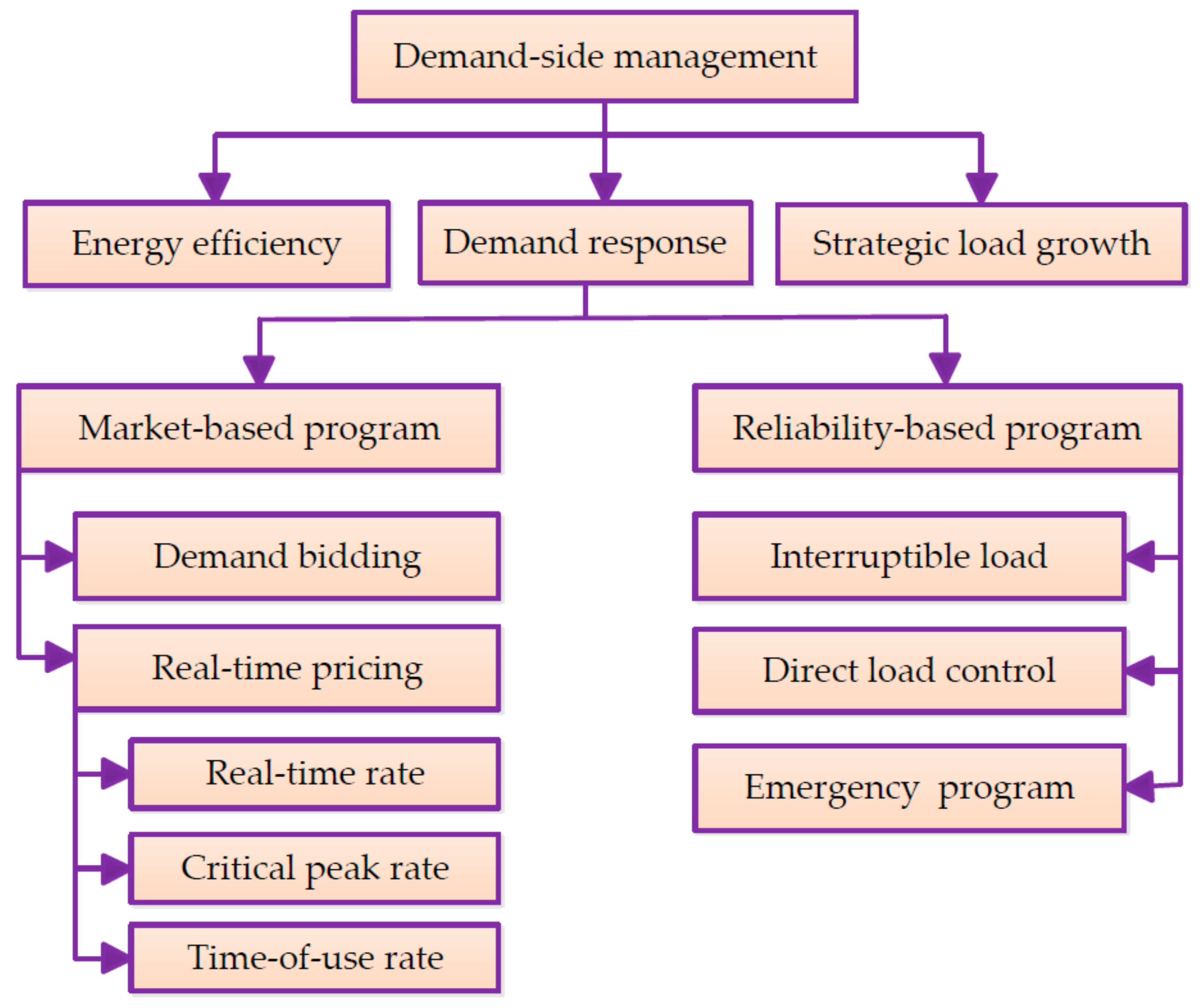
2.1. Energy Efficiency
- Adopting energy-efficient buildings and appliances to optimize energy consumption and encouraging the energy-conscious behavior of users [27].
- Improving the efficiency of power transmission and distribution networks by using (1) distributed generation; (2) advanced control systems for voltage regulation, three-phase balancing, power factor correction and data acquisition and analysis in supervisory control and data acquisition systems; (3) modern technologies, such as low-loss transformers, gas installation substations, smart metering and fiber-optics for data acquisition and (4) high-transmission voltages [27].
2.2. Demand Response
- Interruptible load program. This program is usually applied by large industrial and commercial consumers who can shut down their load for a short duration. In this program, consumers receive discounted electricity rates as compensation for accepting service interruptions. However, they can also be penalized if they do not participate in the program when required.
- Direct load control program. In this program, the utility is allowed to directly interrupt or reduce consumer power supply during peak demand times after consumers are notified. In return, interrupted consumers receive compensation [28].
- Emergency program. Consumers are given incentives to reduce their demand during system contingencies. In contrast to the interruptible load program, this program does not impose any penalties if consumers cannot participate [32].
- Demand bidding program: This program allows major consumers to bid for specific load curtailments. Consumers stay at a fixed rate and they receive high payments when wholesale electricity prices are high [28].
- Real-time pricing program: Electricity production costs fluctuate over time and average system costs are fixed without considering its undesirability, particularly for large commercial and industrial consumers. To address these issues, the real-time pricing program is introduced and implemented through the following [31]:
- Time-of-use rate. This rate is a predefined electricity price offered over a wide range of time periods, that is, seasonal, monthly, weekly or daily. The rate is voluntary and reflects basic production costs to decrease consumer demands during periods of high prices [28].
- Critical peak rate. This rate offers consumers dynamic pricing that reflects actual market costs during critical peaks. This rate is usually offered a day ahead of the expected peak and is predefined but may be dynamic when necessary. Critical peak pricing rates can be used to improve power system reliability because they reflect the system state. Hence, if appropriate critical peak pricing signals are sent out, consumers may participate by decreasing load during system-stress events [31].
- Real-time rate. In this program, consumers pay rates that are a function of actual market rates. Prices are usually supplied hourly or a day ahead to enable preplanning. Thus, rates will vary depending on the fluctuations in electricity supply [32].
2.3. Strategic Load Growth
3. Impacts of DSM on Power Systems
3.1. Electricity Market
3.2. Environment
3.3. Power System Operation
3.3.1. Voltage Stability
3.3.2. Transmission Congestion
3.3.3. Preventive Maintenance
3.3.4. Facility Upgrade
3.3.5. Renewable Energy Sources
3.3.6. Power System Flexibility
3.4. Power System Reliability
3.4.1. Impact of DSM on the HL1 Assessment of Power System Reliability
3.4.2. Impact of DSM on the HL2 Assessment of Power System Reliability
3.4.3. Impact of DSM on the Power System Distribution Network
4. Discussion
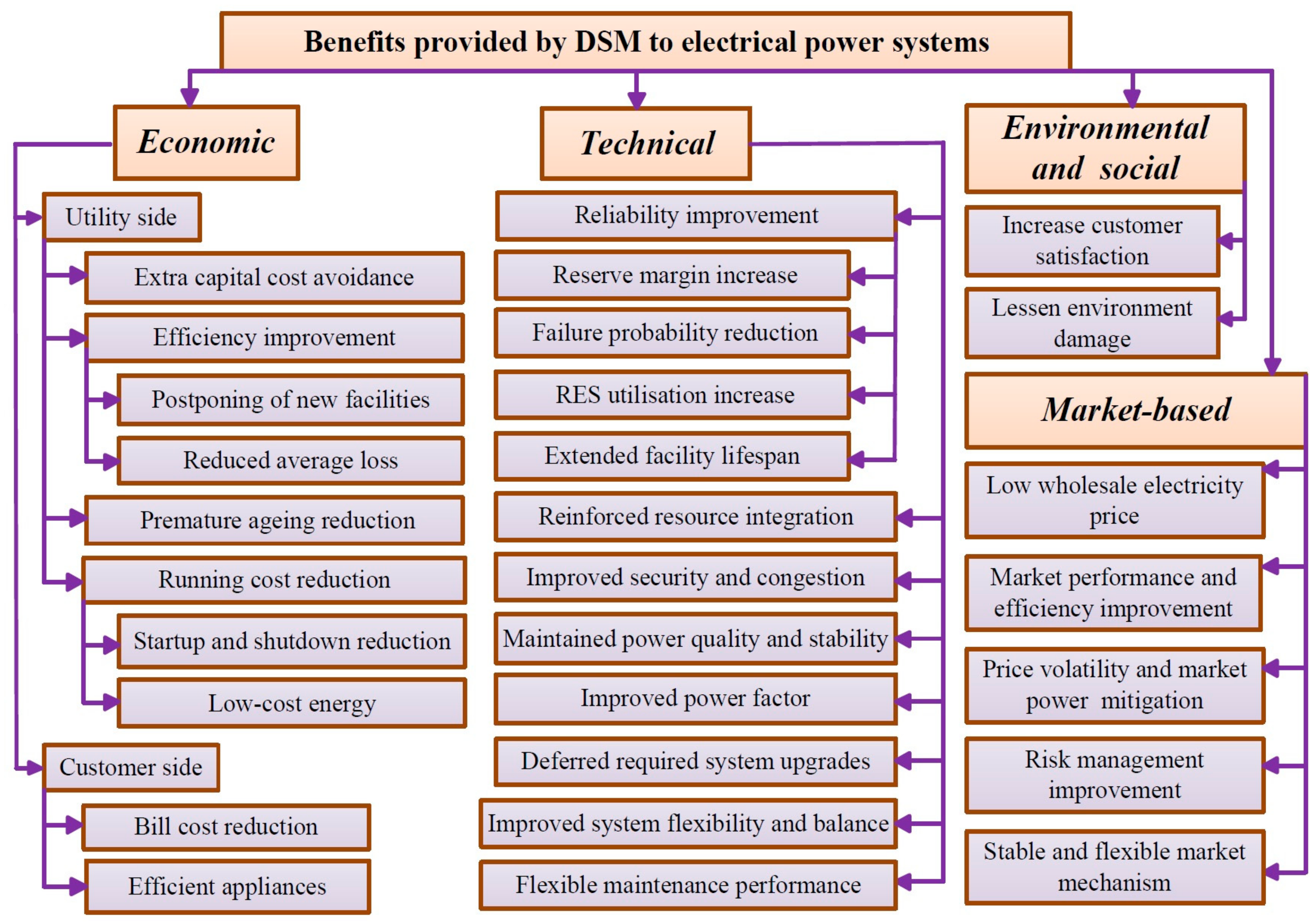
- DSM affects the economic, environmental and market-wide performances of electrical power systems. Nevertheless, few works have assessed the mutual benefits provided by DSM by comparing the impacts of DSM on the economic, environmental and market-wide performances of electrical power systems with those on the reliability of electrical power systems. Thus, many potential advantages of DSM have not been yet thoroughly and quantitatively explored.
- Electrical power system utilities and the electricity market have recently focused on resource integration to increase efficiency. The potentially significant role of DSM in energy resource integration must be considered.
- Energy efficiency is a promising trend because of its contribution to reducing long-term energy costs and its potential impacts on reliability enhancement. However, this issue has yet to be quantitatively explored.
- High-voltage DC transmission line systems are different from high-voltage AC transmission lines in many aspects, such as power flow, failure rate and contingencies. The impacts of DSM on the reliability of electrical power systems have not been examined from this perspective.
- The cost of implementing DSM activities has not been assessed in detail from the perspective of evaluating reliability worth/cost accurately in the presence of DSM. Given that DSM exhibits its own advantages and drawbacks, the possible defects of DSM must be carefully studied.
- The assumptions on the behavior of power systems (e.g., ageing effect, partial outage of generation units, duty cycle and failure initiation of peaking and intermittent operating units, uncertainties, multiarea systems, natural disasters, dynamic thermal ratings and scheduled maintenance) were not considered in most of the studies cited above. Forecast uncertainties (e.g., load magnitude and duration, fuel price, failure rate, DSM measures and renewable energy sources intermittency) in the presence of DSM are poorly investigated. Future works should thoroughly and quantitatively investigate these issues in the implementation of preventive and corrective load shifting.
- DSM programs increase the choices available to planners and decision makers by providing an alternative tool for power generation, transmission and distribution. An accurate assessment needs to be conducted when deciding to implement a DSM program or to build new generating units or transmission lines during expansion planning.
- DSM programs mitigate environmental damage by increasing the utilization of renewable energy sources, reducing the startup and shutdown of peaking and intermittent operating units and deferring the development of addition infrastructure to meet peak demand. Nevertheless, few studies have evaluated the environmental impacts of DSM.
- Other issues in the presence of load shaping should also be explored. These issues include finding the optimal level of reliability that corresponds to the optimal level of production cost and consumer satisfaction; exploring the application of the optimal ancillary service of DR as a spinning reserve over the MW spinning reserve; addressing the diversity of renewable energy sources, energy storage system types and applications and finding a fair rate for the DR program framework in the environment of the electricity market.
5. Conclusions
Acknowledgments
Author Contributions
Conflicts of Interest
References
- Billinton, R.; Allan, R.N. Reliability Evaluation of Power Systems 2013; Plenum: New York, NY, USA, 1984. [Google Scholar]
- Freeman, R. Managing energy: Reducing peak load and managing risk with demand response and demand side management. Refocus 2005, 6, 53–55. [Google Scholar] [CrossRef]
- Martínez-Lao, J.; Montoya, F.G.; Montoya, M.G.; Manzano-Agugliaro, F. Electric vehicles in Spain: An overview of charging systems. Renew. Sustain. Energy Rev. 2017, 77, 970–983. [Google Scholar] [CrossRef]
- Saini, S. Conservation v. generation: The significance of Demand-Side Management (DSM), its tools and techniques. Refocus 2004, 5, 52–54. [Google Scholar] [CrossRef]
- United Nations Industrial Development Organization. Supply Side Management—Module 13. Sustainable Energy Regulation and Policy Making for Africa. Available online: http://africa-toolkit.reeep.org/modules/Module13.pdf (accessed on 5 February 2018).
- Morgan, M.G.; Talukdar, S.N. Electric power load management: Some technical, economic, regulatory and social issues. Proc. IEEE 1979, 67, 241–312. [Google Scholar] [CrossRef]
- Sharifi, R.; Fathi, S.; Vahidinasab, V. A review on demand-side tools in electricity market. Renew. Sustain. Energy Rev. 2017, 72, 565–572. [Google Scholar] [CrossRef]
- Conchado, A.; Linares, P. The economic impact of demand-response programs on power systems. A survey of the state of the art. Handb. Netw. Power Syst. I 2012, WP 02/2010, 281–301. [Google Scholar]
- Shoreh, M.H.; Siano, P.; Shafie-khah, M.; Loia, V.; Catalão, J.P. A survey of industrial applications of demand response. Electr. Power Syst. Res. 2016, 141, 31–49. [Google Scholar] [CrossRef]
- Esther, B.P.; Kumar, K.S. A survey on residential demand side management architecture, approaches, optimization models and methods. Renew. Sustain. Energy Rev. 2016, 59, 342–351. [Google Scholar] [CrossRef]
- Khan, Z.A.; Ahmed, S.; Nawaz, R.; Mahmood, A.; Razzaq, S. Optimization based individual and cooperative DSM in Smart Grids: A review. Power Gener. Syst. Renew. Energy Technol. 2015, 2015, 1–6. [Google Scholar]
- Behrangrad, M. A review of demand side management business models in the electricity market. Renew. Sustain. Energy Rev. 2015, 47, 270–283. [Google Scholar] [CrossRef]
- Kirby, B.J. Demand response for power system reliability: FAQ. Oak Ridge Nat. Lab. 2006. [Google Scholar] [CrossRef]
- Hussain, I.; Mohsin, S.; Basit, A.; Khan, Z.A.; Qasim, U.; Javaid, N. A Review on Demand Response: Pricing, Optimization, and Appliance Scheduling. Procedia Comput. Sci. 2015, 52, 843–850. [Google Scholar] [CrossRef]
- Vardakas, J.S.; Zorba, N.; Verikoukis, C.V. A survey on demand response programs in smart grids: Pricing methods and optimization algorithms. IEEE Commun. Surv. Tutor. 2015, 17, 152–178. [Google Scholar] [CrossRef]
- Khan, A.R.; Mahmood, A.; Safdar, A.; Khan, Z.A.; Khan, N.A. Load forecasting, dynamic pricing and DSM in smart grid: A review. Renew. Sustain. Energy Rev. 2016, 54, 1311–1322. [Google Scholar] [CrossRef]
- Warren, P. A review of demand-side management policy in the UK. Renew. Sustain. Energy Rev. 2014, 29, 941–951. [Google Scholar] [CrossRef]
- Ming, Z.; Song, X.; Mingjuan, M.; Lingyun, L.; Min, C.; Yuejin, W. Historical review of demand side management in China: Management content, operation mode, results assessment and relative incentives. Renew. Sustain. Energy Rev. 2013, 25, 470–482. [Google Scholar] [CrossRef]
- Wang, Q.; Zhang, C.; Ding, Y.; Xydis, G.; Wang, J.; Østergaard, J. Review of real-time electricity markets for integrating distributed energy resources and demand response. Appl. Energy 2015, 138, 695–706. [Google Scholar] [CrossRef]
- Alasseri, R.; Tripathi, A.; Rao, T.J.; Sreekanth, K.J. A review on implementation strategies for demand side management (DSM) in Kuwait through incentive-based demand response programs. Renew. Sustain. Energy Rev. 2017, 77, 617–635. [Google Scholar] [CrossRef]
- Zehir, M.A.; Batman, A.; Bagriyanik, M. Review and comparison of demand response options for more effective use of renewable energy at consumer level. Renew. Sustain. Energy Rev. 2016, 56, 631–642. [Google Scholar] [CrossRef]
- Gellings, C.W. Evolving practice of demand-side management. J. Mod. Power Syst. Clean Energy 2017, 5, 1–9. [Google Scholar] [CrossRef]
- Limaye, D. Implementation of demand-side management programs. Proc. IEEE 1985, 73, 1503–1512. [Google Scholar] [CrossRef]
- Sim, S. Electric Utility Resource Planning: Economics, Reliability, and Decision-Making; CRC Press: Boca Raton, FL, USA, 2011; p. 332. [Google Scholar]
- United Nations Industrial Development Organization. Energy Efficiency Technologies and Benefits-Module 12. Sustainable Energy Regulation and Policy Making for Africa. Available online: Https://www.unido.org/fileadmin/media/documents/pdf/EEU_Training_Package/Module12.pdf (accessed on 9 February 2018).
- Bellarmine, G.T. Load management techniques. In Proceedings of the IEEE Southeastcon 2000, Nashville, TN, USA, 9 April 2000; pp. 139–145. [Google Scholar]
- Abaravicius, J. Demand Side Activities for Electric Load Reduction; Department of Energy Sciences, Lund University: Skanney, Sweden, 2007; p. 153.
- Qdr, Q. Benefits of Demand Response in Electricity Markets and Recommendations for Achieving Them; U.S. Department of Energy: Washington, DC, USA, 2006.
- Walawalkar, R.; Fernands, S.; Thakur, N.; Chevva, K.R. Evolution and current status of demand response (DR) in electricity markets: Insights from PJM and NYISO. Energy 2010, 35, 1553–1560. [Google Scholar] [CrossRef]
- Gellings, C.W. Standars Corner IEEE PES Demand-Side Management Subcommittee. IEEE Power Eng. Rev. 1986, PER-6, 9–12. [Google Scholar]
- York, D.; Kushler, M. Exploring the Relationship between Demand Response and Energy Efficiency: A Review of Experience and Discussion of Key Issues; American Council for an Energy-Efficient Economy: Washington, DC, USA, 2005. [Google Scholar]
- Demand Response Discussion for the 2007 Long-Term Reliability Assessment, North 109 American Electric Reliability Corporation of Site. Available online: http://www.naesb.org/pdf2/dsmee052407w4.pdf. (accessed on 19 February 2018).
- Juaidi, A.; Montoya, F.G.; Gázquez, J.A.; Manzano-Agugliaro, F. An overview of energy balance compared to sustainable energy in United Arab Emirates. Renew. Sustain. Energy Rev. 2016, 55, 1195–1209. [Google Scholar] [CrossRef]
- Delgado, R.M. Demand-side management alternatives. Proc. IEEE 1985, 73, 1471–1488. [Google Scholar] [CrossRef]
- Nguyen, D.H.; Narikiyo, T.; Kawanishi, M. Demand response collaborative management by a distributed alternating direction method of multipliers. Innov. Smart Grid Technol. 2016, 759–764. [Google Scholar] [CrossRef]
- Magnago, F.H.; Alemany, J.; Lin, J. Impact of demand response resources on unit commitment and dispatch in a day-ahead electricity market. Int. J. Electr. Power Energy Syst. 2015, 68, 142–149. [Google Scholar] [CrossRef]
- Aghaei, J.; Alizadeh, M.I.; Siano, P.; Heidari, A. Contribution of emergency demand response programs in power system reliability. Energy 2016, 103, 688–696. [Google Scholar] [CrossRef]
- Alham, M.H.; Elshahed, M.; Ibrahim, D.K.; El Zahab, E.E.D.A. Optimal operation of power system incorporating wind energy with demand side management. Ain Shams Eng. J. 2017, 8, 1–7. [Google Scholar] [CrossRef]
- Kinhekar, N.; Padhy, N.P.; Gupta, H.O. Multiobjective demand side management solutions for utilities with peak demand deficit. Int. J. Electr. Power Energy Syst. 2014, 55, 612–619. [Google Scholar] [CrossRef]
- Jalili, H.; Sheikh-El-Eslami, M.K.; Parsa Moghaddam, M. Reducing reliability cost in presence of renewables by demand side management resources. Int. Trans. Electr. Energy Syst. 2017, 27. [Google Scholar] [CrossRef]
- Martins, A.G.; Coelho, D.; Antunes, H.; Clímaco, J. A multiple objective linear programming approach to power generation planning with demand-side management (DSM). Int. Trans. Oper. Res. 1996, 3, 305–317. [Google Scholar] [CrossRef]
- Mollahassani-pour, M.; Abdollahi, A.; Rashidinejad, M. Investigation of market-based demand response impacts on security-constrained preventive maintenance scheduling. IEEE Syst. J. 2015, 9, 1496–1506. [Google Scholar] [CrossRef]
- Mollahassani-Pour, M.; Rashidinejad, M.; Abdollahi, A.; Forghani, M.A. Demand Response Resources’ Allocation in Security-Constrained Preventive Maintenance Scheduling via MODM Method. IEEE Syst. J. 2017, 11, 1196–1207. [Google Scholar] [CrossRef]
- Reddy, B.S.; Parikh, J.K. Economic and environmental impacts of demand side management programmes. Energy Policy 1997, 25, 349–356. [Google Scholar] [CrossRef]
- United Nations Industrial Development Organization. Demand Side Management-Module 14. Sustainable Energy Regulation and Policy Making for Africa. Available online: http://africa-toolkit.reeep.org/modules/Module14.pdf (accessed on 8 February 2018).
- Shrestha, R.M.; Marpaung, C.O. Supply-and demand-side effects of carbon tax in the Indonesian power sector: An integrated resource planning analysis. Energy Policy 1999, 27, 185–194. [Google Scholar] [CrossRef]
- Holland, S.P.; Mansur, E.T. Is real-time pricing green? The environmental impacts of electricity demand variance. Rev. Econ. Stat. 2008, 90, 550–561. [Google Scholar] [CrossRef]
- Abaravicius, J.; Pyrko, J. Load management from an environmental perspective. Energy Environ. 2006, 17, 583–601. [Google Scholar] [CrossRef]
- Kundur, P.; Paserba, J.; Ajjarapu, V.; Andersson, G.; Bose, A.; Canizares, C.; Hatziargyriou, N.; Hill, D.; Stankovic, A.; Taylor, C.; et al. Definition and classification of power system stability IEEE/CIGRE joint task force on stability terms and definitions. IEEE Trans. Power Syst. 2004, 19, 1387–1401. [Google Scholar]
- Babahajiani, P.; Shafiee, Q.; Bevrani, H. Intelligent demand response contribution in frequency control of multi-area power systems. IEEE Trans. Smart Grid 2016, 9, 1282–1291. [Google Scholar] [CrossRef]
- Kumar, A.; Sekhar, C. DSM based congestion management in pool electricity markets with FACTS devices. Energy Procedia 2012, 14, 94–100. [Google Scholar] [CrossRef]
- Dehnavi, E.; Abdi, H. Determining optimal buses for implementing demand response as an effective congestion management method. IEEE Trans. Power Syst. 2017, 32, 1537–1544. [Google Scholar] [CrossRef]
- Hayes, B.; Hernando-Gil, I.; Collin, A.; Harrison, G.; Djokić, S. Optimal power flow for maximizing network benefits from demand-side management. IEEE Trans. Power Syst. 2014, 29, 1739–1747. [Google Scholar] [CrossRef]
- Allan, R.N. Reliability Evaluation of Engineering Systems: Concepts and Techniques; Springer: Boston, MA, USA, 1983. [Google Scholar]
- Billinton, R.; Huang, D. Peaking Unit Considerations in Generating Capacity Adequacy Assessment. Elect. Comput. Eng. 2006, 386–389. [Google Scholar] [CrossRef]
- Pina, A. Supply and Demand Dynamics in Energy Systems Modeling. Ph.D. Thesis, Technical University of Lisbon, Lisbon, Portugal, 2012. [Google Scholar]
- Pina, A.; Silva, C.; Ferrão, P. The impact of demand side management strategies in the penetration of renewable electricity. Energy 2012, 41, 128–137. [Google Scholar] [CrossRef]
- Hoff, T.E. Identifying distributed generation and demand side management investment opportunities. Energy J. 1996, 17, 89–105. [Google Scholar] [CrossRef]
- Hajebrahimi, A.; Abdollahi, A.; Rashidinejad, M. Probabilistic multiobjective transmission expansion planning incorporating demand response resources and large-scale distant wind farms. IEEE Syst. J. 2015, 11, 1170–1181. [Google Scholar] [CrossRef]
- Kandasamy, N.K.; Tseng, K.J.; Boon-Hee, S. A Virtual Storage Capacity Using Demand Response Management to Overcome Intermittency of Solar PV Generation. IET Renew. Power Gener. 2017, 11, 1741–1748. [Google Scholar] [CrossRef]
- Moura, P.S.; De Almeida, A.T. The role of demand-side management in the grid integration of wind power. Appl. Energy 2010, 87, 2581–2588. [Google Scholar] [CrossRef]
- Aghajani, G.R.; Shayanfar, H.A.; Shayeghi, H. Demand side management in a smart micro-grid in the presence of renewable generation and demand response. Energy 2017, 126, 622–637. [Google Scholar] [CrossRef]
- Heydarian-Forushani, E.; Golshan, M.E.H.; Siano, P. Evaluating the benefits of coordinated emerging flexible resources in electricity markets. Appl. Energy 2017, 199, 142–154. [Google Scholar] [CrossRef]
- Gitelman, L.; Gitelman, L.; Kozhevnikov, M. Fulfilling The Potential of Nuclear Power Industry through Demand Side Management. Int. J. Sustain. Dev. Plan. 2017, 12, 1043–1049. [Google Scholar] [CrossRef]
- Rosso, A.; Ma, J.; Kirschen, D.S.; Ochoa, L.F. Assessing the contribution of demand side management to power system flexibility. In Proceedings of the 2011 50th IEEE Conference on Decision and Control and European Control Conference, Orlando, FL, USA, 12–15 December 2011; pp. 4361–4365. [Google Scholar]
- Patton, A.D.; Singh, C. Evaluation of load management effects using the OPCON generation reliability model. IEEE Trans. Power App. Syst. 1984, PAS-103, 3229–3238. [Google Scholar]
- Salehfar, H.; Patton, A.D. Modeling and evaluation of the system reliability effects of direct load control. IEEE Trans. Power Syst. 1989, 4, 1024–1030. [Google Scholar] [CrossRef]
- Ahsan, Q. Load management: Impacts on the reliability and production costs of interconnected systems. Int. J. Electr. Power Energy Syst. 1990, 12, 257–262. [Google Scholar] [CrossRef]
- Rahman, S. An efficient load model for analyzing demand side management impacts. IEEE Trans. Power Syst. 1993, 8, 1219–1226. [Google Scholar] [CrossRef]
- Billinton, R.; Lakhanpal, D. Impacts of demand-side management on reliability cost/reliability worth analysis. IEE Proc. Gener. Transm. Distrib. 1996, 143, 225–231. [Google Scholar] [CrossRef]
- Osareh, A.R.; Pan, J.; Rahman, S. An efficient approach to identify and integrate demand-side management on electric utility generation planning. Electr. Power Syst. Res. 1996, 36, 3–11. [Google Scholar] [CrossRef]
- Malik, A.S. Simulation of DSM resources as generating units in probabilistic production costing framework. IEEE Trans. Power Syst. 1998, 13, 1528–1533. [Google Scholar] [CrossRef]
- Malik, A. Modelling and economic analysis of DSM programs in generation planning. Int. J. Electr. Power Energy Syst. 2001, 23, 413–419. [Google Scholar] [CrossRef]
- Huang, D.; Billinton, R. Impacts of demand side management on bulk system reliability evaluation considering load forecast uncertainty. In Proceedings of the 2011 IEEE Electrical Power and Energy Conference, Winnipeg, MB, Canada, 3–5 October 2011; pp. 272–277. [Google Scholar]
- Huang, D.; Billinton, R. Effects of Load Sector Demand Side Management Applications in Generating Capacity Adequacy Assessment. IEEE Trans. Power Syst. 2012, 27, 335–343. [Google Scholar] [CrossRef]
- Toh, G.; Gooi, H.B. Procurement of interruptible load services in electricity supply systems. Appl. Energy 2012, 98, 533–539. [Google Scholar] [CrossRef]
- Joung, M.; Kim, J. Assessing demand response and smart metering impacts on long-term electricity market prices and system reliability. Appl. Energy 2013, 101, 441–448. [Google Scholar] [CrossRef]
- Rahmani-andebili, M. Risk-cost-based generation scheduling smartly mixed with reliability-driven and market-driven demand response measures. Int. Trans. Electr. Energy Syst. 2015, 25, 994–1007. [Google Scholar] [CrossRef]
- Zhou, Y.; Mancarella, P.; Mutale, J. Modelling and assessment of the contribution of demand response and electrical energy storage to adequacy of supply. Sustain. Energy Grids Net. 2015, 3, 12–23. [Google Scholar] [CrossRef]
- Karunanithi, K.; Saravanan, S.; Prabakar, B.R.; Kannan, S.; Thangaraj, C. Integration of Demand and Supply Side Management strategies in Generation Expansion Planning. Renew. Sustain. Energy Rev. 2017, 73, 966–982. [Google Scholar] [CrossRef]
- Fotuhi-Firuzabad, M.; Billinton, R. Impact of load management on composite system reliability evaluation short-term operating benefits. IEEE Trans. Power Syst. 2000, 15, 858–864. [Google Scholar] [CrossRef]
- Zhou, M.; Li, G.; Zhang, P. Impact of Demand Side Management on Composite Generation and Transmission System Reliability. In Proceedings of the 2006 IEEE PES Power Systems Conference and Exposition, Atlanta, GA, USA, 29 October–1 November 2006; pp. 819–824. [Google Scholar]
- Goel, L.; Aparna, V.P.; Wang, P. A framework to implement supply and demand side contingency management in reliability assessment of restructured power systems. IEEE Trans. Power Syst. 2007, 22, 205–212. [Google Scholar] [CrossRef]
- Wang, P.; Ding, Y.; Goel, L. Reliability assessment of restructured power systems using optimal load shedding technique. IET Gener. Transm. Distrib. 2009, 3, 628–640. [Google Scholar] [CrossRef]
- Kwag, H.G.; Kim, J.O. Reliability modeling of demand response considering uncertainty of customer behavior. Appl. Energy 2014, 122, 24–33. [Google Scholar] [CrossRef]
- Moshari, A.; Ebrahimi, A. Reliability-based nodal evaluation and prioritization of demand response programs. Int. Trans. Electr. Energy Syst. 2015, 25, 3384–3407. [Google Scholar] [CrossRef]
- Ramandi, M.Y.; Afshar, K.; Gazafroudi, A.S.; Bigdeli, N. Reliability and economic evaluation of demand side management programming in wind integrated power systems. Int. J. Electr. Power Energy Syst. 2016, 78, 258–268. [Google Scholar] [CrossRef]
- Moshari, A.; Ebrahimi, A.; Fotuhi-Firuzabad, M. Short-term impacts of DR programs on reliability of wind integrated power systems considering demand-side uncertainties. IEEE Trans. Power Syst. 2016, 31, 2481–2490. [Google Scholar] [CrossRef]
- Kopsidas, K.; Kapetanaki, A.; Levi, V. Optimal Demand Response Scheduling with Real Time Thermal Ratings of Overhead Lines for Improved Network Reliability. IEEE Trans. Smart Grid 2016, 8, 2813–2825. [Google Scholar] [CrossRef]
- Xu, Q.; Ding, Y.; Zheng, A. An Optimal Dispatch Model of Wind-Integrated Power System Considering Demand Response and Reliability. Sustainability 2017, 9, 758. [Google Scholar] [CrossRef]
- Gonzalez-Cabrera, N.; Gutierrez-Alcaraz, G. Nodal user’s demand response based on incentive based programs. J. Mod. Power Syst. Clean Energy 2017, 5, 79–90. [Google Scholar] [CrossRef]
- Teh, J.; Ooi, C.A.; Cheng, Y.H.; Zainuri, M.A.; Lai, C.M. Composite Reliability Evaluation of Load Demand Side Management and Dynamic Thermal Rating Systems. Energies 2018, 11, 466. [Google Scholar] [CrossRef]
- Li, W. Reliability Assessment of Electric Power Systems Using MONTE Carlo Methods; Springer Science & Business Media: Berlin, Germany, 2013. [Google Scholar]
- Safdarian, A.; Degefa, M.Z.; Lehtonen, M.; Fotuhi-Firuzabad, M. Distribution network reliability improvements in presence of demand response. IET Gener. Transm. Distrib. 2014, 8, 2027–2035. [Google Scholar] [CrossRef]
- Safdarian, A.; Fotuhi-Firuzabad, M.; Lehtonen, M. Benefits of demand response on operation of distribution networks: A case study. IEEE Syst. J. 2016, 10, 189–197. [Google Scholar] [CrossRef]
- Nojavan, S.; Majidi, M.; Esfetanaj, N.N. An efficient cost-reliability optimization model for optimal siting and sizing of energy storage system in a microgrid in the presence of responsible load management. Energy 2017, 139, 89–97. [Google Scholar] [CrossRef]
- Awad, A.S.; El-Fouly, T.H.; Salama, M.M. Optimal ESS allocation and load shedding for improving distribution system reliability. IEEE Trans. Smart Grid 2014, 5, 2339–2349. [Google Scholar] [CrossRef]
- Zeng, B.; Wu, G.; Wang, J.; Zhang, J.; Zeng, M. Impact of behavior-driven demand response on supply adequacy in smart distribution systems. Appl. Energy 2017, 202, 125–137. [Google Scholar] [CrossRef]
- Nosratabadi, S.M.; Hooshmand, R.A.; Gholipour, E.; Rahimi, S. Modeling and simulation of long term stochastic assessment in industrial microgrids proficiency considering renewable resources and load growth. Simul. Model. Pract. Theory 2017, 75, 77–95. [Google Scholar] [CrossRef]

| Source | Contribution | Benefits | Limitation |
|---|---|---|---|
| [66] | Evaluated DSM impact on generating system reliability using the operating consideration (OPCON) model. | Modelled several unit and system operating considerations, such as unit duty cycle, operating reserve policy, outage postponability and unit commitment policy. | Insufficient DSM model that requires expansion to involve other scenarios, such as energy recovery and load diversity. |
| [67] | Assessed the impact of direct load control on the reliability of the generating system. | Preserved the temporal correlation between system load and available generating capacity. | Did not consider dynamic system performance, e.g., partial outage, load uncertainty and maintenance requirements. |
| [68] | Evaluated the impact of DSM on the reliability of the generating system and on the production costs of two interconnected systems. | Applied energy storage systems as a DSM activity and evaluated economic and reliability impacts. | Did not comprehensively investigate the diversity and types of energy storage systems; did not provide optimal load management performance in terms of reliability and production cost and did not use the energy-based reliability index. |
| [69] | Evaluated the impact of DSM on the reliability of the generating system and energy consumption. | Analytically modelled DSM and subjected the load-curve pattern to load-duration curve modelling. | Did not quantify the effects of DSM on the chronological hourly load curve. |
| [70] | Illustrated the integration of supply-side and demand-side planning in reliability cost and reliability worth analysis. | Quantified the effects of DSM on the chronological hourly load curve. Simulated 20 new load models. Investigated the impacts of implementing diverse DSM activities, except flexible load shape, on the worth, reliability and cost of the generating system. | Did not involve production cost and environmental impact and was mostly based on a total system load profile that did not directly include individual load -sector compositions. |
| [71] | Estimated the impacts of DSM impacts on the reliability of the generating system on the basis of future market penetration levels and power/energy reductions of DSM applications. | Modelled energy recovery by accounting for the considerations of DSM priority penetration and uncertainties. | Did not consider the diversity of DSM activities and individual load sector compositions. |
| [72] | Used an analytical method to study the impact of DSM on capacity requirements and energy consumption in probabilistic production costing methodology. | Investigated integrated resource planning requirements and modelled all DSM activities except for flexible load shape. | Did not consider environmental impact. |
| [73] | Probabilistically analyzed the impact of DSM on loss-of-load probability, energy not served, energy consumption and cycling costs of power plants. | Presented the importance of incorporating the cycling costs of power plants in the cost-effectiveness analysis of DSM programs. Studied the avoided start-up cost. Modelled all DSM activities except for flexible load shape. | Did not model peaking and intermittently operating units in the reliability framework. |
| [74] | Evaluated the impact of load shifting on the reliability of the generating system and the carrying capacity of the peak load in the presence of load forecast uncertainty. | Presented load forecast uncertainty. | Did not consider production cost impact, individual load sector compositions and customer damage function. |
| [75] | Evaluated the impact of load shifting on the reliability of the generating system and on load shapes. | Considered load diversity (seven different customer load sectors). | Did not consider the effects of load shifting on customer damage function, DSM activity diversity and production cost. |
| [76] | Evaluated the effect of implementing interruptible loads on reserve allocation in an electricity supply system. Evaluated whether the impact of the penalty scheme can maintain and/or improve the operation of the electricity supply system. | Involved electricity market environment, lost load value and unit commitment. Imposed a penalty cost on interruptible service providers whose loads are supposed to be interrupted. | Did not model real-time production cost and did not assess the customer damage function. |
| [77] | Proposed a framework for the long-term analysis of the electricity market to assess the impacts of demand response and smart-metering infrastructure implementation on market price fluctuations and system reliability. | Analyzed demand and supply uncertainties in a probabilistic manner. Explored interactions among generators under price-responsive demand. Strategic interactions between generators and price-responsive demand enabled by smart metering were considered in the framework. Presented a case study on state of Korean electricity markets in 2010. | Did not consider load forecast and smart-metering uncertainty. |
| [78] | Investigated the reliability- driven and market-driven measures of DR on the reliability of the generating system and system cost. | Determined the optimal scheme for implementing demand-side resources, the optimal commitment status of units and the optimal risk level of the system. Presented the value of lost load, the economic model of responsive loads and the model of risk-cost-based unit commitment problem mixed with demand-side resources. | Did not use the duration and frequency of interruption as reliability indices. |
| [79] | Evaluated the contributions of DR and energy storage systems to supply adequacy, as well as the impacts of the characteristics of energy payback, the flexibility of DR and the capacity and efficiency of the energy storage system. | Modelled the operational flexibility, energy payback and constraints of DR and energy storage systems. | Did not address the diversity of energy storage systems. |
| [80] | Integrated DSM and supply-side management in generation expansion planning. | Assessed the economic, flexibility level, adequacy of supply and environmental influence of RES, DSM and supply-side management on an existing peak-deficit power system in Tamil Nadu, India. | Did not consider the penetration of energy storage systems, the diversity of DSM activities and the uncertainty of flexible resources. |
| Source | Contribution | Benefits | Limitation |
|---|---|---|---|
| [81] | Implemented DSM for the long-term assessment of the operating reserve. Evaluated possible scenarios for the implementation of interruptible load in DSM. | Illustrated the importance of DSM as a cost-saving opportunity in the new competitive electricity market by evaluating the system and societal cost savings achieved on the basis of interruptible load and customer interruption cost. | Excluded individual load sector compositions and frequency and duration-based reliability indices. |
| [82] | Evaluated the impacts of DSM on composite generation and transmission system reliability. | Presented all DSM activities except for flexible load shape. Modelled composite DSM actions in diverse areas of the power system. | Employed DC optimal power flow-based optimal load curtailment objective. Required the assessment of the customer damage function. |
| [83] | Implemented supply- and demand-side contingency management in the reliability assessment of hybrid power markets. | Managed supply- and demand-side contingency. Introduced a model to enable an independent system operator to coordinate reserve and load curtailment bids for contingency states and balance reliability worth and cost. Determined load curtailments and generation redispatch for a contingency state by minimizing the market interruption cost through an optimization technique. | Assumed all bidding costs as constant and thus generated impractical and inaccurate cost models. Excluded generation redispatch costs and transmission line contingencies from the objective function. |
| [84] | Proposed an optimization technique to determine load curtailment and generation redispatch for each contingency state in the reliability evaluation of restructured power systems with the Poolco market structure. Aimed to minimize the total system cost, which includes generation, reserve and interruption costs and is subject to market and network constraints. | Applied the reliability management of a power system during restructuring and deregulation. Presented a model for the contingency management of a Poolco power market. Included generation and reserve biddings, reliability considerations and transmission network constraints in reliability evaluation. | Implemented load shedding as a corrective action after contingencies. Did not consider mixing between load shedding as corrective and preventive actions. Did not model the penalty scheme. |
| [85] | Implemented DR as a generation alternative to improve the reliability indices of the system and load point. | Constructed a reliability model of demand resource based on customer behaviors. Associated DR availability and unavailability with the simple two-state model. | Did not consider partial DR unavailability, large test systems, individual load sector compositions and customer damage function assessment. |
| [86] | Presented reliability-based DR planning programs to demonstrate the superiority of nodal evaluation and prioritization of DR programs to improve reliability. | Evaluated the effects of employing DR programs for global and nodal prioritizing. | Required large test systems and individual load sector compositions. |
| [87] | Assessed the impact of interruptible load location on the economic performance and reliability of the system using security-constrained unit commitment in the presence of wing power. | Assessed the impact of the simultaneous participation of interruptible loads and wind power generation on system costs and reliability. Discussed the economic evaluation of wind power uncertainty, wind farm locations and spinning reserve of generation units. | Did not involve frequency and duration-based reliability indices. |
| [37] | Assessed the influence of emergency DR programs on reliability. | Investigated the efficiency of integrating DR into the problem of security-constrained unit commitment to improve both social welfare and reliability indices. Considered the value of lost load. | Did not evaluate the effect of payback energy on the value of lost load. Did not involve frequency and duration-based reliability indices and DR uncertainty. |
| [88] | Studied the impacts of DR programs on the short-term reliability assessment of wind-integrated power systems. | Presented a new algorithm for short-term reliability evaluation. The algorithm includes the effects of time and the initial states of components and involves a multi segment optimal power-flow approach to model the lead-time of DR and reserve resources and to account for the uncertainties associated with DR programs. | Ignored the uncertainty of wind power. |
| [89] | Studied the impacts of DR scheduling on reliability and economic indices, particularly when emergency energy prices drive load recovery. | Identified the synergy between dynamic thermal ratings and DR in presence of wind-generating units to assess economic and reliability impacts. Proposed a probabilistic framework for optimal DR scheduling in the day-ahead planning of transmission networks. | Ignored the uncertainty of DR. |
| [90] | Proposed a novel economic dispatch model integrated with wind power. This model considers incentive-based DR and reliability measures and combines the probability distribution of the forecast errors of load and wind power, as well as the outage replacement rates of units. | Proposed a model that considers the forecasting errors of wind power and load, the outage replacement rate of all units and customer power consumption response to the incentive price. Optimized the load profile with DR to depress the dispatch influence caused by antipeak-shaving and the intermittence of wind generation. Added the cost of expected energy not supplied to the objective to achieve an optimal equilibrium point between economy and the reliability of power system operation. | Ignored the diversity of DR program. |
| [91] | Described a practical methodology to identify interruptible loads by node to compensate for energy interruptions for nodal consumers willing to reduce their energy consumption. | Based the pricing implementation of a nodal reliability service on the contingency assessment of N − 2 orders for transmission lines. | Did not consider the uncertainty of wind power and the value of lost load. Used DC- optimal power flow mathematical formulation. |
| [40] | Implemented renewables (wind generations and photovoltaic) and DSM resources in a capacity market environment to reduce reliability cost and losses, mitigate market power and enhance voltage profile and system loadability. | Modelled the optimal location, capacity and price of DSM resources and the optimal location of wind farms and photovoltaic set-ups. Determined reliability cost minimization from the perspective of system operator. Considered power loss, voltage profile and system load ability. | Did not calculate reliability indices. |
| [92] | Quantified the reliability impact of the interactions between DSM and the dynamic thermal ratings system on a composite power system. Evaluated the impact of load shifting on load demand curves from the system, bus and load sector levels. Developed a load model starting from the perspective of the load sectors at each bus to achieve modification and a new collective hourly load curve for the system was obtained by combining loads at all buses. | Explored various DSM measures and dynamic thermal rating systems in the transmission network. Considered the correlation effects of line ratings and weather when modelling the dynamic thermal ratings system. | Used DC- optimal power flow mathematical formulation. Did not consider the diversity of DSM activities. |
| Source | Contribution | Benefits | Limitation |
|---|---|---|---|
| [94] | Assessed the potential impacts of DR on major attributes of service reliability in a Finnish distribution network. | Comprehensively studied the potential impacts of DR on the major attributes of service reliability in a residential distribution network. Incorporated the obtained DR model into the reliability assessment of a Finnish distribution network. Proposed different levels for active customer penetration and customer discomfort. | Assumed that the balanced network is an ideal condition. Did not consider distributed generator (DG) penetration, DR uncertainty and islanding operation. |
| [95] | Assessed the potential impacts of DR on the major attributes of the operation of a Finnish distribution network. Studied the impacts of DR on different aspects of network operation, such as network losses, voltage profiles and service reliability. | Studied the impacts of DR potentials on load and voltage profiles, network losses and service reliability, as well as the potential impacts of individual responsive appliances. | Assumed that the balanced network is an ideal condition. Did not consider DG penetration, reactive power, DR availability, interruption cost and islanding operation. |
| [96] | Proposed a biobjective optimization model for the optimal siting and sizing of energy storage systems in a microgrid under a demand response program. The proposed objective optimization model included two different objective functions: (1) the minimization of total investment cost, total cost of microgrid and operation cost and (2) the minimization of loss of load expectation. | Modelled the optimal siting and sizing problem of energy storage systems in the microgrid by a mixed-integer non-linear program. Applied general algebraic modeling system software to solve the problem. Utilized the ε-constraint method to solve the proposed bi-objective optimization model. Determined the best solution among the obtained solutions through fuzzy satisfying technique. | Assumed that DG units operate at the unity power factor. |
| [97] | Proposed a methodology for the cost-effective improvement of system reliability through the allocation of distributed storage units in distribution systems. Primarily aimed to determine the optimal combination of storage units to be installed and the loads to be shed. | Optimized the costs of energy storage installation with respect to the reliability value, which is expressed as the customers’ willingness to pay to avoid power interruptions. Adopted a probabilistic approach that accounts for the stochastic nature of system components. Proposed a two-stage model for the allocation of distributed storage units in distribution systems as a cost-effective means of improving system reliability. Adopted a value-based reliability approach that considers the customers’ willingness to pay as the reliability value benefit of improved system reliability. Minimized the total annual costs comprising distributed storage installation, maintenance and interruption costs to determine the optimal combination of distributed storage units to be installed and the loads to be shed during all possible contingencies. Used a probabilistic approach to calculate power requirements from allocated DS units. The approach considered the stochastic nature of all of the system components, including loads and existing DG. | Did not consider energy payback, energy storage systems availability and DR uncertainty. Assumed that all droop controller parameters are identical and that the terminal voltage of each distributed storage unit is set at 1 per unit. Assumed that the DG synchronous generator has a unity power factor in grid-connected mode |
| [98] | Assessed the contribution of incentive-based DR to the supply adequacy of smart distribution systems. Illustrated the proposed approach by using a small-scale test case and a real regional distribution grid in China. | Proposed a new DR model and considered the variation in demand-side participation. Considered the effects of communication systems on DR realization. Used a hybrid algorithm combining operation optimization and reliability analysis. Considered variations in the availability of customer DR capabilities and willingness of users to participate. | Assumed that transmission lines are 100% reliable and that no possible contingencies exist in the network. Did not consider DG availability. |
| [99] | Assessed the reliability of industrial microgrids in the presence of DG and DR resources. | Applied widely used renewable energy generation technologies, such as wind and photo voltaic. Considered a number of scenarios to determine the DG output amount per hour. Applied the proposed method to IEEE-RBTS BUS2 standard network and to Mahmoud-Abad Industrial Zone Network in Isfahan, Iran. | Did not consider transmission line failure and DR availability. |
© 2018 by the authors. Licensee MDPI, Basel, Switzerland. This article is an open access article distributed under the terms and conditions of the Creative Commons Attribution (CC BY) license (http://creativecommons.org/licenses/by/4.0/).
Share and Cite
Jabir, H.J.; Teh, J.; Ishak, D.; Abunima, H. Impacts of Demand-Side Management on Electrical Power Systems: A Review. Energies 2018, 11, 1050. https://doi.org/10.3390/en11051050
Jabir HJ, Teh J, Ishak D, Abunima H. Impacts of Demand-Side Management on Electrical Power Systems: A Review. Energies. 2018; 11(5):1050. https://doi.org/10.3390/en11051050
Chicago/Turabian StyleJabir, Hussein Jumma, Jiashen Teh, Dahaman Ishak, and Hamza Abunima. 2018. "Impacts of Demand-Side Management on Electrical Power Systems: A Review" Energies 11, no. 5: 1050. https://doi.org/10.3390/en11051050
APA StyleJabir, H. J., Teh, J., Ishak, D., & Abunima, H. (2018). Impacts of Demand-Side Management on Electrical Power Systems: A Review. Energies, 11(5), 1050. https://doi.org/10.3390/en11051050

