Degradation Tendency Measurement of Aircraft Engines Based on FEEMD Permutation Entropy and Regularized Extreme Learning Machine Using Multi-Sensor Data



Abstract
1. Introduction
2. Methodology
2.1. Fast Ensemble Empirical Mode Decomposition
- (1)
- Initialize the number of replicated times M, the amplitude of added white noises, and m = 1.
- (2)
- Add a random Gaussian white noise sequence into the original time series to generate a noise-added signal ,
- (3)
- Decompose the noise-added signal into a series of intrinsic mode functions (IMFs) and a residue using the EMD method,where is the i-th IMF of the m-th trial, is the residue of the m-th trial, and n is the number of IMFs.
- (4)
- If m < M, then repeat step (2) to step (3) with m = m + 1, and add different white noise sequences each time.
- (5)
- Calculate the ensemble mean of the M trials for each IMF and the residue as the final results,where is the i-th IMF component obtained using FEEMD method, and is the final residue.
2.2. Extreme Learning Machine
- (1)
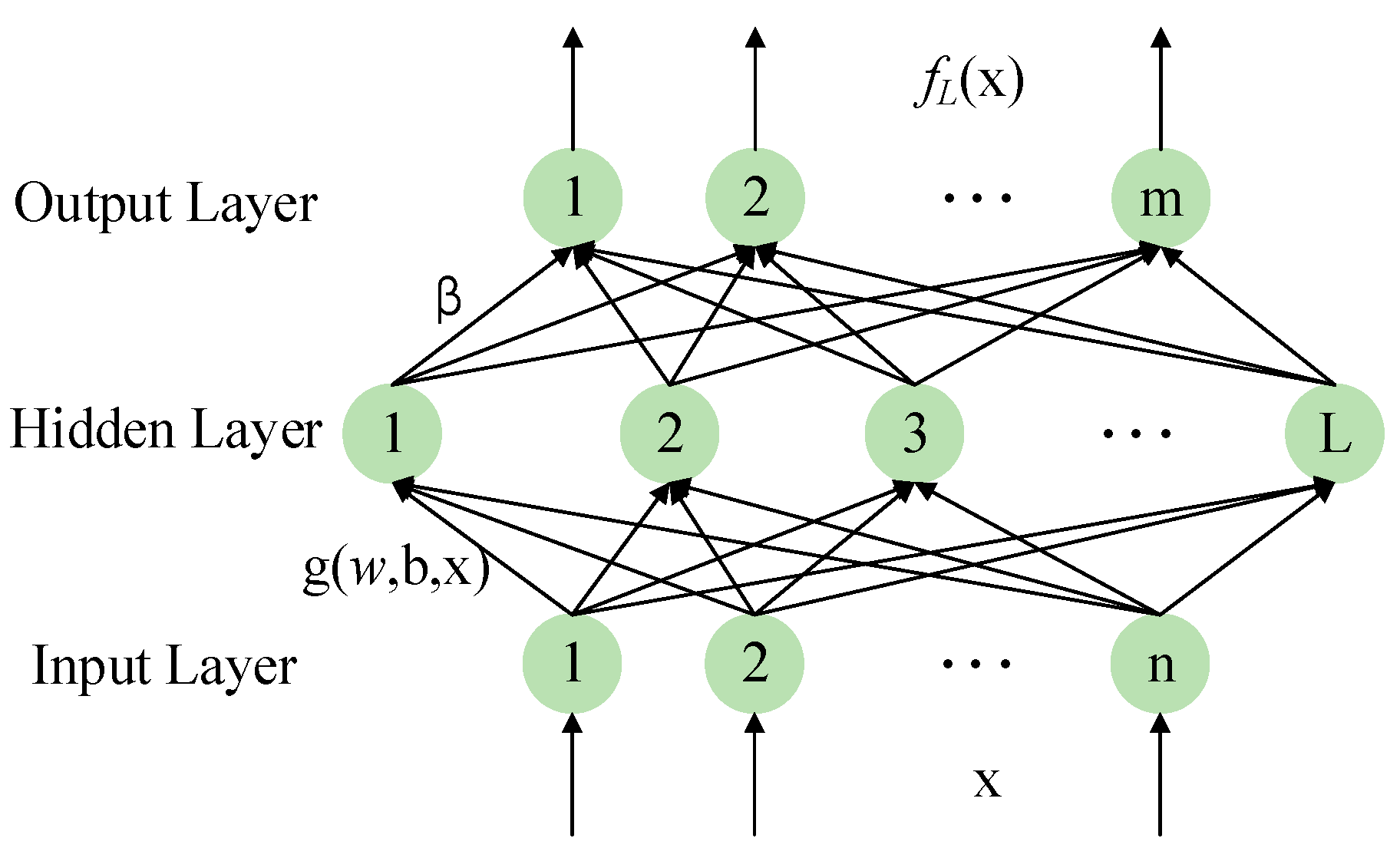
- For a given training set , set the activation function containing L hidden layer nodes as .
- (2)
- The network output of ELM can be expressed aswhere is the weight vector connecting the input vector and the i-th hidden layer node, is the weight vector connecting the i-th hidden node and the output vector, is the bias of the i-th hidden node, is the i-th training sample, and is output vector.
- (3)
- The objective function of ELM can be formulated as
- (4)
- The output weight matrix can be obtained by the following formula:where represents the generalized inverse matrix of hidden layer output matrix .
2.3. Regularized Extreme Learning Machine
3. Proposed Degradation Tendency Measurement Method
3.1. Construction of Synthesized Degradation Index Using Multi-Sensor Data
3.2. Reconstruction of Intrinsic Mode Functions Based on Permutation Entropy Theory
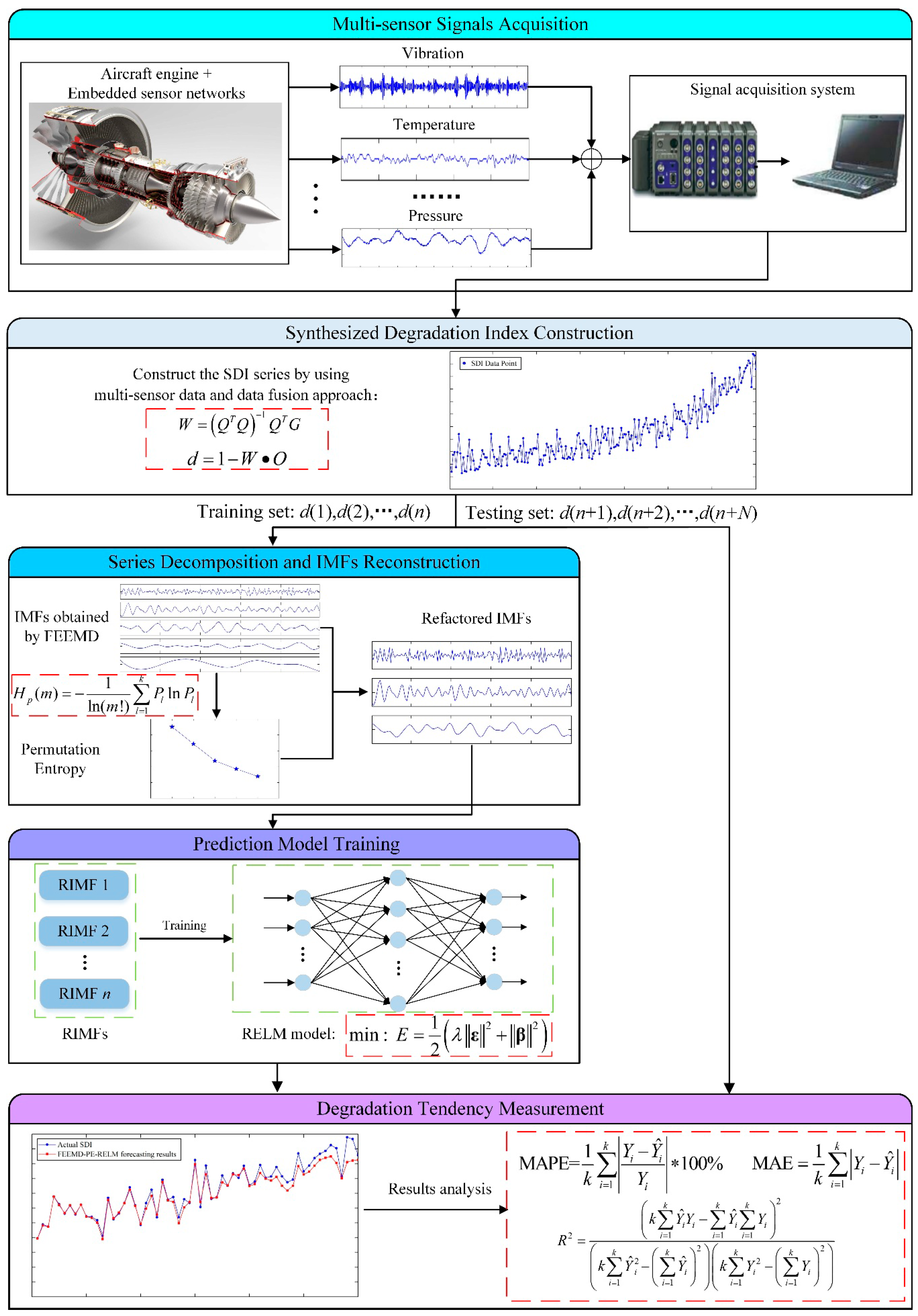
3.3. Procedure of the Proposed Method
4. Experimental Results and Discussion
4.1. Model Performance Evaluation
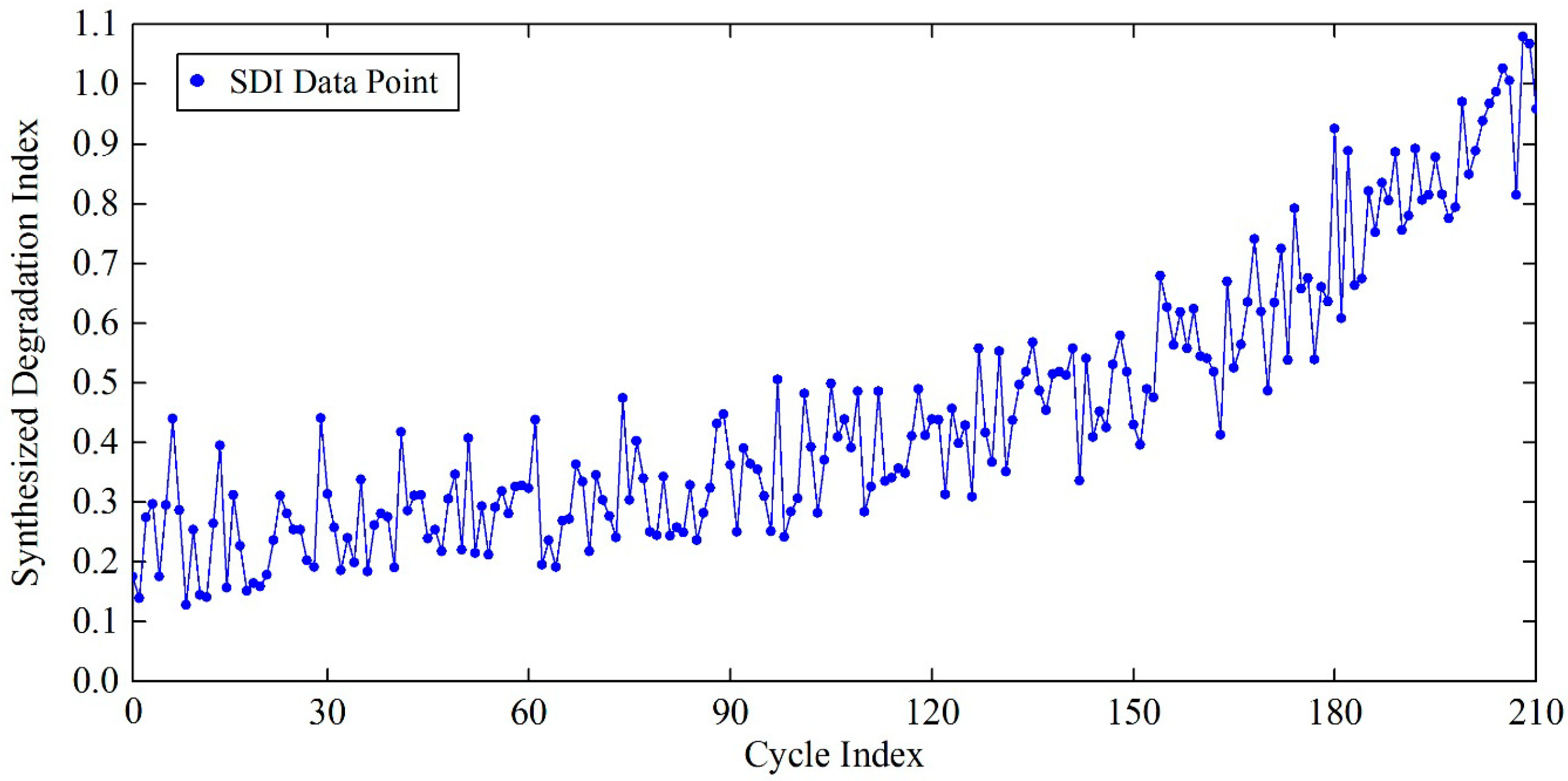
4.2. SDI Series Construction
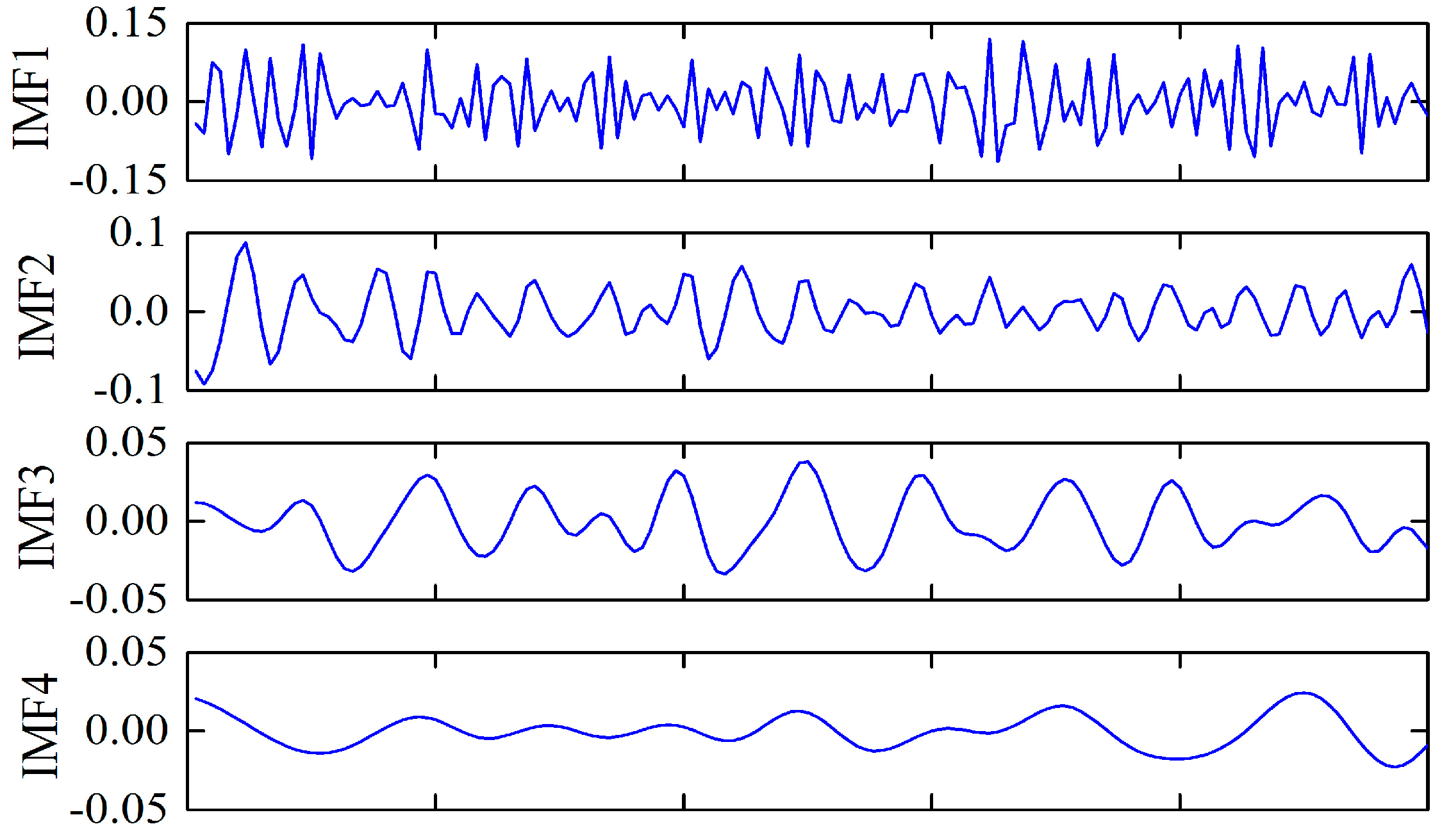
4.3. SDI Series Decomposition and IMF Reconstruction
4.4. Degradation Tendency Measurement of Aircraft Engines
5. Conclusions
Author Contributions
Funding
Conflicts of Interest
References
- Wang, D.; Tsui, K.L. Brownian motion with adaptive drift for remaining useful life prediction: Revisited. Mech. Syst. Signal Process. 2018, 99, 691–701. [Google Scholar] [CrossRef]
- Zhu, S.P.; Huang, H.Z.; Li, Y.; Liu, Y.; Yang, Y. Probabilistic modeling of damage accumulation for time-dependent fatigue reliability analysis of railway axle steels. Proc. Inst. Mech. Eng. Part F 2015, 229, 23–33. [Google Scholar] [CrossRef]
- Witos, M.; Wachlaczenko, M. Structural health monitoring of compressor and turbine blades with the use of variable reluctance sensor and tip timing method. In Proceedings of the 19th WCNDT World Conference on Non-Destructive Testing, Munich, Germany, 13–17 June 2016. [Google Scholar] [CrossRef]
- Bouckaert, J.F. Tip Timing and Tip Clearance Problem in Turbomachines; VKI Lecture Series 2007-03; von Karman Institute for Fluid Dynamics: Sint-Genesius-Rode, Belgium, 2007. [Google Scholar]
- Zhu, S.P.; Huang, H.Z.; Peng, W.; Wang, H.; Mahadevan, S. Probabilistic physics of failure-based framework for fatigue life prediction of aircraft gas turbine discs under uncertainty. Reliab. Eng. Syst. Saf. 2016, 146, 1–12. [Google Scholar] [CrossRef]
- Yu, Z.Y.; Zhu, S.P.; Liu, Q.; Liu, Y. A new energy—Critical plane damage parameter for multiaxial fatigue life prediction of turbine blades. Materials 2017, 10, 513. [Google Scholar] [CrossRef] [PubMed]
- Beaudoin, M.A.; Behdinan, K. Analytical lump model for the nonlinear dynamic response of bolted flanges in aero-engine casings. Mech. Syst. Signal Process. 2019, 115, 14–28. [Google Scholar] [CrossRef]
- Nie, Z.W.; Lin, Y.Y.; Tong, Q.B. Numerical simulations of two-phase flow in open-cell metal foams with application to aero-engine separators. Int. J. Heat Mass Transf. 2018, 127, 917–932. [Google Scholar] [CrossRef]
- Jardine, A.K.S.; Lin, D.; Banjevic, D. A review on machinery diagnostics and prognostics implementing condition-based maintenance. Mech. Syst. Signal Process. 2006, 20, 1483–1510. [Google Scholar] [CrossRef]
- Fu, W.L.; Tan, J.W.; Li, C.S.; Zou, Z.B. A hybrid fault diagnosis approach for rotating machinery with the fusion of entropy-based feature extraction and SVM optimized by a chaos quantum sine cosine algorithm. Entropy 2018, 20, 626. [Google Scholar] [CrossRef]
- Asgarpour, M.; Sørensen, J.D. Bayesian based diagnostic model for condition based maintenance of offshore wind farms. Energies 2018, 11, 300. [Google Scholar] [CrossRef]
- Li, Y.F.; Liu, H.L.; Ma, Z.J. Trend extraction of rail corrugation measured dynamically based on the relevant low-frequency principal components reconstruction. Meas. Sci. Technol. 2016, 27, 105005. [Google Scholar] [CrossRef]
- Heng, A.; Zhang, S.; Tan, A.C.C.; Mathew, J. Rotating machinery prognostics: State of the art, challenges and opportunities. Mech. Syst. Signal Process. 2009, 23, 724–739. [Google Scholar] [CrossRef]
- Witos, M. Increasing the durability of turbine engines through active diagnostic and control. Res. Works Air Force Inst. Technol. 2011. [CrossRef]
- Xu, Y.H.; Zheng, Y.; Du, Y.; Yang, W.; Peng, X.Y.; Li, C.S. Adaptive condition predictive-fuzzy PID optimal control of start-up process for pumped storage unit at low head area. Energy Convers. Manag. 2018, 177, 592–604. [Google Scholar] [CrossRef]
- Provost, M.J. The Use of Optimal Estimation Techniques in the Analysis of Gas Turbines. Ph.D. Thesis, Crandfield University, Bedford, UK, 1994. [Google Scholar]
- Sharpe, J. Active Control of Engine Dynamics, RTO AVT/VKI Special Course; von Karman Institute for Fluid Dynamics: Sint-Genesius-Rode, Belgium, 2001. [Google Scholar]
- Matioudakis, K. Neural Network in Gas Turbine Fault Diagnostics [in:] Gas Turbine Condition Monitoring & Fault Diagnosis; Lecture Series 2003-01; von Karman Institute for Fluid Dynamics: Sint-Genesius-Rode, Belgium, 2003. [Google Scholar]
- Volponi, A.J.; Alonso, F.J. Gas turbine engine health management: Past, present, and future trends. J. Eng. Gas Turbines Power 2014, 136, 051201. [Google Scholar] [CrossRef]
- Gebraeel, N.Z.; Lawley, M.A.; Li, R.; Ryan, J.K. Residual-life distributions from component degradation signals: A Bayesian approach. IIE Trans. 2005, 37, 543–557. [Google Scholar] [CrossRef]
- Kral, J.; Konecny, B.; Kral, J.; Madac, K.; Fedorko, G.; Molnar, V. Degradation and chemical change of longlife oils following intensive use in automobile engines. Measurement 2014, 50, 34–42. [Google Scholar] [CrossRef]
- Zhou, D.J.; Yu, Z.Q.; Zhang, H.S.; Weng, S.L. A novel grey prognostic model based on Markov process and grey incidence analysis for energy conversion equipment degradation. Energy 2016, 109, 420–429. [Google Scholar] [CrossRef]
- Fu, W.L.; Zhou, J.Z.; Zhang, Y.C.; Zhu, W.L.; Xue, X.M.; Xu, Y.H. A state tendency measurement for a hydro-turbine generating unit based on aggregated EEMD and SVR. Meas. Sci. Technol. 2015, 26, 125008. [Google Scholar] [CrossRef]
- Peng, Y.; Hou, Y.D.; Song, Y.C.; Pang, J.Y.; Liu, D.T. Lithium-ion battery prognostics with hybrid Gaussian process function regression. Energies 2018, 11, 1420. [Google Scholar] [CrossRef]
- Wang, R.; Li, J.R.; Wang, J.Z.; Gao, C.Z. Research and application of a hybrid wind energy forecasting system based on data processing and an optimized extreme learning machine. Energies 2018, 11, 1712. [Google Scholar] [CrossRef]
- Li, C.D.; Ding, Z.X.; Zhao, D.B.; Yi, J.Q.; Zhang, G.Q. Building energy consumption prediction: An extreme deep learning approach. Energies 2017, 10, 1525. [Google Scholar] [CrossRef]
- An, N.; Zhao, W.G.; Wang, J.Z.; Shang, D.; Zhao, E.D. Using multi-output feedforward neural network with empirical mode decomposition based signal filtering for electricity demand forecasting. Energy 2013, 49, 279–288. [Google Scholar] [CrossRef]
- Ren, Y.; Suganthan, P.N.; Srikanth, N. A comparative study of empirical mode decomposition-based short-term wind speed forecasting methods. IEEE Trans. Sustain. Energy 2015, 6, 236–244. [Google Scholar] [CrossRef]
- Chitsaz, H.; Amjady, N.; Zareipour, H. Wind power forecast using wavelet neural network trained by improved Clonal selection algorithm. Energy Convers. Manag. 2015, 89, 588–598. [Google Scholar] [CrossRef]
- De Giorgi, M.G.; Congedo, P.M.; Malvoni, M.; Laforgia, D. Error analysis of hybrid photovoltaic power forecasting models: A case study of mediterranean climate. Energy Convers. Manag. 2015, 100, 117–130. [Google Scholar] [CrossRef]
- Wang, Y.H.; Yeh, C.H.; Young, H.W.V.; Hu, K.; Lo, M.T. On the computational complexity of the empirical mode decomposition algorithm. Physica A 2014, 400, 159–167. [Google Scholar] [CrossRef]
- Liu, H.; Tian, H.Q.; Liang, X.F.; Li, Y.F. New wind speed forecasting approaches using fast ensemble empirical mode decomposition, genetic algorithm, mind evolutionary algorithm and artificial neural networks. Renew. Energy 2015, 83, 1066–1075. [Google Scholar] [CrossRef]
- Liu, H.; Tian, H.Q.; Li, Y.F. Comparison of new hybrid FEEMD-MLP, FEEMD-ANFIS, wavelet packet-MLP and wavelet packet-ANFIS for wind speed predictions. Energy Convers. Manag. 2015, 89, 1–11. [Google Scholar] [CrossRef]
- Huang, G.B.; Zhu, Q.Y.; Siew, C.K. Extreme learning machine: A new learning scheme of feedforward neural networks. In Proceedings of the International Joint Conference on Neural Networks, Budapest, Hungary, 25–29 July 2004; pp. 985–990. [Google Scholar]
- Salcedo-Sanz, S.; Muñoz-Bulnes, J.; Portilla-Figueras, J.; Del Ser, J. One-year-ahead energy demand estimation from macroeconomic variables using computational intelligence algorithm. Energy Convers. Manag. 2015, 99, 62–71. [Google Scholar] [CrossRef]
- Lombardi, A.M. Some reasoning on the RELM-CSEP likelihood-based tests. Earth Planets Space 2014, 66, 4. [Google Scholar] [CrossRef]
- Saxena, A.; Gobel, K. Damage propagation modeling for aircraft engine run-to-failure simulation. In Proceedings of the IEEE International Conference on Prognostics and Health Management, Denver, CO, USA, 6–9 October 2008. [Google Scholar]
- Wang, T.; Yu, J.; Siegel, D.; Lee, J. A similarity-based prognostics approach for remaining useful life estimation of engineered systems. In Proceedings of the IEEE International Conference on Prognostics and Health Management, Denver, CO, USA, 6–9 October 2008. [Google Scholar]
- Xu, Y.H.; Li, C.S.; Wang, Z.B.; Zhang, N.; Peng, B. Load frequency control of a novel renewable energy integrated micro-grid containing pumped hydro power energy storage. IEEE Access 2018, 6, 29067–29077. [Google Scholar] [CrossRef]





| Mode | Setting Parameter 1 | Setting Parameter 2 | Setting Parameter 3 |
|---|---|---|---|
| 1 | 0 | 0 | 100 |
| 2 | 10 | 0.25 | 20 |
| 3 | 20 | 0.7 | 0 |
| 4 | 25 | 0.62 | 80 |
| 5 | 35 | 0.84 | 60 |
| 6 | 42 | 0.84 | 40 |
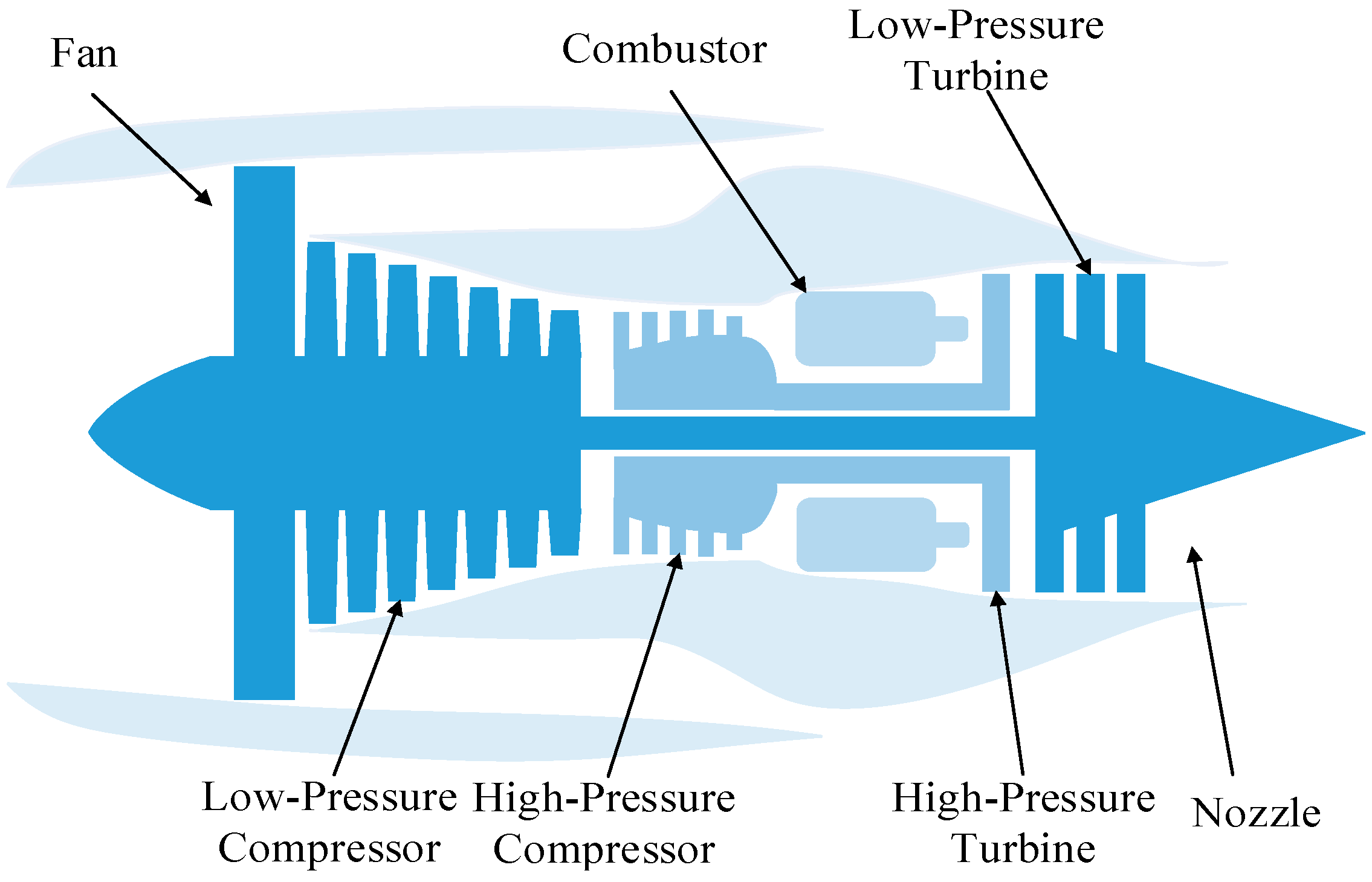
| Index | Symbol | Description | Units |
|---|---|---|---|
| 1 | T24 | Total temperature at low-pressure compressor outlet | °R |
| 2 | T30 | Total temperature at high-pressure compressor outlet | °R |
| 3 | T50 | Total temperature at low-pressure turbine outlet | °R |
| 4 | P30 | Total pressure at high-pressure compressor outlet | psia |
| 5 | Ps30 | Static pressure at high-pressure compressor outlet | psia |
| 6 | Phi | Ratio of fuel flow to Ps30 | pps/psia |
| 7 | BPR | Bypass ratio | - |
| IMF1 | IMF2 | IMF3 | IMF4 | IMF5 | IMF6 | IMF7 | IMF8 | r0 | |
|---|---|---|---|---|---|---|---|---|---|
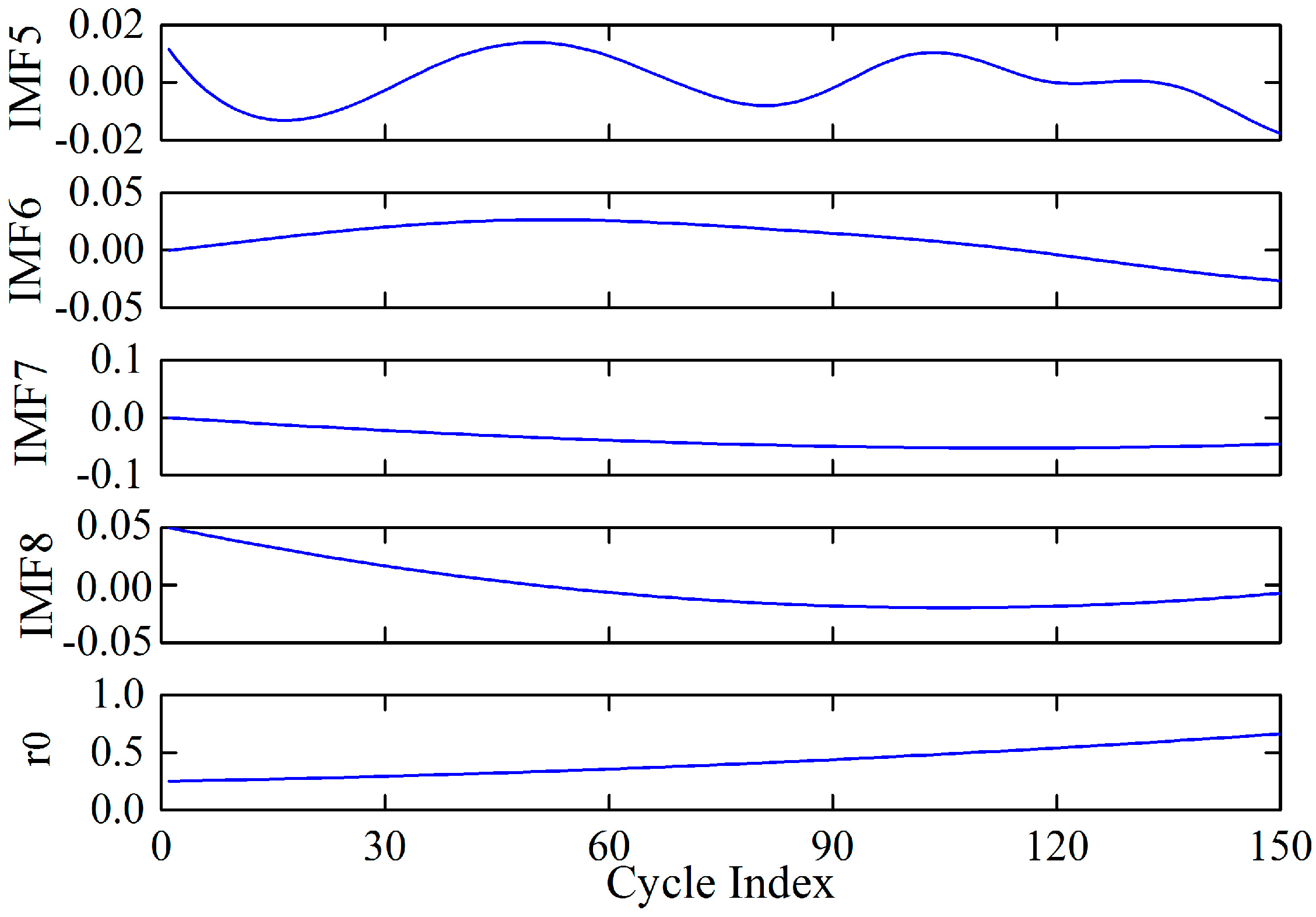
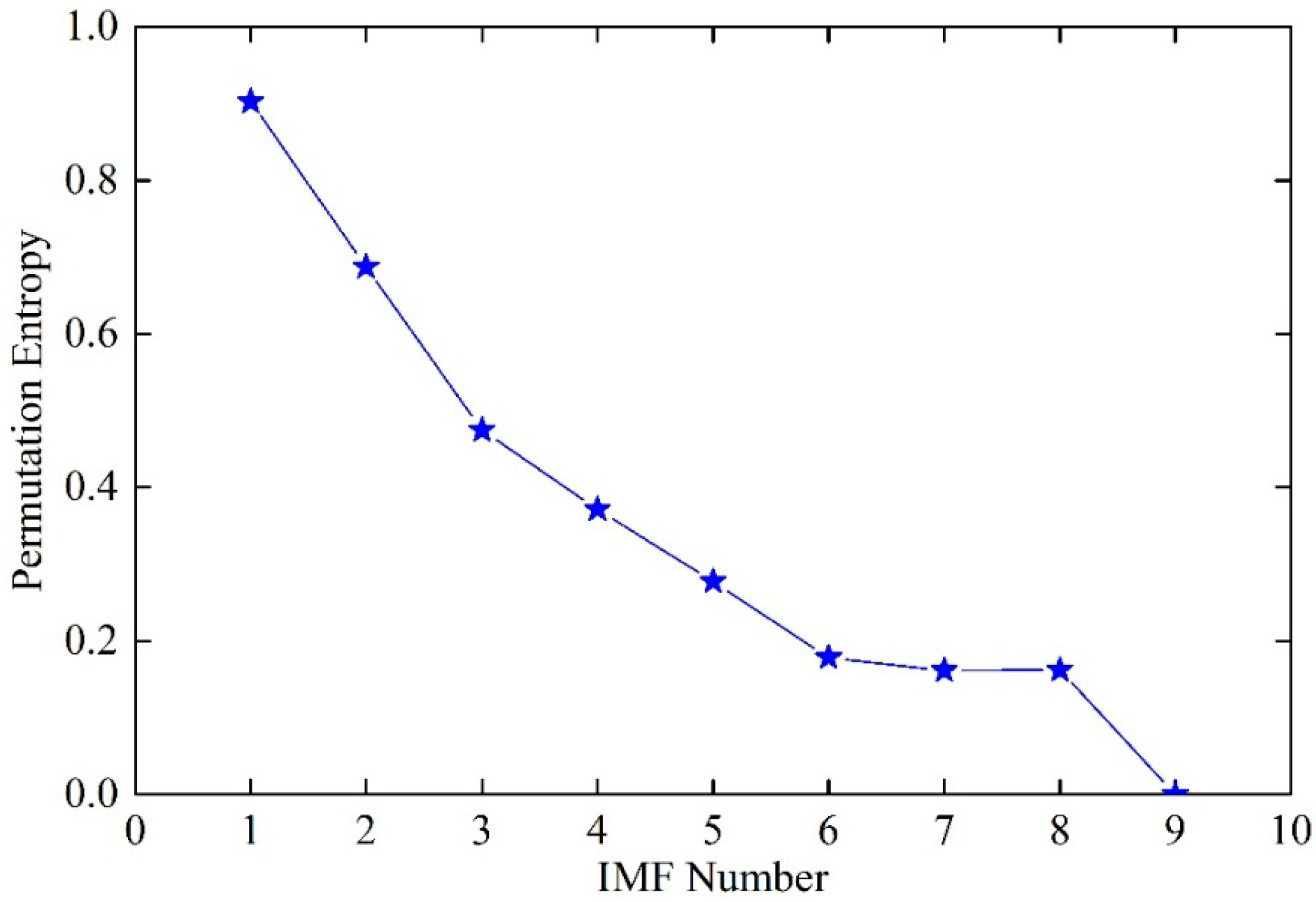
| PE | 0.902 | 0.687 | 0.475 | 0.371 | 0.277 | 0.178 | 0.161 | 0.161 | 0 |
| RIMFs | IMFs Contained | Hp |
|---|---|---|
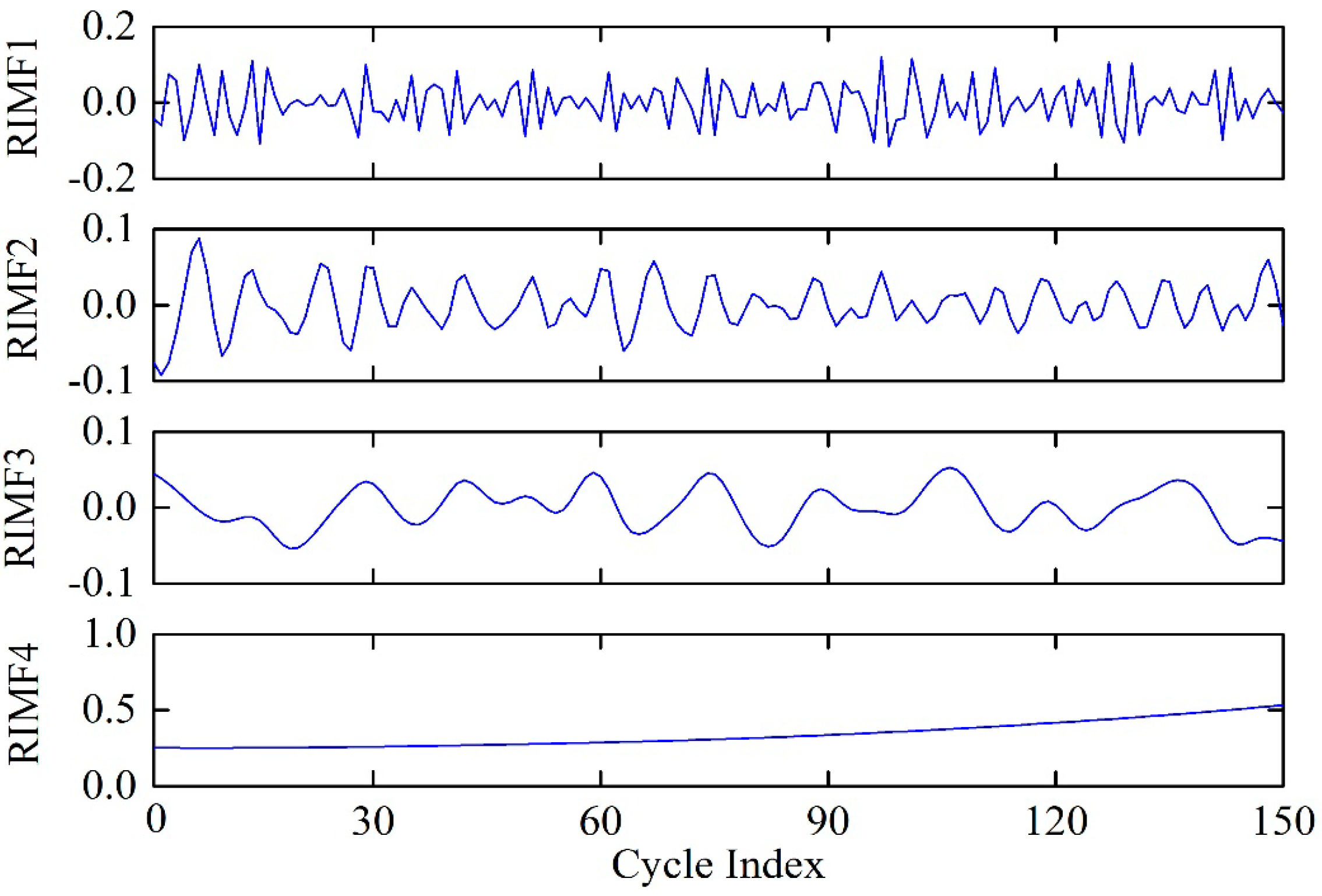
| RIMF1 | IMF1 | [0.702, 0.902] |
| RIMF2 | IMF2 | [0.487, 0.687] |
| RIMF3 | IMF3, IMF4, IMF5 | [0.275, 0.475] |
| RIMF4 | IMF6, IMF7, IMF8, r0 | [0, 0.178] |
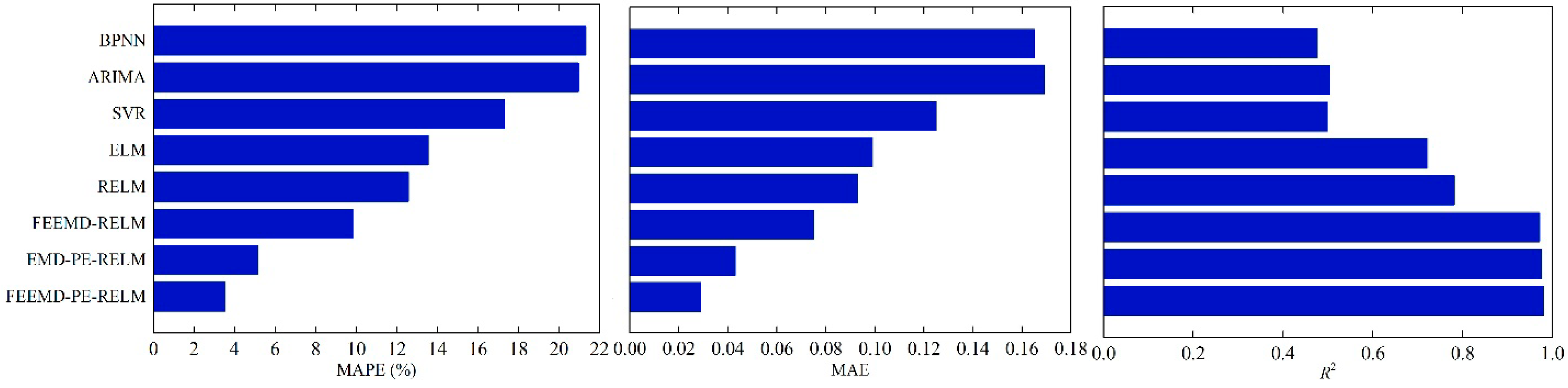
| Models | Forecasting Accuracy | ||
|---|---|---|---|
| MAPE (%) | MAE | R2 | |
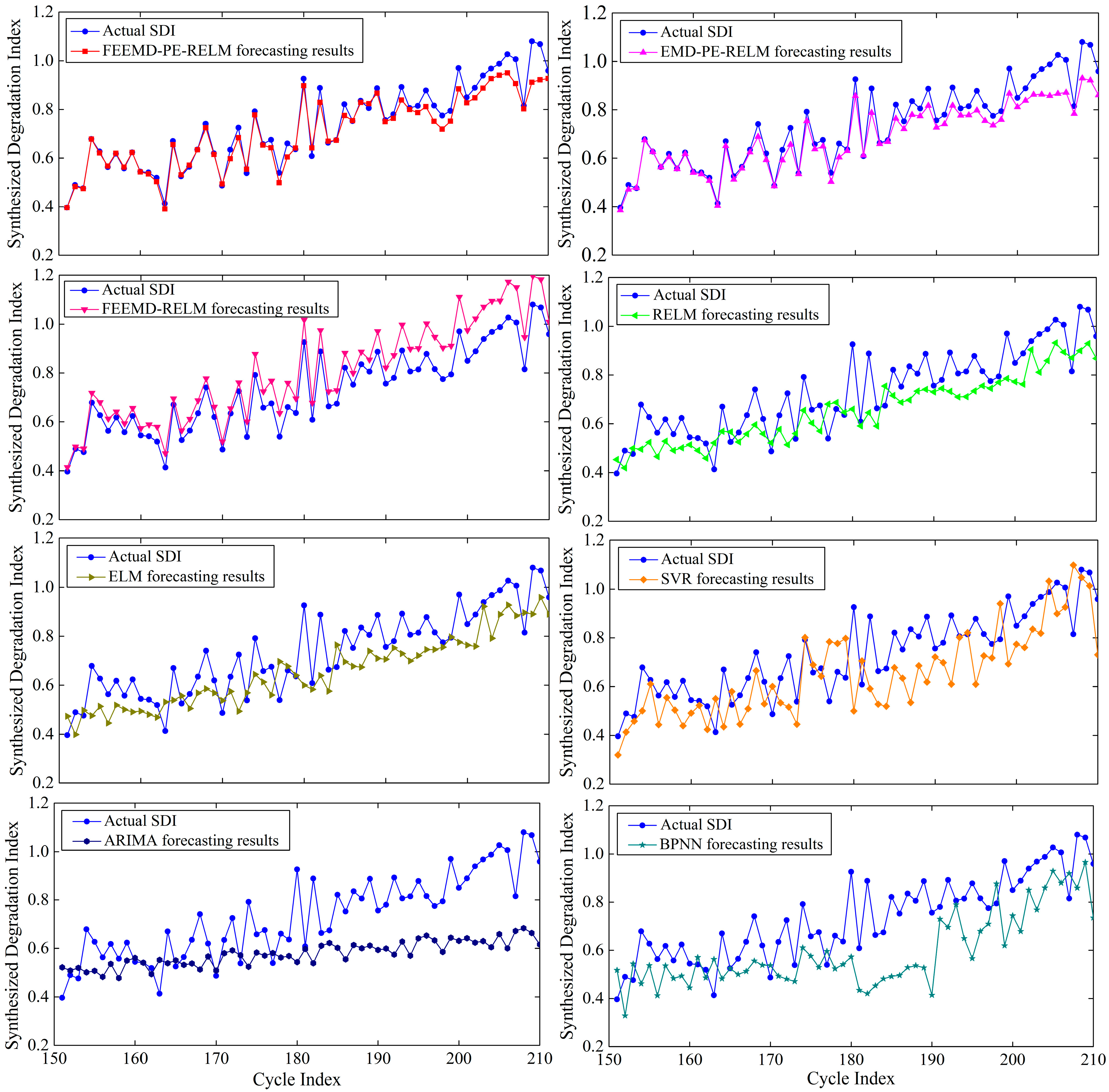
| FEEMD-PE/RELM | 3.552 | 0.029 | 0.979 |
| EMD-PE/RELM | 5.134 | 0.043 | 0.976 |
| FEEMD/RELM | 9.847 | 0.075 | 0.971 |
| RELM | 12.577 | 0.093 | 0.781 |
| ELM | 13.556 | 0.099 | 0.721 |
| SVR | 17.279 | 0.125 | 0.498 |
| ARIMA | 20.965 | 0.169 | 0.503 |
| BPNN | 21.322 | 0.165 | 0.475 |
| RELM | ELM | SVR | ARIMA | BPNN | |
|---|---|---|---|---|---|
| t (s) | 2.31 | 2.14 | 15.37 | 10.22 | 9.93 |
© 2018 by the authors. Licensee MDPI, Basel, Switzerland. This article is an open access article distributed under the terms and conditions of the Creative Commons Attribution (CC BY) license (http://creativecommons.org/licenses/by/4.0/).
Share and Cite
Jiang, W.; Xu, Y.; Shan, Y.; Liu, H. Degradation Tendency Measurement of Aircraft Engines Based on FEEMD Permutation Entropy and Regularized Extreme Learning Machine Using Multi-Sensor Data. Energies 2018, 11, 3301. https://doi.org/10.3390/en11123301
Jiang W, Xu Y, Shan Y, Liu H. Degradation Tendency Measurement of Aircraft Engines Based on FEEMD Permutation Entropy and Regularized Extreme Learning Machine Using Multi-Sensor Data. Energies. 2018; 11(12):3301. https://doi.org/10.3390/en11123301
Chicago/Turabian StyleJiang, Wei, Yanhe Xu, Yahui Shan, and Han Liu. 2018. "Degradation Tendency Measurement of Aircraft Engines Based on FEEMD Permutation Entropy and Regularized Extreme Learning Machine Using Multi-Sensor Data" Energies 11, no. 12: 3301. https://doi.org/10.3390/en11123301
APA StyleJiang, W., Xu, Y., Shan, Y., & Liu, H. (2018). Degradation Tendency Measurement of Aircraft Engines Based on FEEMD Permutation Entropy and Regularized Extreme Learning Machine Using Multi-Sensor Data. Energies, 11(12), 3301. https://doi.org/10.3390/en11123301