

Poly(imide-co-siloxane) as a Thermo-Stable Binder for a Thin Layer Cathode of Thermal Batteries



Abstract
1. Introduction
2. Materials and Methods
2.1. Materials and Instruments
2.2. Preparation of Polyimide
2.3. In Situ PIS Gel Formation and Preparation of FeS2/PIS Cathode Composites
2.4. Thermal Battery Cell Fabrication and Discharge Measurements
2.5. Electrical Conductivity Measurement
2.6. Electrical Properties of the FeS2/PIS Cathode Layer
3. Results and Discussion
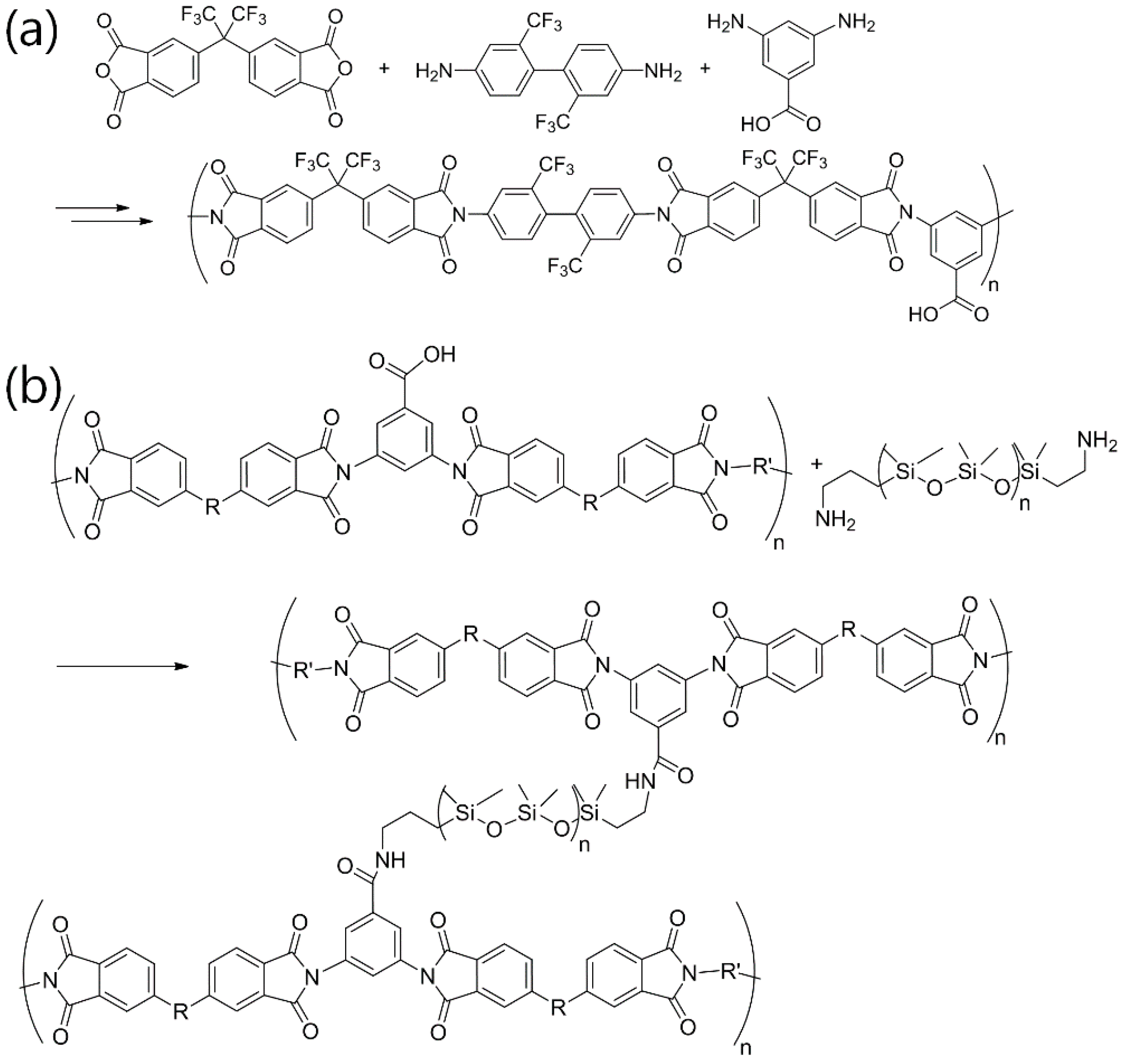
3.1. Synthesis of Polyimide and the Formation of Cross-Linked PIS
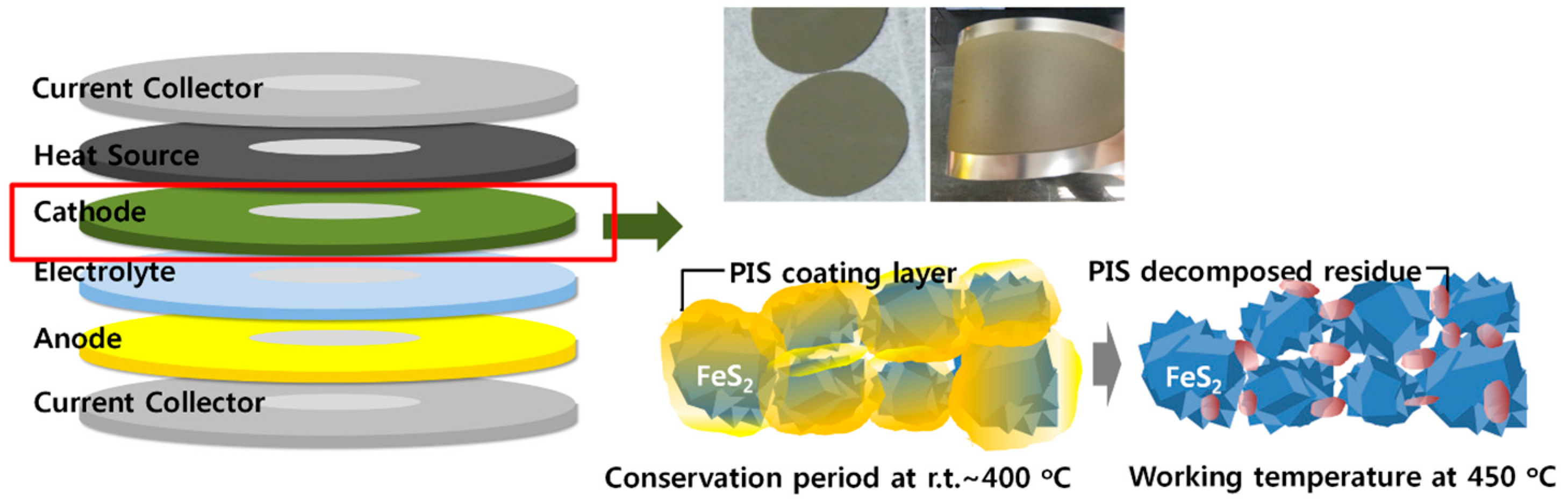
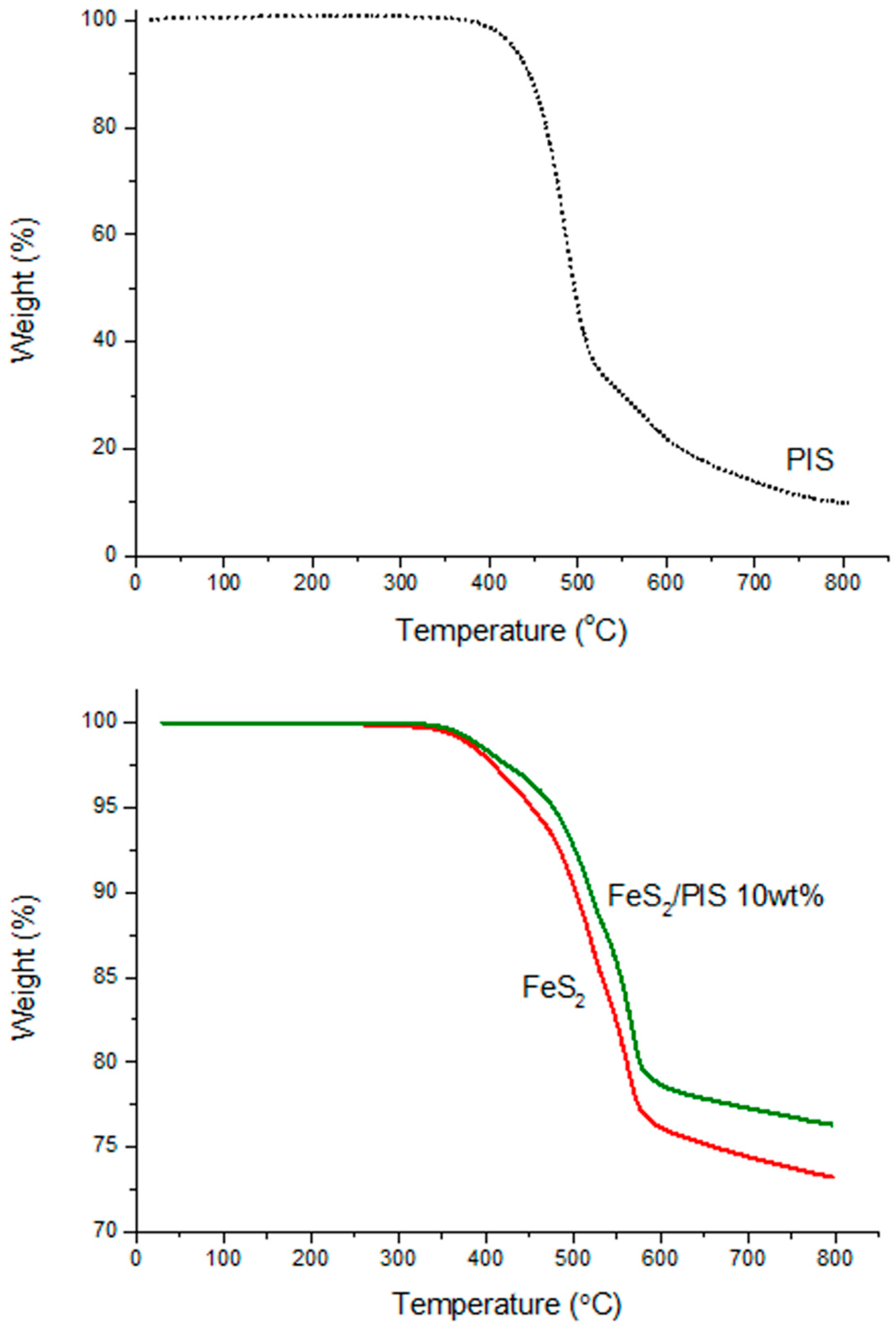
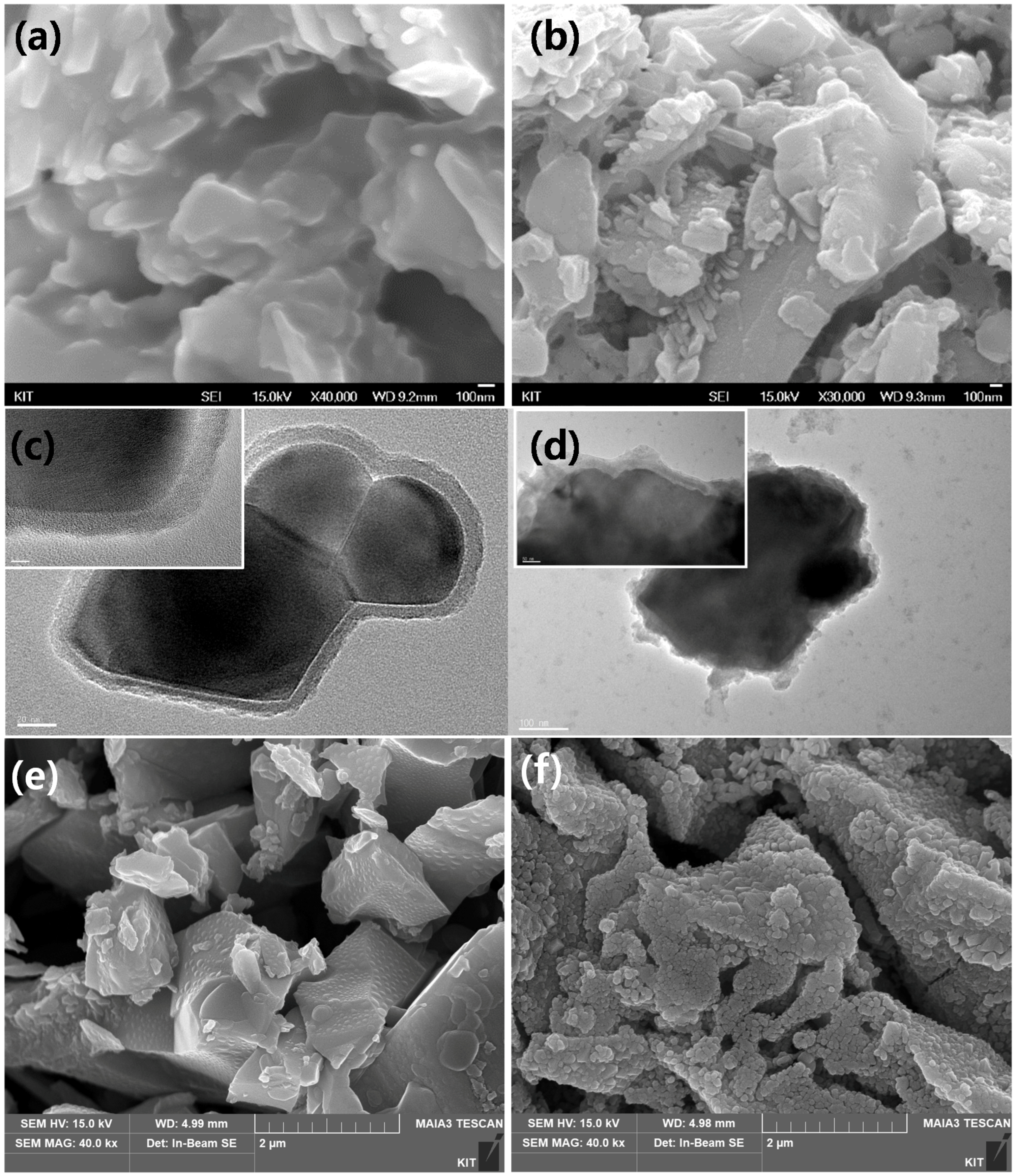
3.2. Formation of the Cathode Thin Layer and Its Thermal Properties
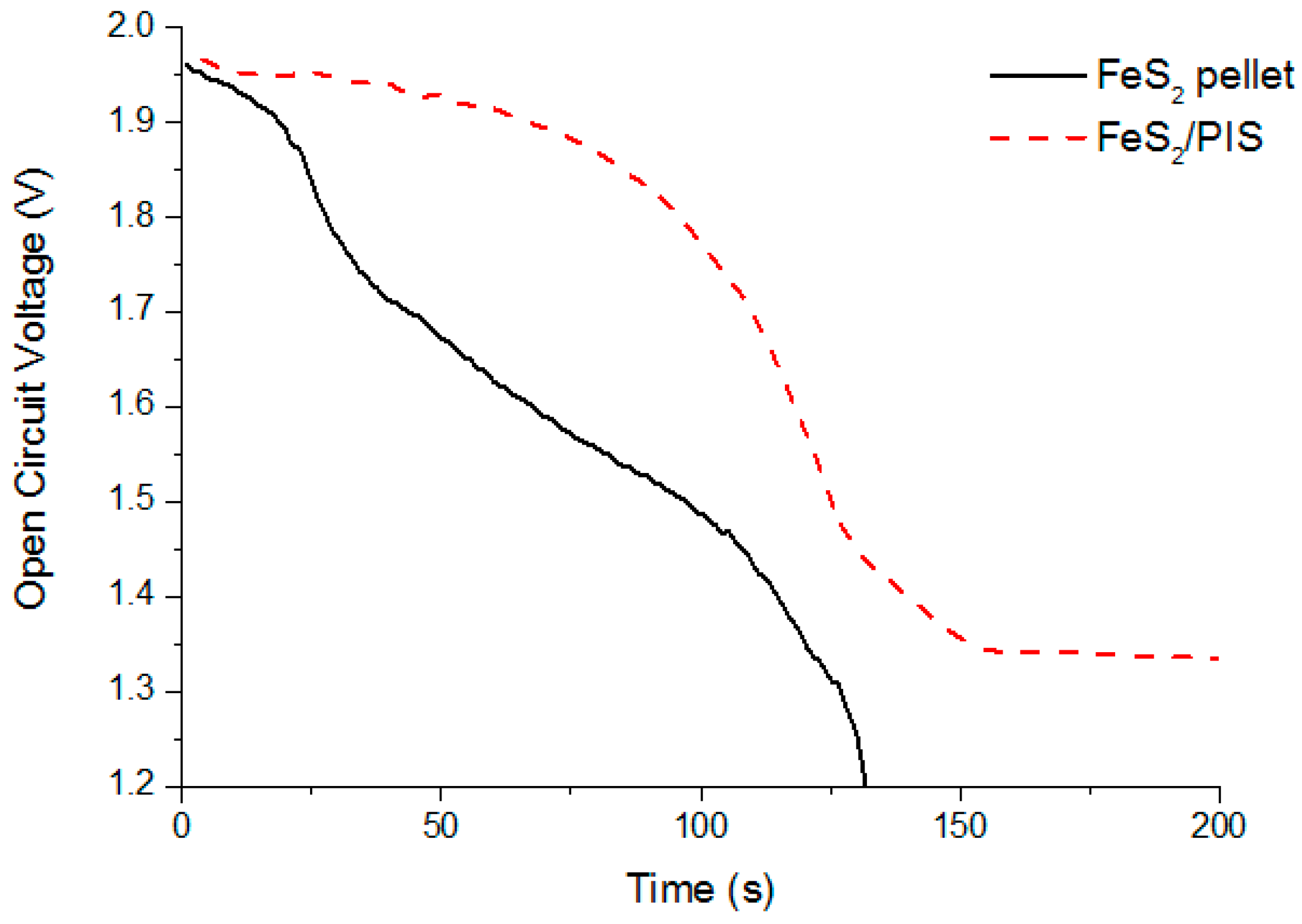
3.3. Electrical Properties of the FeS2/PIS Cathode Layer
- Rt: total polarization (Ω)
- Voc: open circuit voltage (V)
- Vcc: close circuit voltage (V)
- I: discharge current (A)
4. Conclusions
Supplementary Materials
Author Contributions
Funding
Conflicts of Interest
References
- Kim, I.Y.; Shin, S.Y.; Ko, J.H.; Lee, K.S.; Woo, S.P.; Kim, D.K.; Yoon, Y.S. Functional Li-M (Ti, Al, Co, Ni, Mn, Fe)-O Energy Materials. J. Korean Ceram. Soc. 2017, 54, 9–22. [Google Scholar] [CrossRef]
- Lee, J.-Y.; Ngo, D.T.; Park, C.-J. Ge–Al Multilayer Thin Film as an Anode for Li-ion Batteries. J. Korean Ceram. Soc. 2017, 54, 249–256. [Google Scholar] [CrossRef]
- Guidotti, R.A.; Masset, P. Thermally activated (“thermal”) battery technology: Part I: An overview. J. Power Sources 2006, 161, 1443–1449. [Google Scholar] [CrossRef]
- Kim, D.; Jung, H.-M.; Um, S. Theoretical Analysis of the Time-Dependent Temperature Evolution for Thermal Runaway Prevention in Multi-Layered LiCl-LiBr-LiF Thermal Batteries. J. Korean Phys. Soc. 2009, 55, 2420–2426. [Google Scholar] [CrossRef]
- Guidotti, R.A.; Masset, P.J. Thermally activated (“thermal”) battery technology: Part IV. Anode materials. J. Power Sources 2008, 183, 388–398. [Google Scholar] [CrossRef]
- Masset, P.; Guidotti, R.A. Thermal activated (“thermal”) battery technology: Part II. Molten salt electrolytes. J. Power Sources 2007, 164, 397–414. [Google Scholar] [CrossRef]
- Masset, P.J.; Guidotti, R.A. Thermal activated (“thermal”) battery technology: Part IIIa: FeS2 cathode material. J. Power Sources 2008, 177, 595–609. [Google Scholar] [CrossRef]
- Masset, P.J.; Guidotti, R.A. Thermal activated (“thermal”) battery technology: Part IIIb. Sulfur and oxide-based cathode materials. J. Power Sources 2008, 178, 456–466. [Google Scholar] [CrossRef]
- Cho, K.-Y.; Riu, D.-H.; Huh, S.-H.; Shin, D.-G.; Kim, H.-E.; Cheong, H.-W.; Cho, S.-B. The Holding Characteristics of the Glass Filter Separators of Molten Salt Electrolyte for Thermal Batteries. J. Korean Ceram. Soc. 2008, 45, 464–471. [Google Scholar] [CrossRef]
- Ko, J.; Kim, I.Y.; Cheong, H.; Yoon, Y.S. Organic binder-free cathode using FeS2-MWCNTs composite for thermal batteries. J. Am. Ceram. Soc. 2017, 100, 4435–4441. [Google Scholar] [CrossRef]
- Ko, J.; Kim, I.Y.; Jung, H.M.; Cheong, H.; Yoon, Y.S. Thin cathode for thermal batteries using a tape-casting process. Ceram. Int. 2017, 43, 5789–5793. [Google Scholar] [CrossRef]
- Zhang, T.; Li, J.T.; Liu, J.; Deng, Y.P.; Wu, Z.G.; Yin, Z.W.; Guo, D.; Huang, L.; Sun, S.G. Suppressing the voltage-fading of layered lithium-rich cathode materials via an aqueous binder for Li-ion batteries. Chem. Commun. 2016, 52, 4683–4686. [Google Scholar] [CrossRef] [PubMed]
- Zhang, S.; Gu, H.; Pan, H.; Yang, S.; Du, W.; Li, X.; Gao, M.; Liu, Y.; Zhu, M.; Ouyang, L.; et al. A Novel Strategy to Suppress Capacity and Voltage Fading of Li- and Mn-Rich Layered Oxide Cathode Material for Lithium-Ion Batteries. Adv. Energy. Mater. 2017, 7, 1601066. [Google Scholar] [CrossRef]
- Kong, J.-Z.; Xu, L.-P.; Wang, C.-L.; Jiang, Y.-X.; Cao, Y.-Q.; Zhou, F. Facile coating of conductive poly(vinylidene fluoride-trifluoroethylene) copolymer on Li1.2Mn0.54Ni0.13Co0.13O2 as a high electrochemical performance cathode for Li-ion battery. J. Alloys Compd. 2017, 719, 401–410. [Google Scholar] [CrossRef]
- Xu, J.; Chou, S.-L.; Gu, Q.; Liu, H.-K.; Dou, S.-X. The effect of different binders on electrochemical properties of LiNi1/3Mn1/3Co1/3O2 cathode material in lithium ion batteries. J. Power Sources 2013, 225, 172–178. [Google Scholar] [CrossRef]
- Morishita, M.; Yamano, A.; Kitaoka, T.; Sakai, H.; Ojima, T.; Sakai, T. Polyamide-Imide Binder with Higher Adhesive Property and Thermal Stability as Positive Electrode of 4V-Class Lithium-Ion Batteries. J. Electrochem. Soc. 2014, 161, A955–A960. [Google Scholar] [CrossRef]
- Wu, F.; Li, W.; Chen, L.; Lu, Y.; Su, Y.; Bao, W.; Wang, J.; Chen, S.; Bao, L. Polyacrylonitrile-polyvinylidene fluoride as high-performance composite binder for layered Li-rich oxides. J. Power Sources 2017, 359, 226–233. [Google Scholar] [CrossRef]
- Pieczonka, N.P.W.; Borgel, V.; Ziv, B.; Leifer, N.; Dargel, V.; Aurbach, D.; Kim, J.H.; Liu, Z.; Huang, X.; Krachkovskiy, S.A.; et al. Lithium Polyacrylate (LiPAA) as an Advanced Binder and a Passivating Agent for High-Voltage Li-Ion Batteries. Adv. Energy Mater. 2015, 5, 1501008. [Google Scholar] [CrossRef]
- Lee, Y.M.; Choi, J.; Ryou, M.H.; Son, B.; Song, J.; Park, J.K.; Cho, K.Y. Improved high-temperature performance of lithium-ion batteries through use of a thermally stable co-polyimide-based cathode binder. J. Power Sources 2014, 252, 138–143. [Google Scholar] [CrossRef]
- Cho, J.-H.; Park, J.-H.; Lee, M.-H.; Song, H.-K.; Lee, S.-Y. A polymer electrolyte-skinned active material strategy toward high-voltage lithium ion batteries: A polyimide-coated LiNi0.5Mn1.5O4 spinel cathode material case. Energy Environ. Sci. 2012, 5, 7124–7131. [Google Scholar] [CrossRef]
- Park, J.-H.; Cho, J.-H.; Kim, S.-B.; Kim, W.-S.; Lee, S.-Y.; Lee, S.-Y. A novel ion-conductive protection skin based on polyimide gel polymer electrolyte: Application to nanoscale coating layer of high voltage LiNi1/3Co1/3Mn1/3O2 cathode materials for lithium-ion batteries. J. Mater. Chem. 2012, 22, 12574–12581. [Google Scholar] [CrossRef]
- Qian, G.; Wang, L.; Shang, Y.; He, X.; Tang, S.; Liu, M.; Li, T.; Zhang, G.; Wang, J. Polyimide Binder: A Facile Way to Improve Safety of Lithium Ion Batteries. Electrochim. Acta 2016, 187, 113–118. [Google Scholar] [CrossRef]
- Pham, H.Q.; Kim, G.; Jung, H.M.; Song, S.-W. Fluorinated Polyimide as a Novel High-Voltage Binder for High-Capacity Cathode of Lithium Ion Batteries. Adv. Funct. Mater. 2017, 28, 1704690. [Google Scholar] [CrossRef]
- Fujiwara, S.; Inaba, M.; Tasaka, A. New molten salt systems for high-temperature molten salt batteries: LiF–LiCl–LiBr-based quaternary systems. J. Power Sources 2010, 195, 7691–7700. [Google Scholar] [CrossRef]
- Zhang, D.; Mai, Y.J.; Xiang, J.Y.; Xia, X.H.; Qiao, Y.Q.; Tu, J.P. FeS2/C composite as an anode for lithium ion batteries with enhanced reversible capacity. J. Power Sources 2012, 217, 229–235. [Google Scholar] [CrossRef]
- Choi, Y.; Yu, H.; Cheong, H.R.; Cho, S.; Lee, Y.S. Effects of Pyrite (FeS2) Particle Sizes on Electrochemical Characteristics of Thermal Batteries. Appl. Chem. Eng. 2014, 25, 161–166. [Google Scholar] [CrossRef]
- Schoeffert, S. Thermal batteries modeling, self-discharge, and self-heating. J. Power Sources 2005, 142, 361–369. [Google Scholar] [CrossRef]
- Masset, P.; Schoeffert, S.; Poinso, J.Y.; Poignet, J.C. LiF-LiCl-LiI vs. LiF-LiBr-KBr as molten salt electrolyte in thermal batteries. J. Electrochem. Soc. 2005, 152, A405–A410. [Google Scholar] [CrossRef]
© 2018 by the authors. Licensee MDPI, Basel, Switzerland. This article is an open access article distributed under the terms and conditions of the Creative Commons Attribution (CC BY) license (http://creativecommons.org/licenses/by/4.0/).
Share and Cite
Oh, I.; Cho, J.; Kim, K.; Ko, J.; Cheong, H.; Yoon, Y.S.; Jung, H.M. Poly(imide-co-siloxane) as a Thermo-Stable Binder for a Thin Layer Cathode of Thermal Batteries. Energies 2018, 11, 3154. https://doi.org/10.3390/en11113154
Oh I, Cho J, Kim K, Ko J, Cheong H, Yoon YS, Jung HM. Poly(imide-co-siloxane) as a Thermo-Stable Binder for a Thin Layer Cathode of Thermal Batteries. Energies. 2018; 11(11):3154. https://doi.org/10.3390/en11113154
Chicago/Turabian StyleOh, Ilwhan, Jaeyoung Cho, Kwansu Kim, Jaehwan Ko, Haewon Cheong, Young Soo Yoon, and Hyun Min Jung. 2018. "Poly(imide-co-siloxane) as a Thermo-Stable Binder for a Thin Layer Cathode of Thermal Batteries" Energies 11, no. 11: 3154. https://doi.org/10.3390/en11113154
APA StyleOh, I., Cho, J., Kim, K., Ko, J., Cheong, H., Yoon, Y. S., & Jung, H. M. (2018). Poly(imide-co-siloxane) as a Thermo-Stable Binder for a Thin Layer Cathode of Thermal Batteries. Energies, 11(11), 3154. https://doi.org/10.3390/en11113154

