Next Article in Journal
Reconstruction of Maxillary Bone Defects with Cellular Bone Matrix Allografts
Previous Article in Journal
In-Versus Out-Fracture: A Novel Concept in Naso-Orbito-Ethmoid Injury
 
 
Craniomaxillofacial Trauma & Reconstruction is published by MDPI from Volume 18 Issue 1 (2025). Previous articles were published by another publisher in Open Access under a CC-BY (or CC-BY-NC-ND) licence, and they are hosted by MDPI on mdpi.com as a courtesy and upon agreement with Sage.
Article

Does More Invasive Surgery Result in Higher Patient Satisfaction? A Long-Term Follow-Up of 136 Zygomaticomaxillary Complex Fractures

by
Samin Rahbin
1,*,
Ola Sunnergren
2,3,
Ellen McBride
1,
Hatef Darabi
4 and
Babak Alinasab
1
1
Division of ENT Diseases, Department of Clinical Science, Intervention and Technology (CLINTEC), Karolinska Institutet and Department of ENT Diseases, Karolinska University Hospital, 171 77 Stockholm, Sweden
2
Department of Otorhinolaryngology-Head and Neck Surgery, Institute of Clinical Sciences, Sahlgrenska Academy, University of Gothenburg, Sweden
3
Region Västra Götaland, Sahlgrenska University Hospital, Department of Otorhinolaryngology-Head and Neck Surgery, Gothenburg, Sweden
4
The Public Health Agency of Sweden, Stockholm, Sweden
*
Author to whom correspondence should be addressed.
Craniomaxillofac. Trauma Reconstr. 2024, 17(4), 57; https://doi.org/10.1177/19433875241286544

Submission received: 10 June 2024 / Revised: 1 September 2024 / Accepted: 5 September 2024 / Published: 8 October 2024

Abstract

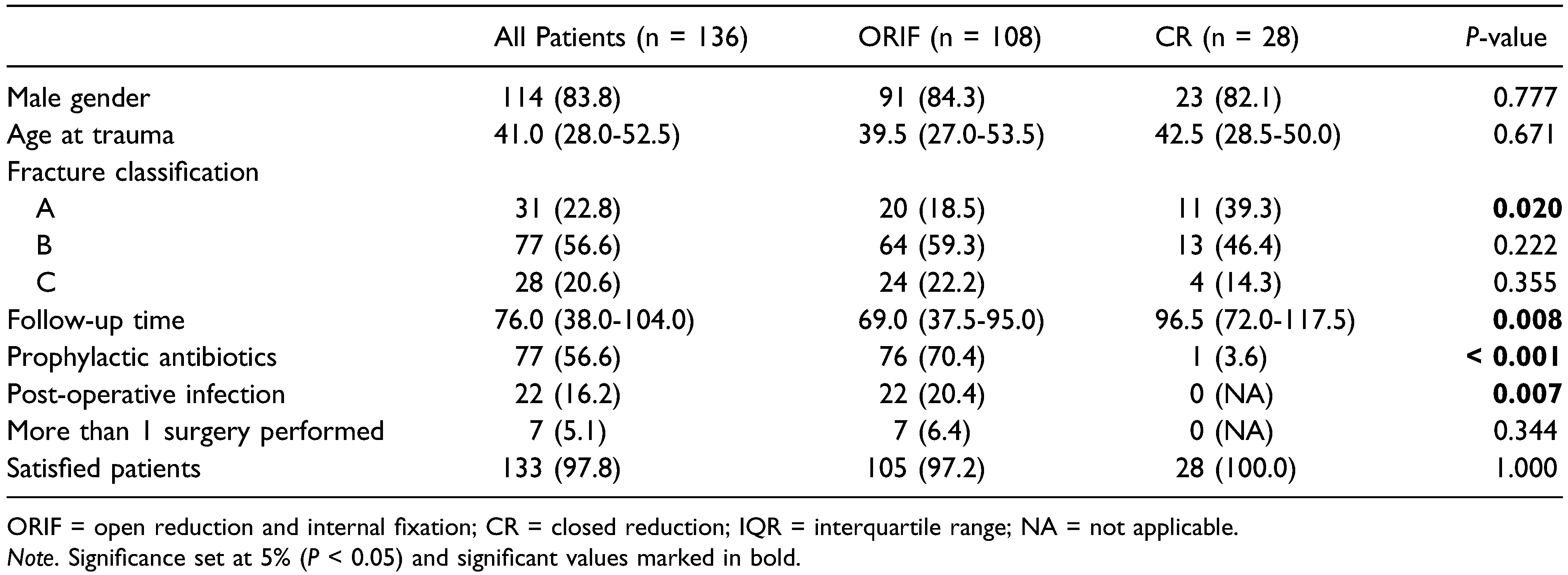
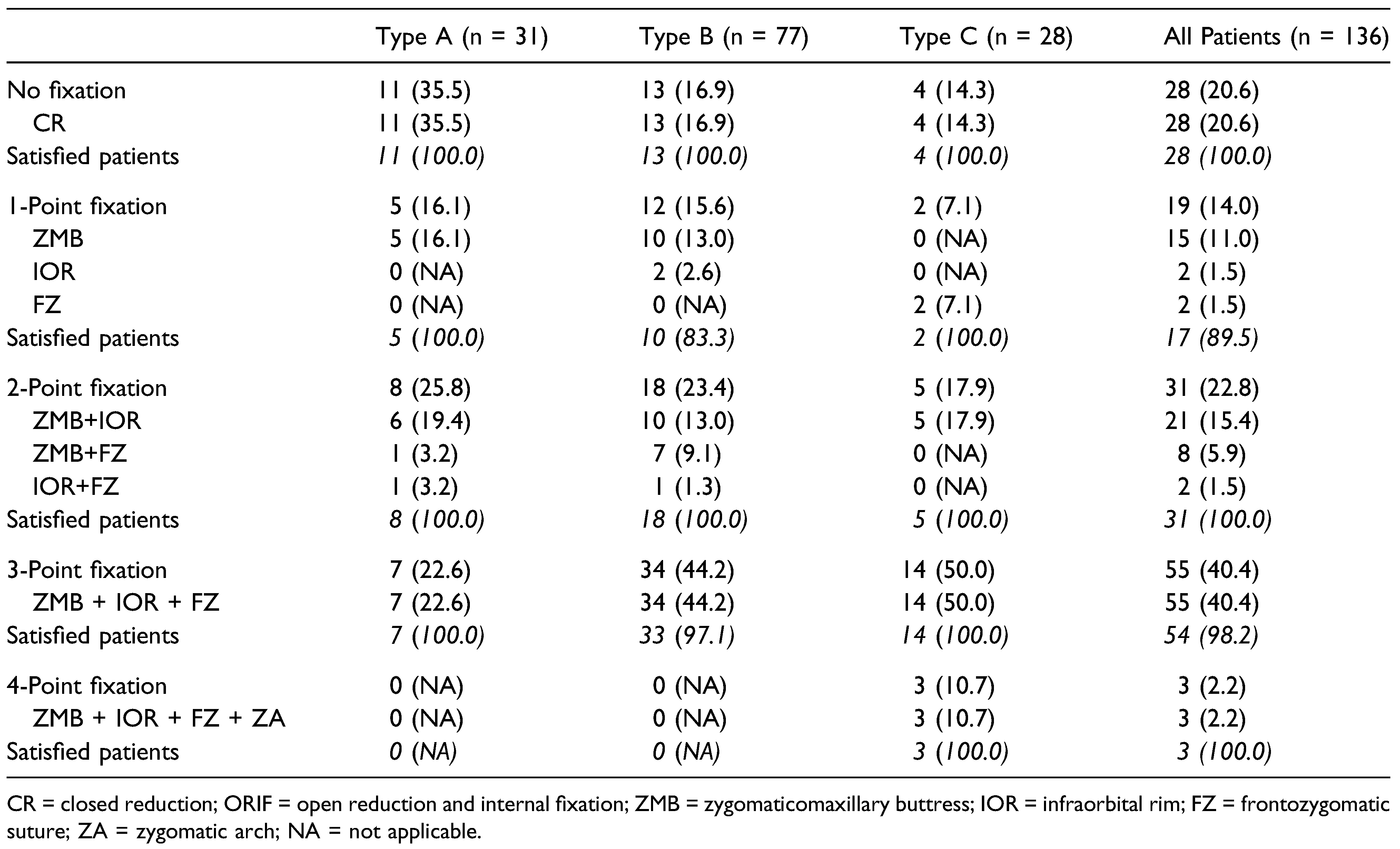
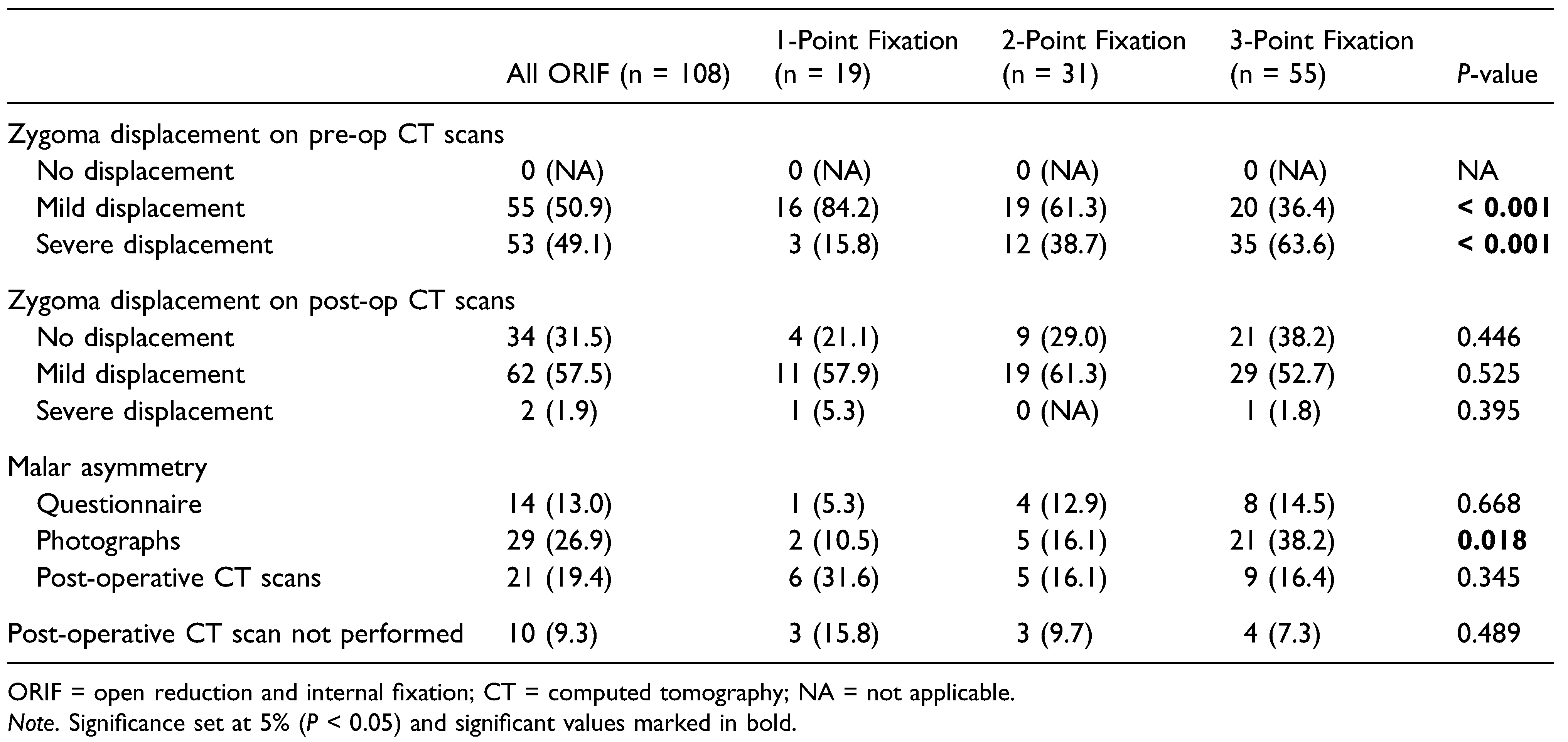
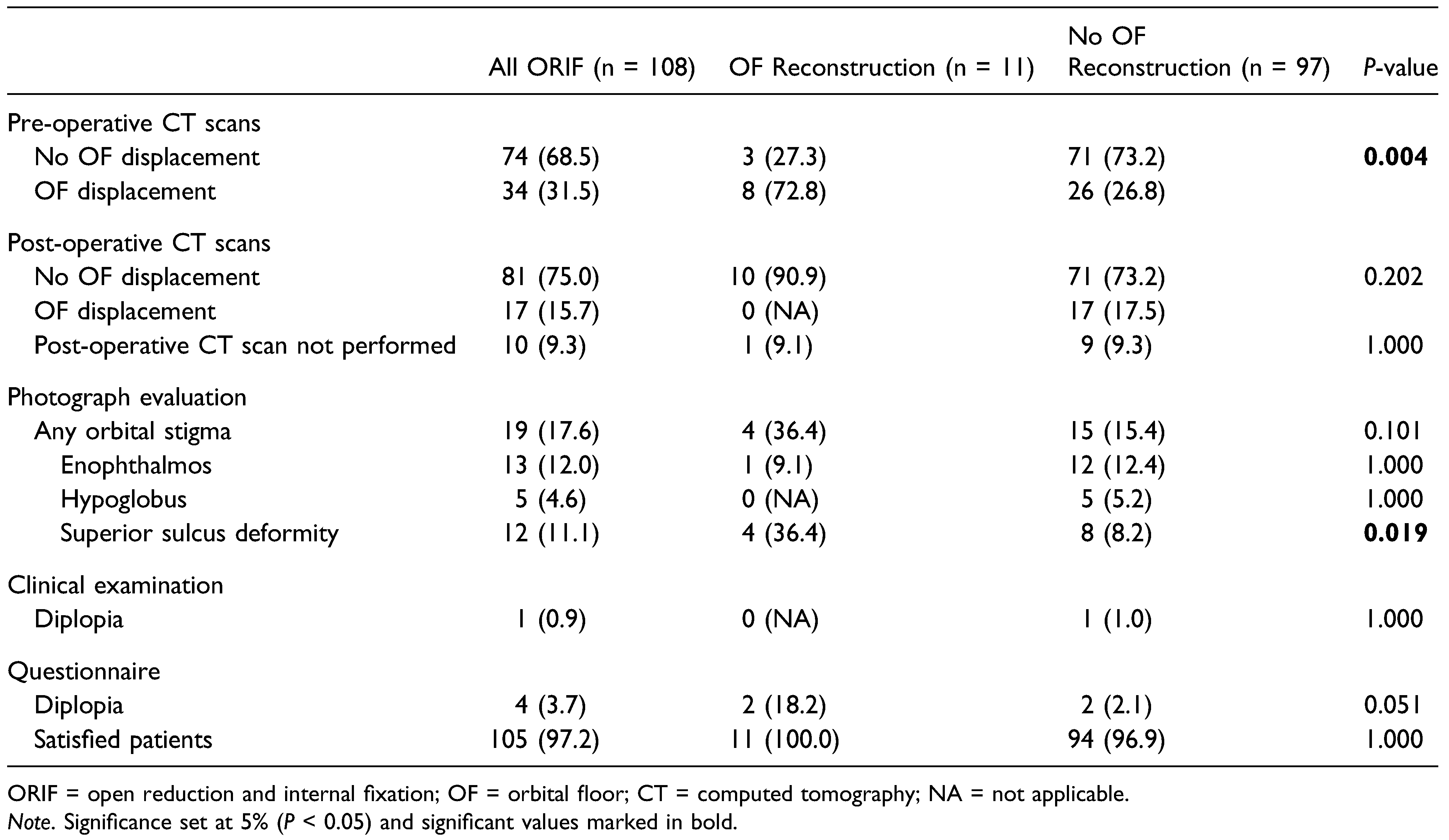
Study Design: Retrospective with follow-up. Objective: To evaluate the long-term satisfaction of surgically treated patients with zygomaticomaxillary complex (ZMC) fractures in relation to the use of internal fixation, number of fixation points, and orbital floor (OF) reconstruction. Secondary objectives were to describe the use of antibiotics and post-operative infections. Methods: Patients with unilateral ZMC fractures between 2007–2018 and treatment with either open reduction and internal fixation (ORIF) or closed reduction (CR) were identified from medical records and invited to follow-ups between 2018–2020. Patients were examined, photographed, and completed a questionnaire. A review panel of 3 experienced surgeons evaluated photographs and computed tomography (CT) scans pre- and post-surgery. Results: The study sample consisted of 136 patients (108 ORIF, 28 CR) with a median follow-up time of 76 months. Patient satisfaction of surgical outcome was high (97.8%), with no significant differences in relation to the use of internal fixation, number of fixation points, or OF reconstruction. Dissatisfaction was primarily related to hypoesthesia. On post-operative CT scans, malar asymmetry was more often predicted in patients with 1-point fixations. On questionnaires and photographs, malar asymmetry was more common in patients with 3-point fixations. Prophylactic antibiotics had no effect on the rate of post-operative infections. Conclusions: Patient satisfaction was not influenced by internal fixation, number of fixation points, or OF reconstruction. Selected ZMC fractures can be treated with less invasive approaches. Caution should be observed when predicting long-term malar asymmetry on post-operative CT scans. The findings of this study highlight the importance of a rational and ethical use of surgery.
Keywords: patient satisfaction; zygomatic fracture; zygomaticomaxillary complex; facial asymmetry; surgical wound infection; antibiotic; prophylaxis patient satisfaction; zygomatic fracture; zygomaticomaxillary complex; facial asymmetry; surgical wound infection; antibiotic; prophylaxis