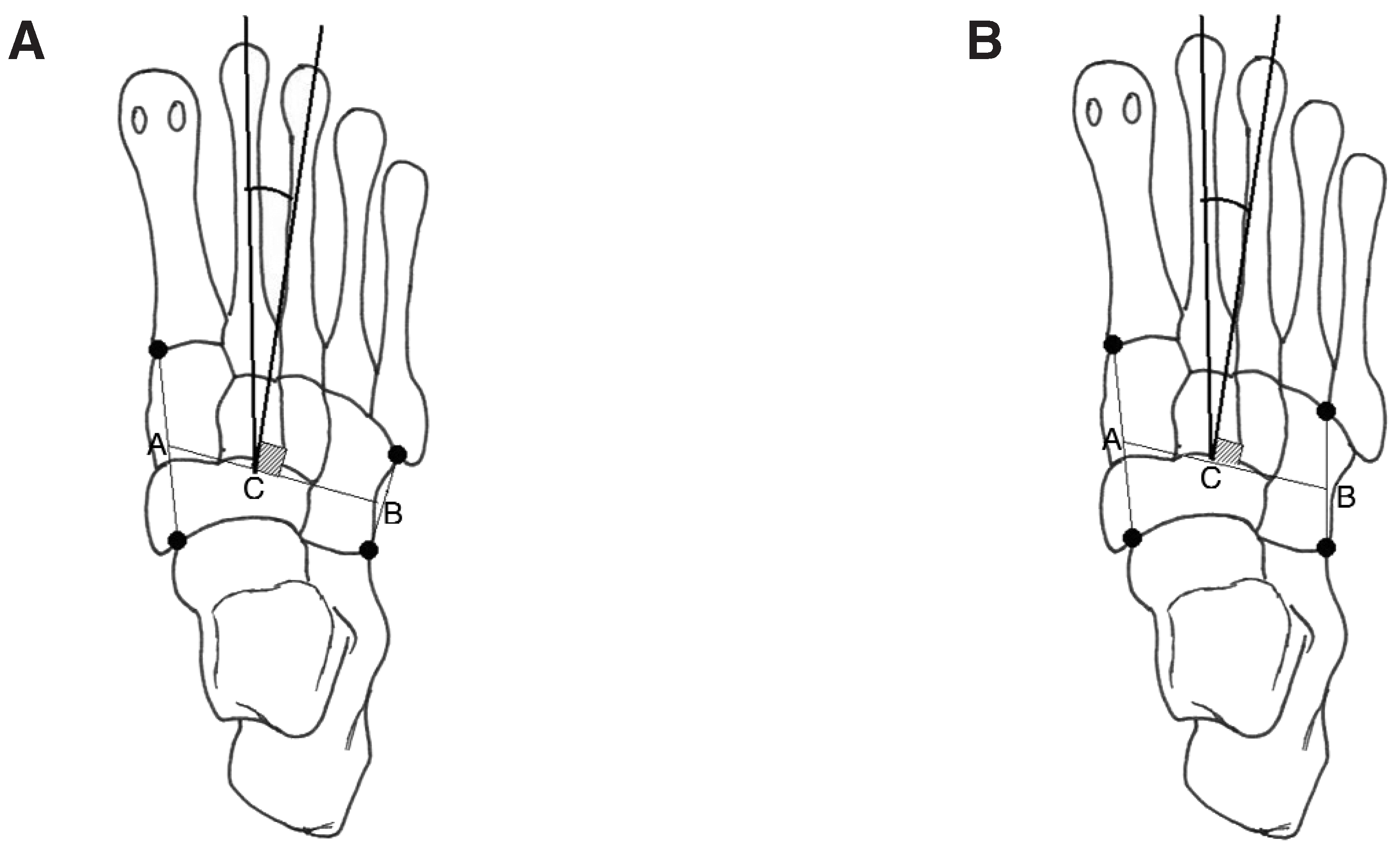
The metatarsus adductus angle determines the relationship between the longitudinal axis of the lesser tarsus and the axis of the metatarsus (which coincides with the axis of the second metatarsal) in a dorsoplantar radiograph.[
1]
The literature contains a variety of techniques for the calculation and tracing of the points and lines composing this angle. A common method, used in the present study and described herein, is to measure the angle between the axis of the second metatarsal and that perpendicular to the transverse axis of the tarsus. Regarding the latter reference, two options are described in the literature: one that uses the joint of the fifth metatarsal with the cuboid as reference [
2,
3,
4]
and one that uses the joint of the fourth metatarsal with the cuboid [
5,
6,
7,
8,
9]
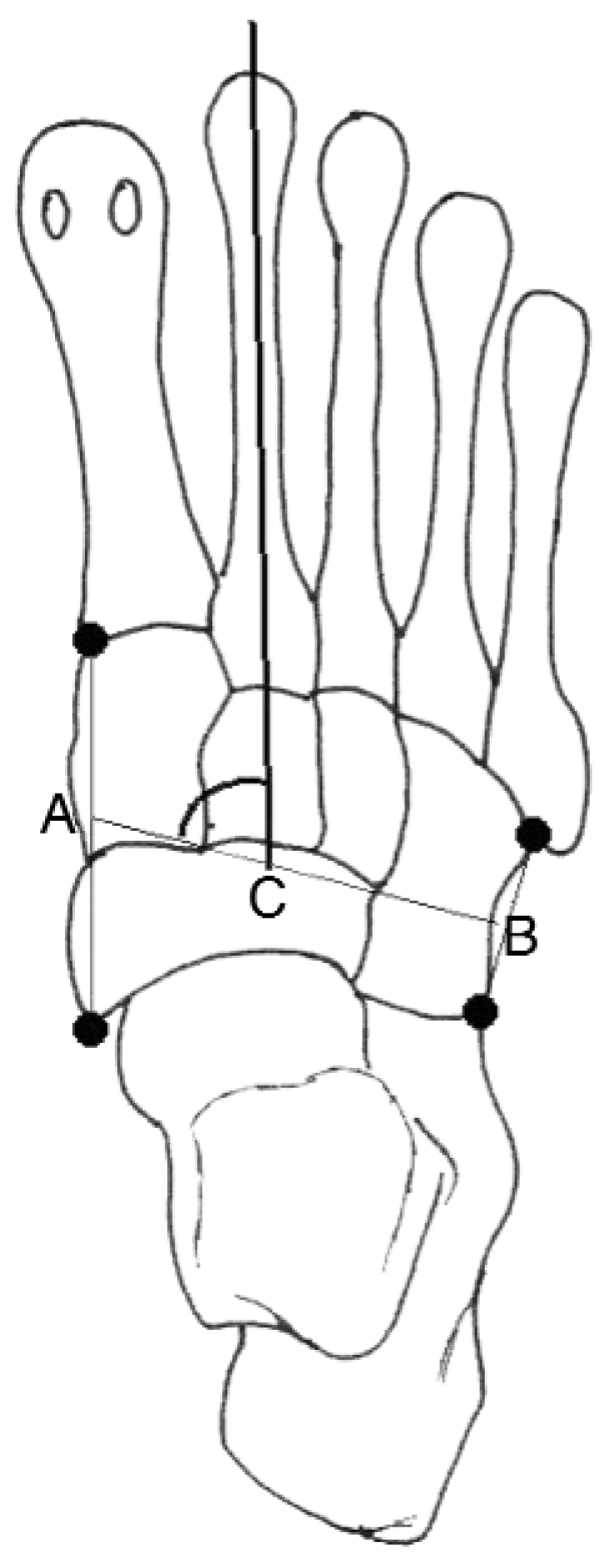
(Figure 1). Other authors use completely different systems. Kilmartin et al. [
4]
measured the angle between the longitudinal axis of the second metatarsal and the transverse axis of the lesser tarsus (Figure 2). Bresnahan[10] proposed, as an ideal method for children’s feet, the angle formed between a line representing the longitudinal axis of the ossified portion of the calcaneus and another representing the longitudinal axis of the second metatarsal. This method is similar to that used by Root et al.,[
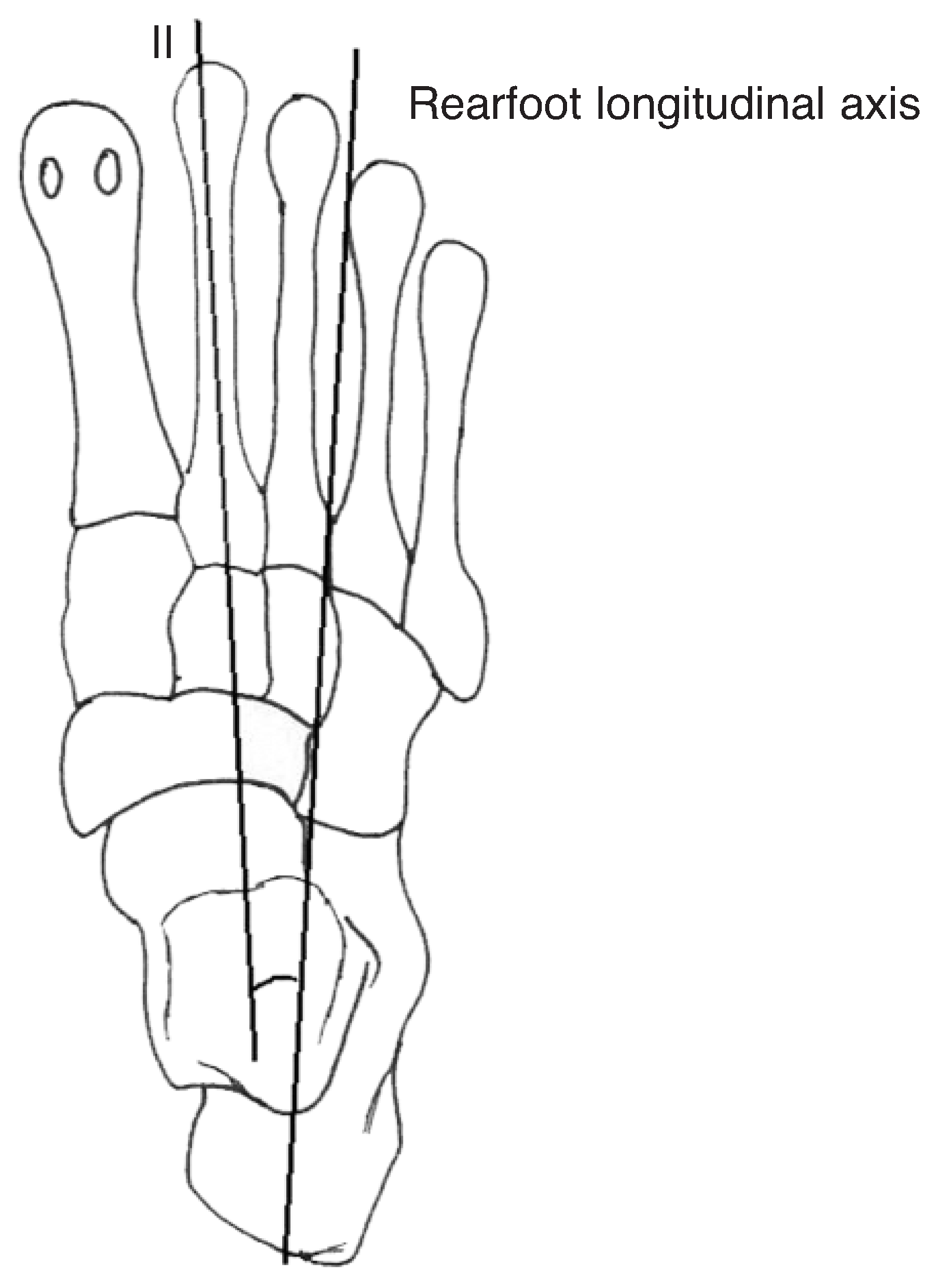
11]
who measured adduction of the forefoot by using an angle formed between the longitudinal axis of the metatarsus and the longitudinal axis of the rearfoot (Figure 3), but they do not specify how to localize those axes. Gentili et al. [
12]
distinguished between the angle of the adductus forefoot, formed between the longitudinal axis of the metatarsus and the longitudinal axis of the rearfoot, and the metatarsus adductus angle, which is shown in Figure 1A. Engel et al. [
13]
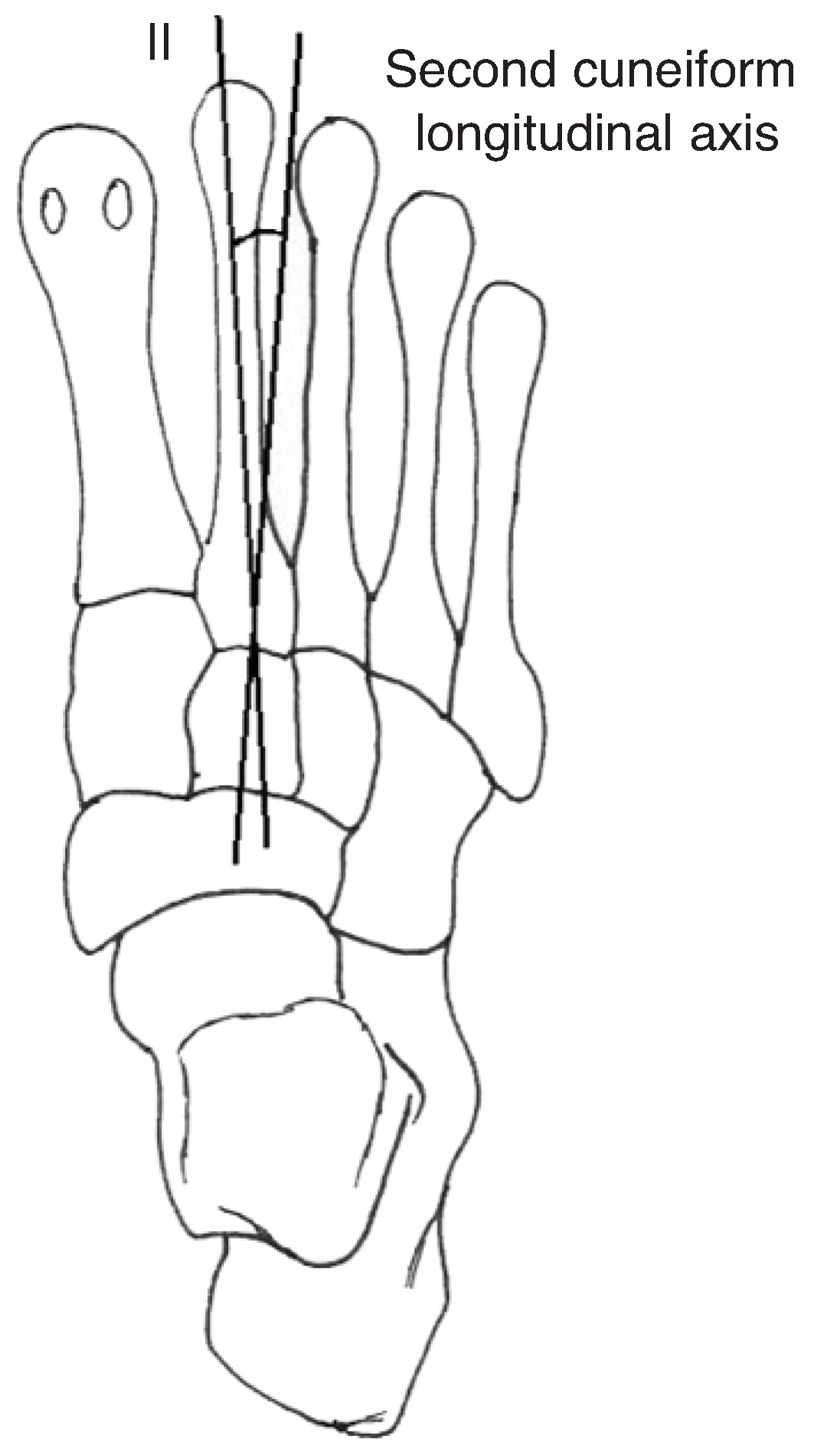
proposed an alternative method by measuring the angle between the longitudinal axis of the second metatarsal and the longitudinal axis of the second cuneiform instead of the longitudinal axis of the lesser tarsus (Figure 4). Using this method, Engel et al. [
13]
obtained an angle approximately 3° greater than that derived from the longitudinal axis of the tarsus. Whatever the system used to evaluate the metatarsus adductus angle, the measurements can be more reliably made with a computer program. This was demonstrated by Farber et al. [
14]
in their study of the angle of hallux abducto valgus and the first and second intermetatarsals and by Piqué-Vidal et al. [
15]
in their comparative study of reliability when measuring the hallux abducto valgus angle manually and using a computer program. The latter authors used a program designed for technical drawing (Autocad 2006; Autodesk Inc, San Rafael, California) to make the radiographic measurements. We have used this same program for some time in various studies that we have performed in the Clinical Podology Department of the University of Seville.[
16,
17]
The reliability of the measurements made on dorsoplantar projections of the foot yielded by this system are very satisfactory. The anthropometric differences cited by various authors regarding the alignment of the lower extremity suggest the need to compare the mean values of the metatarsus adductus angle in men and women. Testud and Latarjet18 established 16 differences between the pelvis in men and women, such as differences in the cervicodiaphyseal angle of the femur. There are also references concerning the difference in angulation of femoral anteversion [
19,
20,
21]
and of physiologic genu valgo depending on sex.[
22,
23,
24]
Regarding the foot, significant differences were found by Steele[25] in the size of the astragalus and calcaneus, by Smith[26] in the size of the metatarsals and toes, and by Ferrari et al. [
27]
in the orientation of the first ray in the transverse plane. Sex-dependent differences have been described regarding the functionality of the lower extremity. Various studies have found significant differences in the internal rotation of the hip,[
28]
the internal rotator pattern,[
29]
the angle of gait,[
29,
30,
31,
32,
33,
34]
and even in plantar pressures during gait.[
35,
36,
37]
The aims of the present study were 1) to obtain the mean values of the metatarsus adductus angle in men and women by using the measurement system most used in the literature: that which determines the angular relationship between the perpendicular to the transverse axis of the tarsus and the longitudinal axis of the second metatarsal; 2) to establish the differences in the measurements made with this system of evaluation when the fourth and fifth metatarsals are used as references; and 3) to determine the reliability of this measurement system when the two anatomical references are used.
Materials and Methods
We used 206 radiographic images in dorsoplantar projection of the healthy feet of 121 podology students at the University of Seville. All of the volunteers participating in the study signed a document of informed consent. The criteria for inclusion in the sample were as follows: age older than 20 years, no degenerative osteoarticular diseases or muscular imbalance, absence of foot pain, no history of foot surgery, no history of foot trauma in the previous 12 months, no history of metatarsal fracture, no signs of alteration in the distribution of the plantar pressures in the forefoot, and no deformities of the forefoot (hallux valgus, hallux limitus, claw toes, etc).
Before the radiographic study, each individual was subjected to a history and examination to rule out podologic abnormalities. Dorsoplantar radiographs were made under load bearing with the two feet together on the chassis, with the light at a distance of 1 m and the tube angled at 15°. The radiographs were not taken in angle and base of gait; each foot was close to the other one. All of the radiographs were scanned with the Epson Expression 1680 Pro (Seiko Epson Corporation, Nagano, Japan) at 1:1, and were processed with the Autocad 2006 program.
The metatarsus adductus angle was measured with the system shown in Figure 1, with the two options described in the literature. First, the most-medial point of the astragaloscaphoid joint and the mostmedial point of the first metatarsocuneiform joint are located. These two points are joined by a line whose midpoint is calculated (point A). Then, the most-lateral point of the calcaneocuboid joint and the most-lateral point of the joint between the cuboid and the fifth metatarsal [
2,
3,
4]
are located. These two points are joined by a line whose midpoint is also calculated (point B). Points A and B are then joined with a line representing the transverse axis of the lesser tarsus, ie, perpendicular to the longitudinal axis of the lesser tarsus, so that any perpendicular to line AB will represent the longitudinal axis of the lesser tarsus. Once this is done, the longitudinal axis of the second metatarsal is traced and prolonged proximally to intersect the transverse axis of the lesser tarsus (point C). From point C a perpendicular line is drawn to line AB, which represents the longitudinal axis of the lesser tarsus, and the angle between that axis and the longitudinal axis of the second metatarsal is measured (Figure 1). The second option of this measuring system is similar to the first, varying only the reference of the most-lateral point of the joint between the cuboid and the fifth metatarsal, which in this case is substituted by the most-lateral point of the line of the joint between the cuboid and the fourth metatarsal (Figure 1).[
5,
6,
7,
8,
9]
Data were analyzed with a computer program (SPSS 12.0 for Windows; SPSS Inc, Chicago, Illinois). To study the reliability of the measurements, 20 radiographic images were chosen at random. The metatarsus adductus angle was measured by two evaluators (G.D. and P.V.M.) to perform the inter-evaluator test. The intraclass correlation coefficient was calculated by using the two-factor random-effects model to study the absolute concordance between the results of the measurements made by these two evaluators. In addition, one evaluator (G.D.) made the measurements at three different times, at intervals of 1 week, to check intra-evaluator reliability. For this, the intraclass correlation coefficient was calculated by using the single-factor random-effects model to study consistency between the results of the measurements made by this evaluator. The mean (95% confidence interval) metatarsus adductus angles in men and women were also calculated. The Student t test for independent samples was used to compare these values between men and women and between left and right feet. This test was chosen for the comparisons once the results of the normality tests (Kolmogorov-Smirnov test) had been evaluated.
Results
All of the radiographic measurements were made on 206 dorsoplantar radiographic images (106 feet of men and 100 feet of women); 103 images were of left feet and 103 of right feet. The mean ± SD age of the sample was 23.88 ± 2.847 years (range, 20–29 years).
The results of the inter- and intra-evaluator tests show very high values for the chosen measurement system whether using the joint between the cuboid and the fourth metatarsal (0.962 and 0.972, respectively) or the joint between the cuboid and the fifth metatarsal (0.962 and 0.970, respectively). Thus, the method of measurement can be considered reliable and reproducible.
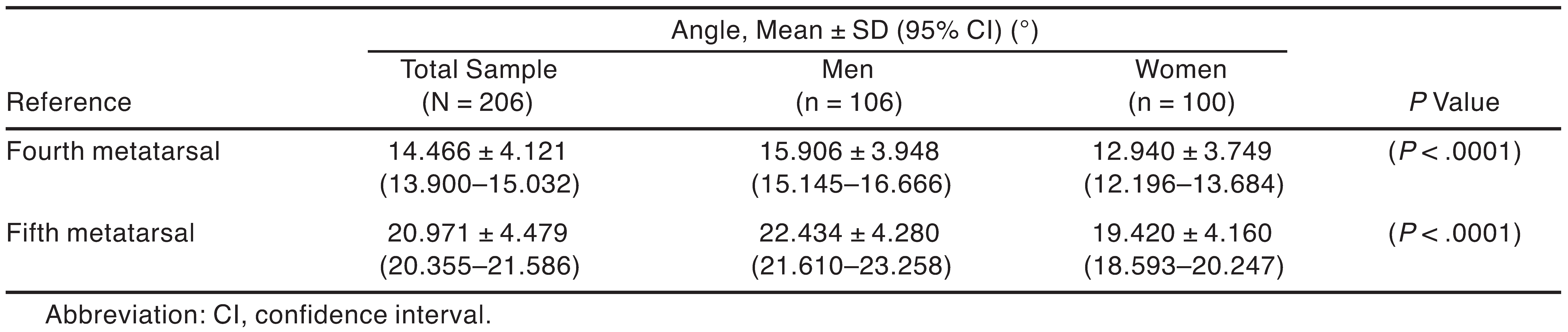
The descriptive statistical results of the mean metatarsus adductus angles are given in Table 1. Comparisons between the metatarsus adductus angle, using as a reference the fourth and fifth metatarsals, showed significant mean values (P < .0001) in the study of the total sample and in the study of the angle depending on sex. In the study of the metatarsus adductus angle depending on laterality, no significant differences were found between left and right feet in the study of the total sample or in the groups of men and women (P > .05).
Discussion
The anatomical differences between the male and female skeleton are not only due to size differences that can be presented by specific osseous parts, for example, the male cranium is larger, with more-marked osseous reliefs (glabella, ciliary arches, inion, occipital condyles, mastoid and styloid apophyses, etc)[18]; the female pelvis is broader[18]; and men have larger bones of the rearfoot,[
25]
metatarsals, and phalanges.[
26]
There are also intersex differences regarding the alignment of certain osteoarticular segments, as in the angle of the knee [
22,
23,
24]
and the angle of femoral anteversion,[
19,
20,
21]
both with higher values in women. Ferrari et al. [
27]
demonstrated in their study of 53 male and 54 female skeletons a greater predisposition of the articular surfaces of the first ray to adduction movements in women, with an orientation of the first metatarsal in adduction. The sex-dependent differences found by various authors regarding the rotational functionality of the lower extremity and, more specifically, the angle of gait have been of little clinical significance according to the studies reviewed. Authors such as Murray et al. [
30,
31]
and Lafuente et al. [
29]
found a difference of approximately 1° to 1.5°, obtaining higher values in the group of men. The studies by Seber et al. [
32]
and Dougan[33] on the angle of gait in men and that by Patek[34] on the angle of gait in women independently noted intersex differences of the same sense and magnitude. There are, however, different parameters of the female skeleton that determine a functionality of the lower extremity with internal alignment, such as the greater angle of femoral anteversion [
19,
20,
21]
and the greater internal rotation of the hip.[
28]
These anthropometric differences, compared and evaluated by means of physical exploration, do not present a significant clinical impact regarding a reduction in the angle of gait of women with respect to that of men, so there must be other parameters in the female skeleton that determine an external alignment of the extremity. The lower degree of adduction of the female forefoot, as shown by the results of this study, could be understood as a determining element in opening the angle of gait in women, the mean values of this variable approaching those found in men. Another type of study would be necessary to evaluate the relationship between the alignment of the forefoot in the transverse plane and the angle of gait in men and women. As far as we know, the references to mean values of the metatarsus adductus angle found in the literature to date do not distinguish between men and women. Authors using the systems of measurement used in this study offer physiologic mean values of the metatarsus adductus angle that, in some cases, are very close. Michaud7 used the fourth metatarsal as a reference to evaluate the metatarsus adductus angle and established as normal those values less than or equal to 10°. Griffiths and Palladino[
38] used this same anatomical reference to measure the angle and established 14° or less as normal, results very close to the mean ± SD of 14.47° ± 4.12° obtained for the total sample in the present study. Sanner[
39] also used the fourth metatarsal as a reference and offers mean values of normality compatible with those of the present study, ranging from 10° to 20°.
Other authors use the fifth metatarsal as a reference to evaluate the metatarsus adductus angle, eg, Banks et al.,[
40] who established values of 14° or less as normal. This is lower than the mean ± SD of 20.97° ± 4.48° obtained for the total sample in our study. Gentili et al.,[
12] also using this system, established values of 15° or less as normal. Bryant et al. [
2] obtained values of normality also considerably lower than those of our study (mean ± SD, 17.7° ± 4.6°).
A significant difference has been observed between the two ways of tracing the metatarsus adductus angle included in our study, that is, using the fourth or the fifth metatarsal as a reference. Consequently, in our opinion, the same method should always be used to quantify adduction of the forefoot because the indiscriminate use of the two could lead the clinician to misinterpret the data. We think that when the literature refers to values close to 15° as normal for the metatarsus adductus angle measured between the longitudinal axis of the lesser tarsus and the longitudinal axis of the second metatarsal, these values correspond to the technique that uses the fourth metatarsal as a reference. As we have verified, when the joint between the cuboid and the fifth metatarsal is used, the mean value in the normal population included in this study is approximately 20°. Therefore, if the clinician opts to use the method taking the fifth metatarsal as a reference, it should be kept in mind that the normal value is not 15° but some degrees higher.
Conclusion
The reliability of the measurements indicates that the reproducibility of the data is good when either the fourth or the fifth metatarsal is used as a reference. The results of our study indicate the significant differences between the measurements made when the fourth and fifth metatarsals are used as a reference to evaluate the metatarsus adductus angle according to the system described. The significant differences between men and women indicate a further anthropometric difference in the osteoarticular alignment of the lower extremity.