Musculoskeletal pain of the lower leg and foot seems to be a common sequela of weightbearing activity and exercise. In a survey of aerobics instructors,[
1]
77% reported injury (53% of the leg, 33% of the ankle, and 20% of the knee). The yearly incidence of injury in runners is 37% to 56%, mainly of the lower leg, with predominance in the knee.[
2]
Foot-care professionals commonly dispense foot orthoses for musculoskeletal complaints of the foot and lower limb (heel, arch, and knee pain). Patient satisfaction surveys [
3,
4,
5]
report that foot orthoses are helpful for improving symptoms. There are however, an insufficient number of randomized clinical trials that evaluate the clinical effectiveness of foot orthoses.[
6,
7]
The literature is inconclusive as to whether prefabricated shoe inserts or custom foot orthoses are less, or equally, effective at controlling musculoskeletal pain. A recent randomized, prospective study[
8]
investigated the effectiveness of three interventions (custom foot orthoses, prefabricated arch supports, and tension night splints) on plantar fasciitis. These researchers used a visual analog scale during 12 weeks when asking patients to rate “first step” morning pain and average pain during the day8 and reported no statistically significant difference in scores. Yet a recent study[
9]
demonstrated that foot orthoses may be the best initial choice for the treatment of plantar fasciitis. The lack of universal terminology to describe foot orthoses prescription and manufacture is another issue in the foot-care field. It is seldom clear in the literature how a foot orthosis was prescribed, including the casting process, the use of materials, and included modifications. A literature review[
3]
on the efficacy of foot orthoses, perhaps unwittingly, underscores the problem of multiple descriptors for foot orthoses. The article cites nine terms for foot orthoses. In many articles it is unclear what the authors specifically mean by custom foot orthoses. A 2004 review[
7]
of the literature concluded that there are no guidelines for defining orthoses, which makes communication difficult. In this study, we describe our prefabricated and custom interventions and the manner in which they were prescribed. Pain is the primary complaint of those with a musculoskeletal injury, and change in pain is a common measurement outcome used by clinicians to monitor intervention effectiveness.[
10]
After a 2-week fabrication interval, the intervention would be dispensed, and the patient would be monitored for symptomatic improvement during the following month. This study describes the pattern of change in pain in participants with common lower-extremity musculoskeletal complaints who used prefabricated shoe inserts and full-contact custom foot orthoses during a 10-week period. We hypothesized that participant pain scores would demonstrate statistically and clinically significant differences between custom-made and prefabricated inserts.
Methods
In this study, a numeric pain rating scale (NPRS) (a 0- to 10-point scale, where greater values indicate greater pain) was used to quantify patient pain at specific times during the study. The NPRS is easy to administer, has good sensitivity, and creates data that can be easily analyzed.[
11]
A change of 2 points on the NPRS is considered clinically significant for patients with chronic pain,[
12]
and the minimal detectable change is 3 points for patients with musculoskeletal injuries.[
13]
However, when NPRS values are at the lower end of the scale (approximately 2), a change of 0.6 points becomes clinically important.[
14]
Participants
A convenience sample of participants was recruited through electronic mail postings on the McMaster University intranet. Individuals came from the medical, teaching, and administrative staff and their spouses, and from the undergraduate and graduate student population. Participants were screened to exclude those who had a systemic disease, such as rheumatoid arthritis or diabetes mellitus; had worn foot orthoses during the past 6 months; had lower-extremity pain as a result of traumatic injury (fracture/ sprain); had a hereditary condition, such as Charcot-Marie-Tooth disease; or had a fixed deformity, such as rigid forefoot equinus. Sex, ethnicity, and body weight were not part of the exclusion criteria.
Individuals 18 years and older were included in the study if they met the following criteria. First, they had to have an active lifestyle. An active lifestyle was defined as routinely (≥ 3 times per week) participating in activities such as walking, jogging, soccer, or basketball (>30 min). Second, participants presented with one (primary) or several (secondary) current musculoskeletal complaints of the lower extremity during activity. These conditions included plantar fasciitis, metatarsalgia, tibialis anterior/posterior tendonitis, and patellofemoral tracking dysfunction as assessed by an experienced foot-care professional. Third, participants had to be available for 10 continuous weeks. During this time, they completed a weekly questionnaire via e-mail and attended a testing facility at weeks 0, 2, 6, and 10. Fourth, participants had to be willing to wear prescribed foot orthoses in a comfortstyle shoe (not heeled or pointed-toe shoes) for 8 continuous weeks.
Sixty individuals were screened for eligibility via an e-mail history form submission. Subsequently, 42 participants were interviewed (history review and examination), and all met the inclusion and exclusion criteria. Participants were randomly assigned to one of two groups. Those receiving the prefabricated insert first and then the custom orthoses were labeled prefabricated-custom. Those with the opposite sequence were labeled custom-prefabricated.
Outcome Measure
The NPRS score was selected as the primary outcome measure. After walking on the treadmill (True S.O.F.T. System 500; True Fitness Technology, O’Fallon, Missouri) for 3 min, participants were asked to circle a number from 0 (no pain) to 10 (worst possible pain) for the following question, “What is your pain right now?” This question was designed to elicit from participants their pain while wearing a given shoe and intervention combination.
During the study, each participant was asked to complete the NPRS 21 times in the sequences diagrammed in Figure 1. We noted that 11 measures were obtained while each participant wore shoes, and five measures were obtained for each of the two intervention conditions (prefabricated and custom). At weeks 2, 6, and 10, participants were assessed in a shoe-only environment for the purposes of refamiliarization with the testing procedure. For this study, a data subset was analyzed. The subset mimicked values expected to be gathered during a typical set of patient-clinician interactions. The third of the three NPRS scores during the initial contact (week 0) was used as the first baseline on which to compare scores between weeks 2 to 6, the first intervention period. The second baseline occurred at week 6; this second baseline was the NPRS response while wearing the intervention for the previous 4 weeks, before the second intervention was distributed. This baseline assumes 4 weeks of acclimatization to the first intervention. The NPRS scores between weeks 6 and 10 were compared with this second baseline.
Interventions
Each of the 42 participants underwent casting at week 0 for a pair of full-contact custom foot orthoses. Prefabricated shoe inserts were ordered for each participant according to shoe size. The interventions were trimmed and fitted into each participant’s footwear by the primary researcher (L.C.T.). The participants were not told any details about the intervention itself. Participants were instructed to wear the combination of intervention and footwear for a single hour the first day, adding an hour or two each day (within tolerance) until they could wear the combination for the entire day. It was not possible to blind the primary researcher to the intervention assignment. In addition, although the participants were not told which intervention they were receiving, differences in the “feel” and appearance of the interventions made complete concealment impossible.
Full-Contact Custom-made Foot Orthoses. A single practitioner (L.C.T.) performed gait-referenced casting on each participant. The intracaster forefoot-to-rearfoot frontal plane angle reliability (p2 = 0.94, a generalizability/reliability coefficient) had been previously established for this technique.[
15]
The casts were sent to a single laboratory for standardization of the materials and the fabrication method (Sole Supports Inc, Lyles, Tennessee). The gait-referenced casting method used for fabrication of the Sole Supports foot orthoses is a departure from the traditional nonweightbearing slipper cast. The gait-referenced method uses a solid frame of reference, ensuring that the heel and the fifth and first metatarsal heads are on the plane of the ground while maintaining maximal attainable arch height. The idealized contours of the foot are captured in a functional posture called maximal arch subtalar stability. In the present study, the custom foot orthosis was defined as follows: cast to maximize the longitudinal arch height at midstance with the heel and the fifth and first metatarsal heads on the ground; created from a non–cast-corrected (no plaster fill was added) three-dimensional plaster of Paris model of each participant’s foot; made from a thermoplastic (high-molecular-weight, high-density polyethylene) matched in thickness to participant characteristics (body weight, arch shape, and arch flexibility rating); and fabricated to fully contact the arch per the original cast. Prefabricated Shoe Inserts. The flat prefabricated insert was a low-density, open-celled, 4-mm foam insert (Tana Sport, division of Sara Lee Household & Body Care, Canada, Cambridge, Ontario, Canada) sized to each participant’s foot. This type of inexpensive cushioning-style shoe insert is representative of those readily available in many retail outlets.
Data Analysis
Our study was originally designed to detect an effect size greater than 1.0 (outcome mean of the custom group greater than 1 SD of the outcome value of the prefabricated group), with type I and type II errors at 0.05 and 0.2, respectively. These values were used to calculate a minimum sample of 16 participants per group (http://www.sportsci.org/resource/stats/index.html). In addition, we assumed a 25% participant dropout rate, which required that we enroll 20 patients per study group. A two-way repeated-measures analysis of variance was used to determine whether the participants’ pain scores differed between the two groups and across time within each group. A mixed-design, general linear model, repeated-measures analysis was performed with SPSS version 14 (SPSS Inc, Chicago, Illinois). In each group, pairwise t tests were used to detect changes in pain scores between baseline and during intervention wear. All of the analyses used α = 0.05 to indicate significant statistical differences.
Results
Descriptive Characteristics
Forty-two participants entered the study; two withdrew before the week 2 and 6 visits to the testing facility due to scheduling conflicts. The loss of two participants represents attrition of approximately 5%, much better than the anticipated 25%.
The remaining 40 participants completed the entire 10 weeks of the study. Most of the participants were females (n = 27) who were also older than the males (n = 13; mean age, 35.7 versus 32.5 years). The overall mean (SD) age was 34.6 (11.3) years. The primary regions of musculoskeletal discomfort were classified into four categories: arch/foot (n = 12), heel (n = 10), metatarsal (n = 8), and shin/knee (n = 10). There was no significant difference in the frequency of regions between groups (χ23 = 0.80, P = .85). A shipping delay of the custom orthoses required that seven participants who were randomized to receive custom orthoses first received the prefabricated inserts first and the custom product second.
Effectiveness of Foot Orthoses in Reducing Pain
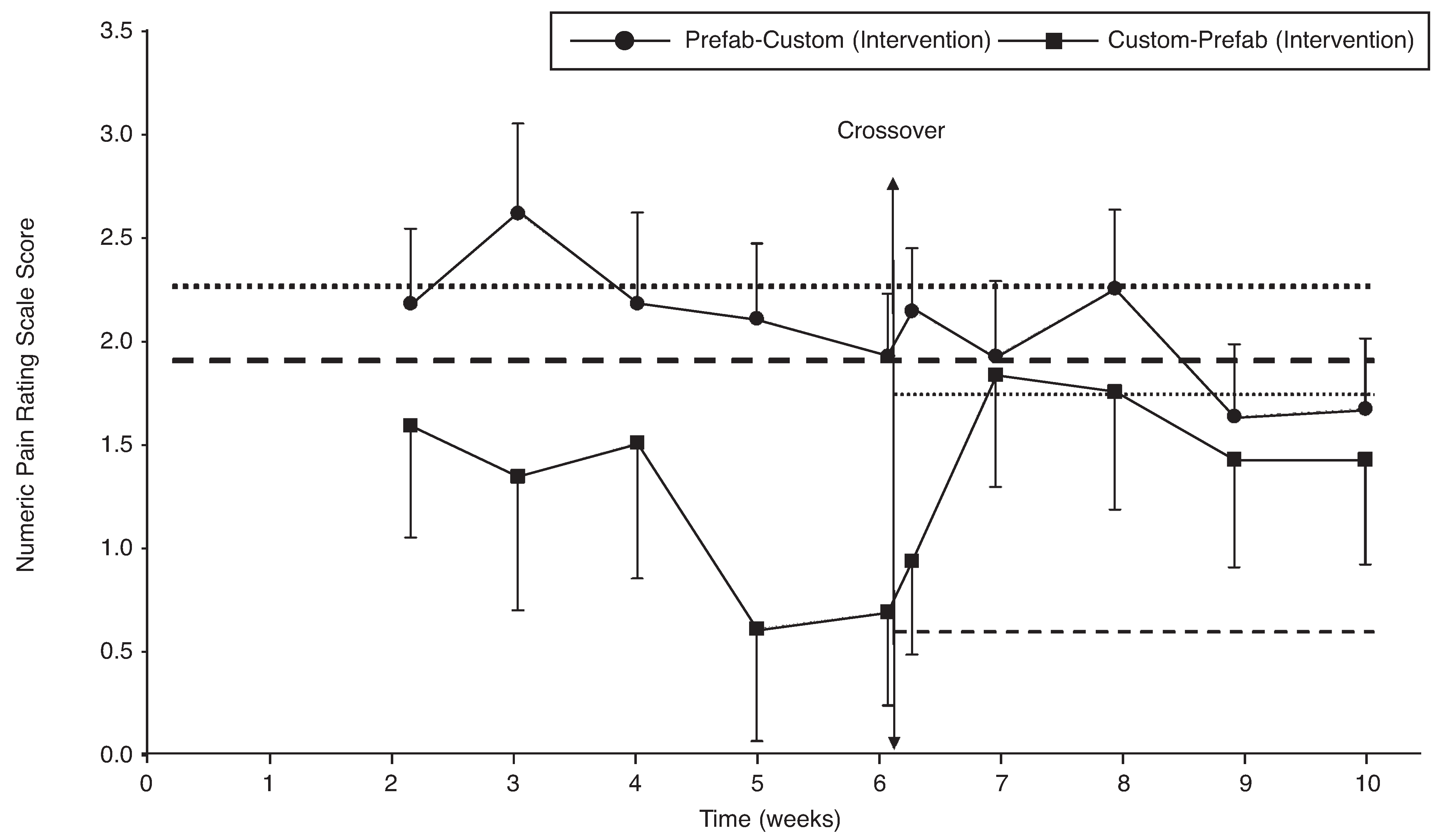
The multiple time points, interventions, and group NPRS data are presented in Figure 2. At the first baseline (week 0), there was no significant difference in pain between the prefabricated-custom and customprefabricated groups wearing shoes (mean (SE), 2.48 (0.38) and 2.08 (0.58), respectively; t12 = 0.589, P = .559). During the first intervention period (weeks 2–6), the prefabricated-custom group did not experience a statistically significant change in pain after 4 weeks. During the same period, the custom-prefabricated group reported significantly lower pain at weeks 3 and 4 (–1.39 pain units, t12 = 2.70, P = .02 and –1.39 pain units, t12 = 2.84, P = .02, respectively). Given that a meaningful clinically important difference is 0.6 pain units, a patient with an NPRS score of 2, these group improvements are also clinically important. At the intervention crossover (week 6), there was a significant difference in the second baseline pain scores between the two groups (mean [SE], 1.93 [0.31] and 0.67 [0.46], respectively; t12 = 2.30, P = .03). During the second intervention period (weeks 6–10), the custom-prefabricated group, now wearing the prefabricated inserts, had greater pain after weeks 1 and 2 (1.1 pain units, t12 = 3.09, P = .01 and 0.9 pain units, t12 = 2.65, P = .02, respectively), which returned to the second baseline value by week 3. The prefabricated-custom group, wearing the custom orthoses during weeks 6 to 10, did not demonstrate lower pain at any week compared with the second baseline values. This group did, however, demonstrate lower pain scores after wearing the custom orthoses for 3 and 4 weeks (chronological weeks 9 and 10) compared with their initial baseline values (–0.85 pain units, t26 = 2.16, P = .04 and –0.81 pain units, t26 = 2.28, P = .03). The custom-prefabricated group did not demonstrate a statistically significant difference from the initial baseline during the second intervention period. Discussion
The findings of this study support our hypothesis that patients with lower-extremity musculoskeletal pain who wear full-contact custom-made foot orthoses for 4 weeks demonstrate clinically important decreases in pain after 3 weeks that are sustained into week 4. The study also found that when the full-contact custom-made foot orthoses were removed and replaced with prefabricated inserts, the pain returned. When full-contact custom-made foot orthoses were prescribed after 4 weeks of prefabricated insert use, there was no significant further decrease in pain compared with the sole effect of the prefabricated insert.
The literature examining the efficacy of foot orthoses is heterogeneous due to variations in the patients, the prescription and manufacturing of the orthotic device, and the selection of measurement outcomes.[
3]
There is concern that most foot-science studies are not well-designed randomized controlled trials.[
16]
Recently, Pratt[
6]
used generally accepted quality guidelines to review 40 studies of foot orthoses.[
17]
He determined that only one study[
18]
achieved a rating greater than “C,” which would include nonrandomized trials with concurrent cohort or historical cohort comparison. Ratings of “A” and “B” consist of large and small randomized trials, respectively. High-quality randomized clinical trials require treatment and control groups with random assignment of treatment, and every attempt must be made to minimize bias. In this study, blinding, although not entirely possible for reasons of practicality, was established in the participants and in analysis of the data. The researchers could not be blinded regarding custom orthoses versus prefabricated inserts owing to the need to have the devices fitted into the participants’ shoes. Complete randomization of the intervention was exacerbated owing to a shipping delay of the custom devices such that the groups became unbalanced at 13 custom-prefabricated and 27 prefabricated-custom participants. Regardless of this issue, the custom-prefabricated group still provided statistically significant findings because of the efficiency of the within-participant repeated-measures design.
The complexity of the research design provided several options to define the “first” interaction between patient and foot-care professional and the value of the patient’s initial pain score. Quantifying the baseline is important for the foot-care professional to monitor change in pain scores and, therefore, to infer improvement or worsening of the patient’s musculoskeletal pain.
We chose to model a more realistic clinical scenario but a less rigorous research design whereby the patient pain scores at the first consultation were used as a baseline. We used the third of three scores during the first consultation to allow the participant an opportunity to become acquainted with the nature of the question and the treadmill walking environment. It is well known that in a research setting, initial participant results are potentially confounded by anxiety due to unfamiliarity and learning effects.[
19]
In addition, in this study the participants were asked to complete the NPRS in the laboratory and e-mail environments. To mitigate these effects and potentially obtain a more stable baseline pain score, we could have defined “baseline” as the average NPRS score obtained at week 0, week 1 (only value via e-mail), and week 2 (first value in the laboratory). All of these values were obtained from each participant in their regular shoes before using an intervention. Although the selection of different baselines alters some of the statistical values presented in this article, no combination substantively altered the conclusions. The strengths of our study include a time course and order of presentation of intervention modeled on plausible interactions between patients and foot-care professionals, a well-defined outcome (pain), precise definitions for casting and for orthoses interventions, and a defined patient population. In addition, our study detailed a specific casting and fabricating technique for application of the custom-made foot orthoses. Although this may limit the generalizability of the results, this study sampled a nonhomogeneous group of patients with musculoskeletal pain who sought relief through the application of custom orthoses.
The overall attrition rate in our study was approximately 5%, whereas similar prospective foot orthoses studies[
7,
20]
had rates of 27% to 41%. This low rate of attrition could be attributed to the fact that this study was conducted in a university hospital environment where the general understanding of and attitudes toward research are very positive. One limitation of our study is that the participants wore the prefabricated inserts and the full-contact custom-made foot orthoses for only 4 weeks each. Depending on the site and the nature of the musculoskeletal injury, tissue heals in 3 to 16 weeks.[
21]
If the insert or orthosis contributes to the ability of damaged tissue to heal, this process is just starting. It seems that the most dramatic response occurs when one aggressively treats a patient with full-contact custom-made foot orthoses compared with prefabricated inserts. It is not clear which biological system (psychological, neurologic, or biomechanical) is responsible for this accelerated change. Future studies should consider measuring the response of patients beyond 4 weeks to provide adequate longer-term follow-up and to explore the mechanisms that contribute to the positive effects. Another limitation of this study is the unbalanced group sizes of 13 and 27 participants. Accordingly, the group with 13 participants was poorly powered (0.44), which decreased our ability to confidently state that nonsignificant statistical differences were true. Adequate power of 0.82 was achieved with the prefabricated-custom group such that there is greater certainty in claiming that the observed nonchanges were, in fact, true. Clinical Scenarios
Our study was designed to examine the pain profiles of patients with musculoskeletal pain while receiving and wearing foot orthoses. Plausible clinical scenarios were embedded in the study. The time course and sequence of interactions between patients and footcare professionals were based on the following four clinical scenarios. In scenarios 1 and 2 (weeks 0–6; prefabricated-custom and custom-prefabricated groups), a patient presents to a foot-care professional in regular footwear (week 0), waits 2 weeks to receive an intervention (weeks 0–2), receives the prefabricated or custom intervention (week 2), and then is monitored for a month (weeks 2–6). A third scenario (weeks 0–10; prefabricated-custom group) is similar to the first two except that at week 2, the foot-care professional prescribes conservative prefabricated shoe inserts for 4 weeks (week 2–6) and then dispenses fullcontact custom foot orthoses (week 6) and monitors use for a month (weeks 6–10). A fourth scenario, which falls outside the bounds of typical clinical practice but is of research interest, extends the second scenario by following patients who receive and wear custom orthoses for 4 weeks and then revert to prefabricated inserts for 4 weeks. It models a patient who is discharged by a foot-care professional and then decides not to wear the custom orthoses.
Participants who began by wearing full-contact custom-made foot orthoses (scenario 2) reported a statistically significant decrease in pain compared with baseline by the third week of wear. Participants who were initially prescribed prefabricated inserts (scenario 1) did not report a statistically significant decrease in pain. These findings suggest that footcare professionals would provide greater benefit to patients with lower-extremity musculoskeletal pain by following the second clinical scenario (baseline assessments then prescribe full-contact custom foot orthoses after a 2-week fabrication interval).
Given the positive findings of clinical scenario 2, scenario 3 (baseline assessments, wear prefabricated inserts for 4 weeks, and then wear full-contact custom-made foot orthoses for 4 weeks) provided some surprising findings. The results of our study suggest that the introduction of full-contact custom-made foot orthoses after a prefabricated insert “priming period” provides a statistically small but significant additional benefit (–0.42 pain units) that is not clinically important (greater than –0.6). Given that this finding is based on the results of 27 participants and has adequate statistical power (0.833), this suggests that footcare professionals must be cautious when prescribing full-contact custom-made foot orthoses to patients already wearing prefabricated shoe inserts for symptomatic relief. The short-term benefit of full-contact custom-made foot orthoses does not seem to be the same with the prefabricated priming.
The finding from clinical scenario 4 (baseline assessments, wear custom orthoses for 4 weeks, and then wear prefabricated inserts for 4 weeks) provides evidence that if a patient ceases to wear a custom orthosis, pain will quickly increase and then return to the level the patient experienced before seeking advice from a foot-care professional.
Conclusion
For patients with lower-extremity musculoskeletal pain, 3 weeks of full-contact custom-made foot orthoses use is associated with a statistically and clinically important decrease in pain. Patients who wear full-contact custom-made foot orthoses first and then wear prefabricated inserts should expect a return of their original symptoms. Patients who begin by wearing prefabricated inserts and then wear full-contact custom-made foot orthoses may not experience noticeable improvements in the short-term. Future work to replicate these findings and to examine whether different types of custom orthoses provide similar findings is recommended.