The incidence of diabetes mellitus is currently estimated to be 10% of the total population, and it is significantly increasing in terms of age, affecting 10% to 15% of people older than 65 years. Twenty percent of the population older than 80 years has diabetes, and an increase by 30% is estimated in the next 10 years. In Spain, there are currently 1.5 million patients with diabetes, and there are probably another 1.5 million who have yet to be diagnosed. The number of patients with diabetes has multiplied by five in the past 10 years, affecting increasingly younger people and even children. The reasons for this significant increase in the number of diabetes-affected people are mainly related to the changes of modern-day living: a sedentary lifestyle, higher consumption of fats, and obesity.[
1,
2,
3]
It has been proved that patients with diabetes are prone to developing foot injuries (such as ulcers) owing to the lack of feeling in their feet as a consequence of the illness. These foot injuries often result in drastic amputations. Patients with diabetes are 20% more likely to have their feet amputated, and they are 30% more likely to experience other kinds of related injuries. Twenty-five percent of patients with diabetes will have to face these problems.[
3,
4,
5] These statistics make the improvement of methods for the prevention of these problems and the enhancement of treatment for existing injuries increasingly necessary.
Podiatric physicians currently treating or preventing these ulcers usually prepare special insoles that adapt to the feet of every patient and reduce pressures exerted at different points where ulcers appear.[
5,
6,
7,
8,
9,
10,
11,
12,
13,
14] These insoles can be made of a combination of different layers of polymeric materials, usually cellular or foamed materials.[
7,
8,
9,
10,
11] A wide range of these materials is currently available, and they can be classified according to their polymeric nature: polyurethane, ethylene vinyl acetate, polyethylene, polyvinylchloride, vulcanized rubber, etc. The first three materials are the most frequently used. These materials can be classified into three types depending on their function in the insole: adaptation or accommodation, cushioning, and filling materials.
The adaptation or accommodation material is in direct contact with the foot, and it must be able to conform to the sole to homogenize the plantar pressures, thus avoiding high pressure points that may cause ulcerations in the feet of patients with diabetes.[
7,
8,
9] Furthermore, this material must be able to remove the humidity produced inside the shoe, and it must be perspiration resistant.[
7] The cushioning material is under the adaptation material, usually covering the ulcerated areas of the foot, and it is aimed at absorbing the impact energy during gait. In addition, it should also be able to absorb humidity produced inside the shoe and be resistant to perspiration. The filling material is under the cushioning material so that the insole perfectly fits the shoe shape. This material has to be hard and stiff enough to provide stability to the assembly.
The use of these materials for the manufacture of insoles is subjective in many cases and depends exclusively on the experience of the podiatric physician. Reasons for this subjectivity are mainly attributable to the lack of criteria for the use of materials due to the scarce technical information about them.[
8,
9,
11] The technical specifications of materials provided by commercial suppliers give, at the most, information regarding the density and hardness of materials. This information is not enough, and sometimes podiatric physicians have to perform trials with their patients without having any information available beforehand that is related to the performance of a given material during its use. Furthermore, these insoles are not very durable because they are compressed or deformed during use and lose their therapeutic effects. This means that the patient’s insoles must be frequently replaced to achieve the suitable effectiveness of the treatment, consequently influencing the final costs.
The purpose of this research is to establish objective criteria that can be used to select materials for the production of insoles that are suitable for diabetic feet. To achieve this, INESCOP (Technological Institute for Footwear and Related Industries) has implemented a test method for the characterization of cellular polymeric materials and their combinations used for insoles. As a result of this research, the general properties of accommodation, cushioning, and filling materials have been determined, as have the most suitable polymer types for each of them. Furthermore, a tool for predicting the behavior of material combinations has been obtained.
Although many articles on insoles for the treatment of the diabetic foot have been published, the existing literature does not consider the technical assessment of such insoles through the physical-mechanical analysis of the materials used for their manufacture, which is the method used in this article. The “Discussion” section includes a concise bibliographical review on the topic of insoles for diabetic foot treatment. This research was performed in cooperation with the Diabetic Foot Unit of Clínica Virgen del Consuelo (Valencia, Spain).
Methods
Tested Materials
This research was based on the characterization of 30 cellular polymeric materials frequently used for the production of diabetic foot insoles, which were provided by several well-known companies specializing in the commercialization of materials for orthopedic, diabetic insoles. Furthermore, rubber latex foams were studied as an alternative to the previously mentioned materials. Table 1 provides the commercial references and the thickness of a sheet of material, as well as their polymeric nature.
Characterization Tests
Tests for the mechanical characterization and tests for the assessment of comfort properties of the different materials were considered. Table 2 includes references to the standards used and the corresponding tests. This testing was performed for each of the materials and for several material combinations. These tests were selected because the assessed properties are related to the expected properties of the accommodation, cushioning, and filling materials mentioned previously herein.
The obtained results were comparable among the different materials studied and their combinations, because standard test methods and standard test piece thicknesses were used regardless of the original thickness of the sheets from which the test pieces were obtained. In accordance with our experience, when working with thinner test pieces (nonstandardized), the values can change, although in general, the behavioral trends between them are maintained.
For the combined materials, the testing of an insole model comprising an adaptation or accommodation material, a cushioning material, and a filling material was established. Polychloroprene adhesive was used to bond the different material layers. Testing of the combined materials was composed of four parts: 1) effect of material thickness variation in a combination, 2) effect of changing a material in a combination, 3) effect of using adhesive to bond the different material layers, and 4) estimation of the combined properties from the properties of the individual materials.

Density. Density is a property for characterizing materials that mainly depends on their polymeric nature and on their foaming character (type, size, and number of cells). It is obtained from the ratio of weight to volume. In the case of foams, an “apparent density” is calculated because part of the volume of the test piece is air instead of polymeric material. It is expressed in kilograms per cubic meter. Test pieces measuring 100 mm in diameter and with the original thickness of the material sheet were used.
Hardness. Hardness describes the degree of penetration of a standard penetration tool on the material under specified conditions. The greater the penetration, the less the hardness, and it depends on the elasticity modulus and the viscoelastic properties of the material. The hardness meter Asker C (models 5019 to 5023-KS; Kobunshi Keiki Co Ltd, Kyoto, Japan) was used. In such equipment, the penetration tool is a metal sphere with a diameter of 5.08 mm, and a weight of 855 g is exerted on it. The reading, in °Asker C, is taken immediately after application of the load on the test piece. Test pieces measuring a minimum of 12 mm thick were used. Several layers of material were overlapped to obtain the requested thickness.

Resilience. Low resilience values are related to the high energy absorption capacity of a material. This test is performed with a modified Schob pendulum (model 645; Instruments J. Bot S.A., Barcelona, Spain), which impacts the test piece with an energy of 0.2 J. The relation between the impact energy applied and the energy returned by the test piece under specified conditions is measured. It is calculated through the relation between the height of the pendulum rebound and the distance from which it is released. The result is expressed as a percentage. The higher the resilience, the lower the energy absorption. Test pieces measuring 50 × 50 mm and 12.5 mm thick were used. Several layers of material were overlapped to obtain the requested thickness.
Stress/Strain Characteristics in Compression. This test is related to the stiffness of the material and its ability to withstand deformation loads. The test is performed with a universal testing machine (model 4302; Instron, Norwood, Massachusetts) at a constant compression rate. The force needed to compress a test piece until a specified deformation is achieved (40% regarding the initial thickness) is measured. It is expressed in kilopascals. Test pieces measuring 50 × 50 mm and 12.5 mm thick were used. Several layers of material were overlapped to obtain the requested thickness.
Compression Set Resistance (Static Method). Low compression set resistance can be related to the high ability of a material to be conformed to the foot shape to homogenize the plantar pressures in the insole. Furthermore, it can also be related to the low durability of the material, if this material must work without conformation.
The compression set equipment (Muver, Petrer, Spain) is composed of two metal plates that apply a specified compression on the test piece (50% of the initial thickness) by means of a gauge of known thickness located between the plates. Compression is applied for 22 hours at 23° and 50°C. The remaining deformation of the test piece is measured 30 min after releasing compression, and the result is expressed as a percentage regarding the initial thickness. The higher-temperature test, at 50°C, is more aggressive considering that temperature may affect the compression set of the material, thus differentiating between materials that show similar test performance at 23°C. Test pieces measuring 40 × 40 mm and 20 mm thick were used. Several layers of material were overlapped to obtain the requested thickness.
Compression Fatigue Resistance (Dynamic Method). Low compression fatigue resistance can be related to the high ability of a material to be conformed to the foot shape to homogenize the plantar pressures in the insole. Furthermore, it can also be related to the low durability of the material, if this material must work without conformation.
This test consists of simulating the continuous compression forces exerted on the insole when walking. Peaks of vertical force occur at the initial contact phase (when the heel strikes the ground) and at the propulsion phase (when the forefoot leans on the ground). During gait, the movement frequency may be approximately 1 step, and vertical pressures are approximately 200 to 500 kPa.[
12,
13,
14,
15] Gait is simulated at the laboratory level by using the compression fatigue test machine (model 5049; Muver). In this test, the test piece is compressed with a piston measuring 50 mm in diameter that performs 100,000 compression cycles, with a pressure of 700 kPa and a frequency of 60 cycles per minute. The remaining deformation of the test piece is measured 30 min after the end of the fatigue process, and the result is expressed as a percentage regarding the initial thickness. Test pieces measuring 45 mm in diameter and 10 mm thick were used. Several layers of material were overlapped to obtain the requested thickness.
Water Vapor Permeability. Perspiration causes humidity inside the shoes during gait. Therefore, materials in contact with the feet should be able to absorb this humidity.[
8] Humidity absorption, as well as other material properties, such as water vapor permeability and breathability, is enhanced in open-cell materials that allow the flow of vapor through them. However, not all of the materials used for insole production have this foamed nature. Therefore, these properties should be tested to determine the extent to which the materials are suitable to be in direct contact with the feet.
The permeabilimeter (Type CTC; Renaud Electronique, St. Georges des Reneins, France) used is aimed at determining the amount of water vapor flowing through a test piece when it is subjected to a vapor-saturated atmosphere in a closed setting. The test piece is clamped over the opening of a container containing distilled water at 32°C. This assembly, composed of the test piece and the container, is weighed at baseline and every 2 hours. The total duration of the test is 8 hours. Water-vapor permeability values in mg/cm2 are obtained at 2, 4, 6, and 8 hours for different test pieces and for each period. The mean permeability values versus time is then graphically represented, with the slope of the straight line representing the final watervapor permeability expressed in mg/cm2 per hour. Test pieces measuring 52 mm in diameter and with the original thickness of the material sheet were used.
Perspiration Resistance. Materials in direct contact with the feet have to be perspiration resistant to avoid a reduction in their effectiveness in the insole.[
8] Taking this resistance into account, this test is aimed at determining the material resistance to an artificial perspiration solution by measuring in percentage the variations in size or shrinkage of the test piece after the test. Test pieces measuring 40 × 40 mm and with the original thickness of the material sheet were used.
Results
Single Materials
When analyzing the obtained results, it was observed that the studied materials (Table 1) have some common properties depending on their polymeric nature. For this reason, in this section the obtained results for each of the commercial references studied have not been included; instead, they have been divided into polymer groups. This way, the results and the conclusions obtained can be generalizable to other commercial references differing from the ones studied in this investigation provided that their polymeric nature is known.
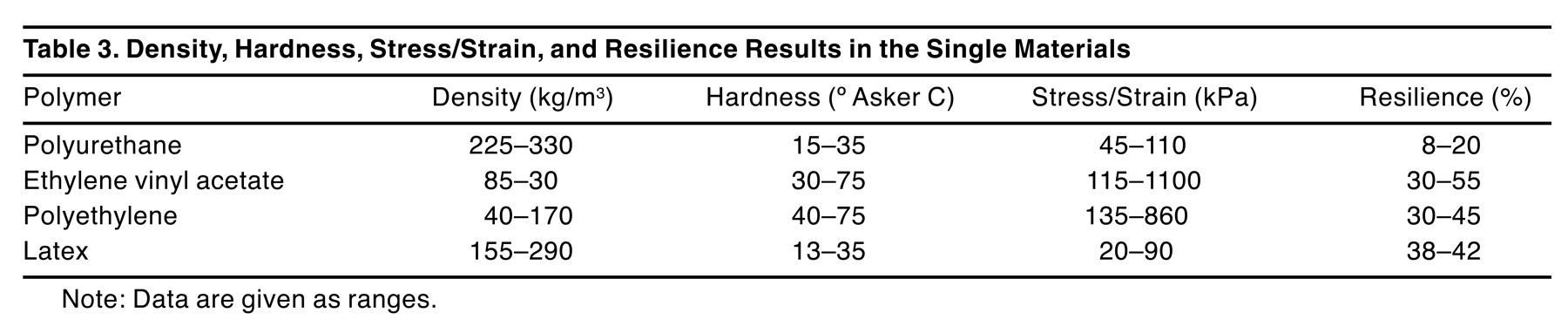
Table 3 provides the apparent density, hardness, stress/strain, and resilience results of the materials tested. It can be observed that there is a wide range of densities (40–330 kg/m3). The highest density values were obtained for polyurethane, ethylene vinyl acetate, and latex foams. The lowest density values were obtained mainly for polyethylene and some ethylene vinyl acetate foams.

Regarding hardness, polyurethane and latex foams showed the lowest hardness values, which were similar in both groups of materials. Polyethylene and ethylene vinyl acetate foams showed the highest hardness values, which could even be compared with the values obtained for footwear soles. Stress/strain results showed trends similar to hardness because the stress/strain of latex and polyurethane foams is lower than the stress/strain of ethylene vinyl acetate and polyethylene. In this case, latex foams were clearly not as stiff as polyurethane, although both presented similar hardness results. Concerning the resilience results, polyurethane foams were the materials that absorbed more impact energy (with lower resilience). The remaining materials showed similar higher resilience values to each other.
Table 4 provides the results of the tests that determine the compression forces produced on the insoles: compression set (static method) and compression fatigue (dynamic method). The results obtained showed that the performance of polyurethane and latex foams is different from that of ethylene vinyl acetate and polyethylene because the former showed clearly lower values of properties or higher resistance to compression forces. This trend was observed in both methods studied. Depending on the use of the material in the insole, high or low deformation of the material against compression forces may be requested.
Regarding the comfort properties of permeability and perspiration resistance, Table 5 shows a similar performance of polyurethane and latex foams on the one hand and ethylene vinyl acetate and polyethylene foams on the other. The first two were clearly more permeable, which may be due to the open cells of these materials compared with the closed cells of polyethylene and ethylene vinyl acetate foams. All of the studied materials showed satisfactory perspiration resistance. Table 6 provides indicative recommendations that result from the obtained material properties and their successful use in clinical practice according to the experience at Clínica Virgen del Consuelo.
Material Combinations
Effect of the Material Thickness.Table 7 shows the three studied combinations, referenced as A, B, and C, of the following materials: Plastazote (polyethylene), Poron (polyurethane), and Ortheva (ethylene vinyl acetate). In combinations B and C, two layers of Plastazote or Poron were used, respectively, compared with combination A. The characterization results of the individual materials used and their combinations are shown in Table 8.
The results of the combinations were related to the properties of the materials making up the combination and their thickness. Plastazote (polyethylene), which was the adaptation material in these combinations, had a compression set of 26.0%, whereas Poron (polyurethane), the cushioning material, had 0.7%. Comparing with combination A, when the thickness of Plastazote increases in the combination B, the percentage of compression set increases, and when thickness of Poron increases in the combination C, the percentage of compression set decreases. This effect could also be observed in the results of the compression fatigue test.


No significant changes were seen in the determination of hardness on the three combinations. It seemed that hardness depended on only the adaptation material because in these three combinations this material was the same, although with different thicknesses.

Concerning the stress/strain properties, the two modified combinations (B and C) showed lower results than the base combination (A). In the case of combinations composed of materials of very different stiffness (or stress/strain properties), the most important compression during the test took place on the softest material, as the stiffer materials were hardly deformed. This effect would be stressed if the thickness percentage of the soft material in the combination was high. In combinations B and C, the Plastazote (polyethylene) or Poron (polyurethane) layers had a higher thickness than the Ortheva layer (ethylene vinyl acetate). Plastazote and Poron had lower stress/strain values than Ortheva, and for this reason, combinations B and C had lower stress/strain values than combination A.


The resilience of combinations B and C increased or decreased in relation to that of combination A depending on the resilience of its thicker material (Plastazote or Poron for the B or C combination, respectively) being higher or lower than the resilience of combination A.
Effect of Changing a Material.Table 9 shows the two studied combinations referenced as D and E. The adaptation material of these combinations was different than the adaptation material used in each case to study the effect of this change in the properties of the combination. Both adaptation materials had the same thickness. Therefore, comparison of the obtained results depended only on the properties of the adaptation material used. The characterization results of single materials and their combinations are given in Table 10.
Concerning the compression set and compression fatigue tests, combination E comprising Plastazote, in general, showed higher deformation percentages, which means lower compression resistance. This was because the compression set percentage of this individual material was higher than that of Podialene 160 carne perforado (polyethylene). The hardness results obtained for both combinations were similar to those of the adaptation material, and the stress/strain properties of combination D were higher than those of combination E because Podialene (polyethylene) is twice as stiff as Plastazote (polyethylene). The same trend is observed in the “Effect of the Material Thickness” subsection.
Effect of the Use of Adhesive. Three materials with different mechanical properties were chosen: Poron (polyurethane), Plastazote (polyethylene), and Podiane I + perforado (polyurethane). Two test pieces of each material were prepared by overlapping different numbers of layers, with and without adhesive between them, to verify its effect on the mechanical properties. The use of adhesive did not have any significant effect on the physical properties studied of the tested materials (Table 11).
The effect of the use of adhesive on comfort properties such as water vapor permeability was also studied. The test pieces were prepared by overlapping one layer of Poron (polyurethane) and Herbiform Plus perforado (ethylene vinyl acetate) with adhesive between them. Although Poron is a permeable material (7.7 mg/cm2 h) and Herbiform Plus is perforated and consequently is also permeable (4.4 mg/cm2 h), the combination is not permeable (0.2 mg/cm2 h) because the adhesive film hinders the flow of water vapor through the combination.


Estimation of the Properties of a Combination From the Properties of the Individual Materials. More than 10 different combinations of cellular materials frequently used for insoles for diabetic feet were prepared. The analysis of the characterization results of single materials and their combinations showed that certain properties of the combinations could be estimated, in a more or less accurate manner, through the results obtained from the single materials. This is applicable to hardness, compression set, and compression fatigue.
Regarding hardness, the combination showed a result similar to that of the adaptation material. In the case of compression set and compression fatigue, the combination showed a result that is similar to that obtained using the following equation:

where
Pc is the result of the property in the combination (compression set or compression fatigue);
P1, the result of the property in the adaptation material;
P2, the result of the property in the cushioning material;
P3, the result of the property in the filling material;
d1, the thickness of the adaptation material;
d2, the thickness of the cushioning material; and
d3, the thickness of the filling material. However, certain properties, such as stress/strain and resilience, were difficult to estimate from the information from the single material properties. In these cases, it is advisable to test the material combinations in specialized laboratories where these values can be determined.
Discussion
A laboratory-scale physical assessment was performed on the materials often used for the production of insoles for diabetic foot treatment. The properties of accommodation, cushioning, and filling materials were determined as a result of this research, and the most suitable polymer nature for each of the three applications was identified. Furthermore, a tool for predicting the behavior of material combinations was obtained. Although many articles on insoles for diabetic foot treatment have been published, the existing literature does not consider the technical assessment of such insoles through the physical-mechanical analysis of the materials used in their manufacture, which is the method used in this article.
Upon reviewing the literature on insoles for the treatment of diabetic feet, it was concluded that the most common bibliography could be classified into three groups. First, many articles provide general information about the problems of foot abnormalities, such as the diabetic foot.[
1,
2,
3,
5,
7,
8,
15,
16] Second, many articles compare the effectiveness in the reduction of plantar pressures of different samples/models of finished products, namely, insoles and footwear products.[
4,
6,
10,
12,
13,
14,
17,
18,
19,
20,
21,
22] In these articles, the physical-mechanical properties of the materials used in manufacturing these products are not often discussed and are not even obtained through experimental techniques. Third, more scarce articles provide some indications of the resistance or thickness of the materials used in the manufacture of insoles, although these physical properties are obtained from the technical specification sheets of the materials provided by the manufacturers.[
22,
23] Along this line, some references were found in which compression fatigue methods had also been used to compare insoles, but, in any case, such methods are far different from that implemented by INESCOP for the accomplishment of this research work.[
19,
11,
23]
No article was found that compared cellular materials for their use in insoles for the diabetic foot, according to the rest of the physical-mechanical properties considered in this research work, such as resilience, stress/strain characteristics in compression, compression set resistance by the static method, water vapor permeability, and perspiration resistance. There also are no studies of how different variables, such as material thickness and the use of adhesive to bond material layers, can affect the performance of an insole made of a combination of materials. Finally, no research work providing tools for the prediction of the behavior of a specific combination of materials in an insole was found.
Certain ethylene vinyl acetate and polyethylene foams within the low hardness range are the most suitable materials for adaptation or accommodation applications: they have low compression set resistance and low compression fatigue resistance, which are equal to the high deformation percentages after these tests. Therefore, they can conform to the foot in the insole and homogenize the plantar pressures. Furthermore, they remove the humidity produced inside the shoe and are perspiration resistant.
Polyurethane foams are the best for cushioning applications: they have low resilience (high energy absorption), they absorb humidity produced inside the shoe, and they are perspiration resistant. Their high compression set resistance and high compression fatigue resistance enhance the durability of the insole. Latex foams may be considered as a suitable alternative to polyurethane, although with higher resilience.
Certain ethylene vinyl acetate and polyethylene foams within the range of high hardness values are the most suitable materials for filling applications: they are hard and stiff enough to provide stability to the insole, and their high compression set resistance and high compression fatigue resistance enhance the durability of the insole.
In the case of properties such as hardness, compression set, and compression fatigue, it is possible to broadly know the performance of a given combination of materials by knowing the properties of the materials composing it and their thickness. This conclusion can help podiatric physicians estimate the performance of a given combination of materials from the properties of the single materials composing it provided that these properties are available in their specification sheets. If not, they can be measured in specialized laboratories. This way, podiatric physicians will have more objective criteria available for the selection of materials for the production of insoles for diabetic feet. Nevertheless, other properties, such as resilience and stress/strain, are difficult to estimate from the properties of the individual materials.
Finally, in the tests performed, adhesive does not have an effect on the mechanical properties studied on the materials, although it may alter comfort-related properties, such as water vapor permeability. In the case that this is a determining property of the combination, it could be advisable to “spot bond” the different material layers.







 where Pc is the result of the property in the combination (compression set or compression fatigue); P1, the result of the property in the adaptation material; P2, the result of the property in the cushioning material; P3, the result of the property in the filling material; d1, the thickness of the adaptation material; d2, the thickness of the cushioning material; and d3, the thickness of the filling material. However, certain properties, such as stress/strain and resilience, were difficult to estimate from the information from the single material properties. In these cases, it is advisable to test the material combinations in specialized laboratories where these values can be determined.