Hallux valgus deformity refers to the abnormality of the foot in which there is a static subluxation of the first metatarsophalangeal joint. This occurs in response to the lateral deviation of the distal end of the great toe, accompanied by medial displacement of the distal end of the first metatarsal.[
1] The abnormality is commonly referred to as a bunion deformity, which specifically describes the painful soft-tissue swelling over the medial prominence of the first metatarsophalangeal joint.[
2] The deformity may be acquired, although it has been suggested that a strong hereditary predisposition exists.[
3-
6] Hereditary factors may contribute only to the basic foot type with its associated biomechanical abnormalities and not to the resulting pathologic condition.[
7] The female-to-male ratio of those affected is reported to be 8:1 or 9:1. This disproportionate incidence in females may be accounted for by the combination of genetic predisposition and prolonged use of high-heeled shoes with narrow toe boxes.[
6,
8] The use of such poor footwear is thought to progressively stretch the medial ligaments and push the great toe into a valgus position.
Today, most research and theoretical questions address the mechanical compensation for the structural and functional deformities of hallux valgus.[
9] LaPorta et al[
7] reported that many of the earlier views regarding extrinsic causes persist despite studies indicating that they are aggravating factors and not the primary etiology. Abnormal subtalar and midtarsal joint pronation is the most widely accepted contributing factor to hallux valgus deformities.[
10] Abnormal joint pronation historically has been viewed as a critical factor in the etiology of hallux valgus.[
9] However, some authors continue to suggest that the abnormal compensation of the hallux region for excessive pronation is the primary etiology of hallux valgus.[
11]
According to current literature, the plantar loading pattern of individuals with a hallux valgus deformity differs from that of individuals without it. Blomgren et al[
12] analyzed the pressure patterns of 66 patients with hallux valgus and 60 normal subjects and concluded that the hallux valgus group had significantly greater maximum pressure in the small toe and tarsal regions and less pressure in the first, second, third, and fourth metatarsal and heel regions. These results were similar to those of other studies, indicating a tendency toward lower toe pressure and greater loads on the lateral metatarsal heads in individuals with a hallux valgus deformity.[
13-
15] Both Hutton and Dhanendran[
15] and Grieve and Rashdi[
16] reported that the load on the hallux appeared to decrease with an increased hallux angle. Mitskewitch[
17] stated that the highest maximal pressure occurred in three locations, depending on the degree of the hallux valgus deformity. When the hallux valgus angle is small, maximal pressure is under the great toe. As the hallux valgus angle increases, maximal loads occur under the first or second metatarsal head. In severe cases of hallux valgus angular deformities, maximal pressure overloads have occasionally been observed under the first, second, and third metatarsal heads. This altered plantar load distribution is related to pain under the lateral metatarsophalangeal joints[
18] or pain associated with the lateral subluxation of the flexor mechanism and sesamoid complex.[
19]
While previous studies have addressed some of the differences between the normal foot and the foot with hallux valgus, none have attempted to assess the strength of clinical and plantar loading characteristics or the risk factors for this condition. The purpose of this study was to characterize the pain and biomechanical risk factors of adults with moderate hallux valgus.
An abundance of information and research is available for describing the rationale and procedures for the correction of hallux valgus deformities. Proposed guidelines have recommended surgical procedures based on the severity of the deformity. How the pain and biomechanics differ in the hallux valgus foot during gait is of considerable interest to podiatrists and orthopedic surgeons. A better understanding of the differences between the hallux valgus foot and a typical asymptomatic foot is imperative if there is to be an improvement in the treatment and intervention of hallux valgus.
Materials and Methods
Subjects
A convenience sample of 40 participants with a diagnosis of moderate hallux valgus deformity was recruited for study from Gundersen Lutheran Hospital in La Crosse, Wisconsin. The mean ± SD weight for the group was 65.9 ± 7.2 kg, and the mean ± SD age was 46.9 ± 5.01 years. The incidence of bilateral hallux valgus in the sample was 37.5% (15/40). Fifty-one healthy control subjects of similar age (44.2 ± 6.8 years) and body weight (67.3 ± 10.1 kg) with no foot deformities were recruited from a university setting. The hallux valgus group had a mean ± SD hallux valgus angle of 30.9° ± 4.1° and a mean ± SD intermetatarsal angle of 15.1° ± 2.1°. The authors were unable to obtain radiographic information on the control group, and the determination of hallux valgus was made by means of visual screening of the subjects’ feet.
Procedures
Each participant was asked to fill out a questionnaire regarding medical history, description and location of symptoms, and perceived pain while walking. The hallux valgus group had dorsoplantar and oblique weightbearing radiographs taken. Hallux valgus and intermetatarsal angles were measured on the dorsoplantar radiographs. The hallux valgus angle was measured as the acute angle between a line bisecting the distal phalanx of the great toe and a line bisecting the first metatarsal. The intermetatarsal angle was measured as the acute angle between the axis of the first and second metatarsals.[
20] Seated first metatarsophalangeal joint range of motion of the involved limb was measured in all subjects using a hand-held goniometer as described by Norkin and White.[
21] The involved side for the hallux valgus subjects was assessed and both sides were measured for the control subjects, with a randomly chosen side used in the analysis. Single-leg resting calcaneal stance position was measured in a standing position, as previously described by McPoil and Cornwall,[
22] where subjects were asked to assume a single-leg standing position by shifting the pelvis laterally over the supporting leg. Marks on the bisected calcaneus and lower leg were measured with a hand-held goniometer rather than a motion-analysis system. Pressure distribution was assessed barefoot for the involved limb using a two-step method first described by Meyers-Rice et al[
23] and Bryant et al.[
24]
Data were collected using a capacitive pressure-measurement platform (EMED SF Pedography Analyzer, Novel GmbH, Munich, Germany) and stored for further analysis. The pressure platform consisted of a 32 × 62-sensor matrix with a resolution of 2 sensors per square centimeter. The sampling frequency was fixed at 70 Hz and was autotriggered to enable data collection to begin with first contact with the platform. The pressure platform was centered and located flush within a 10-m walkway. Trials in which the participant did not place the entire foot on the platform were not considered acceptable. Five acceptable trials were gathered for each participant. The intraclass correlation coefficient for stance time for all participants was 0.84, indicating a high degree of between-trial reliability.
Plantar Regions
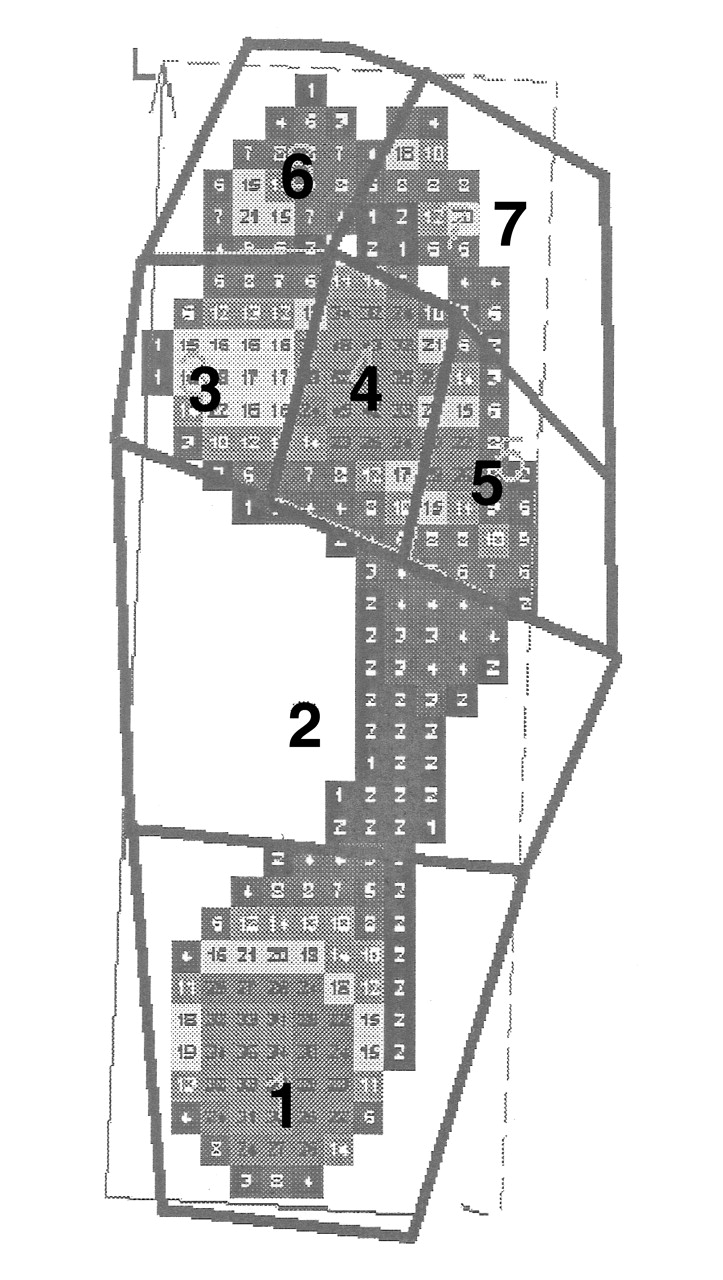
Seven plantar regions on the foot were identified for each pressure-measurement trial: one heel region, one midfoot region, three forefoot regions, and two toe regions. The three forefoot regions underneath the area of the metatarsal heads were of equal size. The medial forefoot region was underneath the first metatarsal head, the central region was underneath the second and third metatarsal heads, and the lateral region was underneath the fourth and fifth metatarsal heads. The two toe regions consisted of the hallux and the lesser toes.
Figure 1 illustrates the various plantar regions. These regions were determined using the maximum pressure picture of each trial with the Novel Multimask software (Novel GmbH). The following variables were generated for each of the seven plantar regions of the foot: peak pressure (kPa), peak force (percentage of body weight [%BW]), pressure–time integral (kPa·s), and force–time integral (%BW·s). Other researchers have performed similar analyses to understand foot function during walking.[
25-
27] On the basis of previous literature related to plantar loading differences associated with hallux valgus, only the medial forefoot, central forefoot, and hallux region were analyzed.
Figure 1.
Graphic representation of the anatomical dimensions of the regions or masks used to describe the plantar loading relative to the foot: 1, heel; 2, midfoot; 3, medial forefoot; 4, central forefoot; 5, lateral forefoot; 6, medial toe; 7, lateral toe.
Figure 1.
Graphic representation of the anatomical dimensions of the regions or masks used to describe the plantar loading relative to the foot: 1, heel; 2, midfoot; 3, medial forefoot; 4, central forefoot; 5, lateral forefoot; 6, medial toe; 7, lateral toe.
Data Analysis
The independent variables consisted of 1) four clinical variables: pain while walking, weightbearing single-leg resting calcaneal stance position, first metatarsophalangeal joint dorsiflexion, and first metatarsophalangeal joint plantarflexion; and 2) nine plantar loading variables: medial forefoot region peak force, medial forefoot region force–time integral, medial forefoot region peak pressure, hallux region peak force, hallux region force–time integral, hallux region peak pressure, central forefoot region force–time integral, central forefoot region peak pressure, and central forefoot region pressure–time integral. The dependent variable in the analysis was 1 or 0. If the subject had hallux valgus, the dependent variable was 1 (group 1). If the subject had no foot deformity, the dependent variable was 0 (group 2). A t-test for independent means was used to assess statistical (univariate) significance of the differences between the two groups. A preliminary analysis was conducted to identify outliers and to examine multicollinearity among the clinical and plantar loading variables prior to developing the model using logistic regression analysis. A stepwise multiple logistic regression analysis was used to test the utility of the independent variables as predictors of the hallux valgus condition. The logistic regression analysis predicts the probability of presence or absence of hallux valgus given a set of scores on the risk factors (independent variables). The α level for the study was set at .05.
Results
The regression coefficients obtained from the logistic regression were used to compute the probability of predicting foot deformity for the given independent variables. Results of the
t-tests for the four clinical variables (
Table 1) indicated that the mean amount of first metatarsophalangeal joint dorsiflexion and first metatarsophalangeal joint plantarflexion were significantly higher in the control group. The pain while walking and single-leg resting calcaneal stance position means were significantly lower in the control group. The means for the plantar loading variables of medial forefoot region peak force and hallux region peak force were significantly higher in the control group. The medial forefoot region force–time integral and central forefoot region pressure–time integral means were significantly lower in the control group. The hallux region peak pressure mean was higher in the hallux valgus group, but the difference was marginally significant.
Table 1.
Univariate Results from Independent t-Tests.
Table 1.
Univariate Results from Independent t-Tests.
The results of multicollinearity analysis indicated no problem for either set of variables (tolerance for both sets was greater than 0.1). The results from examining the outliers indicated that one subject was eliminated (new sample size, 71; 19 cases with missing values on one or more of the variables) when using the clinical variables, and two subjects were eliminated (new sample size, 89) when using the plantar loading variables in the logistic regression analysis. First stepwise logistic regression results (
Table 2) indicated that the final model with three predictors (first metatarsophalangeal joint plantarflexion, pain while walking, and single-leg resting calcaneal stance position) was statistically reliable in distinguishing between the two groups (χ
2 = 40.5,
df = 3,
P = .0001). The model correctly classified 91.5% of the cases (49/50 [98%] for the control group; 16/21 [76.2%] for the hallux valgus group) (
Table 3). Regression coefficients and Wald statistics indicated that first metatarsophalangeal joint plantarflexion, pain while walking, and single-leg resting calcaneal stance position were significant predictors (
Table 2). The odds ratios for pain while walking and single-leg resting calcaneal stance position were greater than 1 (positive regression coefficients), with increased magnitude indicating increased likelihood of hallux valgus. The odds ratio for first metatarsophalangeal joint plantarflexion was less than 1 (negative regression coefficient), with a greater negative magnitude indicating decreased likelihood of hallux valgus. The results from the second stepwise logistic regression (
Table 4) provided a final model with four predictors (hallux region peak force, hallux region peak pressure, hallux region force–time integral, and central forefoot region force–time integral) that was statistically reliable in distinguishing between the two groups (χ
2 = 89.3,
df = 3,
P = .0001). The model correctly classified 93.3% of the cases (47/50 [94%] for the control group; 36/39 [92.3%] for the hallux valgus group) (
Table 5). The regression coefficients and Wald statistics (
Table 4) indicated that hallux region peak force, hallux region peak pressure, hallux region force–time integral, and central forefoot region force–time integral were significant predictors of hallux valgus. However, the odds ratio for the variable hallux region peak force indicated little increase in risk for higher values. The odds ratio for hallux region force–time integral was large, with higher values indicating a greater likelihood of hallux valgus. The coefficient for hallux region peak force was negative, with lower values associated with increased likelihood of hallux valgus.
Table 2.
Logistic Regression Results Using the Three Clinical Variables.
Table 2.
Logistic Regression Results Using the Three Clinical Variables.
Table 3.
Classification Table Using the Clinical Variables.
Table 3.
Classification Table Using the Clinical Variables.
Table 4.
Logistic Regression Results Using the Four Plantar Loading Variables.
Table 4.
Logistic Regression Results Using the Four Plantar Loading Variables.
Table 5.
Classification Table Using the Plantar Loading Variables.
Table 5.
Classification Table Using the Plantar Loading Variables.
Discussion
Hallux valgus is a relatively common foot condition, but there have been few attempts to understand the plantar loading differences associated with it or to predict adequately the pathology from plantar loading results. The current study’s findings suggest that pain while walking, first metatarsophalangeal joint dorsiflexion, and single-leg resting calcaneal stance position differ between subjects with and without hallux valgus, correctly predicting presence of the pathology in approximately 76% of subjects. Pain while walking was higher and first metatarsophalangeal joint dorsiflexion was lower for the participants with hallux valgus. Single-leg resting calcaneal stance position was greater for the hallux valgus subjects. Compared with the control subjects, the hallux valgus subjects demonstrated a decrease in hallux region peak force, an increase in hallux region force–time integral, an increase in hallux region peak pressure, and an increase in central forefoot region force–time integral during gait. These plantar loading measurements predicted the presence of moderate hallux valgus in approximately 92.3% of the subjects.
Differences in data-collection techniques and instrumentation often make it difficult to compare plantar loading data between studies. As a result, few studies are available for direct comparison. The peak pressure in the forefoot regions (medial, central, and lateral) of the hallux valgus sample was typical of asymptomatic subjects as described in previous studies on such subjects using similar plantar loading instrumentation.[
25-
28] This may be due to the nature of the study sample, as the subjects were categorized as having moderate hallux valgus. There was diminished loading in the hallux region in the present study, suggesting that there may be a change in the mechanical function of the hallux.
Loading in the medial forefoot region differed in the hallux valgus and control groups. The authors’ findings conflict with a recent report by Yamamoto et al,[
29] in which 32 subjects with hallux valgus were compared with 40 control subjects; the results demonstrated increased peak pressures beneath the second and third metatarsal heads in hallux valgus subjects. However, validity and reliability of pressure-sensitive film technology for plantar loading applications are unknown, and the description of the results of this study was largely qualitative.
Henry et al[
18] stated that accentuated loading under the central forefoot region is representative of the hallux valgus foot. This was also seen in the current sample. The plantar loading measurements typically are greater using the midgait plantar loading methodology.[
23-
24] In the present study, however, the peak pressure found in the central forefoot regions of the hallux valgus subjects was nearly doubled in comparison with the results of other researchers using similar plantar loading instrumentation and a midgait rather than a two-step method of data collection.[
12,
30] Peak pressure under the lateral forefoot region is considered to be a major contributor to the development of metatarsalgia.[
12,
15] Mitskewitch[
17] reported that in cases where the hallux valgus deformity had progressed to severe deformation and maximal pressures were located more laterally, no surgical procedure changed the lateral loading response. In the current sample, it appears that the major plantar loading differences were associated with the hallux region and the central forefoot region. However, this may be due to the fact that the current sample of subjects had moderate hallux valgus.
A limitation of the present study was the inability to obtain radiographic data on the control group. Visual observation was used to screen the control subjects. Some of the members of the control group may have had mild hallux valgus; however, the subject was not included in the control group if there was any question during the screening.
Conclusion
In this study, high values for two of the four clinical variables (pain while walking and single-leg resting calcaneal stance position) increased the probability of hallux valgus. For example, increasing the value of pain while walking by 1 unit had the effect of multiplying the estimated odds of being in the hallux valgus group by 8.69. Also, high values for three of the plantar loading variables (hallux region peak pressure, hallux region force–time integral, and central forefoot region force–time integral) increased the probability of hallux valgus. High values for both hallux region peak force and first metatarsophalangeal joint plantarflexion decreased the probability of hallux valgus. The results of this study demonstrate that the clinical and plantar loading variables are able to differentiate between the two subject groups. Evidence from this research suggests that the plantar loading variables that were measured had more predictive power than the clinical variables in classifying the hallux valgus subjects. While the plantar pressure variables correctly predicted hallux valgus in 92.3% of these subjects, the same variables incorrectly predicted hallux valgus in 6% of the control subjects (false-positive prediction). However, the clinical variables had a 2% false-positive prediction rate for hallux valgus. The expense and practicality of using plantar loading systems in the prediction of moderate hallux valgus should be weighed against the practicality and low cost of these clinical measurements.