Foot ulcers are a common clinical problem, particularly in two high-risk populations: patients with diabetes mellitus and those with peripheral vascular disease.[
1-
3] A significant complication often associated with foot ulcers is osteomyelitis, which results from direct extension of the infection into the adjacent bone.[
4,
5] Especially in the diabetic population, if this involvement of bone is not recognized or adequately treated, amputation of a portion of the limb may eventually be required, and even this measure may not prevent further morbidity and mortality.[
2,
6] Thus imaging is commonly used to evaluate patients with foot ulcers and suspected bone involvement, especially plain film radiographs,[
7-
10] radionuclide bone scans,[
7-
13] and magnetic resonance imaging (MRI).[
8,
14,
15] Other modalities occasionally used include white blood cell[
5,
16-
19] and gallium[
9,
12,
20] scintigraphy, Doppler ultrasound, and peripheral angiography.[
3] Bone scanning and MRI in particular have high sensitivity for identification of bone infection, but the lower specificity of the former is of concern for clinical decision making.[
5] Although the specificity of MRI is typically higher than that of bone scanning,[
21,
22] noninfectious processes such as trauma and neuropathic arthropathy, both of which are common in diabetic patients, can result in the presence of marrow edema on MRI, analogous to the nonspecific changes in bone metabolism identified by scintigraphy.[
23,
24] Also, because contiguously spread osteomyelitis most likely begins as a periosteal infection, it is probable that only more severe infections progress to osteitis and then eventually involve the myeloid component of bone, thereby meeting the definition of osteomyelitis. Even results of invasive investigation with bone biopsy may not always distinguish a localized periosteal infection from true osteomyelitis in that the source of any infected tissue may be uncertain, particularly if the specimen is obtained for culture but not for histologic examination.
Most published studies, both prospective and retrospective, have focused primarily on the diagnosis of established osteomyelitis and have not specifically addressed the imaging findings associated with the earliest phases of bone infection. The present investigation sought to evaluate findings from multiphase bone scintigraphy in patients with soft-tissue infection of the feet but no definite bone involvement on conventional plain film radiographs. The goal was to assess the significance of any positive findings identified by bone scintigraphy, which is well established as being more sensitive but less specific than plain film radiography for identifying osteomyelitis. The prognostic significance of the bone scan findings was based on clinical outcome during patient follow-up.
Methods
Individuals considered for participation in this study were patients seen in the Podiatry Service of the Veterans Affairs Puget Sound Health Care System–Seattle Division, Seattle, Washington. All potential subjects were evaluated by the study coinvestigator (J.E.W.) and were considered as candidates if they had a new foot ulcer or recurrence of a previously healed foot ulcer. As part of routine clinical care, patients were referred for a radiograph of the infected foot, and these radiographs were reviewed by a radiologist with expertise in skeletal radiology. Only patients whose radiographs showed no changes suggestive of osteomyelitis in the bone or bones adjacent to the soft-tissue ulcer were approached about participating in the study. All patients who entered the study signed an informed consent form. The consent form and study procedures were approved by the Human Subjects Review Board of the University of Washington School of Medicine, Seattle.
At entry into the study, all relevant clinical information was recorded, including history of diabetes mellitus, peripheral vascular disease, and previous trauma and infection in the involved extremity. The location of the ulcer and its dimensions were also recorded, and in some instances photographic records of the lesions were made. All patients subsequently underwent a standard multiphase bone scan. Following an antecubital or other upper-extremity injection of 25.0 mCi (915 MBq) of technetium-99m methylene diphosphonate, a 1-min flow examination was performed over the extremity in question, usually in the plantar or anterior projection, with the opposite limb included for comparison. After the flow examination, one or more blood pool views of the feet were obtained 5 to 10 min after injection. Delayed imaging was then done 3 hours after injection, involving the usual four views of the feet (dorsal, plantar, and both laterals). Twenty-four–hour delayed views of the feet in the same four projections were also acquired when possible.
Bone scan results were not immediately available to the participating podiatric physician, who provided clinical follow-up, including local wound care and oral antibiotics, as per routine. In instances of severe scan abnormalities, the podiatric physician was made aware of those findings; otherwise, given the absence of radiologic or clinical evidence to suggest osteomyelitis, management was usually conservative. Patients were followed clinically, and in a few instances a follow-up bone scan was obtained. Objective evidence of osteomyelitis was recorded, including positive cultures or histologic findings at subsequent biopsy, surgery, or autopsy or definitive findings on follow-up radiologic studies (plain films or MRI).
The initial and follow-up bone scans were independently read by an experienced nuclear medicine physician (A.F.J.) without knowledge of the baseline clinical history or information concerning subsequent clinical outcome. Each series of images, including flow, blood pool, and delayed (3 and 24 hours), was scored visually for abnormalities at the area in question. A scoring scale of 0 to 3+ (0, normal; 1+, mild; 2+, moderate; 3+, severe) was used.
Results
Twenty-four series of studies were performed on 23 patients (1 patient was studied twice owing to different foot ulcers that occurred 2 years apart). All of the patients were men, ranging in age from 34 to 77 years (mean age, 60 years). Ulcers ranged in size from 0.3 to 5 cm and measured less than 2 cm in 19 cases (79%). Fourteen (61%) of the 23 patients were diabetic. Bone scans were performed a mean of 10 days after the qualifying foot radiograph was obtained, with 18 scans (75%) performed within 7 days.
Twenty-one (88%) of 24 pretreatment bone scans had an abnormality scored at 1+ or higher on one of the phases of the study, with abnormal flow and blood pool activity in 18 (75%) and abnormal bone uptake in 17 (71%). The scores on the four phases of the examinations are summarized in
Table 1. All studies with abnormal blood flow demonstrated abnormal blood pool activity of comparable severity. All four phases were scored the same on 16 scans (67%), including 3 that were normal. In five cases, the flow/pool score was higher than the delayed image score, whereas in three instances the reverse was true. Four scans showed only flow or pool abnormalities, with no distinct increased bone uptake on the delayed images.
Table 1.
Summary of Scintigraphic Findings
Table 1.
Summary of Scintigraphic Findings
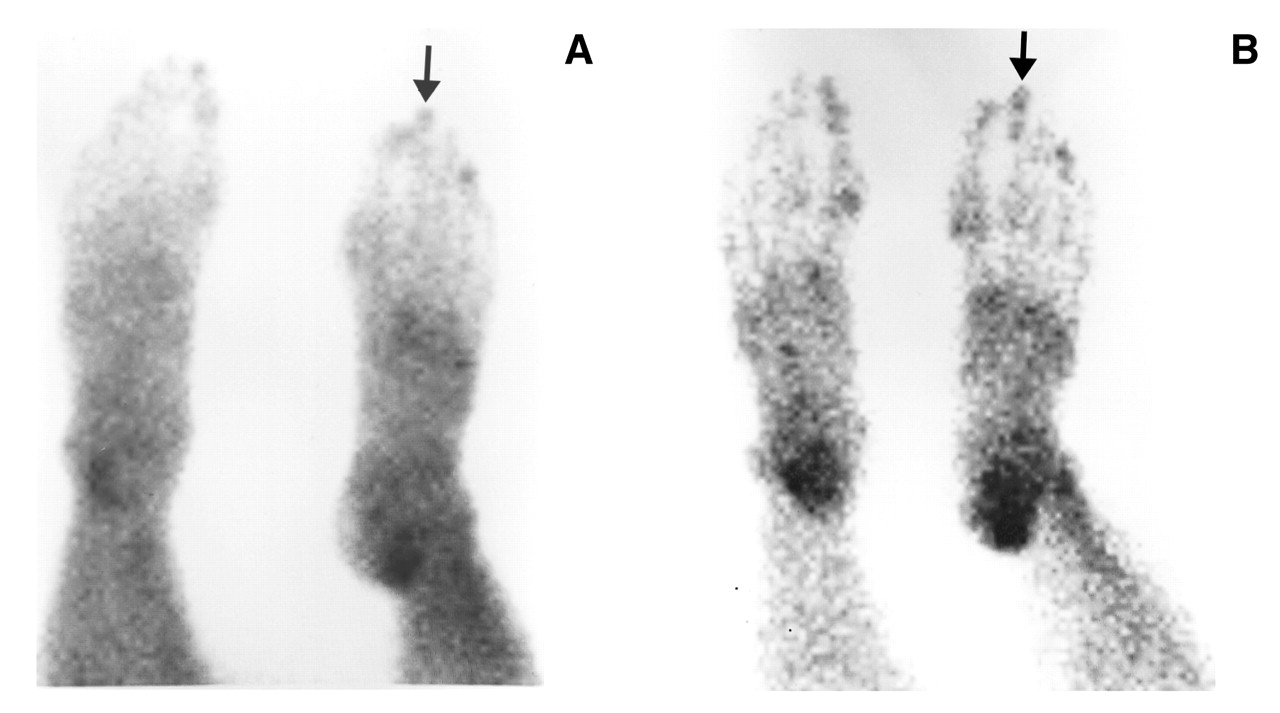
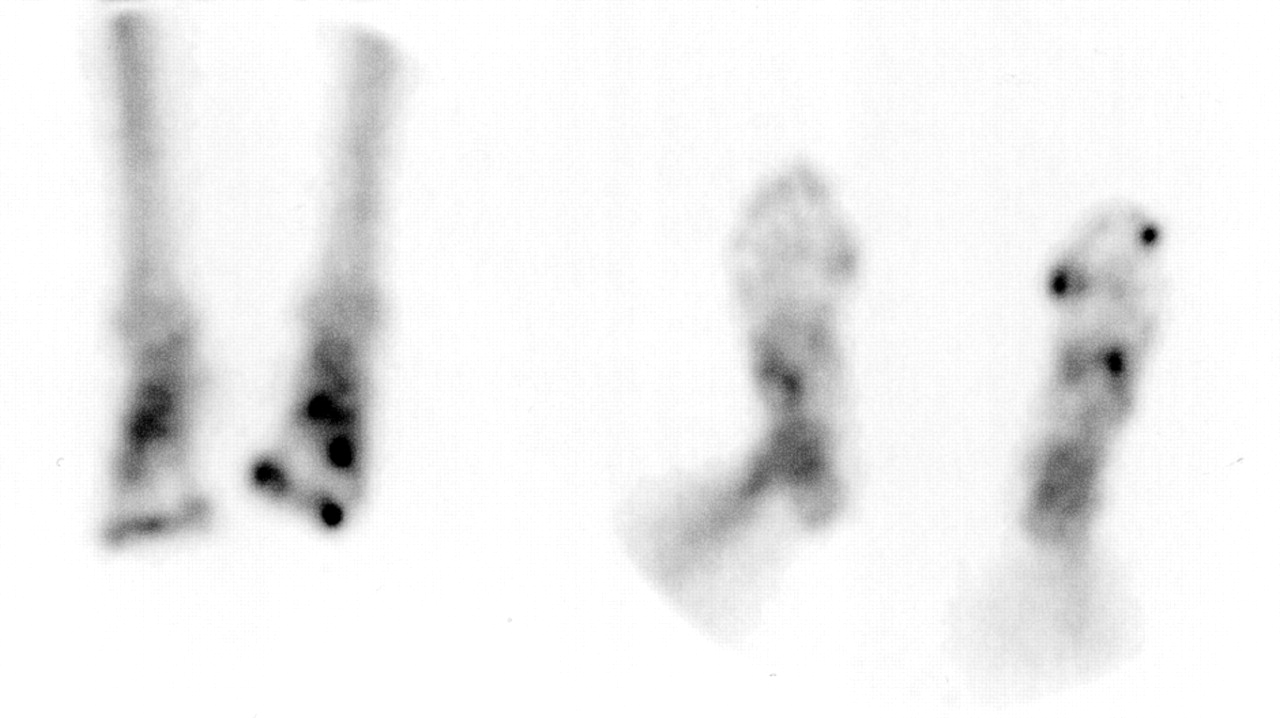
In 20 cases, the ulcers healed with conservative management (
Figs. 1 and
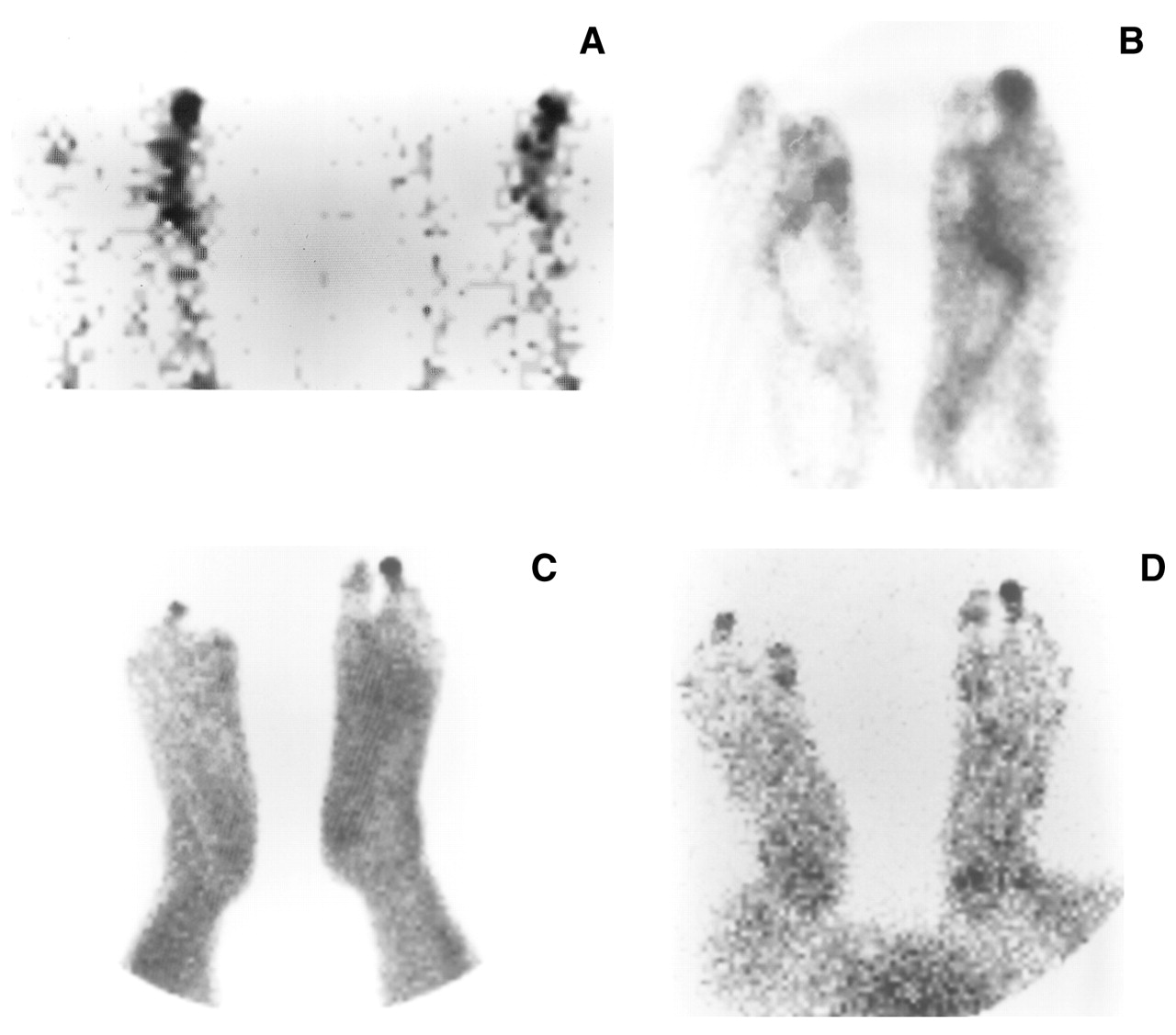
2). Of the remaining four cases, three patients underwent surgery (two below-the-knee amputations and one great toe amputation) and the fourth had follow-up radiographs that showed rapid progression to frank bony destruction consistent with osteomyelitis. The latter group of patients included all three who had 3+ abnormal findings on multiple phases of the bone scans (
Fig. 3). The fourth patient had a nearly normal bone scan, but lower-extremity amputation was deemed necessary as a result of dry gangrene due to peripheral vascular disease rather than infection. A finding of 3+ abnormal bone scan uptake was significantly associated with adverse clinical outcome (
P < .01). Ulcer size at presentation was not predictive of subsequent clinical course.
Figure 1.
Three-hour (A) and 24-hour (B) delayed plantar bone scan images from a patient with a left second toe ulcer reveal mild (1+) abnormal uptake (arrows). Flow and blood pool images (not shown) were unremarkable. Focal increased uptake is also seen in the left fourth and right first toes. The wound healed with conservative management.
Figure 1.
Three-hour (A) and 24-hour (B) delayed plantar bone scan images from a patient with a left second toe ulcer reveal mild (1+) abnormal uptake (arrows). Flow and blood pool images (not shown) were unremarkable. Focal increased uptake is also seen in the left fourth and right first toes. The wound healed with conservative management.
Figure 2.
Twenty-four–hour delayed anterior (left) and plantar (right) images show moderate (2+) increased uptake at the tip of the left third toe, the site of a small ulcer that healed with conservative care. Flow, blood pool, and 3-hour delayed images (not shown) showed similar abnormal uptake. Abnormal uptake at multiple other sites in the left foot reflected degenerative changes evident on correlative radiographs.
Figure 2.
Twenty-four–hour delayed anterior (left) and plantar (right) images show moderate (2+) increased uptake at the tip of the left third toe, the site of a small ulcer that healed with conservative care. Flow, blood pool, and 3-hour delayed images (not shown) showed similar abnormal uptake. Abnormal uptake at multiple other sites in the left foot reflected degenerative changes evident on correlative radiographs.
Figure 3.
An ulcer in the left second toe distally is seen as a focus of severe (3+) increased uptake on plantar flow (A), blood pool (B), and 3-hour (C) and 24-hour (D) delayed bone scan images from a diabetic patient. A smaller focus of abnormal bone uptake is seen in the distal right second toe (history of right great toe amputation). Radiographs obtained several weeks after the bone scan showed bony destruction at the distal end of the left second distal phalanx consistent with osteomyelitis.
Figure 3.
An ulcer in the left second toe distally is seen as a focus of severe (3+) increased uptake on plantar flow (A), blood pool (B), and 3-hour (C) and 24-hour (D) delayed bone scan images from a diabetic patient. A smaller focus of abnormal bone uptake is seen in the distal right second toe (history of right great toe amputation). Radiographs obtained several weeks after the bone scan showed bony destruction at the distal end of the left second distal phalanx consistent with osteomyelitis.
Five patients underwent follow-up scans 1 to 6 months after the initial study. Two patients with 2+ late bone uptake before treatment had only 1+ uptake after treatment, whereas the other three post-treatment scans were unchanged from the earlier examinations (one was normal and two had 1+ late bone uptake). Clinical outcome in all five patients was ulcer healing.
Discussion
Bone scintigraphy is well established as being more sensitive than plain film radiography for identifying various bony pathologic entities.[
7-
10] Nevertheless, the high prevalence of positive bone scans in the present study is somewhat surprising. Although a radiographic examination judged as negative for changes suggestive of osteomyelitis was a prerequisite for entry into the study, almost three-quarters of the patients had abnormalities identified on late bone images, including three with abnormalities scored as severe (3+). Most of these scintigraphic abnormalities did not progress to osteomyelitis following conservative management of the foot ulcers, consistent with the known low specificity of bone scanning.[
5,
13,
18] Only when abnormality severity is used as a discriminating variable, with mild to moderate (1+ to 2+) considered to reflect localized periostitis unlikely to progress to osteomyelitis, are results with sufficient accuracy for clinical use produced. The finding of 3+ abnormal bone uptake had 75% sensitivity but 100% specificity for identification of patients destined to develop frank osteomyelitis or to require surgery for nonhealing foot ulcers.
The value of the prospective method used in this study is that it eliminates the biases that are inevitable in retrospective reviews of clinical series. These biases can be seen in most reviews of the utility of scintigraphic studies such as bone, gallium, and indium white blood cell scans for osteomyelitis diagnosis given that the clinical examinations being reviewed were typically requested as a result of other imaging studies suggesting the presence of osteomyelitis.[
9,
12,
17,
18] The findings of almost all bone scans performed in patients suspected of having osteomyelitis are abnormal because the scans are usually preceded by plain film radiographs with findings indicating possible bone infection. Similarly, in patients with foot ulcers, findings from white blood cell scans are typically positive, at least in the soft tissues, and it is only the ability to localize white blood cell uptake to bone that results in satisfactory sensitivity and specificity for the diagnosis of osteomyelitis.[
5,
19,
25] A deficiency of many retrospective studies[
12,
17,
18,
25] is the limited degree of tissue confirmation for many findings categorized as osteomyelitis, with the diagnosis often based exclusively on radiographic or MRI results, as well as the exclusion of bone infection based on healing of the ulcer without the need for a prolonged course of antibiotics. In the present study, the combination of the absence of bone findings on the original plain film radiographs and the healing of foot ulcers with conservative management may be considered strong confirmation that osteomyelitis was not present in those cases, even without histopathologic confirmation.
The scintigraphic observations in this study provide persuasive evidence that most foot ulcers result in at least some degree of periosteal reaction in the adjacent bone. Whether this represents a histologically confirmable periostitis or periosteal infection is uncertain and probably would be determinable only in an animal model of bone infection. Nevertheless, it is clearly desirable to prevent a superficial infection involving only the periosteum from progressing to a more severe infection involving the osteoid component of bone, and this was accomplished in 13 patients with 1+ or 2+ increased bone uptake on scintigraphy. Interestingly, there was no correlation between the size of the soft-tissue ulcer and either the bone scan findings or the clinical outcome, with the three patients with the largest ulcers (2.5 to 5.0 cm) having no greater than 1+ uptake on any scan phase. Severe (3+) bone uptake on scintigraphy, even in the absence of clinical or radiologic evidence of osteomyelitis, suggests a high risk for progression of the infection and may indicate that the periosteum has already been breached or is in the process of breaking down as a barrier. Although the degree of scintigraphic bone uptake adjacent to a soft-tissue infection always reflects in part the local hyperemia, the presence of underlying pathologic bone involvement must be suspected when the level of uptake is high.
The primary limitation of this study is the small number of patients who were enrolled. The study was open for recruitment of subjects for several years, but it proved increasingly difficult to find patients who had only soft-tissue findings and no bone abnormalities on plain film radiographs. The rigor of the screening process may have eliminated subjects with only minor radiographic abnormalities, but it was judged that the meaningfulness of the study results would be sustained only by avoiding the need to quantify the severity of radiographic abnormalities in relation to scintigraphic findings. Although representing a small experience overall, the data from this series provide a useful complement to the knowledge already assembled in myriad published studies on foot ulcers and their relationship to osteomyelitis.
Conclusion
The present results demonstrate that most patients with soft-tissue ulcers of the foot and unremarkable plain film radiographs will show increased bone uptake of varying degrees on bone scanning of the area. Because most of these scan findings do not prove to be osteomyelitis, caution is required in interpreting an abnormal three-phase bone scan as being consistent with osteomyelitis; such a conclusion seems tenable only when the degree of abnormal bone uptake is severe. For less severe (1+ or 2+) uptake patterns, in the absence of plain film radiographic findings, conservative management seems to be the best initial strategy, with further investigation with MRI or bone biopsy reserved for cases in which there is apparent local progression subsequent to a conventional course of wound care and oral antibiotics. These results relate only to the relatively select group with scan-positive and radiograph-negative findings, and they should not be applied to management decisions for the much larger population of radiograph-positive and scan-positive (or scan-negative) cases, the groups on which most of the published literature on osteomyelitis of the foot are based.[
7-
18]