In today’s health-care environment, prudent hand-washing practices have been adopted to decrease the transmission of bacteria from person to person.[
1] However, the conscientious health-care workers, podiatric physicians, and others who follow these guidelines have a greater risk than less conscientious workers of developing a contact dermatitis due to repetitive hand washing and glove changing.[
2-
7] It has been established that the damaged skin of nurses can carry a greater number of bacterial pathogens associated with nosocomial infections than can healthy, undamaged skin.[
2]
The irony of the antisepsis practices’ causing dermatologic changes was originally discovered by Halstead.[
8,
9] Halstead invented the surgical glove as a means of reducing the hand irritation associated with the antimicrobial agents being used at the time. Although hand-washing formulations have changed since Halstead’s time, the contact dermatitis associated with antimicrobial agents has remained.[
10]
The need for a broad-spectrum, long-lasting antimicrobial hand-wash product that protects the natural skin barrier motivated the development of an alcohol-free formulation of surfactants, allantoin, and benzalkonium chloride (SAB) in a hand spritz.[
11] In this study, the efficacy of this novel formulation was compared with that of an alcohol-containing hand sanitizer using the US Food and Drug Administration (FDA) protocol for health-care personnel antiseptic hand washes. Independent researchers from the California College of Podiatric Medicine conducted the study using 40 volunteer students from the class of 2001.
Materials and Methods
Test Solutions
For this study, two solutions were evaluated using the FDA protocol (21 CFR 333.470) for health-care personnel antiseptic hand washes.
The first solution was the SAB hand wash, HandClens (Woodward Laboratories, Inc, Los Alamitos, California). The active ingredient in this product is benzalkonium chloride (0.13% vol/vol). Other ingredients are water, hydroxypropylmethyl cellulose, propylene glycol, cocamidopropylbetaine, cocamidopropylamine oxide, cetyl, trimethyl ammonium chloride, quaternium-12, imidazolidinyl urea, quaternium-15, allantoin, methyl paraben, propyl paraben, eucalyptol, methyl salicylate, and triethanolamine.
The second solution was alcohol-based Purell (GOJO Industries, Akron, Ohio). The active ingredient is ethyl alcohol (62% vol/vol). Other ingredients are isopropyl alcohol, water, emollients, and thickener.
Subjects
Forty volunteer students from the class of 2001 at the California College of Podiatric Medicine participated in this study. All subjects completed a 7-day quarantine period of abstaining from antimicrobial products prior to testing. All subjects had fingernails no longer than 2 mm. To be eligible for inclusion, subjects could have no abrasions or open lesions on their wrists or hands, and the wearing of jewelry was not permitted. Each subject gave informed verbal and written consent before entering into the study.
Protocol
Each subject was asked to perform a practice wash using the control soap, Dove (Lever Pond’s, Toronto, Ontario, Canada). Then, 5 g of control soap and 15 mL of sterile phosphate buffer were used to wash the hands for 2 min. Subjects then rinsed their hands under tap water for 30 sec.
Each subject was given a baseline inoculation: 5 mL of Serratia marcescens was placed in the subject’s cupped hands. The subject rubbed the hands for 45 sec and allowed the hands to air-dry for another 2 min. Next, subjects underwent gloving and sampling. Large powder-free polyethylene gloves, with 50 mL of sterile phosphate buffer in each glove, were placed on the hands, secured with a rubber band at the wrist, and massaged for 1 min (gloving). Finally, both gloves were drained for “glove juice,” using a sterile technique, into a sterile sampling tube. Undiluted and diluted samples were placed on agar plates, consisting of a combination of lecithin and polysorbate 20, and stored at room temperature, or 25°C (sampling).
Each subject was given a control wash. Subjects were inoculated once again and given 5 g of control soap to wash with for 2 min. They rinsed for 30 sec and then underwent gloving and sampling.
Each subject was allowed ten hand washes with the appropriate test solution. The steps were similar to those in the inoculation procedure: 5 mL of test solution with 2 min of washing, then gloving, and sampling only on hand washes 1, 3, 7, and 10. For hand washes 2, 4, 5, 6, 8, and 9, glove juice was drained down the sink and all other steps remained the same.
Each sample was placed on an agar plate immediately. An undiluted plate was made. For more accurate counting, a diluted plate of a 1:10,000 dilution for baseline, a 1:1,000 dilution for control, and a 1:100 dilution for the hand-wash trials were made. In order to inactivate the benzalkonium chloride, and to prevent further microbicidal activity, a combination of lecithin and polysorbate 20 was used as the agar media. For inactivation of the alcohol-based sanitizer, simple dilution in the phosphate buffer was sufficient.
A 2-min intermission was employed between each contamination/hand-wash cycle and the next contamination/hand-wash cycle. Subjects refrained from touching any items after the practice wash was initiated. After the final hand wash, subjects were given their choice of antimicrobial scrub or soap.
Data Analysis
Statistical analysis was performed using a Student’s t-test available with Microsoft Excel (Microsoft, Inc, Redmond, Washington). For the purpose of comparison, mean differences were considered statistically significant if the confidence value returned from the test was 0.05 (ie, P < .05).
Results
For this experiment, the efficacy of a novel SAB formulation, HandClens,
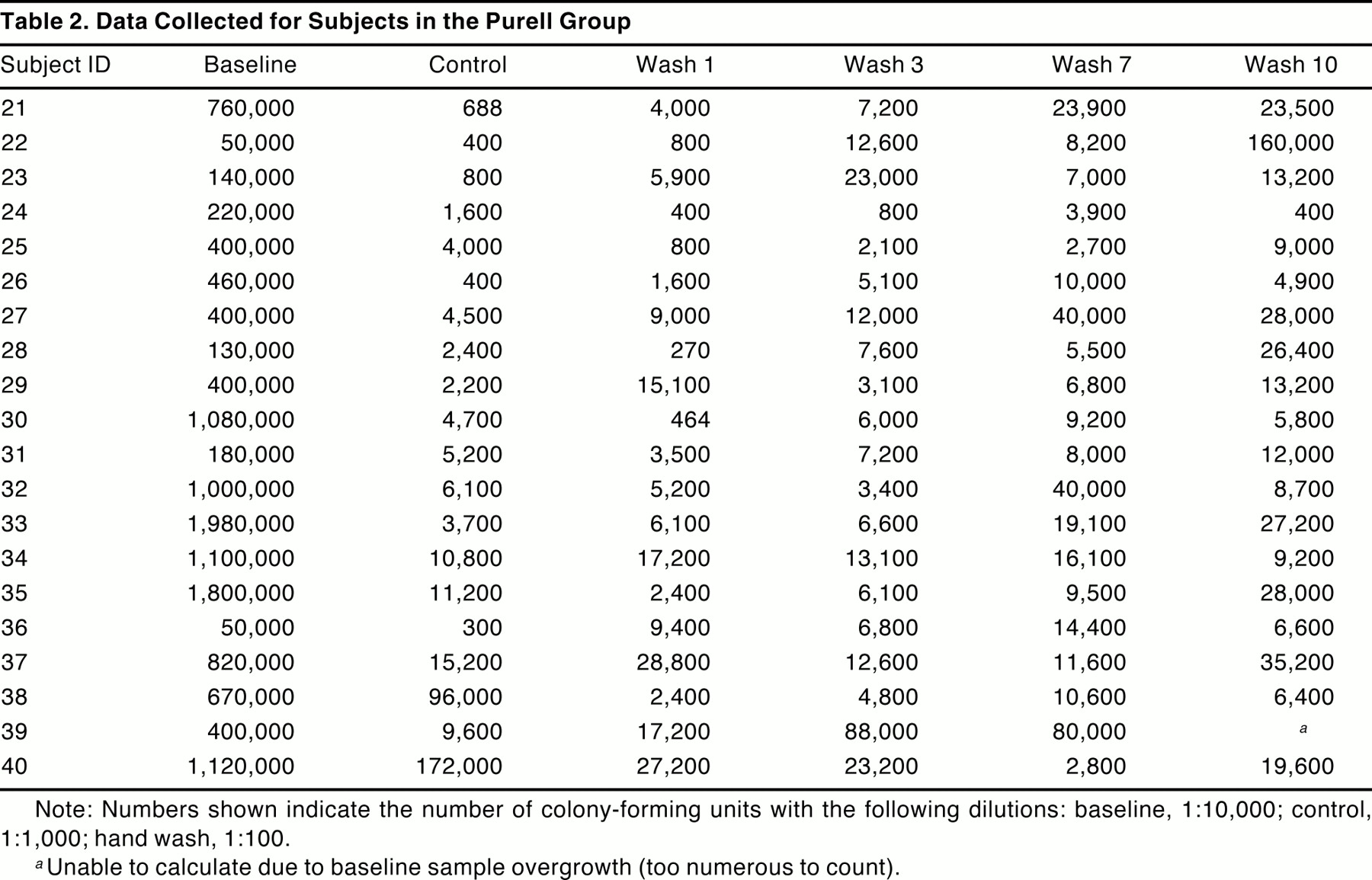
versus an alcohol-based, established formulation, Purell, was evaluated in terms of immediate and residual disinfecting power. Data sheets were kept for all subjects. The number of colony-forming units seen on the lecithin and polysorbate 20 agar plates for both undiluted and diluted samples was recorded for baseline contamination, control soap, wash 1 (test solution), wash 3, wash 7, and wash 10. Data on the individual subjects are provided in
Tables 1 and
2. The efficacy of a test solution was calculated as a reduction factor (RF) defined by the FDA as the difference between the log
10 of the colony-forming unit for baseline contamination (CFU
B) and the log
10 of the colony-forming unit for washes (CFU
W):
Table 1.
Data Collected for Subjects in the HandClens Group
Table 1.
Data Collected for Subjects in the HandClens Group
Table 2.
Data Collected for Subjects in the Purell Group
Table 2.
Data Collected for Subjects in the Purell Group
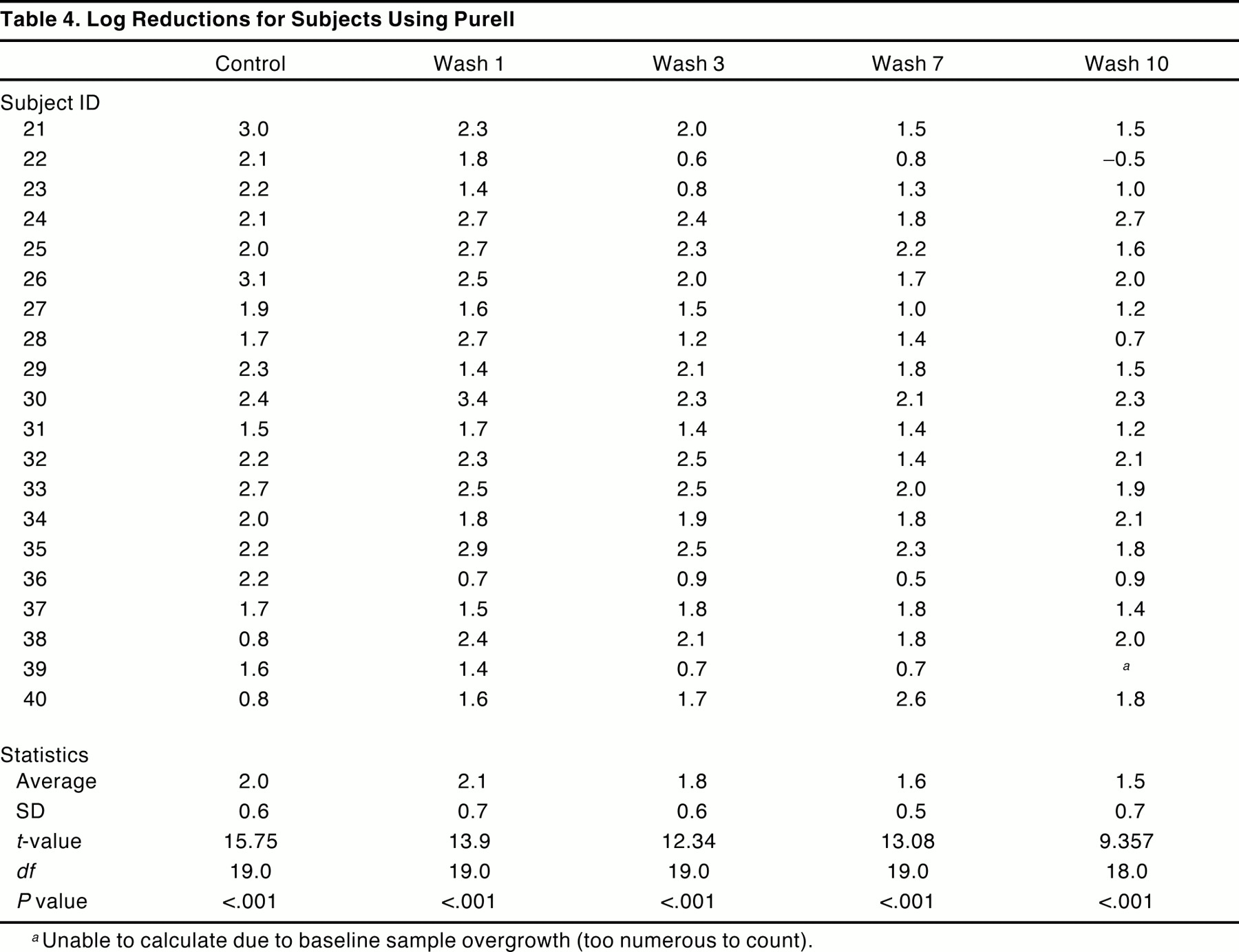
The FDA requires a minimum reduction factor value of 2 after a single hand wash and a minimum reduction factor value of 3 after the tenth hand wash for a hand sanitizer to be considered an acceptable antiseptic formulation. Statistical analysis was performed using the Student’s
t-test, and the results are shown in
Tables 3 and
4.
Table 3.
Log Reductions for Subjects Using HandClens
Table 3.
Log Reductions for Subjects Using HandClens
Table 4.
Log Reductions for Subjects Using Purell
Table 4.
Log Reductions for Subjects Using Purell
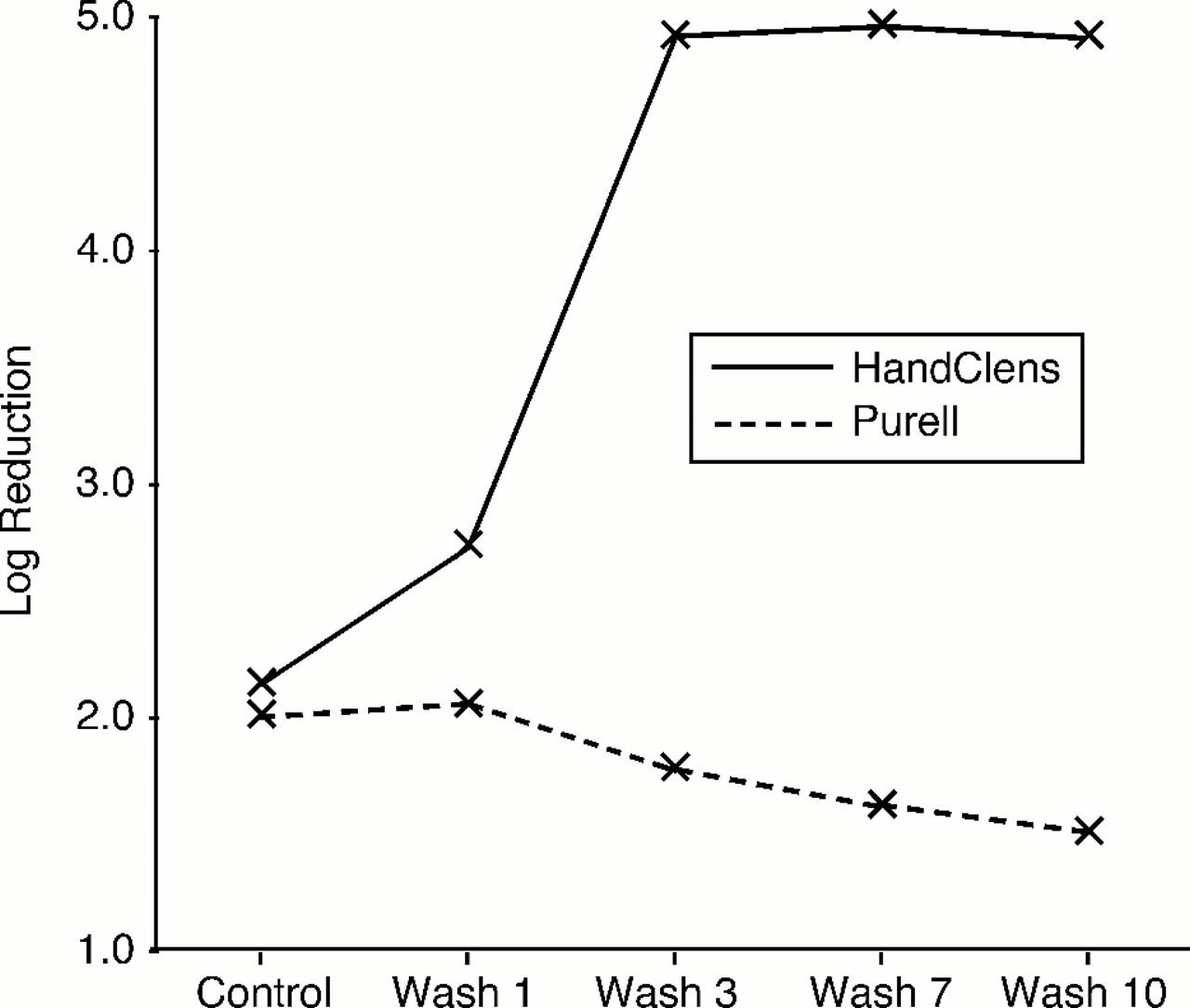
The results showed that both groups met the minimum requirement for the first hand wash, with an average reduction factor value of 2.6 for HandClens and 2.1 for Purell. Next, an overall trend of sustained disinfecting power was seen for HandClens, as demonstrated by reduction factor values of 2.6, 4.9, 5.0, and 4.9 for hand washes 1, 3, 7, and 10, respectively. These values not only met the first requirement, but surpassed the minimum expected persistent values. This is noticeable at the third hand wash, which exceeds the expected persistence by 1.9 log10 units, and also at the seventh hand wash, as demonstrated by 2.0 log10 units.
In contrast, Purell’s performance diminished over time and hand washes, as illustrated by reduction factor values of 2.1, 1.8, 1.6, and 1.5 for hand washes 1, 3, 7, and 10, respectively. Clearly, these values began to plummet as early as the third hand wash (
Fig. 1) and failed to meet FDA standards for an antiseptic hand sanitizer. Indeed, by the tenth hand wash, Purell’s disinfecting abilities did not meet the minimal requirements with a 1.5 log
10 value. In fact, the antimicrobial capacity of Purell by the tenth hand wash was 0.5 log
10 less than that of the control soap (Dove). Surprisingly, only a 0.1 log
10 difference was found between the disinfecting ability of the nonantimicrobial control soap and that of the alcohol-based antimicrobial Purell. The antimicrobial activity of the alcohol-based hand sanitizer was significantly less (wash 1,
P < .001; washes 3, 7, and 10,
P < .001) than that of the alcohol-free HandClens product.
Discussion
The value of using an antimicrobial hand sanitizer with an acceptable disinfecting power defined by the FDA for podiatric physicians and other health-care workers has already been emphasized. A nonirritating sanitizer with residual activity is ideal to preserve the natural skin barrier. This study evaluated the novel SAB formulation HandClens and compared its efficacy with that of an alcohol-based leading brand, Purell. The novel SAB formulation not only effectively killed microbes after the first wash, but continued to do so at a maximal value. The extent of the reduction factor was limited by the baseline contamination.
The efficacy of HandClens may be attributed to its unique SAB formulation. The combination was hypothesized to complement the natural skin barrier and enhance its performance, whereas alcohol-based formulations cause a deterioration of skin over time and with repetitive use. Clearly, HandClens surpassed the minimum FDA standards for an antiseptic hand sanitizer. Most importantly, the proven efficacy of HandClens will promote its adoption as an adjunctive hand sanitizer for busy podiatric physicians and other health-care professionals. Users of this SAB formulation can be assured of its disinfecting residual power and complementary action on their epidermis. The next concern should be testing the development of more SAB products in different vehicles, such as surgical scrubs and hand lotions.
Figure 1.
The average log reduction for the HandClens group and the Purell group for control wash using Dove soap and washes 1, 3, 7, and 10.
Figure 1.
The average log reduction for the HandClens group and the Purell group for control wash using Dove soap and washes 1, 3, 7, and 10.