Plantar pressure–measurement technology can provide the podiatric physician with important information for the assessment of changes in foot function over time or the effects of therapeutic intervention [
1]. The results obtained from plantar pressure–measurement studies in clinical practice may be made more meaningful by comparing test values with normal values of such parameters as peak pressure, mean pressure, and pressure-time integral. The use of the EMED system (Novel Gmbh, Munich, Germany) in the platform or in-shoe mode has been described previously [
2]. The present article presents normal values from plantar pressure measurement at ten sites of the foot in 30 healthy subjects, using the two-step method of data collection described by Meyers-Rice et al. [
3] and the EMED-SF system.
Although the midgait data-collection technique is an accepted protocol for plantar pressure–measurement studies, the two-step technique may be more appropriate for use in clinical practice. From a practical point of view, the two-step method requires less floor space, and is considered easier to perform by most subjects. Therefore, the time required to collect data from repeated trials of a given subject is less than that required with the midgait method. Furthermore, patients with insensate feet or significant medical problems may find it difficult to endure the prolonged data-recording session required by the midgait method and, indeed, may be placed at risk of injury [
3]. Similarly, subjects with gait or visual disturbances, or those with poor coordination, may have difficulty stepping on the pressure platform in the free-flowing manner required by the midgait method, which may affect the quality of the data collected [
4].
Because many factors may influence plantar pressure measurements—such as the equipment used [
5], cadence, step length, and walking speed [
6]—the consistency of the measurement technique is important [
4,
7,
8]. Similarly, the reliability and repeatability of measurements obtained with any testing equipment used must be of an acceptable standard. Hughes et al. [
7], using the EMED-F system (a precursor to the system used in the present study), reported that a good level of reliability was achieved for most force or pressure variables with a single recording. However, when the mean result of three or more trials was used, the reliability was found to be excellent. The overall accuracy of the EMED system is good, with a measurement error of less than 5% reported [
9].
Previous studies have reported normal values of certain pressure parameters, particularly peak pressure, using the midgait recording technique and a variety of platform systems [
5,
10,
11,
12]. Normal values for mean pressure and pressure-time integral have not often been reported in the literature. The purpose of the present study was to record normal referencerange values of selected plantar pressure measurements in ten regions of the foot from repeated trials of 30 healthy subjects using the two-step method of data collection. These values were recorded using the EMED-SF force plate and computer equipment.
Materials and Methods
Subjects
The study group consisted of 30 healthy volunteers (18 women and 12 men) with a mean age of 39.8 years (range, 23 to 68 years), a mean weight of 70.1 kg (range, 48.5 to 96.6 kg), and a mean height of 168.7 cm (range, 156 to 185 cm). All subjects were screened by interview and physical examination for obvious foot or gait abnormalities; subjects had no history of significant foot or lower-limb abnormalities during the 12 months preceding the start of the study. Subjects were excluded from the study if clinical signs of pes valgus or pes cavus or forefoot abnormalities such as hallux valgus or hallux limitus were noted. No attempt was made to differentiate between male and female subjects, as previous studies have found little difference in plantar pressure measurements between the sexes [
10,
12,
13]. Written informed consent was obtained from each subject, and the study was approved by the Human Research Ethics Committee of Curtin University of Technology.
Equipment
The measuring system used in this study was an EMED-SF-4 version 2.1 capacitance mat transducer system, with a platform dimension of 420 × 417 mm and a sensor dimension of 360 × 190 mm, mounted flush with the floor surface at the center of a 10-m raised walkway. Data were acquired with a sampling rate of 50 Hz, using a platform composed of 2,736 individual sensors with a resolution of 4 per square centimeter.
Procedure
Subjects were allowed to familiarize themselves with the testing procedure by walking over the platform at a self-selected pace several times. The subject’s starting position was determined such that the first step was with the foot opposite the one being tested, with the test foot making contact with the platform on the second step from the starting position. To prevent targeting, subjects were instructed not to look down at the platform but to look ahead at a fixed point some distance away. Data to be used in the subsequent analyses were collected from three trials of the left foot for each subject.
Data and Statistical Reporting
The foot of each subject was divided into ten regions or masks using the EMED Automask software (Novel Gmbh). Masks for the heel, midfoot, first through fifth metatarsal heads, hallux, second toe, and third through fifth toes (considered as a unit) were selected for analysis. The EMED Multimask software (Novel Gmbh) was used to gather data on peak pressure, mean pressure, and pressure-time integral. The data were then transferred to a spreadsheet for descriptive statistical reporting.
Results
Table 1 summarizes the mean values for peak pressure, mean pressure, and pressure-time integral that were obtained from the three trials of the 30 subjects studied. The regions of the foot that demonstrate the smallest standard deviations from the mean value, for most variables, are the heel and the second and third metatarsal heads. The regions demonstrating the greatest variation are the midfoot, the fifth metatarsal, and the lesser toes.
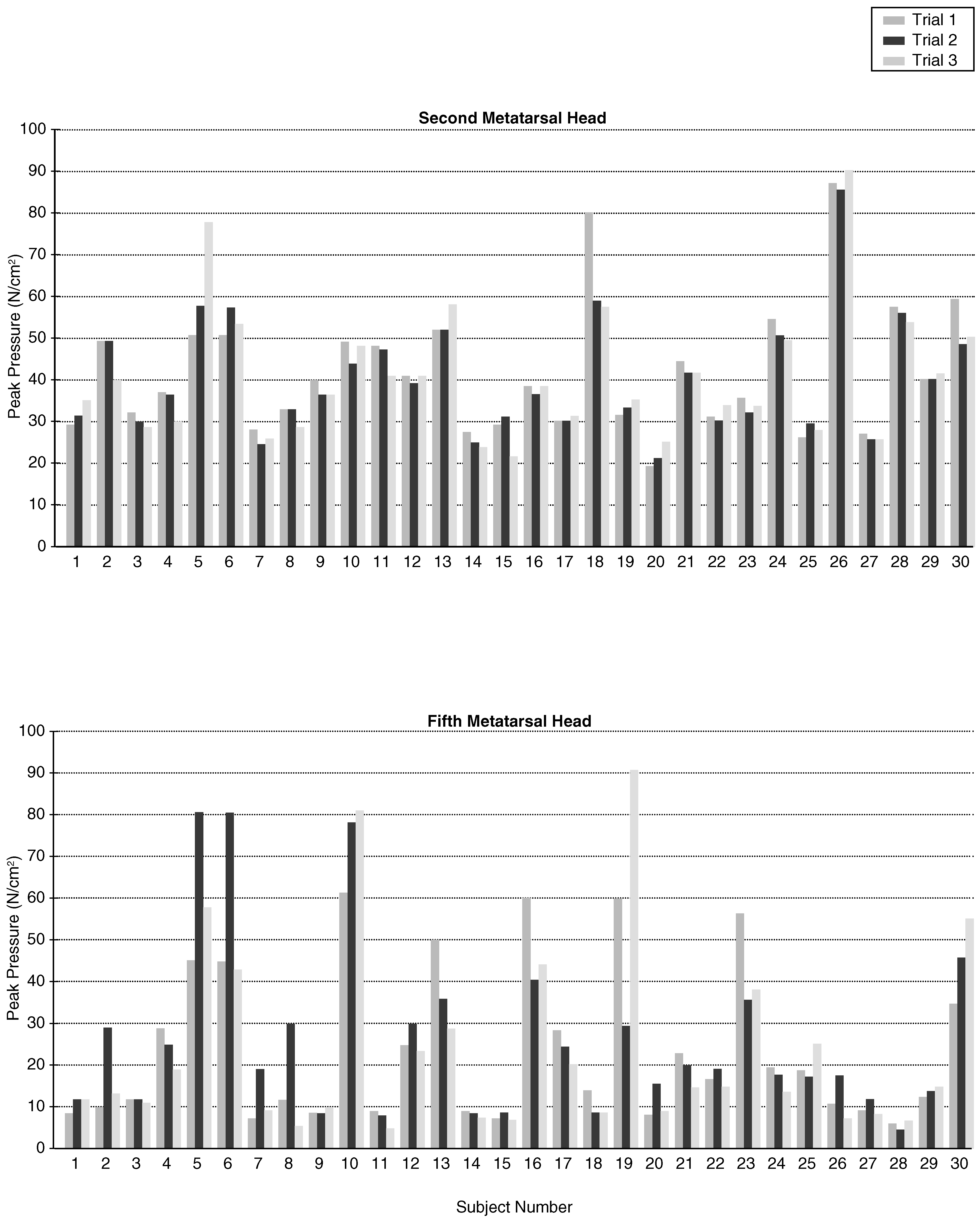
Figure 1 demonstrates this variation of measurement, both within trials and between subjects, for peak pressure for the second and fifth metatarsal heads.
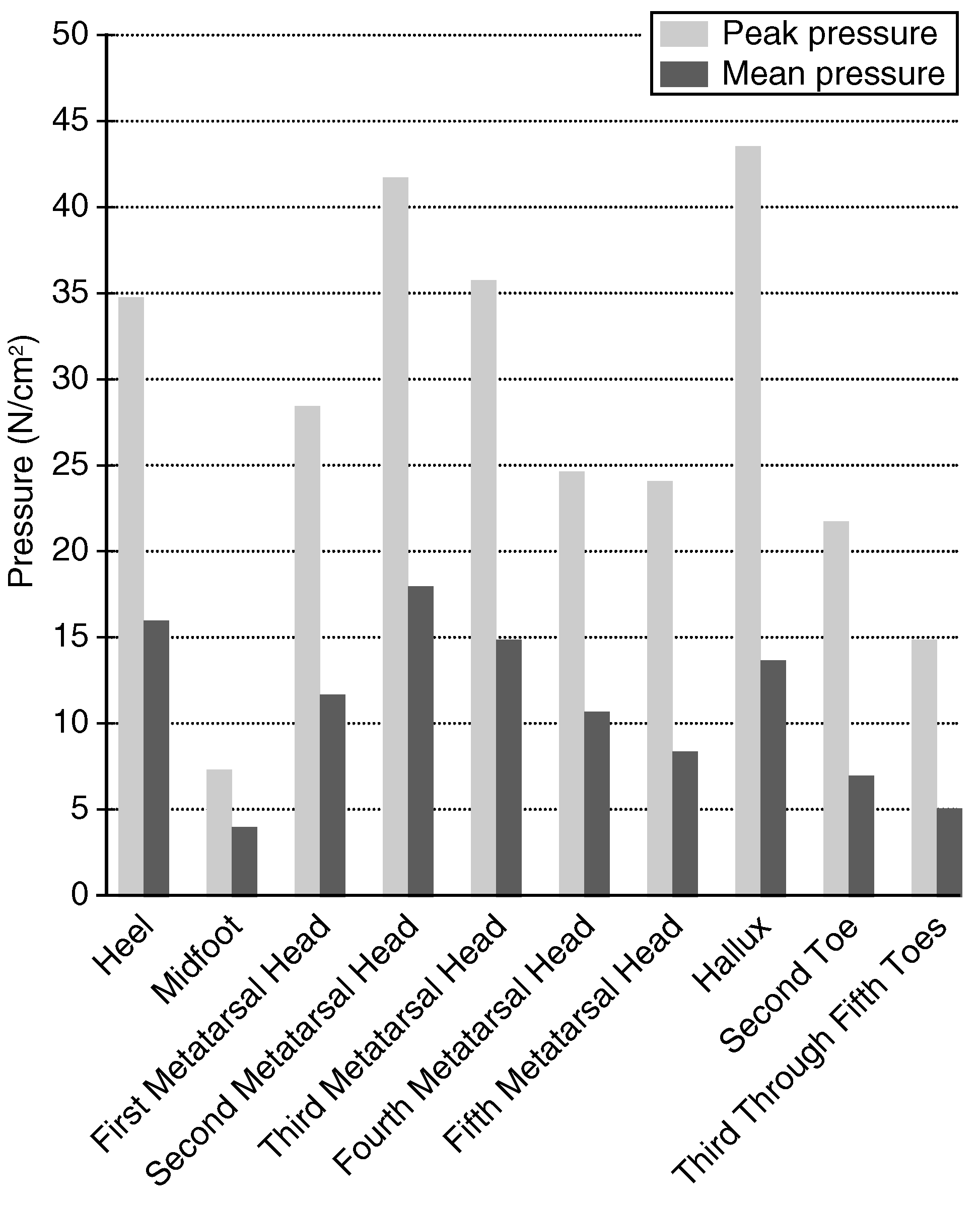
Figure 2 shows average peak pressure and mean pressure recordings across all regions of the foot studied, suggesting that the relative values for peak pressure and mean pressure followed a consistent trend.
Discussion
With respect to peak pressure distribution, the highest mean values were found under the heel, the second and third metatarsal heads, and the hallux. These results are in general agreement with those of
Bennett and Duplock [
10] and Shorten et al. [
12]. These authors grouped the central forefoot, rather than obtaining pressure data for each metatarsal head, but did mask the heel region into medial and lateral sections. Bennett and Duplock [
10] used a Musgrave Footprint system (Musgrave Systems Ltd, Wrexham, North Wales), while Shorten et al. [
12] used an EMEDSF system. Hughes et al. [
5], using an EMED-F system, also reported highest pressures in the region of the central forefoot and hallux. In the current study, peak pressures varied the most under the fifth metatarsal head, the midfoot, and the third through fifth toes, with other regions exhibiting more consistent measurements (
Table 1). Some variations in pressure measurements will inevitably be found in studies that use different subjects, test conditions, methods, and equipment [
5].
Normal reference-range values for mean pressure followed trends similar to those of peak pressure. Mean pressures were understandably lower and tended to show less variation for each region of the foot than did peak pressures (
Table 1). The least variation of plantar pressure measurements was found under the heel and the second and third metatarsal heads, suggesting that the heel and central forefoot region is functionally the most stable area of the foot during the stance phase of gait.
The greatest variation of values was found under the midfoot and toes. Foot morphology, with respect to individual differences in lateral arch height, may be a factor in the large variation in peak pressure and maximum force seen in the midfoot, as this area of the foot corresponds to the cuboid–fifth metatarsal region. Similarly, lesser-digital function would seem to vary considerably, even among healthy subjects, and may be responsible for the large variation of measurements seen in this area of the foot. Although previous research suggests that there is some association between peak pressure measurements and foot structure [
14,
15] or foot type [
16], the relationships between foot structure and function as determined by plantar pressure measurements requires further investigation.
Pressure-time integrals are thought to be important in the pathogenesis of skin lesions [
17] and have been postulated to be a potentially valuable measurement parameter in clinical practice [
13]. Such measurements may prove to be useful in clinical practice, particularly in the management of diabetic or insensate feet. In the present study, pressure-time integral values were highest under the second and third metatarsal heads and the hallux, and the greatest variation was noted under the fifth metatarsal head and toes.
Conclusion
Peak force values found in this study were in general agreement with previously reported measurements, with maximum values in the heel, the second and third metatarsal heads, and the hallux. Mean pressures followed trends similar to those of peak pressures at all regions tested. Plantar pressure measurements varied the least in the heel and the second and third metatarsal heads, and varied the most in the midfoot, the fifth metatarsal head, and the lesser digits.
The normal values for pressure-time integral for the subjects tested in this study may be useful in clinical practice for the purposes of screening and postoperative outcomes research.