Next Article in Journal
First metatarsophalangeal joint implant as a salvage procedure
Previous Article in Journal
Normal values of plantar pressure measurements determined using the EMED-SF system
 
 
Journal of the American Podiatric Medical Association is published by MDPI from Volume 116 Issue 1 (2026). Previous articles were published by another publisher in Open Access under a CC-BY (or CC-BY-NC-ND) licence, and they are hosted by MDPI on mdpi.com as a courtesy and upon agreement with American Podiatric Medical Association.
Article

Levels of evidence of articles in podiatric medical journals

by
Michael A. Turlik
1 and
Donald Kushner
2
1
Ohio College of Podiatric Medicine, 10685 Carnegie Ave, Cleveland, OH 44106
2
Department of Podiatric Medicine, Ohio College of Podiatric Medicine, Cleveland
J. Am. Podiatr. Med. Assoc. 2000, 90(6), 300-302; https://doi.org/10.7547/87507315-90-6-300
Published: 1 June 2000

Abstract

The authors reviewed 322 articles in podiatric medical journals to determine their level of evidence. Only 1% of the articles reviewed were randomized controlled trials. The authors concluded that if the podiatric medical profession wishes to become a participant in evidence-based medicine, greater emphasis must be placed on studies that assess hypotheses.

On April 14, 1999, the Health Systems Committee of the American Podiatric Medical Association held a meeting in Chicago, Illinois, to discuss its Evidence-Based Medicine Project. The committee proposes collecting practice data of podiatric physicians to determine the most cost-effective practice patterns. It plans to use this practice data to develop and validate treatment protocols. This “evidence” will then be used to demonstrate to the payers and gatekeepers of health care that podiatry is the cost-effective provider of choice for foot care.
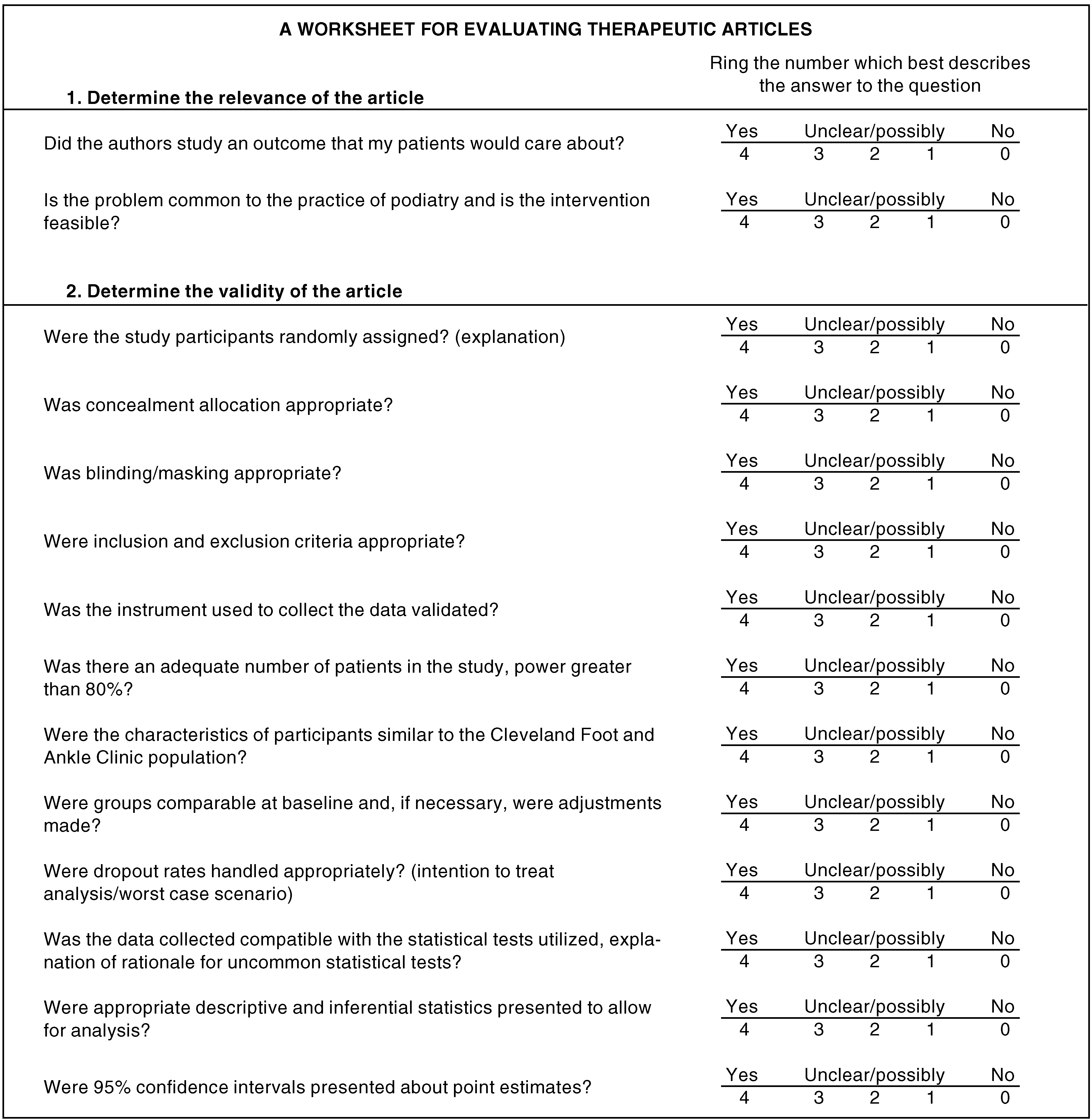
Evidence-based medicine can be defined as a process of lifelong, self-directed learning that involves the integration of clinical expertise with the best available clinical evidence from a systematic search [1]. Evidence-based medicine groups have classified journal articles into several categories—for example, therapy [2], diagnostic studies [3], harm [4], prognosis [5], and practice guidelines [6]. Within each category, the nature of the article largely determines the strength-of-evidence level [7]. For therapy articles, meta-analyses and randomized controlled trials are thought to offer the strongest evidence (level 1) for therapeutic decision making, and expert opinions the weakest evidence (level 5) (Table 1). Evidence-based medicine groups have further described how to critically analyze the medical literature in order to evaluate the quality of the studies [2,3,4,5,6]. The Ohio College of Podiatric Medicine has developed a worksheet to analyze the quality of therapy articles (Fig. 1). The authors undertook a study to determine the level of evidence of articles published in podiatric medical journals.

Materials and Methods

During the spring of 1999, the authors reviewed original articles published in JAPMA (D.K.) and the Journal of Foot and Ankle Surgery (M.A.T.) for the purpose of classifying them into levels of evidence as described by evidence-based medicine groups. Three additional categories were used: literature reviews, animal/cadaver studies, and unclassified. Letters to the editor, editorials, and reviews or summaries of published articles were not considered. The years 1993 and 1998 were chosen arbitrarily for review. The authors worked independently except when one author was unsure of the classification. No attempt was made to analyze the articles to determine their quality.

Results

The authors reviewed 322 articles. Neither JAPMA nor the Journal of Foot and Ankle Surgery published a meta-analysis study for the years reviewed. A total of four randomized controlled trials [8,9,10,11] were published in 1998; none were published in 1993 (Table 2). The most common types of study were the case series and case report, which together accounted for 68% of all of the articles published. There were a large number of unclassified articles in JAPMA in 1993 because a special issue was published on podiatric medical education.

Discussion

It is difficult not to be reminded on a daily basis of the unparalleled growth in the cost of modern health care in the United States. The demand for services has increased while the ability of the system to pay has decreased. Proponents of evidence-based medicine believe that treatment decisions should be based on the strength and quality of clinical evidence whenever possible [1,2]. In the future, payers and gatekeepers of health care may find this approach very appealing.
Of the published articles reviewed in this study, 1% presented what would be considered level 1 evidence. A large majority of the published articles reviewed dealt with generating, rather than testing, hypotheses. If the podiatric medical profession wishes to be a participant in the evidence-based medicine movement, greater emphasis should be placed on publications that are on levels 1 through 3. Further research could be conducted that reviews articles published by podiatric physicians in nonpodiatric journals to determine their level of evidence. It would also be interesting to analyze the quality of the level 1 evidence produced by the profession. Finally, the profession should try to determine what percentage of what podiatric physicians commonly do is based on level 1 evidence versus clinical experience and intuition.

References

  1. SACKETT DL, ROSENBERG WMC, GARY JAM, ET AL: Evidence based medicine: what it is and what it isn’t. BMJ 312: 71, 1996.
  2. GUYATT GH, SACKETT DL, COOK DJ: Users’ guides to the medical literature: II. how to use an article about therapy or prevention. A. are the results of the study valid? Evidence-Based Medicine Working Group. JAMA 270: 2598, 1993.
  3. JAESCHKE R, GUYATT GH, SACKETT DL: Users’ guides to the medical literature: II. how to use an article about a diagnostic test. A. are the results of the study valid? Evidence-Based Medicine Working Group. JAMA 271: 389, 1994.
  4. LEVINE M, WALTER S, LEE H, ET AL: Users’ guides to the medical literature: IV. how to use an article about harm. Evidence-Based Medicine Working Group. JAMA 271: 1615, 1994.
  5. LAUPACIS A, WELLS G, RICHARDSON WS, ET AL: Users’ guides to the medical literature: V. how to use an article about prognosis. Evidence-Based Medicine Working Group. JAMA 272: 234, 1994.
  6. WILSON MC, HAYWARD RS, TUNIS SR, ET AL: Users’ guides to the medical literature: VIII. how to use clinical practice guidelines. B. what are the recommendations and will they help you in caring for your patients? Evidence-Based Medicine Working Group. JAMA 274: 1630, 1995.
  7. BALL C, SACKETT DL, PHILLIPS B, ET AL: Levels of evidence and grades of recommendations. Available at http://cebm.jr2.ox.ac.uk/docs/levels.htm. Accessed May 10, 1999.
  8. HANFT J, GOGGIN J, LANDSMAN A, ET AL: The role of combined magnetic field bone growth stimulation as an adjunct in the treatment of neuroarthropathy/Charcot joint: an expanded pilot study. J Foot Ankle Surg 37: 510, 1998.
  9. MILLER SL, WERTHEIMER SJ: A comparison of the efficacy of injectable dexamethasone sodium phosphate versus placebo in postoperative podiatric analgesia. J Foot Ankle Surg 37: 223, 1998.
  10. JENNINGS MB, ALFIERI D, WARD K, ET AL: Comparison of salicylic acid and urea versus ammonium lactate for the treatment of foot xerosis: a randomized, doubleblind, clinical study. JAPMA 88: 332, 1998.
  11. LYNCH DM, GOFORTH WP, MARTIN JE, ET AL: Conservative treatment of plantar fasciitis: a prospective study. JAPMA 88: 375, 1998.
Figure 1. Worksheet to analyze the quality of therapy articles, developed by the Ohio College of Podiatric Medicine.
Japma 90 00300 g001
Table 1. Levels of Evidence in Therapy Articles.
Japma 90 00300 i001
Table 2. Classification of Journal Articles Reviewed.
Japma 90 00300 i002