

A Proposed Managed-Care Curriculum for Podiatric Residencies
Abstract
Background

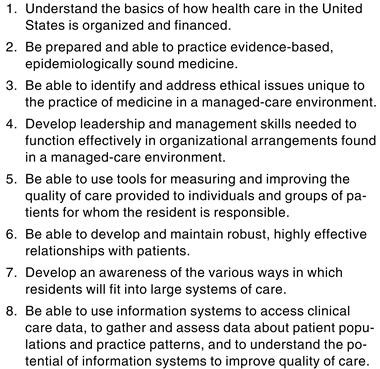 |
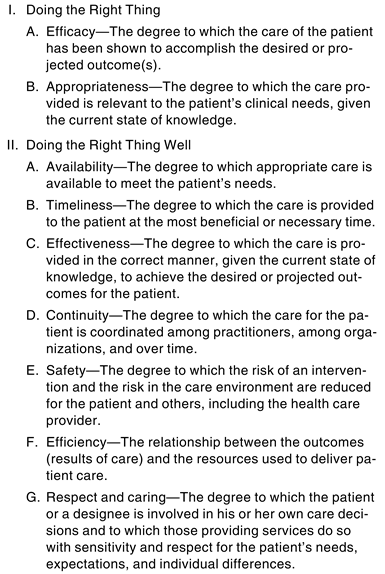 |
Examples of Managed-Care Curricula
The Primary-Care Examples: University of California, Los Angeles, and Tufts University
 |
 |
The Podiatric Example: California College of Podiatric Medicine
 |
Proposed Managed-Care Curriculum
Suggested Objectives
- The resident will demonstrate knowledge of the history of managed care, different payment methmethodologies for service reimbursement, and the dynamics of managed care within the facility at which he or she is training.
- A.
- The resident will be knowledgeable about the differences between the fee-for-service model and capitation, as well as variations of each.
- B.
- The resident will be knowledgeable about the US health-care delivery system of the past 40 years.
- The resident will demonstrate the knowledge to properly use resources within a health-care system.
- A.
- The resident will participate in the utilization or resource management committee.
- B.
- The resident will be able to describe the concept of continuum of care.
- C.
- The resident will demonstrate knowledge of how to add resources to a delivery system.
- The resident will demonstrate knowledge of organizational management and behavior.
- A.
- The resident will demonstrate an understanding of the constituents of a managed-care organization.
- B.
- The resident will attend a leadership meeting of an organization.
- C.
- The resident will participate in various committees of an organization.
- The resident will demonstrate an understanding of medical informatics.
- A.
- The resident will prepare a paper using information obtained from the Internet.
- B.
- The resident will demonstrate an understanding of electronic medical records, telemedicine, and business management systems.
- C.
- The resident will demonstrate a basic under-standing of biostatistics.
- The resident will demonstrate an understanding of performance improvement.
- A.
- The resident will participate in one of the facility’s performance-improvement projects.
- B.
- The resident will be able to describe the difference between quality assurance and quality improvement.
- C.
- The resident will be able to utilize the facility’s measurement systems to perform outcome studies.
- D.
- The resident will participate in the quality-improvement committee.
- The resident will demonstrate an understanding of medical ethics.
- A.
- The resident will participate in a medical ethics committee.
- B.
- The resident will present a case history that involves ethical issues.
- C.
- The resident will obtain a conflict-of-interest policy of an organization and describe scenarios of acceptable and unacceptable circumstances.
- D.
- The resident will participate in a patient-care conference that involves discussion of “do not resuscitate” action.
- The resident will demonstrate the ability to establish effective relationships with patients.
- A.
- The resident will be able to obtain an informed consent.
- B.
- The resident will attend a program on effective communication methodologies.
- C.
- The resident will be able to describe the four different social styles.
- The resident will demonstrate knowledge of evidence-based, population-focused medicine.
- A.
- The resident will understand the concept of evidence-based medicine.
- B.
- The resident will understand concepts of public health.
- C.
- The resident will participate in various community activities involving community health fairs, health screenings, and other patient-education activities.
Methods for Accomplishing Educational Objectives
 |
Evaluation of Methods
Conclusion
References
- LURIE N: Preparing physicians for practice in managed care environments. Acad Med 1996, 71, 1044. [CrossRef]
- TINSLEY, JA. Teaching residents about managed care. Mayo Clin Proc 1996, 71, 201. [Google Scholar] [CrossRef]
- HEWSON, MG; FISHLEDER, AJ; HALPERIN, AK. ET AL: Educating residents for managed care: report on a multidisci-plinary conference. Acad Med 1998, 73, 479. [Google Scholar] [CrossRef]
- GOMEZ, AG; GRIMM, CT; YEE, EFT. ET AL: Preparing residents for managed care practice using an experience-based curriculum. Acad Med 1997, 72, 959. [Google Scholar] [CrossRef]
- PHILLIPS, RR; LEE, MY; BERMAN, HA. ET AL: The Tufts partnership for managed care education. Acad Med 1997, 72, 347. [Google Scholar] [CrossRef]
- MEYER, GS; POTTER, AP; GARY, N. A national survey to define a new core curriculum to prepare physicians for managed care practice. Acad Med 1997, 72, 669. [Google Scholar] [CrossRef]
- CANTOR, JC; BAKER, LC. HUGHES RG: Preparedness for practice: young physicians’ views of their professional education. JAMA 1993, 270, 1035. [Google Scholar] [CrossRef]
- GREENLICK, MR. Educating physicians for the twenty-first century. Acad Med 1995, 70, 179. [Google Scholar] [CrossRef]
- MAINOUS, AG; BLUE, AV; GRIFFITH, CH. ET AL: Assessing residents’ readiness for working in a managed care environment. Acad Med 1997, 72, 385. [Google Scholar] [CrossRef]
- Document HRSA-97-34; Council on Graduate Medical Education: Preparing Learners for Practice in a Managed Care Environ-ment. US Department of Health and Human Services, Health Resources and Service Ad-ministration: Rockville, MD, 1997.
- COHEN JJ: Pew catalyzes education partnerships with managed care organizations. Acad Med 1997, 72, 372. [CrossRef]
- MORREIM EH: Managed care, ethics, and academic health centers: maximizing potential, minimizing draw-backs. Acad Med 1997, 72, 332. [CrossRef]
- MOORE, G; GRINER, P. Medical education and managed care: can sour turn sweet? Acad Med 1997, 782, 568. [Google Scholar] [CrossRef]
- REID, WM; HOSTETLER, RM; WEBB, SC. ET AL: Time to put managed care into medical and public health education. Acad Med 1995, 70, 662. [Google Scholar] [CrossRef]
- FARAGASON, CA; EVANS, HH; ASWORTH, CS; et al. The importance of preparing medical students to manage different types of uncertainty. Acad Med 1997, 72, 688. [Google Scholar] [CrossRef]
- NORITZ G: Students need managed care training. Acad Med 1997, 72, 159. [CrossRef]
- IGLEHART JK: Physicians and the growth of managed care. N Engl J Med 1994, 331, 1167. [CrossRef]
- GREMBOWSKI, DE; COOK, K; PATRICK, DL. ET AL: Managed care and physician referral. Med Care Res Review 1998, 55, 3. [Google Scholar] [CrossRef]
- Liaison Committee on Podiatric Medical Education and PRACTICE: Blueprint for the Future: Educational Enhancement Project (EEP) Report and Recommendations—1998. JAPMA 1998, 88, 523.
- IGLEHART, JK. The American health care system: managed care. N Engl J Med 1992, 327, 742. [Google Scholar] [CrossRef]
- RIVO, ML; SAULTZ, JW; WARTMAN, SA. ET AL: Defining the generalist physician’s training. JAMA 1994, 271, 1499. [Google Scholar] [CrossRef]
- SILVERMAN DR: Narrowing the gap between the rhetoric and the reality of medical ethics. Acad Med 1996, 71, 227. [CrossRef] [PubMed]
- RAMSBOTTOM-LUCIER, M; CAUDILL, TS. Teaching residents in an ambulatory setting: introducing the concepts of managed care in a fee-for-service clinic. Acad Med 1997, 72, 447. [Google Scholar] [CrossRef] [PubMed]
- USTAINE, RP; NGUYEN, K; RANDALL, J. ET AL: Four exemplary preceptors’ strategies for efficient teaching in managed care settings. Acad Med 1997, 72, 766. [Google Scholar] [CrossRef]
- Joint Commission on Accreditation of Healthcare. ORGANIZATIONS: 1996 Accreditation Manual for Health Care Networks; US Department of Health and Human Services, Health Resources and Service Administration: Rockville, MD, 1996; Vol 1, p. 21.
- GREENLICK, MR. Educating physicians for population-based clinical practice. JAMA 1992, 267, 1645. [Google Scholar] [CrossRef]
- SLOTNICK HB: How doctors learn: the role of clinical problems across the medical school-to-practice continuum. Acad Med 1996, 71, 28. [CrossRef] [PubMed]
- VELOSKI, J; BARAZANSKY, B; NASH, DB. ET AL: Medical student education in managed care settings. JAMA 1996, 276, 667. [Google Scholar] [CrossRef] [PubMed]
- Council on Podiatric Medical Education: Standards and Procedures for the Podiatric Residency Program; American Podiatric Medical Association: Bethesda, MD, 1998.
- WOFFORD, JL; MORAN, WP; COHEN, SJ; et al. Physicians in training as quality managers: survival strategy for academic health centers. Am J Managed Care 1997, 3, 1851. [Google Scholar]
- JACOBS, MO; MOTT, PD. Physician characteristics and training emphasis considered desirable by leaders of HMOs. J Med Ed 1987, 62, 725. [Google Scholar] [CrossRef]
- JAKLEVIC MC: Take this job, and this job, and this job. Mod Health (July) 1997, 36.
- WRIGHT S: Examining what residents look for in their role model. Acad Med 1996, 71, 290. [CrossRef]
- CHODOROW, S. Educators must take the electronic revolution seriously. Acad Med 1996, 71, 221. [Google Scholar] [CrossRef]
- WONG ET, ABENDROTH TW: Reaping the benefits of medical information systems. Acad Med 1996, 71, 353. [CrossRef]
Additionnal References
- ASSOCIATION OF AMERICAN MEDICAL COLLEGES: Roles for medical education in health care reform EVIDENCE-BASED MEDICINE WORKING GROUP: Evidence-based medicine: a new approach to teaching the practice of medicine. Acad Med;JAMA 1994, 69 268, 512 2420.
- FRIEDMAN E: Managed care and medical education: hard cases and hard choices. Acad Med 1997, 72, 688.
- GINZBERG E: Medical education and the needs of the public. Acad Med 1997, 72, 663. [CrossRef]
- HEADRICK, LA; NEUHAUSER, D; SCHWAB, P. ET AL: Continuous quality improvement and the education of the generalist physician. Acad Med 1995, 70, S104. [Google Scholar] [CrossRef] [PubMed]
- HOWELL JD: Making a medical practice in an uneasy world: some thoughts from a century ago. Acad Med 1997, 72, 977. [CrossRef] [PubMed]
- JELLINEK, MS. NURCOMBE B: Two wrongs don’t make a right: managed care, mental health, and the marketplace. JAMA 1993, 270, 1737. [Google Scholar] [CrossRef]
- SKIRBOLL LR: The impact of managed care on research: the changing face of medicine. Acad Med 1997, 72, 778. [CrossRef] [PubMed]
- STEIN, DH; SALIVE, ME. Adequacy of training in preventative medicine and public health: a national survey of residency graduates. Acad Med 1996, 71, 375. [Google Scholar] [CrossRef]
- TERRY MA: One program already offering managed care training. Acad Med 1997, 72, 657. [CrossRef] [PubMed]
- WEBER DO: Second thoughts: can managed care be ethical? Healthcare Forum J 1997, 19, (July-Aug).
- WOODSTOCK THEOLOGICAL CENTER: Ethical Considerations in the Business Aspects of Health Care; Georgetown University Press: Washington, DC, 1995.
- ZOOROB, RJ. Practice-management curriculum for family practice residents. Acad Med 1997, 72, 446. [Google Scholar] [CrossRef] [PubMed]
© 1999 American Podiatric Medical Association
Share and Cite
Chinn, S.D. A Proposed Managed-Care Curriculum for Podiatric Residencies. J. Am. Podiatr. Med. Assoc. 1999, 89, 199-211. https://doi.org/10.7547/87507315-89-4-199
Chinn SD. A Proposed Managed-Care Curriculum for Podiatric Residencies. Journal of the American Podiatric Medical Association. 1999; 89(4):199-211. https://doi.org/10.7547/87507315-89-4-199
Chicago/Turabian StyleChinn, Steven D. 1999. "A Proposed Managed-Care Curriculum for Podiatric Residencies" Journal of the American Podiatric Medical Association 89, no. 4: 199-211. https://doi.org/10.7547/87507315-89-4-199
APA StyleChinn, S. D. (1999). A Proposed Managed-Care Curriculum for Podiatric Residencies. Journal of the American Podiatric Medical Association, 89(4), 199-211. https://doi.org/10.7547/87507315-89-4-199
