Next Article in Journal
Orthoses in the treatment of rearfoot problems
Previous Article in Journal
Akin Osteotomy with Horizontal Interosseous Wire-Loop Fixation
 
 
Journal of the American Podiatric Medical Association is published by MDPI from Volume 116 Issue 1 (2026). Previous articles were published by another publisher in Open Access under a CC-BY (or CC-BY-NC-ND) licence, and they are hosted by MDPI on mdpi.com as a courtesy and upon agreement with American Podiatric Medical Association.
Article

A Proposed Managed-Care Curriculum for Podiatric Residencies

by
Steven D. Chinn
pex Healthcare Systems, San Francisco, CA 94111, USA
J. Am. Podiatr. Med. Assoc. 1999, 89(4), 199-211; https://doi.org/10.7547/87507315-89-4-199
Published: 1 April 1999

Abstract

This article describes a curriculum that could be included in podiatric residencies to help residents function successfully in a managed-care environment. Various groups have identified and implemented the competencies necessary to function within such an environment. Podiatric residents, who are well trained in the clinical management of podiatric problems, can succeed in a managed-care environment if residency programs include training objectives and methods to address these competencies. This article describes the managed-care components of two primary-care residency programs and a podiatric program and proposes a managed-care curriculum for podiatric residencies. The author’s goal is to educate residency directors and faculty members on possible objectives and methods that can enhance the podiatric resident’s educational experience and knowledge of managed care.

For several years, management seminars have focused on the day-to-day basics of managing a podiatric practice. Current management programs have placed more emphasis on financial management, especially in the areas of disease management, risk contracting, reengineering, and medical informatics. Allopathic medicine, recognizing the needs of new practitioners, has been moving to develop residents’ clinical skills and knowledge as well as the business tools they need to be competitive in today’s marketplace [1,2,3,4,5].
Similarly, preparing podiatric residents to function in this changing health-care environment has become more important. Podiatric medicine is undergoing the same major changes in patient volume and reimbursement as other specialties. Educational strategies and programs that specifically address managed care will improve the ability of residents to adapt to current situations. This ability will be particularly crucial for those who decide to practice in a community in which managed care has a significant presence.
Medical residents and new practitioners have voiced their concerns about the current medical curriculum [6,7,8]. Although medical education is often strong in presenting scientific analysis and integrating a vast amount of information, managed care is changing at a rate that makes it difficult for experts to comprehend. In some situations, residents are learning the material at the same time as their attending staff [2]. Studies have further stimulated discussions to develop appropriate goals and objectives for residents in training programs so that they can acquire the skills needed to comprehend the managed-care world and function successfully within it [3,6,7,9]. This was the primary reason the Council on Graduate Medical Education (COGME) had commissioned a project to evaluate this area, which was summarized in a September 1997 report, Preparing Learners for Practice in a Managed Care Environment [10].
This article presents an overview of the managed-care curriculum in one podiatric and two primary-care residencies and proposes a curriculum component that could be implemented in a podiatric postgraduate program. The concepts that primary-care programs have adopted are applicable to podiatric programs. These examples have at least a 3-year record and are currently operational. Other allopathic residencies have looked at these programs as models for their own and have obtained funding from such agencies as the Pew Charitable Trust to facilitate the development of such curricula [11]. The movement to expose podiatric residents to health-care facilities outside of the California College of Podiatric Medicine (CCPM) was initiated a number of years ago to increase the variety and number of their clinical experiences. An added benefit of this movement was that residents gained experience working in various managed-care systems.
As health-care delivery systems continue to evolve, residents are requesting more knowledge beyond the basic business skills. Despite any bias the podiatric community may have against managed care, residency programs have a responsibility to train individuals to become competent podiatric physicians. This is true regardless of the payment methodology that is prevalent in the communities in which the graduates end up serving.

Background

The COGME report Preparing Learners for Practice in a Managed Care Environment contained input from national health-care experts about the need to develop basic competencies to train physicians how to function under managed care [10]. It was recognized that the training received by residents in managed-care concepts was not well coordinated and was subject to the biases of academic health centers and managed-care organizations [5,12,13]. To address such concerns, the COGME report described goals and objectives that could be adapted to primary-care residency training programs. The report also presented models that are operating in the country as examples of programs working to achieve these goals. All of the models presented were in internal medicine or family practice.
The Council on Graduate Medical Education was authorized by Congress in 1986 to perform continual assessments of physician staffing needs and to act as an advisory council to the secretary of the Department of Health and Human Services, the Senate Committee on Labor and Human Resources, and the House of Representatives Committee on Commerce. The 17 COGME members represent the continuum of health care, from payers to providers, and also include representatives from the Department of Health and Human Services, the Health Care Financing Administration, and the Department of Veterans Affairs.
The members of COGME include medical educators; administrators of health-care organizations; public health, legal, and ethics experts; and physicians-in-training and residency program directors.
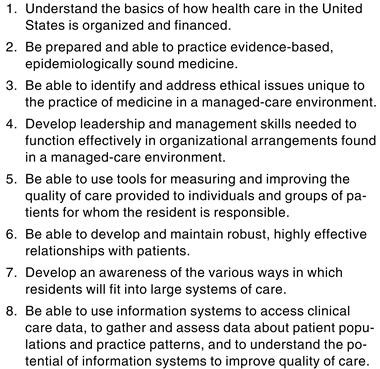
The COGME report identified a number of core competencies that had been previously addressed by other medical educators and classified them into eight key learning objectives [1,10]. These objectives are designed to prepare residents to perform more efficiently within a managed-care environment, while providing the highest quality of care (Table 1).
Table 1. COGME Managed-Care Objectives for Residents.
Japma 89 00199 i001
Source: Council on Graduate Medical Education 10.
Knowledge of managed-care dynamics can help podiatric residents deal with the realities of practicing medicine in the current era [11,14,15,16]. Residencies in all specialties are dealing with issues associated with managed care. The trend during the past 15 years has been to deemphasize the specialties and encourage the development of primary-care programs. This has been reflected in changes in reimbursement, which have resulted in increased revenue to primary-care physicians and decreased revenue to specialists [17]. Demands by payers to lower health-care costs have encouraged insurance companies to move toward managed care, in which primary-care physicians make decisions about referral. As a result, specialists’ salaries are dependent on a restricted referral system and rely on the specialist’s having a contract within the same plan as the primary-care physician [18].
Residents’ primary goal is to develop the clinical knowledge and skills to treat patients. Residents have minimal experience with the financial aspects of today’s patient-care system. Some programs encourage residents to think about health-care finances by having residents provide information on appropriate Common Procedural Terminology (CPT) or International Classification of Diseases, Ninth Revision (ICD-9-CM) codes before they perform a procedure or file for preauthorization for a procedure. The recommendations of the Educational Enhancement Project (EEP) of the Liaison Committee on Podiatric Medical Education and Practice for standard 2-year residency programs will promote the opportunity for residents to become more clinically adept; the goal is for podiatrists graduating from residency programs in the near future to be able to function better in a variety of delivery systems. The 2-year programs will also offer more opportunities to teach podiatric residents about business management and how to become better integrated into the health-care delivery system. The EEP also identified some of the practice-management and managed-care educational needs that the COGME report had addressed [19].
Understanding how health care is being delivered and funded in different settings will allow residents to know how to adapt to changes and to function better when they are in practice in the community. Originally, the innovators of managed care believed that managed care would be a better way to provide the necessary care to a given population without depleting that population’s available resources [20]. The theory was that shifting the financial incentives into the hands of the primary-care physicians would mean that costs would be better controlled because cost decisions would be made by those who understood what was needed. In this model, the primary-care physician assumed the role of gatekeeper in managing the care that the patients receive. Training programs had to be slightly modified to adapt to this paradigm [21].
Podiatric physicians have been dealing with a number of problems. For example, they may not be able to take plain film radiographs in the office because a radiology group had been contracted to provide all plain film radiography services. One would then have to decide between 1) taking the radiograph in the office and not getting paid for it, or 2) referring the patient out. Another dilemma occurs when patients must be referred to one prosthesis maker for all custom-made orthoses, even though the podiatrist knows that better ones could be made, at lower cost, by another orthotic laboratory. Finally, an ethical and financial dilemma can result if the decision to perform a bunionectomy depends on whether the insurer model is fee-for-service or capitated. From a training standpoint, residents need to be challenged by ethical decision making to understand what is confronting physicians on a daily basis [22].
A driving force for podiatric outcome studies is the need to validate the type of care being provided by demonstrating its value and effectiveness. This is what employer groups and other payers are purchasing and demanding. The concept of evidence-based medicine that has a population-focused foundation will be a factor in whether patients requiring certain services will continue to visit podiatrists in managed-care settings. Knowledge of utilization, statistics, and data-collection methodology has begun to affect private practice. Multispecialty groups, through the demands of their managed-care contracts, most likely are providing information to prove positive outcomes. This eventually translates into value as it relates to medical services performed. With accreditation agencies encouraging this type of quality measurement to facilitate improvement, it is likely that clinical practice guidelines will continue to expand in the movement to improve the health of the population that the multispecialty group serves.
Another benefit of a managed-care curriculum will be to ensure the residents’ ability to know what patient-care resources are available and to make better use of those resources [23,24]. The concept of integrated delivery systems revolves around the continuum of care. There should be a seamless flow of care and information, regardless of setting. Fifteen years ago, patients were admitted to a hospital the day before surgery for preoperative laboratory tests, chest x-rays, an electrocardiogram, and a history and physical examination; patients then stayed 2 to 3 days in the hospital for digital arthroplasty procedures. Today, if the patient is classified as American Society of Anesthesiologists Risk Category I, there may be no laboratory tests. The procedure is done in a surgery center or an office; the patient goes home that afternoon, and visiting nurses provide care at home. With the physician understanding how to manage the care-giving process, the end result should be an increase in quality over time.
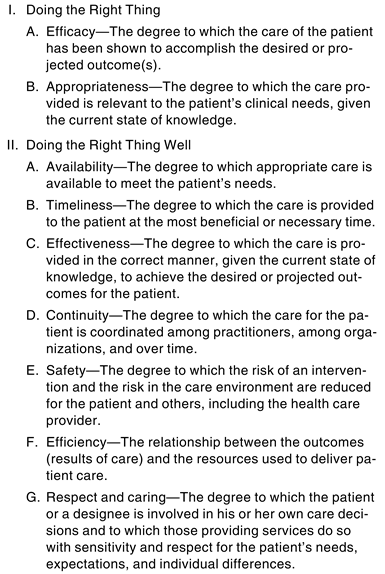
According to the Joint Commission on Accreditation of Healthcare Organizations (JCAHO), the definition of quality of care includes several different parameters. Each parameter contributes to the results (Table 2) [25]. In the past, the phrase “quality of care” implied that the best care was given, but in today’s marketplace, it has a multidimensional explanation, depending on which constituency one is speaking to. If properly administered, managed care can provide the necessary structure and relationships to offer the best quality of care for the population that it is serving [8,26]
Table 2. Dimensions of Quality.
Japma 89 00199 i002
Source: Reprinted with permission from Joint Commission on Accreditation of Healthcare Organizations [25].
Iglehart [17] defines managed care as the system that, to varying degrees, integrates the financing and delivery of medical care through contracts with selected physicians and hospitals that provide comprehensive health-care services to enrolled members for a predetermined monthly premium. Health-care providers have shifted their focus from utilization to cost-effectiveness. Their primary concern is that their community or population receives the necessary care and achieves the most desirable outcomes. As the overall health of that population improves, the cost of improving or maintaining that health should decrease.
This concept follows W. Edward Deming’s philosophy of quality improvement, which has crossed over from the manufacturing sector into health care. Deming’s concept was that the most cost-effective and best results are obtained when something is done right the first time and every time. He focused on the processes that led to the results, not on just the end product. Before US corporations adopted this philosophy, the assumption was that there was an acceptable margin of error in the process of doing business. This was true for manufacturing 1 million widgets or performing 100 heart transplant procedures. A 5% margin of error or of complications resulted in 50,000 defective widgets or 5 patients with negative results. Eventually, Deming’s concepts took hold, and the idea of a margin of error became unacceptable.
The various participants in the health-care system have recognized the need to track “best practices.” This has led to the development of quality-measurement programs such as JCAHO’s ORYX project or the National Committee for Quality Assurance’s Health Plan Employer Data Information Set program. These programs are coordinated databases of specific clinical indicators and measurements that will establish national standards in health care, regardless of whether the organization is a hospital, a health maintenance organization, or a community practice.
These concepts are not novel to most experienced podiatric physicians, but can be overwhelming to residents. Because residents have been operating in an isolated environment, they may not have encountered such principles as performance improvement, reengineering, and encounter-based capitation. Although business administration, public health, medical ethics, and medical jurisprudence are taught in their doctoral programs, the integration of this information does not occur until the residents get opportunities to interact with others in clinical settings. Some believe that courses in managed care and business management should start in the first year of medical school [16,27,28]
A curriculum to instruct podiatric residents in the dynamics of managed care would allow them to function in the administrative side of managed-care organizations and is relevant to the future success of podiatric medicine. Primary-care residencies have implemented such programs aggressively. The transition from podiatric student to physician would be smoother if programs were available to integrate clinical activities with the business arena [7,27]

Examples of Managed-Care Curricula

The Primary-Care Examples: University of California, Los Angeles, and Tufts University

The University of California, Los Angeles (UCLA), School of Medicine has developed a curriculum for two of its internal medicine programs that addresses the need for educational programs in managed care [4].
These activities started in 1990; the school gradually implemented programmatic changes to accomplish its goals and objectives to improve residents’ knowledge of managed care (Table 3). Currently, the focus revolves around residents’ participation in utilization review of outpatient services; the philosophy is that residents should be exposed to this and other activities while they are in an environment where they can obtain educational support [14]. This concept mimics the activities of utilization management committees of most managed-care organizations.
Table 3. UCLA Goals and Objectives for Residents in Managed Care.
Japma 89 00199 i003
Source: Reprinted with permission from Gomez et al [4].
There have been preliminary discussions between UCLA and CCPM regarding increased training integration in the near future. A closer alliance should offer more opportunities for podiatric residents to be trained in additional acute-care/long-term-care facilities, multispecialty medical groups, and community practices. This will also increase the chances of CCPM residents’ participating in the UCLA managed-care curriculum at some point in the future.
Tufts University’s primary-care program was developed in partnership with the Tufts Health Plan, which is an independent physicians association–model health maintenance organization. In 1995, the Tufts Health Plan established a separate institution, the Tufts Managed Care Institute, to develop components of a managed-care curriculum. This resulted in a program that could be delivered as part of a medical education continuum, with the focus on educating medical students, primary-care residents, and faculty members.
The program consists of a series of modules including an overview of the historical background and economics of managed care, the basics of utilization management, capitation, quality assessment in the capitated practice, and ethics. Most of the topics are covered through the use of interactive CD-ROMs. The program is reinforced by having residents rotate through primary-care community practices that use prepaid reimbursement. Additional work has been done to educate residents in developing clinical guidelines and skills that will improve their interaction with patients [7] The Tufts Managed Care Institute identified areas important in preparing physicians to practice effectively in a managed-care environment (Table 4).
Table 4. Managed-Care Curriculum Components for Physicians: The Tufts University Model.
Japma 89 00199 i004
Source: Reprinted with permission from Phillips et al [5].

The Podiatric Example: California College of Podiatric Medicine

The CCPM residency program has two primary goals. One is to inculcate the clinical knowledge and skills necessary to become a competent podiatric physician and thus to prepare residents for board certification. This concept is supported by the EEP, which addressed the role of residency training in the continuum of podiatric career development. The residency programs are required to comply with the standards and processes outlined in the Council on Podiatric Medical Education (CPME) report Standards and Procedures for the Podiatric Residency Program. This document’s standard 4.14 addresses experiences relevant to managed care, specifically medical ethics, quality assurance, and utilization review [29]. Recognition of compliance with the standards outlined in this document results in program accreditation, which authorizes a program to grant the appropriate certificate.
The other major goal of the CCPM residency program is to give residents the opportunity to learn how to function in a managed-care environment. Although the history of health-care delivery is important, clinical training alone does not teach all of the skills needed to function within managed care. The San Francisco Bay area has 57% penetration of managed care, one of the highest rates in the country, according to a 1997 survey by Medical Data International (unpublished data). This rate is comparable to those of other major metropolitan areas, such as Los Angeles, Miami, and Minneapolis (Table 5). Residency programs of CCPM have maintained the philosophy that if a resident can learn and function under these circumstances, he or she should be professionally successful in areas where managed care has a smaller presence.
Table 5. Managed-Care Market Penetration.
Japma 89 00199 i005
The managed-care training of CCPM residents involves both lectures and field experience. The college has taken advantage of the wealth of knowledge available in the region from community-practice physicians and managed-care leaders. Residents are given the opportunity to provide care and to interact with administrators and physicians in a variety of delivery systems, including integrated delivery networks, multispecialty medical groups, and independent physician association–model and staff-model health maintenance organizations.
The college operates three types of residency programs. The podiatric surgical residency is a 3-year program: the first year emphasizes general medicine and surgery, and the last 2 years are spent mostly in a podiatric surgical and medical environment. The podiatric orthopedic residency is a 1-year program in which residents are exposed to a foundation model of an integrated delivery system, an independent physicians association health maintenance organization model, discounted fee-for-service private practices, and staff-model health maintenance organizations. The primary podiatric medicine residency is a 1-year program in which the residents are exposed to the Department of Veterans Affairs system, Kaiser health maintenance organization systems, public/county health-care systems, and multihospital integrated delivery systems.
The podiatric surgical residents spend up to 8 months in the Kaiser Permanente system. Kaiser Permanente is one of the oldest staff-model health maintenance organizations in the country. There, residents learn to function as a major part of the health-care delivery team, typically working side by side with specialists in orthopedics, rehabilitation medicine, internal medicine, and other areas. The residents experience the pressures of providing care according to set clinical guidelines and being scrutinized by utilization management. They also learn that with a large organization, resources are available to develop and implement sophisticated information management systems. The residents have significant exposure to telemedicine, electronic medical records programs, and other patient-management tools.
The podiatric surgical residents also spend time during the first year of their program in the Department of Veterans Affairs medical system, which offers similar experiences. Health-care service for qualified veterans is mandated by the US government; the issues of quality of care are just as significant as anywhere else.
San Francisco General Hospital is one of largest county facilities in the country dedicated to providing care to a low-income population. The state of California has mandated a shift of its version of Medicaid, called Medi-Cal, into managed care; San Francisco General Hospital is the principal facility treating patients who qualify under this program. Medi-Cal operates like any other health maintenance organization: each patient enrolled in the program is assigned to a primary-care physician responsible for coordinating all patient care.
During rotations at San Francisco General Hospital, CCPM residents operate side by side with the other members of the service to which they are assigned. These services include a number of specialties, such as trauma surgery, plastic surgery, orthopedics, dermatology, emergency medicine, and outpatient medicine. The basic services associated with visits are rendered through a utilization review or gatekeeper process. Services beyond those offered through an evaluation and management visit require the approval of the primary-care physician. Additional procedures, such as minor nail or digital surgeries, require treatment authorization requests, which are submitted to a medical director or consultant for review. An additional procedure can be denied for a number of reasons, including being medically unnecessary or being a condition for which insufficient conservative care has been rendered.
Residents also have the opportunity to rotate through a number of private community settings where the practices may have a managed-care capitation-based patient population ranging from 0% to 70% of the total patient population. In these settings, the residents receive considerable exposure to the dynamics of rendering patient care. They experience the frustrations of both physicians and staff and see firsthand the difficulties associated with the process of obtaining medical care. They deal with the day-to-day issues of obtaining appropriate referrals and authorizations, completing medical reports, experiencing accreditation visits, and informing patients of their options within their insurance coverage.
These practices operate within a model in which a managed-care organization contracts with an independent physician association to manage the care of its patient population. The practice assumes the contracted financial responsibilities to provide the necessary care for the patients who are assigned to this practice. There may be additional incentives for the practice based on quality-of-care measurements as well as on ability to manage the utilization of resources within the health-care system. With more individuals enrolling in this type of program, CCPM residents have significant exposure to this delivery system, which is becoming more common in all metropolitan areas.
A portion of the training includes a series of lectures on practice management, managed-care dynamics, and the fundamentals of business administration. These sessions are scheduled once a month, and presentations are given by a panel of experienced practitioners and health-care experts.

Proposed Managed-Care Curriculum

The proposed managed-care curriculum described is based on the core objectives identified by the COGME report, which focus primarily on the role of general or primary-care physicians and their responsibilities. The analogy of the hub-and-spoke system in product distribution applies to the gatekeeper concept of care delivery. The primary-care physician is at the hub of the wheel and directs the movement of patients from one service to another, as from one spoke of the wheel to another. In this analogy, podiatric medicine is one of the spokes or services, and residents must understand the roles of primary-care providers, specialists, hospitals, and other providers.

Suggested Objectives

  • The resident will demonstrate knowledge of the history of managed care, different payment methmethodologies for service reimbursement, and the dynamics of managed care within the facility at which he or she is training.
    A.
    The resident will be knowledgeable about the differences between the fee-for-service model and capitation, as well as variations of each.
    B.
    The resident will be knowledgeable about the US health-care delivery system of the past 40 years.
  • The resident will demonstrate the knowledge to properly use resources within a health-care system.
    A.
    The resident will participate in the utilization or resource management committee.
    B.
    The resident will be able to describe the concept of continuum of care.
    C.
    The resident will demonstrate knowledge of how to add resources to a delivery system.
  • The resident will demonstrate knowledge of organizational management and behavior.
    A.
    The resident will demonstrate an understanding of the constituents of a managed-care organization.
    B.
    The resident will attend a leadership meeting of an organization.
    C.
    The resident will participate in various committees of an organization.
  • The resident will demonstrate an understanding of medical informatics.
    A.
    The resident will prepare a paper using information obtained from the Internet.
    B.
    The resident will demonstrate an understanding of electronic medical records, telemedicine, and business management systems.
    C.
    The resident will demonstrate a basic under-standing of biostatistics.
  • The resident will demonstrate an understanding of performance improvement.
    A.
    The resident will participate in one of the facility’s performance-improvement projects.
    B.
    The resident will be able to describe the difference between quality assurance and quality improvement.
    C.
    The resident will be able to utilize the facility’s measurement systems to perform outcome studies.
    D.
    The resident will participate in the quality-improvement committee.
  • The resident will demonstrate an understanding of medical ethics.
    A.
    The resident will participate in a medical ethics committee.
    B.
    The resident will present a case history that involves ethical issues.
    C.
    The resident will obtain a conflict-of-interest policy of an organization and describe scenarios of acceptable and unacceptable circumstances.
    D.
    The resident will participate in a patient-care conference that involves discussion of “do not resuscitate” action.
  • The resident will demonstrate the ability to establish effective relationships with patients.
    A.
    The resident will be able to obtain an informed consent.
    B.
    The resident will attend a program on effective communication methodologies.
    C.
    The resident will be able to describe the four different social styles.
  • The resident will demonstrate knowledge of evidence-based, population-focused medicine.
    A.
    The resident will understand the concept of evidence-based medicine.
    B.
    The resident will understand concepts of public health.
    C.
    The resident will participate in various community activities involving community health fairs, health screenings, and other patient-education activities.

Methods for Accomplishing Educational Objectives

1. Involvement with Management Committees of a Managed-Care Organization. Committees in a managed-care organization are similar to those in hospitals. Before the advent of managed care, most of the decision making regarding health-care delivery was centered at the hospitals. Training programs and the continuum of care were centered at the local acute-care hospital. With the paradigm shift, a significant portion of the decision making about care has moved from the hospital to the managed-care organization, with input from the physicians. Podiatric residents should be exposed to the inner workings of managed-care organizations, just as they have been exposed to the inner workings of acute-care hospitals.
If one were to review the organizational charts and policy manuals of managed-care companies, one would see operational committees in such areas as credentials, peer review, utilization management, risk management, safety/environment of service, infection control, pharmacy and therapeutics, and quality/performance improvement. Typically, man-aged-care organizations are controlled by a board of directors, which appoints a chief executive officer to implement the plans of the board. The committees are working teams formed to support the action of the chief executive officer.
A. Utilization/Resource Management Committee. A major issue for managed care is the management of resources, which usually relates to cost containment. Residents would benefit from participation on the utilization review/management committee, which would take up issues regarding resource management and appropriateness of service. This committee is usually headed by a clinically trained individual, such as the chief medical director or quality-assurance nurse. Discussed are such topics as length of inpatient stay, specialty referral patterns, pharmacy utilization, and the expansion or restriction of benefits.
B. Quality/Performance Improvement Committee. The primary role of the quality or performance improvement committee is to direct the continuous improvement activities of the organization. This is not limited to clinical issues, but also includes operational and financial matters. Topics discussed might be information from working groups on resource/utilization management, information management, financial issues, provider relationships, and patient relationships.
The concept of total quality improvement involves all aspects of the organization and is typically the force driving an organization to look critically at ways to improve customer satisfaction. As previously stated in this article, the focus is not on individuals, but on the process; this differs considerably from the previous philosophy of quality assurance. The participation of residents on this committee or on a project assigned by this committee is of great educational value as well as of value to the organization [30].
C. Medical Ethics Committee. Medical ethics can be an elusive concept. Medical ethics is constantly discussed within the managed-care environment. Doing what is right the first time, every time, sounds simple, but some people question whether that can be accomplished in a managed-care world. The public has demanded some degree of accountability on the part of managed-care organizations. A simple mission, vision, and ethics statement would satisfy the basic requirements, but to know what an organization’s ethics are, one would need to see firsthand how it responds to issues of patient care.
D. Credentialing Committee. The credentialing committee has the responsibility of overseeing the approval process of all providers within the managed-care organization’s network. This committee credentials not only physicians, but also any entities that provide health care to the organization’s patients. These entities would include allied health professionals, hospitals, ambulatory care centers, long-term-care facilities, suppliers of durable medical equipment, and pharmacies.
Credentialing, based on a set of criteria, is one method that an organization uses to assure quality. An individual or organization that does not meet the criteria is not permitted to render services to the managed-care organization’s panel of patients. Non-credentialed entities can provide care, but typically they are not reimbursed and do not receive referrals for their services.
E. Medical Executive Committee/Board of Directors Meetings. Meetings of senior management and of the board of directors can give a resident a unique view of the kinds of processes and decision making that go into an organization. The short-term and long-term success of the organization comes from the accomplishments of these meetings. The resident can learn how a new program may be presented, how its implementation may be recommended, and how maintenance and program reductions can occur.
2. Clerkships/Internships with Administrators and Medical Directors of Managed-Care Organizations. Rotations with health-care executives will provide valuable insight. One professional organization, the American College of Healthcare Executives, requires that candidates for fellowship status spend a certain amount of time with an administrator in the delivery system that fits the candidates’ professional goals. A clerkship or an internship will allow the resident to gain an inside view of the workings of managed-care organizations.
Programs in primary care and behavioral medicine often offer residents time with medical directors of different managed-care organizations. Depending on the length of this experience, residents can assist medical directors and administrators with clinical information reviews. The residents can be instructed to develop a paper on a particular topic for presentation to one of the organization’s committees. Such a project can help the organization prepare for regulatory or accreditation reviews. The field experience will help residents gain a better understanding of their roles in the delivery system. This firsthand experience is similar to the residents’ education in clinical aspects of medicine [27.]
3. Educational Programs in Managed Care. Although the CCPM doctoral program includes courses in business administration, medical ethics, managed care, and public health, podiatric residents need to be better exposed to the details and dynamics of man-aged-care operations. Compared with practicing physicians, students have only a minimal interest in the subject, as they are generally more concerned with the next examination or obtaining a residency. Once in the residency program, the physician-in-training will be better able to focus on developing clinical skills and knowledge, as well as learning ways to succeed financially and professionally. Residents are considerably more receptive than students to discussions on managed care or business administration, especially in the last 6 months of their programs.
Such discussions may take place within the clinical lecture series and quarterly forums or seminars. Excellent workshops and seminars are sponsored by a number of professional health-care organizations, including those listed in Table 6.
Table 6. Health-Care Administration Organizations.
Japma 89 00199 i006
Quality-of-care issues are on the agenda of every medical group meeting across the country. Most practitioners deal with these issues as part of the daily work of their practice. Residents are constantly exposed to some of these issues, and these concerns need to be discussed in a forum of peers and colleagues.
4. Mentorship by Managed-Care Administrators. Like a clerkship or an internship, a mentorship program requires a commitment by individuals to advise and guide residents. Mentorship relationships are typically one-on-one and require regular communication. Specific goals and objectives must be developed for the resident and mentor. The primary objective is for the resident to establish a relationship with an individual who is working in a capacity other than clinical care.
Either through experience or because of legislation, insurance companies have recognized that the health care for which they are brokering is more effective when there is significant input from clinicians. This has created a growing need for doctors with business skills, similar to the natural synergy between physicians and pharmaceutical and medical equipment companies. Jacobs and Mott [31] have described characteristics that health maintenance organizations are looking for in their physicians. Now, not only do doctors treat patients, conduct research, and/or teach, but many have entered into adjunct or secondary careers in health-care administration [32]. There are numerous examples of podiatric physicians who are employed within managed-care organizations as administrators, medical directors, medical advisors, consultants, utilization review and quality improvement experts, business managers, and accreditation compliance specialists. Podiatric residents can benefit from mentors—or role models—who are successful in these capacities [33].
5. Graduate Education Programs. The growing interest of physicians in additional education has spawned numerous programs throughout the country offering graduate-level degrees in public health, health-care administration, business administration, management, and the like. These programs focus on giving an individual a firm grounding in the historical and theoretical aspects of the area, with the intent that these will be applied to current issues and methodologies. Such programs provide an added resource by introducing the physician to the network of others in the program. This network could prove helpful in the future.
Executive programs are also popular; they usually have classes in the evenings and on weekends. These programs are usually geared toward working individuals with some prior experience, and the programs often draw on the students’ experience for research or discussion. There are also long-distance learning programs, which use videotapes and the Internet. Programs at Golden Gate University (San Francisco), Colorado State University (Fort Collins), and Century University (Albuquerque) utilize these modalities and encourage self-education. Like the traditional programs, executive programs offer both relevant information and the chance to get to know a network of individuals who might be helpful in the future.
Decisions by residents to enroll in such a program revolve around the issues of time and money. Most residencies do not have the scheduling flexibility to allow their residents to have certain days off, especially if the program has few residents. Rotation assignments cannot be changed to accommodate special interests, unless this is done for all residents.
The cost of some executive programs can run into the tens of thousands of dollars. If the facility sponsoring the residency program is affiliated with other institutions, the institutions might consider developing a joint degree program, something that is offered by some large academic health centers. Programs leading to such degrees as a master’s in public health or business administration can be coordinated with residency program requirements, which could make a program more attractive.
6. Research Paper/Independent Study. The CPME has requirements for first-year residents to develop a research proposal, which could be extended to a formal paper. The research involved in developing a paper is useful in enhancing the communication skills of residents. The successful practice of medicine relies in large part on the physician’s ability to communicate. Developing an idea and communicating it in writing requires logical thinking, organization, and perseverance.
For a number of years, CCPM has required podiatric residents to give grand round presentations. These may consist of unusual case histories or presentations of original research. Those attending the presentations critique them in terms of presentation skills, use of media, and information presented. This experience allows residents to improve their communication, research, and organizational skills.
With the availability of Internet access and computer technology, there is no longer a shortage of information. The computer sophistication of residents has improved every year, allowing them to take advantage of the new technologies [34,35]. Teleconferencing and telemedicine will become more common and will facilitate educational opportunities. Education will have to incorporate issues related to the electronic revolution, such as patient confidentiality and information security.

Evaluation of Methods

A curriculum can be evaluated in a number of ways. The first way presented here focuses on in-training program evaluation; the second looks at the residents after they graduate and are in practice.
1. In-Training Program Evaluation. During a program, the residents’ fulfillment of the managed-care objectives is the best indicator of the program’s ability to meet its stated goals. The objectives may have been too difficult or too easy; if so, they need modification. Concurrent feedback about the program would be helpful in determining the need for program modification. This feedback should come from all constituencies, such as the managed-care organizations, the facility that is sponsoring the residency programs, physicians, residents, and patients. Because clinical evaluations of residents should be done regularly, the managed-care objectives could be evaluated at the same time. The information collected should be aggregated and compared for the various residents and for various programs.
An exit interview at the end of the residency would provide insight into the program’s success. All constituencies should provide cumulative feedback on the outcome of the training program. Information should be solicited on the program’s strengths and weaknesses and on suggested areas for improvement. A summary that includes information from the concurrent evaluations should be generated and discussed at the annual residency curriculum review.
2. Post-Training Program Evaluation. Post-training evaluations could provide valuable information about the program’s ability to train residents to function in a managed-care environment. A survey of residents who have graduated 1 year, 5 years, and 10 years ago could ask them, for example, whether they were satisfied with their program, whether the program had adequately trained them for practice, and whether they felt they had an impact on the podiatric health of their community. Standardized surveys would be very helpful for aggregating data from a number of different residencies that decided to implement a managed-care component in their program. Such information could be presented in residency directors’ conferences to discuss strengths and weaknesses in the program.
A managed-care organization that participates in a residency program might provide information about utilization activities and outcome information, for example, on such matters as the reduction of amputation rates in patients with diabetes or improving the recovery time after an ankle injury. Such feedback is one good reason for a managed-care organization to be involved in a podiatric residency program.
A secondary benefit of having a managed-care organization involved with a residency program is that it allows the organization to have a better idea of what podiatric medicine can provide for it, which may result in more opportunities for podiatric physicians.
The annual residency curriculum review should evaluate not only the residents, the goals and objectives of the program, and the clinical rotations, but also the program’s managed-care component. The input from all parties associated with the program can offer important insights into the strengths and weaknesses of the curriculum. Comparison with residency programs that have implemented similar programs should be encouraged.

Conclusion

Educating podiatric residents about managed care will better equip them to practice and increase their chances of success in an evolving health-care delivery environment. The work of COGME and programs such as the ones at the CCPM, the UCLA School of Medicine, and Tufts University offer useful teaching models, which can be applied to podiatric programs. By using a curriculum that combines didactic material, role modeling, and practical experience in a variety of health-care environments, program directors could evaluate their current objectives and determine whether there is a need to implement an additional managed-care component. The goal is to develop podiatric residents who are better prepared to cope with managed care and are more confident about their future.
Podiatry has worked hard to align its education and training programs with those of general medicine and has advanced considerably in the past 30 years. As a result, podiatry is experiencing many of the same pressures as the rest of medicine. To be competitive in an evolving health-care environment, podiatric residents should have comprehensive education and training in both the clinical and the business aspects of health care. A managed-care component, such as the one suggested here, should be part of the continuum of education from podiatric medical college through residency training that eventually leads to practice.

References

  1. LURIE N: Preparing physicians for practice in managed care environments. Acad Med 1996, 71, 1044. [CrossRef]
  2. TINSLEY, JA. Teaching residents about managed care. Mayo Clin Proc 1996, 71, 201. [Google Scholar] [CrossRef]
  3. HEWSON, MG; FISHLEDER, AJ; HALPERIN, AK. ET AL: Educating residents for managed care: report on a multidisci-plinary conference. Acad Med 1998, 73, 479. [Google Scholar] [CrossRef]
  4. GOMEZ, AG; GRIMM, CT; YEE, EFT. ET AL: Preparing residents for managed care practice using an experience-based curriculum. Acad Med 1997, 72, 959. [Google Scholar] [CrossRef]
  5. PHILLIPS, RR; LEE, MY; BERMAN, HA. ET AL: The Tufts partnership for managed care education. Acad Med 1997, 72, 347. [Google Scholar] [CrossRef]
  6. MEYER, GS; POTTER, AP; GARY, N. A national survey to define a new core curriculum to prepare physicians for managed care practice. Acad Med 1997, 72, 669. [Google Scholar] [CrossRef]
  7. CANTOR, JC; BAKER, LC. HUGHES RG: Preparedness for practice: young physicians’ views of their professional education. JAMA 1993, 270, 1035. [Google Scholar] [CrossRef]
  8. GREENLICK, MR. Educating physicians for the twenty-first century. Acad Med 1995, 70, 179. [Google Scholar] [CrossRef]
  9. MAINOUS, AG; BLUE, AV; GRIFFITH, CH. ET AL: Assessing residents’ readiness for working in a managed care environment. Acad Med 1997, 72, 385. [Google Scholar] [CrossRef]
  10. Document HRSA-97-34; Council on Graduate Medical Education: Preparing Learners for Practice in a Managed Care Environ-ment. US Department of Health and Human Services, Health Resources and Service Ad-ministration: Rockville, MD, 1997.
  11. COHEN JJ: Pew catalyzes education partnerships with managed care organizations. Acad Med 1997, 72, 372. [CrossRef]
  12. MORREIM EH: Managed care, ethics, and academic health centers: maximizing potential, minimizing draw-backs. Acad Med 1997, 72, 332. [CrossRef]
  13. MOORE, G; GRINER, P. Medical education and managed care: can sour turn sweet? Acad Med 1997, 782, 568. [Google Scholar] [CrossRef]
  14. REID, WM; HOSTETLER, RM; WEBB, SC. ET AL: Time to put managed care into medical and public health education. Acad Med 1995, 70, 662. [Google Scholar] [CrossRef]
  15. FARAGASON, CA; EVANS, HH; ASWORTH, CS; et al. The importance of preparing medical students to manage different types of uncertainty. Acad Med 1997, 72, 688. [Google Scholar] [CrossRef]
  16. NORITZ G: Students need managed care training. Acad Med 1997, 72, 159. [CrossRef]
  17. IGLEHART JK: Physicians and the growth of managed care. N Engl J Med 1994, 331, 1167. [CrossRef]
  18. GREMBOWSKI, DE; COOK, K; PATRICK, DL. ET AL: Managed care and physician referral. Med Care Res Review 1998, 55, 3. [Google Scholar] [CrossRef]
  19. Liaison Committee on Podiatric Medical Education and PRACTICE: Blueprint for the Future: Educational Enhancement Project (EEP) Report and Recommendations—1998. JAPMA 1998, 88, 523.
  20. IGLEHART, JK. The American health care system: managed care. N Engl J Med 1992, 327, 742. [Google Scholar] [CrossRef]
  21. RIVO, ML; SAULTZ, JW; WARTMAN, SA. ET AL: Defining the generalist physician’s training. JAMA 1994, 271, 1499. [Google Scholar] [CrossRef]
  22. SILVERMAN DR: Narrowing the gap between the rhetoric and the reality of medical ethics. Acad Med 1996, 71, 227. [CrossRef] [PubMed]
  23. RAMSBOTTOM-LUCIER, M; CAUDILL, TS. Teaching residents in an ambulatory setting: introducing the concepts of managed care in a fee-for-service clinic. Acad Med 1997, 72, 447. [Google Scholar] [CrossRef] [PubMed]
  24. USTAINE, RP; NGUYEN, K; RANDALL, J. ET AL: Four exemplary preceptors’ strategies for efficient teaching in managed care settings. Acad Med 1997, 72, 766. [Google Scholar] [CrossRef]
  25. Joint Commission on Accreditation of Healthcare. ORGANIZATIONS: 1996 Accreditation Manual for Health Care Networks; US Department of Health and Human Services, Health Resources and Service Administration: Rockville, MD, 1996; Vol 1, p. 21.
  26. GREENLICK, MR. Educating physicians for population-based clinical practice. JAMA 1992, 267, 1645. [Google Scholar] [CrossRef]
  27. SLOTNICK HB: How doctors learn: the role of clinical problems across the medical school-to-practice continuum. Acad Med 1996, 71, 28. [CrossRef] [PubMed]
  28. VELOSKI, J; BARAZANSKY, B; NASH, DB. ET AL: Medical student education in managed care settings. JAMA 1996, 276, 667. [Google Scholar] [CrossRef] [PubMed]
  29. Council on Podiatric Medical Education: Standards and Procedures for the Podiatric Residency Program; American Podiatric Medical Association: Bethesda, MD, 1998.
  30. WOFFORD, JL; MORAN, WP; COHEN, SJ; et al. Physicians in training as quality managers: survival strategy for academic health centers. Am J Managed Care 1997, 3, 1851. [Google Scholar]
  31. JACOBS, MO; MOTT, PD. Physician characteristics and training emphasis considered desirable by leaders of HMOs. J Med Ed 1987, 62, 725. [Google Scholar] [CrossRef]
  32. JAKLEVIC MC: Take this job, and this job, and this job. Mod Health (July) 1997, 36.
  33. WRIGHT S: Examining what residents look for in their role model. Acad Med 1996, 71, 290. [CrossRef]
  34. CHODOROW, S. Educators must take the electronic revolution seriously. Acad Med 1996, 71, 221. [Google Scholar] [CrossRef]
  35. WONG ET, ABENDROTH TW: Reaping the benefits of medical information systems. Acad Med 1996, 71, 353. [CrossRef]

Additionnal References

  1. ASSOCIATION OF AMERICAN MEDICAL COLLEGES: Roles for medical education in health care reform EVIDENCE-BASED MEDICINE WORKING GROUP: Evidence-based medicine: a new approach to teaching the practice of medicine. Acad Med;JAMA 1994, 69 268, 512 2420.
  2. FRIEDMAN E: Managed care and medical education: hard cases and hard choices. Acad Med 1997, 72, 688.
  3. GINZBERG E: Medical education and the needs of the public. Acad Med 1997, 72, 663. [CrossRef]
  4. HEADRICK, LA; NEUHAUSER, D; SCHWAB, P. ET AL: Continuous quality improvement and the education of the generalist physician. Acad Med 1995, 70, S104. [Google Scholar] [CrossRef] [PubMed]
  5. HOWELL JD: Making a medical practice in an uneasy world: some thoughts from a century ago. Acad Med 1997, 72, 977. [CrossRef] [PubMed]
  6. JELLINEK, MS. NURCOMBE B: Two wrongs don’t make a right: managed care, mental health, and the marketplace. JAMA 1993, 270, 1737. [Google Scholar] [CrossRef]
  7. SKIRBOLL LR: The impact of managed care on research: the changing face of medicine. Acad Med 1997, 72, 778. [CrossRef] [PubMed]
  8. STEIN, DH; SALIVE, ME. Adequacy of training in preventative medicine and public health: a national survey of residency graduates. Acad Med 1996, 71, 375. [Google Scholar] [CrossRef]
  9. TERRY MA: One program already offering managed care training. Acad Med 1997, 72, 657. [CrossRef] [PubMed]
  10. WEBER DO: Second thoughts: can managed care be ethical? Healthcare Forum J 1997, 19, (July-Aug).
  11. WOODSTOCK THEOLOGICAL CENTER: Ethical Considerations in the Business Aspects of Health Care; Georgetown University Press: Washington, DC, 1995.
  12. ZOOROB, RJ. Practice-management curriculum for family practice residents. Acad Med 1997, 72, 446. [Google Scholar] [CrossRef] [PubMed]