The consensus in the medical community is that the wearing of high-heeled shoes may have adverse effects on women’s feet [
1,
2,
3,
4]. Despite this, it has been reported that 59% of women wear high-heeled shoes between 1 and 8 hours per day [
5]. Female patients presenting for foot evaluation often attribute symptomatology to wearing high-heeled shoes, but few quantitative studies exist to demonstrate a causal relationship. Barefoot ambulation has been found to produce the greatest pressure under the second metatarsal head [
6,
7]. Footwear has been shown to modify the transmission of the ground-reactive forces during the stance phase of walking [
8]. However, there is much controversy about the effects of wearing high-heeled shoes on the distribution of plantar pressures.
A variety of methods have been used to investigate plantar pressures, and these studies have yielded conflicting results. Methods of evaluation of plantar pressures have included the Harris mat, oscillograph technique, strain-gauge technology, the Electrodynograph® (Langer Biomechanics Group, Inc, Deer Park, NY.), force plates, and various pedobarographs. Each method of evaluation has been criticized on one point or another. The literature reporting quantitative analysis of plantar peak pressures as they relate to increasing heel height contains conflicting results.
Using an oscillograph technique, Schwartz et al
2 observed that wearing high-heeled shoes caused a significant increase in pressure under the first metatarsal head and a decrease in pressure under the fifth metatarsal head. Contrasting results were offered by Godfrey et al [
3], who used a similar technique to study plantar pressure. Their results indicated a decrease in pressure under the first and fifth metatarsophalangeal joints. Examination using strain-gauge technology yielded results consistent with those of Schwartz et al: Soames and Clark [
4] found the mean peak pressure to be highest under the first and second metatarsal heads, while the pressure was lowest under the third, fourth, and fifth metatarsal heads. The magnitude of this difference was shown to increase with increasing heel height. Gastwirth et al [
9] performed a study using the Electrodynograph and reported findings suggesting an increased duration of forefoot loading rather than an increased actual pressure. A uniform pressure distribution and a higher overall pressure across the metatarsal heads were the results of a study done by Snow et al [
10] using the Biokinetics
® (BTE, Inc, Baltimore, MD) pedobarograph. A Musgrave Footprint
® (Musgrave Systems, Ltd, Wrexham, United Kingdom.) pedobarograph was used by Corrigan et al
11 and showed an elevation of load toward the medial side of the forefoot with a resultant increase in pressure.
The purpose of this study was to evaluate plantar pressures in women wearing shoes of various heel heights by means of the F-Scan
® (Tekscan, Boston, MA.) analysis system. The F-Scan insole is a pressure-measurement insole that uses 960 individual sensors. The insole is 0.007 inch thick and is placed between the sock and shoe. Plantar pressures are recorded by means of a computer system and analyzed with the F-Scan analysis system software. One of the advantages of the F-Scan system is that it enables the examiner to not only quantify the magnitude of the plantar pressures but see the distribution of these pressures graphically. The use of an in-shoe pressure-measurement system also allows the examiner to see how the shoe affects the plantar pressures in the dynamic state. However, reliability of pressure-measurement insoles has been a subject of much debate, and the reproducibility of data has come into question [
12].
This study was conducted to examine the effects of high-heeled shoes on plantar peak pressures during ambulation and to determine the areas and magnitude of peak pressures throughout the forefoot. The authors hypothesized that peak forefoot pressures would be shifted medially to the first metatarsal when heel height was increased from sneakers to a shoe with a 3-inch heel. The authors also examined the reproducibility of the data acquired by studying the in-shoe pressure-measurement system and testing its reliability through multiple trials.
Materials and Methods
Thirty-five women were evaluated for this study. The average age of the subjects was 25.5 years (range, 23 to 32 years); the average weight was 132.5 pounds (range, 98 to 210 pounds). Twelve of the subjects were determined to be left-foot dominant and 23 were right-foot dominant. Foot dominance was determined by observing which foot the subject used to begin ambulation.
The subjects selected had experience wearing high-heeled shoes. Each subject was evaluated biomechanically. Those with limb-length discrepancy, hallux abducto valgus, tailor’s bunion, hammer digits, and plantar callosities were excluded from the study. All subjects were evaluated while wearing sneakers and shoes with 2-inch and 3-inch heels. The high-heeled shoes all had narrow toe boxes, low vamps, and thin heel widths.
Determination of Plantar Pressures
A Pentium® (Intel Corp, Santa Clara, CA.) processor was used to run the F-Scan analysis system software version 3.711. Color printouts were obtained with a Hewlett-Packard DeskJet® (Hewlett-Packard Co, Palo Alto, CA.) 1200C printer. The F-Scan insole was attached to the coupler, which was attached to the subject’s leg with a VELCRO® (Velcro USA, Inc, Manchester, NH.) fastener. Cables were attached to the coupler and fastened around the subject’s waist. The cable allowed for 30 feet of unrestricted gait. The cables are attached to the computer via an interface card.
The subjects were allowed to walk freely for 3 minutes, after which the insoles were calibrated by having each subject stand independently on each foot. Calibrations took place prior to each trial. The subjects were then asked to walk a distance of 28 feet. The distance walked amounted to approximately ten steps for each foot (ten gait cycles). A graph was generated for each trial and the middle five steps were used to obtain data points and location for the peak forefoot pressure. The peak forefoot pressures of the five consecutive steps were averaged and recorded for each trial bilaterally.
Reliability Testing
The second part of this study examined the reliability of the F-Scan analysis system. Five test subjects were each given a set of F-Scan insoles. The subjects were asked to walk for 3 minutes on the insoles, and then the insoles were calibrated. On day 1, the subjects were asked to walk for two trials. Each trial consisted of walking approximately 28 feet, resulting in approximately ten steps. The first two and the last three steps were discarded; the middle five steps were used for analysis. Data were recorded from the right insole only. The subjects were asked to take their insoles home and return 2 days later for reexamination. On the second visit, the subjects were asked to walk on the insoles for one trial after the calibration. Data were again recorded using the right insole. The subjects were asked to return 2 days later for the final visit. The subjects then walked two more trials after the calibration. The middle five steps of each of the five trials were analyzed for peak forefoot pressure and these results were recorded. The 25 peak pressures were averaged and analyzed for reproducibility.
Results
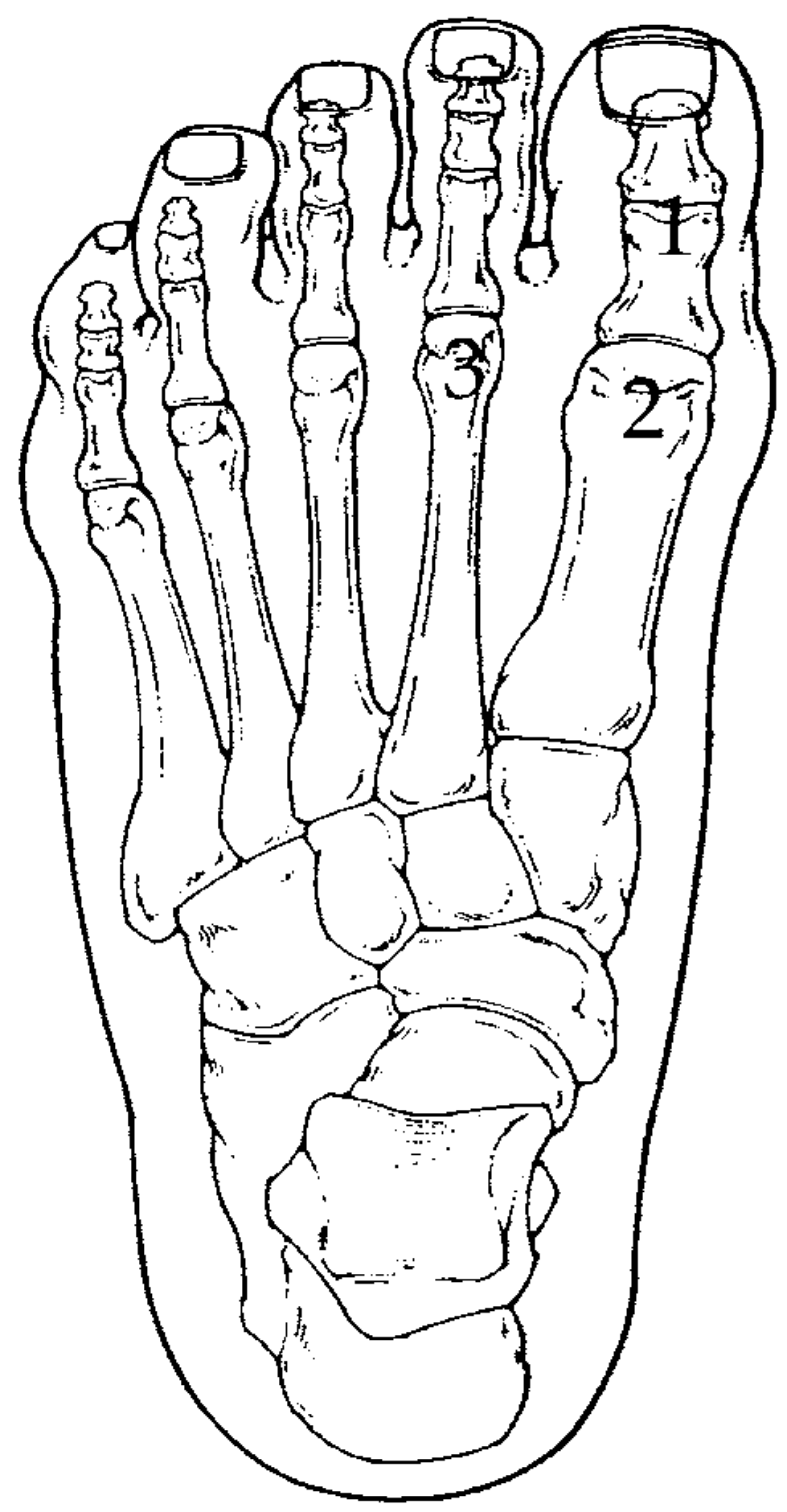
Table 1 gives the average location of the peak forefoot pressures. The location was determined by arbitrarily assigning values to locations on the forefoot (
Figure 1). A designation of 1 represented a peak pressure under the hallux. A designation of 2 represented a peak pressure under the first metatarsal. A designation of 3 represented a peak pressure under the second metatarsal.
The average peak pressure was observed under the second metatarsal in subjects wearing sneakers. The peak pressure shifted to a position slightly lateral to the first metatarsal head in 2-inch high-heeled shoes and almost completely to the hallux in 3-inch high-heeled shoes. The peak pressures were recorded for both the left and right feet. For subjects tested in sneakers, the average peak pressure was 63.26 psi on the left forefoot and 64.59 psi on the right forefoot (P = .76). When subjects were tested in 2-inch highheeled shoes, the average peak pressure was 98.01 psi on the left and 110.99 psi on the right (P = .08). The average peak forefoot pressure in 3-inch highheeled shoes was 123.36 psi on the left and 148.42 psi on the right (P < .05).
When the subjects were analyzed according to foot dominance, the following data were obtained. For the 12 left foot–dominant subjects, the average peak pressure in sneakers was 67.16 psi on the left and 68.83 psi on the right (P = .84). The average peak pressure in 2-inch high-heeled shoes was 93.95 psi on the left and 101.96 psi on the right (P = .53). In 3-inch highheeled shoes, the average peak pressure was 135.64 psi on the left and 176.36 psi on the right (P < .05).
For the 23 test subjects who were right-foot dominant, the following data were obtained: The average peak pressure in sneakers was 61.22 psi on the left and 62.38 psi on the right (
P = .69). In 2-inch highheeled shoes, the average peak pressure was 100.10 psi on the left and 115.71 psi on the right (
P = .07). In 3-inch high-heeled shoes, the average peak pressure was 116.96 psi on the left and 133.83 psi on the right (
P = .05). A one-way analysis of variance was performed comparing peak pressures in each group; the results are shown in
Table 2.
Five test subjects were tested in sneakers with the insoles. Peak forefoot pressures on the right foot only were examined and data were obtained. The average of 25 steps was recorded and analyzed. The mean peak pressure, standard deviation, and confidence interval were calculated. Calculations were carried to the 95% confidence level with the significance level (alpha) as .05.
Table 3 summarizes these findings.
Discussion
This study revealed that the peak forefoot pressure measured by means of the F-Scan analysis system increased 63% with the change from a sneaker to a 2-inch high-heeled shoe and 30% with the change from a 2-inch to a 3-inch high-heeled shoe. The peak forefoot pressure increased 110% with the change from a sneaker to a 3-inch high-heeled shoe.
When the test subjects were divided into left foot– dominant and right foot–dominant groups, some interesting differences were noted. Compared with walking in sneakers, the subjects who were rightfoot dominant experienced an increase in peak forefoot pressure of 74.6% while walking in 2-inch heels, as compared with a 44% increase in subjects who were left-foot dominant. Compared with walking in 2-inch high-heeled shoes, the subjects who were right-foot dominant experienced an increase of 16% in peak forefoot pressure while walking in 3-inch high-heeled shoes, while those who were left-foot dominant experienced a 59.2% increase. The overall increase in peak forefoot pressure with the change from a sneaker to a 3-inch high-heeled shoe was 102% for the right foot–dominant subjects and 120% for the left foot–dominant subjects. Statistical t-tests were performed for each group of subjects. Pressure differences for each group were not significant except for the left foot–dominant group when examined in 3-inch high-heeled shoes. The right foot was found to have uniformly greater peak pressures regardless of foot dominance.
Each method of examination has its own limitations. Common criticisms of force-plate analysis include the need for test subjects to adjust their gait to land on the plate and the lack of in-shoe measurement gait parameters [
12]. Data obtained from transducers under the foot may be affected by their placement, and the translation of plantar skin with gait can cause the transducers to shift from their desired position [
12].
Bonney and Macnab [
13] performed a
post hoc analysis of surgical procedures for hallux rigidus and hallux valgus. They discovered that women accounted for 90% and 68%, respectively, of 518 surgical procedures. The sex bias was attributed to the difference in typical footwear used by the two sets of subjects.
It has been suggested that the foot is pronated during gait in high-heeled shoes [
14]. It has also been suggested that excessive pronation leads to the development of hallux abducto valgus. The pathomechanics of hallux abducto valgus have been described by Root et al [
15], who contend that the most common etiology revolves around hypermobility of the first ray resulting from the foot pronation or pronation of the subtalar joint during the propulsive phase of gait. Another proposed etiology of hallux abducto valgus is related to the shape of the shoe. The narrow toe box of high-heeled shoes forces abduction of the hallux and rotation of the fourth and fifth digits, as well as hammering of all digits. Once this position has been assumed, it is reinforced by the person’s own muscular strength. This, in turn, leads to a varus position of the first metatarsal.
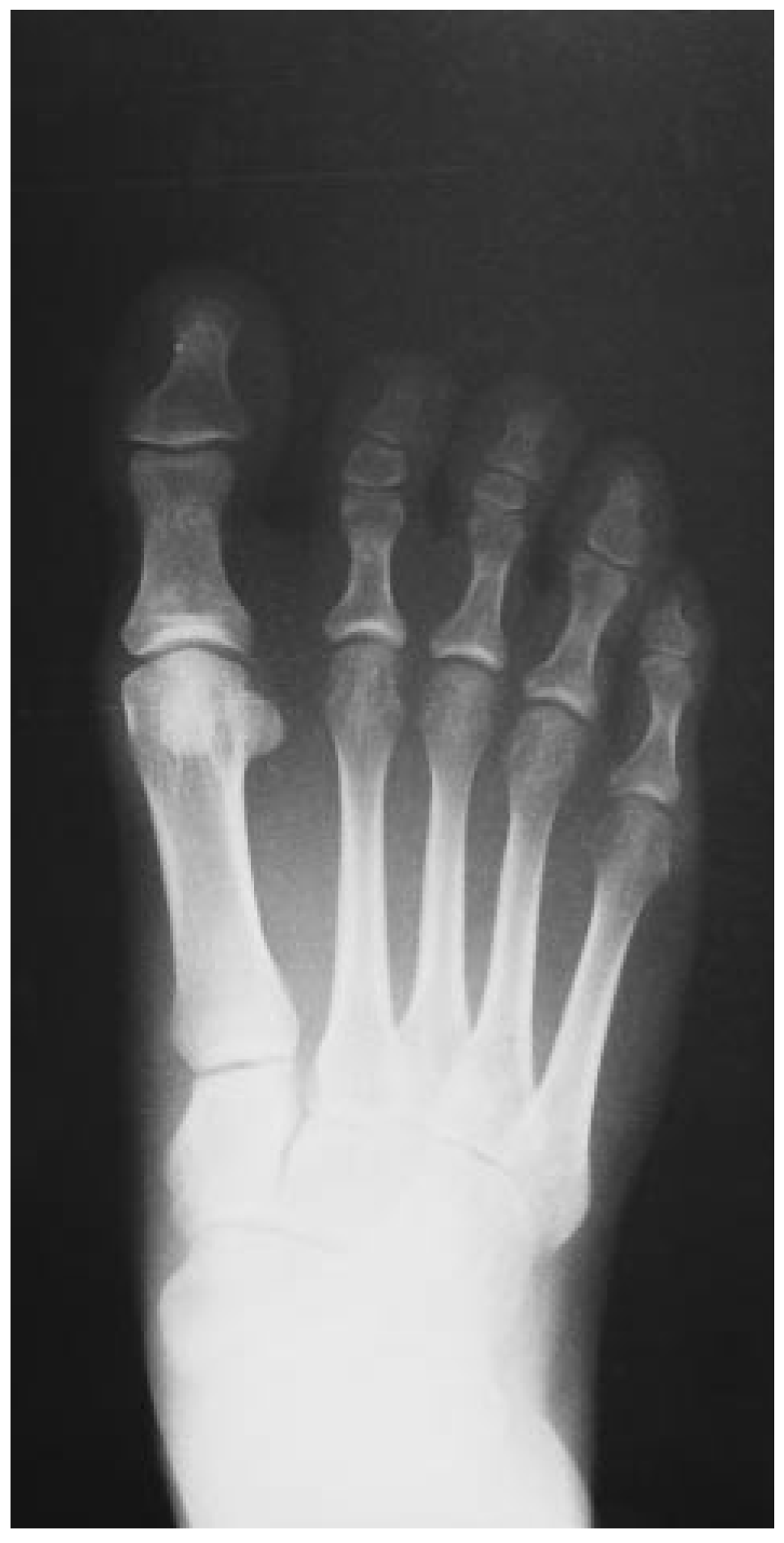
Figure 2 shows a foot out of footwear.
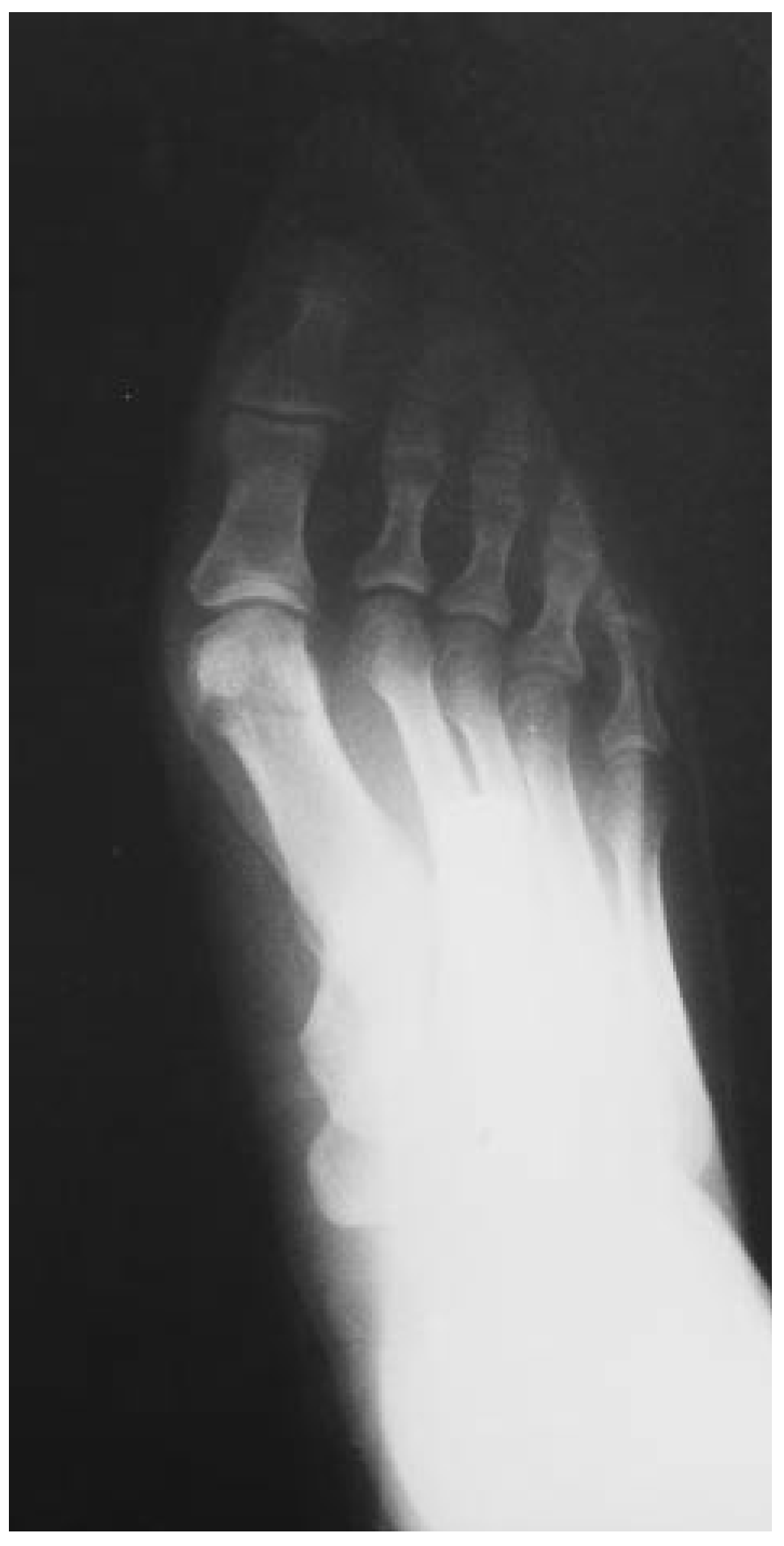
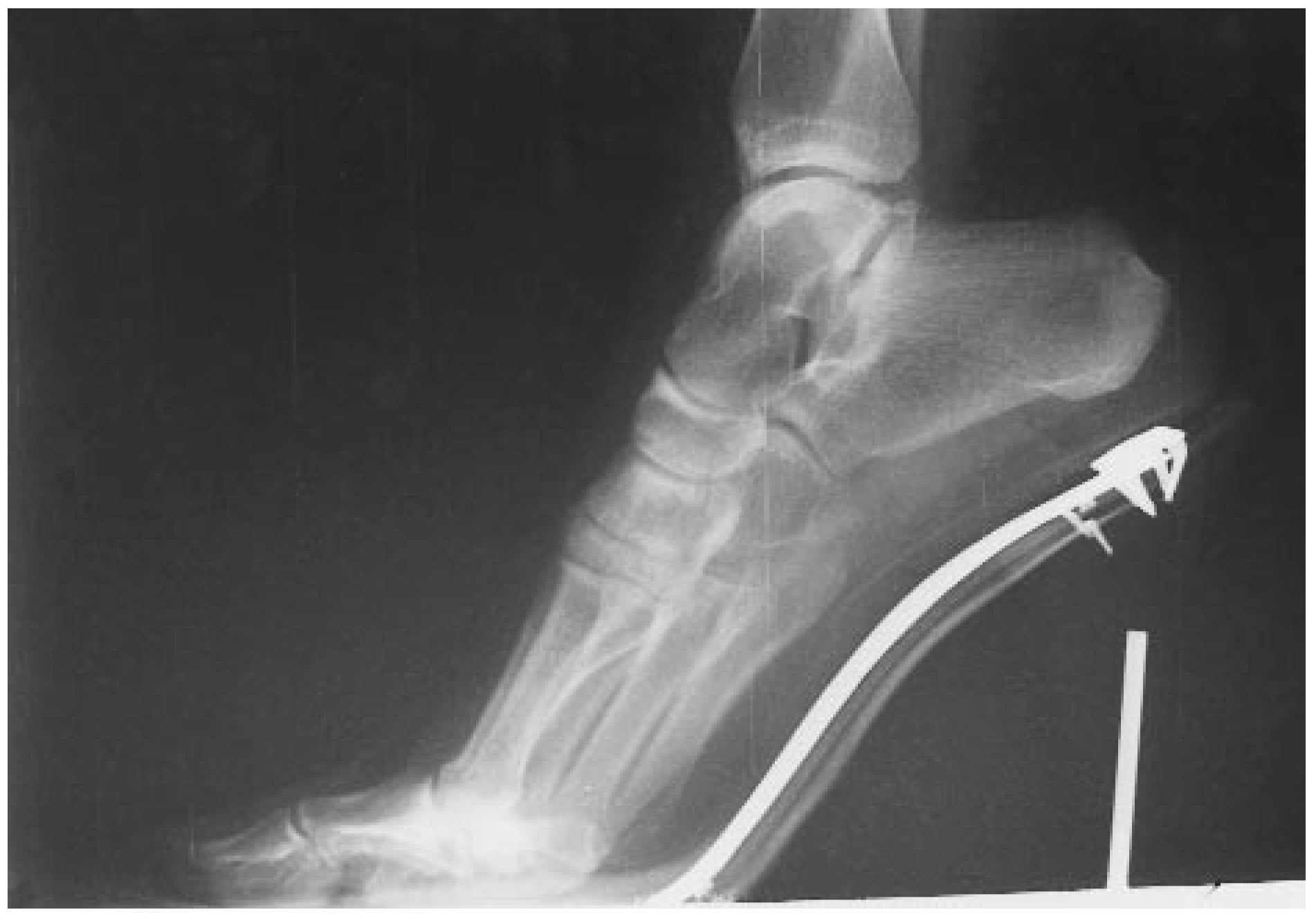
Figure 3 is an anteroposterior view and
Figure 4 is a lateral view of this same foot in a 3-inch high-heeled shoe. Note the hammer digits of the fourth and fifth digits as well as an increase in both the intermetatarsal and hallux abductus angles. This phenomenon has been described in a biomechanical model, which has been verified
in vivo [
16].
This problem is compounded by ill-fitting shoes on a “normal” foot, which can cause hammer digits, hallux valgus, bunionettes, tylomas, and other disabling problems. In a study of 356 women, 88% (313) were wearing shoes that were an average of 1.2 cm shorter than their feet [
17]. Ill-fitting shoes can physically deform the foot in the shoe and exert abnormal pressure on specific areas of the foot. This may lead to structural deformity of the foot out of shoes and symptoms of pain, fatigue, and numbness.
In-shoe pressure-measurement systems evaluate the shoe-foot interface. Ground-reactive forces are transmitted through the shoe to the foot and can be modulated by the composition of the materials that make up the shoe, as well as the fitting of the shoe to the foot. The pressure-measurement insole used in this study was 0.007 inch thick. The design of this insole is based on the resistive principle: When pressure is applied to a sheet of metal, its resistance to the conduction of electricity changes. The major problem with this type of insole is that, over time, the sensor changes its properties and can yield different measurements when tested with the same pressure [
18]. Results of the trials examining the F-Scan insole in five test subjects indicate that the insole measurements were reproducible to within 3%. However, it was observed that the sensors gave erratic readings when used more than five times. As a result of these findings, the sensors were discarded after five uses in this study.
Conclusion
Increasing heel height increases pressure to the forefoot and shifts that pressure’s location to the hallux during ambulation. Women’s high-heeled shoes force the foot into a position in which these forces could have a deleterious effect on the structure of the foot. The goals of this study were to demonstrate the effects of increasing heel height on peak forefoot pressures and to test the reliability of the F-Scan in-shoe pressure-measurement system. The data acquired by use of these insoles were found to be reproducible to within 3%.