Next Article in Journal
Novel Methodology to Obtain Salient Biomechanical Characteristics of Insole Materials
Previous Article in Journal
Amputation and Reamputation of The Diabetic Foot
 
 
Journal of the American Podiatric Medical Association is published by MDPI from Volume 116 Issue 1 (2026). Previous articles were published by another publisher in Open Access under a CC-BY (or CC-BY-NC-ND) licence, and they are hosted by MDPI on mdpi.com as a courtesy and upon agreement with American Podiatric Medical Association.
Article

The Acutely Infected Diabetic Foot Is Not Adequately Evaluated in an Inpatient Setting

by
Gary W. Edelson
,
David G. Armstrong
,
Lawrence A. Lavery
and
Gene Caicco
J. Am. Podiatr. Med. Assoc. 1997, 87(6), 260-265; https://doi.org/10.7547/87507315-87-6-260
Published: 1 June 1997

Abstract

Objective: To evaluate the standard of evaluation and treatment of the infected diabetic foot ulceration at a 551-bed university teaching institution. Design: A retrospective review of a 4-year consecutive sample (1991-1994). Population: Two hundred fifty-five patients who were admitted to a hospital for care of an infected diabetic foot ulceration. Patients were subdivided into the following 4 dichotomous variables: (1) whether the patient underwent a lower-extremity amputation, (2) whether the patient was admitted once or multiple times, (3) whether the patient underwent intraoperative debridement, and (4) whether the patient was admitted to medical or surgical services. Results: All groups that were evaluated had undergone a less than adequate foot examination. Of the admitted patients, 31.4% did not have their pedal pulses documented; 59.7% of the admitted patients were not evaluated for the presence or absence of protective sensation. Nearly 90% of the wounds were not evaluated for involvement of underlying structures, and foot radiographs were not performed in 32.9% of the patients. There were more blood cultures ordered (62.0%) than wound cultures (51.4%). Conclusion: The results of this study highlight the need for a systematic, detailed lower-extremity examination for every diabetic patient who is admitted to a hospital, particularly those who are admitted with a primary diagnosis that involves a foot complication.

DIABETES IS the most common underlying cause of lower-extremity amputations in the United States and Europe. Of the approximately 125 000 lower-extremity amputations that are performed each year, 50% to 80% are directly attributable to diabetes mellitus [1]. Individuals with diabetes have a 15- to 30-fold greater risk of lowerextremity amputation than those without diabetes [2] The most common components in the causal pathway to loss of a limb in patients with diabetes mellitus include peripheral neuropathy, peripheral vascular disease, structural deformity, ulceration, and infection [3,4,5]. Treatment of infected foot wounds accounts for up to one quarter of all diabetic patients who are admitted to hospitals in the United States and Great Britain [6,7,8,9]. Evaluation of these parameters is critical in the start of appropriate treatment of the high-risk diabetic patient.
We have observed that patients who are admitted for care of diabetic foot infections are often not adequately evaluated according to the standards that have been set by the American Diabetes Association, Bethesda, Md [10]. In an outpatient setting, feet are rarely examined during a regularly scheduled visit for patients with diabetes [11]. However, we have been unable to find any information in the medical literature that evaluates the quality of a foot examination on an inpatient basis. We would expect that the more severe the infection, the more closely the patient would be evaluated during his or her admission. The purpose of this study is to evaluate the standard of treatment of the diabetic foot infection at a university teaching institution.

PATIENTS AND METHODS

Participants in this review were patients who were admitted to a 551-bed university teaching hospital between January 1, 1991, and December 31, 1994, with a primary diagnosis of an infected diabetic foot ulceration. Patients were identified by using codes 250.8 and 707.1 according to the International Classification of Diseases, Ninth Revision, Clinical Modification [12].
All patients were diagnosed as having diabetes mellitus by using the criteria set forth by the World Health Organization, Geneva, Switzerland [13]. We abstracted medical records to identify the following parameters: lower-extremity vascular assessment, sensory assessment, ulcer examination, laboratory tests, radiographic studies, admitting service, surgery performed, consultations requested, and outcomes. The result of a pulse examination was scored as positive if either the dorsalis pedis or posterior tibial foot artery was documented in any physical examination during the hospitalization. Likewise, the finding from a sensory examination was positive if any description of foot and ankle deep tendon reflexes (eg, vibratory, sharp or dull, light touch) or Semmes-Weinstein monofilaments were documented in the medical record.
Records were evaluated for identification of the following wound characteristics: depth, size, and general wound description (eg, drainage, description of margins, viability of wound base). A wound score was calculated based on the documentation of none, 1, 2, or 3 of these variables. Likewise, a comprehensive wound evaluation score was defined as a combination of x-ray film, foot pulse, and wound description. These elements were included in the scoring scheme because when they were combined, they represented what we considered minimal evaluation criteria for a patient who was hospitalized with a diabetic foot infection. In this minimum evaluation competency score, the wound evaluation was considered to be adequate if documentation of 2 of the above wound descriptors (size, depth, or characteristics) was present.
A subanalysis was performed in which patients were categorized by the following outcome variables: lower-extremity amputation, multiple hospitalizations, and intraoperative debridement. We also compared evaluation and outcomes according to the admitting service. The “medicine” group included patients who were admitted to the Departments of Internal Medicine or Family Practice. The “surgery” group included those who were admitted to the Departments of Orthopaedic Surgery, General Surgery, or Vascular Surgery. The χ2 analysis with the odds ratio (OR) and 95% confidence interval (CI) was used to compare the independent variables in the above groups. The Mann-Whitney U test was used to compare quantitative data between the groups. Characteristics of these patient groups are summarized in Table 1.

RESULTS

Of 255 consecutively admitted patients, 144 were male and 111 were female, with a mean ±SD age of 59.9 ±14.0 years (Table 1). Only 35.7% of the patients who were admitted for infected foot ulcers had the size of their wound recorded. Evaluation of wound depth or involvement of underlying structures was evaluated in only 10.2%. Description of exudate and general wound characteristics was recorded for 63.2% of the patients who were admitted. Sensory examination was performed on only 40.4% of the patients who were admitted. Pulses were evaluated in 68.6% of the patients.
At admission, 21% of the patients were taking a rheologic agent (pentoxifylline) for treatment of peripheral vascular disease. There was not a significant difference in pulse evaluation in those who were taking the medication vs those who were not (74.1% vs 67.2%, P>.05). Patients who had angiograms performed did not have their pedal pulse checked significantly more often than those who did not have angiograms done (75.6% vs 67.3%, P>.05). While patients who underwent Doppler noninvasive vascular examinations had their pulses examined more often than those who did not (79.3% vs 64.0%; OR, 2.2; CI, 1.2-4.1; P=.02), we were surprised by the fact that more than 20% of the patients who underwent this ancillary examination did not first have their pulses evaluated.
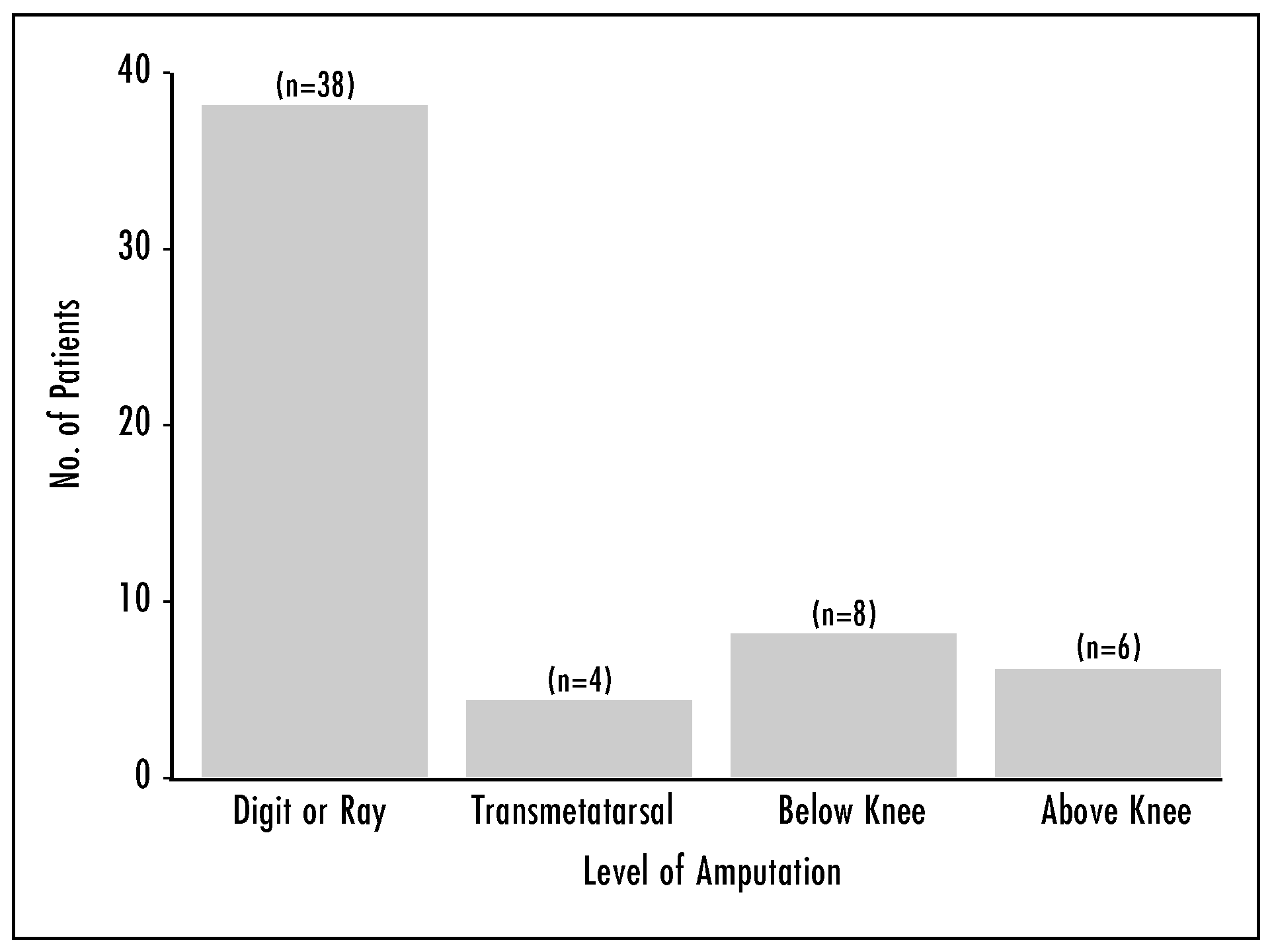
Twenty-two percent of the patients who were admitted underwent a lower-extremity amputation as a result of their foot infection. Most of these amputations were partial foot amputations that involved a digit or ray (Figure). There was not a significant difference between any of the parameters that we reviewed among patients who required an amputation and those who did not require amputation (Table 2). Nearly all patients who were reviewed, regardless of the presence or absence of an amputation during the hospitalization, underwent a less than adequate wound evaluation, with only 8% of the patients who were admitted having size, depth, and description of the wound documented. The mean ±SD wound evaluation score was 1.1 ±1.0 for all admissions. No patients who underwent a high level (transfemoral or transtibial) amputation had all 3 descriptors documented. In fact, 57% of those patients had no wound descriptors documented (Table 3). The minimum mean±SD evaluation competency score was 1.6±0.9 for all patients who were admitted. Less than 14% of all patients met all 3 criteria for minimum evaluation competency. There was not a significantly different minimum evaluation competency score in patients who had undergone amputation compared with that in those who did not. However, there were significant differences in patients who had high-level amputations compared with those of other groups (Table 3).
Patients who were admitted multiple times for a foot infection constituted 51.8% of all those studied.These patients received a documented wound description significantly more frequently than did those in the group with single admissions (Table 4). The group with multiple admissions was 1.8 times more likely to undergo an intraoperative debridement (81.1% vs 70.1%; CI, 1.0-3.2; P=.05) and 2.6 times more likely to receive home health care following discharge (15.2% vs 6.5%; Cl, 1.1-6.1; P=.04).
Seventy-six percent of the patients who were admitted underwent surgical debridement. Those who underwent debridement were more than 8 times more likely to have the generalized appearance of the wound and wound drainage evaluated. These patients were nearly twice as likely to have wound cultures taken (Table 5). There was no difference in home health care referral rates or in the rate of lower-extremity bypass grafting among those who underwent surgical debridement (P>.05).
The medicine and surgery groups showed little statistical difference in the evaluation parameters. These data are summarized in Table 6. However, we noticed a trend toward more laboratory tests and radiographic studies ordered by the medicine group. The surgeons showed a slightly greater percentage of wounds that were evaluated, as well as documented lower-extremity vascular and sensory testing. Patients who were admitted to a medicine service were more than 3 times more likely to have multiple consultations than those who were admitted to a surgical service. Patients who were admitted to a surgical service also were significantly more likely to have a lower-extremity arterial bypass graft (13% vs 4.5%; (OR, 3.2; CI, 1.1-9.0; P=.05). The patients in the surgery group were more likely to be admitted multiple times (70.4% vs 40.8%; OR, 2.7; CI, 1.4-5.2; P=.003). There was not a significant difference in lower-extremity amputations, number of surgical debridements, or home health care utilization after discharge between the 2 groups (P>.05).
Wound care techniques were also evaluated. Nearly half (48.2%) of the patients who were admitted received no specific orders or instructions for daily wound care. Wet to dry dressings with normal saline solution were prescribed for 22.7% of the patients who were admitted. Soaks or whirlpool therapy was ordered for 16.5% of the patients who were admitted. Gels or alginates were used on 6.3% of the patients who were admitted. Iodine-soaked gauze was applied on 4.3% of the admitted patients' foot infections. Hydrogen peroxide-soaked gauze was ordered for 2% of the patients. There were no significant differences in the wound care regimen that was ordered based on any of the dichotomous groups that were studied.
At discharge, all patients who underwent an amputation at the transfemoral (above-knee) or transtibial (below-knee) level had a specific plan for rehabilitation or amputation stump accommodation. Of all other patients who were admitted, only 1.6% were discharged with prescriptions for accommodative off-weighting modalities (eg, casting, bracing, accommodative healing sandals, wheelchairs), and 11.0% had arrangements that were made for home health wound care.

COMMENT

The results of this study highlight the need for a systematic, detailed lower-extremity examination for every diabetic person who is admitted to a hospital, particularly those who are admitted with a primary diagnosis that involves a foot complication. We expected that patients who were admitted for more severe diabetes-related lowerextremity sequelae would be evaluated more closely, particularly if they were to undergo a lower-extremity amputation; this was not supported by the findings. The quality of the examination was inadequate in all subgroups. Less than 14% of all patients who were admitted met all 3 criteria for minimum evaluation competency.
The decision to amputate is based on several parameters. These include wound and infection severity, degree of peripheral arterial occlusive disease, ambulatory status of the patient, and a variety of other psychosocial factors. There were significant differences in the thoroughness of wound evaluation and minimum evaluation competency scores in patients with proximal amputations compared with those in patients with foot amputations or no amputation. However, we cannot be certain that significant comorbidities or other factors in the decision-making process besides basic elements in the physical examination did not affect the outcome. Without independent objective evaluation for each patient, it would be difficult to determine whether amputations were performed unnecessarily or conversely, if an ablative procedure was in fact indicated. Clearly, a prospective observational study to determine the effect of evaluation on outcome is indicated.
The American Diabetes Association has set forth generalized recommendations for a foot examination. These guidelines suggest that a foot examination should be performed at every regular outpatient visit. However, it has been well established that the feet are infrequently examined during a general physical examination on an outpatient basis. On a diabetic patient’s routine visit to a primary care physician, foot examinations are only performed between 10% and 19% of the time [14,15]. It seems reasonable that a lower-extremity examination in patients who are admitted with a primary diagnosis of a diabetic foot infection would be performed far more frequently and thoroughly. We were surprised that in the vast majority of the inpatient population reviewed, this was not the case. Qualitative and quantitative analysis of the ulcer is critical in establishing an overall treatment plan. The cause of the ulceration should be recognized to establish a treatment regimen and also for future prevention. Dimensions of the ulcer should be recorded to help monitor the progression of treatment. It is essential to document the depth of the ulcer and the involvement of underlying structures (tendon, joint capsule, or bone). This may be performed with a sterile blunt probe. Serous or purulent drainage should be distinguished with a further description of color and odor, as necessary. The base of the ulcer may be classified as granular, fibrotic, or necrotic. Wound margins should be described as viable or nonviable. Periwound descriptors may include the presence or absence of edema, erythema, fluctuation, or subcutaneous emphysema. The involved extremity should be examined for lymphangitis, lymphadenopathy, and cellulitis. A complete bilateral dermatologic examination (including inspection between the toes and posterior aspects of the heels) is recommended to rule out other ulcerations or sources of contiguous infection. In this study, a wound description was documented in 63%, wound size was delineated in 36%, and evidence that the wound was evaluated for involvement of deep structures was found in only 10% of those patients who were admitted with a chief diagnosis of an infected diabetic foot ulcer.
Cultures of the wound should be obtained to guide antibiotic therapy effectively and accurately. Tissue samples from the base of the ulcer are the most definitive in determining the infectious organism [16]. Blood cultures are useful in the face of sepsis, but are of limited value in determining the infectious organism. It was surprising that in this study blood cultures were performed more frequently than were wound cultures (62% vs 51%). When culture and sensitivities are established, antibiotics may be altered from a broad-spectrum agent to a more microbiologically focused, cost-effective agent [17].
The technetium bone scan is an expensive, nonspecific test for evaluating bony pathology (eg, osteomyelitis) [18]. Probing to bone, when combined with clinical evaluation and radiographic interpretation, is a more cost-effective and specific modality [19,20,21]. However, the only definitive means of diagnosing osteomyelitis is a bone biopsy. While only 67% of the patients had a plain radiograph obtained of the ulcerated foot, nearly 40% had bone scans done. As discussed earlier, only 10% of the patients who were admitted had the depths of the wound probed for assessment of involvement of underlying soft tissue and bony structures.
Peripheral neuropathy is present in more than 80% of patients with a foot ulceration [22]. Direct impact or repetitive stress eventually results in tissue breakdown in the insensate extremity [23,24]. Violation of the skin predisposes the patient to subsequent infection and possible amputation. In this study, only 40.4% had undergone even a gross lower-extremity neurologic assessment. Although identifying the degree and extent of neuropathy is not essential in planning intervention for acute infections, it is critical in establishing a patient’s risk for reinjury and planning a long-term treatment course.
The lower-extremity vascular examination is critical in determining the healing potential of the diabetic wound. It has been estimated that 60% of patients with nonhealing ulcers have peripheral vascular disease [25]. Noninvasive vascular studies and angiography should be used to complement, not substitute for, the clinical evaluation. Unfortunately, evaluation of pedal pulses was not documented in 31.4% of the patients. In this study, documentation of pedal pulses was not significantly different in patients for whom invasive lower-extremity angiograms were ordered.
Shoe gear may serve as either a precipitating or a preventive factor in the genesis of diabetic foot infections. In a hospital that lacks a dedicated diabetic foot care team, appropriate referral to a certified pedorthist or orthotist for temporary or permanent shoe gear may be overlooked. Following resolution of infection, a specific plan to off-weight the affected area should be started. This may include contact casting, complete non-weightbearing devices (eg, crutches or wheelchair), or customfabricated braces or sandals. Only 1.6% of the patients had any of these modalities prescribed at discharge.
In summary, the standard of evaluation of treatment of the infected diabetic foot was generally not met. Several authors have advocated the team approach in the treatment of the diabetic foot ulcer as both a more efficacious and a more cost-effective means of limb salvage [26,27,28,29,30]. When utilized, this approach has reportedly reduced the incidence of lower-extremity amputation and has reduced hospital stay by an average of 33% [31]. We observed no team approach, no obvious pattern of referral, and no specific treatment algorithm followed for the patient population that was reviewed in this study.
Accepted for publication July 1, 1996.
Presented as an abstract at the Sixth International Symposium on the Diabetic Foot, Great Malvern, England, May 5, 1996.

REFERENCES

  1. Lavery LA, Ashry HR, van Houtom W, Pugh JA, Harkless LB, Basu S. Variation in the incidence and proportion of diabetes-related amputations in minorities. Diabetes Care. 1996;19:48-52.
  2. van Houtom WH, Lavery LA, Harkless LB. The impact of diabetes-related lower extremity amputations in the Netherlands. J Diabetes Complications. In press.
  3. Pecoraro RE, Reiber GE, Burgess EM. Causal pathways to amputation: basis for prevention. Diabetes Care. 1990;13:513-521.
  4. Kannel WB, McGee DL. Diabetes and glucose tolerance as risk factors for cardiovascular disease: the Framingham Study. Diabetes Care. 1979;2:120-126.
  5. Frykberg R. Diabetic foot ulcerations. In: Frykberg R, ed. The High Risk Foot in Diabetes Mellitus. New York, NY: Churchill Livingstone Inc; 1991:151-195.
  6. Levin M. Pathophysiology of diabetic foot lesions. In: Davidson JK, ed. Clinical Diabetes Mellitus. A Problem-Oriented Approach. New York, NY: Thieme-Stratton Inc; 1991:504-510.
  7. Gibbons G, Eliopoulos GM. Infection of the diabetic foot. In: Kozak GP, Hoar CD, Rowbotham JL, eds. Management of Diabetic Foot Problems. Philadelphia, Pa: WB Saunders Co; 1984:97-102.
  8. Pliskin MA, Todd WF, Edelson GW. Presentations of diabetic feet. Arch Fam Med. 1994;3:273-279.
  9. Reiber GE, Pecoraro RE, Koepsell TD. Risk factors for amputation in patients with diabetes mellitus: a case control study. Ann Intern Med. 1992;117:97-105.
  10. American Diabetes Association. Foot care in patients with diabetes mellitus. Diabetes Care. 1995;18(suppl 1):26-27.
  11. Cohen SJ. Potential barriers to diabetes care. Diabetes Care. 1983;6:499-500.
  12. International Classification of Diseases, Ninth Revision, Clinical Modification. Washington, DC: Public Health Service, US Dept of Health and Human Services; 1988.
  13. World Health Organization. Second Report on Diabetes Mellitus. Geneva, Switzerland: World Health Organization; 1980.
  14. Wylie-Rosset J, Walker EA, Shamoon H, Engel S, Basch C, Zybert P. Assessment of documented foot examinations for patients with diabetes in inner-city primary care clinics. Arch Fam Med. 1990;4:46-50.
  15. Bailey TS, Yu HM, Rayfield E. Patterns of foot examination in a diabetic clinic. Am J Med. 1985;78:371-374.
  16. Perry CR, Pearson RL, Miller GA. Accuracy of cultures of material from swabbing of the superficial aspect of the wound and needle biopsy in the preoperative assessment of osteomyelitis. J Bone Joint Surg Am. 1991;73:745-749.
  17. Armstrong DG, Liswood PL, Todd WF. Prevalence of mixed infections in the diabetic pedal wound. J Am Podiatr Med Assoc. 1995;85:533-537.
  18. Keenen AM, Tindel NL, Alavi A. Diagnosis of pedal osteomyelitis in diabetic patients using current scintigraphic techniques. Arch Intern Med. 1989;149: 2262-2266.
  19. Caputo GM, Cavanaugh PR, Ulbrecht JS, Gibbons GW, Karchmer AW. Assessment and management of foot disease in patients with diabetes. N Engl J Med. 1995;332:854-860.
  20. Grayson ML, Balaugh K, Levin E, Karchmer AW. Probing to bone in infected pedal ulcers: a clinical sign of underlying osteomyelitis in diabetic patients. JAMA. 1995;273:721-723.
  21. Caputo GM. Infection: investigation and management. In: Boulton AJM, Connor H, Cavanagh PR, eds. The Foot in Diabetes. 2nd ed. New York, NY: John Wiley & Sons Inc; 1994;21.
  22. Boulton AJM. The diabetic foot: neuropathic in aetiology? Diabet Med. 1990; 6:852-858.
  23. Beach RB, Thompson DE. Selected soft tissue research: an overview from Carville. Phys Ther. 1979;59:30-35.
  24. Manley MT, Darby T. Repetitive mechanical stress and denervation in plantar ulcer pathogenesis in rats. Arch Phys Med Rehabil. 1980;51:171-175.
  25. Pomposelli FB Jr, Jepsen SJ, Gibbons GW. Efficacy of the dorsal pedal bypass for limb salvage in diabetic patients: short term observations. J Vasc Surg. 1990;11:745-782.
  26. Apelqvist J, Ragnarson-Tennval G, Persson U, Larsson J. Diabetic foot ulcers in a multidisciplinary setting: an economic analysis of primary healing and healing with amputation. J Intern Med. 1994;235:463-471.
  27. Levin ME. The diabetic foot: pathophysiology, evaluation and treatment. In: Levin ME, O'Neal LW, eds. The Diabetic Foot. St Louis, Mo: Mosby-Year Book Inc; 1988:7-27.
  28. Tan JS, Flanagan PJ, Donovan DL, File TM. Team approach in the management of diabetic foot infections. J Foot Ankle Surg. 1987;25(suppl 1):12.
  29. Edmonds ME. Experience in a multidisciplinary diabetic foot clinic. In: Connor H, Boulton AJM, Ward JD, eds. The Foot in Diabetes. New York, NY: John Wiley & Sons Inc; 1987:121-131.
  30. Reiber GE. Diabetic foot care: financial implications and practice guidelines. Diabetes Care. 1992;15:29-31.
  31. Gibbons GW, Marcaccio EJ Jr, Burgess AM, et al. Improved quality of diabetic foot care, 1984 vs 1990: reduced length of stay and costs, insufficient reimbursement. Arch Surg. 1993;128:576-581.
Level of amputation.
Japma 87 00260 g001
Table 1. Patient Characteristics*.
Japma 87 00260 i001
* There was not a significant difference in age, sex, or diabetes type among any of the groups studied. The average length of hospital stay was significantly longer in patients who underwent a lower-extremity amputation (P<.001). Patients with multiple admissions averaged 35.1±24.2 total days of hospitalization for a foot infection during the period reviewed.
Table 2. Evaluation by Amputation*.
Japma 87 00260 i002
*OR indicates odds ratio; CI, confidence interval. †P<.05.
Table 3. Wound Evaluation Score and Minimum Evaluation Competency Score by Amputation Outcome.
Japma 87 00260 i003
*P<.05.
Table 4. Evaluation by Multiple Admissions*.
Japma 87 00260 i004
*OR indicates odds ratio; CI, confidence interval. †P<.05.
Table 5. Evaluation by Surgical Débridement*.
Japma 87 00260 i005
*OR indicates odds ratio; CI, confidence interval. †P<.05.
Table 6. Evaluation by Service*.
Japma 87 00260 i006
*OR indicates odds ratio; CI, confidence interval. †P<.05.