Diabetes mellitus is the most common underlying cause of lower extremity amputation in the US and Europe. Approximately 120,000 nontraumatic amputations are performed each year in the US. Of these amputations, 45% to 83% involve diabetes [
1,
2,
3]. Patients with diabetes are at 15 to 46 times greater risk for receiving a lower extremity amputation than people without diabetes [
3,
4]. Approximately one half of diabetic amputations are performed at the level of the foot [
5]. Diabetes-related amputations are an important public health issue because many amputations can be prevented when high-risk patients receive preventive medical care [
6,
7,
8].
The authors have observed that while numerous studies have focused on lower extremity amputations in general, amputations at the level of the foot are often treated as a single level or not stratified by specific site within the foot. In the majority of cases, this is because of the fact that data are gathered from secondary databases that do not provide specific documentation about amputation location. Perhaps for this reason, the authors have not encountered any works in the medical literature that have reported on a large number of foot amputations, categorizing them by specific level and etiology. The purpose of this article is to identify the influence of age, prevalence of arterial disease as a precipitating factor, gender, and ethnicity on diabetes-related foot-level amputation.
Materials and Methods
The authors abstracted the medical records for each hospitalization for a lower extremity amputation from January 1 to December 31, 1993, in six metropolitan statistical areas in south Texas: San Antonio, Corpus Christi, Brownsville, McAllen, Laredo, and Victoria. Each hospital in the study areas, including military and Veterans Affairs hospitals, provided a list of patients who had amputations in 1993. Patients were identified from ICD-9-CM codes 84.11 to 84.18 and 84.30 [
9].
Patients with peripheral arterial occlusive disease were identified from codes 250.7, 440.2, 440.9, 443.0, 443.1, 443.8, 443.81, 443.9, 444.22, and 444.9. The level of amputation and presence of peripheral arterial occlusive disease were verified after reviewing the operative report and physician documentation. For the purposes of analysis, lower extremity amputations were initially categorized into three levels: foot, leg, and thigh. Thigh amputations involved levels proximal to through knee procedures. Leg amputations included procedures from the ankle to through knee amputations. Foot amputations included all amputations below the ankle. As a basis for further comparison, foot amputations were divided into five categories: hallux or first ray, middle digit or ray, fifth digit or ray, multiple digit or ray, and midfoot amputations. The middle digit or ray group included digits and rays 2 through 4. Transmetatarsal and Lisfranc’s or Chopart’s joints were combined into “midfoot amputation,” as no amputations were recorded at the Lisfranc’s (tarsometatarsal) joint level and less than 0.5% of all foot amputations occurred at the level of the Chopart’s joint. There were no rearfoot (ie, Syme’s) amputations performed in south Texas in 1993. Amputees that lived outside the geographic boundaries of the metropolitan statistical areas listed above were excluded from analysis. For each patient with multiple lower extremity amputations during the study year, only the highest amputation was used in the data analysis.
Race or ethnicity was identified by reviewing the admitting physician’s history and physical, hospital admission database information, and the nurse’s hospital admission notes. Previous history of lower extremity amputation and the level of amputation were identified from the physician’s or nurse’s admission notes. A diagnosis of diabetes mellitus was verified in each case using World Health Organization criteria [
10].
A Kruskall-Wallis test was used to compare differences in age by level of foot amputation. A Mantel-Haenszel chi-squared test (χ
2MH) was used to compare differences in the proportion of persons with amputations among race or ethnic group, previous lifetime lower extremity, and multiple amputations during a single hospitalization between race or ethnic groups [
11]. A Mantel-Haenszel chi-squared test was used also to control for age as a confounding variable. Age was therefore stratified into four ordinal variables: < 45 years, 45 to 64 years, 65 to 75 years, and > 75 years [
12].
Results
Among residents with diabetes in the geographic areas studied, 1,944 lower extremity amputations occurred during 1,228 hospital episodes in 1,043 patients with diabetes. Amputations at the level of the foot were performed on 477 (45.7%) of these individuals, 305 males, 172 females, in 1993 (
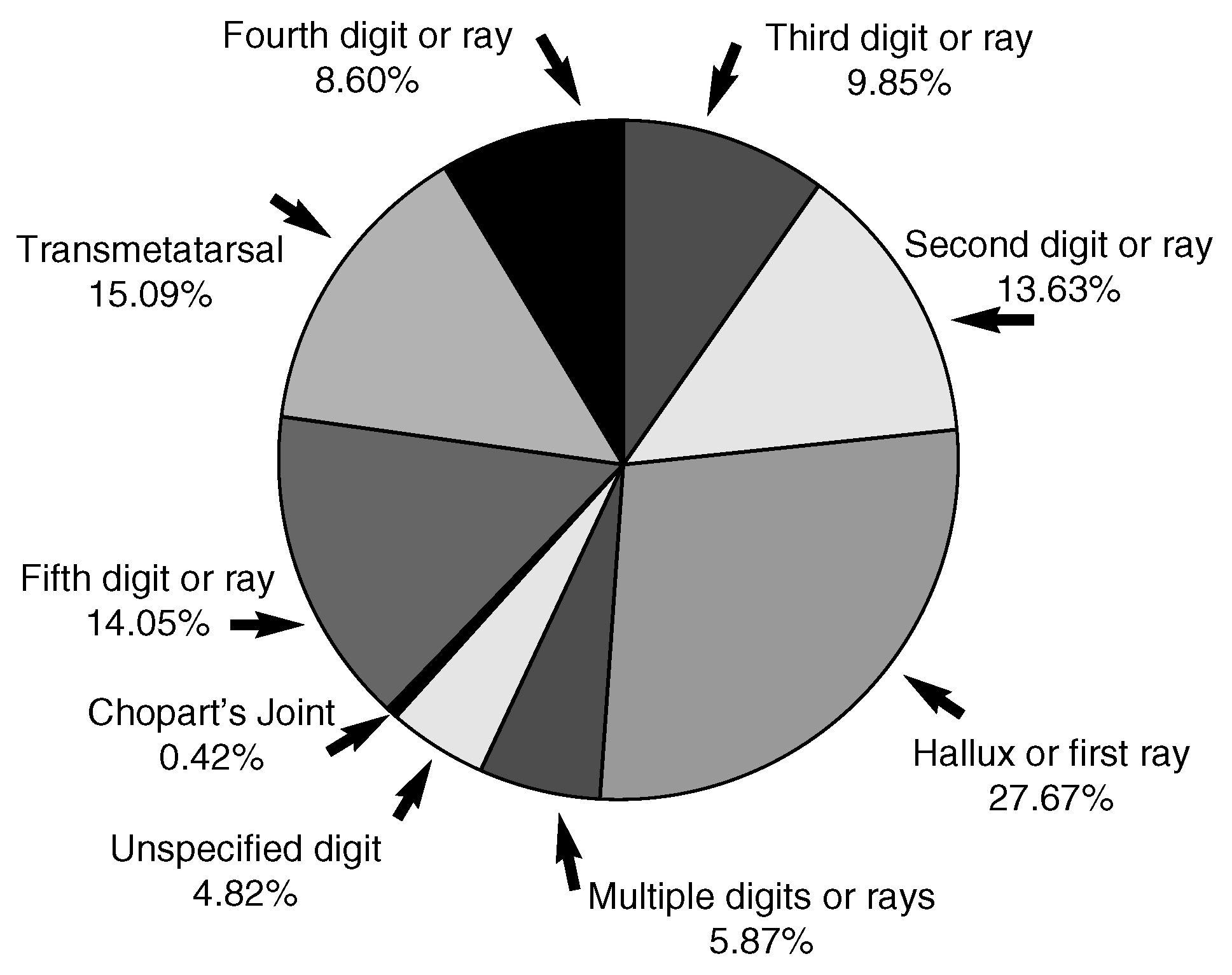
Table 1). The mean age of patients at the time of foot-level amputation was 61.3 ± 11.8 years. The specific level of foot amputation for the entire population is detailed in
Figure 1. Of all patients undergoing a foot amputation, 37.3% had a history of previous lower extremity amputation. There was not a significant difference in prevalence of prior amputation history based on race or ethnicity. Patients undergoing an amputation of the midfoot were more than two times more likely to have had a prior amputation (52.8%
versus 34.6%, p < 0.004, χ
2MH = 3D 8.7, odds ratio = 2.11).
There was not a significant difference in the proportion of males and females based on the level of foot amputation. Additionally, there was no difference in gender based on race or ethnicity. Men were significantly younger than women (59.9 ± 11.1
versus 63.9 ± 12.6 years, p < 0.001) at the time of foot amputation. Among all foot amputations, however, there were not significant differences between age and race or ethnicity. These data are further delineated in
Table 2.
A diagnosis of peripheral arterial occlusive disease was made in 62.7% of patients undergoing foot amputation. Patients undergoing amputations proximal to the foot were nearly twice as likely to have a diagnosis of peripheral arterial occlusive disease (75.8% versus 62.7%, p < 0.0001, χ2MH = 20.1, odds ratio = 1.9). There was no significant difference in prevalence of peripheral arterial occlusive disease by race, level of foot amputation, previous amputation history, or gender in this population.
When broken down by specific foot amputation site, for both Mexican-Americans and non-Hispanic whites, forefoot-level amputations, particularly those involving the first ray and middle digits and rays, were by far the most common site for amputation. This was not the case, however, with the African-American population, which was nearly three times as likely to undergo foot amputation at the midfoot level than were their non-African-American counterparts (31.3% African-American
versus 13.9% other, p < 0.009, χ
2MH = 7.0, odds ratio = 2.9). These data are summarized in
Table 3.
A total of 13.4% of patients who underwent a footlevel amputation received a previous amputation within the study period. While more patients undergoing a transmetatarsal amputation had a history of a prior amputation during the study period, this association did not reach significance (21.9% transmetatarsal amputation versus 14.0% other amputation, p > 0.05). There was not a significant association between ethnicity and gender based on this recent prior amputation history.
Discussion
The results of this study indicate that, overall, the foot was the most common site for lower extremity amputation, with the middle digits and rays being the most common region affected. The hallux or first ray was the most common single site affected. The diagnosis of peripheral arterial occlusive disease at the time of foot amputation was significantly less common than in higher level amputations. African-Americans were at significantly greater risk to receive a higher level foot amputation than the rest of the population. Nearly 40% of these patients had a previous history of amputation, with 13% of previous footlevel amputations occurring within the previous calendar year.
Lavery et al [
13] have reported that there is a significantly higher incidence of diabetes-related lower extremity amputations in African-Americans and Mexican-Americans. There are numerous reasons why diabetes-related lower extremity amputations are more common in minority populations. Minorities are more likely to have nearly every major risk factor leading to diabetes-related amputation such as peripheral arterial occlusive disease, neuropathy, retinopathy, and nephropathy [
14,
15,
16,
17] As with other minorities, Mexican-Americans and African-Americans are more likely to be poor and uninsured. Therefore, they are less likely to have access to appropriate preventative medical care and will therefore seek care only when their malady is acute and potentially limb- or life-threatening [
18,
19,
20,
21,
22] Whether socioeconomic, genetic, or both variables play independent roles as risk factors for amputation is beyond the scope of this investigation. However, with further investigation, the authors believe that these factors may help to explain why significantly more African-Americans were likely to have their foot amputation performed more proximally.
This study reaffirmed the fact that the documentation of many patients being admitted to the hospital for lower extremity complications is sorely lacking. In a previous study, it was noted that patients admitted for a diabetic foot infection to a university teaching institution were evaluated, even with minimum competency, less than 15% of the time [
23]. Nearly 5% of the population in the present study underwent a lesser digit or ray amputation but had no preoperative, perioperative, or postoperative documentation as to which digit or ray was resected. While this may seem insignificant, the authors believe it is a symptom of a larger problem of apathy toward the diabetic foot that still may exist in the medical profession today.
Previous population-based studies have reported that the foot was the most common site for lower extremity amputation in patients with diabetes mellitus [
2,
5,
24]. These same studies also indicated that the prevalence of lower extremity amputations primarily caused by peripheral arterial occlusive disease was lowest at the level of the foot. Ischemia in and of itself is frequently enough to necessitate an amputation. The most common component in the causal pathway to diabetes-related foot-level amputation, however, is neuropathy, not ischemia [
25] Neuropathy alone cannot be the sole cause of an amputation. It must be combined with other factors, such as poorly fitting shoes, deformity, and repetitive stress leading to skin breakdown [
26]. Nearly 40% of foot-level amputations in the population studied were not ischemia related. In the absence of critical ischemia, early, effective, preventative intervention could dramatically decrease the incidence of neuropathic ulcers, infections, and amputations [
27,
28].
Conclusion
Foot-level amputations are frequently performed on patients without critical ischemia and on patients with a previous history of amputation. These are amputations that are frequently preventable even without limb-saving vascular surgery. Diabetic patients with a previous foot ulcer or amputation should undergo aggressive and frequent preventative care including regular foot care visits, diabetic foot education, specialized footwear, and evaluation for other complications. These patients should be identified as high-risk patients by every member of the health care team [
27].
Partial foot amputations often predispose diabetic patients to increased foot pressures and the development of foot deformities, which will further increase their risk for ulceration and amputation [
25,
29,
30]. Appropriate community screening using a classification that considers previous history of amputation, neuropathy, vascular disease, and other common risk factors could be effectively used to communicate risk and direct treatment, thereby reducing the number of preventable diabetes-related lower extremity amputations [
27].
Acknowledgment. Research support was provided by the American Podiatric Medical Association and the South Texas Health Research Center.