The anatomy of both the Achilles and posterior tibial tendons contains torsion between their proximal origin and distal insertion [
1,
2,
3,
4,
5,
6,
7,
8]. The Achilles tendon possesses a lateral twist within the transverse plane that approaches 90°, while the tendon of tibialis posterior possesses a lateral twist of approximately 47.5° within the transverse plane [
1,
2,
3,
4,
5,
6,
7,
8]. Inman6 showed, through a series of wooden models, that torsion within the Achilles tendon was required for normal functioning of the ankle and subtalar joints. Recently, Roukis et al [
8] have shown, through a series of wooden models similar to those utilized by Inman [
6], that the presence of torsion within the tendon of tibialis posterior eliminates the need for longitudinal slippage between individual tendon fibers during the triplanar movements of the ankle, subtalar, and oblique midtarsal joints.
The authors of this article theorize that a torsion, similar to that of the Achilles and posterior tibial tendons, might be present within the tendons of the other extrinsic muscles of the foot. Initial cadaveric dissection was conducted, revealing the presence of torsion within the tendon of peroneus brevis. An extensive review of the medical literature was conducted. No previous mention of torsion within the tendon of peroneus brevis was found.
The purpose of this study is to document and quantify a previously undocumented torsion located within the tendon of peroneus brevis and to discuss the embryologic origins and possible functional significance of such a torsion.
Peroneus brevis is a flat, broad, multipennate, sheet-like muscle located within the lateral compartment of the leg, deep and distal to the musculotendinous unit of peroneus longus. The muscular portion of peroneus brevis originates from the distal one-half to two-thirds of the lateral surface of the fibula, and the anterior and posterior intermuscular septae of the leg [
2,
9,
10,
11].
The muscular origins of peroneus brevis converge distally toward a central tendon, which travels over the lateral malleolar fossa, anterior to the tendon of peroneus longus, and passes under the superior peroneal retinaculum. The tendon of peroneus brevis continues distally along the lateral surface of the calcaneus, and enters the inferior peroneal retinaculum, superior to the tendon of peroneus longus. The tendon of peroneus brevis then grooves the dorsolateral surface of the cuboid prior to inserting on the tuberosity (styloid process) of the fifth metatarsal [
2,
9,
10,
11].
The tendon of peroneus brevis crosses the ankle joint, the functional subtalar joint, and the oblique axis of the midtarsal joint [
2,
9,
10,
11,
12]. As a result of this course, peroneus brevis can simultaneously perform movement across all three joints [
12]. The tendon of peroneus brevis passes lateral to the subtalar joint axis of motion and has a long lever arm to this joint. For this reason, peroneus brevis is often described as the principal evertor and a fairly strong pronator of the foot [
11,
12,
13]. However, the tendon of peroneus brevis also passes posterior to the ankle joint and lateral to the oblique midtarsal joint axes of motion. The tendon of peroneus brevis has a short lever arm to the oblique midtarsal joint axis and almost parallels the ankle-joint axis. Therefore, peroneus brevis also plantarflexes the ankle joint, and dorsiflexes and abducts the midtarsal joint, albeit with less strength [
12,
13]. When all of these actions are combined, pronation of the foot is produced.
Peroneus brevis functions during the stance phase of the gait cycle, beginning midway through the midstance period (ie, just after forefoot loading) and ending during the last third of the propulsive period (ie, just prior to toeoff). Midway through midstance, peroneus brevis eccentrically contracts, exerting a pronatory force across the subtalar joint axis of motion [
12,
13]. During the propulsive period, peroneus brevis concentrically contracts, assisting the peroneus longus in lifting the lateral aspect of the foot. This action transfers body weight medially across the forefoot of the ipsilateral limb and to the foot of the contralateral limb as it enters heel contact [
12].
Materials and Methods
Forty-six lower extremities (24 left, 22 right) from 28 cadaver specimens (16 female, 12 male) were dissected. The mean age of all 46 cadaver specimens was 76 years, with a range of 37 to 103 years. The musculotendinous units of peroneus brevis were carefully dissected from surrounding structures, isolating all aspects of the tendon and its insertional slip.
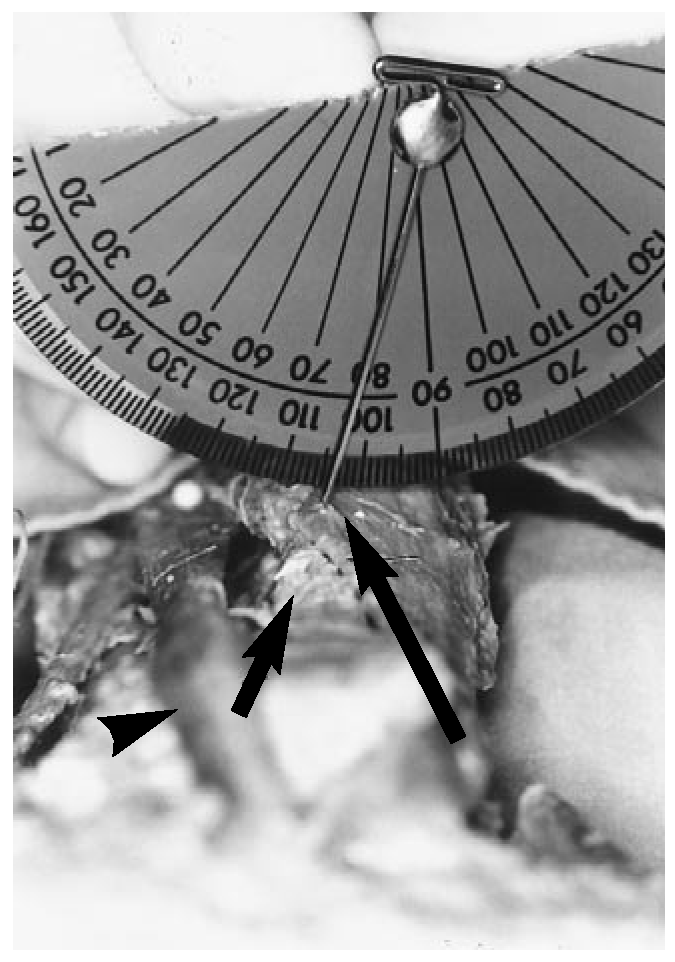
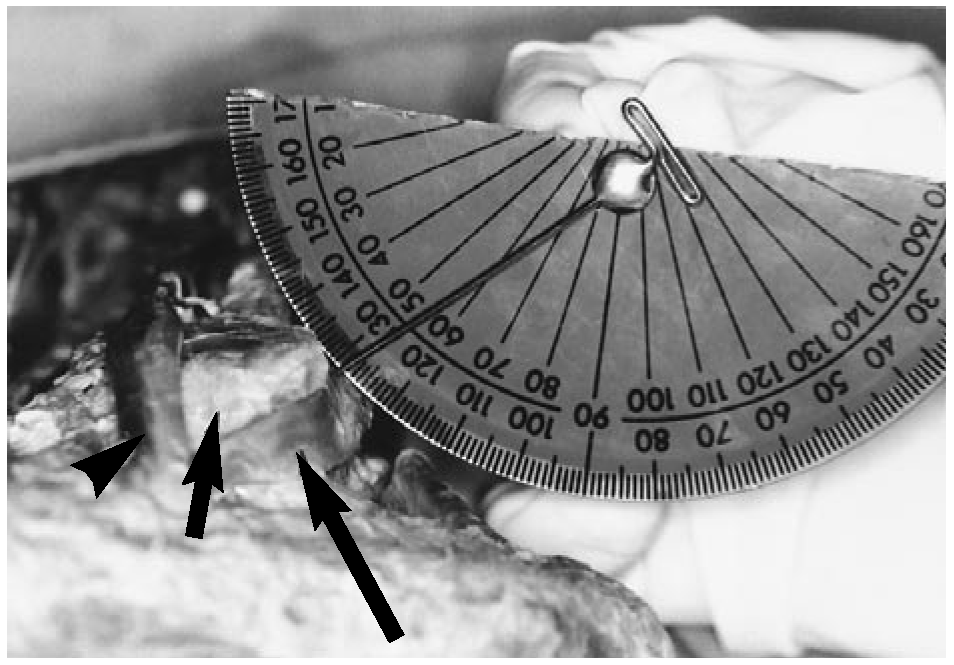
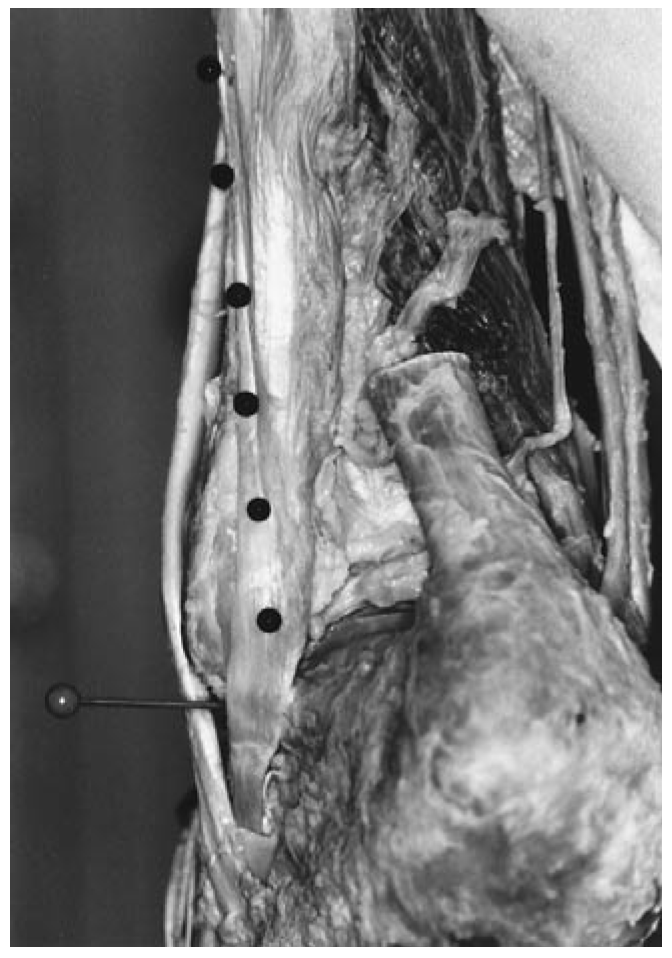
The lateral aspect of each lower extremity was exposed by positioning the axis of motion of the knee joint perpendicular, and the midsagittal section of the foot parallel, to the transverse plane. The natural plane between two individual tendon fibers was identified and separated distally by blunt dissection. This natural plane could not be followed distal to the lateral malleolus because of the impression of the tendon of peroneus longus onto the tendon of peroneus brevis at the level of the lateral malleolar fossa. For the purpose of data collection, six measurement positions were chosen within the natural plane of the tendon. The first position was created by connecting a perpendicular line from a pin placed just distal to the tip of the lateral malleolus to the main tendon of peroneus brevis. The tendon was then marked from distal to proximal every 2.5 cm, creating a total of six locations for measurement across a segment of tendon 12.5 cm in length.
A small goniometer, similar to the one designed and used by Roukis et al, [
7] was constructed for obtaining angular measurements. The tip of the pin was inserted into the natural plane of the tendon (ie, the space between the separated tendon fibers) with its shaft perpendicular to the surface of the tendon and maintained in this position by holding the stem of the bolt. With the tip of the pin in the natural plane of the tendon, and the shaft of the pin positioned perpendicular to the surface of the tendon, the protractor would rotate upon the bolt and come to rest with its base parallel to the transverse plane. This orientation allowed an angle to be measured between the shaft of the pin and the degree markers on the protractor (
Figure 1A and
Figure 1B).
The tip of the pin was placed in, and angles recorded from, each of the six chosen measurement positions (
Figure 2). After a period of acclimation to the use of the small goniometer, this procedure was repeated on random specimens, twice at each position by one examiner. Thus a total of two values, from each of the six measurement locations, was obtained for each cadaver specimen. The mean of these values was used during statistical analysis.
The Student’s t-test was performed to compare the mean degrees of total torsion (ie, the difference between the 12.5- and 0-cm measurement locations) within all 46 cadaver specimens. The Student’s t-test was performed to compare the mean degrees of total torsion between the right and left lower extremities. The Student’s t-test was performed to compare the mean degrees of total torsion between male and female cadaver specimens. Analysis of variance was performed to compare the mean degrees of torsional difference between all measurement locations. Fischer’s Protected Least Significance Difference was then performed to compare the mean degrees of torsional difference between all measurement locations.
All statistical analysis was performed using the StatView 4.02 (Abacus Concepts, Inc, Berkeley, CA) program, and graphs were produced using Cricketgraph 1.3.2 (Cricket Software, Malvern, PA), both on a personal computer.
Results
Torsion of the tendon of peroneus brevis was present in all 46 cadaver specimens. The direction of torsion was clockwise for the right and counterclockwise for the left (ie, from proximal to distal an individual fiber may begin laterally, pass posteriorly, and end plantarly), which is similar to the lateral rotation in the Achilles and tibialis posterior tendons. The mean degrees of total torsion for all 46 cadaver specimens was 38.5°, with a standard error of 3°. The mean degrees of total torsion (ie, the difference between the 12.5- and 0-cm measurement locations) was significant (P ≤ 0.0001).
A comparison of the difference in the total torsion within the tendon of peroneus brevis showed no significant differences between the right and left (P ≤ 0.2348) or between the male and female cadaver specimens (P ≤ 0.2736).
Discussion
This study has established that torsion exists within the tendon of peroneus brevis. The answer to the question, “Why is torsion present within the tendon of peroneus brevis?” may lie with the embryologic development of the lower extremities. Both osseous and muscular components of the embryologic development may contribute to the torsion. Because of the scarcity of research regarding the torsional development of the fibula, the authors will use the development of tibial torsion during the following discussion, with the assumption that the fibula closely follows the torsional development of the tibia [
14,
15,
16,
17,
18].
During the fifth and sixth embryonic weeks, the lower-limb buds lie perpendicular to the long axis of the axial skeleton. Early in the seventh embryologic week, the lower-limb buds medially rotate approximately 90°, causing the original dorsal (extensor) surface to lie anterolaterally and the ventral (flexor) surface to lie posteromedially [
19,
20,
21].
From the eighth embryonic week until parturition, the lower extremities are subjected to compressive forces due to the intrauterine position and rapid enlargement of the fetus within the constraints of the uterine cavity [
22]. These compressive forces cause flexion and external rotation of the lower extremities at the hip, which subsequently drive the leg and foot into internal rotation [
23].
During the fetal period the tibia has a slight internal torsion within the transverse plane (5° to 10°), which reaches a neutral or slightly external position (5°) at birth [
24,
25]. During the first few years of life, the tibia undergoes a marked increase in external torsion, reaching an average value between 20° and 30° by the age of 5 years [
15,
16,
17,
18,
22,
25,
26].
The combined average degree of torsion within the tendon of peroneus brevis in this study was 38.5°, much higher than that of the average tibia. Roukis et al [
7] state,
When reviewing the embryologic development of the fetus, it becomes clear that for the tibiae to reach their adult position of 20° to 30° of external torsion, a total external torsion between 30° and 40° is required, because they initially develop with approximately 10° of internal torsion. All of the leg’s osseous and muscular components have formed with a significant amount of intrauterine internal torsion. Thus, a much greater amount of genetically and mechanically developed external torsion is required to reach the necessary positions for normal functioning of the subtalar joint.
Therefore, the authors of this article suggest that if the fibula undergoes an external torsion similar to that of the tibia, then the musculotendinous unit of the peroneus brevis, which is attached to the fibula, would be forced to rotate upon itself as the tibialis posterior does. Additionally, since the foot develops in a supinated position during the fetal period, it must pronate to assume its neutral adult position [
2,
11,
19,
20,
21,
23]. Therefore, the authors suggest that since the musculotendinous structures of the foot have developed in a supinated position, when the foot pronates, the tendon of peroneus brevis is further forced to twist upon itself, resulting in an even greater external torsion within the tendon of peroneus brevis.
It is possible that, in a manner similar to the Achilles and posterior tibial tendons, torsion of the tendon of peroneus brevis may have a functional significance [
6,
7,
8]. The fact that the tendon of peroneus brevis crosses the ankle, subtalar, and oblique midtarsal joint axes of motion must be considered. During open kinetic chain motion caused by the pull of the peroneus brevis, motion from pronation to supination occurs in all three cardinal planes simultaneously and uses motion from all three joints. Owing to the position of the tendon and bend around the lateral malleolus, such motion would require fibers on the lateral side of the tendon to move through a greater excursion than the medial fibers. This would require longitudinal slippage between individual tendon fibers. Since tendons function as a single solid unit, any situation that requires longitudinal slippage is an unlikely and unnatural one [
6,
7,
8,
27,
28]. Torsion of the tendon of peroneus brevis may equalize the excursion of individual tendon fibers and eliminate the need for any longitudinal slippage between fibers. The functional significance of torsion of the tendon of peroneus brevis warrants further investigation.
Conclusion
A previously undescribed torsion within the tendon of peroneus brevis has been presented, with special attention to its embryologic origins. A thorough discussion of the biomechanical function and surgical significance of such a torsion is beyond the scope of this article but deserves further investigation. The possibility that torsion, similar to that located within the Achilles, tibialis posterior, and peroneus brevis tendons, may be present within the tendons of the other extrinsic muscles of the foot also deserves further study.