Plantar heel pain syndrome is a painful and disabling disorder affecting millions of people each year. [
1,
2,
3,
4,
5,
6,
7,
8] The exact cause of plantar heel pain syndrome has not been clearly established. The syndrome is characterized by medial or central heel pain in an adult associated with walking, and tenderness over the heel (the medial tuberosity of the calcaneus). The pain is not related to specific trauma, inflammatory arthritis, or systemic neurologic pathology. Various terms for this entity have been used and include plantar fasciitis, heel spur syndrome, and plantar heel pain syndrome. The presence of a heel spur is not required for the diagnosis. [
6,
7,
9,
10,
11,
12] The disorder is often considered to be self-limited, that is, the natural progression of the disorder is resolution of pain over a period of up to 1 year, but in many cases, the symptoms can reoccur or occur on the opposite side. Moreover, because the pain and disability associated with plantar heel pain syndrome can be severe, many patients seek medical therapy. [
13]
For this study, the definition of plantar heel pain syndrome will be pain and tenderness under the heel at the calcaneal origin of the plantar aponeurosis not associated with specific trauma or inflammatory arthropathy. Characteristically, patients with plantar heel pain syndrome have pain with the first steps after rising in the morning, followed by some improvement in pain with walking, but ultimately have increased pain with walking and standing during the day.[
6,
9,
11,
12,
14,
15,
16,
17,
18,
19,
20,
21]
Although in the authors’ experience, patients usually present with unilateral symptoms, one textbook reported that 8% to 13% of patients had bilateral symptoms, [
9] and some of the larger series reported bilateral involvement in approximately 30% to 58%. [
1,
4,
16] It has been proposed that plantar heel pain syndrome occurs most commonly in the “dominant foot” (for example, the foot used to kick a ball), theoretically because this is the foot that bears the most weight when standing.[
22,
23]
The use and effectiveness of the most frequently used modalities for heel spur syndrome have been well documented in the literature. These include: exercises, paddings and strappings, corticosteroid injection, physical therapy, and nonsteroidal anti-inflammatory medication, various foot orthoses such as the viscoelastic heel orthoses, functional foot orthoses, University of California Biomechanics Laboratory insert, night splints, and surgical intervention. [
3,
10,
14,
15,
18,
19,
20,
24,
25,
26,
27,
28,
29,
30,
31,
32,
33,
34]
Various magnetic modalities have been described in the lay press and promoted medically as a panacea for relieving pain.[
35,
36] However, there is no empirical study that has tested the effectiveness of these magnetic components for the treatment of pain in the foot. Therefore, the purpose of the present study was to evaluate the effectiveness of magnetic energy in the treatment of heel pain. The historical background and scientific basis for the use of magnetic foil will first be presented.
Use of Magnetic Foil for the Relief of Pain
The history of magnetic fields for therapeutic use dates to the time of the Egyptian priest Hippocrates and other famous physicians of antiquity. They reported indications and uses for treatment of muscular tension, joint pain, circulatory disturbances, and swelling. [
37] Recently, the efficacy of pulsed magnetic fields has been acknowledged from the clinical point of view for the treatment of various disorders. A study done at the Ludwig Boltzman Acupuncture Institute in Vienna by Kokoschinegg and Bischko had an 80% success rate in the treatment of fractures, backache, sciatica, arthroses, and leg pain of indefinite nature. [
37]
The structure of the magnetic foil consists of alternating rubber foil with a high content or ferromagnetic material. The ferromagnetic foil is covered with evaporated aluminum and gold. This coating increases the mechanical stability and the heat-reflective properties of the entire foil device. The opposite side of the foil has a nonirritant adhesive with a protective layer that is removed prior to its use.
The field strength declines from approximately 500 gauss at foil surface to approximately ten gauss at a depth of 7 mm. The biologically relevant interaction can be assumed to be approximately ten gauss, which results in an interaction depth of approximately 7 mm. [
37,
38]
Prior testing with the foil indicates an increase in temperature and therefore an increase of vascular flow to the area. This was documented with the use of thermography.[
2] Other observations revealed the field has spasmolytic properties to relieve muscular tension, with noticeable improvement within several hours to days.
The magnetic foil also has an effect at the cellular level, which was demonstrated by researchers at the Institute of Biophysics at Salzburg, who studied the intercellular voltage levels. The magnetic field apparently reduced the neural depolarization of the slow C-fibers by shifting the membrane resting potential, the C-fibers being the starters of neural response to painful stimuli. The entire excitation of pain is thus influenced, changing the subjective perception of pain.[
39]
Areas of disturbance, ie, pain conditions, are always accompanied by changes in temperature, which range from fractions of a grade unit to several grade units. Any therapeutic effect on the irritated area, ie, the pain, can therefore also be ascertained by a temperature change in the respective area.[
38]
The reason for skin temperature changes is the reflex mechanism of the vegetative system. Just like in the somatic nervous system, the reflex also consists of centers, and afferent and efferent fibers. The sympathetic and the parasympathetic nerve trunks constitute the efferent side, consisting of two neurons (preganglionic and postganglionic), which transmit impulses from the center of the periphery.
The skin has a large blood vessel network that regulates the temperature in a definite area. Also, the heat emission is controlled by the vessel diameter. Vessels do not only have sensitive fibers, but also vasoconstrictory and vasodilatory nerves, controlled by the sympathetic nervous system through vasomotor centers located in the immediate vicinity of the vessels, and within their walls, which are capable of forming an independent tonus.
The results of physiologic experiments and clinical observations have shown that inflammatory processes cause disturbance on the vasoconstriction and vasodilatation of the blood vessel network in the affected area causing temperature and sensory changes.[
26] In previous studies with the magnetic foil, not only did it demonstrate an increase in temperature by 1° to 5° C to the area where it was applied, but it also has been effective in regulation of neurologic disturbances.[
37,
38,
39] The product was tested on humans; and in New Mexico, Blach [
40] demonstrated the effectiveness of the magnetic foil used on horses with acute shin buck of the forelegs.
Methods and Materials
A clinical study was conducted at the Foot Clinics of New York to evaluate the effectiveness of magnetic energy in the treatment of heel pain. During 2 years, patients between 18 and 80 years of age were screened for medial plantar calcaneal heel pain (medial calcaneal tuberosity). Those with a history of diabetes mellitus, peripheral vascular disease, rheumatoid arthritis, seronegative spondylopathy, and allergy to any of the materials used for the study were excluded. Radiographs were taken of the affected foot to rule out tumor or fracture, which would also exclude the patient from the study.
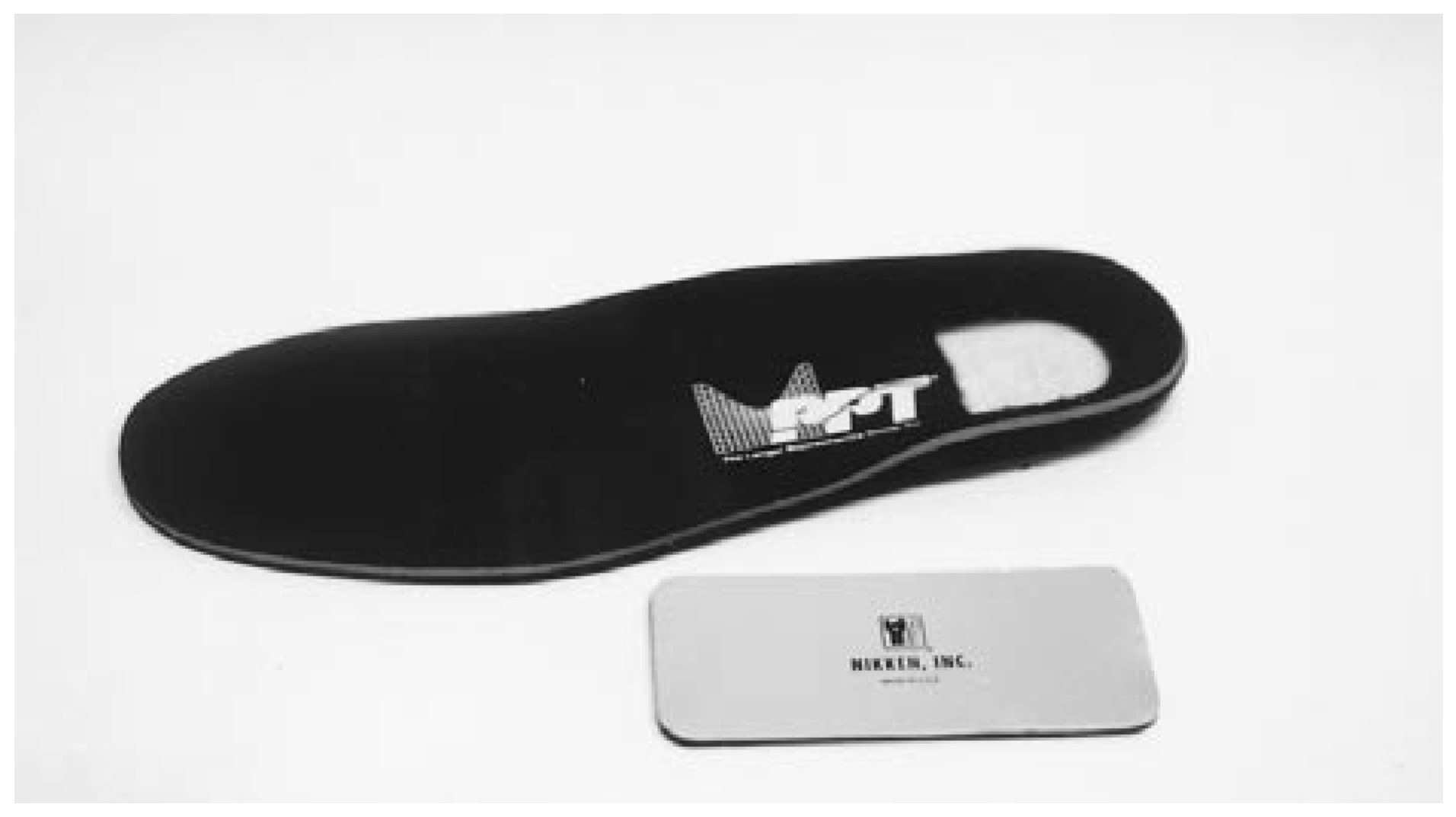
Patients were randomly divided into two groups. The first group wore PPT/Rx Firm Molded Insoles containing a Nikken
® (Nikken, Inc, Los Angeles) magnetic foil placed in the heel (
Figure 1). The second group received the same insoles as the first group but without the magnetic foil. (The PPT Firm Molded Insoles are comprised of PPT, an Ultralure
® (Langer Biomechanics, Deer Park, NY) top cover, and a polypropylene foam shell).
Subjects were required to wear a closed shoe that would accommodate the study device. All patients wore the insoles for 4 weeks. The insoles were fitted to the patients’ feet and shoes. Patients using the insole with the magnetic foil were compared with those wearing the insole with no magnetic foil using the foot function index. The foot function index was used to evaluate patients prior to and at the conclusion of 4 weeks of treatment.
Patient Population
The initial study group consisted of 40 patients suffering from heel pain. Patients were randomly divided into two treatment groups. Twenty patients wore a PPT Insole with the Nikken magnetic foil placed in the heel, and 20 patients wore the PPT Insole with no magnetic foil in the heel. Thirty-four patients (12 males and 22 females), ranging in age from 28 to 59 years (average age 43 years) completed the study. Nineteen patients completed the study using the magnetic foil insoles and 15 with insoles without magnetic foil. All patients were evaluated after 4 weeks. Six patients either did not return within the designated period, or were lost for follow-up care.
Foot Function Index
The foot function index was developed to measure the impact of foot pathology on function in terms of pain, disability, and activity restriction. [
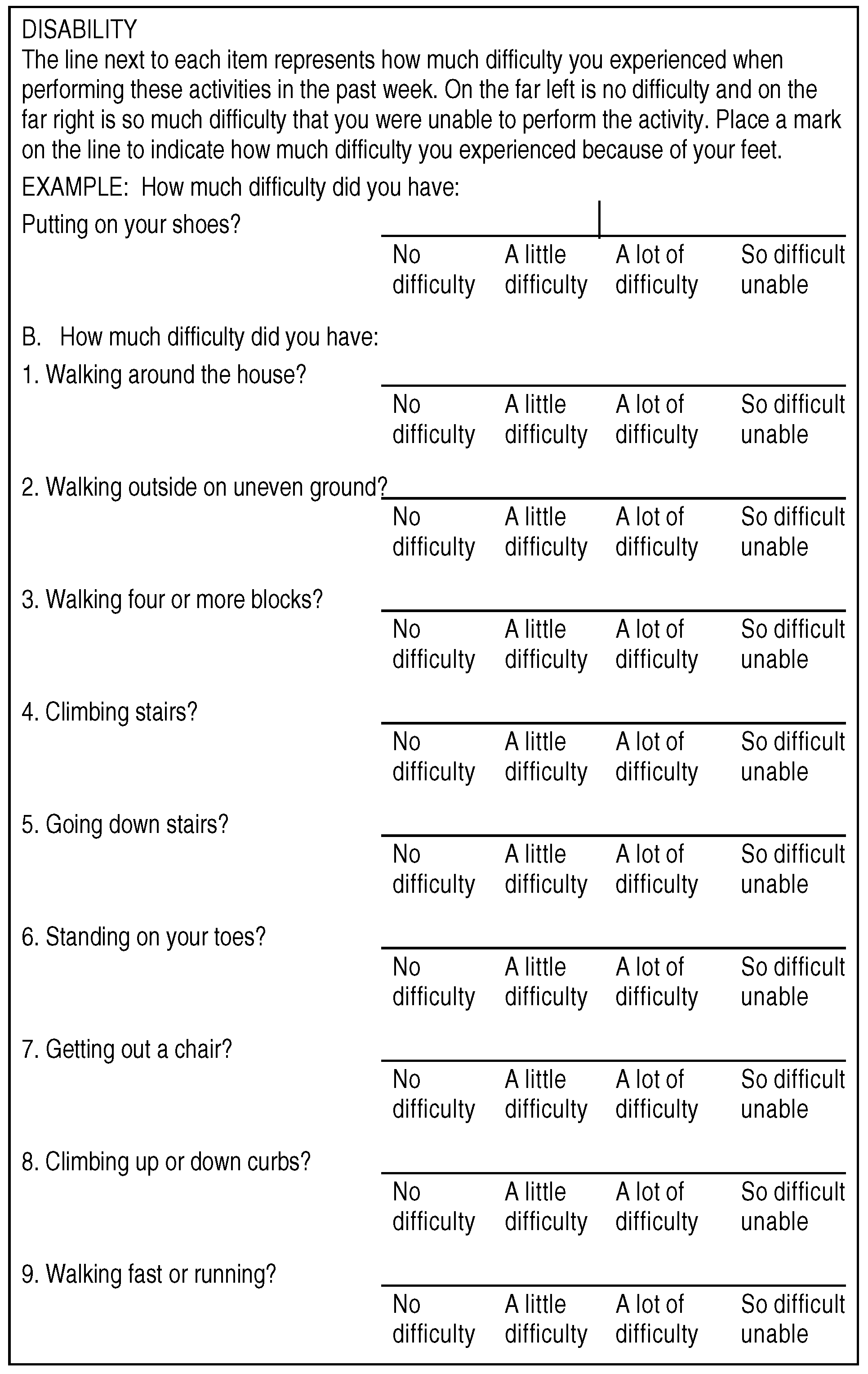
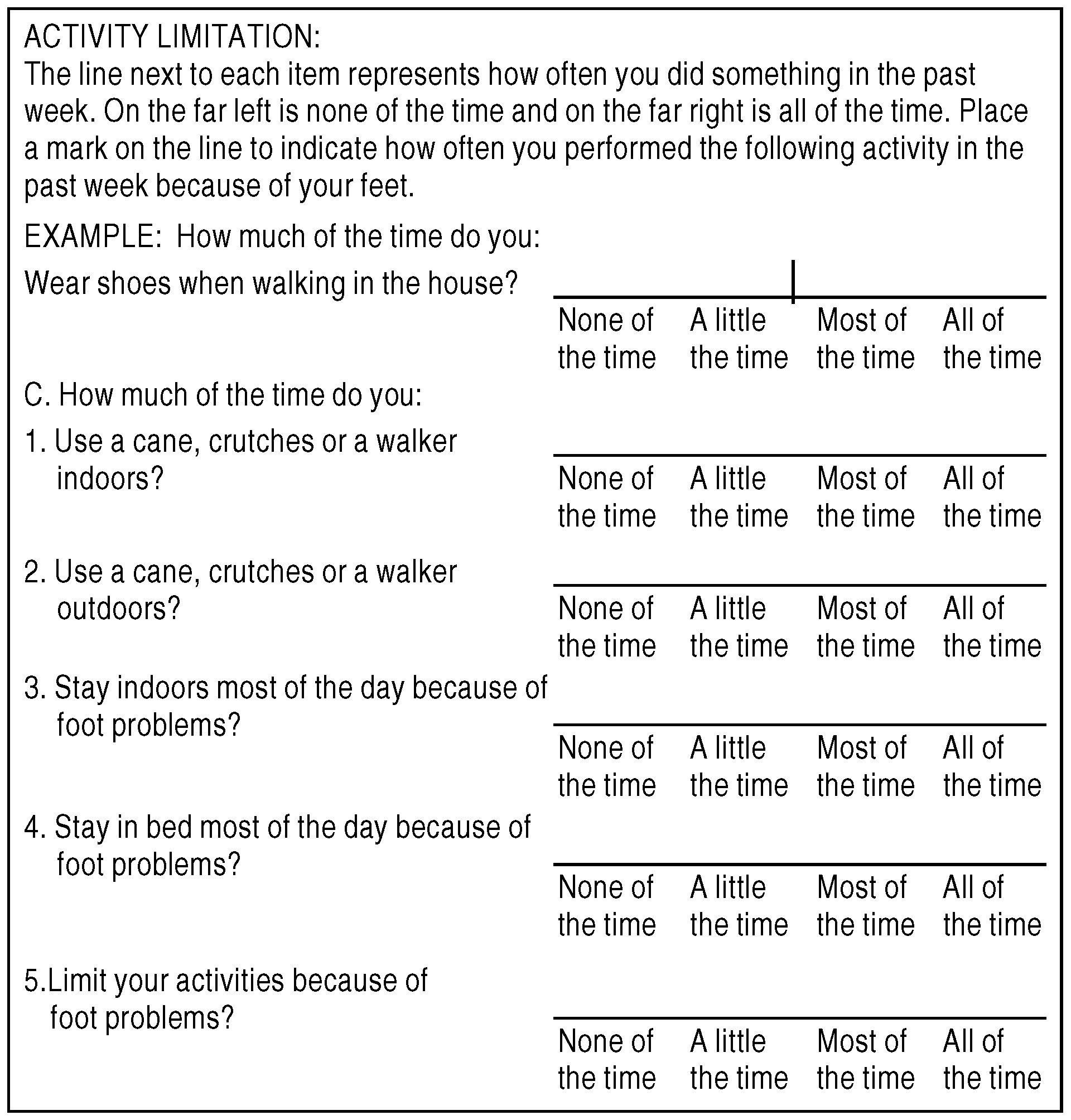
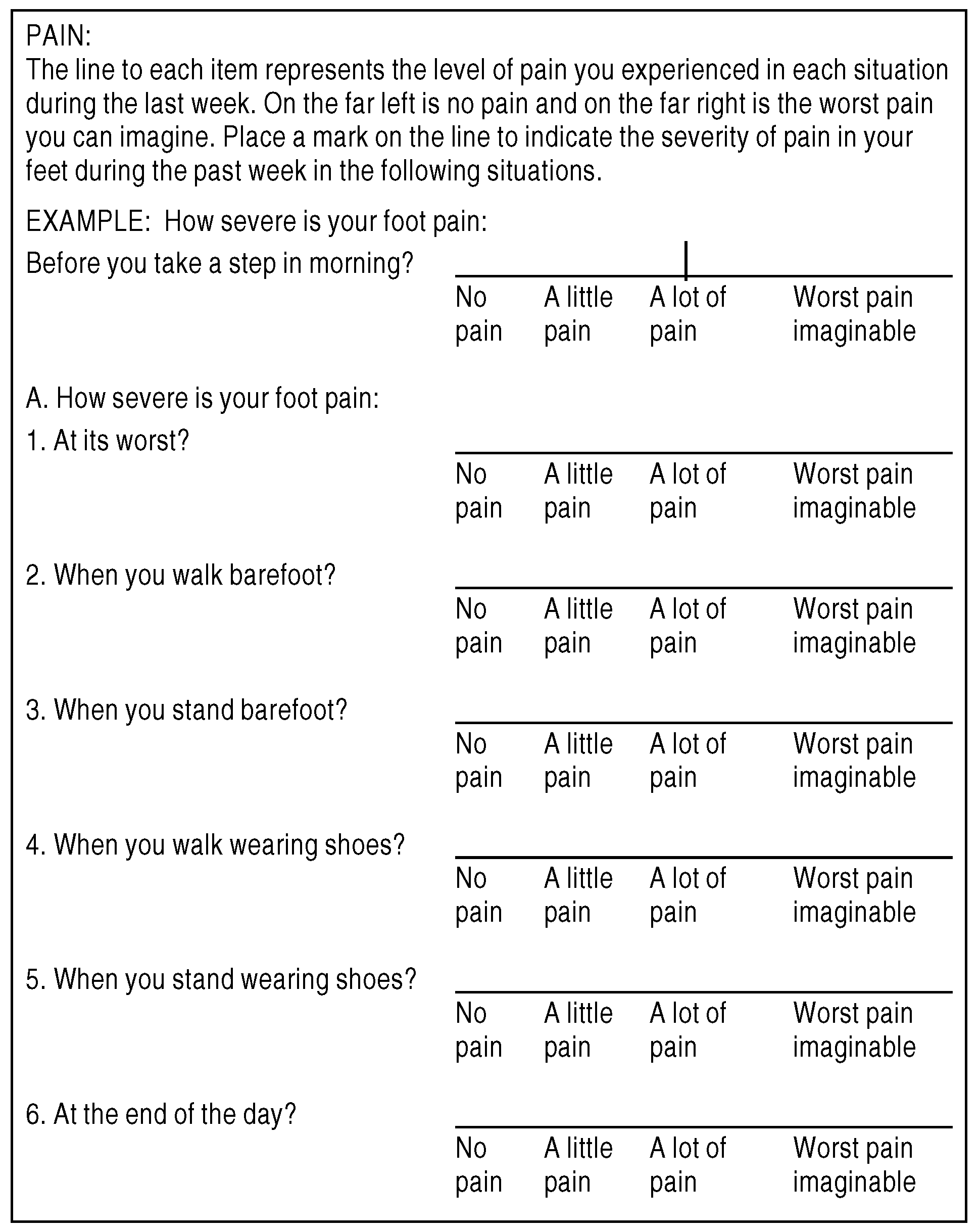
41] The foot function index is a self-administered index consisting of 20 items divided into three subscales. The foot function index was examined for test-retest reliability, internal consistency, and construct and criterion validity. There was a strong correlation between the foot function index total and subscale scores and clinical measures of foot pathology.
All items in the foot function index are rated using a visual analogue scale. The visual analogue scales used in this instrument consisted of horizontal lines to which were attached no numbers or divisions. Verbal anchors, representing opposite extremes of the dimension being measured, were placed at either end of the line. The patient was instructed to place a mark on the line in a position that best represented his or her experience in the past week.
The pain subscale measured the level of foot pain in a variety of situations (
Figure 2). It contained six items. The measurement dimension used by this subscale is severity of pain. The visual analogue scale anchors are “no pain” and “worst pain imaginable.” The disability subscale described the difficulty in performing various activities caused by foot problems (
Figure 3). This subscale consisted of nine items. The measurement dimension used for this subscale is degree of difficulty. The anchors for the visual analogue scale are “no difficulty” and “so difficult unable.” The activity limitation subscale addressed activity limitations caused by foot problems (
Figure 4). It consisted of five items and the dimension of measurement for this subscale is frequency. The visual analogue scale anchors are “none of the time” and “all of the time.”
Scoring System
The foot function index’s scoring system is based on the assumption that the severity of an impairment in foot function is determined both by the number of situations in which the patient experiences pain, disability, or activity limitation caused by a foot problem, and the intensity of that experience in each situation. A score was derived for each item by dividing the attached horizontal line into ten equal segments and assigning a number ranging from zero to nine to each segment. To obtain a subscale score, the item scores for a subscale were totaled and then divided by the maximum total possible for all the subscale items that the patient indicated were applicable. If a subject indicated that he did not perform an activity, such as walking barefoot, that item was marked as not applicable. Any item marked as not applicable was excluded from the total possible. To eliminate the decimal point, the score was multiplied by 100. Therefore, subscale scores ranged from 0 to 100 with higher scores indicating greater impairment. A total foot function score was derived by calculating the average of the three subscale scores. [
41]
Results
Eleven out of 19 patients (58%) with a complaint of heel pain reported an improvement in foot function after 4 weeks of wearing a PPT/Rx Firm Molded Insole with a magnetic foil in the heel versus nine out of 15 patients (60%) reporting improvement wearing a PPT/Rx Firm Molded Insole without a magnetic foil in the heel. There was no significant difference between the number of patients reporting improvement in each group (X2 = 1.22; p = NS). There was also no significant difference in the improvement made by the magnetic foil group versus the PPT/Rx Firm Molded Insole group as measured by the percentage difference in the mean scores on the foot function index (X2 = 3.0; p = NS). The score before the foot function index was 34 for the magnetic foil and 29 for the PPT insole. The score after the foot function index was 31 for the magnetic foil and 28 for the PPT insole.
Conclusion
Approximately 58% of patients using the PPT/Rx Firm Molded Insole with magnetic foil for 4 weeks and 60% of patients using the PPT/Rx Firm Molded Insole alone for the same period reported improvement in foot function as measured by the foot function index. However, although both groups reported improvement, there was no significant difference in the percentage improvement reported by the two groups as measured by the difference in the pretest and post-test scores on the foot function index.
These results suggest that the PPT/Rx Firm Molded Insole was effective in treating heel pain after only 4 weeks. The magnetic foil offered no advantage over the insole. That 60% of patients with heel pain reported improvement in foot function in only 4 weeks after being fitted with an inexpensive PPT/Rx Firm Molded Insole and with no other treatment, such as anti-inflammatory medications, physical therapy, or prescribed rest, is an important finding. Given the safety, simplicity, and low cost of the insoles versus injection therapy, nonsteroidal anti-inflammatory medications, and physical therapy, these are significant findings.