Toe walking that is not associated with cerebral palsy has been estimated to occur in 7% to 24% of the normal childhood population. [
1,
2,
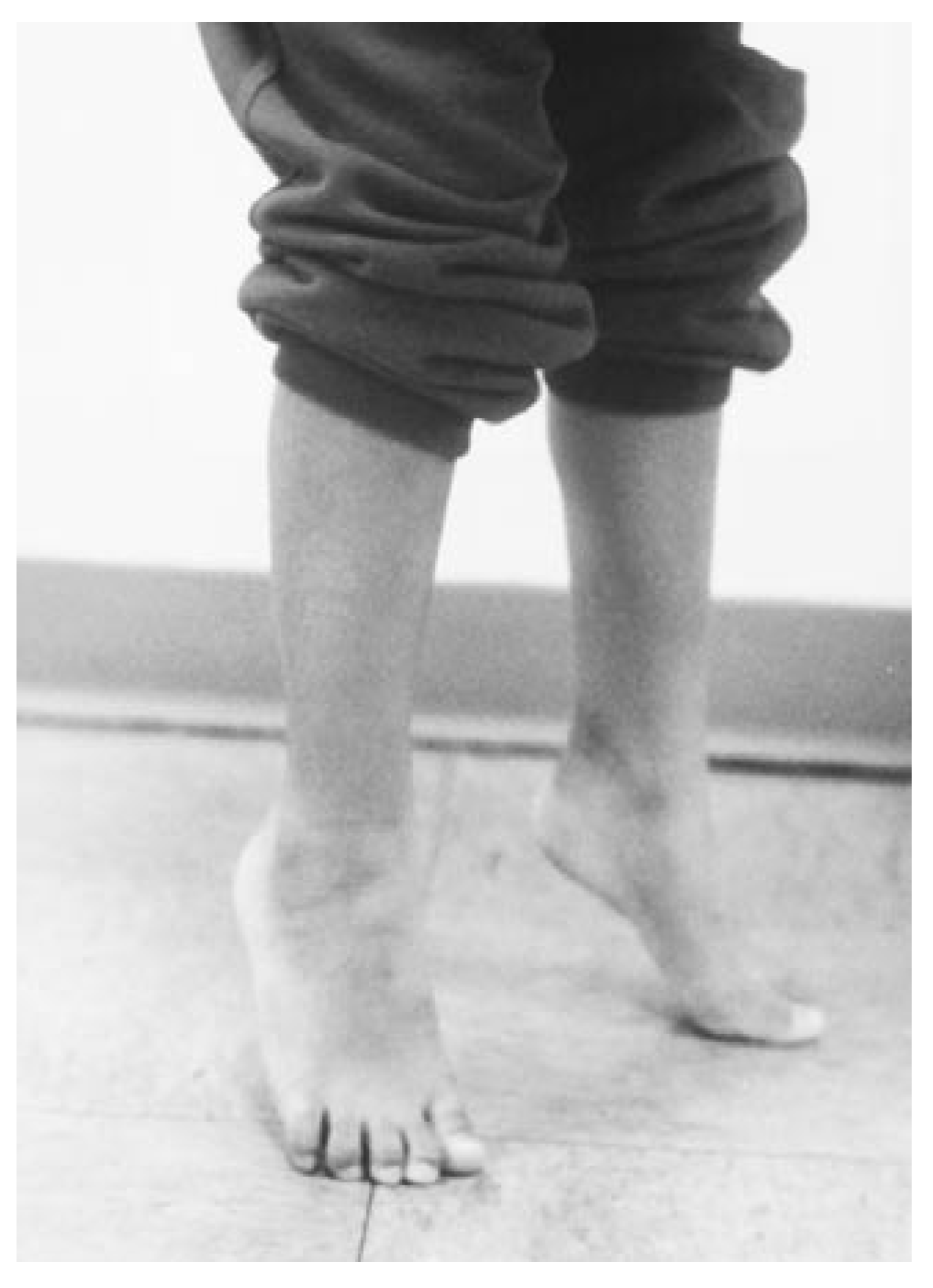
3] The etiology of toe walking has been attributed to: congenital short tendo calcaneus (
Fig. 1); [
4] abnormal soleus muscle; [
5] unknown central nervous system defect; [
6] autosomal dominant inheritance with unequal penetrance; [
7] delayed maturation of the cortical spinal tract; [
5] normal transient phase of development; [
8] vestibular dysfunction; [
9,
10] viruses; [
11] time spent in baby walkers; [
12] and habit. [
13]
The usual developmental sequence for learning to walk does not include walking on the toes [
14] and generally proceeds gradually to a heel-toe pattern [
2,
15] with a heel strike present at 18 months and a heel-to-toe gait achieved by age 3. [
16] Toe walking occurs with high frequency in persons with cerebral palsy [
17,
18,
19,
20,
21] and muscular dystrophy [
22,
23,
24,
25] and has been associated with autism, [
8] childhood schizophrenia, [
9] delayed language development,[
1,
26] and low IQ. [
26]
Yet tiptoe walking is considered by many to be a normal variant or phase that some children go through when learning to walk, [
2,
4,
5,
13] which is generally outgrown 3 to 6 months after first walking, [
5,
15] or by age [
7,
6] and results in no long-term neuro-orthopedic consequences. [
27] There are only six previous studies in the literature that deal with toe walking that is not associated with neuromuscular or mental disease (
Table 1). These reports chiefly have been concerned with distinguishing idiopathic toe walkers from toe walking caused by cerebral palsy usually by electromyography and have involved mostly small numbers of children. Electromyographic analysis has been found to be abnormal in toe walkers [
13] and has been considered to be effective [
28] and ineffective [
6] in separating idiopathic toe walkers from cerebral palsy toe walkers. Hicks et al [
29] observed that habitual toe walkers manifested a more variable gait than children with cerebral palsy. Furrer [
3] was able to differentiate habitual toe walkers with normal dorsiflexion (11 children), from those with minimal spastic diplegia (ten children), and congenital short tendo calcaneus (seven children) on the basis of a careful physical examination.
Although several texts [
5,
14,
27,
30] and studies refer to the characteristics of toe walkers, the authors have not seen any reports containing data on large numbers of toe walkers on which these descriptions are based (
Table 1). The purpose of the present study is to describe the natural history and general features of a large group of idiopathic toe walkers and to determine the relationship between the development of ankle equinus and increasing age.
Methods and Patients
Between 1992 and 1995, 60 toe walkers from age 1 to 15 years were evaluated at the Foot Clinics of New York (
Table 2). Thirty-three patients were males and 27 were females. Patients with obvious spastic diplegia, hemiplegia, or unilateral toe walking from any cause were excluded. Similarly, any patient who demonstrated spasticity or abnormal patellar or Achilles tendon reflexes was excluded. None of the patients had Achilles tendon lengthening or other orthopedic surgery prior to the evaluation.
Information was obtained for each child including: 1) demographic data; 2) perinatal and postnatal history; 3) the age at which the child first started to walk as compared with when the toe walking first began; 4) family history of toe walking; 5) toe walking patterns such as frequency of toe walking, whether the child stands on the toes when not walking, ability to perform a heel-toe gait on command, toe walking in shoes, and various anecdotal information.
All children were observed walking with and without shoes. In most instances, it was possible to observe children walking when they were unaware of being watched and also during the formal evaluation. Patients were observed as to whether they walked on their toes all of the time or intermittently. All mothers were instructed to ask their children to demonstrate a heel-to-toe gait. Children were observed to determine whether they still stood on tiptoe when standing still. A child was considered to be a constant toe walker if he or she always walked on his or her toes even if standing in a plantigrade fashion.
Passive ankle dorsiflexion with the knee extended was measured for each child by one of the authors with a two-arm manual goniometer. A child was considered to be an equinus toe walker if the ankle dorsiflexion measured 0° or less. All children with ankle dorsiflexion more than 0° were considered to be habitual toe walkers. In cases where the dorsiflexion was different for the right and left feet, the two measurements were averaged.
Results
Sixty toe walkers (33 males and 27 females) between the ages of 1 and 15 years (average 3.5 years) were evaluated (
Table 2). Forty-six children (81%) weighed 6 pounds or more at birth (average birth weight 7.06 pounds). Most of the children were born with no complications (85%).
All parents were aware that their children toe walked; however, 85% of parents brought their children to the clinic because of the toe walking. Other problems that the parents complained of included: falling, in-toe, pain, fatigue, flatfoot, limping, poor balance, and bunions.
A positive family history of toe walking was reported in 30% of patients (
Table 2). Relatives who toe walked included the father (5%), mother (3%), uncle (3%), siblings (12%), and other relatives (7%). One patient’s mother reported that every member of the maternal side of her family toe walked including several adults.
The children first walked at a mean age of 11.14 months (
Table 2). The majority of children walked on tiptoe as soon as they began to walk (87%). Those who did not toe walk immediately began toe walking an average of 6 months after they first started to walk. Most children were able to walk with a heeltoe gait when asked to do so (88%), had a plantigrade stance position (90%), toe walked intermittently (68%), toe walked in shoes (61%), or had tight tendo Achillis (46%) (
Table 2).
Ankle Dorsiflexion. Ankle dorsiflexion averaged 6.2° for all toe walkers with no significant difference between the right and left foot (
Table 3). However, there were 11 children with differences in dorsiflexion between the right and left foot (mean difference 7.7°; range 5° to 10°). Children who toe walked intermittently (average dorsiflexion of 8.08°) had significantly greater ankle dorsiflexion than those who toe walked all of the time (average dorsiflexion of 1.94°) (p < 0.01). Toe walkers with ankle equinus (average dorsiflexion of -5.18°) had significantly less ankle dorsiflexion than habitual toe walkers (average dorsiflexion of 16.9°) (p < 0.01) (
Table 3).
Ankle dorsiflexion tended to decrease with increasing age, averaging 12° in the 1- and 2-year-old children and gradually diminished to -4° in the 6- to 15-year age group (
Table 4). The proportion of children with ankle equinus tended to increase with increasing age (
Table 4). An average of 35% of the 1- to 3-year age group demonstrated ankle equinus. Seventy-one percent of 4-year-olds and 100% of 5-year-olds had ankle equinus. For the five children 6 years of age and older, only one child (age 9 years) had greater than 0° of ankle dorsiflexion.
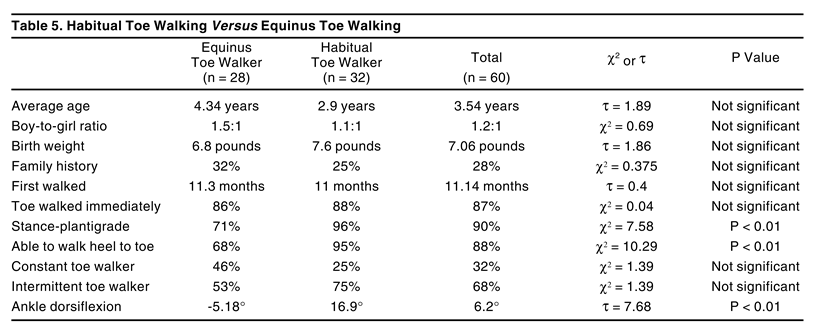
Equinus Toe Walkers Versus Habitual Toe Walkers. Forty-six percent of all toe walkers had 0° or less of passive ankle dorsiflexion (equinus toe walkers) (
Table 5). The average ankle dorsiflexion for the equinus toe walkers was -5.2°
versus 16.9° for the habitual toe walkers (P = < 0.01) (
Table 5).
Equinus toe walkers tended to have a higher ratio of boys to girls, weighed almost a pound less at birth, walked an average of 3 months later, and more frequently had a family history of toe walking than the habitual toe walking group (
Table 5). Although these differences were not statistically significant, they are clinically impressive.
Ninety-five percent of habitual toe walkers
versus 68% of equinus toe walkers were able to demonstrate a heel-toe gait on command (P = < 0.01). Similarly, 96% of habitual toe walkers
versus 71% of equinus toe walkers stood plantigrade (P = < 0.01) (
Table 5).
Forty-six percent of the equinus group
versus 25% of the habitual toe walking group constantly walked on their toes. The majority of the habitual toe walkers (75%) walked with a heel-toe gait at least some of the time (
Table 5).
Toe-walking Patterns. Ten children were labeled as excessively “high toe walkers.” These children walked high up on their toes. Eighty percent of this group had an ankle equinus deformity and 50% had a positive family history of toe walking. Children in this group first walked at an average of 10.3 months. One child in the group would take a few normal steps and then plantarflex his toes and walk like a toe dancer. He was reported to walk this way 80% of the time. Another child in this group walked high up on his toes, even in rigid high-top sneakers.
Children were found to exhibit the following toe walking patterns: take a few normal steps and then go right up on the toes (one child); toe walk only after walking a long time (one child). One child toe walked only when he thought no one was watching him because the mother admitted that he was punished for toe walking. One child toe walked only in shoes but not barefoot. In fact, 61% of children toe walked both barefoot and in shoes.
One child (31/2-year-old male) walked with a heel-to-toe gait in front of one of the authors, and the mother insisted that it was the first time that he did not toe walk. Another child first began toe walking when using a walker. Finally, one mother reported that her child began toe walking at the age of 15 months after returning home from a 3-month trip to the Dominican Republic. The mother stated that the child started walking at 12 months of age and did not toe walk. She said that the child did a lot of walking in the Dominican Republic, including walking up a hill that she considered to be the cause of the toe walking.
Discussion
The present study is the largest recent systematic investigation of idiopathic toe walkers, a group that has been largely ignored and relegated to a diagnosis of exclusion. [
4,
6,
27] The children reported here and by others [
4,
5,
13,
32] were all normal except for walking on their toes. There was a slight preponderance of males, which is consistent with other reports. [
3,
4,
6,
13] Motor development was not delayed. Fifty-three percent walked earlier than 12 months and no child started walking later than 18 months. This early walking pattern is another feature that distinguishes idiopathic toe walking from cerebral palsy toe walking.
Toe walkers have been reported to walk on time, begin toe walking immediately when first starting to walk [
3,
4,
13] (87% in the present study) and are usually able to demonstrate a heel-toe gait (88% in the present study) (
Table 1).
This study reported a 30% family history of toe walking. Family history of toe walking in the literature ranges from 10% to 88% and is considered to be a characteristic of toe walking (
Table 1). [
4,
5,
6,
13,
28] Levine [
7] described a family with five affected members with toe walking caused by a short tendo calcaneus and considered the trait to be dominantly inherited with unequal penetrance. Katz and Mubarak [
32] believed that a positive family history was characteristic of toe walking and could distinguish idiopathic toe walking from cerebral palsy toe walking since the latter does not have a familial tendency.
The average ankle dorsiflexion for all toe walkers was 6.2° (
Table 3). Approximately half of all toe walkers (46%) had an ankle equinus (ankle dorsiflexion 0° or less) (
Table 4). In contrast, others have reported limited dorsiflexion in all toe walkers. [
6,
7,
13] The equinus group had an average of -5.2° ankle dorsiflexion as compared with 16.9° for those with a full range of ankle dorsiflexion (habitual toe walkers) (p = < 0.01). Similarly, Furrer [
3] also reported that children with tight tendo calcaneus had 4° of ankle dorsiflexion
versus 16° of ankle dorsiflexion for habitual toe walkers.
The equinus toe walkers differed as a group in other ways from those with full ankle dorsiflexion, although these differences did not always approach statistical significance. Equinus toe walkers stood more often on tiptoe (p < 0.01) and were less frequently able to walk with a heel-toe gait (< 0.01) as compared with the habitual toe walkers (
Table 5).
Tachdjian [
5] stated that toe walking is generally outgrown 3 to 6 months after a child first begins to walk. Kalen et al [
6] stated that toe walking could be normal until age 7. In the present study, the number of children who presented for toe walking gradually diminished with age (
Table 2). There were 21 toe walkers age 2 (35%), but only five toe walkers (7%) between the ages of 9 and 15, presumably because the condition had resolved in most children by this age. There is a small segment of toe walkers who do not resolve as evidenced by the older toe walkers in this study and those with adult relatives who toe walk.
Ankle equinus was found to be especially common in older children who toe walked. The range of ankle dorsiflexion tended to decrease with increasing age and the percent of those with equinus increased gradually as the children got older (
Table 4). There was only one child out of 12 older than 4 years of age with a normal amount of ankle dorsiflexion. Similarly, Furrer [
3] found a diminished range of ankle dorsiflexion in older toe walkers. There were no children over the age of 8 years in his study with normal ankle dorsiflexion.
It has been previously suggested that the limited ankle dorsiflexion present in some toe walkers is the result of secondary contracture of the tendo Achillis from spending long periods on the toes rather than the primary etiology of the toe walking. [
3,
32] The authors’ results tentatively support this hypothesis, although their data are not longitudinal.
It is possible that the large percentage of older children with ankle equinus found here had a normal amount of dorsiflexion at an earlier age and developed tendo Achillis contractures from chronically walking on tiptoe. It is likely that in most habitual toe walkers with normal ankle dorsiflexion, the condition resolves in early childhood, which would account for the small number of older children who toe walk. However, it seems that some of the younger toe walkers do not improve, and develop equinus contractures from continually walking on tiptoe.
There were children presented here with limited ankle dorsiflexion in the youngest age groups (1 to 3 years); therefore, in at least some children, the reduced ankle dorsiflexion was present from the beginning and was not an accommodation to walking tiptoe. The authors do not know how many of the older equinus toe walkers had limited ankle dorsiflexion at an earlier age.
Longitudinal data are necessary to determine whether the ankle equinus is the primary etiology of toe walking or is the result of secondary contractures. However, since there may be a relationship between persistent toe walking and the development of ankle equinus in some children, intervention should be considered before contractures develop. Serial casting [
6,
13,
28,
32,
33] and surgery [
4] have resulted in permanent heel-toe gait in toe walkers. Ankle-foot orthoses, [
5] exercise, [
5,
32] and shoe therapy [
31,
32] may also be useful.