To the Editor:
Cleft foot, lobster foot, claw foot, and ostrich foot are synonyms for a rare pedal deformity occurring in 1:90,000 births. The defect is characterized by the absence of the central digits and metatarsals. The first and fifth digits, with their respective metatarsals, are frequently present, along with a concomitant hypertrophy of the first ray. A common presentation of the malformation is a concomitant cleft foot and hand.
Early references to ectrodactyly are rare. Such occurrences were merely regarded as “monsters.” However, an early clinical reference to the hand and foot ectrodactyly was made by Pare in 1573 [
1]. Far from an association with monsters, the malformation is believed to be transmitted in an autosomal dominant inheritance pattern. Males are more frequently affected than females [
2,
3].
Cleft foot may exist as a unilateral or bilateral pedal deformity in many combinations with other deformities. It may present as an isolated deformity or simultaneously with similar defects in the hand. It most frequently presents as part of a defect syndrome, including defects of the eye, palate, audition, and abnormalities of the kidneys [
4]. The cleft foot, absent of similar upper extremity deficits, occurs in 10% to 50% of cases of trisomy 18 [
5]. Severe mental retardation, seizures, microcephaly, abnormal facies, and vertebral anomalies are frequently present as a result of a 7q chromosomal deletion [
6]. Few reports exist of ectrodactyly that is bilateral and of isolated, spontaneous origin.
Case Presentation
A 15-month-old male was presented by his parents, who were distressed at the child’s abnormality. Except for the presence of bilateral cleft hands and feet, the child was typical for a child his age. The parents feared that they had done “something wrong” which had manifested as the child’s deformity.
According to the parents, the pregnancy and delivery were unremarkable, with the child carried to full term. Both parents denied exposure to mutagenic agents or knowledge of other family members with the deformity. Neither parent used tobacco, drank alcoholic beverages, or used recreational drugs. A consanguineous marriage was also denied. There were no other children as a result of the marriage and both parents presented with normal extremities and were free of other congenital anomalies.
Physical examination of the patient was unremarkable, except for the deformities of the upper and lower extremities. The facies were entirely normal and there was no evidence of cleft palate or lip. The child was alert and showed normal developmental skills for his age. While the child had not yet attempted bipedal ambulation, he showed an interest in attempting to place his feet under his body. The child also made an active effort to grasp objects with his “pincer-like” hands. The feet had normal sensory capabilities and the child responded to manipulation of his feet during the examination.
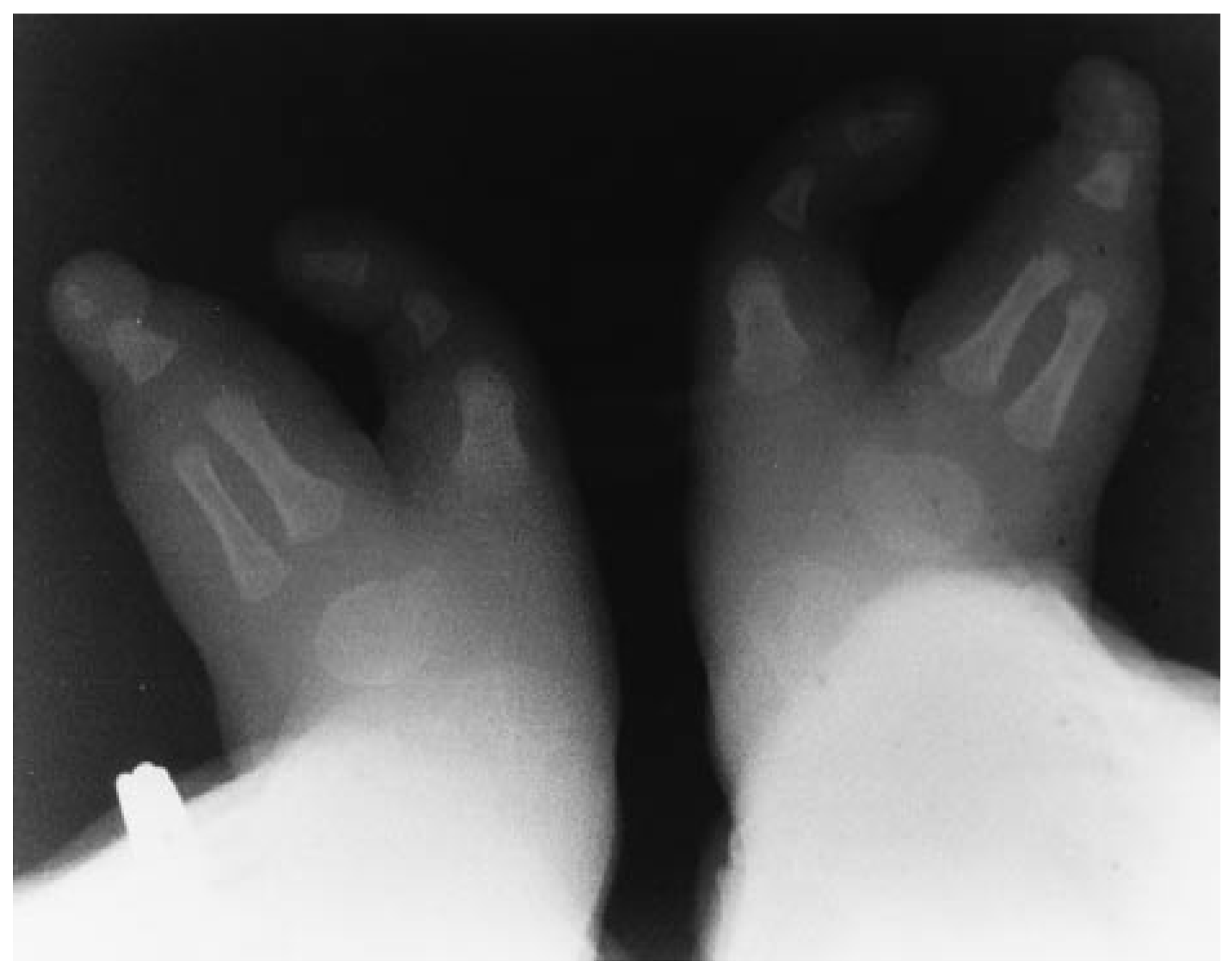
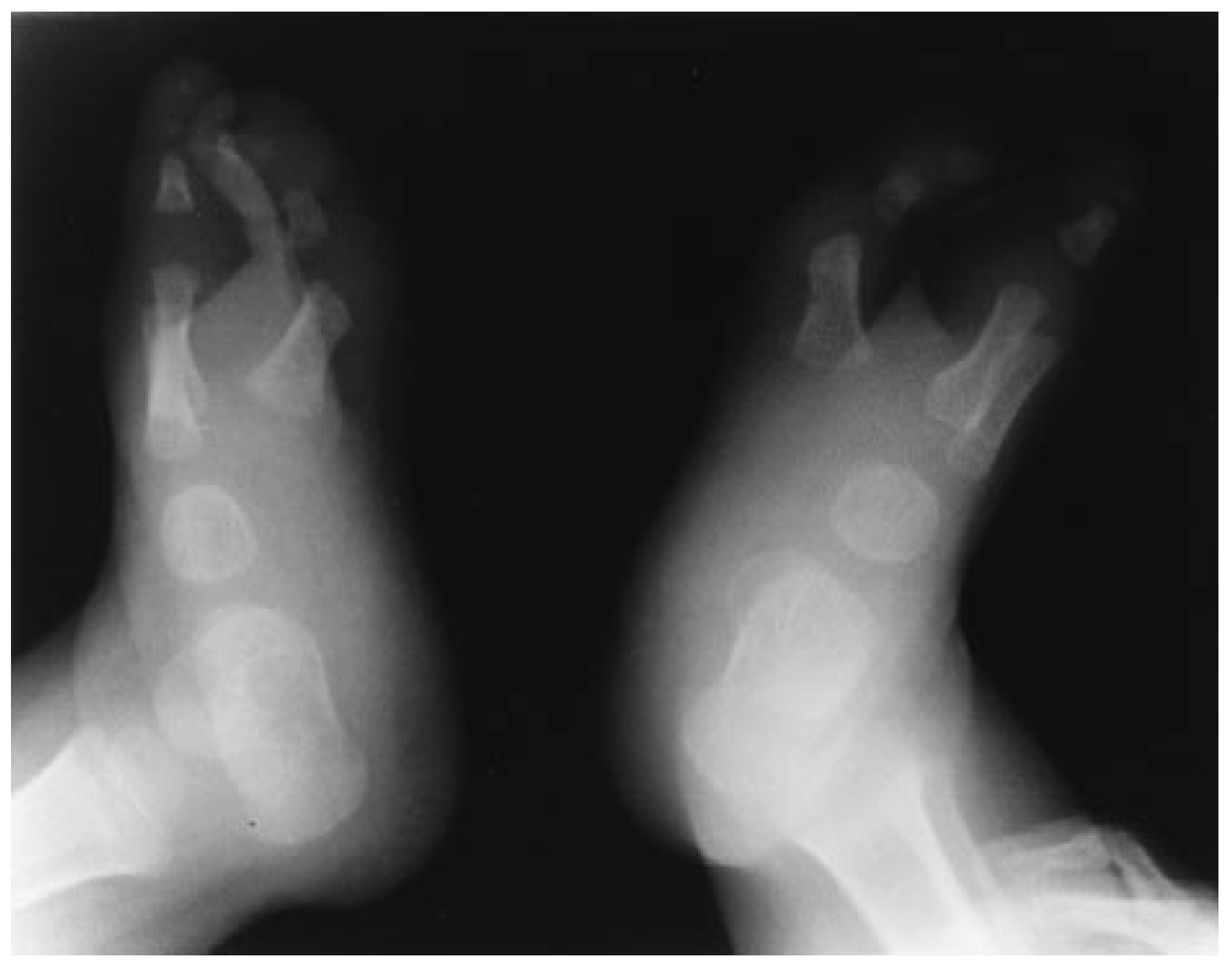
A radiographic examination of the feet was performed (
Figure 1 and
Figure 2). An expected and obvious finding was a bony agenesis of the central lesser digits. The greater tarsal bones were present. However, the osseous structures normally associated with the second and third digits were absent. The halluces were skeletally complete and were bilaterally hypertrophic. The metatarsals of the fourth and fifth digits were complete and independent. The proximal, intermediate, and distal phalanxes were present as independent structures, forming a single digit. This digit was supported by the fully formed fourth and fifth metatarsals.
Accommodation of the deformity was recommended until further development of the distal extremity had taken place. The parents strongly desired an early heroic effort to provide the child with more “normal appearing” hands and feet. Attempts to guide the parents into a supportive network failed and the patient was eventually lost for follow-up care.
According to the information from the history and physical examination, the patient represented a purely spontaneous occurrence of isolated, bilateral cleft hands and feet. However, the child had achieved all expected developmental milestones and appeared mentally capable to achieve skills later such as walking.
Conclusion
Ectrodactyly is extremely rare and is often associated with other deformities. The authors’ case presentation, however, was of a spontaneous origin and without other abnormalities. Otherwise, the clinical presentation of the hands and feet were consistent with the literature.