To the Editor:
Milroy’s disease, initially described by Letessier in 1865, is a rare congenital lymphedema characterized by familial occurrences of painless swelling in one or both lower extremities. The incidence of this disease is approximately one per million live births [
1]. The pathogenesis of the disorder is unclear, but it is thought to be secondary to dysplasia and abiogenesis of the lymphatic channels. Associated features typically include an autosomal dominant inheritance, multiple ocular abnormalities, and vertebral and spinal cord anomalies [
1]. The authors present a case of an adult male patient with Milroy’s disease to clarify the difficult management of the soft tissue complications of this disease.
Case Report
A 43-year-old male was referred by his primary care physician for preoperative evaluation prior to surgical debridement and skin grafting of the right and left feet.
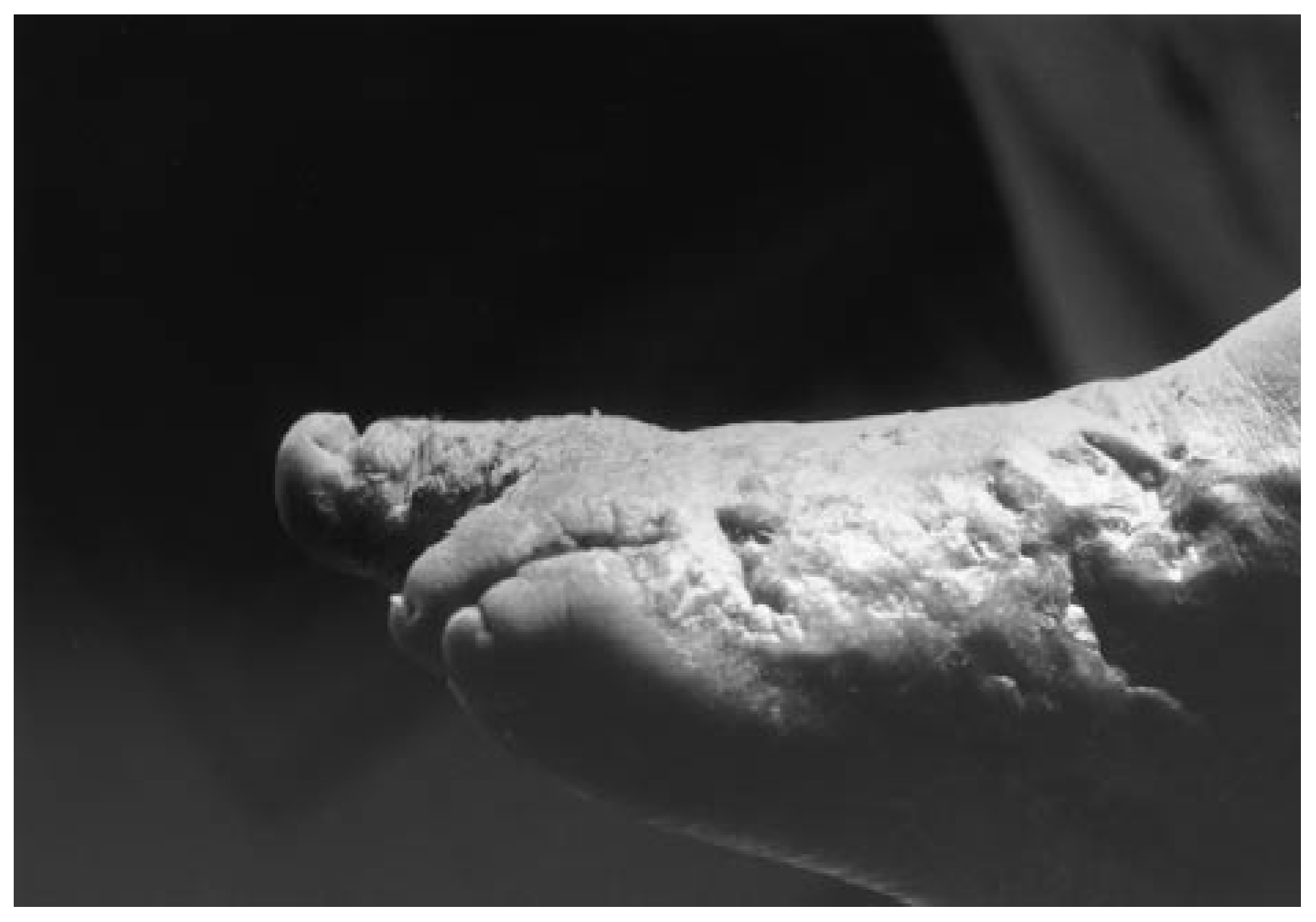
The patient had suffered from idiopathic congenital lymphedema since birth, and according to the patient, had undergone approximately 198 reconstructive surgeries of the lower extremities. The patient had suffered from chronic infections of the feet bilaterally, particularly of the left foot, and has had multiple episodes of cellulitis complicating his lymphedema. He had a transmetatarsal amputation of his right foot (Fig. 1).
On his left foot, the great toe had suffered repeated bouts of cellulitis and subsequent eschar in the hyperkeratotic areas. The patient had been conservatively treated for 8 months using whirlpools, dressings, and multiple courses of antibiotics.
The patient had continued to have recurrent infections on the dorsal aspect of the left great toe and a recurrent pressure ulceration on the dorsal aspect of the right foot. Multiple soft tissue cultures were taken intermittently from the foot and toes, revealing heavy Staphylococcus aureus and β-hemolytic Streptococcus group G growth, organisms typical of lymphedema. These organisms were sensitive to cephalosporins. There was no anaerobic growth.
Medical history is significant for heart disease with no known family history of Milroy’s disease. A
Figure 1.
Dorsal view of the right foot.
Figure 1.
Dorsal view of the right foot.
review of systems revealed no evidence of any lung, kidney, liver, or bleeding problems.
The physical examination showed that the patient was a well developed, well nourished male. There was bilateral congenital lymphedema and evidence of surgeries and skin grafts extending proximal to the inferior abdominal area and involving the scrotum.
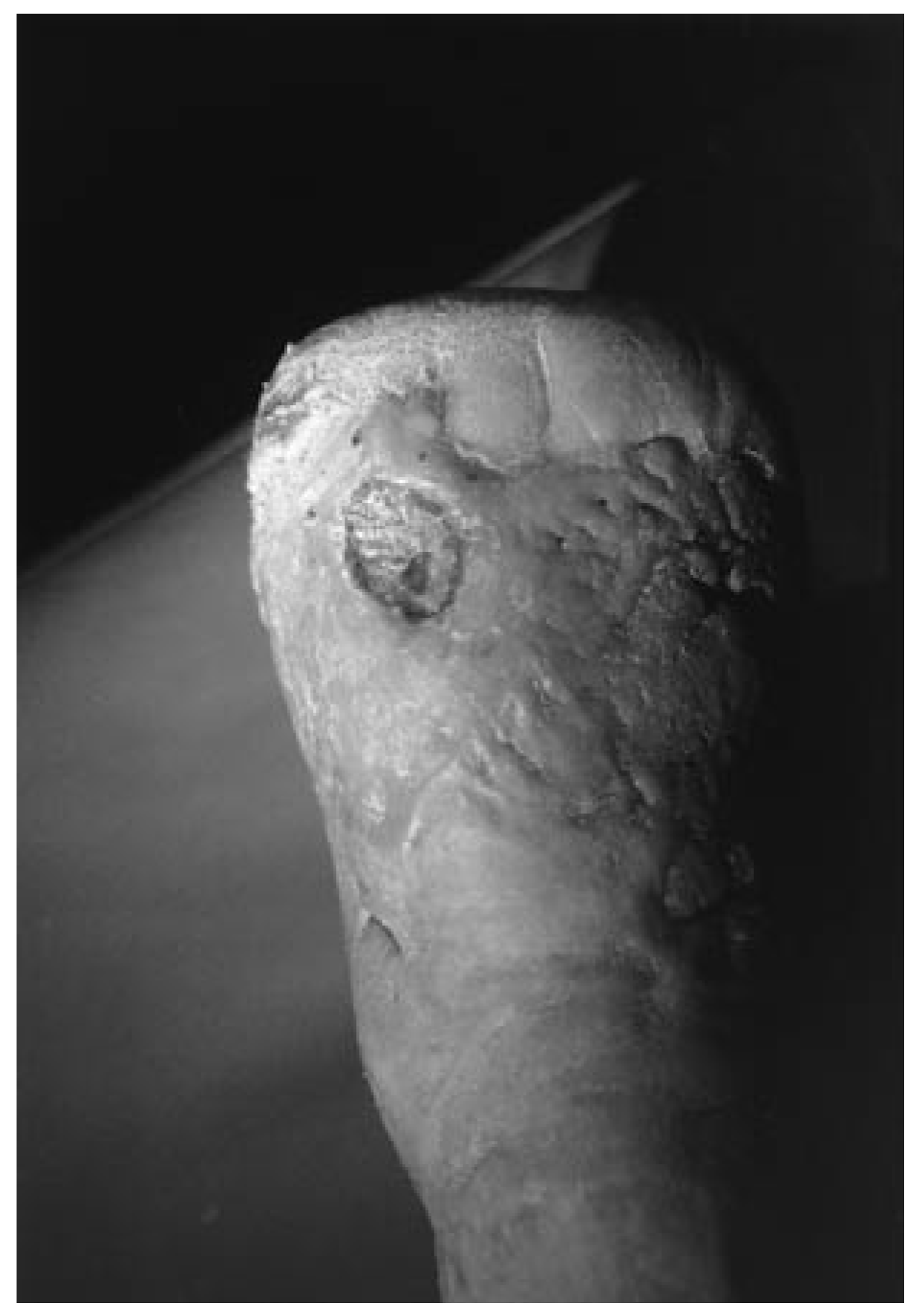
The left great toe had hyperkeratotic areas on the dorsum from previous skin grafts, with fissuring and recurrent infections. The left pedal skin was indurated and bound with multiple fissuring and pitting, with the largest pits extending to a depth of approximately 1 cm. The induration extended proximally to include the ankle areas (Fig. 2).
The right foot was also indurated, and exhibited a 4-cm ulceration at the dorsal aspect proximal to the metatarsal heads, which was caused by pressure from the tongue of the shoe. This ulcer was treated with antibiotic and felted foam therapy for approximately 3 weeks prior to skin grafting. The dorsal skin on both feet was from previous skin grafts. The skin on the plantar aspect was normal bilaterally.
Surgery
The procedure began with debridement of the ulcers on the right dorsal foot, and the left great toe, and the space between the great toe and small toe where the toes had been amputated. This was excised down to bleeding dermis to remove all necrotic buildup. A split thickness skin graft was harvested from the right thigh. This was meshed 1.5 to 1 and applied to the open areas.
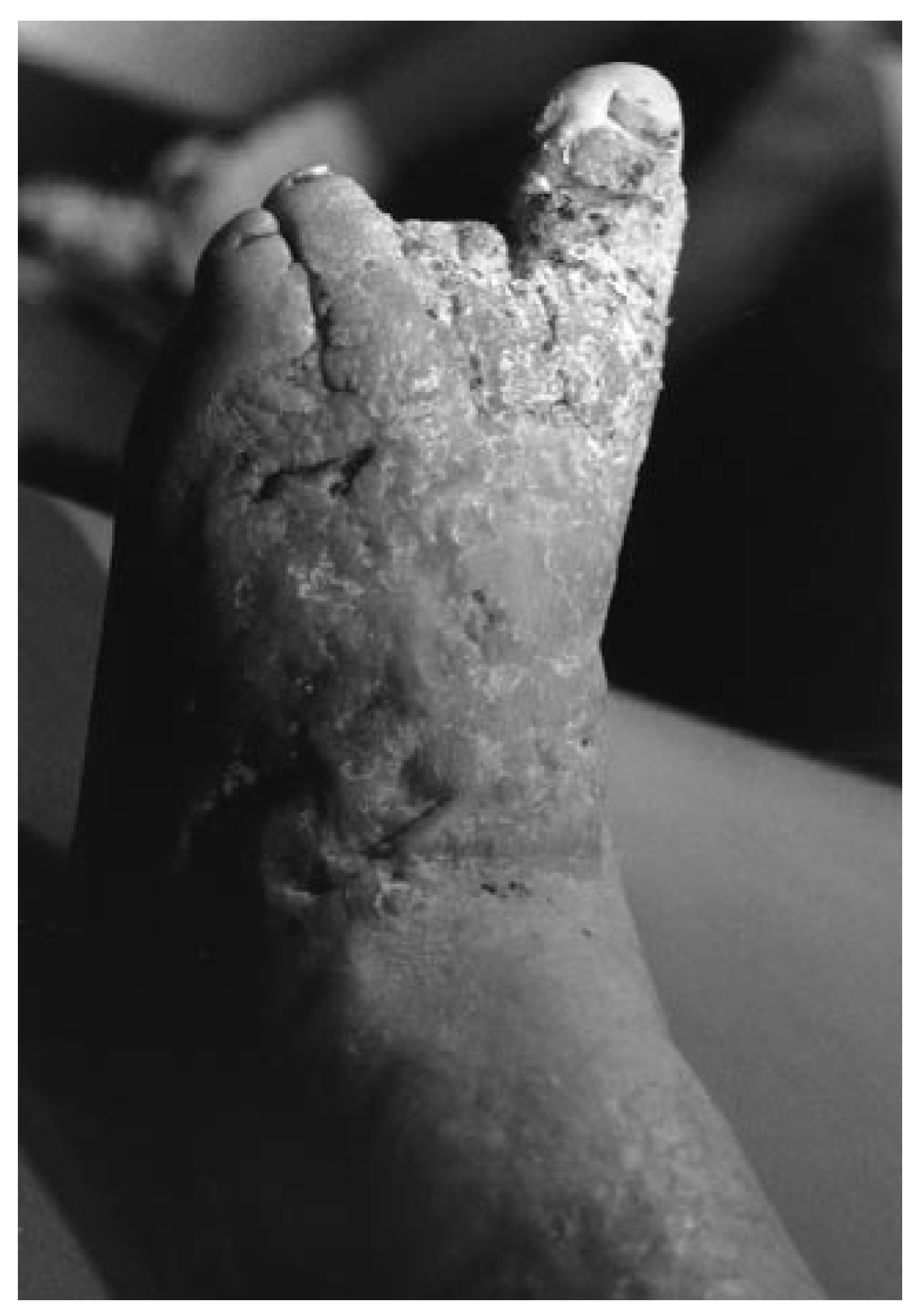
At the 1-month postoperative visit, the skin graft and donor sites had healed without complications. Approximately 2 months after the surgery, the patient was back at work, however not yet wearing shoes. There was recurrent breakdown of the skin graft of the left great toe (Fig. 3). After discussion with the patient, both the patient and surgeons believed that the patient would probably be better served by a transmetatarsal amputation.
Figure 2.
Note deep fissuring of the left foot.
Figure 2.
Note deep fissuring of the left foot.
Figure 3.
Two months after surgery on left foot.
Figure 3.
Two months after surgery on left foot.
Discussion
The management of lymphedema is difficult and often unrewarding [
2]. Recurrent attacks of cellulitis caused by β-hemolytic
Streptococcus are common and should be vigorously treated. Debridement, dressings, and cephalosporin-type antibiotics ought to be administered to avoid further lymphatic destruction, septic arthritis, or systemic infections.1 Prophylactic antibiotics for prevention should be considered. Surgery or excision of edematous tissue is reserved for severe cases where the swelling is marked, irreversible, and extremely disfiguring. Microlymphatic surgery, as described by Puckett [
3], has also been attempted to manage lymphedema, but with little success.
Summary
A pedal complication of Milroy’s disease has been presented. With a history of multiple debridement procedures as in this case, there is the risk of recurrent infections and the possibility of permanent vascular compromise, particularly with respect to the thin pedal skin on the dorsal aspect. When the toes are recurrently involved with infection, a patient may be best served with a transmetatarsal amputation using a skin flap on the plantar aspect.