The pressure to provide high-quality health care is higher than ever. Patients expect and deserve the best care possible; yet, that does not mean perfection. Any surgery entails a degree of risk, and postoperative infection is a ubiquitous example. The incidence of surgical site infections (SSIs) is well documented in musculoskeletal surgery [
1,
2,
3]. The economic burden of SSI management is high. Identifying the epidemiology and potential risk factors of SSIs is critical to prevention. Much of the available data are inclusive and do not separate nonelective surgery from elective surgery. As we collectively face increased scrutiny for the care we render, it is incumbent on us to establish reasonable benchmarks by which we are judged. In that spirit, the goal of this study was to evaluate published SSI rates for elective foot and ankle surgery and establish a reasonable standard to be applied in judging infection rates.
According to the Centers for Disease Control and Prevention (CDC), SSIs are the third most frequent nosocomial infection reported and are responsible for more than 36% of hospital-acquired infections in the United States [
4,
5]. This has a significant economic burden, accounting for the greatest hospital-acquired cost estimated to be
$3.3 billion annually [
5]. Compared with SSI rates in the orthopedic literature, it has been suggested that foot and ankle SSIs are higher due to the increased microbiological flora, especially interdigitally and within nail folds [
6]. Rates of SSI in the foot and ankle have been reported to vary between 1.0% to 5.3% [
7]. However, most of the studies reported SSIs as secondary rather than primary outcomes and vary in the definition of an infection, which limits interpretation. Miller [
8] first reported rates of clean foot and ankle procedures in 1981, with an overall infection rate of 2.2% in 1,841 procedures. Zgonis et al. [
9] found an overall 3.1% infection rate in 555 patients in elective outpatient foot and ankle surgery. An Australian study sought to identify SSI in podiatric surgery by nine surgeons. The overall infection rate was 3.1%, with 0.25% of infections requiring readmission [
10].
Many factors are associated with an increased risk of SSIs, and few studies have sought to identify these relationships in elective foot and ankle surgery. Wiewiorski et al. [
6] found age, obesity, use of tobacco, diabetes mellitus, multiple procedures on the same foot, operative time, tourniquet time, and duration of hospital stay to be significantly associated with the occurrence of SSIs. Identifying the SSI rate and risk factors for elective foot and ankle surgery is critical to effectively assess the operative risk for patients, to provide patient education, for operative treatment course, and for reimbursement systems to establish acceptable reimbursement principles based on accurate data that currently does not exist in the literature. The primary aim of this meta-analysis was to perform a comprehensive systematic review of the literature to identify the SSI rate and risk factors for elective foot and ankle surgery in the adult population.
Patients and Methods
A standard systematic review was performed by following the criteria described by Stroup et al. [
11] for reporting observational studies. A prospective protocol regarding the study objectives, study outcome measure or metameter (the number of soft-tissue site infections after elective foot and ankle surgery), inclusion and exclusion criteria, search strategy, and data of interest were carefully constructed and strictly followed. A meta-analysis was then performed on elective foot and ankle SSI articles.
Inclusion criteria for this meta-analysis included studies published on patients undergoing primary elective foot and ankle surgery who were 18 years or older. Study designs could have been experimental (randomized or not) or observational. Studies must have been published from 1999 to 2017 due to the timing of the definition of an SSI by the CDC. Studies must have reported extractable data regarding SSIs.
Studies were excluded if the patients included in the study had a history of infection before surgery, revision procedures, pediatric cases, case studies, and nonelective surgeries such as trauma and limb salvage procedures. Other excluded study designs included case series, abstracts from scientific meetings, review articles, nonhuman studies, studies in which the necessary data cannot be extracted from the published work, and studies in languages other than English. Of note, multiple publications identifying on the same patient population were pulled to avoid double counting data. The study with the longest follow-up was chosen.
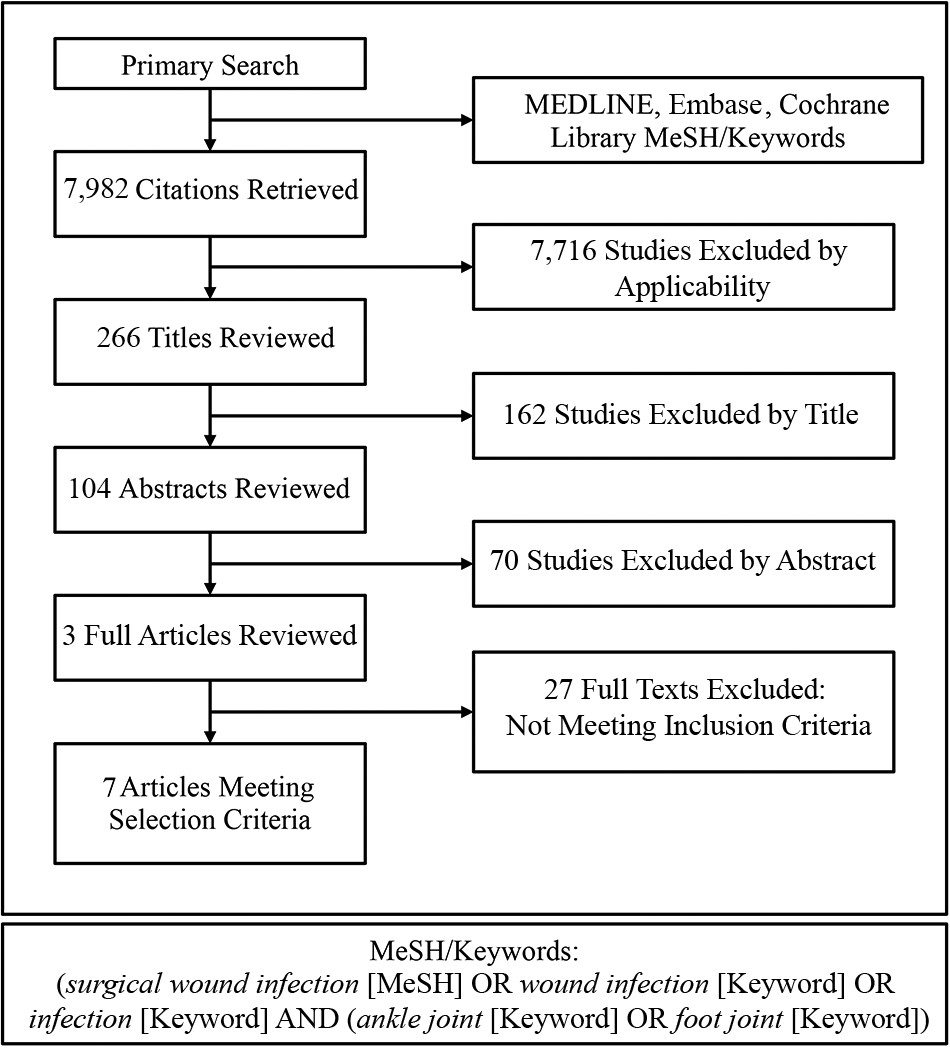
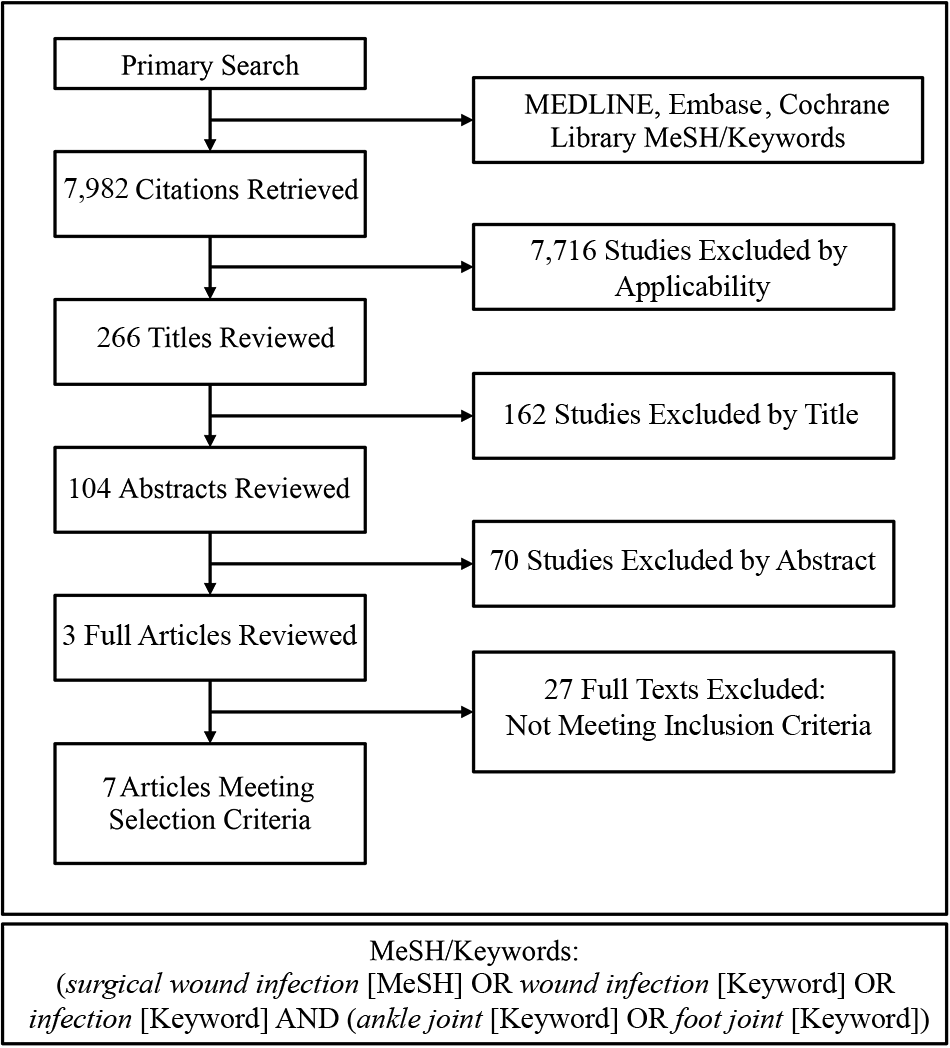
The following electronic databases were systematically searched for relevant articles from January 1999 to January 2017: MEDLINE, Embase, and Cochrane Library. Both Medical Subject Headings and exploiting terms aided in the initial search strategy to help ensure the capture of all articles. The use of “NOT” terms was used as necessary to avoid excessive capture. The following keywords and search terms were used:
surgical wound infection, wound infection, infection, ankle joint, and
foot joint (
Fig. 1).
Figure 1.
Consort diagram of meta-analysis search results. MeSH, Medical Subject Headings.
Figure 1.
Consort diagram of meta-analysis search results. MeSH, Medical Subject Headings.
Two readers (E.M., B.M.) who are both foot and ankle specialists evaluated whether the studies fulfilled the selection criteria, as outlined previously. The readers performed the article screening independently. If both readers did not agree with any articles throughout the entire data extraction process, discrepancies were resolved by a third independent person (E.A.C.). This person was blinded to the study title, authors, and location.
The primary outcome measure, or metameter, was the proportion of patients who had SSIs after elective foot and ankle surgery. Surgical site infection was defined according to the CDC and stratified as superficial, deep, or organ (involving bone) where possible. Superficial infections are localized to the skin and subcutaneous tissues. Deep SSIs affect the muscle and fascial regions. Organ-level infections extend to specified anatomy such as joint or bone [
12].
Data extraction included the following additional variables: study name, year of publication, country of origin, study design, number of patients and procedures, type of procedure, hardware included, sex, age, definition of infection, smoking status, comorbidities, immunocompromised status, and infection rate. A well-documented and accepted risk of bias tool, the Newcastle-Ottawa Scale (NOS), was implemented to assess the quality of nonrandomized studies used in a meta-analysis. The NOS provides a star ranking based on selection (4 stars), comparability (2 stars), and exposure or outcome (3 stars) (
Table 1) [
13].
Table 1.
Study Characteristics, Demographics, and Newcastle-Ottawa Scale Rating.
Table 1.
Study Characteristics, Demographics, and Newcastle-Ottawa Scale Rating.
All of the data were analyzed with Comprehensive Meta-Analysis (Version 2.2.046; Biostat Inc, Englewood, New Jersey) and SAS (Version 9.1.3R33; SAS Institute Inc, Cary, North Carolina). Determination of the appropriate model was then chosen based on the amount of heterogeneity present. It was suspected that heterogeneity would be high due to variations in the types of surgery included, follow-up time, variations in outcomes reported, proportion of patients lost to follow-up, comorbidities of the patients, and study quality. Therefore, a random-effects model was used in analyzing the overall results.
Separate subanalyses, sensitivity analyses, analysis of variance, and meta-regression were used to help identify and control for potential confounders. A meta-regression was planned to evaluate the relative risk of SSI, and wound dehiscence stratification of deep versus superficial infections was also planned. The Cochran Q statistic for heterogeneity, the I2 statistic, and the Kendall tau-squared statistic were calculated for each subgroup analysis. The differences between subgroups were tested for significance with the analysis of variance technique. A P < 0.05 was considered statistically significant.
Results
The primary search revealed 7,982 citations. Of those, 266 titles were found to be applicable and were, therefore, reviewed. After excluding 162 titles, 104 abstracts were reviewed, leaving 34 full articles that were reviewed by two independent researchers (E.M., B.M.). Of the 34 full articles reviewed, 27 did not meet the inclusion criteria and were excluded from the meta-analysis. Seven articles met the selection criteria and were entered into the analysis. Study attrition is outlined in
Figure 1. The seven articles that met the inclusion criteria included 7,310 procedures in 6,257 patients. Demographics included 70% female with a mean age of 51.22 years. The risk of bias was assessed with the NOS, which demonstrated an average selection score of 3.3 of 4 stars, comparability score of 2 of 2 stars, and exposure/outcome score of 3 of 3 stars (
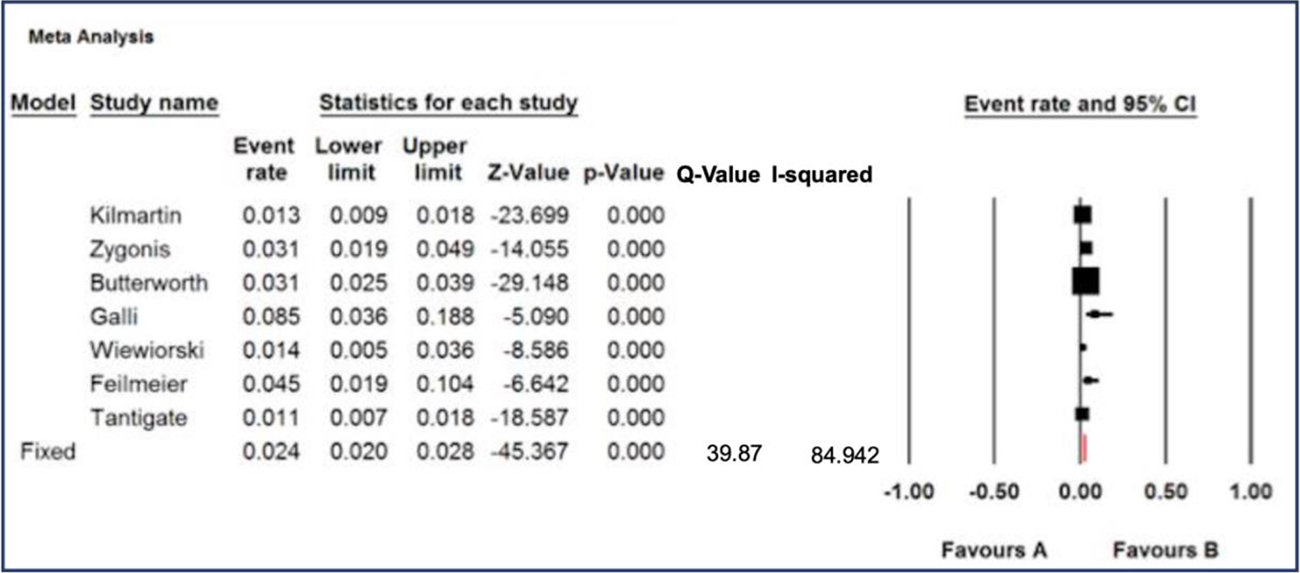
Table 1). Meta-analysis of the data using a random-effects model demonstrated an SSI rate of 2.5% (0.025), with
Q = 39.847. As anticipated, heterogeneity was found to be high, with
Q = 39.87 and
I2 = 84.942 (
Fig. 2). Using a one-study-removed model, heterogeneity remained high. Galli et al's [
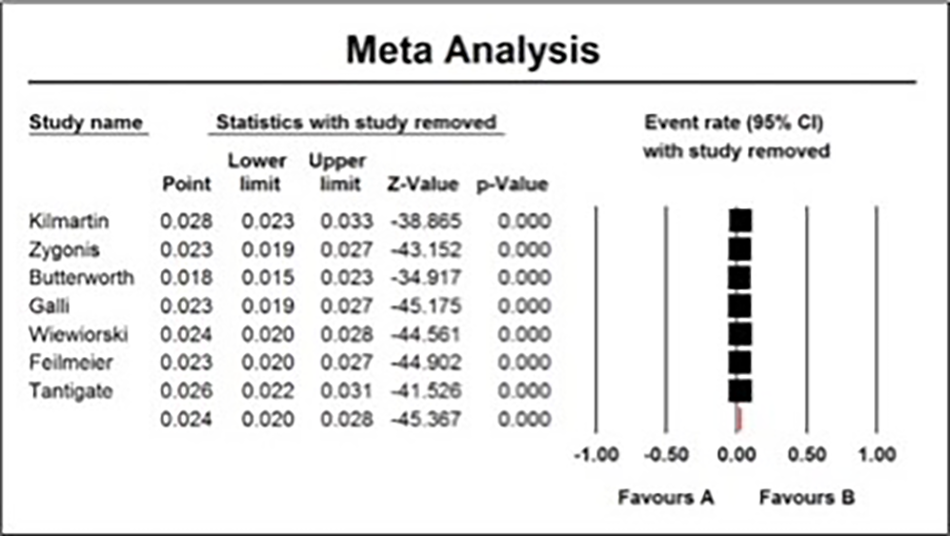
14] SSI rate of 8.47% was identified as the largest deviation, and its exclusion resulted in the overall SSI rate being lowered to 0.021 (95% confidence interval [CI], 0.015-0.039) SSI rate (
Fig. 3).
Figure 2.
Forest plot of the seven included studies. CI, confidence interval.
Figure 2.
Forest plot of the seven included studies. CI, confidence interval.
Figure 3.
Forest plot of the one-study-removed model. CI, confidence interval.
Figure 3.
Forest plot of the one-study-removed model. CI, confidence interval.
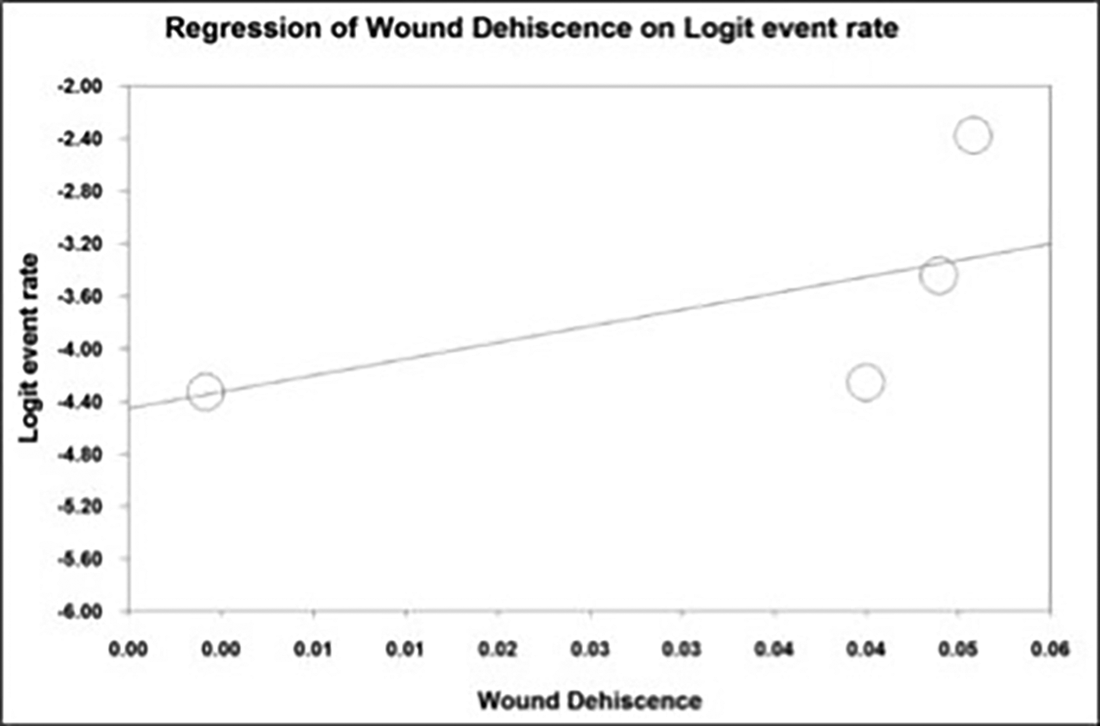
A meta-regression evaluating the association of SSI and wound dehiscence showed that the relative risk of infection was 21 (95% CI, 9.96-32.84;
P = .00024) when wound dehiscence was reported (
Fig. 4). Subgroup analysis of deep versus superficial SSIs showed a superficial infection rate of 0.009% and a deep infection rate of 0.0042% in elective foot and ankle surgery. Only one study reported on SSI causing bone infection, at a rate of 0.004%.
Figure 4.
Meta-regression evaluating the association of surgical site infection and wound dehiscence.
Figure 4.
Meta-regression evaluating the association of surgical site infection and wound dehiscence.
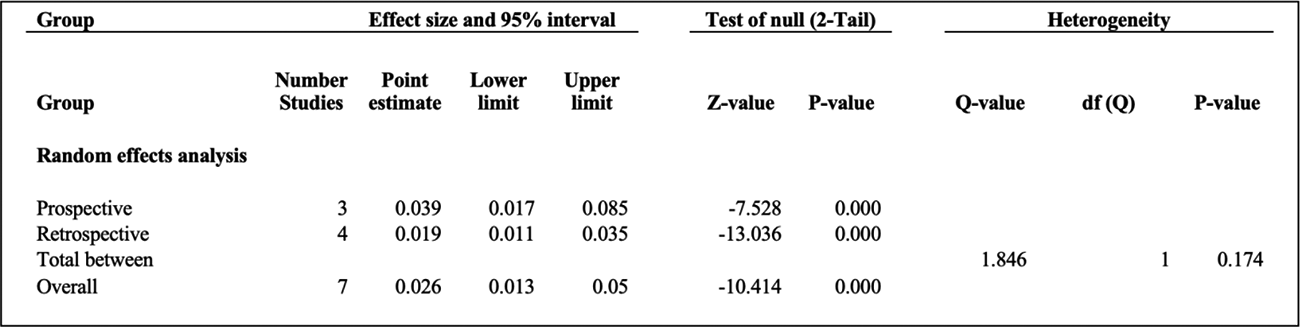
Subgroup analysis was performed to determine whether study design had a statistically significant effect on the results. Specifically, the difference in the reported infection rate between prospective and retrospective studies was analyzed. The observed heterogeneity dictated that a random-effects model would be more appropriate. Using the random-effects model, prospective trials reported a mean infection rate of 0.039 (95% CI, 0.017-0.085) and retrospective studies had a mean rate of 0.019 (95% CI, 0.011-0.035). Using the random-effects model, this difference was not found to be significant (
P = .174) and suggests that study design is a less relevant factor (
Fig. 5).
Figure 5.
Random-effects analysis of prospective versus retrospective studies. CI, confidence interval.
Figure 5.
Random-effects analysis of prospective versus retrospective studies. CI, confidence interval.
Discussion
The primary aim of this investigation was to identify the SSI rate for elective foot and ankle surgery. In the literature, SSI rates in the foot and ankle have been reported to vary between 1.0% and 5.3% [
5]. The present meta-analysis calculated an overall SSI rate in elective foot and ankle surgery of 2.5% (random-effects model).
Note that there was a high level of heterogeneity in the studies (
Q = 39.847). To address this potential limitation, all of the analyses were conducted assuming a random-effects model. This approach is considered conservative, making it more difficult to achieve statistical significance. At the same time, the random-effects model is effective in estimating heterogeneity and effect size in this setting. Furthermore, it was identified that the study by Galli and colleagues [
14] had the highest deviation in SSI rate, reported to be 8.47%. It was, therefore, decided to perform a one-study-removed analysis, which found a relatively stable SSI rate of 0.021 (95% CI, 0.015-0.039), which is comparable with the literature [
14,
15,
16].
Clinically, wound dehiscence increases our awareness of the risk of infection after surgery, but the magnitude of that risk has yet to be specified. To examine this relationship further, a meta-regression was performed. The purpose of this meta-regression was to identify possible risk factors that contributed to SSI, allowing wound dehiscence to be assessed. In this analysis, a significant relationship was observed where the relative risk of infection was 21 (95% CI, 9.96-32.84; P = 0.00024) when wound dehiscence was reported. This supports the long-held belief that wound dehiscence is a meaningful risk factor for surgical infection. Only four of the studies specified the rate of wound dehiscence, which reduced the sample size.
A comparison was made to determine whether there was a difference in reported infection rates between prospective and retrospective studies. The observed heterogeneity dictated that a random-effects model would be more appropriate. Using this model, prospective trials reported a mean infection rate of 0.039 (95% CI, 0.017-0.085) and retrospective studies had an observed mean rate of 0.019 (95% CI, 0.011-0.035). This difference was not significant (P = 0.174) and suggests that study design is a less relevant factor. Moreover, a more likely contributing factor was the mean number of procedures performed: 155 for the prospective studies and a much higher 1,712 for the retrospective studies.
An interesting finding of the present study was the infection rate compared with the use of prophylactic antibiotics. Zgonis et al. [
9] reported in their 2004 article that the use of prophylactic antibiotics did not significantly impact SSI rates, finding a 1.4% infection rate with prophylaxis and a 1.6% infection rate without prophylaxis. Only three of the selected studies in the present analysis specified the use of preoperative antibiotics. Two of the studies used preoperative antibiotics in at least 99% of elective cases and reported a mean infection rate of 1.2%. What makes this interesting is that Zgonis et al used prophylaxis in 55% of cases and had a far larger overall infection rate of 3.1%. It is difficult to confirm this finding because of the relative dearth of data and the lack of infusion time relative to tourniquet application, which is a known moderator of antibiotic effectiveness [
17].
Another interesting finding was that in patients provided prophylactic antibiotics, the rate of any reported wound complication was higher at 5.5% [
6,
9,
12] versus 1.62% [
9] in those not receiving antibiotics beforehand. At least in the case of the study by Zgonis et al. [
9], their data indicated that antibiotics were provided more frequently in more complicated cases. This may be driven by the fact that cases with multiple procedures and incisions may be perceived as higher risk by the surgeon and intrinsically carry an elevated risk of wound complication.
The NOS, a risk of bias tool for determining a quality study, is a well-documented and accepted method of assessing nonrandomized studies for use in a meta-analysis. This study used articles that were deemed high quality [
13]. The average NOS ratings for selection, comparability, and exposure/outcome were 3.3 stars, 2 stars, and 3 stars, respectively. The seven articles that met the inclusion criteria for this study were published in five different journals (
The Foot, The Journal of Foot and Ankle Surgery, Foot & Ankle Specialist, Foot & Ankle International, and
Australian Health Review). This limited diversity in publications is likely due to the inclusion criteria specifying elective foot and ankle surgery.
A significant limitation of the present study was that although a plan to analyze risk factors and subgroups existed, the data could not be stratified in a way that was amenable to an additional subanalysis. The limitation of meta-regression for observational data is under extensive research and is limited in this meta-analysis by the number of studies that where included. Additional known risk factors for SSI were reported by several of the studies meeting the inclusion criteria, but incomplete data limited their inclusion. For example, although four studies reported on populations with diabetes and rheumatoid arthritis, the rate of infection for these subgroups could not be isolated from the overall rate of infection. Only Wiewiorski et al. [
6] delineated the infection rate for tobacco users (8.7%) versus more than 1% in the rest of the cohort. Although the length of surgery and tourniquet use are reported risk factors, none of the elective studies reported a difference in SSI rates based on these factors [
17]. Wiewiorski et al did note that longer surgery times increased the risk of wound complication, which the meta-regression indicates is a meaningful risk factor for SSI. Finally, a reliable comparison could not be made based on the surgical setting (hospital versus ambulatory surgery center) due to the confounding factor of preoperative antibiotic prophylaxis.
Additional limitations of this meta-analysis included the challenges in the methods of reporting SSIs for foot and ankle surgery. Many studies combined elective and nonelective cases. Infection was often not the primary outcome measure, and generally nonstandardized definitions of infection were reported. There was variable follow-up across studies, and many studies were from only one surgeon or one center. Although the subanalyses were intended to address these concerns to the best of our ability, the results are still limited to the available data.
In conclusion, an established benchmark for infection rates for elective foot and ankle surgery is needed. Overall, these results show that SSI rates in elective foot and ankle surgery are comparable with those documented in the orthopedic literature. The large amount of heterogeneity among studies, the limited comparable data, and a multitude of confounding factors affecting the incidence rate of infection limited the analysis. Using standardized definitions of SSI as defined by the CDC would be useful in future studies reporting SSIs in foot and ankle surgery.