Next Article in Journal
A Nonhealing, Painful, Exophytic, Eroded Nodule on the Left Fifth Toe
Previous Article in Journal
Treatment of a Damaged Posterior Tibialis Tendon Through Reconstruction Using a Hamstring Autograft. A Case Report
 
 
Journal of the American Podiatric Medical Association is published by MDPI from Volume 116 Issue 1 (2026). Previous articles were published by another publisher in Open Access under a CC-BY (or CC-BY-NC-ND) licence, and they are hosted by MDPI on mdpi.com as a courtesy and upon agreement with American Podiatric Medical Association.
Article

Results of Bioabsorbable Screws for the Fixation of Chevron Osteotomy in the Treatment of Hallux Valgus Deformities

Orthopaedic Medical Center, The Second Hospital of Jilin University, Changchun, China
*
Author to whom correspondence should be addressed.
J. Am. Podiatr. Med. Assoc. 2025, 115(2), 24043; https://doi.org/10.7547/24-043
Published: 1 March 2025

Abstract

Background: This study aimed to investigate the safety and reliability of using bioabsorbable screws for the fixation of chevron osteotomy in the treatment of hallux valgus (HV) deformity. Methods: Clinical cases of chevron osteotomy in the treatment of HV deformities in our hospital between December 2018 and August 2022 were retrospectively summarized to compare preoperative imaging indices, including HV angle (HVA), intermetatarsal angle, and tibial sesamoid position, with those at the final follow-up session. The American Orthopaedic Foot & Ankle Society hallux metatarsophalangeal-interphalangeal scale, 36-Item Short Form Survey, and European Foot and Ankle Society scale were used to assess therapeutic efficacy. The visual analog scale was used to assess pain relief. Moreover, complications were recorded. Results: Twenty-six patients (39 feet) were included, and the mean follow-up period was 24.0 months. No infection, delayed healing, or nonhealing was recorded. The osteotomy ends healed well without nonunion or delayed union. Four cases of recurrence (HVA $20°), two cases of numbness in the distal toe, one case of necrosis of the first metatarsal head, and one case of osteoarthritis of the first metatarsophalangeal joint occurred. No patients underwent secondary surgery. The HVA, intermetatarsal angle, and tibial sesamoid position significantly reduced at the final follow-up session compared with their preoperative values, and significant improvement was seen in clinical scores. Conclusions: The use of bioabsorbable screws for the fixation of chevron osteotomy is safe and effective in the treatment of HV deformities.

Hallux valgus (HV) is the most common deformity in the foot and ankle, with an extremely high prevalence, and often needs surgery. Specifically, chevron osteotomy is one of the most widely performed procedures and has demonstrated favorable results.[1] After osteotomy, a hollow headless metal compression screw is usually used for fixation. The osteotomy end may be well fixed using metal screws. However, like other metal implants, metal screws are associated with issues such as stress shielding and delayed foreign body reaction, which often requires secondary removal surgery, increasing the physical, psychological, and economic burden of the patient.
In recent years, development has been seen in bioabsorbable materials, which have been increasingly used in surgery to treat HV deformities. Bioabsorbable screws have an elastic modulus similar to that of cancellous bone and have been shown to prevent the stress shielding and bone atrophy caused by metal screws. Moreover, these screws are more biocompatible, can be naturally absorbed by the body through decomposition and metabolism, have a higher safety profile, and do not require removal by secondary surgery.[2,3,4] However, the reliability of the fixation by bioabsorbable screws remains controversial because they have lower strength than metal screws. Our previous biomechanical study revealed that bioabsorbable screws exhibited compression strength comparable to that of hollow titanium alloy screws and 60% to 90% of the stiffness of the hollow screws.[5] Moreover, polylactic acid (PLA) bioabsorbable screws retained their strength and stiffness after as many as 240,000 compression cycles while avoiding stress shielding. Thus, this study aimed to investigate the efficacy and safety of using bioabsorbable screws in the fixation of chevron osteotomy for the treatment of HV deformities by retrospectively comparing and analyzing preoperative and postoperative clinical scores and imaging indices of patients with HV deformity.

Materials and Methods

Research Ethics

This study strictly adhered to the Declaration of Helsinki and passed the review by the institutional review board of the hospital.

Patient Screening

This study retrospectively analyzed clinical cases in which bioabsorbable screws were used for the fixation of chevron osteotomy in the treatment of HV deformities in the study hospital between December 2018 and August 2022. The inclusion criteria were as follows: 1) patients with HV and observable clinical symptoms, 2) patients who underwent chevron osteotomy, 3) patients who underwent fixation of osteotomy using bioabsorbable screws, 4) patients aged $18 years, and 5) patients with a follow-up period $12 months. The exclusion criteria were as follows: 1) patients who underwent other operative procedures, 2) use of internal fixation materials other than bioabsorbable screws, 3) follow-up period <12 months or loss to follow-up, and 4) hallux valgus deformity caused by rheumatoid arthritis.

Surgical Methods

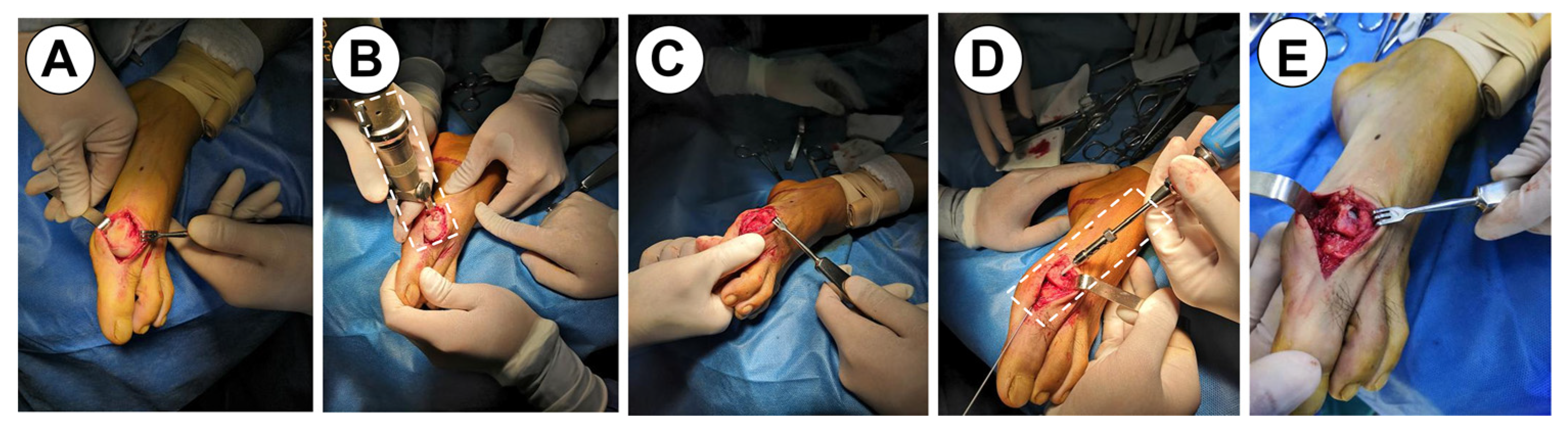
Nerve block and local infiltration anesthesia were performed in all patients. As shown in Figure 1, the patient was placed in the supine position and a rubber tourniquet was tied around the proximal end of the ankle joint on the operative side. All patients were initially subjected to lateral soft tissue release. A 1-cm longitudinal incision was made in the web space between the first and second toes of the foot to separate the metatarsophalangeal joint capsule, cut off the adductor hallucis muscle, and release the sesamoid ligaments and lateral joint capsule. Next, a longitudinal incision of approximately 3 cm was made on the anteromedial aspect of the distal end of the first metatarsal to expose the first metatarsal head. After removing hyperplasia exostosis, a V-shaped osteotomy (chevron osteotomy) of 60˚ to 90˚ was made, with the center of the metatarsal head as the apex. After pushing the distal end of the osteotomy outward by 6 to 8 mm depending on the severity of the HV deformity, a 2.7-mm bioabsorbable screw (SinoBiom, Changchun, China) was used for fixation from the proximal aspect. Next, tightening of the medial joint capsule was simulated and a closing wedge osteotomy (Akin osteotomy) of the proximal phalanx was performed if the surgeon is not satisfied with the foot’s appearance. After a visual inspection of the foot alignment, the procedure was completed with layer-by-layer suturing.
Wound dressing was changed and anti-inflammatory therapy was provided postoperatively. The medical staff also assisted the patient in performing active and passive movements of the first metatarsophalangeal joint. The patient was allowed to walk off the floor in a forefoot decompression shoe 1 week postoperatively. The patient resumed normal weight-bearing walking 6 weeks postoperatively.

Observation Items and Methods

Radiologic Assessment. Anteroposterior and lateral views of weightbearing radiographs of the affected foot were taken before surgery and at the final postoperative follow-up to measure the HV angle (HVA) and intermetatarsal angle (IMA) and assess the tibial sesamoid position (TSP).
Functional Assessment. The American Orthopaedic Foot & Ankle Society (AOFAS) hallux metatarsophalangeal-interphalangeal scale was used to assess therapeutic efficacy, with 100 as the total score (90–100 points indicating excellent, 75–89 indicating good, 50–74 indicating fair, and <50 indicating poor). The 36-Item Short Form Survey (SF-36) and European Foot and Ankle Society (EFAS) scale were also used to assess therapeutic efficacy.
The visual analog scale (VAS) was used to assess the degree of pain relief and complications were recorded.

Statistical Methods

Data were analyzed using SPSS Statistics 27.0 (IBM, Armonk, New York) for Windows (Microsoft, Redmond, Washington) and measurement data were expressed as mean 6 SD. The paired t test was used to compare preoperative and postoperative measurement data and the independent samples t test was used to compare results between groups. P < .05 indicated a statistically significant difference.

Results

Clinical Outcomes

A total of 26 patients (23 female and three male [39 feet]) were included in this study, with eight, five, and 13 cases involving the left, right, and bilateral feet, respectively. The mean patient age was 39.3 years (range, 20–63 years). The mean follow-up period was 24.0 months (range, 12–57 months). Distal osteotomy of the first metatarsal (chevron osteotomy) was performed on all 39 feet. Akin osteotomy was additionally performed on seven feet, distal chevron osteotomy of the fifth metatarsal was performed on two feet, Weil osteotomy of the second metatarsal was performed on one foot, second interphalangeal joint fusion was performed on one foot, and Morton neuroma excision was performed on one foot. No infection, delayed healing, or nonhealing was seen, and osteotomy ends healed well without nonunion or delayed union. Regarding complications, four cases of recurrence (HVA $20˚), two cases of distal toe numbness, one case of necrosis of the first metatarsal head, and one case of osteoarthritis of the first metatarsophalangeal joint occurred, and none required secondary surgery (Table 1).

Imaging Assessment

Radiologic assessment parameters, including HVA, IMA, and TSP grade, significantly improved at the final follow-up compared with preoperative levels. As seen in Table 2 , the postoperative and preoperative HVAs were 12.7˚ 6 5.1˚ and 33.4˚ 6 6.7˚, the postoperative and preoperative IMAs were 5.8˚ 6 1.7˚ and 14.6˚ 6 2.9˚, and the postoperative and preoperative TSP grades were 2.9 6 0.9 and 6.0 6 0.7, respectively. Compared with preoperative scores, postoperative clinical scores, including AOFAS, SF-36, EFAS, and VAS scale scores, were significantly improved. The postoperative and preoperative AOFAS scale scores were 94.3 6 6.1 and 64.2 6 11.0, the postoperative and preoperative VAS scale scores were 0.6 6 0.7 and 4.4 6 1.6, the postoperative and preoperative EFAS scale scores were 20.5 6 3.5 and 9.6 6 4.1, and the postoperative and preoperative SF-36 scores were 96.4 6 3.4 (physical component score) and 82.7 6 16.4 (mental component score) and 81.1 6 7.5 (physical component score) and 73.2 6 13.6 (mental component score), respectively.

Reduction of TSP and Therapeutic Efficacy

To assess the effect of TSP reduction on therapeutic efficacy, study cases were divided into two groups: a TSP reduction group (n 5 29) and a TSP nonreduction group (n 5 10). The results of the comparative analysis of the postoperative imaging parameters as well as pain and functional scores showed no significant difference in HVA, IMA, VAS scale scores, or AOFAS scale scores between the two groups.

Discussion

The use of bioabsorbable materials for the treatment of HV deformities was first reported in 1995, when Small et al[6] used bioabsorbable polydioxanone pins for the fixation of chevron osteotomy. The patients were followed up for 1 year, and the results showed no complications or infections, no fractures or displacements, and no need for pin removal, which appeared to be a significant benefit compared with fixation using metals. Since then, a few studies have reported favorable outcomes.[7,8,9]
In the present study, HVA, IMA, and TSP grade were significantly improved at the final follow-up compared with preoperative levels, with a mean follow-up period of 24 months. Postoperative AOFAS, SF-36, EFAS, and VAS scale scores were also significantly improved. These findings were similar to those of previous reports, and the therapeutic efficacy of bioabsorbable screws was comparable to that of metal screws reported during the same period,[10,11,12] which indicated the favorable clinical efficacy of bioabsorbable screws. Moreover, secondary surgery was not required to remove the implants, which reduced the physical and psychological burden on patients, resulting in high acceptance of and satisfaction with the surgery.
Mechanical strength is a major concern when using bioabsorbable materials for the fixation of fracture or osteotomy. However, these materials are relatively safe when used in chevron osteotomy because of the following reasons. First, chevron osteotomy is a V-shaped and embedded osteotomy in which the upper and lower osteotomy surfaces are compressed against each other, resulting in relatively higher stability when bearing load and thus requiring relatively lower strength of the implant material.[13] Second, unlike most previous studies, which mainly used materials such as PLA or its copolymers, the novel material used in the present study incorporated hydroxyapatite, which increased the flexural and tensile strength of the material.[14] In addition, owing to the presence of threads, the screws demonstrated stronger grip and resistance to pulling out, unlike previously used pins, which increased the stability of the fixation. Our previous biomechanical study revealed that bioabsorbable screws exhibited compression strength comparable to that of hollow titanium alloy screws and 60% to 90% of the stiffness of the hollow screws.[5] Moreover, PLA bioabsorbable screws retained their strength and stiffness after as many as 240,000 compression cycles while avoiding stress shielding. Based on the aforementioned experimental analyses, despite the huge difference in the mechanical properties between the two materials, the fixation outcomes are compatible when they are used for fixation as implants in chevron osteotomy. The most significant difference between the two materials is that at low load levels (no more than 300 N), the mean angular deformation of PLA is approximately 2.3 times higher than that of titanium, indicating that micromotion is more likely to occur when using PLA screws for fixation. Numerous clinical studies have revealed that bone healing begins with a certain degree of mobility and fracture width and that the adaptability to deformation at the fracture healing site is quite astonishing; therefore, appropriate physical stimulation is a key factor in promoting fracture healing.[15,16,17] We believe that the stiffness of PLA screws lower than that of metal screws should not be considered a disadvantage but rather an advantage in promoting fracture healing following osteotomy.
Although we could not assess dynamic changes in bioabsorbable screws in the fixation of chevron osteotomy to determine transient stability, as patients’ immediate postoperative radiographs were non-weightbearing and any loss of displacement distance could not be measured accurately, the osteotomy of all patients healed by primary intention without non-union or delayed union, which indirectly confirmed the stability of the fixation of the osteotomy.
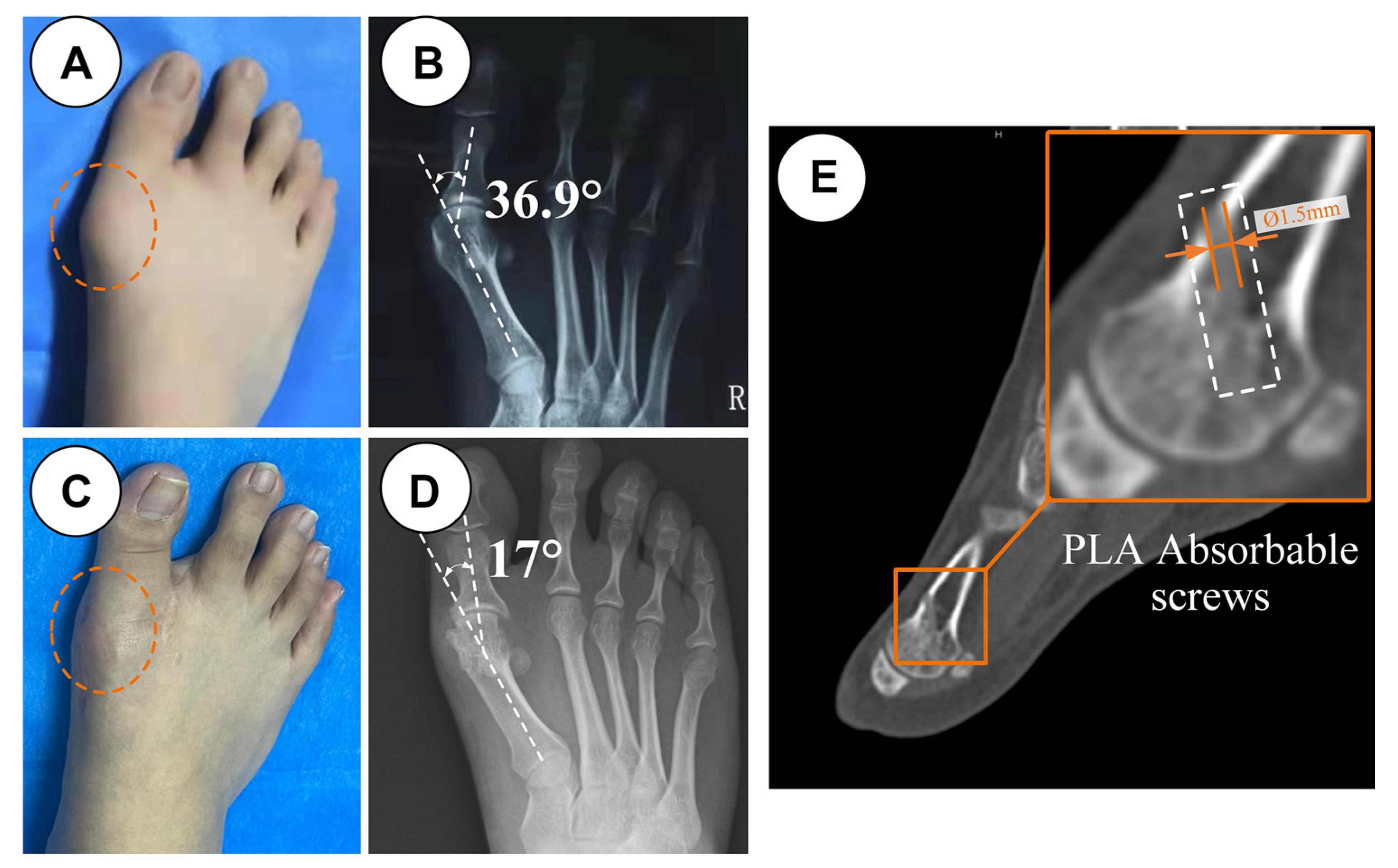
Regarding complications, four cases of recurrence, two cases of distal toe numbness, one case of necrosis of the first metatarsal head, and one case of osteoarthritis of the first metatarsophalangeal joint occurred, none of which required secondary surgery. All of these were common procedure-related complications rather than material-related complications.[18] The most common complications associated with the use of bioabsorbable materials include foreign body reactions, osteolysis, and bone cysts. Bostman and Pihlajamaki[19] reported clinically significant local inflammation and sterile tissue reactions in 108 of 2,528 patients (4.3%) who underwent surgery with pins, rods, bolts, and screws made of polyglycolic acid or PLA. In patients experiencing severe reactions, extensive osteolytic lesions were seen along the implant tract, which histopathologically manifested as nonspecific foreign body reactions. Pavlovich and Caminear[20] reported a case of a cystic lesion on magnetic resonance imaging after fixation of chevron osteotomy with bioabsorbable material in the treatment of HV deformities. After surgical excision, the lesion was identified as a giant cell granuloma. None of the aforementioned complications were recorded in this study, and the probable reason is that most of the bioabsorbable materials used in previous studies were monomers of polyglycolic acid or PLA, which would be resorbed within a short period of time, eliciting an extensive immune response, with a large increase in macrophages and cavity formation. By contrast, the novel material used in the present study consisted of a mixture of PLA and hydroxyapatite, which would be resorbed over a long period of time, eliciting a much weaker immune response. Moreover, the addition of hydroxyapatite can provide a weakly alkaline local environment to promote osteogenesis in the surrounding tissues, making the material more biocompatible.[21] In this study, at 2 years postoperatively, most of the screws had not been completely resorbed, maintaining a favorable mass effect, which made fixation of the chevron osteotomy using absorbable screws safer (Figure 2).
In the treatment of HV deformities, whether the position of the sesamoid bone should be reduced has been controversial. Some studies have suggested that poor TSP reduction may lead to poorer clinical outcomes and higher recurrence rates post-operatively,[22,23] whereas others have shown no significant relationship between postoperative TSP reduction and clinical outcomes.[24,25] In the sub-group analyses in the present study, the relationship between TSP reduction and prognostic imaging and functional pain scores was explored, and the results showed no significant differences in imaging parameters between the TSP reduction group and the TSP nonreduction group. Regarding clinical pain and functional scores, although the TSP nonreduction group had poorer scores than the TSP reduction group, the results were not statistically significant (Table 3).
This study has some limitations. First, retrospective analyses without a control group were performed. In this study, compared with similar studies, analogous clinical efficacy was obtained. Second, the follow-up period was short and may be categorized as short-term follow-up. The follow-up period has not yet reached the time required for the complete resorption of bioabsorbable screws. Thus, future studies should have a longer follow-up period. Finally, the number of cases analyzed was low; thus, more cases are needed to support our findings.

Conclusions

The fixation of chevron osteotomy with bioabsorbable screws is safe and effective in the treatment of HV deformities.

Funding

This work was supported by the National Key R&D Program of China (grant number 2022YFE0107700), Science and Technology Department Program of Jilin Province (grant numbers 20190304121YY and 20210402006GH), and Finance Department of Jilin Province (grant number 2020SC2T001).

Conflicts of Interest

None reported.

References

  1. Clemente, P.; Mariscal, G.; Barrios, C. Distal chevron osteotomy versus different operative procedures for hallux valgus correction: a meta-analysis. J Orthop Surg Res 2022, 17, 80. [Google Scholar] [CrossRef]
  2. Pietrzykowska, E.; Romelczyk-Baishya, B.; Chodara, A.; et al. Microstructure and mechanical properties of inverse nanocomposite made from polylactide and hydroxyapatite nanoparticles. Materials (Basel) 2021, 15, 184. [Google Scholar] [CrossRef]
  3. Am, Ibrahim; Pg, Koolen; Kim, K.; et al. Absorbable biologically based internal fixation. Clin Podiatr Med Surg 2015, 32, 61. [Google Scholar]
  4. Daghino, W.; Bistolfi, A.; Aprato, A.; et al. Bioabsorbable implants in foot trauma surgery. Injury 2019, 50 (suppl 4), S47. [Google Scholar] [CrossRef] [PubMed]
  5. Liu, C.; Huang, L.; Zhang, H.; et al. Biomechanical comparison between bioabsorbable and medical titanium screws in distal chevron osteotomy of first metatarsal in hallux valgus treatment. J Mech Behav Biomed Mater 2022, 131, 105260. [Google Scholar] [CrossRef] [PubMed]
  6. Hn, Small; Wg, Braly; Tullos, H.S. Fixation of the chevron osteotomy utilizing absorbable polydioxanon pins. Foot Ankle Int 1995, 16, 346. [Google Scholar]
  7. Jh, Song; Kang, C.; Park, Wh.; et al. Extended distal chevron osteotomy and Akin osteotomy using bioabsorbable materials for treatment of moderate to severe hallux valgus. J Foot Ankle Surg 2021, 60, 1110. [Google Scholar]
  8. Morandi, A.; Ungaro, E.; Fraccia, A.; et al. Chevron osteotomy of the first metatarsal stabilized with an absorbable pin: our 5-year experience. Foot Ankle Int 2013, 34, 380. [Google Scholar] [CrossRef]
  9. Caminear, Ds; Pavlovich, R.; Pietrzak, W.S. Fixation of the chevron osteotomy with an absorbable copolymer pin for treatment of hallux valgus deformity. J Foot Ankle Surg 2005, 44, 203. [Google Scholar] [CrossRef]
  10. Giotis, D.; Nk, Paschos; Zampeli, F.; et al. Modified chevron osteotomy for hallux valgus deformity in female athletes. A 2-year follow-up study. Foot Ankle Surg 2016, 22, 181. [Google Scholar] [CrossRef]
  11. Komur, B.; Yilmaz, B.; Kaan, E.; et al. Mid-term results of two different fixation methods for chevron osteotomy for correction of hallux valgus. J Foot Ankle Surg 2018, 57, 904. [Google Scholar] [CrossRef]
  12. Zhang, S.; Wang, X.; Chen, T.; et al. Outcomes of modified chevron osteotomy for hallux valgus. Foot Ankle Surg 2022, 28, 514. [Google Scholar] [CrossRef]
  13. Favre, P.; Farine, M.; Snedeker, J.; et al. Biomechanical consequences of first metatarsal osteotomy in treating hallux valgus. Clin Biomech (Bristol) 2010, 25, 721. [Google Scholar] [CrossRef][Green Version]
  14. Hong, Z.; Zhang, P.; He, C.; et al. Nanocomposite of poly(L-lactide) and surface grafted hydroxyapatite: mechanical properties and biocompatibility. Biomaterials 2005, 26, 6296. [Google Scholar] [CrossRef]
  15. Perren, S.M. Fracture healing: fracture healing understood as the result of a fascinating cascade of physical and biological interactions. Part I. An attempt to integrate observations from 30 years AO research. Acta Chir Orthop Traumatol Cech 2014, 81, 355. [Google Scholar] [CrossRef]
  16. Perren, Sm; Fernandez, A.; Regazzoni, P. Understanding fracture healing biomechanics based on the “strain” concept and its clinical applications. Acta Chir Orthop Traumatol Cech 2015, 82, 253. [Google Scholar] [CrossRef]
  17. Al, Foster; Tf, Moriarty; Zalavras, C.; et al. The influence of biomechanical stability on bone healing and fracture-related infection: the legacy of Stephan Perren. Injury 2021, 52, 43. [Google Scholar] [CrossRef]
  18. Trnka, H.J. Managing complications of foot and ankle surgery: hallux valgus. Foot Ankle Clin 2022, 27, 271. [Google Scholar] [CrossRef] [PubMed]
  19. Om, Bostman; Pihlajamaki, H.K. Adverse tissue reactions to bioabsorbable fixation devices. Clin Orthop Relat Res 2000, (371), 216. [Google Scholar]
  20. Pavlovich, R.; Caminear, D. Granuloma formation after chevron osteotomy fixation with absorbable copolymer pin: a case report. J Foot Ankle Surg 2003, 42, 226. [Google Scholar] [CrossRef] [PubMed]
  21. Cui, Y.; Liu, Y.; Cui, Y.; et al. The nanocomposite scaffold of poly(lactide-coglycolide) and hydroxyapatite surface-grafted with L-lactic acid oligomer for bone repair. Acta Biomater 2009, 5, 2680. [Google Scholar] [CrossRef] [PubMed]
  22. Bello-Tejeda, L.; Perez-Aznar, A.; Sebastia-Forcada, E.; et al. Sesamoid position change over 2 years after distal chevron osteotomy for moderate to severe hallux valgus: a prospective cohort study. Foot Ankle Int 2023, 44, 95. [Google Scholar] [CrossRef] [PubMed]
  23. Rikhraj, Jy; Gatot, K.; et al. Tibial sesamoid position influence on functional outcome and satisfaction after hallux valgus surgery. Foot Ankle Int 2016, 37, 1178. [Google Scholar] [CrossRef] [PubMed]
  24. Kim, Th; Yr, Choi; Lee, H.S.; et al. Relationship between hallux valgus recurrence and sesamoid position on anteroposterior standing radiographs after distal chevron metatarsal osteotomy. Foot Ankle Int 2023, 44, 130. [Google Scholar] [CrossRef]
  25. Zitouna, K.; Ma, Selmene; Khlif, M.A.; et al. Effect of sesamoid position on functional outcome of operated hallux valgus. Tunis Med 2019, 97, 1370. [Google Scholar]
Figure 1. Surgical procedure. A, Dorsomedial incision to expose the first metatarsal head. B, V-shaped osteotomy with an angle of 60° to 90°. C, Lateral displace 6 to 8 mm. D, Bioabsorbable screw (2.7 mm) implantation. E, The distal part of osteotomy is displaced laterally by 6 to 8 mm.
Japma 115 24043 g001
Figure 2. A 21-year-old female with right foot hallux valgus deformity. A, Preoperative image. B, Preoperative anteroposterior radiograph. C, Image at 24 months after surgery. D, Anteroposterior radio-graph at 24 months after surgery. E, Computed tomography scan at 24 months after surgery showing that the diameter of the bioabsorbable screw was approximately 1.5 mm.
Japma 115 24043 g002
Table 1. Patient Information.
VariableValue
Age (mean [range] [years])39 6 15 (20–63)
Sex (No. [%])
Female23 (88.5)
Male3 (11.5)
Operative side (No. [%])
Left8 (30.8)
Right5 (19.2)
Bilateral13 (50)
Deformity severity (No. [%])
Mild, HVA <30°12 (30.8)
Moderate, HVA 30–40°22 (56.4)
Severe, HVA .40°5 (12.8)
Additional surgery (No. [%])
Akin osteotomy7 (17.9)
Distal osteotomy of fifth metatarsal2 (5.1)
Weil osteotomy of second metatarsal1 (2.6)
Second interphalangeal joint fusion1 (2.6)
Morton neuroma excision
Functional rating after operation (No. [%]) Excellent
1 (2.6)
34 (87.2)
Good5 (12.8)
Fair0 (0)
Poor0 (0)
Complication (No. [%])
Recurrence4 (10.3)
Numbness2 (5.1)
Necrosis of first metatarsal head1 (2.6)
Arthritis of first metatarsophalangeal joint1 (2.6)
Follow-up, months21.0 (12–57)
Abbreviations: HVA, hallux valgus angle; NA, not applicable.
Table 2. Comparison of Preoperative and Postoperative Radiologic and Clinical Function Results.
IndexPreoperativePostoperativeP Value
HVA°33.4 6 6.712.7 6 5.1<.001
IMA°14.6 6 2.95.8 6 1.7<.001
TSP6.0 6 0.72.9 6 0.9<.001
VAS score4.4 6 1.60.6 6 0.7<.001
AOFAS score64.2 6 11.094.3 6 6.1<.001
EFAS score9.6 6 4.120.5 6 3.5<.001
SF-36, PCS81.1 6 7.596.4 6 3.4<.001
SF-36, MCS73.2 6 13.682.7 6 16.4<.001
Abbreviations: AOFAS, American Orthopaedic Foot & Ankle Society; EFAS, European Foot and Ankle Society; HVA, hallux valgus angle; IMA, intermetatarsal angle; MCS, mental component score; PCS, physical component score; SF-36, 36-Item Short Form Survey; TSP, tibial sesamoid position; VAS, visual analog scale. Note: Data are given as mean 6 SD.
Table 3. Comparison of Radiologic and Clinical Function Results Between Sesamoid Reduction and Nonreduction.
Sesamoid ReductionSesamoid Nonreduction
Index(n 5 29)(n 5 10)P Value
HVA°12.7 6 5.513.2 6 3.5.788
IMA°5.8 6 1.85.9 6 1.2.883
TSP2.5 6 0.54.2 6 0.4<.001
VAS score0.4 6 0.60.9 6 0.9.112
AOFAS score95.0 6 6.092.4 6 6.4.274
EFAS score21.2 6 2.720.2 6 3.0.693
SF-36, PCS96.6 6 2.595.8 6 1.9.862
SF-36, MCS80.8 6 4.581.2 6 3.1.792
Abbreviations: AOFAS, American Orthopaedic Foot & Ankle Society; EFAS, European Foot and Ankle Society; HVA, hallux valgus angle; IMA, intermetatarsal angle; MCS, mental component score; PCS, physical component score; SF-36, 36-Item Short Form Survey; TSP, tibial sesamoid position; VAS, visual analog scale. Note: Values are given as mean 6 SD.