Lowell et al [
1] recently published survey results from the Council of Teaching Hospitals (COTH) detailing residency program director and student applicant perceptions of the virtual podiatric medicine residency interview held in 2021 as our profession continued to react to the consequences of the COVID-19 pandemic. They found that although the virtual format was generally considered to be successful, both residency programs and applicants preferred an in-person format.
Two years later, during the 2022–2023 academic year, the in-person Centralized Residency Interview Program (CRIP), administered by COTH and the American Association of Colleges of Podiatric Medicine, resumed. It might be interesting to consider that podiatric medicine and surgery was relatively unique as a profession in returning to a primarily in-person residency interview process, as most allopathic and osteopathic programs have remained in a largely virtual-only format. [
2] COTH made this change in large part due to survey results of preferences of both student applicants and residency program directors.
As representatives and the leadership of COTH and the American Association of Colleges of Podiatric Medicine, it is the intent of this article to provide an update and general overview of COTH survey results since the transition back to an in-person format occurred (ie, survey results from the 2022–2023 and 2023-2024 academic years). We feel that it is important to inform the profession as a whole, as well as program directors and student applicants specifically, about the drivers of decision-making on this important issue in graduate medical education.
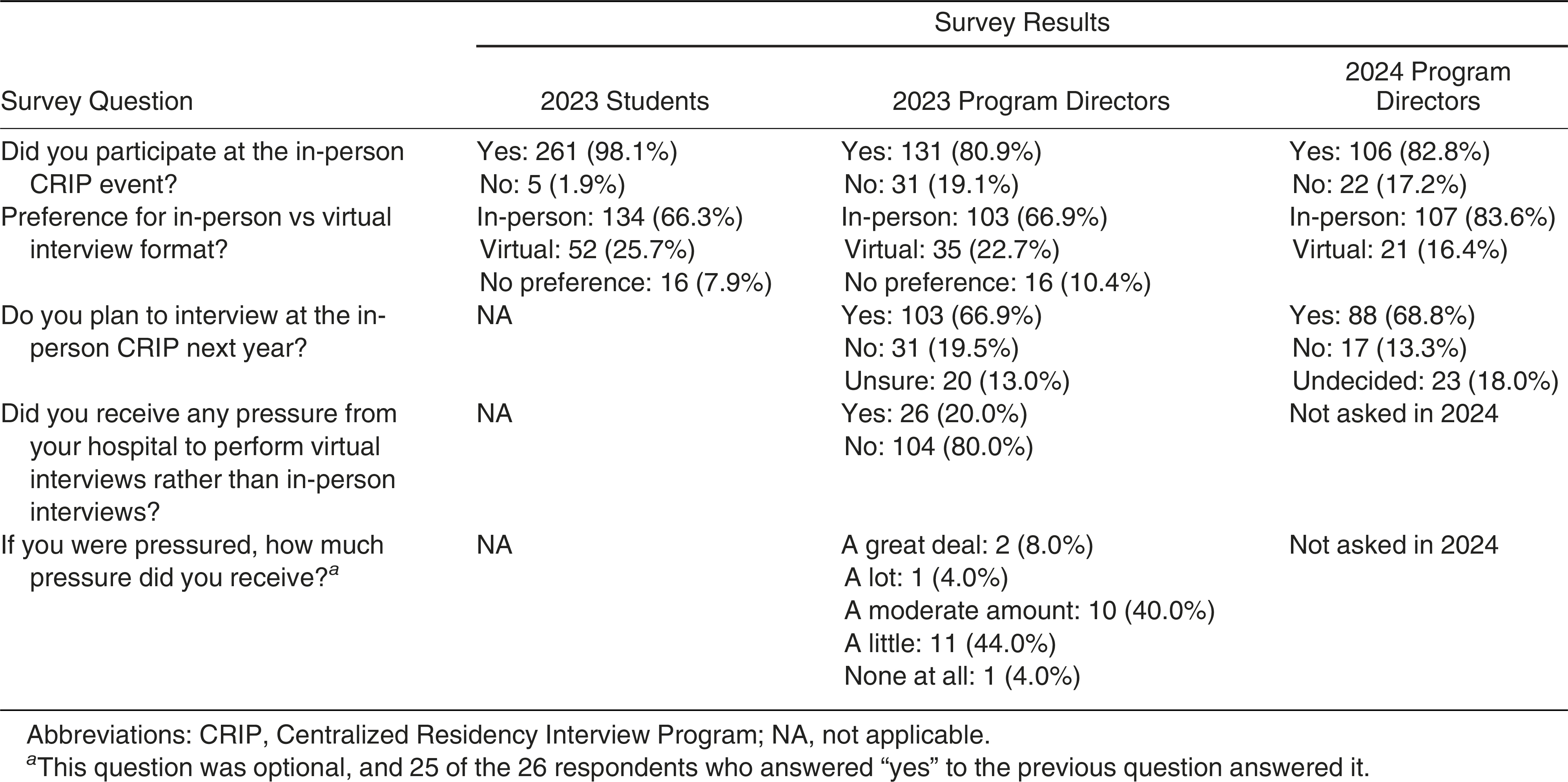
Two broad themes emerged from the survey results. The first is an objective overwhelming preference for an in-person format for the residency interview process (
Table 1). In 2023, 98.1% of student applicant survey respondents reported participating at the in-person CRIP, and 66.3% of students reported preferring an in-person format. COTH did not specifically ask these questions of student applicants in 2024, but another student survey of the 2024 CRIP cycle found that 97.6% of students attended the event, with 59.7% preferring an in-person format. [
3]
Table 1.
Residency Program Director and Student Applicant Survey Results
Table 1.
Residency Program Director and Student Applicant Survey Results
Residency program directors seem to share a similar enthusiasm for an in-person format. In 2023, 80.9% of program directors reported participating at the in-person CRIP, and in 2024 this number was 82.8%. In 2023, 66.9% of program directors reported preferring an in-person format, and 66.9% reported that they were planning on attending the in-person 2024 CRIP. In 2024, 83.6% of program directors reported preferring an in-person format, and 68.8% reported that they were planning on attending the in-person 2025 CRIP. Based in part on these results, COTH has committed to an in-person CRIP through at least 2027.
The second broad theme we observed during the 2024 CRIP process was also objective and was an apparent narrowing of the consideration of residency programs by student applicants. In 2023, students were able to apply to 18 programs as part of the standard registration fee. However, they actually interviewed at an average of only 6.5 programs during CRIP and eventually ranked an average of only 5.88 programs. In 2024, students were able to apply to 12 programs as part of the standard registration fee. However, they actually interviewed at an average of only 6.7 programs during CRIP and eventually ranked an average of only 5.95 programs. This seems to indicate that students are casting a relatively narrow net in terms of their interest in residency programs and that program directors might face challenges in the near future when considering the growing residency position surplus and podiatric medical school applicant shortage. [
3,
4]
There are two additional salient points that we feel are of interest to the profession regarding recent survey results. The first is individual and institutional costs of attending the event. COTH is highly aware that all of the participants face some degree of financial constraints to provide funding for food, accommodations, and travel during the weeklong event. This is taken into account during contract negotiations for future locations and hotel contracts. As mentioned previously, the unique nature of the podiatric medicine profession allows for the opportunity to provide a single location and short window of interviewing that is made available for all of the programs and candidates to participate. This limits the overall need for additional travel costs for candidates to travel to individual programs. The continuation of a hybrid model, which allows for virtual interviewing after the CRIP event, enables all of the programs and candidates to take full advantage of both formats to alleviate financial burden when possible.
A final point is concern surrounding adherence to ethics, rules, and regulations at the event. This is most specific to applicants reporting feeling undue pressure from residency programs with respect to their rankings during the open response portion of the survey. As such, it is difficult to objectify. COTH takes complaints about behavior at CRIP seriously and has been reaching out to those programs and candidates addressed within the context of informal comments on the survey and formal complaints. CRIP participants are reminded that they sign an agreement regarding expectations at CRIP and that all of the candidates and program representatives present are bound by that agreement. Formal complaints are encouraged. Match integrity is of utmost importance. COTH will continue to follow up on formal or informal complaints and report to the Council on Podiatric Medical Education when appropriate.
We hope that this article can provide an organizational update of the residency interview process to the profession, residency program directors, and student applicants since the return of an in-person CRIP. We also want to encourage everyone who participates in podiatric medical education to complete surveys and voice their opinions because we are listening and making decisions based on this feedback.