Since being introduced in the 1960s, fluoroquinolones (FQ) have gained recognition as effective antimicrobials for various infections. [
1] Most FQs, especially ciprofloxacin and levofloxacin, are frequently prescribed for airway and urinary tract infections. Another common use for levofloxacin is
Helicobacter pylori (HP) eradication. [
2] The recommended dosage is 500 mg once daily when taken with a proton pump inhibitor, along with either 1 g amoxicillin (typically twice daily) or clarithromycin 500 mg twice daily (if not previously used). [
2]
Gastrointestinal problems (1%–5%), skin reactions (maculopapular or rashes), light sensitivity (less than 2.5%), and neurologic effects (headache and dizziness in 1%–2%) are the main side effects of FQ. [
1] One of the lesser-known adverse effects of FQ treatment is tendinopathy, which is often associated with one or more synergistic factors. Researchers have documented more than 100 cases of FQ-induced tendinopathy in the literature since the initial report in 1983. [
3] The chelating properties of FQ may disrupt tendon integrity by potentially targeting mitochondria. Tendinopathies can develop from FQ even when taken as prescribed. However, the treatment duration seems to impact on the severity of tendinopathy. [
4] Daily doses ranging from 400 to 1200 mg of FQ have been observed to induce tendinopathy in many studies, suggesting that the impact on tendons is not dose dependent. [
5] Many researchers report the symptoms may appear anywhere between 2 hours and 6 months after FQ intake. Despite FQ-induced tendinopathy being extremely rare, Achilles tendinopathy and tendon rupture are well-documented side effects of levofloxacin treatment. [
6] The occurrence of tendinopathy varies from 0.1% to 0.01%, while tendon rupture occurs less than 0.01% of FQ users. Diagnosis was determined by the sudden pain and swelling around the tendon, along with recent FQ use and no other apparent causes for tendinopathy. If not suspected, internal medicine physicians may treat FQ-induced tendon ruptures instead of orthopedic surgeons or rehabilitation specialists, which may cause undiagnosed cases. [
5] Therefore, it is crucial to inform patients about FQ-induced complications, including tendinopathy and tendon rupture.
Older age (over 60), long-term lung disease, steroid treatment, and impaired renal function are all risk factors for tendinopathy. [
7] Induced Achilles tendinopathy is often linked with ciprofloxacin and pefloxacin. However, rupture has been associated with common FQs like levofloxacin, ofloxacin, and norfloxacin. [
2] Reported cases resulted in a black box warning for quinolone antibiotics by both the US Food and Drug Administration and European Medicines Agency. [
8,
9]
The treatment for levofloxacin-induced tendinopathy/rupture includes immediate discontinuation of FQ, resting the affected tendon, and managing pain. [
3] Mild tendinopathy could be addressed with 2 to 6 weeks of nonweightbearing activity.
Despite being optional, imaging proves to be highly advantageous in the diagnosis process, as evidenced in our case, especially for visualizing deep structures. Operator dependency limits the widespread use of ultrasound evaluation. Thickened tendon with accompanying increased flow on color Doppler is considered a typical ultrsound finding in tendinopathies. Magnetic resonance imaging is useful in clarifying uncertain diagnoses or for locating tears prior to surgery. [
3]
Treatment options comprise casting or surgery for operative repair. Even with early detection and treatment, the healing rate of tendinopathy remains slow. Nonsteroidal anti-inflammatory drugs (NSAIDs), therapeutic ultrasound, and eccentric loading are the recommended methods in Achilles tendinopathy. [
10]
Tendinopathy can fully heal within 3 weeks to 3 months, as long as the tendon remains intact. On average, it takes between 4.5 weeks and 6 months to recover from a tendon rupture. [
10] We were able to achieve complete remission in 12 weeks by using NSAIDs, physical therapy, and splinting.
This case report aimed to demonstrate a rare occurrence of tendon rupture due to levofloxacin use in HP eradication and provide a literature review. The informed consent was obtained from the patient.
Case Report
A 55-year-old female patient with no history of chronic illness history arrived at the internal medicine outpatient clinic after being referred from another hospital. Her symptoms included upper abdominal pain, stomach burning, indigestion, and bloating. The patient has not used steroids for any reason in the past year. The patient’s lack of response to antacids and proton pump inhibitor treatment led to endoscopic investigation, which confirmed the presence of HP, based on the Sidney classification system.
Lansoprazole 30 mg twice daily, amoxicillin 1000 mg twice daily, levofloxacin 500 mg once daily for 14 days were prescribed as part of the treatment plan for HP eradication, based on the diagnostic results. The patient was admitted to our tertiary referral hospital on the seventh day of treatment due to severe foot pain and difficulty in walking.
Swelling and tenderness were observed in the Achilles tendons at the calcaneal insertion during the physical examination. The patient’s laboratory tests showed a white blood cell count of 5400 x10
3/mL, a neutrophil count of 2350 x10
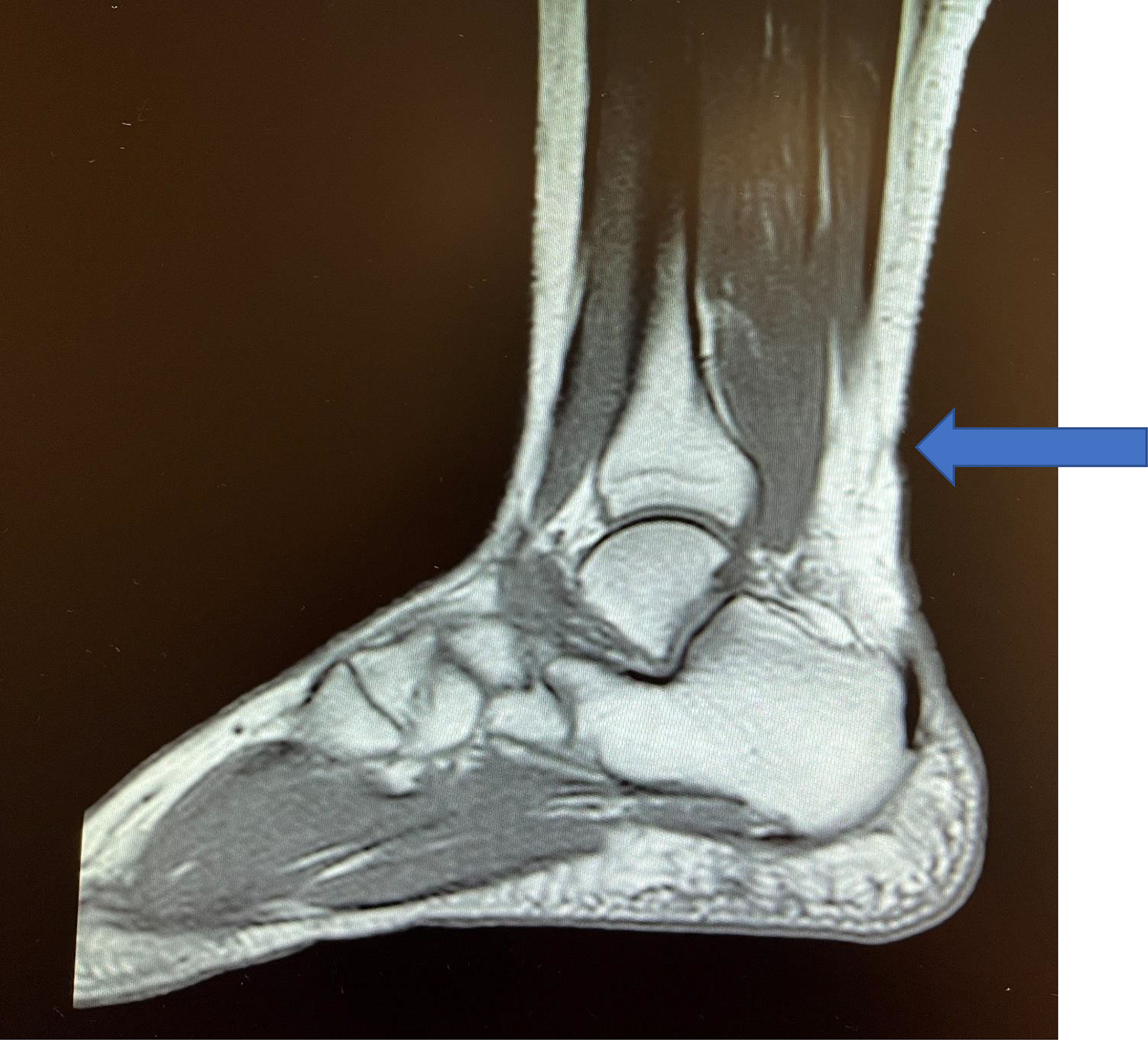
3/mL, a C-reactive protein of 3.4 mg/L, and an erythrocyte sedimentation rate of 12 mm/h. We also consulted an orthopedic surgeon. The initial ultrasound evaluation identified the following abnormalities in the Achilles tendons: diffuse thickening, loss of the “fibrillar” echotexture, blurred margins, and bilateral partial tendon tears. According to the radiologist’s report, magnetic resonance imaging revealed an increase in calibration in the middle part of the Achilles tendon, suggesting an Achilles tendon rupture (
Fig. 1).
Figure 1.
Magnetic resonance image showing Achilles tendon rupture, noted by the arrow.
Figure 1.
Magnetic resonance image showing Achilles tendon rupture, noted by the arrow.
The orthopedic surgeon applied a splint for 6 weeks to stabilize the patient’s tendon, and NSAIDs were administered for pain control. The patient was transferred to the rehabilitation program by the physical therapist after 6 weeks. Achieving complete remission took 12 weeks with the aid of NSAIDs, physical therapy, and splinting.
Discussion
The broad spectrum of FQ makes them a versatile group of antibiotics, and therefore, more and more commonly used in infection management. [
4] Levofloxacin is frequently prescribed as an antibiotic for treating HP. [
2] The recommended dosage is 500 mg once daily when taken with a proton pump inhibitor, along with either 1 g amoxicillin (typically twice daily) or clarithromycin 500 mg twice daily (if not previously used). [
2] Our case demonstrates this as well.
Our patient was given the recommended dose of levofloxacin, which initially did not raise any concerns. According to the literature, the onset of symptoms related to tendon rupture may happen within the initial 6 months, and in our situation, the patient experienced these symptoms early on. [
5]
The reported cases suggest that tendinopathy can take between 3 weeks and 3 months to fully heal, assuming the tendon remains intact. In severe instances, the process can take longer than 6 months. [
10] These reports indicate an average recovery period for our patient.
Conclusions
Levofloxacin-induced tendinopathy and/or rupture are rare complications that are often linked to age and sex. The initial treatment step involves an immediate cessation of drug use. Successful rehabilitation for FQ-induced tendinopathy/rupture may require a gradual and less intense healing process. Health-care providers should exercise caution when prescribing fluoroquinolones, especially to at-risk patients, and should inform them about potential side effects.