The rates of surgical site infections (SSIs) in elective foot and ankle surgeries are higher than those of other elective orthopedic procedures. [
1,
2] Reported incidences of SSI after elective knee and hip arthroplasty are 0.6% and 0.7%, respectively. In contrast, it has been reported that after foot and ankle surgery, the SSI rate is 2.2% to 4.8%. [
1,
2,
3] During elective foot and ankle surgery performed in a hospital or ambulatory surgery center, it has been found that patients without comorbidities have an SSI incidence of up to 3.5%. [
4] On the contrary, research has shown that diabetic patients undergoing elective foot and ankle surgery have encountered an infection or complication rate of up to 13.2%. [
1] Miller, [
2] in 1983, was one of the first to report the incidence of postoperative infections in elective foot and ankle surgery, with a rate of 2.2%. Reports before 2000 demonstrated infection rates after clean foot and ankle surgery ranging from 1.0% to 1.35%. [
5,
6] In a retrospective study by Wukich et al [
1] in 2010, the reported overall infection rate in more than 1,000 patients, both diabetic and nondiabetic, undergoing elective foot and ankle surgery was 4.8%. Foot and ankle surgeons treat diabetic patients on a routine basis. Ralte et al [
7] found that there was a 2.9% incidence of SSIs in 1,737 patients who underwent elective foot and ankle surgery, with most of them being superficial and resolving with a single course of oral antibiotics. Also, Meng et al, [
8] in 2020, evaluated more than 1,200 elective foot and ankle cases and reported an overall incidence rate of soft-tissue infections of 2.1% while stating that forefoot procedures having a higher predisposition to SSI than the remainder of the foot. Furthermore, these studies captured rates of SSI where procedures were performed in a hospital or ambulatory surgery center and collectively revealed rates from 1.0% to 4.8%. [
8]
Currently, SSI is a burden on the health-care system and should not be neglected amid the recent pandemic. The COVID-19 outbreak placed a significant burden on hospital resources and equipment and an emphasis on face-to-face efforts to limit spread. [
9] For this reason, office-based surgical procedures in the outpatient setting have provided an effective way to minimize the congestion and burden in increasingly pressured hospital systems across the country. [
10] Currently, outpatient clinics with rooms for surgical procedures have been underused. [
11,
12] Surgeons with appropriate training and experience can perform low-risk procedures in outpatient clinics on high-risk patients at their time of need with little to no delay compared with a hospital. Furthermore, besides safety and efficacy concerns, economically, the concerns of inpatient admission can be avoided by using office-based surgeries, which provide greater surgeon control, more patient convenience, and lower costs. [
13] With the principle of cost-effective decision-making, elective surgeries in the hospital setting may be unnecessary. Understanding the implications of inpatient stays for foot and ankle surgery can ultimately result in cost savings to the US health-care system and to patients individually. [
10]
WALANT (wide awake, local anesthesia, no tourniquet) is a recently advocated surgical technique that avoids the use of general anesthesia, a tourniquet, and a traditional hospital operating room setting. This has been applied highly in hand and wrist surgery. Most procedures are under local anesthesia (most often lidocaine with epinephrine) without using a tourniquet on the patient. This technique provides excellent postoperative pain control and mitigates the need for tourniquet and general anesthesia use in the “austere” environment. [
14] This technique has been shown have a high rate of patient satisfaction in multiple applications and settings and can be used in medically compromised patients. [
15,
16] Use of a WALANT technique in a hand surgery clinic setting revealed overall complication rates of 3%, in which superficial infections were treated with oral antibiotics. [
15] This parallels a similar infection rate associated with elective foot and ankle surgeries.
However, we believe that the same in-office techniques that have been used in a clinical scenario by plastic surgeons in the upper extremity can be correlated to the lower extremity, namely, the foot and ankle. [
13,
14,
15,
16,
17,
18] To our knowledge, there have been no known studies on the safety and cleanliness of different types of in-office procedures to this extent. We attempted to demonstrate and represent data to show a glimpse of the research into the safety and efficaciousness of in-office procedures by showing the infection rate we encountered. We hope that this would be one of the first studies to advocate for performing rather minor procedures in the foot and ankle outside of a hospital or ambulatory center. We hypothesized that the infection rate for office-based surgical procedures is equivalent to, if not lower than, previously reported infection rates.
Methods and Procedures
All of the patients were seen in the office by the primary surgeons (M.R., C.P.) and underwent a full surgical consultation after conservative management of their pathologic condition was exhausted. The risks and benefits of performing surgery in the office compared with in an operating room were explained in detail, and patients who elected to proceed with their surgery in the office met the inclusion criteria for this retrospective study. The only exclusion criterion used was the presence of active infection at the time of the procedure.
In total, 121 patients underwent 205 in-office surgeries during the 3.5-year period from February 1, 2018, to July 31, 2021. A total of 228 procedures were initially documented, but 23 were excluded due to active infection at the time of surgery. Thus, 205 procedures met the inclusion criteria. Unlike the local hospital and surgery center surgeries, the in-office surgeries did not necessitate a COVD-19 test during the pandemic.
Preoperative local anesthesia was performed using an equal combination of lidocaine (2% Xylocaine plain; Fresenius USA Manufacturing Waltham, Massachusetts) with 0.5% bupivacaine plain. At the discretion of the surgeon, 1% Xylocaine with epinephrine (1:100,000) was used along the planned incision line for hemostasis. No patients were treated with preoperative antibiotics. The lower extremity was prepared with betadine solution, unless an allergy prohibited its use, in which case chlorhexidine was used. Sterile draping, gloves, and instruments/materials were used for every procedure. For osseous procedures proximal to the metatarsophalangeal joint, sterile gowns and personal protection equipment were used as would be in a traditional hospital-based operating room. Incisions were dressed with betadine-soaked gauze, followed by the appropriate dressing for the surgery performed, and the patient was instructed to not remove the dressing until seen for a first postoperative visit. This study was approved by Kent State University’s institutional review board and ethical committee. A retrospective medical record review was then performed to determine the number of SSIs resulting from the previously mentioned surgeries.
The Infectious Diseases Society of America (IDSA) defines infection as an area of erythema greater than 2 cm that is treated with antibiotics as seen in the postoperative note in the electronic medical record. [
19] Thus, an SSI was defined in this study as erythema greater than 2 cm from the incision and the patient having been given an oral course of antibiotics.
Initial data entry and all of the statistical analyses were compiled using a spreadsheet program (Microsoft Excel; Microsoft Corp, Redmond, Washington). Electronic medical record review was performed by two of us (L.A., N.J.). Data review and medical record review were completed by all of us. Infection was diagnosed in the medical record and based on clinical examination notes, previously mentioned guidelines, and whether the patient received oral or intravenous antimicrobial therapy. Meticulous charting was organized by procedure. No χ2 or t test was performed.
Results
Overall, mean follow-up for the first postoperative visit was 7.4 days (four patients who followed up 92, 170, 245, and 177 days later were excluded). The mean ± SD age of participants was 64.7 ± 15.9 years. The most-performed procedure was digital tenotomy and interphalangeal joint capsulotomy (55.6%), followed by deep hardware removal (11.7%) and hammertoe correction (interphalangeal joint arthroplasty) (9.8%). Specifically, hardware removal included buried wires, screws, or plates. A full breakdown of procedures is listed in
Table 1.
Table 1.
List of Procedures
Table 1.
List of Procedures
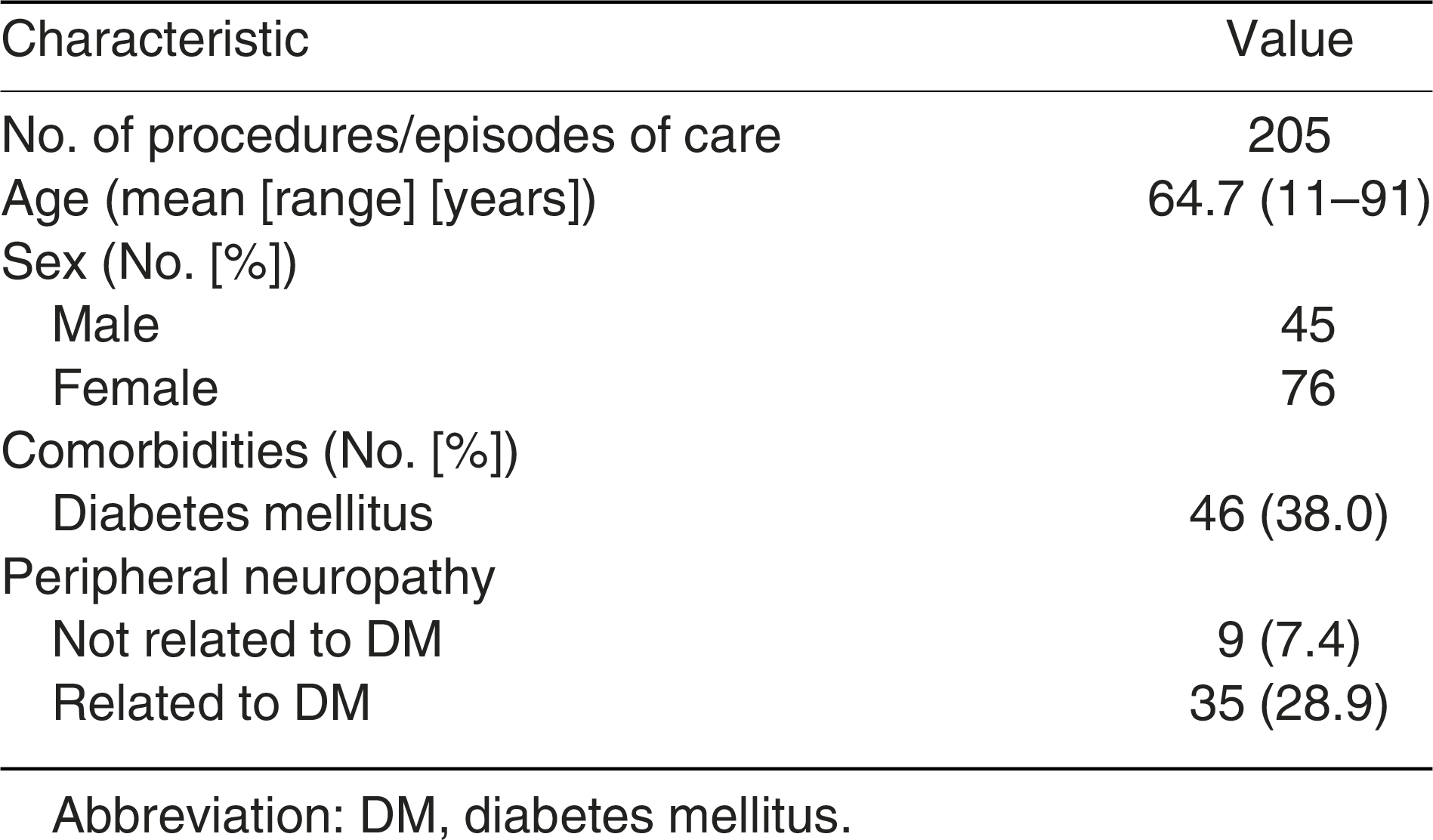
Comorbidities evaluated in the study included diabetes mellitus and neuropathy. Of the 121 patients, 46 (38.0%) had diabetes mellitus
, 35 (29.8%) had peripheral neuropathy related to diabetes, and nine (7.4%) had neuropathy unrelated to diabetes (
Table 2).
Table 2.
Characteristics of the 121 Study Patients
Table 2.
Characteristics of the 121 Study Patients
There were four episodes of superficial infection reported postoperatively and no deep infections. The SSIs occurred at an overall rate of 1.95% (four of 205). When removing all of the tenotomy procedures from the incidence of infection; the overall infection rate postoperatively was 3.3% (three of 91). Overall, infections occurred after tenotomy and capsulotomy, metatarsophalangeal joint capsulotomy, cheilectomy, and metatarsal head resection procedures. Confirmed infection occurred in a patient who had both of the observed comorbidities, and the remaining three patients had no comorbidities.
Discussion
The incidence of SSI in the present study was 1.95%. Removing 114 flexor tenotomy and capsulotomy procedures, the rate of infection became higher at 3.3%. To our knowledge, this is the first study to evaluate the safety of a multitude of different procedures and the infection rate in the clinic setting. The results demonstrate that a relatively narrow range of selected procedures that can be performed under local anesthesia are safe in a clinic and do not incur the expenses that are generated from a hospital or surgery center–based surgery.
A review of the literature reports that the incidence of SSIs after elective knee and hip arthroplasty has been reported to be 0.6% and 0.7%, respectively, whereas after foot and ankle surgery it is 2.2% to 4.8%. [
1,
2,
3] However, as of recently, this might be changing with better techniques. Infection in the foot can be attributed to several reasons. The microflora of the foot is much different than that of the rest of the body. The foot microflora consists mainly of gram + cocci (staphylococci) and diphtheroid (
Corynebacterium). Furthermore, the presence of increased eccrine sweat glands on the foot allows for a moist microenvironment with currently used footwear. The moist web space consistently contains more dense colonies of microorganisms than any other area of the foot. [
7,
20,
21,
22] In addition, the forefoot is more densely populated with bacteria and microorganisms than the rest of the foot, and it has been shown by Meng et al [
8] that the number of SSIs is twice as much after forefoot surgery. For these combined reasons, the foot has predispositions to infection.
The Centers for Disease Control and Prevention defines an SSI as an incisional infection that occurs within a 30-day window after surgery if no implant is left in the patient, or within 1 year if an implant is left in place. [
23] An SSI is classified as superficial incisional or deep incisional. The deep SSI involves deep soft tissue (fascial and muscle layer) and must have one or more of the following: persistent wound discharge; visible abscess or gangrene that necessitates debridement, implant exchange, or removal; plus an infection that involves only the skin or subcutaneous tissue presenting with a wound with signs of infection (redness, swelling, hot, pain, tenderness). However, if the infection at hand does not meet the diagnosis criteria of a deep SSI, it is deemed to be a superficial SSI of the skin or subcutaneous tissue. [
23] The IDSA defines infection as an area of erythema greater than 2 cm that is treated with antibiotics as seen in the postoperative note in the electronic medical record. [
19] We confirmed SSIs based on the IDSA guidelines and if they were found in the patient note written by the primary author from the electronic medical record based on the postoperative documentation, as well as obvious culture with proven microbial agent infection. A culture was obtained only after use of initial oral antibiotics without improvement and presence of purulent drainage.
The present study encompassed patients with comorbidities (
Table 2). It is well-known that diabetic patients have impaired wound healing among other complications. Many physicians avoid operating on diabetic patients with a hemoglobin A
1c level greater than 8% due to adverse complications postoperatively, namely, infection. [
3] Data have shown that there is a 5% increase in risk of developing a complication after elective foot and ankle surgery for every 1% increase in hemoglobin A
1c level. [
24] A large retrospective study by Domek et al [
24] revealed that nondiabetic patients with neuropathy had rates of SSI similar to patients with uncomplicated diabetes. Furthermore, this large population study revealed that diabetic patients have a 7-fold increased risk of SSI; neuropathy alone still has a 4.72-fold increased risk of SSI. [
24] To combat these risks, outpatient treatment approaches have been used more often to mitigate complications in the operating room with anesthetic complications while allowing patients the ability for correction that they may otherwise need.
To our knowledge, this is the first study to put forth data showing an array of in-office– or in-clinic–based procedures and incidence rates of postoperative infection. The present study gives fair insight into the results of flexor tenotomy and capsulotomy, proximal interphalangeal joint arthroplasty, and hardware removal. Foot and ankle surgeons have used tenotomies in an office setting with great success. Recently, Smith and Miller [
25] presented evidence suggesting favorable outcomes to treating apical toe ulcerations with flexor tenotomies, with an overall infection rate of 2.8% and a mean healing time of 10.2 days. These were effectively performed in treatment chairs in an office setting. Furthermore, a systematic review of flexor tenotomies showed a mean healing time of 2 months, high rates of up to 100% healing of ulcers, low recurrence, and reported infection rates from many studies of 0%. [
26] Many flexor tenotomies can be done in an office setting, although some surgeons prefer to perform these in the operating room.
The present study is not without limitations. The study was conducted retrospectively, which inherently introduces the risk of bias. Second, the incidence rate of SSI might be underestimated owing to the imperfect follow-up strategy or patient noncompliance. Most, if not all, of the in-office procedures were treated by the primary author at a single institution and within a certain geographic area. Another reasonable criticism for the reported infection rate is that of the four individuals who were not infected before surgery and reported with infection postoperatively, only one has comorbidity with peripheral neuropathy, thus making the cohort of neuropathy and diabetes 25% of the infected population, although this is negligible. Another patient who reported cultured infection claimed to cycle for physical exercise the day after surgery, and throughout the postoperative course, which is thought to likely have contributed to infection.
Other questions have arisen when considering the successful outcomes of in-office procedures regarding what could be done going forward. Currently, the use of betadine or other iodine-containing solutions for preparing the foot before surgery are widely used. However, chlorhexidine-containing solutions are superior in reducing bacterial loads in the foot and ankle. [
20] In the future, the use of chlorhexidine for skin preparation instead of betadine, or in conjunction with it, could augment in-office procedures to promote a more sterile environment. Another question is whether to administer preoperative antibiotics. Zgonis et al [
27] evaluated the efficacy of prophylactic use of antibiotics in foot and ankle surgery but did not find a significant difference in SSI between patients who received preoperative antibiotics and those who did not (1.6% vs 1.4%). Last, laminar airflow in hospital operating rooms has been suggested and proved to decrease rates of SSI. [
23] Many foot and ankle surgeons do not use this technology in their private offices because of shear cost and minimal need for use. However, considering the state of the current health-care system, the future might shift to more office-based surgery, and considerations for office room construction may evolve without going as far as building a full surgical suite. The present study demonstrates that in-office procedures can be successful with good outcomes and low rates of SSI when proper precautions and techniques are considered and a clean environment is created.
In conclusion, the overall reported rate of infection was 1.95%. Documented infection rates in orthopedic foot and ankle surgery range from 1.0% to 4.8%. [
1,
2,
3,
4,
5,
6,
7,
8,
24,
25] The present rate of 1.95% falls within this spectrum. Overall, patients were pleased with these procedures. Although we did not conduct a survey, patients expressed their satisfaction with the ability to have these procedures performed in this manner. Patients chose to do this because of low cost and saving time to avoid performing preadmission testing in the hospital and waiting for delays in the operating room. In addition, it is beneficial to the time of the outpatient surgeon in terms of efficiency by treating patients in the office setting while doing surgical procedures in the same location. Furthermore, we propose that performing an array of in-office surgical procedures under typical sterile technique is a relatively safe and otherwise efficient choice for treating patients and saving time as a foot and ankle surgeon. Further data on this subject are needed to validate the safety and efficacy of additional procedures that can be performed in the office setting.