Ankylosing spondylitis (AS) is a chronic, rheumatic disease that affects the vertebral column and sacroiliac joints and may progressively cause decreased range of motion and deformities. Increased thoracic kyphosis, flattened lumbar lordosis, and rigid vertebral column may occur in the later stages of the disease. These postural changes result in a change in the body center of mass. Flexion in the knee, dorsiflexion in the feet, and tilt in the pelvis develop over time as a compensation mechanism. Impaired balance is frequently seen in patients with AS due to postural changes [
1,
2]. One of the main features of the disease is inflammatory low back pain and inflammation of enthesis called enthesitis. Enthesitis usually involves the lower extremities and causes structural damage such as tendon damage, enthesophyte formation, and dysfunction [
3]. A high rate of subclinical enthesitis has been observed in ultrasonography, which is known to be superior in diagnosis although enthesophyte formations are thought to occur in the late period [
4,
5]. Heel pain is a major symptom observed in 30% to 42% of patients with spondyloarthropathies, and was found to be associated with calcaneal enthesitis [
6]. Pain and edema may occur in the calcaneal insertion area because of enthesitis in the Achilles tendon and plantar fascia. These symptoms, and enthesopathies, may cause deterioration in foot functions in patients with AS [
7]. Sahli et al [
6] reported that 52% of AS patients had foot involvement but found that only 35% of them were symptomatic.
Studies and observations demonstrated that patients with AS had an impaired gait and were “walking gingerly” with a reduced reaction force. The decrease in hip and knee flexion and in stride length may be considered indicators of walking gingerly [
2,
8]. Impaired gait was found to stem from back pain, decreased spinal mobility, postural changes, and foot abnormalities [
9]. Zebouni et al [
8] found spinal changes as the primary reason for impaired gait in AS patients due to having no pain and no hip pathologies. Antalgic gait, which is thought to develop as a compensation mechanism due to foot pain or deformity, was also determined in patients with AS [
10]. However, in some studies, no significant difference was found in gait velocity and cadence in AS patients compared to healthy controls [
2,
11].
Although there are few studies that investigate gait parameters and compare them with healthy controls, to the best of our knowledge no study has investigated the relationship between gait parameters and enthesopathies in plantar fascia. Therefore, the aim of this study was to investigate the potential relationships of spatiotemporal parameters with enthesopathies in the foot, spinal mobility, disease activity, and functional status. A secondary aim of the study was to compare the spatiotemporal parameters of patients with AS with those of healthy controls.
Methods
This study was approved by Firat University Clinical Research Ethics Committee, Elazig, Turkey. An informed consent form was taken from all participants. All procedures were conducted according to the ethical principles and standards of the Declaration of Helsinki.
Participants
The minimum number of patients required for the present study was determined by prior sample size calculation section of the G*Power 3.1.9.2 program (Software, concept, and design of the University of Kiel, Germany, free Windows software by Franz) [
12]. Data from a similar study published by Zhang et al [
13] was used as a reference. The calculations based on a two-tailed test, an alpha level of .05, and an anticipated power of 80%, revealed that a total number of 33 patients and 33 healthy controls were necessary. Thus, the study group included 33 patients who were diagnosed with AS according to Modified New York criteria, were aged between 18 and 65 years, and were being followed at Firat University Department of Rheumatology. Patients who were pregnant, malignancy, hip involvement, were hospitalized in the last 3 months, a change in medical treatment in the previous 6 months, and had neurologic or orthopedic problems in their lower limbs were excluded from the study.
The control group comprised 33 healthy hospital staff who were age and gender-matched and had no orthopedic or neurological problems.
Outcome Measurements
Demographics (age, gender, dominant extremity, body mass index [BMI], and disease duration) and spatiotemporal parameters were evaluated and recorded for both groups. Spinal mobility, disease activity, function, and enthesitis in the plantar fascia were assessed in patients with AS.
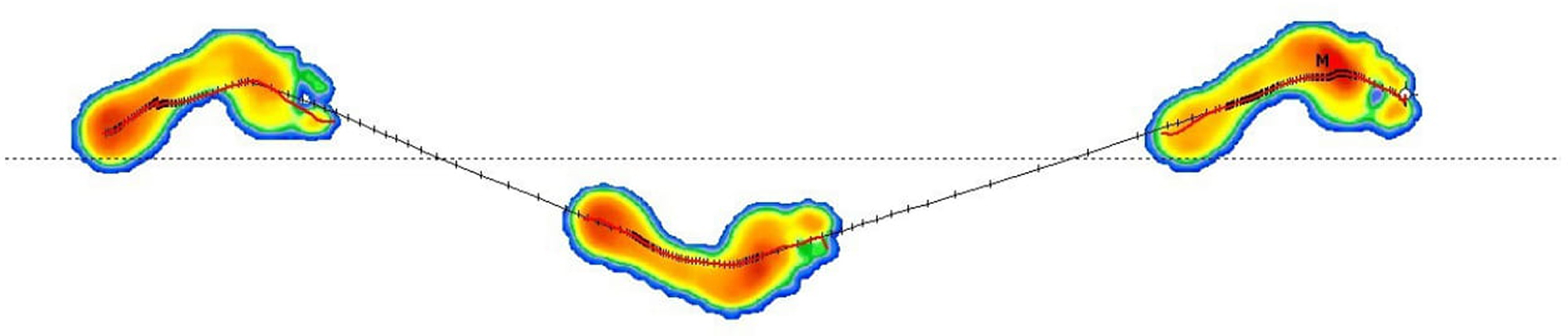
Spatiotemporal parameters. The Win-Track platform (MEDICAPTEURS Technology, France) was used to measure gait parameters during barefoot walking (
Fig. 1). The platform used to measure the patient’s static posture and dynamic gait parameters is 1,610 mm × 652 mm × 30 mm in length, width and height, respectively, and is 9 mm thick. In this system, data is loaded into a computer that performs automatic step identification and parameter calculations. Three attempts were made with the participant taking at least three steps on the platform. To avoid aiming, participants were asked to look ahead and walk on the platform at a comfortable pace. Total weight transfer, step cycle duration, double-support phase, swing phase, step length, and cadence measurements were obtained by the platform.
Figure 1.
Spatiotemporal parameter evaluation.
Figure 1.
Spatiotemporal parameter evaluation.
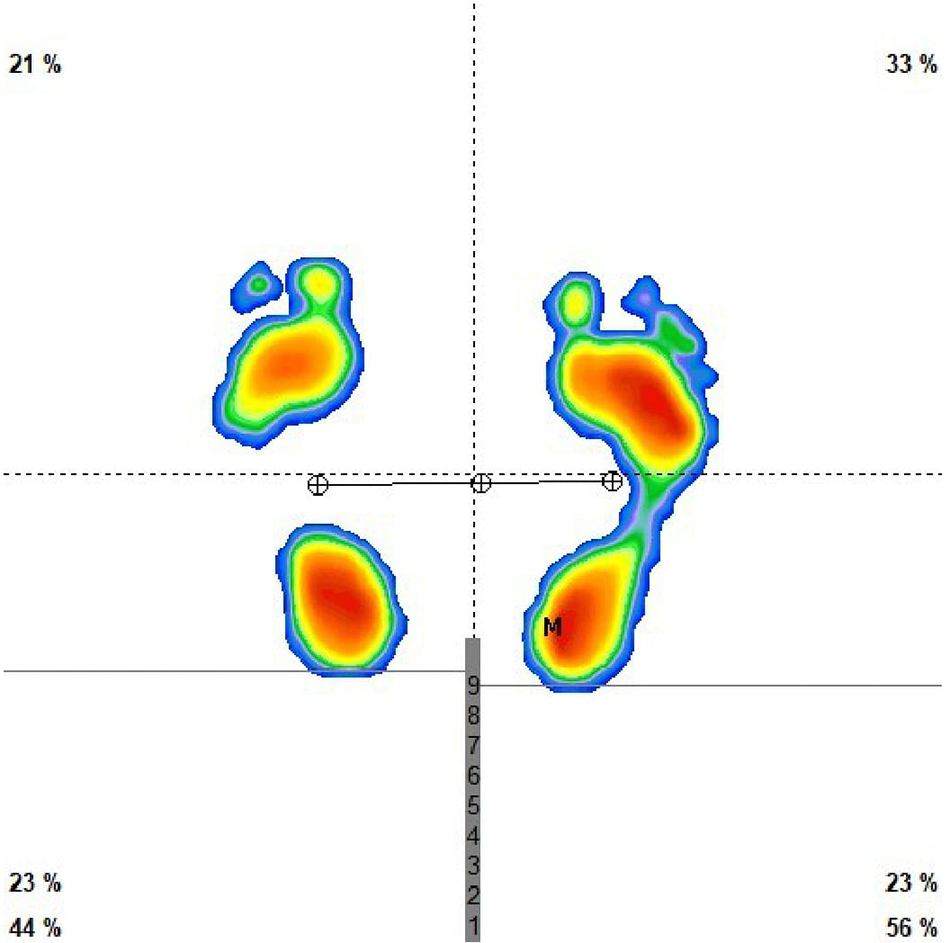
Balance. Participants were asked to stand on the Win-Track platform with their feet shoulder-width apart and look straight ahead. Meanwhile, the data was uploaded to a computer with automatic weight transfer and parameter calculations (
Fig. 2).
Figure 2.
Balance measurement with Win-Track platform.
Figure 2.
Balance measurement with Win-Track platform.
Ultrasonography. Measurements of plantar fascia thickness were taken with a 5-13 MHz linear transducer using ZONARE Medical Systems (San Jose, California). Measurements were made by asking the patient to lie in a supine position with both lower extremities in full extension and both ankles at 90°. The ultrasound probe was placed on a line connecting the second toe to the midpoint of the calcaneus. The probe was placed both longitudinally and transversely [
14] to measure the thickness of the plantar fascia at three points: the origin (from the insertion point of the plantar fascia into the calcaneus), the midfoot (from the central metatarsal region to the calcaneus), and the insertion (between the first and second toes). All ultrasonographic measurements were made by a physician (G.A.) experienced in musculoskeletal ultrasonography.
Spinal Mobility. The Bath Ankylosing Spondylitis Metrology Index (BASMI) was used to evaluate spinal mobility. BASMI has five subparameters including lateral lumbar flexion, tragus-to-wall distance, lumbar flexion (Modified Schober test), maximal intermalleolar distance, and cervical rotation.
Patients were asked to stand upright on their knees with their feet and back touching the wall, and bend to their right and left sides without compensation, such as flexing knees or losing contact with the wall, in order to evaluate lumbar lateral flexion. The distance between the third finger and the floor was recorded before and after bending.
The same position was used to evaluate the tragus-to-wall distance. Patients were asked to make head retractions as much as possible and the distance between the tragus and the wall was recorded.
Ten centimeters up and 5 centimeters down the lumbosacral junction were marked in a standing upright position to assess the Modified Schober test. Then patients were asked to bend forward as much as possible, without bending their knees, and the measurement was repeated. Differences between the first and last measurements were recorded. Patients were asked to lay on a mat in the supine position and separate their legs along the surface as far as possible to evaluate the maximal intermalleolar distance. Distance between medial malleoli for both legs was recorded.
Patients were asked to rotate their neck to right and left sides as much as possible without compensation to evaluate cervical rotation. A goniometer was used to record the measurement. The BASMI score was calculated with a ten step definition [
15].
Disease Activity. Disease activity was evaluated with the Bath Ankylosing Spondylitis Disease Activity Index (BASDAI). The index consists of six questions evaluating fatigue, axial pain, peripheral pain, enthesopathy, and rigidity. The Visual Analog Scale (VAS) was used to score the index [
16].
Function. The Bath Ankylosing Spondylitis Function Index (BASFI) was used to assess function. The index includes ten questions about daily life activities. A 10-cm VAS was used to score each question [
17]. Patients were asked to mark on the scale according to their functional status and the mean value was recorded as the BASFI score.
Statistical analysis
The SPSS 22.0 package program (IBM SPSS Statistics for Windows, Version 20.0, Armonk, New York) was used for the statistical analysis of the study. Data obtained in the study were given as the mean ± standard deviation. Independent Student t test was used to compare parameters showing normal distribution and homogeneity for quantitative data. Regression analysis was used to find the cause-and-effect relationship between the variables, and correlation analysis was performed to find the direction and severity of the relationship between the variables. Statistical values of P < .05 were considered significant.
Results
The study included 31 patients with AS and 31 healthy individuals in the control group. Two patients with AS were excluded from the study due to changes in medical treatments. Two healthy subjects were excluded from the study due to having orthopedic problems in a lower extremity.
The study group was 68% female (21 participants) whereas the control group was 39% female (12 participants). The mean ± SD age was 38.65 ± 9.20 years in the study group and 39.00 ± 7.27 years in the control group. The mean BMI was 26.83 ± 3.58 kg/m2 in the study group and 27.80 ± 4.02 kg/m2 in the control group. Demographics and mean values of spatiotemporal parameters, BASMI, BASFI, and BASDAI are summarized in
Table 1. No significant differences were observed in the characteristics of participants in either group, including mean ages, BMI, and gender (
P > .05). There were significant differences in some spatiotemporal parameters including cadence, swing phase, step length for the right extremity, and double support phase (
P < .05 for all) (
Table 1).
Table 1.
Demographics, Disease Specific Measurements, and Spatiotemporal Parameters in the Study Groups
Table 1.
Demographics, Disease Specific Measurements, and Spatiotemporal Parameters in the Study Groups
The relationship between disease-specific measurements, ligament thickness measurements, and spatiotemporal parameters are summarized in
Table 2. According to these results, cadence and step cycle duration had a significant relationship with all regions of plantar fascia enthesitis measurements and disease-related assessments (
P < .05 for all). In addition, step length had a significant relationship with fascia thickness in midfoot and metatarsal areas, BASMI, and BASDAI; left step length had a significant relationship with all evaluation parameters except for BASMI. Swing phase (right) had a significant relationship with BASMI, BASDAI, and enthesitis in the left side of the calcaneal region. The double-support phase had a significant relationship with enthesitis measurements and BASMI (
P < .05).
Table 2.
Correlations Between Ultrasonographic Measurements, Balance, and Disease-related Assessments With Gait Parameters
Table 2.
Correlations Between Ultrasonographic Measurements, Balance, and Disease-related Assessments With Gait Parameters
In the regression analysis, BASMI and BASFI values were not significantly related with gait parameters (
P > .05). A significant correlation was found between BASDAI and step cycle duration (
P < .05). A significant correlation was observed between all ultrasonographic parameters and cadence and step cycle duration values (
P < .05). However, according to multivariate linear regression analysis, all disease-related parameters except BASMI were found to be related to gait parameters (
P < .05) (
Table 3).
Table 3.
Regression Between Ultrasonographic Measurements and Disease-Related Assessments With Gait Parameters
Table 3.
Regression Between Ultrasonographic Measurements and Disease-Related Assessments With Gait Parameters
Discussion
This study was designed to investigate factors affecting gait parameters in patients with AS and compare these parameters with healthy controls. The results of the study showed that significant differences were found in cadence, swing phase, and right step length compared to healthy controls. In addition, some spatiotemporal parameters, such as cadence, step cycle duration, step length, and double support phase, were found to have a significant relationship to plantar fascia enthesitis, BASFI, BASDAI, and BASMI. Also, reasons for impaired gait were observed in both disease-specific measurements and plantar fascia enthesitis. However, it was observed that BASMI had less effect on gait parameters compared to other measurements, which is likely due to the low BASMI scores of the patients who participated in the study.
Impaired gait and walking gingerly were observed in AS patients [
8]. There were significant differences in cadence, swing phase, step length for the right extremity, and double support phase between AS patients and healthy controls in this study. Cadence was lower and swing phase and step length were shorter in the patients with AS compared to healthy controls; patients with AS in our study had a slower and more careful gait. Studies investigating gait with comparisons to healthy controls in the literature are contradictory. Previous studies showed shorter stride lengths in AS patients compared to healthy controls [
8,
13]. Although these results were not confirmed by subsequent studies, documenting these parameters showed similarities between patients with AS and healthy counterparts [
2,
11]. In addition, Zhang et al [
13] concluded that gait velocity decreased in AS patients compared with healthy subjects; however, some studies found no significant differences in gait velocity [
18,
19]. Zebouni et al [
8] stated that patients with AS tend to avoid jarring during walking, and therefore, when they walk carefully, they feel vibrations more prominently. Studies investigating gait parameters in patients with AS concluded that “walking gingerly in AS” might be explained by the decreased angle of flexion at the knee and hip, and shorter stride length [
8,
9]. Symptoms such as pain, limitation in spinal mobility, and enthesitis might affect gait in AS patients. Previous studies showed that impaired gait in AS might be due to decreased joint movement, pain, postural changes, and foot abnormalities [
20,
21,
22].
The incidence of peripheral enthesitis is 25% to 58% in patients with AS. Entheseal lesions are considered as characteristic features according to some spondyloarthropathy classification systems. Ultrasonography is widely accepted as a gold standard in diagnosis of enthesitis [
3]. This study included ultrasonographic measurements to evaluate enthesitis in three different areas from plantar fascia, including the metatarsal, midfoot, and calcaneal regions. As a result, cadence, step cycle duration, step length, and double support phase were found to have a significant relationship with all regions of plantar fascia enthesitis. Enthesitis had a negative impact on cadence and step length, while step cycle duration and double support phase were positively impacted. These results demonstrated that enthesitis affects gait negatively in patients with AS; plantar fascia is the most commonly affected enthesitis area in those with AS. Enthesopathies can cause pain and decreased foot function [
7]. Lopez-Bote et al [
23] concluded that calcaneal erosive changes were found to occur in the early stages of AS, and sclerotic and proliferative lesions were found to develop in the late stages of AS. It was found that enthesitis in the calcaneal region had effects on spatiotemporal parameters in regression analysis in this study. Calcaneal erosive changes in early and late stages can cause symptoms like pain and limitation, and hence, can cause impaired spatiotemporal parameters in AS patients, according to our study. In addition, it was observed that enthesitis measurements from the calcaneus and other parts of the plantar fascia affected gait at almost the same rates. Aydin et al [
24] investigated plantar pressure distribution in AS patients and concluded that dynamic peak plantar pressure was higher at the midfoot and metatarsal area in patients with AS compared to healthy controls. Also, postural alterations were exhibited during gait, not in standing position [
24]. Impaired gait parameters may be observed due to excessive pressure distribution reflected on the front and middle of foot in this study. Therefore, therapy for enthesitis and balance exercises should be considered in routine treatment of patients with AS.
A significant relationship between cadence, step cycle duration, swing phase, step length, and double support phase, and BASFI, BASMI, and BASDAI was found in this study. Reduction in spinal mobility and dysfunction are seen in AS patients over time. Patients who participated in our study had about the median value of BASDAI, which reflects pain and edema in AS patients in this study. These symptoms may cause impaired gait in AS patients. Previous studies have shown impaired gait in AS may be due to decreased range of motion, pain, altered posture, and foot abnormality [
7,
18,
22,
25]. The results of this study were consistent with the literature.
Regression analysis found that disease activity, enthesitis, and function had a greater effect on gait than did spinal mobility. It is known that rigid spine develops as a result of syndesmophyte, and bamboo spine may develop in time in patients with AS. Impairment of gait is expected as spinal mobility decreases. Spinal mobility was correlated with gait parameters; however, the correlation rate was lower than other assessments in our study. The mean BASFI score of the patients was low (3.16 out of 10) so it might not have been so effective on gait. On the other hand, significant correlation between gait parameters and the presence of impaired gait compared to healthy controls indicated that impaired gait can also be seen in patients with AS who do not have advanced deformities. In contrast to our study, Zhang et al [
13] concluded that spinal mobility was the most determining factor in abnormal gait in patients with AS. Decreased gait velocity and decreased step length and stride length, were found in AS patients with hip involvement compared with healthy people [
13]. We excluded patients with hip involvement from our study in order to determine the effectiveness of enthesitis in plantar fascia and disease-specific measurements because hip involvement may have an effect on gait in patients with AS.
Spinal pain, foot pain, and Achilles tendinopathy were not evaluated in this study, which may be considered a limitation. However, we could comment on pain by evaluating disease activity.
Conclusions
In conclusion, gait parameters were impaired in patients with AS compared with healthy controls, and enthesitis in plantar fascia, decreased spinal mobility, dysfunction, and disease activity caused impaired gait in AS patients, according to our study. This study is important because it is the first study investigating the effects of enthesitis and disease-specific measurements on gait parameters in patients with AS. In light of the results of this study, therapy for enthesitis, and exercise for foot and balance should be considered in routine treatment. Future studies should include the effects of enthesopathies in the plantar fascia and Achilles on kinetic and kinematic parameters of gait.