Ankle fractures continue to increase in incidence and severity in an older, more challenging geriatric population. Data show that geriatric ankle fractures are bound to increase due to an aging population. According to recent data put forth by the Centers for Disease Control and Prevention, the life expectancy in America has increased to approximately 78.7 years of age.[
1] Orthopedic injuries account for a large portion of admissions to hospitals in the elderly, mostly occurring due to falls.[
2,
3] With these falls comes multiple orthopedic issues, the most common being hip fractures. Ankle fractures have been reported as the third most prevalent fractures in this population. Estimates show that Medicare patients experience ankle fractures at a rate of 8.3 per 1,000 per year.[
4] Approximately 15% of those presenting to emergency services with a chief complaint of ankle pain will be diagnosed as having an ankle fracture.[
3] As the volume of elderly patients increases, and as they prove to be increasingly active later in life, it is important to discern optimal clinical treatment of these fractures.
Medial malleolus fractures are a commonly treated entity in the management of unstable ankle fractures. The medial malleolus has been historically fixated with screws, plating, or tension band wiring. Medial malleolus fractures are commonly fixated with one to two 4.0-mm partially threaded cannulated cancellous screws.[
5] Biomechanical studies have demonstrated screw pullout as the mechanism of failure in this particular construct.[
5,
6] Increasing pullout strength may be accomplished by decreasing the screw pitch, increasing the major diameter of the screw, and increasing the length of a screw.[
5,
7] Thompson et al[
6] in 1997 found that increased length of threaded screws and noncannulated screws correlated with the increased pullout force required. Pollard et al[
8] found the pullout strength to be significantly higher in a bicortical fully threaded screw versus unicortical screws (116.2N versus 327.6N). Meeks et al[
9] showed that far endosteal fixation of the medial malleolus had greater insertion torque than did unicortical fixation. Fowler et al[
10] demonstrated increased strength to 2-mm displacement and catastrophic failure in bicortical screws in medial malleolar fractures in both transverse forces and tension. The studies mentioned herein correlate to the present study as we sought to compare clinical outcomes between bicortical fully threaded 3.5-mm screw fixation and unicortical partially threaded 4.0-mm fixation in medial malleolar fractures. Our aims were to compare postoperative complications such as screw failure or loosening, nonunion, delayed union, and painful hardware while also analyzing clinical outcomes such as time to union and time to full weightbearing. Demographic data and comorbidities were recorded and analyzed to see whether certain populations would perform better with bicortical fixation. We hypothesized that patients treated with bicortical screw fixation will present with significantly fewer postoperative complications while achieving similar time to union and time to full weightbearing compared with those treated with unicortical fixation.
Methods
The two primary surgeons (J.M. and G.M.) listed in this study work at level 1 trauma centers in Pittsburgh, Pennsylvania. After institutional review board approval was secured, medical records from the two primary surgeons were reviewed from January 1, 2012, through December 31, 2020, using
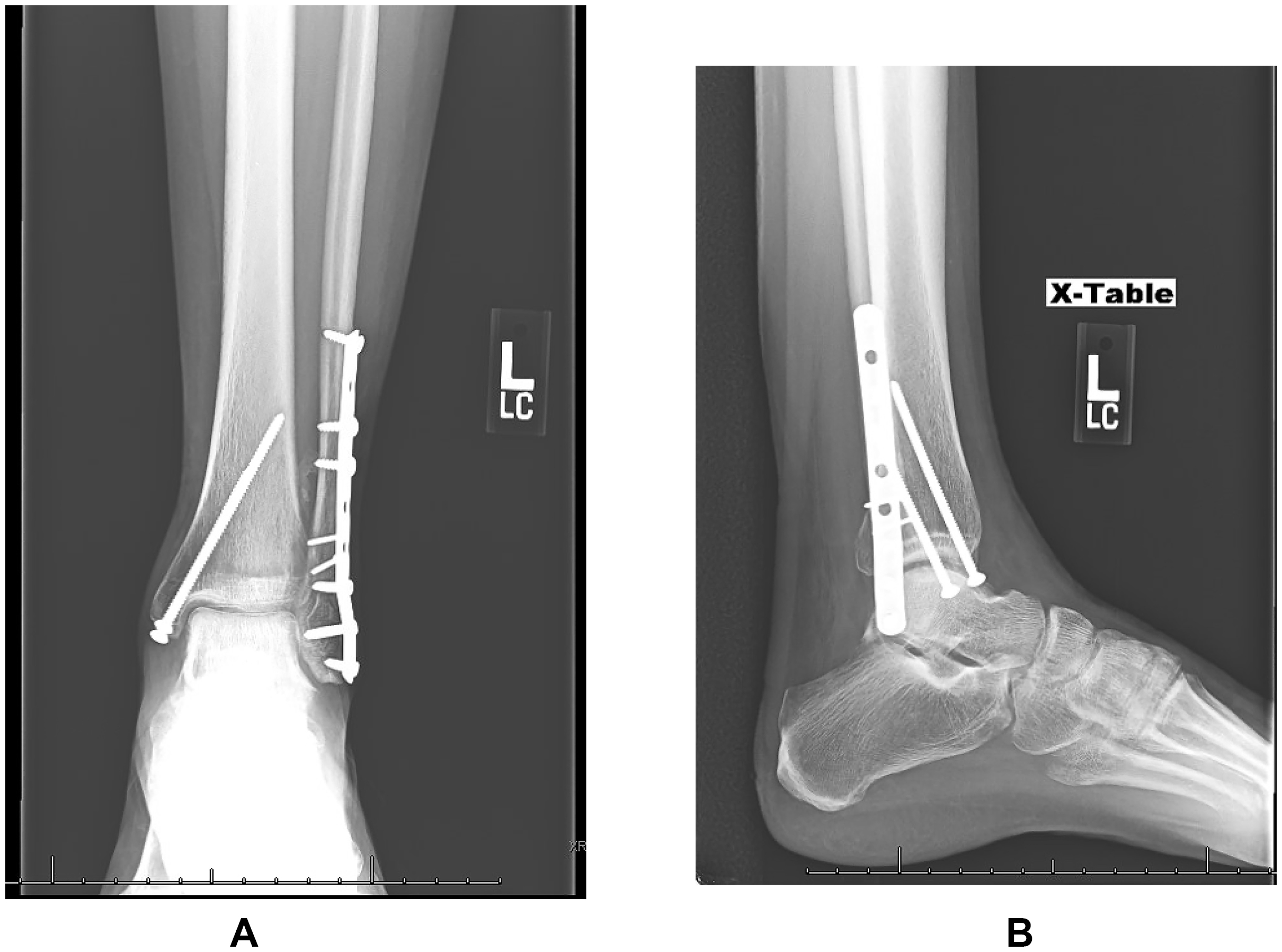
Current Procedural Terminology codes to identify those with medial ankle fracture screw fixation. Of 292 patients retrospectively reviewed, 126 were included following the inclusion and exclusion criteria. Patients 18 years and older treated with open reduction and internal fixation of the medial malleolus with unicortical or bicortical screw fixation were included. Exclusions included medial malleolar fractures treated with plating, open fractures, and Charcot’s neuroarthropathy. Unicortical fixation was accomplished using the previously mentioned 4.0-mm cannulated, partially threaded cancellous screws using standard AO technique (
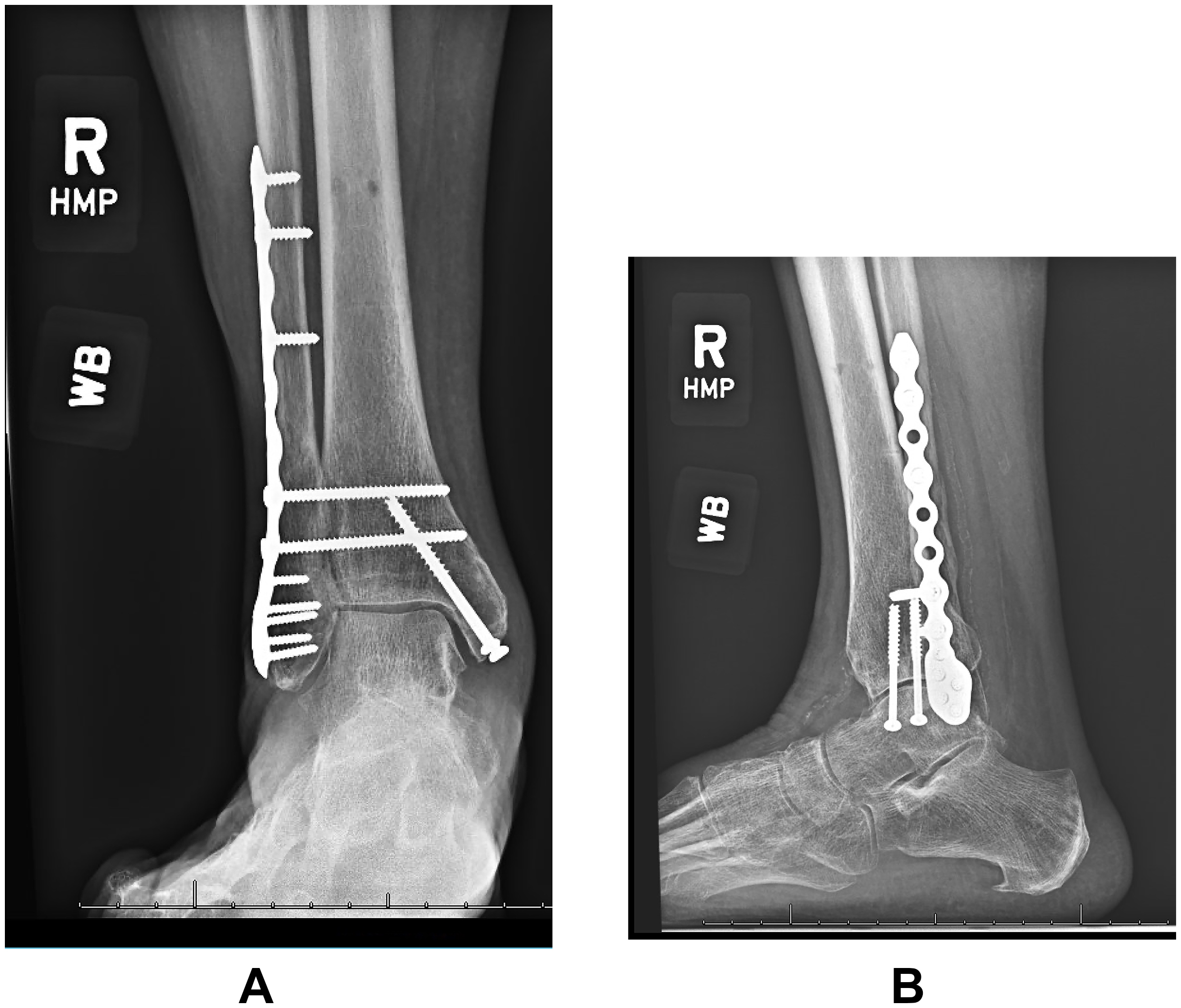
Fig. 1). Bicortical fixation was performed with 3.5-mm fully threaded cortical screws using a positional screw technique (2.5-mm underdrill) (
Fig. 2). The postoperative protocol consisted of a well-padded posterior splint for 1 to 2 weeks with transition to a below-the-knee cast versus a controlled ankle motion boot once sutures were removed. Patients were nonweightbearing typically for 6 to 8 weeks depending on bone healing. Postoperative complications, including screw failure or loosening, nonunion, delayed union, and painful hardware, were recorded. We also recorded time to union (as demonstrated on serial radiographs on two or more views) and time to full weightbearing, which was routinely recorded in the notes. Notes were typically dictated by the attending surgeons on record. Demographic data and comorbidities were also reviewed. Statistics were calculated by the university’s statistician using the χ
2 test for binary variables, the two-sample
t test for continuous variables that were symmetrical, and the Wilcoxon rank sum test for continuous variables with a skewed distribution.
Figure 1.
Anteroposterior (A) and lateral (B) radiographic views demonstrate the typical construct for a bimalleolar ankle fracture treated with unicortical fixation of the medial malleolus.
Figure 1.
Anteroposterior (A) and lateral (B) radiographic views demonstrate the typical construct for a bimalleolar ankle fracture treated with unicortical fixation of the medial malleolus.
Figure 2.
Anteroposterior (A) and lateral (B) radiographic views demonstrate the typical construct for a bimalleolar ankle fracture treated with bicortical fixation of the medial malleolus.
Figure 2.
Anteroposterior (A) and lateral (B) radiographic views demonstrate the typical construct for a bimalleolar ankle fracture treated with bicortical fixation of the medial malleolus.
Results
The cohort included 87 women and 39 men with a mean ± SD combined age of 56.0 ± 18.0 years old (
Table 1). There were 48 patients in the bicortical group and 78 in the unicortical group. Overall, 20% of the patients had diabetes, with 9% having documented neuropathy on examination. There were ten obese patients (body mass index >30 [calculated as the weight in kilograms divided by the square of the height in meters]) and four patients with peripheral vascular disease. Hypertension occurred in 48% of the population and hyperlipidemia in 33%. Eleven of the patients had a history of myocardial infarction. There was no statistically significant difference in the overall rate of complications between groups, with three patients (6%) with bicortical screw fixation and six patients (8%) with unicortical screws experiencing complications. Complications for the unicortical group included two patients with delayed wound healing and four with delayed unions. Complications for the bicortical group included one nonunion (>6 months), one delayed union (>3 months), and one malunion. Reoperations for the unicortical group included one hardware removal for a nonhealing wound and for the bicortical group included hardware removal for nonunion. No statistically significant differences were found between groups in sex, age, neuropathy, obesity, peripheral vascular disease/peripheral artery disease, coronary artery disease, or myocardial infarction. There was a significantly higher number of diabetic patients treated with unicortical fixation (
P = .04). No statistically significant difference was noted for time to ambulation between the groups, with bicortical being 8.4 ± 3.2 weeks and unicortical being 8.9 ± 3.5 weeks. Mean time to union (defined as absence of fracture line on two radiographic views) was also not statistically significant, with bicortical being 7.7 weeks and unicortical being 8.1 weeks. There were six deaths during the postoperative period, including two in the bicortical group and four in the unicortical group, all of which were unrelated to their ankle injuries or surgeries.
Table 1.
Demographic Data, Complications, and Time to Ambulation and Union
Table 1.
Demographic Data, Complications, and Time to Ambulation and Union
Discussion
When considering fixation methods of medial malleolus fractures, it is important to consider both surgeon experience and fracture fragment type. Some fracture fragments are better fixated with plating techniques such as a buttress or hook plates, and other fracture fragments are amenable to screw fixation. In those amendable to screw fixation alone, multiple options exist, including partially threaded screws (lag by design), fully threaded screws (lag by technique), or positional screws without generation of compression. One concern postulated with the use of partially threaded cancellous screws hypothesizes that there is poor screw fixation strength in metaphyseal bone.[
11] Lag by technique using a fully threaded screw or the use of fully threaded positional screws with far cortical fixation theoretically allows for better bone quality and purchase but requires longer screw lengths, which may not be readily available.
We report on 126 operatively treated medial malleolus fractures: 48 treated with bicortical screws and 78 treated with unicortical, partially threaded screws. In this cohort, there are no differences in rate of union, time to union, or hardware failure between the groups. These results demonstrate that screw fixation of medial malleolus fractures has overall low complication rates, 7% in this series, which is comparable with the current literature, and that complication rates do not differ based on fixation type. Mean follow-up was 7.5 months for both groups. Women were more likely to have an ankle fracture (69%) compared with men in this study. Mean ± SD age for both groups was 56.0 ± 18.0 years. Postoperatively, the data showed that 80% of the patients received physical therapy.
In their 2012 research, Ricci et al[
12] performed a two-part study looking at insertional torque in cadavers as well a clinical cohort study comparing bicortical and unicortical fixation. The fully threaded bicortical fixation had an insertional torque three times higher than that of unicortical fixation (14.4 inch-pound force [in-lbf] versus 4.0 in-lbf). Their clinical cohort portion demonstrated a significantly lower rate of screw loosening in the fully threaded bicortical fixation group.[
12] This finding contrasts with the present study, which reports similar rates of fracture union but without a demonstrated difference between the two groups regarding screw loosening.
King et al[
13] in 2012 demonstrated that 91.3% of medial malleolus bicortical fixations healed uneventfully in a complicated patient cohort at risk for healing complications. Their study population had undergone bicortical screw fixation of the medial malleolus, with one or more of the following comorbidities: age of 55 years or older, osteoporosis, diabetes mellitus, peripheral artery disease, end-stage renal disease, chronic kidney disease, history of a kidney transplant, peripheral neuropathy, or use of tobacco. The four complications in their study were one nonunion, one malunion, and two cases of painful hardware. This study is similar to the present study in the relatively low complication rates despite having complicated patient populations. Interestingly the present patient population had a high incidence of diabetes and neuropathy in the unicortical group, although this did not correlate with increased complications.
With an increased number of low-energy ankle fractures in the elderly likely owing to multiple factors, including polypharmacy, increased body mass index/weight, and falls, optimal fixation of the medial malleolus should be explored.[
14–
17] The most common ankle fracture seen by ankle fracture surgeons is a supination and external rotation injury as defined by Lauge-Hansen.[
18] Medial malleolus fractures in supination and external rotation fractures are most commonly of a transverse or short oblique morphology and amendable to screw fixation.[
19] When considering operative versus nonoperative fixation of elderly ankle fractures, it has been shown that these patients do better functionally with operative fixation.[
20] The mean age of the present clinical cohort was 56 years, which is considered elderly, and the data demonstrate low risk in operating on these people as the complication rates were low. Although we did have six patients who died during the postoperative period, none of the deaths were attributed to the surgery or injuries sustained to the ankle.
We demonstrated no significant differences in complications, weeks to ambulation, or time to union between bicortical and unicortical fixation. Overall, bicortical and unicortical fixation showed similar clinical results, with low complication rates. We believe that this is the largest study comparing bicortical and unicortical fixation for the medial malleolus.
We recognize that the present study has several limitations. The retrospective nature of the study lends itself to having selection bias. To our knowledge, this is the only reported study on bicortical fixation time to return to work and time to union. Another limitation is that many patients elect not to follow up after 6 months, once their fractures have uneventfully healed, which limits our ability to detect delayed implant-related complications. However, patients were followed until important clinical outcomes were achieved (ie, radiographic union).
In conclusion, this study demonstrated that both bicortical and unicortical screw fixation can be used for medial malleolus fractures with high union rates and low complications rates.