Amputation is an important condition that affects the physical function and quality of life of the individual and can lead to psychological and social isolation.[
1,
2] Although amputation is seen as the end point of surgical treatment, it also constitutes the beginning of the rehabilitation process.
Appropriate prosthesis applications that can compensate for the lost extremity functions constitute the basis of rehabilitation in amputee patients. Lower-extremity amputations account for more than half of all amputations.[
3] Although the main goal of prosthesis application in these patients is to regain walking, functional results may be affected by factors such as amputation level, age, and gender and may vary.[
4,
5,
6,
7] In addition to the function, many factors such as the comfort, appearance, weight, and ease of use of the prosthesis are effective in the patient’s use of the prosthesis.[
8] For this reason, it is important to consider the patient’s prosthesis satisfaction from a multidimensional perspective.
For the patient, amputation not only means loss of organs but also loss of function, work, and relationships, and changes in body image. Body image is a multidimensional and complex structure defined as the way an individual perceives his or her body physically and functionally and is shaped by the individual’s values, personality, relations with other people, and personal thoughts; and values of the society.[
9,
10]
In the literature, there are studies examining prosthesis satisfaction, physical activity status, and functional status in patients with lower-extremity amputation.[
11,
12] In this study, it was planned to investigate the prosthesis satisfaction, psychological state, and quality of life of patients with lowerextremity amputation and using prosthesis, and the factors affecting them, and it is important because it is the first study to investigate all these features together.
Methods
A total of 63 participants, who applied to our hospital between May of 2021 and May of 2022 and used prostheses for at least 1 year because of lower-extremity amputation, were included in this study. The subjects were informed about the study and written informed consent was obtained at the beginning of the study. The study protocol was approved by the Local Ethics Committee (approval date, May 4, 2021; approval number 108/05). The study was conducted in accordance with the principles of the Declaration of Helsinki.
The study inclusion criteria were defined as 1) age 18 to 85 years, 2) amputation of at least one lower-extremity, 3) using prosthesis because of lower-extremity amputation for at least 1 year, and 4) willingness to participate in the research and having sufficient cognitive functions to answer the survey questions. The study exclusion criteria included the following: 1) concomitant mental, cognitive, and neurologic disease in individuals; and 2) any musculoskeletal disease or neurologic disease such as neuropathy in an intact extremity.
Demographic data (age, sex, body mass index, education, employment, and marital status), smoking and alcohol use, comorbidities, amputation date, cause, side, and level were recorded by completing a face-to-face questionnaire. How long they had been using the prosthesis and daily prosthesis use times, whether there was residual extremity pain and phantom pain, and the severity and stump features, if any, were queried and the prosthesis features were noted.
The prosthesis satisfaction of the patients was measured with the Prosthesis Satisfaction Questionnaire (PSQ), a Turkish validity and reliability study.[
13,
14] In this survey consisting of 15 questions, the maximum score that could be obtained was 45 points, which meant 100% satisfaction, and the minimum score was 0 points, which meant 0% satisfaction.
Participants’ physical activity levels were evaluated with the Medicare Mobility Scale. The Medicare Mobility Scale is a measurement tool that has been shown to be valid and reliable in Turkish, and which classifies a patient’s ambulation with the prosthesis, functional capacity, and transfer ability.[
15] As a result of this evaluation, prosthesis users can be classified as follows: K0, the patient is immobile, and does not have the potential and ability to ambulate or transfer with the prosthesis; K1, the patient can use the prosthesis for ambulation and transfers (prostheses provide limited or unlimited in-home ambulation); K2, the patient provides limited ambulation in the community with the prosthesis; K3, the patient has the potential to use the prosthesis at variable speeds (the patient can use the prosthesis not only for ambulation, but also for occupation, therapeutic activities, and exercises); or K4, the patient has the potential and ability to use the prosthesis in high-energy activities.[
16]
The Amputee Body Image Scale (ABIS), of which Turkish validity and reliability studies were conducted, was used for body image assessment. The ABIS consists of 20 items that question an amputee’s perceptions and feelings about their own body experience and examines amputee body image in three different areas: personal, social, and functional factors.[
17,
18] High scores on this 20-item scale indicate high body image distortion.[
18]
Emotional status evaluation of patients was performed using the Hospital Anxiety Depression Scale (HADS), the Turkish validity and reliability of which was established by Aydemir and Guvenir.[
19] The HADS is a self-report scale. As a result of the study conducted in Turkey, the cutoff score was 10 for the anxiety subscale and 7 for the the depression subscale. Accordingly, those who score above these scores are considered at risk.[
19,
20]
The Turkish version of the Nottingham Health Profile (NHP) scale was used to evaluate the quality of life. In the NHP scale, which consists of six subparameters including energy level, emotional reactions, physical activity, pain, sleep, and social isolation and a total of 38 items, the total score is between 0 and 600, and the high health perception–related quality of life is inversely proportional to the score obtained.[
21] Then, quality of life, anxiety and depression levels, body image, and prosthesis satisfaction and the relationship between them were examined according to amputation level.
Statistical Analysis
Data were analyzed using IBM SPSS for Windows version 28.0 software (IBM Corp., Armonk, New York). The variables were investigated using visual (histograms, probability plots) and analytical methods (Kolmogorov-Smirnov test) to determine whether or not they were distributed normally. Categorical data were presented as number (%); nonnormally distributed numerical data and ordinal data were presented as median (range); and normally distributed numerical data were presented as mean ± standard deviation. According to the amputation level, NHP, HADS, ABIS, and PSQ results were compared with the Kruskal-Wallis test. The relationship between NHP, HADS, ABIS, and PSQ results of the patients was examined with the Spearman correlation test. Factors influencing the results of HADS-total, PSQ, and NHP-total were examined by univariate linear regression analysis. The factors that were found to be effective in the total level of NHP by univariate regression analysis were then included in the multivariate regression analysis and examined. The findings were assessed at a confidence interval of 95%, and statistical significance was accepted as P < .05 for all statistical analyses.
Results
The mean age of 63 patients (15 women and 48 men) included in our study was 43.25 6 13.86 years. The mean body mass index was 26.15 ± 5.14 kg/m
2. The demographic characteristics of the patients are shown in
Table 1, and
Table 2 shows the clinical features of the patients related to amputation.
Table 1.
Demographic Featuresa
Table 1.
Demographic Featuresa
According to different amputation levels, patients have HADS-anxiety, HADS-depression, HADS-total, NHP-pain, NHP-emotional reactions, NHP-sleep, and NHP-social isolation; NHP-physical activity, NHPenergy, NHP-total, ABIS, and PSQ results were not significantly different (
P > .05) (
Table 3).
There was a significant positive correlation between HADS-anxiety scores and HADS-depression, HADS-total, NHP-emotional reactions, NHP-sleep, NHP-social isolation, NHP-total, and ABIS (P < .05). A negative correlation was found between HADS-anxiety and PSQ results (r = –0.394, P = .003).
A positive correlation was found between HADSdepression scores and NHP-pain, NHP-emotional reactions, NHP-social isolation, NHP-total, ABIS (
P < .05), and a negative significant correlation was found with PSQ questionnaire scores (
r = –0.427,
P = .001) (
Table 4).
There was a positive significant correlation between HADS-total scores and NHP-emotional reactions, NHP-sleep, NHP-social isolation, NHP-physical activity, NHP-energy, NHP-total, and ABIS (P < .05); There was no significant correlation between HADS-total scores and PSQ (P > .05).
A positive significant correlation was found between ABIS and NHP-pain, NHP-emotional reactions, NHP-social isolation, NHP-physical activity, NHP-energy, and NHP-total (
P < .05). A negative significant correlation was found between PSQ and NHP-social isolation, NHP-physical activity, and NHPtotal scores (
r = –0.312,
P = .019;
r = –0.312,
P = .019; and
r = –0.277,
P = 0.039, respectively).
Table 2.
Clinical Featuresa
Table 2.
Clinical Featuresa
Table 3.
Investigation of Quality of Life, Body Image, Psychological Status, and Prosthesis Satisfaction According to the Amputation Level
Table 3.
Investigation of Quality of Life, Body Image, Psychological Status, and Prosthesis Satisfaction According to the Amputation Level
Table 4.
Examination of the Relationship between Patient Quality of Life, Body Image Perception, Psychological Status, and Prosthesis Satisfaction
Table 4.
Examination of the Relationship between Patient Quality of Life, Body Image Perception, Psychological Status, and Prosthesis Satisfaction
When the factors affecting the psychological state of the patients were examined, only the presence of residual extremity pain was found to be an effective factor on the psychological state (
β = 0.429,
P = .001) (
Table 5). When the factors affecting the prosthesis satisfaction of the patients were examined, it was determined that the presence of residual limb pain and phantom pain were the factors affecting the prosthesis satisfaction (
β = 20.41,
P = .001;
β = 20.406,
P = .001, respectively) (
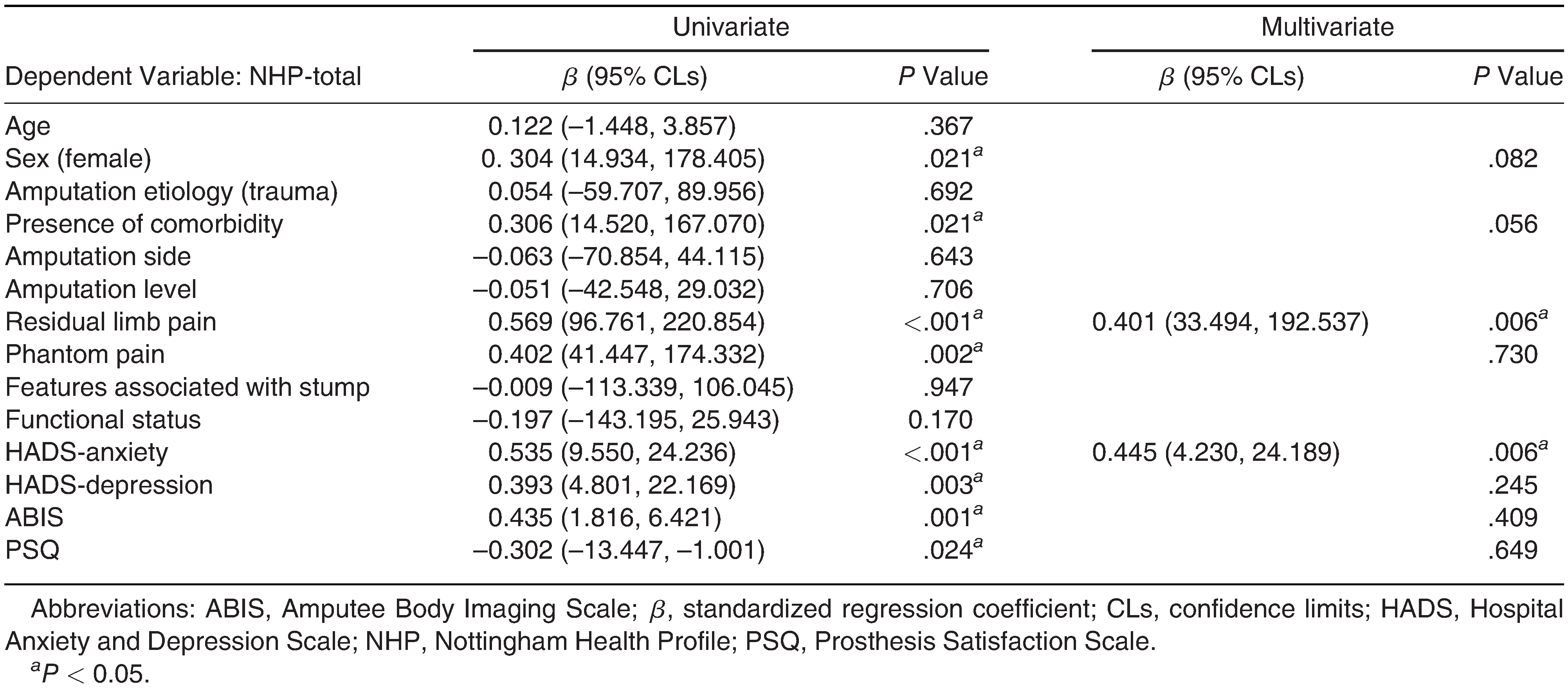
Table 6). When the possible factors were entered into multivariate regression analysis, only the presence of residual extremity pain and anxiety level were found to be independent risk factors on NHP (
β = –0.401,
P = .006; and
β = –0.445,
P = .006, respectively) (
Table 7).
Table 5.
Examination of the Factors Affecting the Psychological State of the Patients with Univariate Regression Analysis
Table 5.
Examination of the Factors Affecting the Psychological State of the Patients with Univariate Regression Analysis
Table 6.
Investigation of Factors Affecting Prosthesis Satisfaction with Univariate Regression Analysis
Table 6.
Investigation of Factors Affecting Prosthesis Satisfaction with Univariate Regression Analysis
Table 7.
Examination of the Factors in Quality of Life with Univariate Regression Analysis
Table 7.
Examination of the Factors in Quality of Life with Univariate Regression Analysis
Discussion
In this study, prosthesis satisfaction, psychological state, and quality of life of lower-extremity amputee patients who used prostheses for at least 1 year were evaluated and related factors were revealed. Although a significant positive correlation was found between HADS, NHP, and ABIS, a significant negative correlation was found between PSQ and NHP-social isolation, NHP-physical activity, and NHP-total scores. When the demographic and clinical characteristics of the patients were examined, it was found that only residual extremity pain had an effect on the psychological state. Residual extremity pain and anxiety were found to be the most effective factors on quality of life.
The effects of amputation levels on prosthesis users have been investigated in various studies.[
11,
12,
22] In a study evaluating prosthesis satisfaction in lower-extremity amputees, no significant correlation was found between amputation level and satisfaction.[
12] In another study investigating the effect of amputation level on body image perception and depression, no significant relationship was found between level and body image perception and depression.[
11] In a study in which Kablan and Tatar[
22] examined 88 patients, it was stated that quality of life did not show a significant relationship with the level of amputation. Similar to the literature, we did not find any significant difference in psychological status, quality of life, prosthesis satisfaction, and body image evaluation according to amputation levels in our study.
In this study, we also found that NHP and ABIS scores increased as anxiety and depression increased. This means a decrease in the quality of life and a further deterioration in body image perception. In addition, we found a negative relationship between anxiety and prosthesis satisfaction. This is a result similar to the literature highlighting that poor body image has a major impact on anxiety and depression.[
23,
24]
Body image perception was positively correlated with all subscales of NHP in our study. This is similar to the results of a study that investigated body image and quality of life in lower-extremity amputees, although it used other rating scales.[
25]
The prosthesis-related satisfaction level is related to health-related quality of life. In our study, a negative correlation was obtained between PSQ and NHP-social isolation, NHP-physical activity, and NHP-total. It was interpreted that as satisfaction with the prosthesis increases, NHP scores will decrease (ie, quality of life will increase). This result was not inconsistent with the literature.[
26]
In our study in which we investigated the effects of conditions such as age, sex, amputation etiology, comorbidity, amputation side and level, residual limb pain, phantom pain, stump features, and functional level, we found that only the presence of residual limb pain affects the psychological state. Similarly, in a study by Desmond and MacLachlan,[
27] it was emphasized that the anxiety level of those with residual limb pain or phantom pain was higher than those of lower-extremity amputees without pain, but at the level of the healthy population. As with phantom pain, residual limb pain has been shown to be important in psychosocial adjustment.[
28] In contrast, Durmus et al[
29] showed that the presence and severity of phantom pain were not related to general psychiatric symptomatology.
The person’s satisfaction with the prosthesis provides convenience in amputee rehabilitation. Various studies have shown that phantom pain affects prosthesis satisfaction.[
28,
30] Although we found a decrease in prosthesis satisfaction in the presence of these two pain types, we could not find a significant relationship between age and amputation level and satisfaction, in line with the literature.[
12,
31]
Our main goal in amputee rehabilitation is to facilitate adaptation to a new life and to try to increase the quality of life. Asano et al[
32] stated that variables such as age, depression, and prosthetic problems affect the quality of life of lower-extremity amputee patients. Demirdel and Bayramlar[
26] demonstrated that stump pain limits reparticipation in life. We found that residual extremity pain and anxiety were the most effective factors on quality of life in lower-extremity amputee patients.
Conclusions
This study has several limitations, primarily attributable to the small number of patients and the cross-sectional design, and not including long-term follow-up results. As a result, individuals using prostheses because of lower-extremity amputation should be examined in terms of prosthesis-related features, prosthesis satisfaction, psychological state, body image perception, and quality of life, and these factors should be considered during rehabilitation processes. Studies with a larger patient population and including long-term follow-up results are needed.