Methods
A phenomenologic approach [
35] was taken for this qualitative, exploratory study, which received ethical approval from the University of Exeter (210324A-01). Participants provided informed consent electronically.
Participants were purposively recruited by means of e-mail through personal contacts, sports clubs, and the VOICE network (
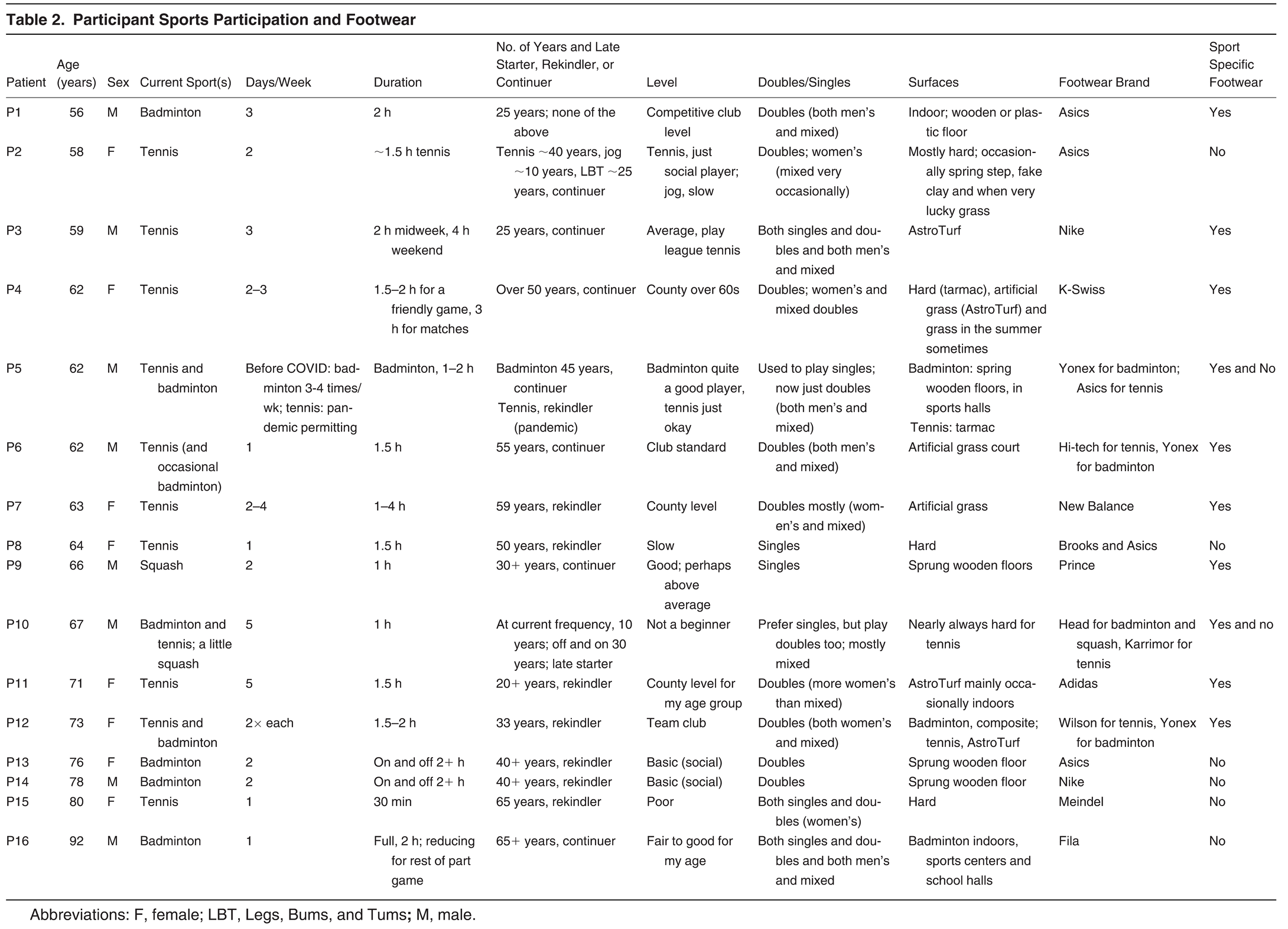
www.voice-global.org) to take part in a focus group or semistructured interviews face to face but online by means of Zoom (Zoom Video Communications, Inc., San Jose, California). The eligibility criteria were 1) a resident of the United Kingdom or Ireland, 2) age older than 55 years, 3) play a racket sport or team sport at least once a week (recently, before the COVID19 pandemic), and 4) English speaking. A total of 16 participants were recruited (eight male and eight female), which is a sample size similar to previous qualitative work on footwear needs. [
32,
36,
37]
Informed consent was obtained before the preliminary questions and interviews, including consent for the interviews to be recorded. Before the interviews and focus group, participants completed a preliminary questionnaire, which they returned by means of e-mail that included the following: age, gender, location, current and previous sports, the frequency and duration they typically play their sports (before the COVID-19 pandemic), whether they play doubles or singles (if they play a racket sport), and what type of surfaces they typically play on. Participants were asked if they consider themselves with respect to sport a “late starter” (not playing until after 50 years of age, a “rekindler” (played at a young age, took a break, and reinitiated involvement), or a “continuer” (involved in sport for most of life) according to the definitions of Brennan et al. [
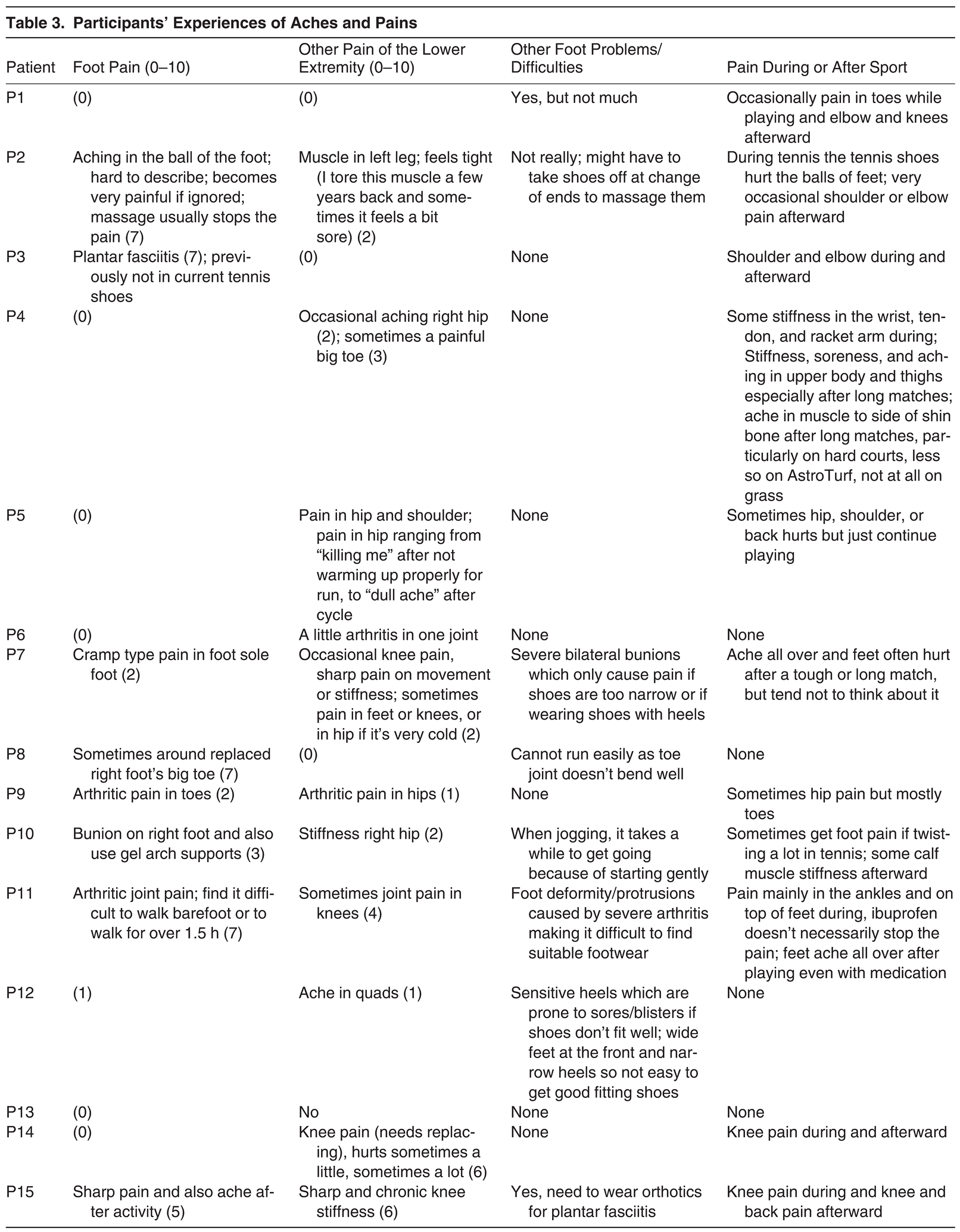
38] Participants were also asked in the preliminary questionnaire about aches/pains of the lower body and specifically in the foot during everyday life and during/after sport and whether they experience any other difficulties with their feet that do not necessarily cause them pain.
The open questions used in the interviews and focus group (
Table 1) were based on previous work on the footwear needs of standing workers. [
32] As per the previous study, the participants’ own definitions of the words “comfortable,” “supportive,” and “cushioned” were explored, as these are words commonly used by footwear manufacturers. [
32] Questions 2 through 4 and 12 (
Table 1) were included following consultation with an industry partner who intended to develop an all-arounder athletic shoe suitable for older adults and who is considering a hookand-loop fastener (Velcro) version. To explore participants’ perceptions of falling and injury risk in their sports and whether these perceptions may relate to their footwear choices, question 16 was adapted from a previous study on the fall-risk experience of Canadian Masters Athletes. [
38] Questions were not necessarily asked sequentially, depending on the participant’s responses (semistructured approach). General prompts were given during the interviews where appropriate such as “Can you expand on that a little bit?” or “What do you mean by.. .?” Question-specific prompts are included in
Table 1. The preliminary questionnaire questions and interview questions were piloted before data collection to establish comprehensibility with one woman (age 61 years) who was a former badminton player with 40 years of playing experience. As a result of piloting, in the preliminary questionnaire, italics were used to distinguish the difference between questions regarding aches and pains “when you are actually playing your sport(s)” and “after your sport(s).” For the interview questions, “if there are any” was added to questions 7 and 8 regarding the good and bad aspects of participants’ current sports shoes. The pilot data were not included in the analysis.
The interviews were all conducted by one of the authors (J.R.) from March to May of 2021 and lasted for a mean 6 SD of 27 6 9 minutes. Interviews were transcribed verbatim using the Zoom automatic transcription feature and manually edited to correct errors. Thematic analysis was performed manually by one of the authors (J.R.) following the approach outlined by Attride-Stirling. [
39] Transcription and analysis took place while data collection was ongoing. The results were reviewed by two of the authors (S.D. and A.W.) in a consensus meeting to substantiate interpretation. Because of the nature of this research, participants of this study did not agree for their data to be shared publicly, so supporting data are not available.
Themes
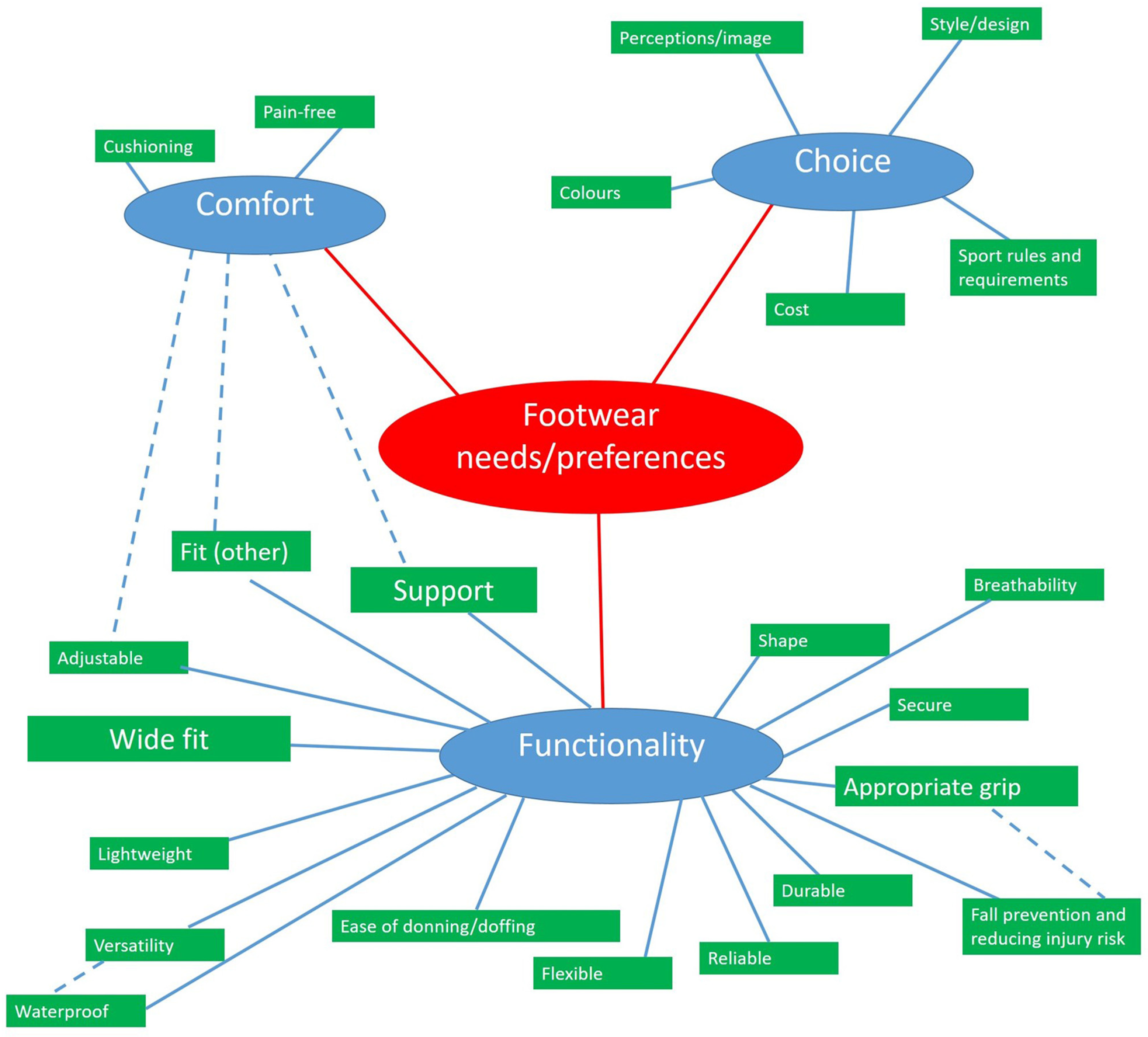
The global theme of “footwear needs/preferences” was split into organizing and basic themes that were often interrelated (
Figure 1). The number of participants discussing each basic theme is included in
Table 4. The theme of “support” was placed under the organizing theme of “sensations,” in previous work [
32]; however, we chose to place it under “functionality” because participants typically defined “supportive” in relation to resisting/ protecting against excessive movement or foot posture, rather than a subjective feeling. “It protects and holds your foot” (P4); “instead of going, you know sideways.. .” (P1) and it “keeps your foot in proper alignment” (P12).
Theme 1: Comfort. Footwear not hurting one’s feet (pain-free) and cushioning were grouped together with general comfort. The basic themes were often related to each other and others under functionality, such as fit and support.
Comfort and Pain-Free. Comfort in general was regarded as important or very important by nearly all participants (n = 15). “It would be comfort over style, comfort over brand, comfort over everything” (P6). “I would say comfort is by far and away the most important thing, because if you’re, if you’re not comfortable with putting your shoe on you’re not going to play, because you don’t have to at my age” (P9). Participants’ descriptions of comfort often related to being pain-free and having a cushioned feel: “It doesn’t rub, it doesn’t give you blisters and things like that” (P12); “It’s when you just first put them on and you feel the cushion effect” (P2). Descriptions of comfort also related to the general fit (grouped under function) and conforming to the shape of your foot: “I mean it was adjustable to fit your foot wouldn’t it, if it was comfortable” (P12). “So it’s a kind of you know, fitness, fitting to your, fitting to the foot you, you have that kind of comfortable” (P1). Comfort was described as both an immediate and longer term feeling: “It’s not thinking about it because I, you know, for me, I know, as I say, within a minute of putting my foot in the shoe that I’m in pain, and if I’m not thinking about my feet, then they’re comfortable” (P7). “[You] can wear them for two hours tennis, an hour and a half tennis [and] not feel anything” (P6).
However, there were concerns that comfort on its own is not enough for sports footwear and that it needs to provide adequate support as well: “you just feel right okay it’s comfortable um but may not be strong enough” (P1). “I think support is probably more important for me. I mean, but it’s got to be comfortable, because otherwise obviously you wouldn’t run, or you wouldn’t you know do things, but I think um. I think good ankle support is quite important for me” (P8). For one male participant, the term comfortable meant “not sporty” and “cushioned” was “too much like slippers” and they reported being more drawn to “something that’s got a veneer of science” like “gel cushioned” (P10).
Cushioning. Cushioning and comfort were often described together: “The tennis shoes don’t feel as comfortable as the trainer. They don’t feel as good when you put them on. They just, I don’t know why, but they just don’t feel as comfortable. And yeah, I think they, I think the sole isn’t... You haven’t got the cushioning!” (P2). Cushioning in the heel and forefoot were considered important: “yeah for me cushioning particularly, balls of my feet as well and heels, but yeah that’s and that’s great if it’s like a real air bubble” (P11). The definitions of cushioning often related to shock absorption and a springy feel “absorbing the impact” (P1); “absorbs the vibration” (P4); “reducing the impact on your joints” (P5); “Kind of you know bounciness” (P1). However, sometimes the word “support” was used in defining cushioning: “To support the impact, I guess” (P6); “you need to know that um the shoe that you play in is going to support your heel and not give you that pain [plantar fasciitis in particular]” (P3). Similarly, one participant discussed impacts in relation to a supportive shoe: “so much impact in sport isn’t there that you want to have a good heel support” (P5).
Theme 2: Functionality. Factors grouped under functionality involved the structure of the shoe and sports performance.
Support. Support was considered important with particular references to the heel and ankle in relation to preventing excessive movement: “something with good supports that is going to prevent any turn in the ankles” (P15). The sporting movements performed were sometimes mentioned regarding areas of the shoe that needed to provide support. “The sides I would think and the back, because you’re moving around a lot with badminton” (P13) and “you know if that’s the foot out there [pointing at the lateral border of their hand], especially that bit is extremely you know, you move quite a lot. So it, it tears, very often, from that point” (P1). The arch area and support in the sole was also discussed with regard to arch support for flat feet, “keeps your foot in proper alignment” (P12), and the capacity to accommodate an orthotic or change the insole: “I have to have a shoe that the orthotic can go into” (P15).
Three participants used the word “sturdy” in a similar context to definitions of support “because you can easily twist your um foot. So I think the sturdiness is quite important for me” (P1) and another participant used the word “robustness”: “[my trainers] would not be suitable for tennis, they don’t have enough, they’re not robust enough, they’re not err, they don’t protect your foot, they don’t wouldn’t stop your ankle going over” (P4). Flexibility in both the upper and the sole were discussed; however, it was often stressed that there should be a balance between being “rigid” and “flexible”: “You know that give that slight, slight rigidity, flexible rigidity, if you like” (P9).
Wide Fit. Nine of the 16 participants mentioned needing a wide-fit shoe and difficulties in finding a wide-fit shoe for sport, which was related to comfort and a very important factor for them. “I’m more comfortable with a wide fit shoe... but you can’t get them, you know” (P5). Some reported having to wear a larger shoe size to get the necessary width: “Yes, width is definitely a problem I tend to have... larger size shoes to get wider width” (P16). “I’ve had to go into a larger size than I should be in” (P8). Some women reported resorting to men’s shoes to get the width: “I’m directed towards the men’s shoes, because actually they are broader than the women’s shoes, but sometimes they’re just, they’re just too broad it’s, getting something that isn’t off the shelf, but actually is comfortable” (P8). The reasons reported for needing a wide-fit shoe included having a generally broad foot: “I’ve got duck feet” (P12); “I’ve got broad feet, I do find difficulty getting broad sizes” (P5); “I think your feet do broaden as you get older and I think that’s a really important thing to take into consideration for the older athlete or the oldest sportsperson” (P9). Specific foot conditions such as bunions/hallux valgus and toe deformities were also cited as reasons for needing a wide-fit shoe, with the additional requirement of not having stitching over painful areas: “sometimes they you know they try and put these attractive logos on it and the stitching comes exactly over my bunion and I know that rules them out” (P7). A further reason for needing a wide-fit related to support: “I think the support has, has to come more in the err, the width of the foot bed, so that you’re not rocking” (P9).
Grip. Appropriate grip was important for half of the participants, and it was recognized that different grip is needed for different surfaces (especially in tennis). However, there was a preference to have one shoe that would be suitable for all surfaces (versatility for different surfaces). “Ideally, I’d have one pair that did everything” (P6). One participant mentioned wearing shoes with a worn grip for indoor tennis: “shoes, with a strong grip can be dangerous on indoor courts, because your foot gets stuck as you’re, as you’re running and that’s when I thought I’ll save my old battered pair of K-Swiss and just wear them when I play [indoor tennis]” (P4).
Secure, Ease of Adjusting Tightness, and Ease of Donning and Doffing. When asked whether they would consider a Velcro sports shoe, participants were typically strongly against the idea because of concerns that their feet would not be as secure as with laces and it would be more difficult to adjust the tightness of the shoe. “I think it’s um, security is important and the laces probably still the main choice, if not the only choice” (P1). “I think I’d go for, I’d always go for laces because, because I’d want to control the err tightness and the, err the constriction around my foot. And um sometimes you might, I might have thicker socks than other times, so yeah. I would want control of that” (P4). However, one 92-year-old participant reported that they “.. .did look for something without laces” for ease of donning and doffing (“to not waste time when I change my shoes” [P16]).
Fall Prevention and Reducing Injury Risk. Despite support being considered important and frequently defined in relation to preventing ankle injuries, when participants were asked directly what they do to manage their risk of falling and injuries, avoidance and care was more commonly cited as a strategy than footwear or clothing choice (
Table 5). Avoidance/care mostly related to not going for certain shots that they might have gone for when they were younger: “it doesn’t matter that you don’t run for every single shot and it might be that you decide, let that one go.. . in order to save your body, so there is a little bit more selfpreservation than just being, you know straight and running everything down” (P9). When footwear was mentioned in relation to fall/injury prevention, it was discussed more in the context of appropriate grip than support. “it’s always the grip is the reason I have to change the shoe, because the grip starts to wear and if you’re starting to feel slippy err and not having any confidence when you’re playing, um you can’t play, as well as you want to because it’s in your mind that you might go over” (P3).
Other. Other factors less commonly mentioned were lightweight, breathability, shape, waterproof, and durable. For one participant, lightness and not applying too much pressure on the top of her foot was particularly important due to “sort of nodules and my feet are a bit deformed” (P11). Shape was discussed in relation to the sole shape “so that it has like a curved part on your, on the ball of your foot” (P12) and the heel collar “little dip in the heel” so that it doesn’t rub (P15).
Theme 3: Choice. Factors that influenced foot-wear selection that were not related to physical sensations or the performance of the shoe were organized under “choice” and mostly involved the appearance of the shoe. The choice themes included perception/image, style/design, colors, cost, and sport rules and requirements.
Color. The color of sports footwear was a preference that was very varied, for both men and women. Some preferred white as is tradition in racket sports: “possibly if the options were there I would go back to traditional white” (P16). “I’m a traditionalist. I like, if I’m playing tennis, I like my shoes to be white. I don’t like black trainers and things like that I like a little bit of color if possible, a bit of pink or blue or you know something, just to mix it up” (P2). For others they liked a lot of color because “I mean I’ve always liked shoes that don’t conform... color is quite important, and err you know can reflect your personality a bit as well” (P9). “I don’t like white ones, I never tend to get white ones. So I always tend to get some that are colored” (P3). When discussing wearing other athletic footwear for everyday use, black was seen as being versatile: “I’ll wear a pair of black trainers as a pair of ordinary shoes and try and get away with it. Even in more formal settings” (P9), “for the wintertime because I’m wearing dark trousers, so I prefer darker color” (P15). For some, color was not at all important: “The last thing I would think of would be color” (P6).
Style/Design. Similar to color, the style/design in terms of aesthetics were preferences and not as important as other themes such as comfort and support: “if there were two choices of shoes then I’d probably pick the one with the nice design, but if, if there’s not much.... But, it doesn’t, doesn’t override the support and the comfort really, they’re the two important things really, yeah” (P5). A preference for a slimmer look was mentioned by some women: “I think if they could design, something that makes the foot look slimmer” (P15); “Well I don’t actually like them really, because they look crap you know ha-ha. I mostly wear tracksuit bottoms to play and I look like I’ve got these kind of wedges on my feet” (P4).
Perceptions/Image. Participants reported not wanting to wear footwear that looked like it was designed for older adults, particularly among the female participants. Perceptions were discussed in relation to a Velcro shoe: “And it also, it’s almost a sign of your age, isn’t it? That if you’ve got, you’re either really young and you need Velcro, or you’re really old and you need Velcro! Because you can’t do it...” (P2). In addition, in relation to how the general design influences the image: “I’m thinking of the ordinary shoes where sometimes they look very much like they are medically engineered. And haha, yeah you want them to look like regular trainers really” (P11); “if I thought a shoe was for an older person I might not look at it, because I’m thinking: “Hang on I don’t want to [be] put in that bracket” (P12).
Cost. While some participants mentioned buying footwear in sales or not wanting to “spend oodles of money on sports shoes” (P12), others emphasized the need to spend money on good quality footwear as “an investment” (P5) and “there’s no point in buying cheap ones basically” (P14).
Sports Rules and Requirements. This theme related to the requirements of the sport or the venue, such as needing to wear nonmarking soled shoes for indoor venues or tennis shoes on grass courts: “if you play on the grass courts at my club, they insist that you have to wear tennis shoes and they’ve got the special dimples on the bottom that don’t hurt the grass” (P2).
Discussion
This study explored the footwear needs and preferences of older adults who regularly play racket sports. The factors that were discussed were grouped into the themes of sensations, functionality, and choice. Comfort was key for the majority of participants, although it was often stressed that comfort alone was not sufficient and a sports shoe must also provide good support. Over half the participants reported needing a wide-fit shoe and having difficulties in purchasing wide-fitting sports shoes. The insights provided in this study can be used to inform footwear design and manufacture and suggest that the athletic footwear industry in the United Kingdom may not currently be recognizing the needs of active older adults.
Comfort was the feature of sports footwear most reported as important by the older adults. Previous qualitative research into the footwear needs of workers [
32,
40] and community-dwelling older adults (60–80 years old) [
41] also found comfort to be a primary factor in footwear selection. It has been suggested that older adults may be more driven by cost and comfort than safety considerations when purchasing footwear. [
42] Whether there are specific design requirements of footwear for older adults playing racket sports remains largely unknown. Some participants reported footwear design features that have been shown to relate to pain and directly or indirectly to injury risk as important, such as grip [
43,
44] and sole curvature. [
27] However, it would appear that if footwear was designed with the goal to reduce injury risk of older adults playing racket sports, comfort may be a key factor in whether such footwear was accepted, particularly as the older adults in this study reported changing their behavior on court with age more than footwear selection as a means of managing their risk of injury. Similar to previous work, comfort, being pain-free, cushioning, and support were related, as there was an overlap of terms in given definitions, such as a comfortable shoe having a cushioned feel. [
33,
40]
The cushioning of footwear was mentioned by the majority of participants, but it was emphasized less than other themes such as being pain-free. Good cushioning is arguably important in footwear for racket sports at any age because of the high impact forces involved. [
22] However, cushioning of court shoes may have traditionally been seen as less important than cushioning in running shoes. [
44] For older participants, there may also be increased need for cushioning in athletic footwear (eg, because of reduced elasticity of plantar fat tissue, [
45,
46] and stiffer joints associated with osteoarthritic changes leading to less effective lower limb cushioning [
47,
48]).
The need for a wide-fitting sport shoe was reported by over half the participants, and for those participants, it was a very important factor in footwear selection. Increased foot width with age, especially in the forefoot region, is well established and can be a consequence of many factors such as swollen feet because of venous deficiencies, reduced medial longitudinal arch height, toe deformities, rheumatoid arthritis, and hallux valgus. [
49,
50,
51] A systematic review found that footwear width was frequently a concern for older adults and that older adults often wear footwear that is too narrow for their feet. [
52] Some participants in the present study reported going up a shoe size to get the correct width, which supports the suggestion that individuals wearing shoes that are too long but the correct width may be attributable to selecting a shoe that is too long to accommodate a wide foot. [
52,
53] Shoes that are too long may increase the risk of falling because of the ball of the foot being in a suboptimal position within the shoe for push off, [
54] and ill-fitting footwear has been reported as a cause of falls. [
55] Although footwear with sufficient sole width has been advocated for older adults for the sake of lateral stability, [
56] only one participant mentioned width as important so that “you’re not rocking.”
It has been demonstrated that older adults with appropriate-fitting footwear have better balance and less fear of falling than older adults with ill-fitting footwear. [
57] By providing readily available wide-fitting sports shoes, the athletic footwear industry could reduce the risk of falling during sport. The provision of safe and comfortable footwear may also encourage participation of older adults in sport. Appropriate athletic footwear is therefore important not just for foot health but also for overall social and physical health, which are known benefits of participating in sport for older adults. [
58]
The color and style of the sports shoes were considered more preferences than essential requirements and very individual. In contrast, a study on footwear selection with regard to fall prevention found aesthetics to be the main factor influencing footwear choice. [
41] In the earlier study, participants were asked generally about their main considerations when purchasing footwear, but also about their perceptions of the Prope´t washable walker shoes (Prope´t USA Inc, Auburn, Washington) they were provided. Reasons for not wearing the Prope´t shoe related to its “ugly” appearance and the perception of it being “good for older ladies, not me.” Similarly, in the present study, participants reported the desire to wear sporty looking footwear, not footwear that was obviously designed for older adults. This finding is in line with previous work that reported that women in particular have negative feelings toward therapeutic footwear that makes them visibly different from others and influences how others see them. [
37] Footwear development must consider the psychological and physiologic needs of the user and the importance of a usercentered and demand-oriented approach has been emphasized for the design of footwear for older adults. [
59]
A small sample of 16 participants could be considered a limitation of this study, which reduces the generalizability of the findings. However, no new basic themes were identified from the last two participants interviewed, so it was considered that data saturation was reached. Furthermore, this study was designed to be exploratory and has achieved its aim of gaining insights into the footwear needs and preferences of some older adults in racket sports. Findings were from participants from widely distributed locations within England and with an age range from 56 to 92 years. However, the majority of participants had been involved in sports for a lot of their lives; only one considered themselves a “late starter” and our inclusion criteria required that they typically play their sport once per week. It is possible that older adults taking up sport later in life and those who play racket sports less often have different perspectives on footwear selection compared to the participants in this study. A few participants reported having specialist footwear for their primary sport of badminton and more general-purpose footwear or running shoes for tennis, which they played less often. In the future, we plan to conduct a survey, with a wide geographic spread, to include older adults who participate in racket sports at least once per year to gain insights from a wider range of playing experiences and frequencies and establish the generalizability of the current findings. We were not able to recruit any older adults who play team sports, which also involve lateral movements as in racket sports, so future work could explore the footwear preferences and needs from this group. In addition, future work is required to investigate the biomechanical requirements of athletic footwear for older adults in multidirectional sports and improve our understanding of the relationship between physiologic/biomechanical and psychological footwear needs.