Transmetatarsal amputations (TMAs) are limb salvage operative procedures that preserve limb length and functional ankle joints. [
1] Indications for TMAs include forefoot trauma, infection, and ischemia. Prior research demonstrates that patients who undergo TMAs have a lower 2-year mortality rate compared to those who undergo below-knee amputations (BKAs). [
1,
2] In addition, prior research indicates that patient selection for TMAs is critical for optimizing healing potential of the operative site. Important factors to evaluate before TMA surgery include patient vascular status and adequate soft-tissue coverage. [
1,
3,
4,
5] Traditionally, TMAs are not primarily closed; however, recent research shows that after thorough operative debridement, infection control, and clean wound-site margins, primary closure of the amputation site can be appropriate. [
6,
7,
8,
9] The controversy between primary closure of TMAs versus secondary healing of TMAs is ongoing. Some researchers argue that primary closure of the surgical site can help to decrease healing time and the need for additional operations. [
8,
10,
11] Nevertheless, other investigators stress that the recurrent infection rate is higher in primarily closed operative sites. [
7] The literature investigating primary closure versus staged closure of partial foot amputations is scarce, and a conclusion has yet to be reached. Even less literature specifically investigates primary closure versus secondary healing of TMAs.
The aim of this study was to determine whether primary closure of TMAs is an acceptable treatment for forefoot infection, dry gangrene, or chronically nonhealing ulceration. We hypothesize that primary closure of a TMA is a superior treatment method compared to secondary wound closure of a TMA in particular cases of forefoot infection, dry gangrene, or chronically nonhealing ulceration. Our primary aim was to measure healing time and complication rates, including recurrent infection, recurrent gangrene, revision pedal surgery, and higher-level amputations such as BKAs and above-knee amputations (AKAs). We retrospectively reviewed patients’ charts to compare the outcomes of those who had undergone TMAs with primary closure and TMAs with secondary healing.
Methods
Study Population
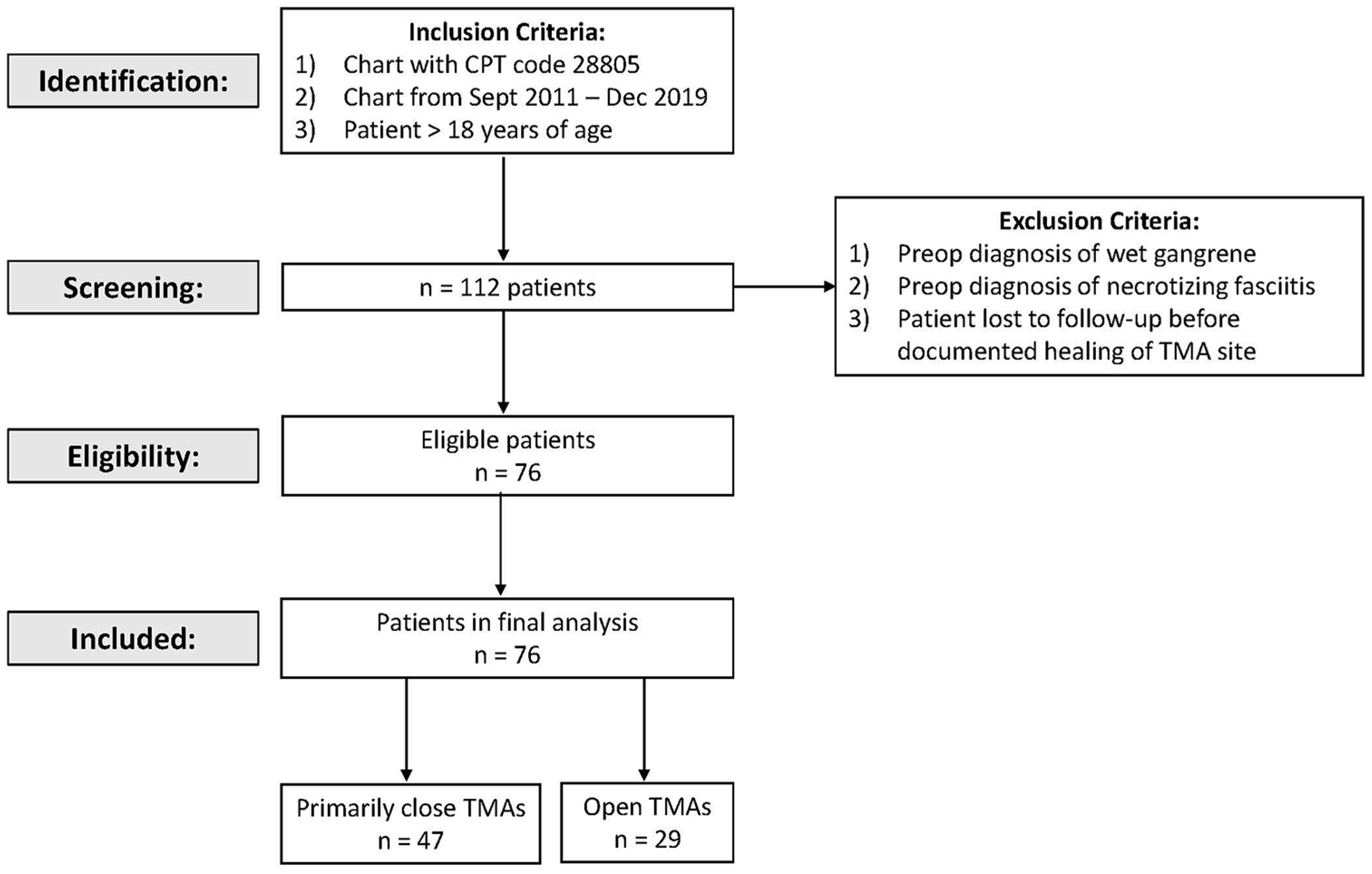
A retrospective chart review was performed by two of the authors (C.C. and Z.J.) on 112 patients older than 18 years of age who required a transmetatarsal amputation because of forefoot infection, gangrene, or chronic ulceration between September of 2011 and December of 2019. After approval from our institution’s institutional review board, patients were selected through an electronic medical record search of Current Procedural Terminology code 28805 from the senior author’s private practice (J.G.). Excluded were 1) patients with a preoperative diagnosis of wet-gangrene and/or necrotizing soft-tissue infection, and 2) patients lost to follow-up before documented healing of the TMA operative site.
Operative Procedures
Foot and ankle surgeons determined whether a patient required a TMA because of forefoot gangrene, infection, or chronically nonhealing ulceration. Moreover, through clinical observation and advanced imaging, when indicated, the surgeon diagnosed the extent of infection and tissue damage. In addition, all patients’ vascular statuses were assessed. If pedal pulses were palpable, vascular status was deemed appropriate for healing and vascular consultation was not provided unless healing of the amputation site was stalled/delayed. Furthermore, if pedal pulses were nonpalpable, further vascular studies were performed such as ankle-brachial index and/or arterial duplex scanning. From here, if vascular studies demonstrated suboptimal healing potential, the patients were then evaluated by vascular specialist physicians. Ultimately, vascular optimization was performed on those patients that the vascular specialists deemed appropriate either by endovascular or open techniques, which was determined by the vascular specialist physicians. Next, patients were placed on broad-spectrum antibiotics if the severity of infection indicated treatment.
Foot and ankle surgeons performed all operations. Intraoperative assessment of the forefoot further determined the extent of tissue necrosis and infection. Operative principles included aggressive debridement of all nonviable soft tissue and bone, wide drainage of purulent collections, and TMAs. Moreover, intraoperative cultures and tissue clearance fragments were obtained and sent for further pathologic and microbiologic evaluation. These findings dictated a postoperative antibiotic course for each patient. Before operative closure, the attending surgeon evaluated the extent of infection, viability of remaining tissues, and demarcation of necrosis. Next, wound closure was handled in one of two ways: primary closure (group 1) or left open (group 2) as judged clinically appropriate by the attending surgeon.
Data Collection and Follow-Up
Postoperatively, all patients were monitored in an outpatient clinic by their surgeons. Wound healing was based on medical record physical examination documentation. Variables measured included healing time of TMA site, recurrent infection, recurrent gangrene, revision pedal surgery, and the need for more proximal amputations such as BKAs or AKAs. Minimum follow-up requirement was time to healing of the surgical site. Records were reviewed for patient demographics, presenting forefoot lesion, diabetes mellitus, peripheral neuropathy, peripheral vascular disease, hypertension, and hyperlipidemia.
Statistical Analysis
The statistical software package SAS (SAS Institute Inc, Cary, North Carolina) was used for data analysis. For all statistical analyses, significance was set at P < .05. The comparison of demographic data was performed using x2 or Fisher’s exact test. Furthermore, x2 analysis or Fisher’s exact test was performed to compare healing rates and complication rates between open and closed TMAs.
Results
Medical records of 112 patients who underwent TMAs between September of 2011 and December of 2019 were analyzed, and final review included 76 patients (
Figure 1). Patients were placed into one of two groups: group 1, closed TMAs, yielded 47 patients; whereas group 2, open TMAs, yielded 29 patients. In our data set, there was no significant difference in demographic information (age, sex, pertinent medical history, and concurrent vascular and antibiotic therapy) between the two treatment groups (
P > . 05) (
Table 1).
Furthermore, peripheral vascular disease was documented in 65 of 76 patients (85.5%). In patients who underwent closed TMAs, 40 of 47 (85.1%) had peripheral vascular disease, whereas in patients who underwent open TMAs, 25 of 29 (86.2%) had peripheral vascular disease (P = .89). Vascular intervention/optimization was performed in 44 of 76 patients (57.9%): 24 of 47 patients (51.1%) in the closed TMA group and 20 of 29 patients (69.0%) in the open TMA group (P = .12).
In group 1, closed TMAs (n = 47), 11 patients healed within 4 weeks, 26 patients healed in greater than 4 weeks, and 10 patients failed to heal; whereas in group 2, open TMAs (n = 29), one patient healed within 4 weeks, 10 patients healed in greater than 4 weeks, and 18 patients failed to heal (
Table 2). Closed TMAs resulted in a significantly greater overall healing rate of 78.7% (37 of 47), compared to open TMAs, with a healing rate of 37.9% (11 of 29;
P < .01).
The median healing time for closed TMAs was 8 weeks (range, 4–25 weeks) versus 22 (range, 17–40 weeks) for open TMAs. Within this data set, there was a significant difference shown between median healing times of closed versus open TMAs (P = .02).
Closed TMAs had a recurrent infection rate of 10.6% (five of 47), whereas open TMAs had a recurrent infection rate of 17.2% (five of 29). Closed TMAs were not more likely than open TMAs to experience recurrent infections (P = .41).
Closed TMAs experienced significantly less recurrent gangrene, with a rate of 17.0% (eight of 47), whereas open TMAs had a recurrent gangrene rate of 48.3% (14 of 29) (P < 0.01).
Closed TMAs required revision TMA surgery at a rate of 6.4% (three of 47), whereas open TMAs required revision TMA surgery at a rate of 34.5% (10 of 29). Closed TMAs were found to be significantly less likely than open TMAs to require a revision within our data set (P < .01).
Closed TMAs had a significantly lower likelihood of progressing to more proximal amputation at a rate of 17.0% (eight of 47), whereas open TMAs required more proximal amputation at a rate of 62.1% (18 of 29; P < .01).
Discussion
Our research investigated and found that primary closure of a transmetatarsal amputation is an acceptable treatment option for forefoot infection, dry gangrene, or chronically nonhealing ulceration. Prior studies recommend that TMAs be performed as staged procedures or remain open to heal by secondary intention. [
7,
12] Our data demonstrate that primarily closed TMAs yielded a 78.7% (37 of 47) overall healing rate. This is a statistically significant greater healing rate compared to open TMAs, which yielded a healing rate of only 37.9% (11 of 29). Primarily closing TMAs accelerated the healing process, possibly by approximating skin edges and decreasing the surface area required for healing. Landry et al [
13] found a similar high rate of healing of 67% with primarily closed TMAs. Similarly, Anthony et al [
14] showed that primarily closed TMAs had a higher rate of healing at 84% compared to open TMAs, with a healing rate of 57%. These studies, along with our data, strengthen the argument that if patients meet the criteria of appropriate vascular healing potential, skin flap viability, and eradication of infection, primary closure of amputation sites improves the healing rate. This superior healing of TMAs can hasten return to daily activity, increase quality of life, and increase limb preservation rates.
Furthermore, in our study, the closed TMA group had a statistically significant shorter median healing time of 8 weeks compared to 22 weeks in the open TMA group. Aerden et al [
10] performed metatarsal head amputations on patients with osteomyelitis and infected ulcerations with primarily closed fillet hallux flaps after all infected tissue had been debrided. This study demonstrated a mean healing time of 6 weeks. These and other researchers found that shorter healing times reduced wound care costs, the nonweightbearing period for the patients, and the rate of recurrent infection, ultimately leading to greater limb preservation. [
2,
5,
9,
10,
11,
15] With a healing difference of 14 weeks between open TMAs and closed TMAs, our study echoes these prior findings.
Furthermore, our data demonstrated no statistically significant difference between vascular intervention in the closed TMA group versus the open TMA group. These findings strengthen the argument that closed TMAs compared to open TMAs lead to improved healing rates when vascular status and intervention do not differ between the two groups. However, although no statistical significance existed between treatment groups and vascular intervention performed, a greater number of patients with open TMAs did undergo revascularization procedures compared with closed TMAs, and this may demonstrate a trend that open TMAs possibly had more severe peripheral arterial disease (PAD). The severity of PAD may have played a role in healing, yet measuring the severity of PAD is beyond the scope of this study. The authors feel that investigating the severity of PAD and the type and aggressiveness of revascularization with regard to open versus closed TMAs would be beneficial for future research.
In addition, our study demonstrated a recurrent infection rate of only 10.6% in the closed TMA group compared to 17.2% in the open TMA group. There is no difference in recurrent infection rate between open and closed TMAs. This strengthens the argument that if performed under the optimized conditions such as appropriate vascular healing potential, viable skin flaps, and eradication of infection, primary closure of TMAs should be performed, as there is no increased risk of recurrent infection compared with open TMAs. With no increased rate of recurrent infection, primarily closing TMAs benefits the patient, as healing rate and time are shorter and limb salvage is greater with closed TMAs. Our findings are consistent with Nehler et al, [
5] who concluded that primarily closed wounds showed significantly better healing rates than those that were left to heal by secondary intention and further supports primary closure of TMAs as an acceptable treatment for these midfoot amputations.
Our study also revealed a significantly lower recurrent gangrene rate in the closed TMA group compared to the open TMA group. This finding is important, as it demonstrates that closing TMAs does not lead to strangulation of tissue or further necrosis. Moreover, these findings support the argument that primary closure of TMAs is an appropriate treatment option that yields an increased chance of limb preservation.
Our data demonstrated that closed TMAs are statistically less likely than open TMAs to require future revision pedal surgery. Mayfield et al [
2] demonstrated that limb-salvage amputations such as TMAs, Lisfranc, and Chopart amputations yield a 28% higher 2-year survival rate than BKAs. The findings of Mayfield et al [
2] and those in this study are important because decreasing the need for future revision operations should result in higher limb salvage rates and thus lower morality.
In addition, our findings show a statistically significant lower rate of the need for more proximal amputations in the closed TMA group compared with the open TMA group. This research demonstrates that primary closed TMAs had fewer postoperative complications and proximal amputations than open TMAs. This finding is of great importance, as prior research has greatly demonstrated the increased mortality rates associated with more proximal amputations such as BKAs and AKAs. [
16] Our data, by demonstrating lower rates of higherlevel amputations for patients with closed TMA, consequently decrease patient mortality.
Limitations to the present study exist and should be acknowledged. First, this is a retrospective study and as such lacked a control group. Furthermore, multiple foot and ankle surgeons performed the TMAs, creating a lack of homogeneity, with some surgeons having more years of experience than others and selection of surgical treatment bias. However, having multiple foot and ankle surgeons who performed the TMAs may allow this study to be more applicable to a community group of surgeons, as there will rarely be a single physician operating on all foot infections at a single medical center location. Another limitation could be attributed to a lack of standardization in wound care treatment in the follow-up period. Also, this study simply looked at open versus closed healing of TMAs. The scope of this study did not include delayed closure of TMAs. In addition, the severity of PAD was not assessed because of limitations of patient documentation, and it is possible that the severity of PAD did play a role in poor healing and increase the number of higher-level amputations required in the open group. Finally, our study had a small sample group of patients in total, which may have contributed to a lack of statistical significance to be found regarding complications between the open and closed TMA groups. Despite the aforementioned study limitations, this study is important because there is a lack of literature present on the subject.
Future studies should address the aforementioned limitations specifically focusing on prospective studies across multiple medical centers. This would afford not only a control group but also a greater number of patients, which would allow for more significant data to be generated. In addition, a beneficial future study could investigate primary closure of TMAs versus delayed closure of TMAs versus TMAs healed by secondary intention and whether there is a clinical trend between these three treatment options.
Conclusions
In conclusion, our data demonstrate that after thorough debridement of infection, primarily closed TMAs may be a superior treatment modality to staged or open TMAs and offer the patient a better chance of healing and decreased risk of complications in the postoperative period, and therefore increases limb salvage.