The plantar fascia is fibrous connective tissue that originates from the calcaneus to the metatarsophalangeal joints to form the medial longitudinal arch, which acts as a dynamic shock absorber [
1–4].
Plantar fasciitis is the most common cause of heel pain [
5]. Approximately 10% of the general population experiences this type of pain at least once in their lifetime [
6]. It is a degenerative process due to microtears caused by biomechanical stress such as prolonged weightbearing, obesity, limited ankle joint dorsiflexion, posterior muscle group tightness, and maladaptive patterns of walking or running [
7,
8]. There is no strong evidence to support that plantar fasciitis is associated with inflammation; therefore, the changes in the fascia may best be classified as fasciosis rather than as fasciitis [
7].
Plantar fasciitis is diagnosed by pain around the heel that starts after the first few steps after rest and by localized tenderness at the medial calcaneal tubercle [
1]. A calcaneal spur on plain radiography is not diagnostic because it may be found in only 50% of symptomatic patients and in up to 20% of asymptomatic patients [
9,
10].
Ultrasonography (USG) is a noninvasive, radiation-free, widely available, and cost-effective technique [
10–12]. The operator dependency of USG is its major limitation. Ultrasonography can visualize plantar fascia thickness (PFT), hypoechoic changes, loss of elasticity, calcifications in the plantar fascia, perifascial fluid collections, and the presence of calcaneal spurs. In inflammatory fasciitis, the volume of plantar fascia is increased with loss of fibrillar pattern and perifascial edema. The presence of hyperemia on Doppler evaluation further confirms the inflammatory pathology. A PFT of 4.5 mm or greater or a difference in PFT greater than 1 mm in the symptomatic heel compared with the asymptomatic heel is a USG diagnostic criterion of plantar fasciitis [
13–15]. Commonly, the treatments can be divided into noninvasive and invasive categories. The noninvasive methods include physical therapy [
16–18], orthosis [
19,
20], nonsteroidal anti-inflammatory drugs [
21], radiotherapy [
22], and shockwave therapy [
23]. The invasive methods include corticosteroid injection (more useful in inflammatory fasciitis) [
24–26], botulinum toxin injection [
27], platelet-rich plasma injection [
28], ozone injection [
29], and surgical interventions [
30]. Local corticosteroid injection is used to control pain when other conservative treatment has failed [
31–33]. Several studies have suggested that palpation-guided injection costs less than USG-guided injection and is equally effective [
34,
35]. However, palpation-guided injection may fail mainly because of inaccurate guidance [
13,
36]. Moreover, the repeated corticosteroid injections tend to cause fat pad atrophy and plantar fascia rupture [
37].
Many studies have suggested that USG is a useful adjunct in enhancing the accuracy of corticosteroid injection because of precise localization of the lesion and needle placement [
15,
24,
34,
38,
39]. The aim of the present study was to evaluate the outcome of local corticosteroid injection in plantar fasciitis and to compare the palpation- and USG-guided techniques.
Materials and Methods
We conducted an interventional prospective randomized study of 60 clinically diagnosed patients with plantar fasciitis. The inclusion criteria were age 18 years or older; a diagnosis of unilateral plantar fasciitis having no improvement with conservative management for 4 weeks or more; and real-time USG showing PFT of 4.5 mm or more or a difference in PFT greater than 1 mm in the symptomatic heel compared with the asymptomatic heel, in association with hypoechogenicity and/or loss of definition of the borders of the fascia distal to the anteroinferior border of the calcaneus. The exclusion criteria were a history of coagulopathy; previous surgery for plantar fasciitis, equinus, or Achilles tendinopathy; uncontrolled diabetes; and local trauma or infection.
Procedure
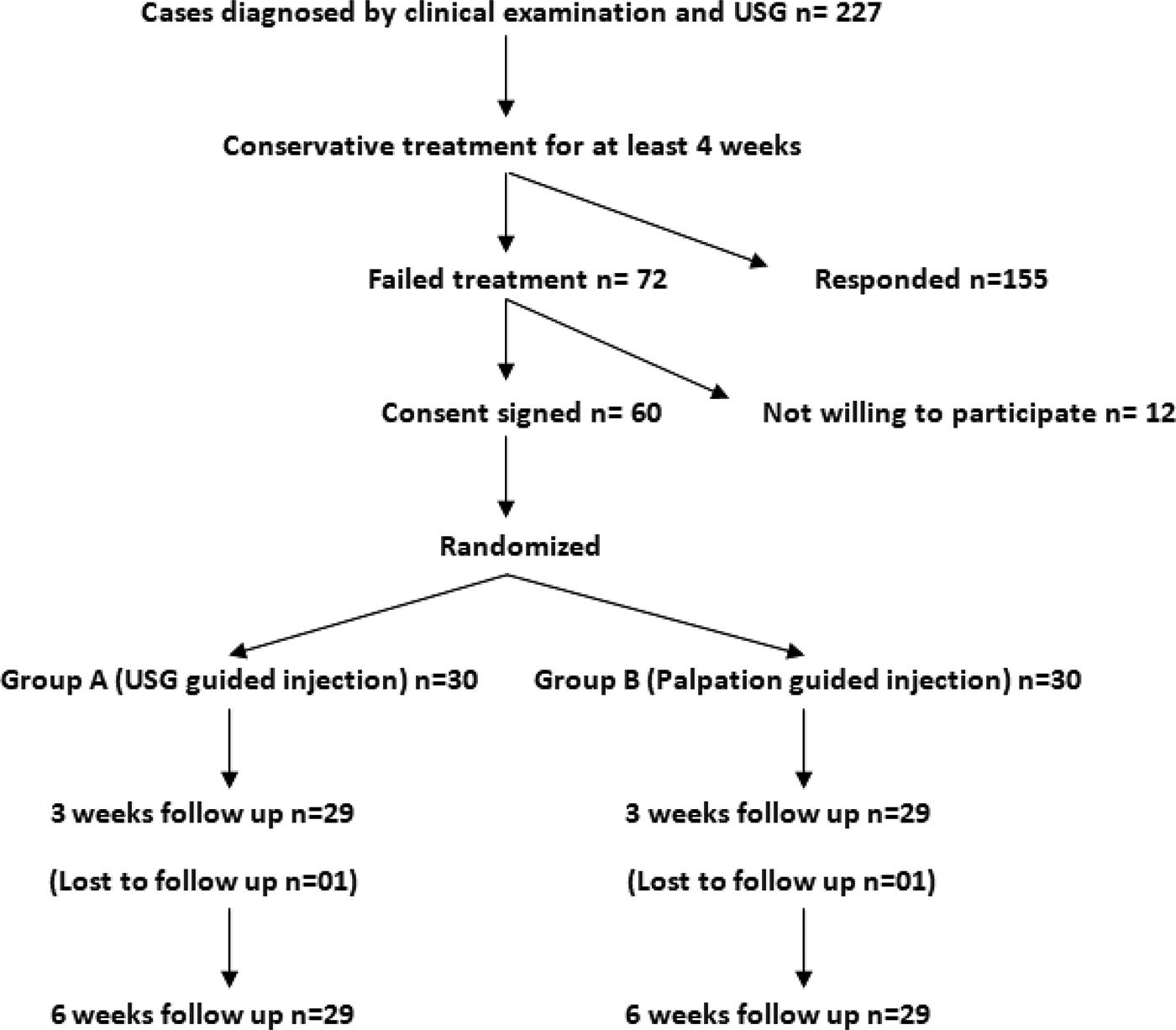
After we obtained clearance from the All India Institute of Medical Sciences (New Delhi, India) ethical body, 227 patients were screened for plantar fasciitis by clinical examination and USG between July 1, 2015, and November 30, 2016. All of the patients were given conservative treatment (analgesics, anti-inflammatory agents, contrast bath, exercise therapy, shoe modification) for 4 weeks. Of these 227 patients, 155 responded to conservative treatment and 72 did not. Of these 72 patients, 12 were not willing to participate and 60 gave written consent to participate in the study. Patients (60 symptomatic feet) who satisfied the inclusion and exclusion criteria were randomly assigned by the computerized block randomization method into two groups: group A (30 symptomatic feet) was treated with USG-guided injection and group B (30 symptomatic feet) was treated with palpation-guided injection (
Fig. 1).
Figure 1.
The CONSORT (Consolidated Standards of Reporting Trials) diagram for the study. USG indicates ultrasonography.
Figure 1.
The CONSORT (Consolidated Standards of Reporting Trials) diagram for the study. USG indicates ultrasonography.
All of the patients underwent pain assessment and USG examination before injection (baseline) and 3 and 6 weeks after corticosteroid injection. One patient in each group was lost to follow-up. In addition, all of the patients were advised to continue the rehabilitation measures, which consisted of patient education, footwear advice, and stretching and strengthening exercises.
Assessment Parameters
Heel pain was assessed with a visual analog scale (VAS) from 0 to 10, in which 0 represents no pain, 5 represents distressing pain, and 10 represents unbearable pain (). Plantar fascia thickness was measured by USG at a longitudinal view at its proximal end near (approximately <1 cm) its insertion to the calcaneus at its thickest portion. Heel pad thickness (HPT) was measured by USG from the skin surface to the nearest calcaneal tuberosity. All of the measurements were performed by the same investigator (S.M.) using a 6- to 13-MHz linear array transducer USG machine (MyLab One; Esaote SpA, Genoa, Italy).
Corticosteroid Injection in the Plantar Fasciitis
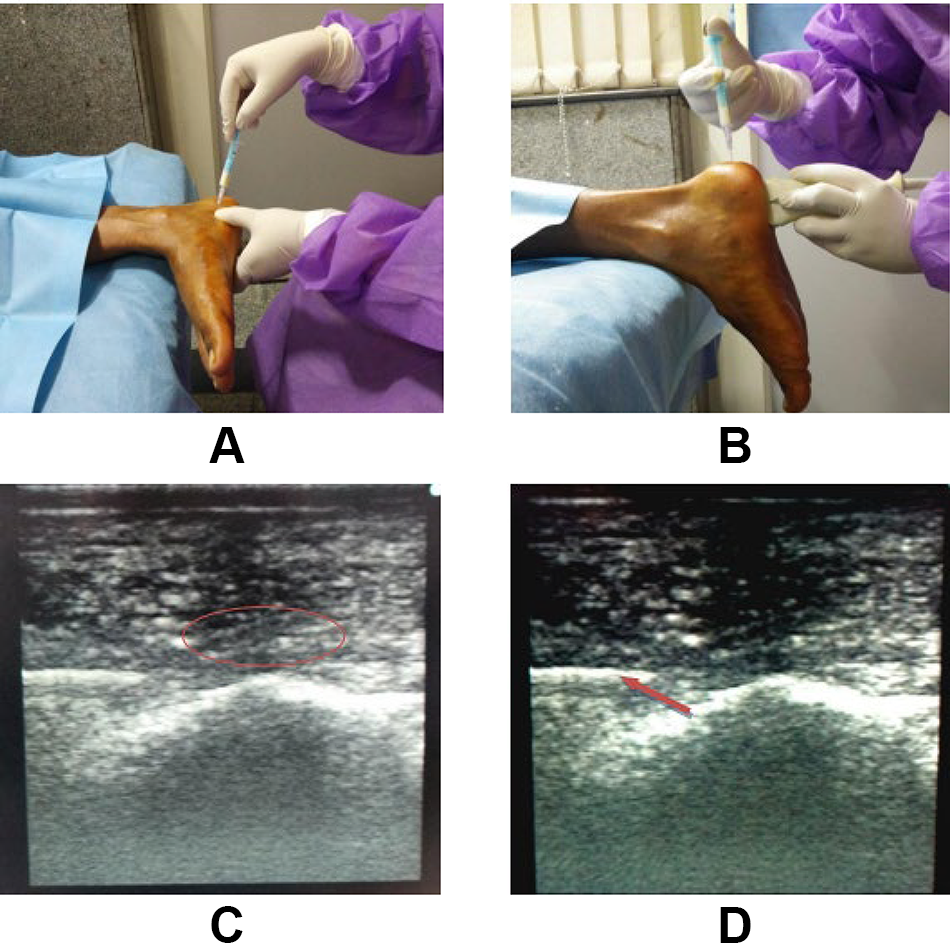
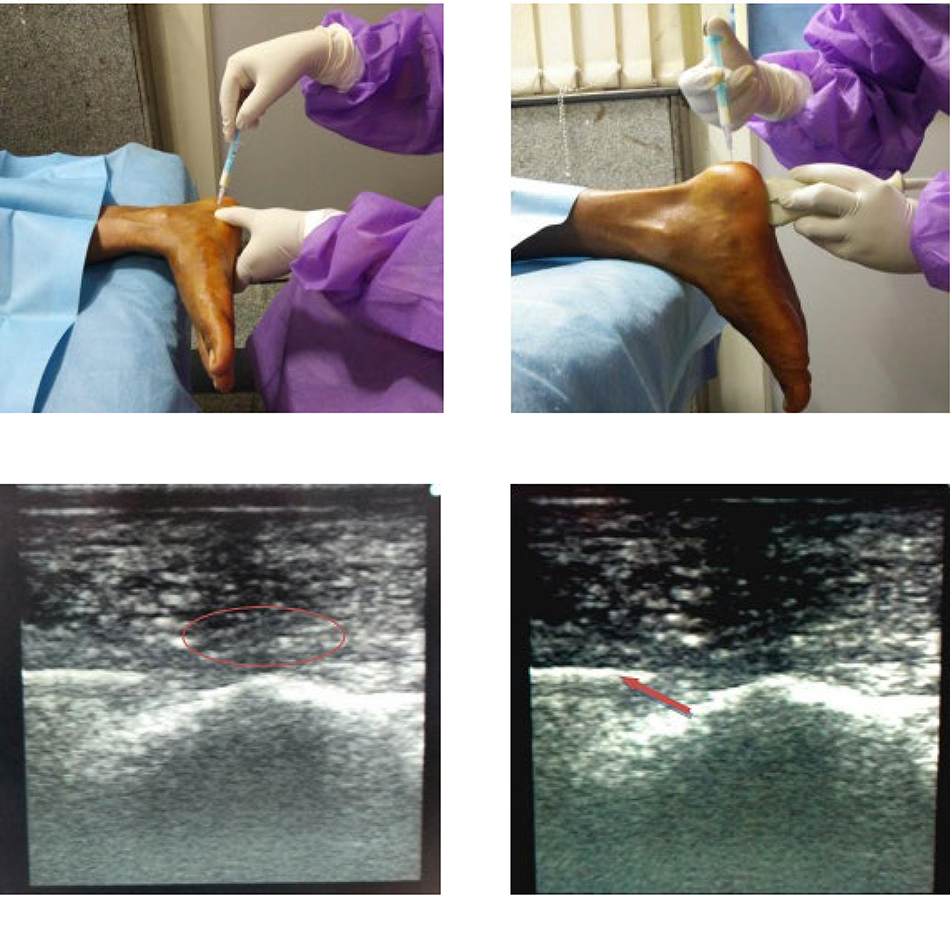
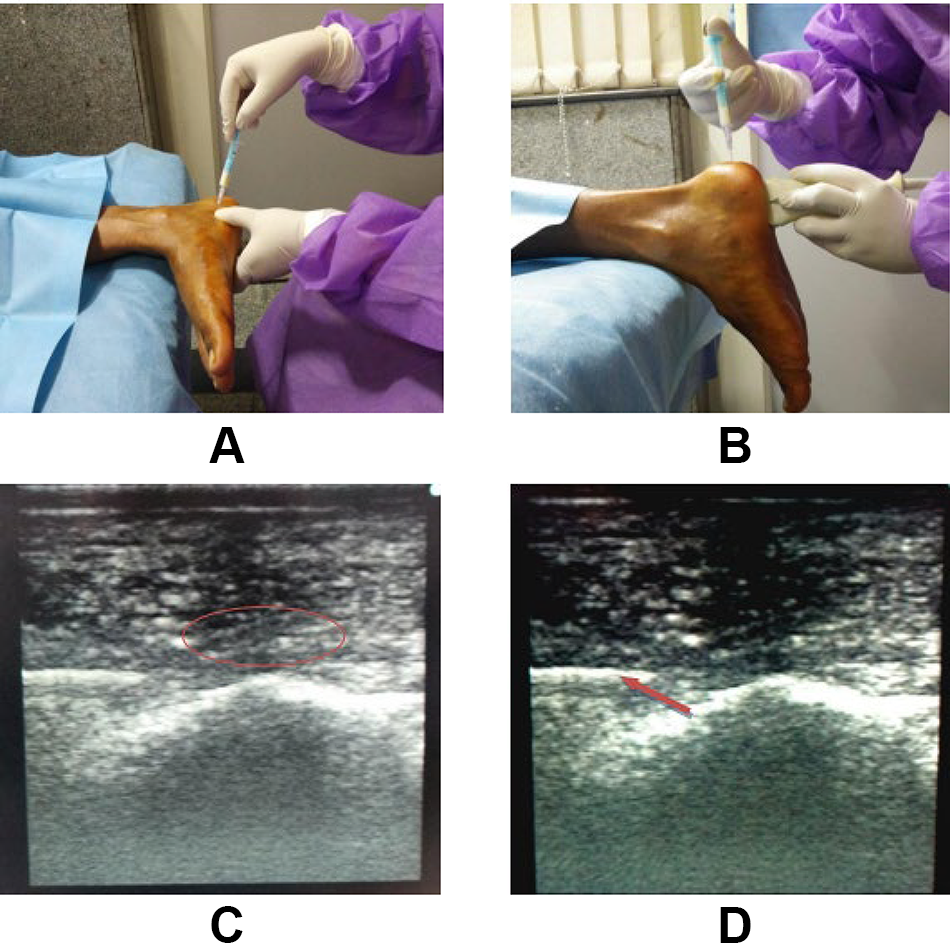
A 22-gauge, 1.5-inch needle connected to a 2-mL syringe filled with 1 mL (40 mg) of methylprednisolone acetate was used for injection. The injection was given after implementation of aseptic precautions and after injecting 2 to 3 mL of 1% lidocaine at the local site. The palpation-guided injection was given from the medial aspect of the heel to the point of maximal tenderness after negative aspiration, in the lateral position (
Fig. 2A). The USG-guided injection was given through the posterior heel parallel to the long axis of the transducer (
Fig. 2B). The plantar fascia is examined in the prone position under USG, and a thickened, hypoechoic portion is noticed (
Fig. 2C). The needle is inserted under continuous USG guidance, and corticosteroid is injected in the thickened proximal part of the plantar fascia (
Fig. 2D). In the postinjection protocol, all of the patients were followed up at 3 and 6 weeks. They were treated according to the protocol described previously herein, and the VAS was applied along with the measurement of PFT and HPT by USG at each follow-up.
Figure 2.
A, Medial approach of palpation-guided injection. B, Posterior approach of ultrasonography (USG)-guided injection. C, A hypoechoic, thickened proximal plantar fascia (red oval) seen on USG. D, Hypodermic needle localized under USG (red arrow).
Figure 2.
A, Medial approach of palpation-guided injection. B, Posterior approach of ultrasonography (USG)-guided injection. C, A hypoechoic, thickened proximal plantar fascia (red oval) seen on USG. D, Hypodermic needle localized under USG (red arrow).
Statistical Analysis
All of the data were entered into a spreadsheet (Excel; Microsoft Corp, Redmond, Washington) and were analyzed with a statistical software program (IBM SPSS Statistics for Windows, Version 20.0; IBM Corp, Armonk, New York). Categorical variables are presented as number and percentage, and continuous variables are presented as mean ± SD and median. The normality of data was tested by the Wilcoxon signed rank test. If the normality was rejected, then a nonparametric test was being used. Quantitative variables were compared using the unpaired t test/Mann-Whitney U test between the two groups and the paired t test/Wilcoxon rank sum test within the groups. Qualitative variables were compared using χ2 and Fisher exact tests.
Results
Sixty patients with plantar fasciitis satisfying the inclusion criteria were enrolled in the study and randomly allocated into two groups. Two patients (one in each group) were lost to follow-up, and 29 in each group completed the 6 weeks of follow-up.
During follow-up examinations, all of the patients reported complete compliance with a recommended postprocedure exercise program with the standardized protocol. No complications were noted in either group at any time. All of the demographic variables were statistically comparable with their baseline (
Table 1).
Table 1.
Demographic Characteristics of the Study Groups
Table 1.
Demographic Characteristics of the Study Groups
We observed statistically significant decreases in VAS scores 3 and 6 weeks after injection in both groups. In group A there was a significant reduction in mean VAS score from baseline to 3 weeks (
P < .001) and from baseline to 6 weeks (
P < .001) (
Table 2). We also observed a significant reduction in mean VAS score in group B from baseline to 3 weeks (
P < .001) and from baseline to 6 weeks (
P < .001) (
Table 2). However, when we compared the groups, the pain improvement was significantly higher in group A (
Table 2).
Table 2.
Comparison of VAS Scores by Group at Baseline and at 3 and 6 Weeks and Comparison of Within-Group Decrement at Sequential Follow-up Visits
Table 2.
Comparison of VAS Scores by Group at Baseline and at 3 and 6 Weeks and Comparison of Within-Group Decrement at Sequential Follow-up Visits
Statistically significant decreases in PFT were observed 3 and 6 weeks after injection in both groups. We observed a significant decrease in mean PFT in both groups from baseline to 3 weeks (
P < .001) and from baseline to 6 weeks (
P < .001) (
Table 3). However, when we compared the groups, the decrement was significantly greater in the USG-guided group (
Table 3).
Table 3.
Comparison of Plantar Fascia Thickness by Group at Baseline and at 3 and 6 Weeks and Comparison of Within-Group Decrements at Sequential Follow-up Visits
Table 3.
Comparison of Plantar Fascia Thickness by Group at Baseline and at 3 and 6 Weeks and Comparison of Within-Group Decrements at Sequential Follow-up Visits
There was no statistically significant difference noted in HPT 3 and 6 weeks after corticosteroid injection in both groups (
Table 4). In group A, the mean HPT changes were not significant from baseline to 3 weeks (
P = .999) and from baseline to 6 weeks (
P = .999) after injection. In group B, the mean HPT changes were also not significant from baseline to 3 weeks (
P = .320) and from baseline to 6 weeks (
P = .774) after injection. Similarly, when we compared the groups there was no difference in the mean HPT values in both groups (
Table 4). No patients in either group had atrophy of the heel pad, infection at the injection site, or plantar fascia rupture after the intervention.
Table 4.
Comparison of Heel Pad Thickness by Group at Baseline and at 3 and 6 Weeks and Comparison of Within-Group Decrements at Sequential Follow-up Visits
Table 4.
Comparison of Heel Pad Thickness by Group at Baseline and at 3 and 6 Weeks and Comparison of Within-Group Decrements at Sequential Follow-up Visits
Discussion
In most of the previous studies, the local injections were advised after at least 8 weeks of conservative treatment. However, our departmental practice is to give 4 weeks of conservative treatment because as a referral center we mostly see patients already being conservatively treated for months.
The USG-guided injection provides real-time imaging of the plantar fascia during needle insertion and corticosteroid delivery, leading to better therapeutic efficacy. It is associated with lower recurrence rates [
15,
24,
34,
38,
39]. At our center, the most commonly advised invasive treatment for plantar fasciitis is local corticosteroid injection, followed by platelet-rich plasma injections, based on the consultant’s preference. To reduce bias, all of the injections and USG measurements were performed by the same investigator.
As expected, there were statistically significant improvements in VAS scores 3 and 6 weeks after the intervention in both groups, and when we compared the groups, a significantly greater improvement in pain was noticed in the USG-guided group (
Table 2). Similar findings were observed in studies by Tsai et al [
38] and Li et al [
15], and Yucel et al [
39] also observed significant improvement in pain in both groups and no difference between the two groups. That means this study proves that local corticosteroid injection is effective in controlling pain in plantar fasciitis, and the findings are well supported by previous studies.
This study showed a statistically significant decrease in PFT in both groups at the end of 3 and 6 weeks of intervention, and when the groups were compared, PFT was significantly more decreased in the USG-guided group. These findings were also supported by studies by Tsai et al [
38] and Li et al [
15]. However, Yucel et al [
39] also observed significant but equal decrement in PFT in both groups. Similar to the VAS, this study proves that local corticosteroid injection is effective in decreasing PFT, and the findings are well supported by previous studies.
Inadvertent injection in the heel pad can cause heel pad atrophy. Obviously, USG guidance is less likely to be associated with heel pad atrophy. However, in this study, the HPT was not decreased in either group after corticosteroid injection. Similarly, there were no changes found in mean HPT by Tsai et al [
38], Yucel et al [
39], and Li et al [
15]. In a study by Mann et al [
4] there was a significant decrement in HPT after palpation-guided injection but not after USG-guided injection, and the reason given was that inaccurate injection caused fat pad atrophy.
Multiple corticosteroid injections at shorter intervals can caused plantar fascia rupture. [
40] None of the patients enrolled in this study had plantar fascia rupture, probably because all of the patients had only a single corticosteroid injection and were followed for a shorter period.
The two limitations of this study were the small sample size and the short duration of follow-up. A larger sample size will reduce the sampling errors and increase the power of study, and a longer duration of follow-up will reveal the recurrence rate and long-term complications after corticosteroid injections.
Conclusions
Local corticosteroid injection is an effective and safe treatment for plantar fasciitis. Both the USG- and palpation-guided injections significantly improve pain and reduce PFT. However, USG guidance is a more effective technique in reducing pain scores and PFT. We are planning a trial with a larger sample size and longer follow-up to support these findings.
Clinical Practice Points
Several studies supported the use of local corticosteroid injection to control pain in resistant plantar fasciitis. Some other studies showed that USG is useful in enhancing the accuracy of corticosteroid injection because it precisely localizes the lesion and needle placement, and some showed that palpation-guided injection costs less than USG-guided injection and is equally effective.