Rheumatoid arthritis (RA) is a chronic, symmetrical, autoimmune disease characterized by synovial joint inflammation and destruction. Pharmacologic treatment of this condition involves the use of disease-modifying drugs, corticosteroids, nonsteroidal anti-inflammatory drugs, and biologicals, among others. Although highly effective, certain pharmacologic management options for this condition can carry significant adverse effects, such as the risk of soft-tissue infection with glucocorticoids and biological therapies [
1,
2].
It is reported that at initial visits, synovitis presents in 20% of patients [
3], with the metatarsophalangeal joints typically being the first to be affected [
4]. Even before the development of forefoot pain, it has been shown that there is a significant peak plantar pressure increase in the first metatarsophalangeal joint accompanied by a reduction in fifth metatarsophalangeal joint peak plantar pressure, indicating that forefoot biomechanics may be affected by this autoimmune condition even at a very early stage [
5], which may be further compounded by the presence of other musculoskeletal conditions, such as neuromas, bursitis, digital neuritis, and capsulitis.
Deformity and joint damage due to synovitis in the metatarsophalangeal joints consequently lead to increased forefoot plantar pressure, forefoot pain, and disability, together with activity limitation [
6].
Studies report high joint erosion scores at the metatarsophalangeal joints in patients with chronic RA, leading to further forefoot deformities, deformities of the lesser toes and metatarsophalangeal joints, and hallux valgus [
7]. These resultant deformities have a severe negative effect on mobility and functional capacity [
8].
Foot orthoses are often used in the management of patients living with RA, being indicated for a variety of reasons, such as resting and stabilization of joints, reduction of pain and inflammation, improvement of function, and prevention of deformity [
9]. Various studies have shown the efficacy of these devices, ranging in complexity from custom-made to off-the-shelf devices and from semirigid to soft orthoses [
10].
Ethyl vinyl acetate (EVA) accommodative foot orthoses, which were provided to patients with metatarsalgia, were assessed using the Foot Function Index (FFI) and were reported to provide improvement in all three subscales of this validated tool when used over 180 days [
4]. Woodburn et al [
11], on the other hand, used harder carbon graphite orthoses, which were shown, also through the FFI, to produce a decrease in pain, disability, and functional limitation, which was sustained throughout the whole trial period of 30 months [
11]. Gatt et al [
10] compared rigid thermoplastic orthoses with soft EVA devices fabricated over the same casts and reported that although both types of orthoses effectively reduce pain levels according to the FFI, they did not totally eliminate pain.
However, acquiring the correct foot orthoses may often involve complex prescriptions with significant delays and associated high financial burden. Delay in off-loading deformed joints due to lengthened production of custom orthoses may encourage deformity because these joints need to be addressed promptly. Simple insoles are easier, less expensive, and less time-consuming to produce compared with other types of orthotic devices, which may be extremely intricate to manufacture and dispense given the complex nature of the rheumatoid foot. These simple devices can be easily fabricated as chair-side appliances by a podiatric physician or other health-care practitioner, requiring very few skills and readily-available materials.
Thus, if simple insoles are effective in reducing pain, disability, and activity limitation in this patient population, it makes clinical sense to provide these to the afflicted patient to initiate off-loading therapy as early as possible.
Thus, this study aimed to investigate whether simple insoles incorporating a plantar metatarsal pad (PMP) decrease metatarsophalangeal joint pain, together with resultant disability and activity limitation, in patients living with RA.
Methods
Ethical approval was sought and obtained from the University of Malta (Msida) research ethics committee. This trial was performed in accordance with the ethical standards of the 1964 Declaration of Helsinki and its later amendments or comparable ethical standards [
12]. Informed consent was obtained from all of the study participants included.
A same-subject, pretest-posttest, quasi-experimental design using a convenience sample was used, in conformity with several similar trials used in this field of research in the rheumatoid foot [
13,
14]. All of the participants were recruited on a first-through-the-door basis [
15]. Participants were adults diagnosed as having RA by a consultant rheumatologist according to the 2010 American Rheumatism Association revised criteria [
16] and who were experiencing forefoot pain for at least 2 weeks that had not been relieved by medication. Participants were included only if they were not making use of foot orthoses for the month before their recruitment. This restriction was necessary to introduce a washout period to eliminate any possible interaction with use of previous orthoses. Exclusion criteria included flare-ups during the trial period, any change in the participant’s treatment regimen or other foot-specific interventions such as corticosteroid infiltrations or any other form of therapy that could directly affect pain, and any systemic and neurologic involvement, such as diabetes and neuropathy, respectively. All of the participants had to be firm of mind and able to communicate freely.
All of the participants were recruited and interviewed at a rheumatology clinic. A footprint was then acquired using a Harris and Beath mat (Algeos, Liverpool, England), which is a simple, widely used method of obtaining a footprint. This instrument incorporated a ridged rubber mat to which ink was applied. A sheet of paper was consequently placed beneath the rubber sheet, and the whole device was placed on the floor, onto which the participant was asked to stand so that a static imprint was achieved. Simultaneously, an outline of the foot was drawn [
17]. The procedure was then repeated for the other foot.
Demographic data, current medications, duration of disease, and duration of forefoot pain, together with location of pain and any foot deformities, were recorded.
Insole Fabrication
Simple insoles were fabricated from a 1.5-mm EVA base; preformed cobra pads, which are the closest to molded orthotic devices because they incorporate an arch profile and a heel cup
18 together with a hand-crafted metatarsal pad and a Poron Grey top cover (Algeos) to complete the whole insole. The cobra pads were glued to the EVA base with contact adhesive. The size of the insole base was determined by the size of the participant’s shoes, and the PMP, which was also glued to the base, was placed 10 mm proximal to the central three metatarsophalangeal joints [
19]. A variety of studies have been conducted to evaluate the effect of PMPs on plantar pressure and their mechanism of action, with Kang et al [
20] and Mueller et al [
21] having both found this type of pad to significantly decrease pressure underneath the metatarsal heads, with the former also reporting a correlation between the decrease in pressure and pain improvement. The actual position of the PMP in relation to the impression of the metatarsophalangeal joints in the inked pedograph was determined by drawing the outline of the insole template around the pedograph, which permitted the localization of the pad and the other components of the insole.
This pad was fashioned from PPT Combo Slow Recovery, which is a combination of PPT Slow Recovery and PPT Medical Grade (Langer Biomechanics Ronkonkoma, New York.) Finally, each insole was covered with 3-mm Poron Grey 4000 (Algeos) to provide additional cushioning. All of the simple insoles were manufactured by an experienced podiatric physician who carefully devised each component according to each participant’s pedograph.
All of the insoles were dispensed within 2 weeks of the interview. During this visit, all of the participants were requested to complete the FFI, which is a validated tool for measuring the level of pain, disability, and activity limitation [
22–24] and has been used many times to assess the effect of foot orthoses on these variables in RA due to its optimum psychometric properties [
4–6]. Instructions on the FFI were given to each participant before he or she completed the 3-page document alone to avoid researcher influence. This was possible because the FFI is a self-administered, easy-to-use questionnaire that is relatively simple for the participants to understand and complete [
25]. A 10-cm visual analog scale with verbal anchors identifying opposite extremes presented each criterion. Several criteria composed each subset for pain, disability, and functional limitation. To obtain the scores, each participant was asked to mark the number that best reflected a particular aspect of forefoot pain during the past week. A subscale score was then obtained by summing the value of each item. A total FFI score was then obtained by calculating the average of the three subscale scores.
An acclimatization period to enable each participant to get used to the intervention, ie, the insoles, was given to each participant. All of the participants were required to use a logbook to record the number of hours of insole use. They were then reviewed after 3 months, when the FFI was administered again to document any possible change in the criteria composing the tool.
Statistical Analysis
Statistical analysis was performed using a software package (IBM SPSS Software for Windows, Version 16; IBM Corp, Armonk, New York). The one-sample Kolmogorov-Smirnov test was used to test the distribution of the data. Consequently, because the distribution was normal for all of the variables, the paired-sample t test was used to compare the FFI scores before and after the intervention period, with P < .05 being accepted for significance as per normal practice.
Results
Eighteen potential participants were invited to take part in the study, three of whom refused to participate. Thus, 15 participants (13 females and two males; mean RA duration, 12 years [range, 4 months to 60 years]) started the trial; however, one male participant had to be withdrawn because of a flare-up, resulting in 14 participants in this study. Mean duration of forefoot pain was 96 weeks (1.85 years), ranging from 3 weeks to 7 years. Of these 14 participants, three were on disease-modifying antirheumatic drugs (DMARDs) together with nonsteroidal anti-inflammatory drugs, three were on DMARDs and corticosteroid therapy, two were on biological agents alone, and six were on a DMARD only.
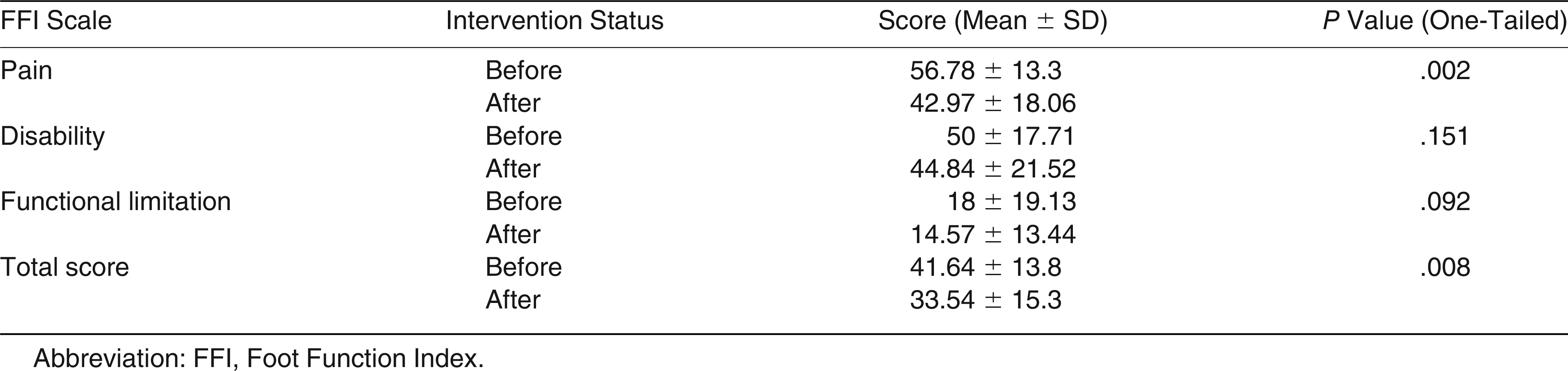
Statistical analysis compared the level of forefoot pain, disability, and functional limitation, together with total FFI score before and after the intervention, ie, use of the supplied simple insoles. Results for pain, disability, functional limitation, and total FFI scores are presented in
Table 1.
Table 1.
Pain, Disability, Functional Limitation, and Total FFI Scores Before and After the Intervention in the 14 Study Patients
Table 1.
Pain, Disability, Functional Limitation, and Total FFI Scores Before and After the Intervention in the 14 Study Patients
There was a significant difference in mean FFI pain (P = .002) and total FFI (P = .0085) scores. Although there was a reduction in the mean differences in disability and functional limitation, this was not significant (P = .151 and P = .092, respectively).
Discussion
This study set out to investigate a relatively simple method of managing forefoot pain in RA through the use of a chair-side appliance known as a simple insole in the podiatric medical profession. It is well-known that patients living with RA undergo prolonged and sometimes aggressive drug therapy, thus a nonpharmacologic intervention that would possibly reduce the possibilities of increased adverse effects would certainly be welcomed by both health-care professional and patient alike.
These results show a significant decrease in forefoot pain and total FFI scores, with the latter summarizing all of the criteria investigated. Although disability and functional limitation were not statistically significantly decreased, it is clear that reduction in their mean scores was present and, in combination with the other scores, positively affected the total FFI score.
This finding is in congruence with a crossover trial by Gatt et al [
10] that investigated EVA and subortholen (Tuefel, GmBH, Frankfurt Germany) orthoses in patients with RA with hindfoot involvement. Although the results of both studies showed a significant reduction in pain, neither totally eliminated it. These results clearly imply that, on their own, orthoses do not remove pain but require some other concomitant management option. However, this does not diminish the positive effect that such orthoses have had on participants’ pain, with the possible resultant increase in comfort to enable them to continue with their daily activities with the least amount of pain possible.
The clinical value of this present study over other studies that use foot orthoses in some form or other is that simple insoles can be fabricated literally within minutes, with the patient present in the clinic. This offers tremendous advantages over other methods of fabrication because the patient may benefit immediately after being assessed by the clinician. If better-suited orthotic devices would be required for long-term management, the patient would at least initiate treatment using a device that is known to improve forefoot pain, which is so prevalent in RA.
This method of fabrication is one of a variety of ways in which such a device can be simply manufactured in an office using readily available, inexpensive material and some contact adhesive. No special grinding equipment was necessary, thus making this manufacturing process much more widely available to clinicians who want to provide an appropriate and quick chair-side appliance to their patients.
Although the small sample size is an obvious limitation of this study, the improvement in pain, functional limitation, and disability reported in the study is certainly due to the devices provided to the participants because forefoot pain ranged from a few weeks to a few years. Another possible limitation could be the lack of randomization; however, one must appreciate the difficulty in recruiting participants with the required inclusion criteria. Occupation, physical activity, body weight before and after the trial, together with footwear worn were not recorded; however, because participants acted as their own controls, these confounding variables were automatically adjusted for. However, participants were encouraged to use their regular footwear for which the insoles had been devised and to maintain their normal physical activity during the trial period of 3 months. Furthermore, they would have been excluded if a change in treatment was necessary, denoting a change in disease activity.
The use of such simple devices can make the difference in a patient’s quality of life by lessening pain, disability, and functional limitation. These devices cost a fraction of other types of insoles; thus, we feel that due consideration should be given to their prescription and utilization, more so given their obvious advantages and effectiveness. Certainly, more research is warranted in this area.
Conclusions
The results of this study show a significant reduction in pain and total FFI scores when simple insoles are used to manage forefoot pain in a population with RA over a 3-month period, although the sample size was somewhat small. This positive outcome should encourage their utilization because such devices can be fabricated quite easily and at very low expense. Such devices can offer reduced dependency on sometimes potent pharmacologic interventions, with a consequent reduction in associated drug adverse effects. Further studies are warranted in this area to confirm the positive finding using larger sample sizes.