Next Article in Journal
Methods of Investigation of Functional Disturbances After Burn Injury of the Foot
Previous Article in Journal
The Management of Metatarsalgia in Rheumatoid Arthritis Using Simple Insoles: An Effective Concurrent Treatment to Drug Therapy
 
 
Journal of the American Podiatric Medical Association is published by MDPI from Volume 116 Issue 1 (2026). Previous articles were published by another publisher in Open Access under a CC-BY (or CC-BY-NC-ND) licence, and they are hosted by MDPI on mdpi.com as a courtesy and upon agreement with American Podiatric Medical Association.
Article

Extracorporeal Shockwave Therapy for Foot and Ankle Disorders: A Systematic Review and Meta-Analysis

by
Tengku Nazim B. Tengku Yusof
1,
Dexter Seow
2,* and
Khushdeep S. Vig
3
1
Hospital Kuala Lumpur, Malaysia
2
Royal College of Surgeons in Ireland, Dublin, Ireland
3
Department of Orthopedic Surgery, Albany Medical Center, Albana, NY
*
Author to whom correspondence should be addressed.
J. Am. Podiatr. Med. Assoc. 2022, 112(3), 18191; https://doi.org/10.7547/18-191
Published: 1 May 2022

Abstract

Background: Extracorporeal shockwave therapy (ESWT) was first introduced into clinical practice in 1982 and has been a beneficial inclusion to the noninvasive treatment option of numerous orthopaedic pathologies. However, clinical evidence of the use of ESWT for various foot and ankle disorders has been limited with a consensus on its efficacy yet available. Therefore, the purpose of this study is to systematically review the literature, to provide a critical evaluation and meta-analysis for the use of ESWT in foot and ankle disorders. Methods: The PubMed and Embase databases were systematically reviewed and clinical studies that reported ESWT use for various foot and ankle disorders included. Results: A total of 24 clinical studies that included 12 randomized controlled trials and 12 case series were identified. Analysis of the evidence has indicated that ESWT can help manage plantar fasciitis, calcaneal spur, Achilles tendinopathy and Morton’s neuroma. Meta-analysis of the change in pre- to post-VAS overall scores for plantar fasciitis significantly favored ESWT compared to placebo/conservative treatment with a MD -3.10 (95% CI, -4.36 to -1.83; I2 = 68%; P < 0.00001). Conclusions: The current evidence has suggested that ESWT can provide symptomatic benefit to plantar fasciitis treatment, with minimal and unremarkable side effects. Overall, ESWT has been demonstrated to be a safe treatment option with a favorable complication profile. Further well-designed studies of ESWT for the treatment of calcaneal spurs, Achilles tendinopathy and Morton’s neuroma are warranted to more soundly and safely support its current use. Future studies are suggested to investigate the optimization of ESWT treatment protocols.

Extracorporeal shockwave therapy (ESWT) is a noninvasive treatment option for musculoskeletal healing. In vitro and animal studies have demonstrated that ESWT can promote cellular reparative effects by breaking down scar tissue,[1] increasing the bloody supply,[2–4] and stimulating the release of growth factors at injured sites.[5,6] The exact mechanism of how ESWT exerts these effects remains uncertain.[7] However, postulations have included mechanotransduction, whereby a mechanical load on the cellular cytoskeleton can induce signals for cellular repair.[8,9] Another postulation is that shockwaves can produce microfractures that subsequently stimulate the migration of a mesenchymal clot for healing at the injured site.[10,11]
Two types of shockwaves can be emitted from ESWT: focused and radial.[9] Focused ESWT applies a converging pressure field, whereas radial ESWT produces a diverging pressure field. Focused ESWT allows an adjustable focus at a selected depth of tissue, enabling it to penetrate deeper tissues compared to radial ESWT. In contrast, the diverging pressure field generated with radial ESWT is limited in tissue penetration despite being placed at the injured site with maximum pressure. Their differences in therapeutic effects, if any, are currently unclear. Nonetheless, ESWT can be a useful addition or alternative in the treatment of potentially many disorders, given its healing effects coupled with the currently limited capabilities of many conservative treatments.
Albeit the promising effects of ESWT indicated in in vitro and animal studies, the extent of clinical success has been inconsistent with no overview present for the musculoskeletal applications of ESWT for foot and ankle disorders. There has also been no consensus on the optimal protocol for ESWT (focused vs radial, energy-flux density, number of pulses administered and how often). Therefore, the purpose of this study is to systematically review the literature, to provide a critical evaluation and meta-analysis for the use of ESWT in foot and ankle disorders.

Methods

Search Strategy and Study Identification

Two separate authors (T.N.B.T.Y and D.S.) systematically reviewed the PubMed and Embase databases according to the Preferred Reporting Items for Systematic Reviews and Meta-Analyses (PRISMA) guidelines in April 28, 2016.[12] The search terms employed were: (Extracorporeal shockwave therapy OR extracorporeal shockwave treatment) AND (orthopaedic OR bone OR soft tissue OR muscle OR ligament OR tendon OR fascia OR musculoskeletal). No time limit was given for the publication date. The titles, abstract, and full-texts of the studies were reviewed using the eligibility criteria illustrated in Table 1. In addition, all citations of included studies were manually assessed for any possible inclusion. Studies were included based on the agreement between the two authors with any discrepancies resolved by mutual consensus.
Table 1. Eligibility Criteria
Japma 112 18191 i001

Assessment of Evidence

The level of evidence (LoE) published in all reviewed studies was assessed using previously published criteria from The Journal of Bone and Joint Surgery.[13] The quality of evidence (QoE) was assessed using the Newcastle-Ottawa Scale,[14] a nine-point scale, with studies having six or more points being defined as having a low risk of bias and studies with fewer than six points defined as having a high risk of bias.[15]

Data Categorization and Evaluation

Predetermined data of the included studies were collected and categorized into the following: 1) plantar fasciitis, 2) calcaneal spur, 3) Achilles tendinopathy, and 4) Morton’s neuroma. The extent of clinical success was measured by the “relative change” of collected outcome scores from baseline to final follow-up using the following formula: ([pretreatment outcome score − posttreatment outcome score]/[pretreatment outcome score]) × 100. A positive score indicated an improvement in outcomes, whereas a score of zero was no improvement in outcomes and a negative score was a deterioration in outcomes.

Statistical Analysis

Statistical analysis was performed using RevMan version 5.3 (The Nordic Cochrane Centre, Copenhagen, Denmark). Meta-analysis for the results was performed if two or more studies employed the same outcome scores. I2 values expressed heterogeneity with <25% being considered low heterogeneity, ≥25% of moderate to high heterogeneity.[16] Continuous outcomes were expressed as mean difference (MD) and dichotomous outcomes as risk ratio (RR). Fixed-effects models were used if the calculated heterogeneity was low, and random-effects models were used if the calculated heterogeneity was moderate to high.[17] Methods described by Wan et al[18] were used to estimate the mean and standard deviation if other measures of averages were reported. Standard deviation of pre- and posttreatment outcome scores were standardized according to the law of cosines by the following formula: (Sx2 + Sy2) where x and y represent the standard deviation of a specific pre- and posttreatment outcome score respectively. Values of P < .05 were considered statistically significant.

Results

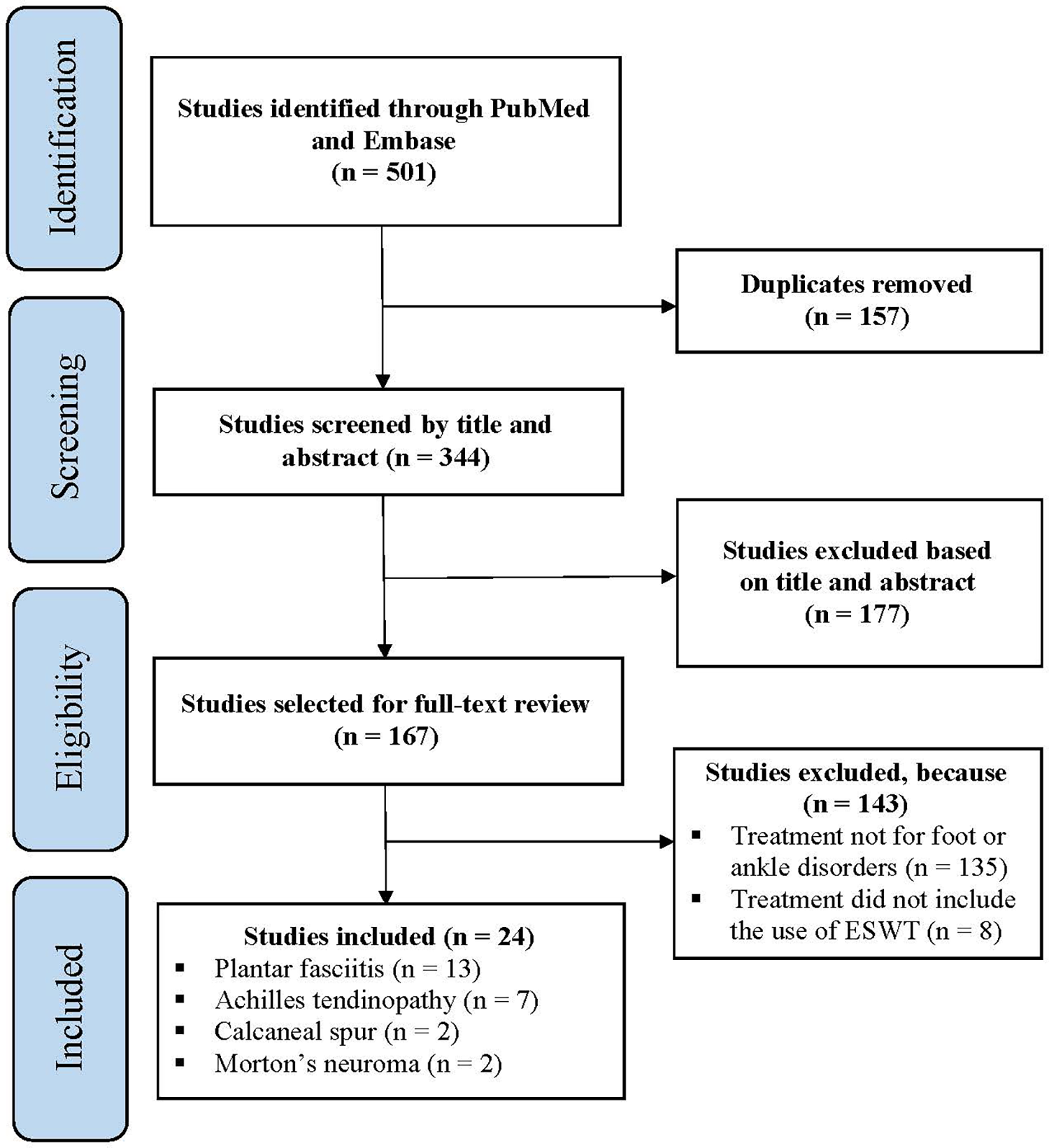
The search strategy identified 24 studies for inclusion after applying specific eligibility criteria (Fig. 1).[7,19–41] This included 13 studies that assessed the efficacy of ESWT for plantar fasciitis,[19–31] two studies for calcaneal spur,[32,33] seven studies for Achilles tendinopathy,[7,34–39] and two studies for Morton’s neuroma.[40,41] The included studies were published between 2002 and 2016, with 12 studies being of LoE I (50%) and 12 studies of LoE IV (50%). The mean QoE of 5.08 ± 8.24, with 12 studies having a good QoE of ≥ 6 points on the Newcastle-Ottawa Scale. The characteristics of the included studies are summarized in Table 2.
Figure 1. Preferred Reporting Items for Systematic Reviews and Meta-Analyses flow diagram.
Japma 112 18191 g001
Table 2. Characteristics of Included Studies
Japma 112 18191 i002a
Japma 112 18191 i002b

Plantar Fasciitis

The application of ESWT for plantar fasciitis was reported in 7 RCTs[19–25] and 6 case series.[26–31] The RCTs compared the efficacy of ESWT against a placebo, conservative treatment (physiotherapy, iontophoresis, and NSAIDs), injections (corticosteroid and autologous conditioned plasma injections) and surgical treatment (plantar fasciotomy). The mean relative change for reported outcome scores (VAS, AOFAS, SF-12, Roles & Maudsley, Mayo scoring system) for ESWT in the 7 RCTs was 47.6%. Treatment with ESWT was noted to be superior compared to placebo or conservative treatment (33.2% mean relative change; VAS, AOFAS, SF-12, Roles & Maudsley)[19–22,24,25] but inferior compared to plantar fasciotomy (81.7% mean relative change; VAS, Roles & Maudsley)[23] and injections (63.3% mean relative change; VAS overall, AOFAS, Mayo scoring system).[22,24] The mean relative change for outcome scores was higher in the 6 case series[26–31] compared to the 7 RCTS[19–25] of ESWT in plantar fasciitis (60.9% vs. 47.6% mean relative change, respectively; outcome scores in case series were VAS, AOFAS, Roles & Maudsley, Japanese Society for Surgery of Foot (JSSF). A summary of the outcomes scores for the included RCTs and case series are illustrated in Table 3 and Table 4, respectively. Meta-analysis of the change in pre- to post-VAS overall scores significantly favored ESWT compared to placebo/conservative treatment with a MD -3.10 (95% CI, -4.36 to -1.83; I2 = 68%; P < 0.00001).[21,23,24] This is illustrated using a random-effect model in Figure 2.
Figure 2. Meta-analysis of the change in pre- to post-VAS overall scores for plantar fasciitis, random-effects model.
Japma 112 18191 g002
Table 3. Summary of Outcome Scores for Randomized Controlled Trials (Relative Change, %)
Japma 112 18191 i003
Table 4. Summary of Outcome Scores for Case Series (Relative Change, %)
Japma 112 18191 i004

Calcaneal Spur

The application of ESWT in calcaneal spurs was reported in a single RCT[32] and one case series.[33] The RCT compared 20 patients who underwent ESWT against 20 patients who received a placebo;[32] a higher mean relative change for outcome scores were indicated in the ESWT group compared to the placebo group (63.9% vs. 40.5%, respectively; VAS, Roles & Maudsley). The case series indicated a similar mean relative change of 63.4% for the overall VAS outcome score.[33]

Achilles Tendinopathy

The application of ESWT for Achilles tendinopathies was reported in 2 RCTs[34,35] and 5 case series.[7,36–39] The RCTs compared the efficacy of ESWT versus cold air and high-energy laser therapy (CHELT) and ESWT given with oral/placebo supplementation. The mean relative change for outcome scores (VAS, Roles & Maudsley, Ankle-Hindfoot scale) of the 2 RCTs for ESWT alone was 38.0%; which is inferior compared to cold air and high-energy laser therapy (CHELT) (40.1% mean relative change)[35] but superior compared to ESWT given in combination with oral supplementation/placebo supplementation (35.9% and 23.7% mean relative changes, respectively).[34] The oral supplementation was suggested to be implicated in tendon healing with the ingredients included to be:[34] arginine-L-alpha-ketoglutarate (500 mg), methyl-sulfonyl-methane (550 mg), hydrolyzed collagen type I (300 mg), Vinitrox (Nexira, CITY, STATE, COUNTRY) (125 mg), bromelain (50 mg), and vitamin C (60 mg). The mean relative change for outcome scores was higher in the 5 case series[7,36–39] compared to the 2 RCTS[34,35] of ESWT in Achilles tendinopathies (75.9% vs. 38.0% mean relative change, respectively; outcome scores in case series were VAS, AOFAS, Roles & Maudsley, Victorian Institute of Sports Assessment – Achilles Questionnaire (VISA-A)).

Morton’s Neuroma

The application of ESWT for Morton’s neuroma was reported in two RCTs.[40,41] Both RCTs compared ESWT to a placebo. The mean relative change for outcome scores was noted superior in the ESWT group compared to the placebo group (41.0% vs. 13.3%, respectively; VAS, AOFAS).

Discussion

The National Institute for Health and Care Excellence (NICE) has published guidelines for the use of ESWT in specific foot and ankle disorders that is plantar fasciitis and Achilles tendinopathy.[42] The current systematic review has indicated that ESWT can improve symptoms for the following foot and ankle disorders: plantar fasciitis, calcaneal spurs, Achilles tendinopathies and Morton’s neuroma. However, due to the high heterogeneity and/or limited evidence, its extent of clinical success remains debatable.
ESWT may have an energy flux density–responsive treatment efficacy. The optimal energy flux density required for various disorders has yet been determined. The inconsistent use of outcome scores for ESWT assessment has limited specific subgroup meta-analysis. In an animal study on 42 rabbits with Achilles tendinopathy, Rompe et al[43] suggested that an energy flux density of no more than 0.28 mJ/mm2 should be clinically used, as tissue damage can occur if not adhered to. Rompe et al[43] added that permanent tissue damage was observed with the use of high-energy ESWT (0.60 mJ/mm2) was used. In plantar fasciitis, Lee et al[44] reported superior results in medium energy ESWT (0.16 mJ/mm2) when compared to low energy ESWT (0.08 mJ/mm2). Specifically, medium energy ESWT was more effective in reducing pain, with this having incorporated the absence of side effects associated with high energy shockwaves.[44] A 2-point reduction of a 10-point VAS pain scale has been accepted to be clinically significant in reducing pain and improving patient satisfaction.[45,46] With this, the current study has demonstrated that ESWT can clinically mitigate the pain for plantar fasciitis, calcaneal spurs, Achilles tendinopathy and Morton’s neuroma.
ESWT has demonstrated unremarkable complications for the treatment of plantar fasciitis, calcaneal spurs, Achilles tendinopathy and Morton’s neuroma. Complications have included local pain during treatment, residual pain, mild edema and erythema at the site of ESWT application. Low energy ESWT (<0.2 mJ/mm2) has generally been reported to be a well-tolerated treatment with minimal complications. In contrast, high energy ESWT (>0.2 mJ/mm2) has been reported to have required local anesthesia due to pain and discomfort during the procedure.[47] Two studies included in the current systematic review reported similar experiences with high energy ESWT (0.36 mJ/mm2), with these studies having added local anesthesia for pain control.[20,26] Kudo et al[20] reported that in 53 plantar fasciitis treated with high energy ESWT (0.36 mJ/mm2), 79.3% of patients complained of pain during the procedure while 14% of patients had residual pain at three months follow-up after ESWT application; attributing this to the insufficient amount of local anesthesia given and also the lower pain threshold of selected patients. Chuckpaiwong et al[26] also noted complications of pain during high energy ESWT (0.36 mJ/mm2) in 7.1% of 225 patients treated for plantar fasciitis. Interestingly, several studies have found superior treatment outcomes in patients given ESWT without local anesthesia. It has been postulated that anesthesia may affect the inflammatory mediated processes and alters the biological effects of ESWT.[48] Therefore, medium energy ESWT (0.08 to 0.28 mJ/mm2) without anesthesia may be the optimal balance of least complications (most commonly, pain during ESWT) and outcomes.
Comparing the alternative nonsurgical treatment options, ESWT has had inferior results of RCTs for plantar fasciitis when compared to autologous conditioned plasma (ACP), while being less invasive (47.6% vs 55% mean relative change, respectively; VAS, AOFAS).[19–22,24,25] Although superior treatment outcomes have been demonstrated in patients that underwent plantar fasciotomy compared to ESWT (47.6% vs. 81.7% mean relative change, respectively; VAS, AOFAS, Roles & Maudsley), it appears sound that ESWT should be trialled before more invasive measures are considered, for example injections. Importantly, ESWT has demonstrated minimal complication rates, a lessened painful recovery and that hospitalization not required.[23] Interestingly, Notarnicola et al[35] reported that in patients with Achilles tendinopathy, cold air and high-energy laser therapy (CHELT) produced a faster and more efficacious pain relief compared to ESWT.
There were several limitations of this study. Only studies in English were screened within the PubMed and Embase databases, which potentially predisposes selection bias. The RCTs included in this review were also of small sample sizes, and the results may not be truly representative of the general population. The extensive range and inconsistent use of treatment regimens (energy-flux density, number of pulses and sessions administered), treatment types (focused vs radial), and outcome measures (16 various outcome measures) may have predisposed elements of procedural and reporting bias respectively.

Conclusions

This systematic review has indicated that reasonable evidence is present for the use of ESWT for plantar fasciitis. Overall, ESWT appears to have a favorable complication profile with minimal and unremarkable side effects. Further well-designed studies of ESWT for the treatment of calcaneal spur, Achilles tendinopathy, and Morton’s neuroma are required to confirm its safe and efficacious use. Future studies are suggested to maximize patient outcomes by the investigation if an optimal ESWT type (focused vs radial), energy flux density and/or treatment regimen is present.

Funding

None reported.

Conflicts of Interest

None reported.

References

  1. Farr S, Sevelda F, Mader P, et al: Extracorporeal shockwave therapy in calcifying tendinitis of the shoulder. Knee Surg Sports Traumatol Arthrosc 19: 2085, 2011.
  2. Yan X, Zeng B, Chai Y, et al: Improvement of blood flow, expression of nitric oxide, and vascular endothelial growth factor by low-energy shockwave therapy in random-pattern skin flap model. Ann Plast Surg 61: 646, 2008.
  3. Kisch T, Wuerfel W, Forstmeier V, et al: Repetitive shock wave therapy improves muscular microcirculation. J Surg Res 201: 440, 2016.
  4. Bosch G, de Mos M, van Binsbergen R, et al: The effect of focused extracorporeal shock wave therapy on collagen matrix and gene expression in normal tendons and ligaments. Equine Vet J 41: 335, 2009.
  5. Chen YJ, Wurtz T, Wang CJ, et al: Recruitment of mesenchymal stem cells and expression of TGF-beta 1 and VEGF in the early stage of shock wave-promoted bone regeneration of segmental defect in rats. J Orthop Res 22: 526, 2004.
  6. Frairia R, Berta L: Biological effects of extracorporeal shock waves on fibroblasts. A review. Muscles Ligaments Tendons J 1: 138, 2012.
  7. Carulli C, Tonelli F, Innocenti M, et al: Effectiveness of extracorporeal shockwave therapy in three major tendon diseases. J Orthop Traumatol 17: 15, 2016.
  8. Burger EH, Klein-Nulend J: Mechanotransduction in bone—role of the lacuno-canalicular network. FASEB J 13(suppl): S101, 1999.
  9. van der Worp H, van den Akker-Scheek I, van Schie H, et al: ESWT for tendinopathy: technology and clinical implications. Knee Surg Sports Traumatol Arthrosc 21: 1451, 2013.
  10. Ogden JA, Tóth-Kischkat A, Schultheiss R: Principles of shock wave therapy. Clin Orthop Relat Res 387: 8, 2001.
  11. Wang CJ, Wang FS, Yang KD: Biological effects of extracorporeal shockwave in bone healing: a study in rabbits. Arch Orthop Trauma Surg 128: 879, 2008.
  12. Liberati A, Altman DG, Tetzlaff J, et al: The PRISMA statement for reporting systematic reviews and meta-analyses of studies that evaluate health care interventions: explanation and elaboration. Ann Intern Med 151: W–65, 2009.
  13. Wright JG, Swiontkowski MF, Heckman JD: Introducing levels of evidence to the journal. J Bone Joint Surg Am 85: 1, 2003.
  14. Wells GA, Shea B, O’Connell D, : Newcastle-Ottawa Scale (NOS) for Assessing the Quality of Nonrandomised Studies in Meta-analyses, Ottawa Hospital Research Institute, Ottawa, Ontario, Canada, 2012.
  15. Deng Z, Jin J, Zhao J, et al: Cartilage defect treatments: with or without cells? Mesenchymal stem cells or chondrocytes? Traditional or matrix-assisted? A systematic review and meta-analyses. Stem Cells Int 2016: 9201492, 2016.
  16. Higgins JP, Thompson SG, Deeks JJ, et al: Measuring inconsistency in meta-analyses. BMJ 327: 557, 2003.
  17. Haidich AB: Meta-analysis in medical research. Hippokratia 14(suppl 1): 29, 2010.
  18. Wan X, Wang W, Liu J, et al: Estimating the sample mean and standard deviation from the sample size, median, range and/or interquartile range. BMC Med Res Methodol 14: 135, 2014.
  19. Hammer DS, Rupp S, Kreutz A, et al: Extracorporeal shockwave therapy (ESWT) in patients with chronic proximal plantar fasciitis. Foot Ankle Int 23: 309, 2002.
  20. Kudo P, Dainty K, Clarfield M, et al: Randomized, placebo-controlled, double-blind clinical trial evaluating the treatment of plantar fasciitis with an extracorporeal shockwave therapy (ESWT) device: a North American confirmatory study. J Orthop Res 24: 115, 2006.
  21. Wang CJ, Wang FS, Yang KD, et al: Long-term results of extracorporeal shockwave treatment for plantar fasciitis. Am J Sports Med 34: 592, 2006.
  22. Saber N, Diab H, Nassar W, et al: Ultrasound guided local steroid injection versus extracorporeal shockwave therapy in the treatment of plantar fasciitis. Alexandria J Med 48: 35, 2012.
  23. Saxena A, Fournier M, Gerdesmeyer L, et al: Comparison between extracorporeal shockwave therapy, placebo ESWT and endoscopic plantar fasciotomy for the treatment of chronic plantar heel pain in the athlete. Muscles Ligaments Tendons J 2: 312, 2013.
  24. Chew KT, Leong D, Lin CY, et al: Comparison of autologous conditioned plasma injection, extracorporeal shockwave therapy, and conventional treatment for plantar fasciitis: a randomized trial. PM R 5: 1035, 2013.
  25. Gollwitzer H, Saxena A, DiDomenico LA, et al: Clinically relevant effectiveness of focused extracorporeal shock wave therapy in the treatment of chronic plantar fasciitis: a randomized, controlled multicenter study. J Bone Joint Surg Am 97: 701, 2015.
  26. Chuckpaiwong B, Berkson EM, Theodore GH: Extracorporeal shock wave for chronic proximal plantar fasciitis: 225 patients with results and outcome predictors. J Foot Ankle Surg 48: 148, 2009.
  27. Gordon R, Wong C, Crawford EJ: Ultrasonographic evaluation of low energy extracorporeal pulse activated therapy (EPAT) for chronic plantar fasciitis. Foot Ankle Int 33: 202, 2012.
  28. Ilieva EM: Radial shock wave therapy for plantar fasciitis: a one year follow-up study. Folia Med (Plovdiv) 55: 42, 2013.
  29. Hsu WH, Lai LJ, Chang HY, et al: Effect of shockwave therapy on plantar fasciopathy. A biomechanical prospective. Bone Joint J Br 95: 1088, 2013.
  30. Maki M, Ikoma K, Imai K, et al: Correlation between the outcome of extracorporeal shockwave therapy and pretreatment MRI findings for chronic plantar fasciitis. Mod Rheumatol 25: 427, 2015.
  31. Scheuer R, Friedrich M, Hahne J, et al: Approaches to optimize focused extracorporeal shockwave therapy (ESWT) based on an observational study of 363 feet with recalcitrant plantar fasciitis. Int J Surg 27: 1, 2016.
  32. Gollwitzer H, Diehl P, von Korff A, et al: Extracorporeal shock wave therapy for chronic painful heel syndrome: A prospective, double blind, randomized trial assessing the efficacy of a new electromagnetic shock wave device. J Foot Ankle Surg 46: 348, 2007.
  33. Moretti B, Garofalo R, Patella V, et al: Extracorporeal shock wave therapy in runners with a symptomatic heel spur. Knee Surg Sports Traumatol Arthrosc 14: 1029, 2006.
  34. Notarnicola A, Pesce V, Vicenti G, et al: SWAAT study: extracorporeal shock wave therapy and arginine supplementation and other nutraceuticals for insertional Achilles tendinopathy. Adv Ther 29: 799, 2012.
  35. Notarnicola A, Maccagnano G, Tafuri S, et al: CHELT therapy in the treatment of chronic insertional Achilles tendinopathy. Lasers Med Sci 29: 1217, 2014.
  36. Fridman R, Cain JD, Weil L Jr, et al: Extracorporeal shockwave therapy for the treatment of Achilles tendinopathies: a prospective study. JAPMA 98: 466, 2008.
  37. Vulpiani MC, Trischitta D, Trovato P, et al: Extracorporeal shockwave therapy (ESWT) in Achilles tendinopathy. A long-term follow-up observational study. J Sports Med Phys Fitness 49: 171, 2009.
  38. Saxena A, Ramdath S Jr, O’Halloran P, et al: Extra-corporeal pulsed-activated therapy (“EPAT” sound wave) for Achilles tendinopathy: a prospective study. J Foot Ankle Surg 50: 315, 2011.
  39. Taylor J, Dunkerley S, Silver D, et al: Extracorporeal shockwave therapy (ESWT) for refractory Achilles tendinopathy: a prospective audit with 2-year follow up. Foot (Edinb) 26: 23, 2016.
  40. Fridman R, Cain JD, Weil L Jr: Extracorporeal shockwave therapy for interdigital neuroma: a randomized, placebo-controlled, double-blind trial. JAPMA 99: 191, 2009.
  41. Seok H, Kim SH, Lee SY, et al: Extracorporeal shockwave therapy in patients with Morton's neuroma: a randomized, placebo-controlled trial. JAPMA 106: 93, 2016.
  42. National Institute for Health Care and Excellence (NICE): NICE Guidance, 2018. Available at: https://www.nice.org.uk/guidance. Accessed.Q5
  43. Rompe JD, Kirkpatrick CJ, Küllmer K, et al: Dose-related effects of shock waves on rabbit tendo Achillis. J Bone Joint Surg Br 80: 546, 1998.
  44. Lee SJ, Kang JH, Kim JY, et al: Dose-related effect of extracorporeal shock wave therapy for plantar fasciitis. Ann Rehabil Med 37: 379, 2013.
  45. Hawker GA, Mian S, Kendzerska T, et al: Measures of adult pain: Visual Analogue Scale (VAS Pain), Numeric Rating Scale for Pain (NRS Pain), McGill Pain Questionaire (MPQ), Short-Form McGill Pain Questionaire (SF-MPQ), Chronic Pain Grade Scale (CPGS), Short Form-36 Bodily Pain Scale (SF-36 BPS), and Measure of Intermittent and Constant Osteoarthritis Pain (ICOAP). Arthritis Care Res (Hoboken) 63(suppl 11): S240: 2011.
  46. Lee JS, Hobden E, Stiell IG, et al: Clinically important change in the visual analog scale after adequate pain control. Acad Emerg Med 10: 1128, 2003.
  47. Rompe JD, Furia J, Weil L, et al: Shock wave therapy for chronic plantar fasciopathy. Br Med Bull 81-82: 183, 2007.
  48. Klonschinski T, Ament SJ, Schlereth T, et al: Application of local anesthesia inhibits effects of low-energy extracorporeal shock wave treatment (ESWT) on nociceptors. Pain Med 12: 1532, 2011.