Next Article in Journal
Traumatic Hallux Varus in Association with Agenesis of the Fibular Sesamoid: A Case Study
Previous Article in Journal
The Solitary Blue Toe: A Unique Presentation of Antiphospholipid Syndrome
 
 
Journal of the American Podiatric Medical Association is published by MDPI from Volume 116 Issue 1 (2026). Previous articles were published by another publisher in Open Access under a CC-BY (or CC-BY-NC-ND) licence, and they are hosted by MDPI on mdpi.com as a courtesy and upon agreement with American Podiatric Medical Association.
Article

Polyarteritis Nodosa Following Vaccination Against Hepatitis B Virus with Lower-Extremity Manifestations: A Case Report †

by
Daniel R. Wright
1,*,
Jenni M. Davis
2,
Karl Robstad
3,
Melissa D. Shah
4,
Michael C. Keller
5 and
John R.L. Froude
6
1
Health Alliance of the Hudson Valley, Kingston, NY, USA
2
Orange Pathology Associates, PC, Suffern, NY, USA
3
Affiliated Pathology Services, Kingston, NY, USA
4
The Vascular Group, Kingston, NY, USA
5
Hudson Valley Foot Associates, Kingston, NY, USA
6
Medical Associates of the Hudson Valley, Kingston, NY, USA
*
Author to whom correspondence should be addressed.
n/a
J. Am. Podiatr. Med. Assoc. 2019, 109(3), 241-245; https://doi.org/10.7547/17-121
Published: 1 May 2019

Abstract

Polyarteritis nodosa is a progressive, often life-threatening, vasculitis affecting multiple organs, including the skin and peripheral nerves. We report a patient presenting with systemic features of the disease and with characteristic lesions in the feet 3 weeks after vaccination against hepatitis B virus infection.

Polyarteritis nodosa (PAN) affects predominantly medium-sized arteries. and Maier first described the disease in 1866.[1] Lesions occur at arterial bifurcations and are characterized by fibrinoid necrosis. Aneurysms, hemorrhages, thromboses, and infarctions occur. The disease spares capillaries, veins, and large vessels, such as the aorta.[1,2] In common with other vasculitides, any organ may be involved, although the lungs and central nervous system (CNS) are relatively spared.[3]
The lower extremities are often affected by peripheral neuropathy presenting as mononeuritis multiplex or as distal symmetric neuropathy. Cutaneous lesions that may involve the lower extremity include palpable purpura, livedo reticularis, infarctions of digits, and nodules that can become ulcerative.[1,3]
The 5-year survival rate before glucocorticoids was a mere 13%.[3] This dismal prognosis has improved dramatically with treatment. Steroids with or without cyclophosphamide for more severe disease has improved the 5-year survival rate to 80%.[4]
Although the pathogenesis of this rare disease is unknown, an association between PAN and hepatitis B virus (HBV) infection is well documented.[1-3,5] This association was previously seen in approximately one in three patients up until vaccination became widespread.[3] Prevention of HBV infection by means of immunization appears to have lowered the number of new cases of PAN caused by HBV.[6]
In a smaller number of cases, hepatitis C virus infection and PAN coexist.[7] There are also reports of PAN occurring after HBV vaccination.[8-10]

Case Report

A 31-year-old African American man presented with a main complaint of black spots on his toes. The patient also complained of episodic fevers, chills, weight loss of 10 pounds, aches and pains all over the body (particularly in his muscles), and numbness on the soles of his feet. These symptoms had started gradually and progressed over the month before admission.
The patient had just completed rehabilitation for alcohol addiction. He smoked a half-pack daily for 17 years. He denied intravenous and all other forms of illicit drug use. He had been vaccinated with HBV vaccine 3 weeks before the onset of symptoms. Apart from this, he had no significant medical history and was not taking medications.
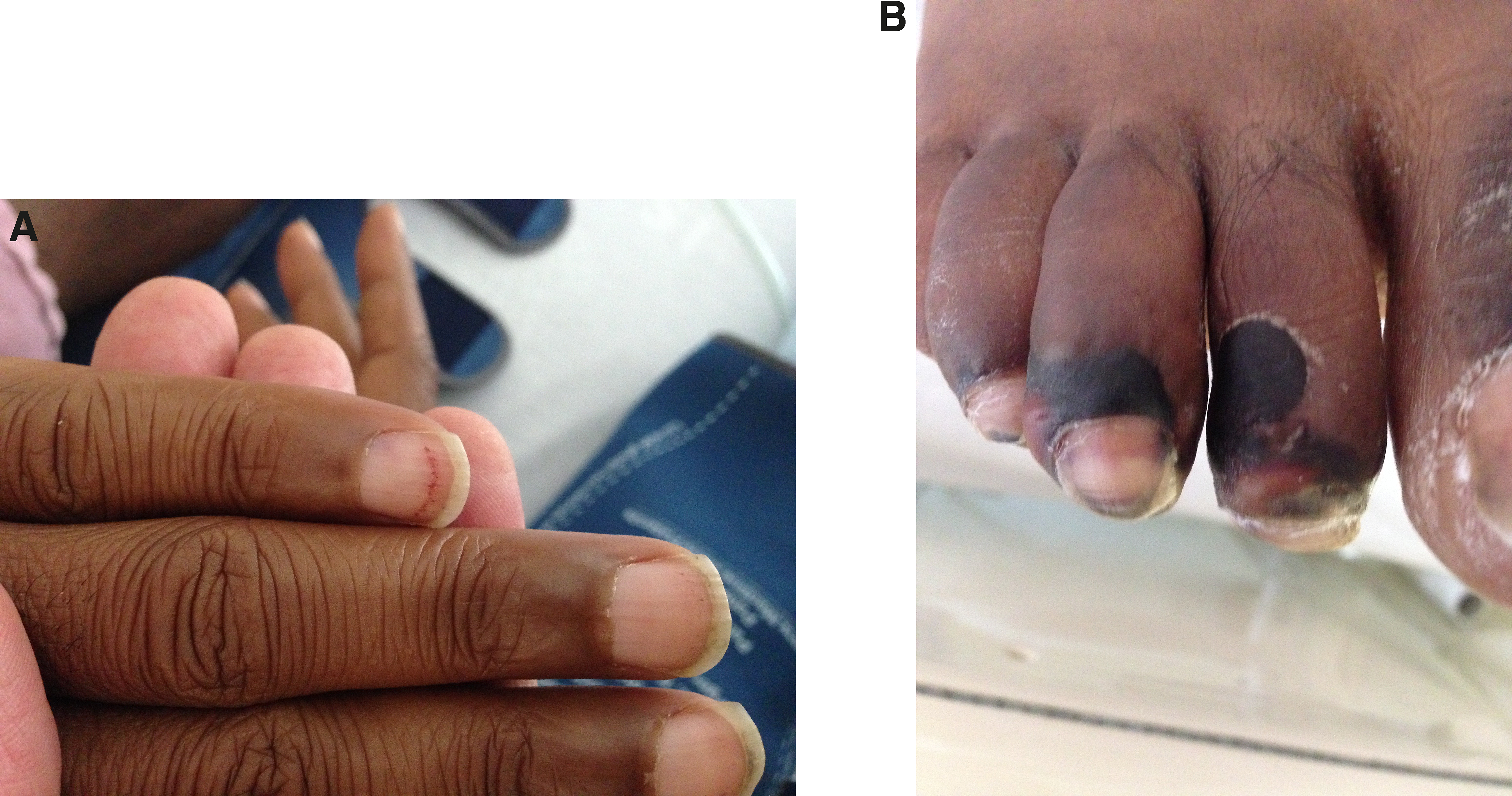
On physical examination, the patient had relapsing and remitting fever from 36° to 38.6°C. The patient's blood pressure was 130/80 mm Hg lying and standing. The examination was also remarkable for splinter hemorrhages of his fingernails and necrotic lesions at the tips of his toes (Fig. 1). There was no drainage, erythema, or malodor from these lesions.
Figure 1. Clinical appearance of the (A) splinter hemorrhages of fingernails and (B) necrotic lesions of toes.
Japma 109 00241 g001
Reflexes were 2+ and symmetric except that his Achilles tendon reflexes could not be elicited. Numbness was noted in a stocking distribution to the midcalf region. Joint position sense was impaired bilaterally in the small joints of the foot. Vibration sense, preserved in the ankle, was missing over his toes. The rest of the clinical examination was unremarkable.
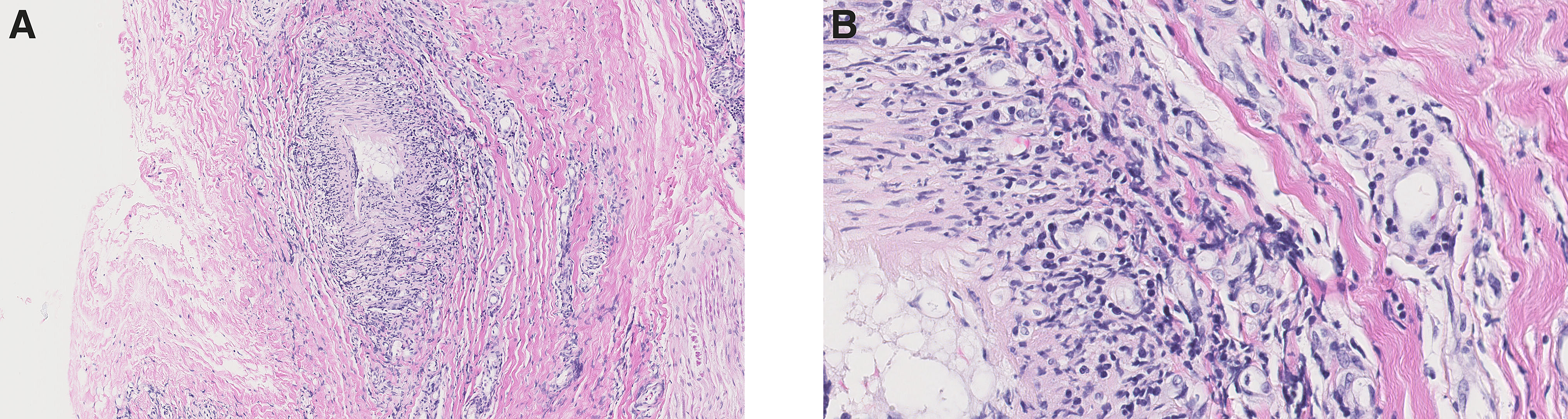
The patient was admitted to the hospital and workup was performed (Table 1). Biopsy specimens were taken from the lesions of the toes and the sural nerve to evaluate for vasculitic involvement. Histologic sections revealed lymphocyte-mediated muscular artery vasculitis with fibrinoid necrosis and neutrophilic infiltration consistent with PAN (Fig. 2).
Table 1. Laboratory Findings from Clinical Workup of Patient
Japma 109 00241 t001
Figure 2. Medium-size muscular artery demonstrating lymphocyte-predominant vasculitis with focal luminal fibrinoid necrosis (A, H&E, ×100; B, H&E, ×400).
Japma 109 00241 g002
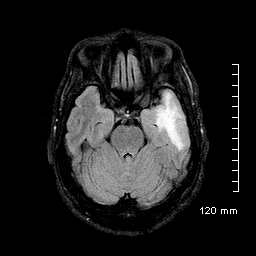
Magnetic resonance imaging (MRI) was performed to more clearly assess which specific organ systems were involved, as PAN can affect any organ. Although CNS involvement is rare, MRI of the brain revealed a gross abnormality in the left temporal lobe consisting of white matter edema (Fig. 3). The findings were consistent with and fulfilled the American College of Rheumatology 1990 criteria for the classification of polyarteritis nodosa (Table 2).[11]
Figure 3. Axial magnetic resonance imaging (fluid-attenuated inversion recovery sequence) scan showing increased signal intensity of the white matter of the left temporal lobe.
Japma 109 00241 g003
Table 2. 1990 Criteria for the Classification of Polyarteritis Nodosa
Japma 109 00241 t002
The patient was treated successfully with corticosteroids, discharged to a tertiary facility, and followed by the rheumatologist for weekly intravenous treatments of rituximab. The patient was lost to follow-up with us and with the tertiary facility to which he was referred.

Discussion

Polyarteritis nodosa is an uncommon vasculitic illness. We report a patient who presented to the podiatric service following HBV vaccination.
The vasculitic lesions on the feet of our patient with bilateral motor and sensory neuropathy led to a narrow differential diagnosis. Splinter hemorrhages of the nail beds of toes or fingers is typical of the vasculitis that may accompany endocarditis. This was ruled out in our patient by the absence of positive blood cultures and the absence, clinically and electrocardiographically, of heart lesions.
There are approximately 30 reports of PAN following HBV vaccination, as was the case in the present patient. All occurred within 2 to 6 weeks after the vaccine; some were restricted to the skin, but many met the criteria for full-blown PAN.[8-10,12]
A cautionary note is struck by the Vaccine Adverse Event Reporting System. They found that, in a 12-year period from 1990 to 2001, 25 possible cases of PAN following HBV vaccination were reported. Nine of these met criteria for possible or probable PAN.[13] This is a measure of the rarity of this complication. The Committee to Review Adverse Effects of Vaccines from the Institute of Medicine, National Academies finds the evidence inadequate to accept or reject the association between HBV vaccination and onset of PAN.[14]

Conclusions

We noted the temporal lobe lesion on MRI in this case to be a unique finding, as CNS involvement occurs in only 5% of cases of PAN and is usually attributable to cerebral infarction.[3,4] The podiatric literature makes scant reference to vasculitic lesions.[15-17] Polyarteritis nodosa should be included in the list of systemic diseases that may present to the podiatrist.
Financial Disclosure: None reported.
Conflict of Interest: None reported.

References

  1. Stone JH: Polyarteritis nodosa. JAMA288: 1632, 2002.
  2. Matteson EL: A history of early investigation in polyarteritis nodosa. Arthritis Care Res12: 294, 1999.
  3. Rott KT: “Polyarteritis Nodosa,” inPrimer on the Rheumatic Diseases, 13th Ed, edited byJHKlippel, JHStone, LJCrofford, et al, p410, Springer, New York, 2008.
  4. Guillevin L, Cohen P, Mahr A, et al: Treatment of polyarteritis nodosa and microscopic polyangiitis with poor prognosis factors: a prospective trial comparing glucocorticoids and six or twelve cyclophosphamide pulses in sixty-five patients. Arthritis Rheum49: 93, 2003.
  5. Guillevin L, Lhote F, Jarrousse B, et al: Polyarteritis nodosa related to hepatitis B virus: a retrospective study of 66 patients. Ann Med Interne (Paris)143: 63, 1992.
  6. The Vasculitis Foundation: Polyarteritis nodosa. Available at: http://www.vasculitisfoundation.org/education/forms/polyarteritis-nodosa/. Accessed May 16, 2016.
  7. Saadoun D, Terrier B, Semoun O, et al: Hepatitis C virus-associated polyarteritis nodosa. Arthritis Care Res63: 427, 2011.
  8. Ventura F, Antunes H, Brito C, et al: Cutaneous polyarteritis nodosa in a child following hepatitis B vaccination. Eur J Dermatol19: 400, 2009.
  9. De Keyser F, Naeyaert JM, Hindryckx P, et al: Immune-mediated pathology following hepatitis B vaccination: two cases of polyarteritis nodosa and one case of pityriasis rosea-like drug eruption. Clin Exp Rheumatol18: 81, 2000.
  10. Bourgeais AM, Dore MX, Croue A, et al: Cutaneous polyarteritis nodosa following hepatitis B vaccination. Ann Dermatol Venereol130: 205, 2003.
  11. Lightfoot RW, Michel BA, Bloch DA, et al: The American College of Rheumatology 1990 criteria for the classification of polyarteritis nodosa. Arthritis Rheum33: 1088, 1990.
  12. De Carvalho JF, Pereira RM, Shoenfeld Y: Systemic polyarteritis following hepatitis B vaccination. Eur J Intern Med19: 575, 2008.
  13. Begier EM, Langford CA, Sneller MC, et al: Polyarteritis nodosa reports to the Vaccine Adverse Event Reporting System (VAERS): implications for assessment of suspected vaccine-provoked vasculitis. J Rheumatol31: 2181, 2004.
  14. Institute of Medicine,Stratton K, Ford A, et al: “Hepatitis B Vaccine,” inAdverse Effects of Vaccines: Evidence and Causality, edited byKStratton, AFord, ERusch, et al, p865, National Academies Press, Washington, DC, 2012.
  15. Silverman LJ: Collagen disease in podiatry. J Am Podiatry Assoc52: 281, 1992.
  16. Goldman EP, Stess RM: Rheumatoid vasculitis: a case report. J Am Podiatry Assoc74: 514, 1984
  17. Wagoner MR, Creech CL, Vlahovic TC: Idiopathic mixed small and medium vessel cutaneous vasculitis: a case report. Foot Ankle Online J7:5, 2014. doi: 10.3827/faoj.2014.0701.0005.Available at: http://faoj.org/wp-content/uploads/2014/03/vasculitis_final.pdf. Accessed June 5, 2016.