The American Podiatric Medical Association (APMA) is currently the largest national podiatric medical society, representing more than 18,000 Doctors of Podiatric Medicine in the United States. [
1] Since the society's inception in 1912, the APMA conference has served as a platform to disseminate research and educate the profession through oral and poster abstract presentations annually. The quality of the content presented at national society conferences is often assessed indirectly by analyzing the journal publication rates for the abstracts presented. [
2-
5] Several studies have previously reported the abstract to journal publication rates from the American College of Foot and Ankle Surgeons (ACFAS), which ranged from 67.5% to 76.7% for oral abstracts and from 23.2% to 24.0% for poster abstracts. [
5-
7] However, to our knowledge, no previous study has evaluated the journal publication rates for abstracts presented at the APMA annual conference. Therefore, the primary objective of the present retrospective study was to assess the journal publication rates for abstracts (oral and poster) presented at the APMA conference from 2010 to 2014. Secondary objectives included comparing the results obtained with those for the 2010 to 2014 ACFAS conferences.
Materials and Methods
All of the abstracts (oral and poster) presented at the APMA annual conference from 2010 to 2014 were compiled by the director of Programs and Continuing Education and the Scientific Affairs Department assistant at the APMA head office. The abstract titles and authors' names were entered into a database. Oral and poster abstracts were grouped separately, and according to the year of presentation. A single resident foot and ankle surgeon (C.J.R.) then conducted a comprehensive literature search of all of the abstracts identified using PubMed and Google Scholar. An abstract conversion cutoff date of July 1, 2017, was selected and was desirable given that the publication plateau for abstracts from national foot and ankle society conferences typically occurs within 3 years of the respective conference. [
5-
7] Assigned podium tract lectures, student abstracts, and abstracts from organizations outside of the APMA at the annual conference were excluded.
The titles and authors were first searched in PubMed individually and then combined using a standard Boolean operator (AND). Considerable consistency in the authors and titles between the original abstract and the final publication was required for the identification of a match, which was confirmed by two resident foot and ankle surgeons (G.M. and T.A.). Only abstracts achieving full-text journal publication were included for the purposes of this study. Other publication types identified were deemed unpublished and were excluded. If no corresponding publication match was identified via PubMed, the search was repeated using Google Scholar. If no publication match could be identified during the literature search, the abstract was deemed unpublished. In cases in which the title of the final publication differed considerably from the title of the original abstract, direct communication with the corresponding author(s) provided the final verification.
The numbers of presented abstracts (oral and poster) at the APMA annual conference between 2010 and 2014 were recorded by year. For each article, the date of publication was recorded by month and year. The time to publication was recorded as the number of months from initial presentation at the APMA annual conference to the month of publication (online ahead of print or in print), rounded to the nearest whole month. For abstracts published before presentation at the conference, the time to publication in months was assigned a value of 0. The number of accepted abstracts, publication rate, mean time to publication, and publication rate within 3 years of conference presentation were calculated for each annual conference individually and collectively. The most common journals of abstract (oral and poster) publication were calculated separately and compared. These data are summarized in
Tables 1 through
4. The number of accepted abstracts, publication rate, mean time to publication, and most common journals of abstract (oral and poster) publication were then compared between the APMA and ACFAS 2010 to 2014 conferences (
Tables 5–
7).
Table 1.
Most Common Journals of Publication for Oral and Poster Abstracts
Table 1.
Most Common Journals of Publication for Oral and Poster Abstracts
Table 2.
American Podiatric Medical Association Oral Abstracts: 2010 to 2014
Table 2.
American Podiatric Medical Association Oral Abstracts: 2010 to 2014
Table 3.
American Podiatric Medical Association Poster Abstracts: 2010 to 2014
Table 3.
American Podiatric Medical Association Poster Abstracts: 2010 to 2014
Table 4.
Overall American Podiatric Medical Association Oral and Poster Abstracts
Table 4.
Overall American Podiatric Medical Association Oral and Poster Abstracts
Table 5.
Oral Abstracts from the APMA versus ACFAS 2010 to 2014 Conferences
Table 5.
Oral Abstracts from the APMA versus ACFAS 2010 to 2014 Conferences
Table 6.
Poster Abstracts from the APMA versus ACFAS 2010 to 2014 Conferences
Table 6.
Poster Abstracts from the APMA versus ACFAS 2010 to 2014 Conferences
Table 7.
Overall Abstracts from the APMA versus ACFAS 2010 to 2014 Conferences
Table 7.
Overall Abstracts from the APMA versus ACFAS 2010 to 2014 Conferences
Spreadsheet software (Microsoft Excel; Microsoft Corp, Redmond, Washington) was used to collect and store all of the data. Categorical continuous data were summarized using counts, percentages, means, and standard deviations. Two-tailed t tests were performed to determine significance between continuous variables, and the Fisher exact test was used to assess trends in abstract publications over time. An odds ratio (OR) with 95% confidence intervals (CIs)was calculated to determine differences in manuscript and poster publication rates, mean time to publication, and rates of publication within 3 years of conference presentation. In addition, an OR was calculated to determine differences in variables between the APMA and ACFAS 2010 to 2014 conferences. A P ≤ .05 was considered statistically significant.
Results
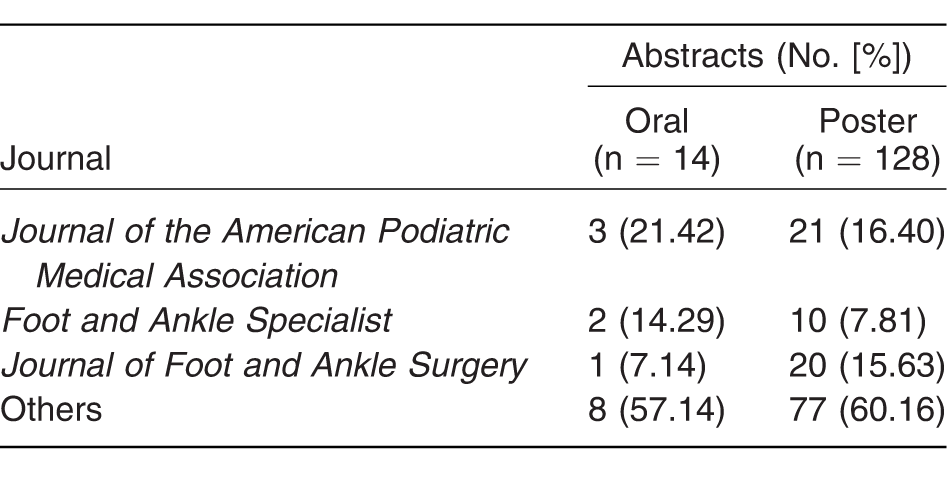
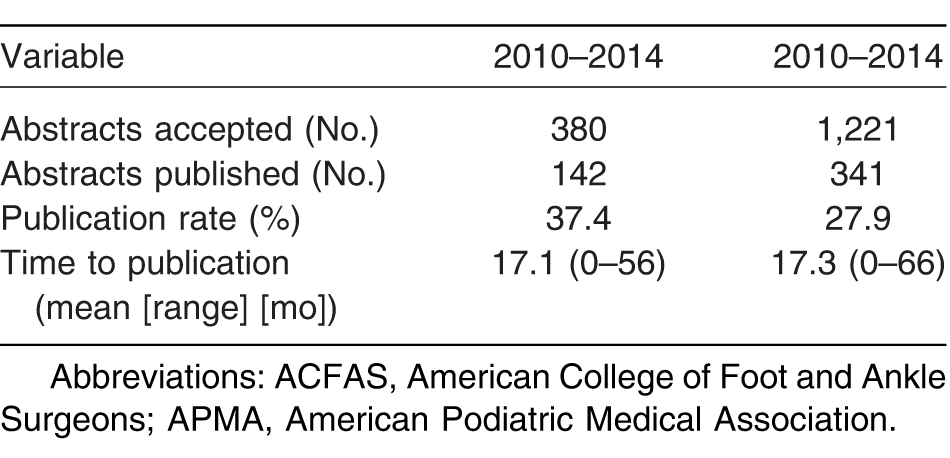
From 2010 to 2014, a total of 380 abstracts (oral and poster) were presented at the annual APMA conference. Overall, the abstract to journal publication rate was 37.4% (142 of 380), with mean time to publication of 17.1 months (range, 0–56 months). The most common journals of publication are listed in
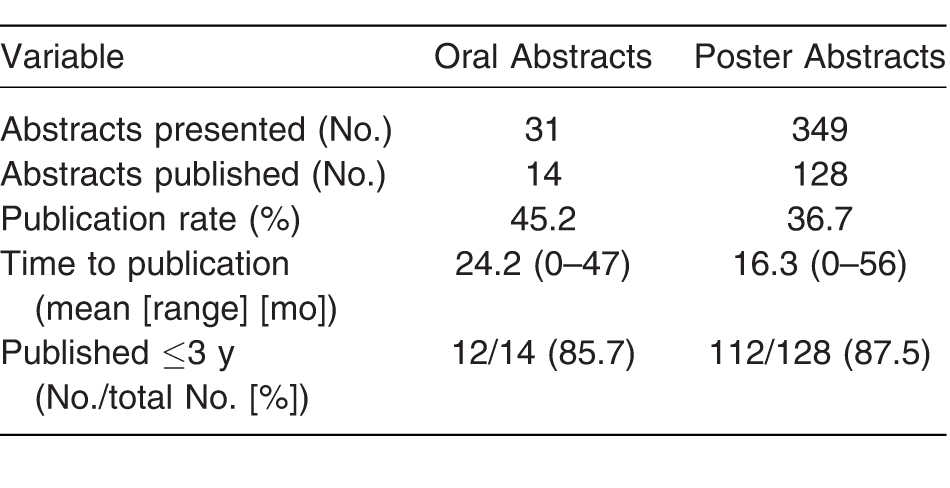
Table 1. Analyzing oral and poster abstracts separately, 45.2% of the former (14 of 31) and 36.7% of the latter (128 of 349) ultimately achieved journal publication. The difference was not significant (OR, 1.42; 95% CI, 0.68–3.0;
P < .35). The time to publication also was not significantly different, with a mean of 24.2 months (range, 0–47 months) and 16.3 months (range, 0–56 months) for oral and poster abstracts, respectively (OR, 1.0; 95% CI, 0.3–3.9;
P < .96). However, a significant trend toward a decrease in the mean time to publication was identified for both oral abstracts and posters during the conference years analyzed (OR, 0.59; 95% CI, 0.38–0.93;
P < .023). Of the published abstracts identified, 18 (two oral and 16 poster abstracts) had already achieved journal publication (online ahead of print or in print) before presentation at the conference and were designated with a value of 0 months. These abstracts accounted for 12.7% (18 of 142) of the total publication rate. Similar to other national foot and ankle society conferences, most of the abstracts that achieved publication did so within 3 years of conference presentation. The data are summarized in
Tables 2 through
4.
In comparing the abstract publication rates from the APMA and ACFAS 2010 to 2014 conferences, significant differences were identified. The number of abstracts presented at the APMA conferences was significantly lower than the number presented at the ACFAS conferences (OR, 0.75; 95% CI, 0.60–0.94;
P < .012) and in contrast to the increasing number of abstracts presented from 2010 to 2014 for the ACFAS; no such trend was retrospectively identified for the APMA. Overall, abstracts from the APMA conferences were more likely to be published (37.4% versus 27.9%) (OR, 0.75; 95% CI, 0.60–0.94];
P < .15), with a similar mean time to publication (
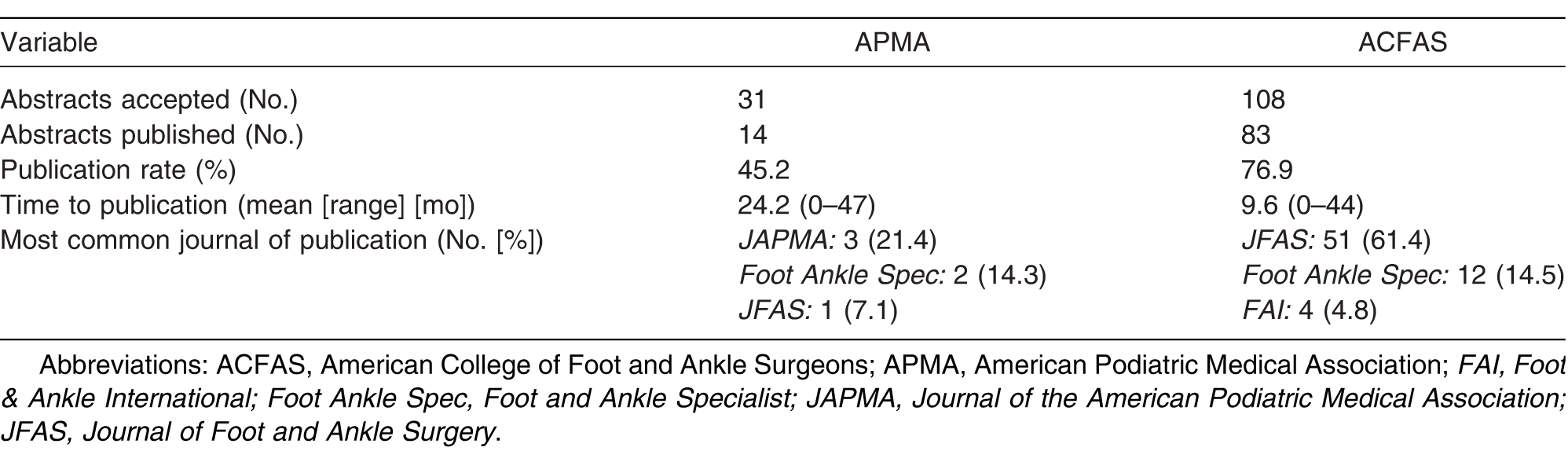
Table 7). More oral versus poster abstracts were accepted and published, with shorter mean time to publication from the ACFAS versus the APMA conference (OR, 1.70; 95% CI, 0.85–2.80;
P < .13) (
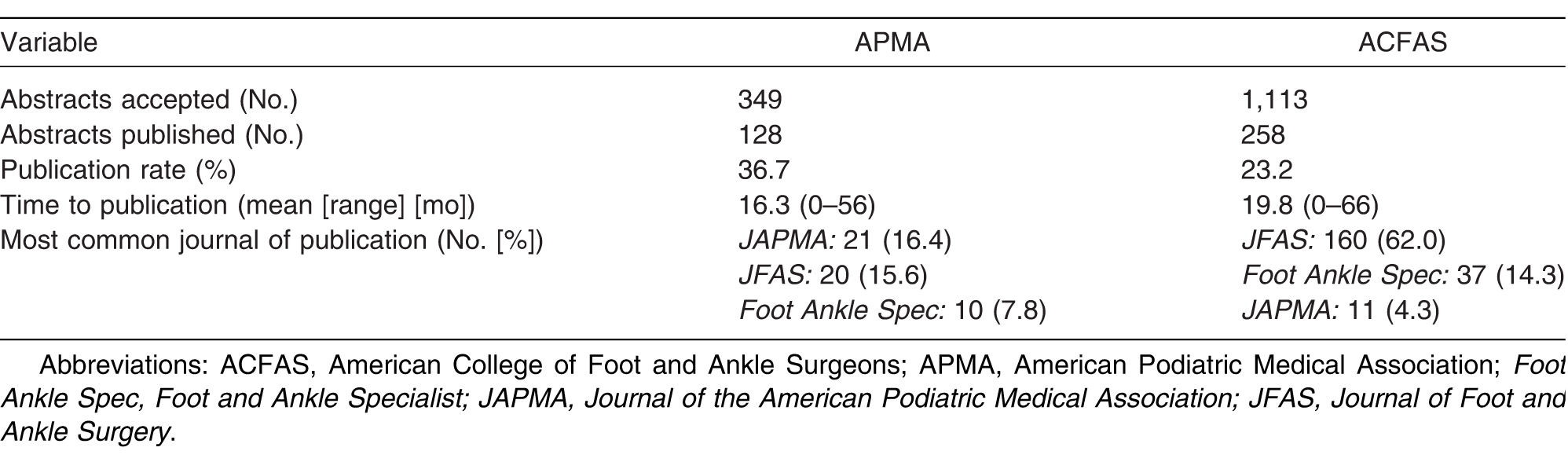
Table 5). Fewer poster abstracts were also presented at the APMA conferences, although poster abstracts from APMA went on to publication more often, with shorter mean times to publication than posters from the ACFAS (OR, 0.63; 95% CI, 0.50–0.81;
P < .0002) (
Table 6). For both societies, the
Journal of the American Podiatric Medical Association (JAPMA), the
Journal of Foot and Ankle Surgery, and
Foot and Ankle Specialist were among the most common journals of publication, although the proportion of abstracts published in each varied between the two societies (
Tables 5 and
6). For abstracts achieving journal publication from either society, most typically did so within 3 years of the respective conference.
Discussion
To our knowledge, the present study is the first to evaluate the abstract to journal publication rate for the APMA conference. From 2010 to 2014, the APMA abstract to journal publication rate overall was 37.4% (142 of 380), representing the highest reported of any national podiatric foot and ankle society conference to date (
Table 4). The publication rates were 45.2% (14 of 31) and 36.7% (128 of 349) for oral abstracts and posters, respectively. Oral abstracts went on to successfully navigate the peer review process and achieve full-text journal publication more often than posters, although the difference was not significant (OR, 1.42; 95% CI, 0.68–03.0;
P < .35) (
Tables 2–
4). The mean times to publication also were not significantly different between the oral and poster abstracts, and most of the abstracts that achieved publication from the APMA did so within 3 years of the respective conference (OR, 1.0; 95% CI, 0.3–03.9;
P < .96). [
5-
7] The most common journals of abstract publication are listed in
Table 1.
In comparing the two leading podiatric national foot and ankle societies (APMA and ACFAS), the significance of the conclusions reached is somewhat difficult to interpret. Oral abstracts from the ACFAS were published more often, with shorter mean times to publication than oral abstracts from the APMA, whereas with posters, the converse was true. Overall, the publication rates of abstracts presented at either society's annual conferences were not statistically significantly different (APMA: 37.4%, ACFAS: 27.9%). However, abstracts from the ACFAS outnumbered those from the APMA 3:1 over the same conference years analyzed, and, in contrast to the increasing number of abstracts from the ACFAS (n = 5), a trend toward a decrease in the number of abstracts from the AMPA was identified. Although this finding could be interpreted as reflecting a decrease in research interest among members of the APMA organization (attendings and residents) over the conference years analyzed, it may also be interpreted as reflecting a possible increase in the stringency criteria for abstract acceptance at the annual conference. Certainly, research at any point in a physician's career remains challenging and yet essential to advancing the profession, fostering innovation, and improving patient outcomes. Although the reasons for the decreasing trend remain undetermined, the former supposition is particularly disconcerting given the increasing impact of research on the health-care system. In the current era of health-care reform, cost-containment, and reimbursements based on value and quality, the findings suggest that concerted efforts between competing societies (APMA and ACFAS) are necessary to increase research interest and productivity among foot and ankle specialists in the United States. [
8]
This study has several limitations inherent to its design. First, although the compiled abstracts from the APMA office represent the presented abstracts for each conference's respective year, the abstract submission acceptance rate of each conference was not analyzed. This prevented comparisons between oral and poster abstract submission acceptances but did not affect comparisons between the APMA and the ACFAS from 2010 to 2014. Second, the broad search was limited to PubMed and Google Scholar. The selection of these search engines was intentional to allow comparisons to previous studies, and attempts were made to minimize the inherent subjectivity of the searches by having multiple resident foot and ankle surgeons (G.M., T.A.) conduct verification searches of all of the published abstracts. Still, it is possible that an abstract achieving journal publication may have been excluded. Third, we designated abstracts accepted for publication before presentation at the conference with a value of 0 rather than a negative value, as in some other studies. This is similar to a previous study conducted at our institution [
5] to allow for more accurate comparisons between the APMA and the ACFAS from 2010 to 2014. Last, we selected a 3-year minimum follow-up for identifying abstract journal publications. This was based on previous studies, which consistently noted a plateau in the abstract to journal publication within 3 years of conference presentation. [
5-
7] Although abstracts from the APMA 2010 to 2014 conferences may be published in the coming years, we are confident that it will not substantially affect the findings.
In conclusion, to our knowledge, the present study is the first to report on the journal publication rates for abstracts presented at the APMA conferences. The overall abstract to journal publication rate for the APMA conferences was 37.4%, and, expectedly, oral abstracts achieved publication more often than posters. Although the overall abstract publication rate for the APMA represents the highest reported for any national podiatric foot and ankle society conference to date, the decreasing number of abstracts presented at the APMA conference over the years analyzed is disconcerting. Moving forward, a concerted effort between competing societies (APMA and ACFAS) seems necessary to increase research interest, institutional support, and formal mentorship for future generations of foot and ankle specialists.