Next Article in Journal
Variability of the Dynamic Stiffness of Foot Joints: Effect of Gait Speed
Previous Article in Journal
Publication Rates for Oral and Poster Abstracts from the American Podiatric Medical Association: 2010–2014
 
 
Journal of the American Podiatric Medical Association is published by MDPI from Volume 116 Issue 1 (2026). Previous articles were published by another publisher in Open Access under a CC-BY (or CC-BY-NC-ND) licence, and they are hosted by MDPI on mdpi.com as a courtesy and upon agreement with American Podiatric Medical Association.
Article

Does Flexible Flatfoot Require Treatment? Plantar Pressure Effects of Wearing Over-the-Counter Insoles when Walking on a Level Surface and Up and Down Stairs in Adults with Flexible Flatfoot

Department of Orthopaedics, The First Affiliated Hospital of Xi'an Jiaotong University, Xi'an 710061, China
*
Author to whom correspondence should be addressed.
J. Am. Podiatr. Med. Assoc. 2019, 109(4), 299-304; https://doi.org/10.7547/16-103
Published: 1 July 2019

Abstract

Background: Orthotic insole is a popular physiotherapy for flatfoot. However, the effects and whether flexible flatfoot needs orthotic insole treatment are not clear, and how the plantar pressure changes while walking up and down stairs has not been studied. Therefore, this study observed the plantar pressures of different walking conditions to find the answers. Methods: Fifteen adults with flexible flatfoot and 15 adults with normal foot were examined while walking on a level surface and while walking up and down 10- and 20-cm stairs before treatment. The maximum force and the arch index were acquired with a force plate system. Participants with flexible flatfoot were instructed to wear the orthotic insoles for 3 months, and plantar pressures were measured again after treatment. The repeated measure was performed to analyze the data. Results: The maximum force and the arch index of flatfoot after treatment were significantly decreased under different walking conditions (P < .01). When walking down 10- and 20-cm stairs, the plantar data of normal foot and flatfoot were significantly increased (P < .05). Conclusions: Orthotic insoles could effectively improve the plantar pressure of flatfoot under different walking conditions. In addition, the arches of normal foot and flatfoot were obviously influenced when walking down stairs. It is, therefore, necessary to wear orthotic insoles for flexible flatfoot to prevent further deformation.

Flexible flatfoot is a common lower-limb deformity [1] characterized by a low medial longitudinal arch. [2] Owing to incorrect alignment of the foot bones, [3] it causes calcaneal eversion, talar adduction with plantarflexion, and dorsolateral forefoot subluxation. The deformity will change the plantar pressure distribution and the gait over time, [4] producing a substantial effect on the quality of life of the patient. [5]
Flatfoot can be divided into rigid flatfoot and flexible flatfoot. [6] Regarding the former, the arch of the foot is always missing in either the weightbearing or nonweightbearing position, [7] and surgery is needed to restore the missing arch. [8] Regarding the latter, the arch is missing only in the weightbearing position; in nonweightbearing, the arch is the same as that of a normal foot. [9] Owing to the arch's flexibility, the treatment methods and whether the flexible flatfoot requires treatment have always been controversial. [10,11]
Orthotic insole is a kind of popular physiotherapy. Previous studies have focused only on the effects of wearing orthotic insoles when walking on a level surface. [12,13] However, the effects were mixed, and how the plantar pressure changes while walking up or down stairs has not been studied.
In this study, we examined the plantar pressure of flexible flatfoot before and after wearing orthotic insoles while walking on a level surface and while walking up and down 10- and 20-cm stairs to determine whether plantar pressure improves and further to find out whether flexible flatfoot needs orthotic insole treatment.

Materials and Methods

Participants

The study protocol was approved by the institutional review board of The First Affiliated Hospital of Xi'an Jiaotong University (Xi'an, China). All of the participants signed the written informed consent form before study participation.
Fifteen college students with flexible flatfoot and 15 college students with normal foot were subjected to footprint collection with a force plate by two researchers. For participants with flatfoot, the arch was missing in a load-bearing position, the proportion of the midfoot print between the hollow and solid areas was 1/2, or the hollow area was missing. For participants with normal foot, the arch was always present, and the proportion was 2/1. All of the participants were female students, and there was no significant difference between flatfoot and normal foot in participant age, height, weight, and foot length. None of the participants had experienced any lower-limb diseases in the past 6 months.

Procedure

Before the measurement, participants needed to take off their shoes, wear the unified socks, and perform the walking exercises at a speed of 1 step per second. Then the participants were asked to walk on the level force plate and then up or down 10- or 20-cm stairs on the instrument. The maximum force and the arch index of the foot were recorded by the force plate system under those walking conditions. To ensure accuracy, the data were measured three times and an average was obtained. After all of the data were collected, participants with flexible flatfoot were asked to wear the unified shoes with orthotic insoles 8 hours a day for 3 months. After the treatment, the maximum force and the arch index were measured again. Finally, the repeated measure of the general linear model with significance of P < .05 was performed using SPSS for Windows, Version 13.0 (SPSS Inc, Chicago, Illinois).

Equipment

A force plate (footscan 7 USB2 gait; RSscan International, Paal, Belgium) with an area of 40 × 50 cm, including four sensors in each square centimeter, was used to measure the dynamic data of maximum force and arch index under different walking conditions. When the participant was walking on the force plate, the foot was divided into ten parts automatically: toe 1, toes 2 through 5, first metatarsal, second metatarsal, third metatarsal, forth metatarsal, fifth metatarsal, midfoot, medial heel, and lateral heel.
In addition, there is a main difference of plantar pressure in the midfoot region between normal foot and flatfoot. For normal foot, the main load-bearing regions include the metatarsal area and the heel area, but for flatfoot it includes not only the metatarsal and heel areas but also the midfoot. [14] In other words, it is the pressure of the midfoot that differs in flatfoot versus normal foot. Therefore, we focused only on the midfoot data.

Orthotic Insoles

In this study, the orthotic insoles were over-the-counter insoles made of ethylene vinyl acetate resin material. The thickness of the foot arch is 2.6 cm, and the thickness of the forefoot and heel is 0.4 cm.

Data Analysis

This study measured two kinds of dynamic data: maximum force and arch index. With progression of the disease, the arch will become flat and the structure of the foot bones will be deformed, which results in increased pressure of the midfoot, further increasing the maximum force [15] and the arch index. [16] Maximum force, is defined as the maximum plantar pressure of one part of the foot. [17] Arch index, a proportion of the midfoot area and the whole foot area, is useful in determining the prevalence of flatfoot and possibly in predicting pathologic foot conditions. [18] We focused on the maximum force of the midfoot and the arch index.
Before data analysis, all of the data were divided into three groups: flatfoot before treatment, flatfoot after treatment, and normal foot. Each group was further divided into five conditions: walking on a level surface, walking up 10- and 20-cm stairs, and walking down 10- and 20-cm stairs.
In the SPSS 13.0 system, we first created six columns (group, level surface, up 10- and 20-cm stairs, and down 10- and 20-cm stairs) and 45 rows (15 rows for each group) and input the corresponding data. Then, the repeated measure of the general linear model with significance of P < .05 was performed using SPSS 13.0. The 95% confidence interval (CI) (P < .05) were considered statistically significant. Finally, we used the five walking conditions as within-subject variables and the three groups as between-subject factors to analyze the data.

Results

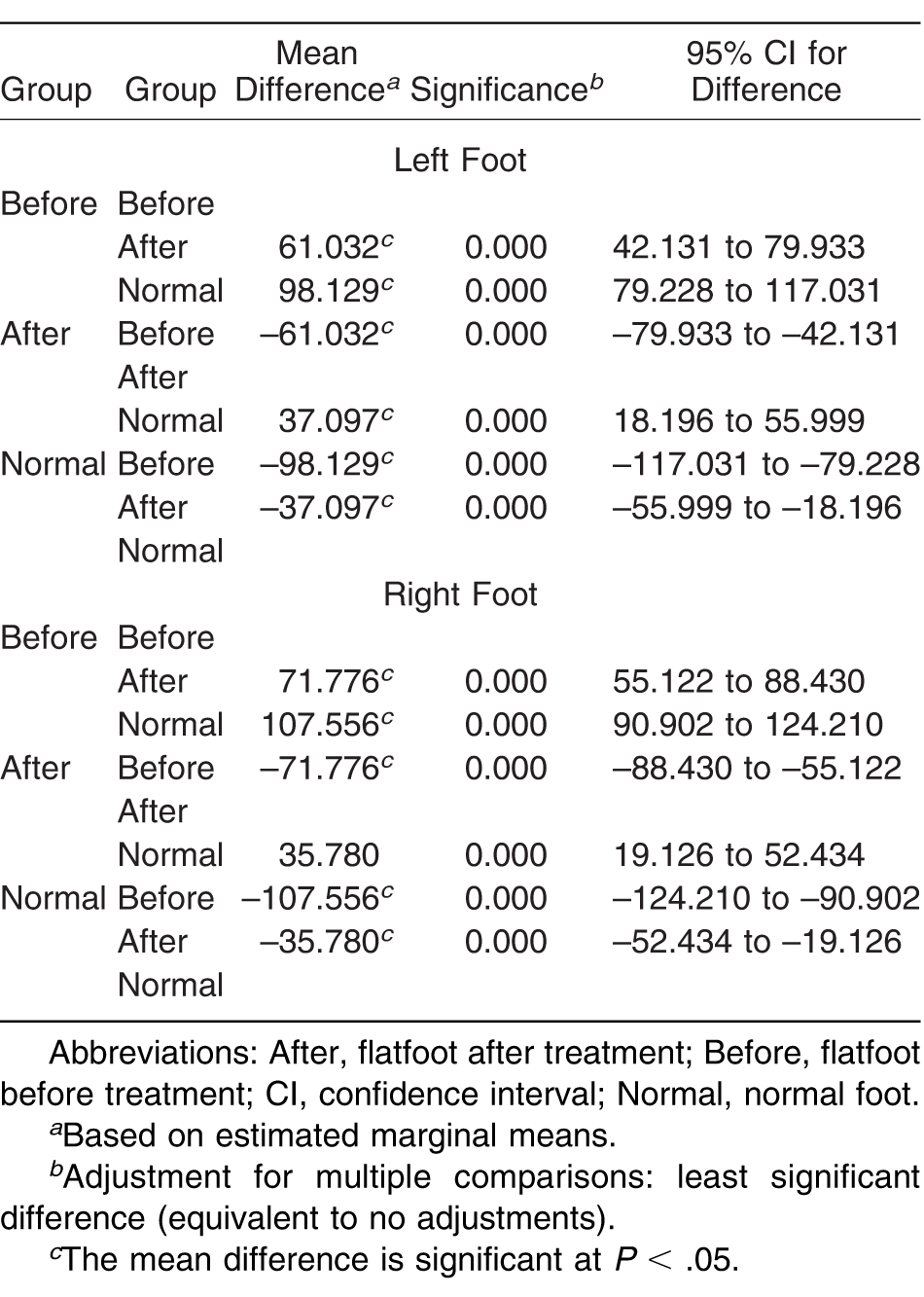
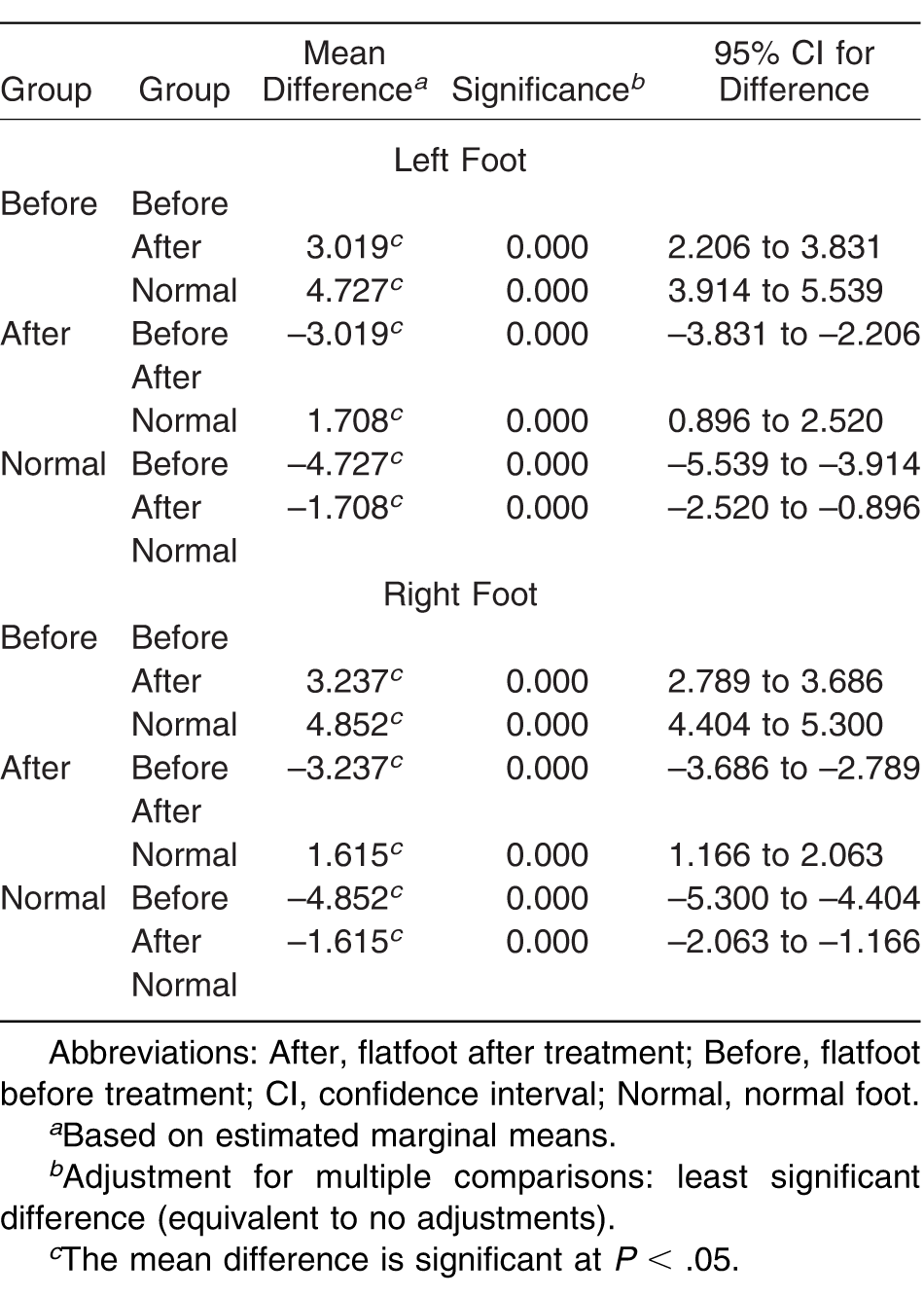
Significant differences were found in the maximum force and the arch index before and after treatment (P < .01), and there was still a significant difference between the posttreatment foot and the normal foot in both measures (P < .01) (Tables 1 and 2).
 Table 1.  Maximum Force Before and After Treatment
 Table 1.  Maximum Force Before and After Treatment
Japma 109 00299 g001
 Table 2.  Arch Index Before and After Treatment
 Table 2.  Arch Index Before and After Treatment
Japma 109 00299 g002
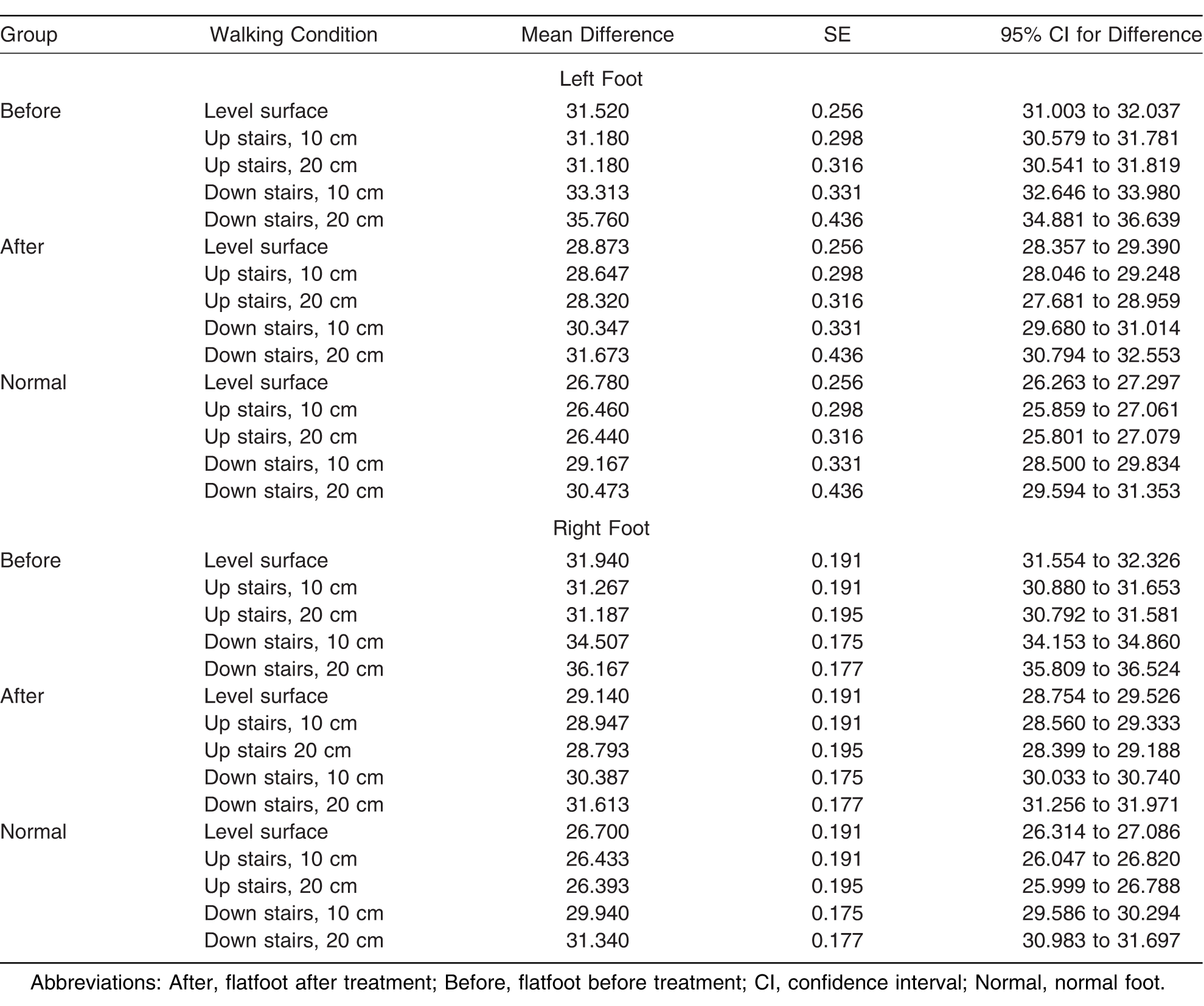
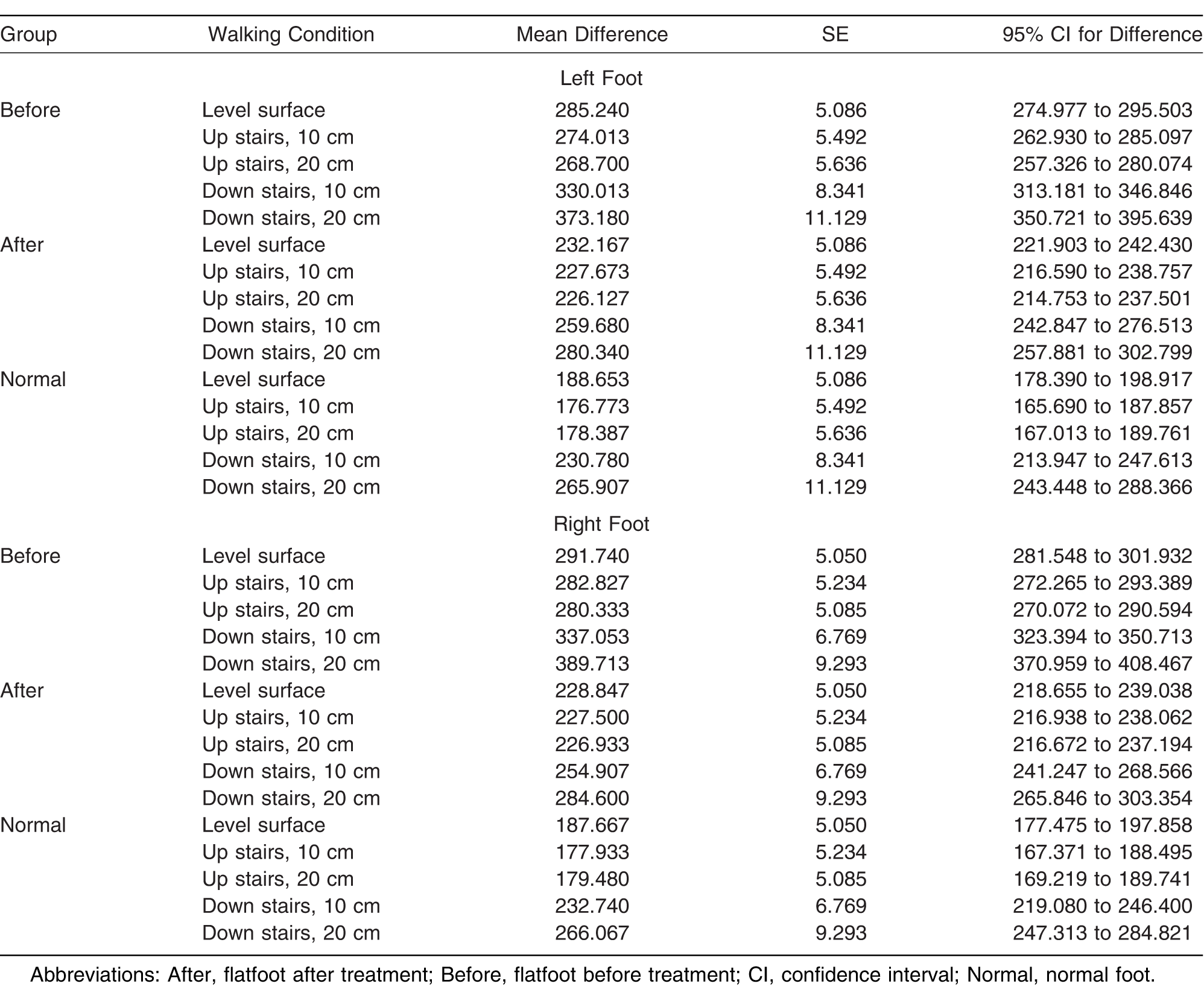
In addition, there was no intersection of the 95% CIs of both measures before and after treatment in five different walking conditions. However, there was an intersection between the posttreatment foot and the normal foot in both measures when walking down 10- and 20-cm stairs (Tables 3 and 4).
 Table 3.  Maximum Force of Different Walking Conditions
 Table 3.  Maximum Force of Different Walking Conditions
Japma 109 00299 g003
 Table 4.  Arch Index of Different Walking Conditions
 Table 4.  Arch Index of Different Walking Conditions
Japma 109 00299 g004
Furthermore, the 95% CIs of the maximum force and the arch index for walking down stairs did not intersect with those of any other walking conditions not only in flatfoot but also in normal foot (Tables 3 and 4).
These results imply that although there was still a difference between the posttreatment foot and the normal foot, the plantar pressures of flatfoot were effectively decreased after treatment, especially when walking down stairs. In addition, the arches of both normal foot and flatfoot were obviously deformed when walking down 10- and 20-cm stairs.

Discussion

Orthotic Effects of Maximum Force and Arch Index

The results showed that the maximum force and the arch index of flatfoot were effectively decreased after wearing orthotic insoles, which is in accordance with previous studies. [19-22]
Orthotic insoles can support the form of the foot arch, [23,24] which reduces the load-bearing of the midfoot and further decreases the maximum force of the midfoot and the arch index. However, although the plantar pressures of flatfoot were effectively improved, there was still a difference between the posttreatment foot and the normal foot. This may have happened because the treatment duration was not long enough.

Orthotic Effects on Different Walking Conditions

Previous studies have estimated that orthotic insoles could improve the plantar pressure of flatfoot when walking on a level surface. [19-22] However, it has not been examined how the plantar pressure changes when walking up and down stairs. In this study, the maximum force and the arch index were effectively decreased not only when walking on a level surface but also when walking up and down stairs after treatment. This result indicates that orthotic insoles could improve the plantar pressure of flatfoot, [25] and the function could be explained by that because the insoles have always been maintaining the proper form of the foot and finally reducing the load-bearing of the midfoot. [26]
On the one hand, the largest maximum force and arch index values were in walking down 20-cm stairs, and the second largest were in walking down 10-cm stairs, which may be due to the fact that the plantar pressure is influenced not only by the body weight but also by the acceleration of gravity when a person walks down stairs. [27] Therefore, with the increase in gravity, the plantar pressure increases as well.
On the other hand, according to this study, the maximum force and the arch index of both normal foot and flexible flatfoot were obviously larger when walking down stairs, illustrating that the arches of both normal foot and flatfoot were apparently deformed whenever walking down 10- or 20-cm stairs. Because the arch of the normal foot needs certain elasticity to protect plantar vessels and nerves from compression, [28] the arch could be influenced by the impact of walking down stairs. The arch of flatfoot was more easily influenced owing to the weak stability. [29] In other words, it is harmful to the foot arch when walking down stairs. Ironically, people prefer to take an elevator when walking up stairs but, as long as the floor is not too high, would rather walk down stairs than wait for the elevator.
Furthermore, none of the participants reported discomfort throughout the treatment, and the therapeutic effects were apparent. In addition, even the arch of the normal foot will be influenced when walking down stairs; therefore, it could be treated for flexible flatfoot to avoid further development.

Conclusions

Wearing orthotic insoles could effectively decrease the plantar pressure of flexible flatfoot not only when walking on a level surface but also when walking up and down stairs. In addition, the data from both normal foot and flexible flatfoot were influenced whenever walking down 10- or 20-cm stairs. Therefore, adults with flexible flatfoot may need to wear orthotic insoles to prevent further deformation. However, further studies are necessary to analyze the plantar pressure of adults with flatfoot in other areas in the future.

Financial Disclosure

None reported.

Conflict of Interest

None reported.

References

  1. Chen MJ, Chen CP, Lew HL, et al: Measurement of forefoot varus angle by laser technology in people with flexible flatfoot. Am J Phys Med Rehabil82: 842, 2003.
  2. Pehlivan O, Cilli FM, Karabudak O, et al: Radiographic correlation of symptomatic and asymptomatic flexible flatfoot in young male adults. Int Orthop33: 447, 2008.
  3. Chang JH, Wang SH, Kuo CL, et al: Prevalence of flexible flatfoot in Taiwanese school-aged children in relation to obesity, gender, and age. Eur J Pediatr43: 144, 2004.
  4. Needleman RL: Current topic review: subtalar arthroereisis for the correction of flexible flatfoot. Foot Ankle Int26: 336, 2005.
  5. Catanzariti AR, Mendicino RW: Adult acquired flatfoot deformity. Clin Podiatr Med Surg31: 95, 2014.
  6. Francisco R, Chiodo CP, Wilson MG: Management of the rigid adult acquired flatfoot deformity. Foot Ankle Clin12: 317, 2007.
  7. Luhmann SJ, Rich MM, Schoenecker PL: Painful idiopathic rigid flatfoot in children and adolescents. Foot Ankle Int21: 59, 2000.
  8. Demetracopoulos CD, Nair P, Malzberg A, et al: Outcomes of a stepcut lengthening calcaneal osteotomy for adult-acquired flatfoot deformity. Foot Ankle Int36: 749, 2015.
  9. Giza E, Cush G, Schon LC: The flexible flatfoot in the adult. Foot Ankle Clin12: 251, 2007.
  10. Haendlmayer KT, Harris NJ: Flatfoot deformity: an overview. Orthop Trauma23: 395, 2009.
  11. Haddad SL, Myerson MS, Younger A, et al: Symposium: adult acquired flatfoot deformity. Foot Ankle Int32: 95, 2011.
  12. Lee HJ, Lim KB, Yoo J, et al: Effect of custom-molded foot orthoses on foot pain and balance in children with symptomatic flexible flat feet. Ann Rehabil Med39: 905, 2015.
  13. Liao S: The effect of orthotic insole on coupling mechanism of flatfoot in Gait. Foot Ankle Surg22: 111, 2016.
  14. Imhauser CW, Siegler S, Abidi NA, et al: The effect of posterior of tibialis tendon dysfunction on the plantar pressure characteristics and the kinematics of the arch and the hind foot. Clin Biomech19: 161, 2004.
  15. Leung AK, Cheng JC, Mak AF: A cross-sectional study on the development of foot arch function of 2715 Chinese children. Prosthet Orthot Int29: 241, 2005.
  16. Wearing SC, Hills ANM, Hennig EM, et al: The arch index: a measure of flat or fat feet?Foot Ankle Int25: 575, 2004.
  17. Begg L, Mclaughlin P, Vicaretti M, et al: Total contact cast wall load in patients with a plantar forefoot ulcer and diabetes. J Foot Ankle Res9: 1, 2016.
  18. Igbigbi PS, Msamati BC, Shariff MB: Arch index as a predictor of pes planus: a comparative study of indigenous Kenyans and Tanzanians. JAPMA95: 273, 2005.
  19. Aminian G, Safaeepour Z, Farhoodi M, et al: The effect of prefabricated and proprioceptive foot orthoses on plantar pressure distribution in patients with flexible flatfoot during walking. Prosthet Orthot Int37: 227, 2013.
  20. Aboutorabi A, Saeedi H, Kamali M, et al: Immediate effect of orthopedic shoe and functional foot orthosis on center of pressure displacement and gait parameters in juvenile flexible flat foot. Prosthet Orthot Int38: 218, 2014.
  21. Chia KKJ, Suresh S, Kuah A, et al: Comparative trial of the foot pressure patterns between corrective orthotics, formthotics, bone spur pads and flat insoles in patients with chronic plantar fasciitis. Ann Acad Med Singapore38: 869, 2009.
  22. Havenhill TG, Toolan BC, Draganich LF: Effects of a UCBL orthosis and a calcaneal osteotomy on tibiotalar contact characteristics in a cadaver flatfoot model. Foot Ankle Int26: 607, 2005.
  23. Rasenberg N, Fuit L, Poppe E, et al: The STAP-study: the (cost) effectiveness of custom made orthotic insoles in the treatment for plantar fasciopathy in general practice and sports medicine: design of a randomized controlled trial. BMC Musculoskeletal Disord17: 31, 2016.
  24. Kuhn DR, Shibley NJ, Austin WM, et al: Radiographic evaluation of weight-bearing orthotics and their effect on flexible pes planus. J Manipulative Physiol Ther22: 221, 1999.
  25. Kido M, Ikoma K, Hara Y, et al: Effect of therapeutic insoles on the medial longitudinal arch in patients with flatfoot deformity: a three-dimensional loading computed tomography study. Clin Biomech29: 1095, 2014.
  26. Shih YF, Chen CY: Effect of insole application on lower extremity kinematics in children with flexible flatfoot. Gait Posture30: 151, 2009.
  27. Rao S, Carter S: Regional plantar pressure during walking, stair ascent and descent. Gait Posture36: 265, 2012.
  28. Xiong S, Goonetilleke RS, Witana CP, et al: Foot arch characterization: a review, a new metric, and a comparison. JAPMA100: 14, 2010.
  29. Radl R, Fuhrmann G, Maafe M, et al: Hindfoot valgus: diagnosis and therapy of flatfoot [in German]. Orthopäde41: 313, 2012.